

Written by: Allan Rowe (MA, PhD), Heritage Marker Program Coordinator
Water transportation has long played an important role in Alberta’s history. Long before the arrival of the first Europeans, Indigenous people travelled Alberta’s many rivers in canoes and crossed the rivers in ‘bull boats,’ small, round crafts made by stretching buffalo hides over a wood frame. European fur traders adapted these technologies for their own use starting in the late eighteenth century, while other strategies were developed to cross rivers, including small row boats (for passengers) and removing the wheels off Red River carts and floating cargo across on the flat bed. The arrival of agricultural settlement in the 1870s created much greater demand for safe and reliable river crossings – out of this demand emerged Alberta’s ferry system, which evolved from a small number of private operators to a sophisticated network of ferries across the entire province.
Prior to 1877, ferries in present-day Alberta operated free of any regulation of oversight. Entrepreneurs established ferries in areas of sufficient demand and were free to set their own schedules and toll rates. By the mid-1870s, however, early settlers were complaining to the Territorial Government about irregular service and high fees. The government responded in 1877 with the first Ferries Ordinance, which established a licensing system and a set of rules within which ferry owners would have to operate. Ferrymen were required to get a license, valid for three years, that gave them exclusive rights over a particular area of river. Tolls were set at a reasonable rate, though owners could charge double for service between 9 p.m. and 6 a.m. The ordinance also mandated free passage for children going to and from school as well as for mail delivery (Haestie, p. 16). While this did not completely solve the problem of unlicensed ferrymen – the government did not have the capacity to enforce the new rules properly across the entire territory – the ordinance was the first step in the emergence of an organized ferry system.

One of the most vivid early accounts of ferry travel in Alberta comes from Alexander Sutherland, a Methodist minister who travelled west with the Church Missionary Society in 1879. Sutherland was part of a substantial party comprised of 12 wagons that needed to cross the Belly River near present-day Lethbridge. The group hired the services of Nicholas Sheran, an Irish-American settler who established the ferry in 1874. Sutherland recounts the arduous task of getting his party across the river:
We found the river high, and that it would be impossible to ford it; but a man named Sherin [sic], who has opened a coal mine a short distance down the river, had a couple of flat-bottomed boats, and arrangements were made with him to ferry the party and their goods to the other side. This was no small task. All the waggons had to be unloaded, and their contents transferred piece-meal to the boats. Trunks and boxes were piled in the bottom, to serve as ballast, and then a waggon with two wheels taken off, was nicely balanced on the top. With this ticklish load, in some cases weighing twelve or fifteen hundred pounds, the board was rowed across a swift and powerful current to the other side.
For Sheran, the ferry was a secondary enterprise – the main source of his wealth came from coal mining, and the ferry offered an excellent source of secondary income. The same was true of John Walter, who operated Edmonton’s first commercial ferries starting in 1882. Walter settled on the south side of the North Saskatchewan River (in what would become Strathcona) in the late 1870s and worked as a boat builder for the Hudson’s Bay Company and other clients. This business naturally left him well positioned to become a ferry operator and he was given licenses starting in the 1880s to operate three ferries crossing the North Saskatchewan River (one of which continued to operate until 1913). Walter went on to open a sawmill in 1893 and emerged as one of Strathcona’s most prominent early businessmen.

Efforts by the Territorial Government to regulate ferries with licensing was only partially successful. The government continued to get “numerous complaints” from the public, leading the Director of Public Works to write the following on unlicensed ferries in his 1900 Annual Report:
The owners claim that, being private undertakings, they can operate these ferries as they please and charge such tolls as they see fit. As a result the ferries are operated in a very casual manner, and persons who have driven long distances to cross the river at points where these ferries are located often find the owner absent from home and the ferry on the opposite site of the river, or are forced to submit to exorbitant charges if the owner of the ferry does not feel like operating his ferry at a reasonable rate.
The most significant reform came after Alberta was established as a province in 1905. The new provincial government assumed control of the ferry system, responsible for ferry repair, maintenance and construction, and made ferrymen salaried government employees. Most importantly, ferry travel between 7 a.m. and 7 p.m. was made free, with a small fee charged for after hours service. By the early twentieth century, river ferries were fully integrated into Alberta’s transportation network.
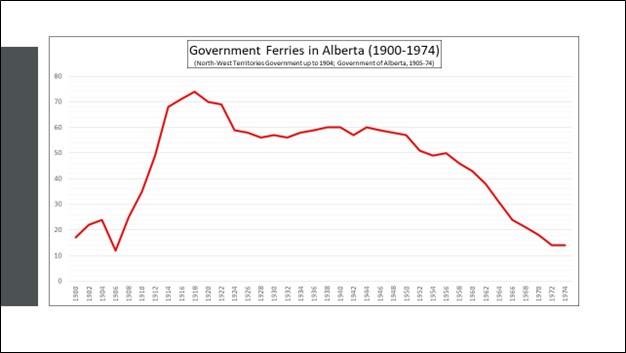
The number of ferries skyrocketed after 1906 with the explosive growth of Alberta’s population, which more than tripled from 1906 (185,412) to 1921 (588,454). With this growth in settlement came persistent demands from around the province for bridges across the province’s many rivers. The Department of Public Works responded by stating “it is impossible, with the funds at our command, to construct all large bridges required” and that the department would instead increase the number of ferries “as a first means of meeting the requirements.” As a result, the number of ferries operating in Alberta skyrocketed from 12 in 1906 to a high of 74 in 1918.
While ferries were primarily valued for their economic role transporting goods and people, they could play an important social role in community life as well. As noted by Elizabeth Haestie in her comprehensive history of Alberta ferries, crossing sites were often “a gathering place for social evenings,” with the flat deck of the docked ferry serving as a makeshift dance floor (36-7). This quote from the Medicine Hat Times (July 1891) illustrates the importance of ferries in large community celebrations, in this case Dominion Day:
The committee of management deserve great credit for the admirable arrangements for carrying the large crowd of picknickers to and from the grounds. As advertised, conveyances were waiting at the appointed hour and for two hours or more the trail leading to the ferry presented a gay scene. Arrived at the ferry the pleasure seekers boarded Mr. Minneswhesky’s craft and were soon landed on the north side of the river where a short walk brought them to the ‘Picnic Grove,’ a magnificent natural park bounded by three sides by the swiftly flowing river.

Despite being presented by the Department of Public Works in the early twentieth century as a temporary solution to the province’s bridge shortage, ferries continued to play a crucial role in Alberta’s transportation history well after the Second World War. The system shrank slightly after the end of World War One but remained relatively stable between 1924 and 1950 during which time there were between 56 and 60 ferries operating each year in Alberta. Increased public works spending in the 1950s and 1960s led to the construction of new bridges that rendered ferry service in many locations obsolete and the number of ferries in service steadily declined. Ferries did not disappear entirely, however – there are still six ferries operating in Alberta. The Crowfoot Ferry provides service across the Bow River; the Bleriot and Finnegan Ferries cross the Red Deer River; the Klondyke Ferry crosses the Athabasca River, while the La Crete and Shaftsbury Ferries take passengers and vehicles across the Peace River. In addition to continuing to offer service, these last ferries provide a tangible link to a heritage of water transportation dating back to the late nineteenth century.
Sources
Alberta. Department of Public Works and Department of Transportation: Annual Reports. 1905-74.
Canada. Annual Report of the North-West Territorial Government. 1898-1904.
Donnelly, Peggy. John Walter – One of the Makers of Edmonton. RETROactive, 11 October 2017. Accessed 4 October 2023.
Gilpin, John. Roads to Resources: A History of Transportation in Alberta. Edmonton: Alberta Roadbuilders & Heavy Construction, 2005.
Haestie, Elizabeth. Ferries and Ferrymen in Alberta. Calgary: Glenbow Museum, 1986.
Lukasiewicz, Krystyna. “Wincenty Miniszewski: Soldier, Policeman and Rancher.” Alberta History, Winter 1999: 8-16.
Sutherland, Alexander. A Summer in Prairie-Land: Notes of a Tour Through the North-West Territory.
Toronto: Printed for the author at the Methodist Book and Publishing House, 1881.
 RETROactive