

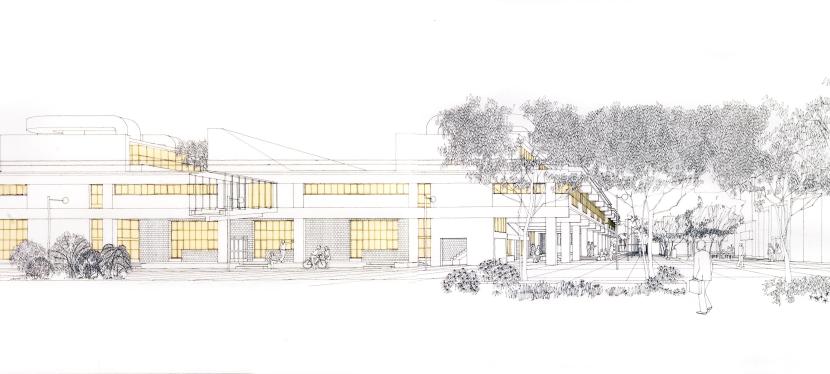
Editor’s note: The following interview has been lightly edited for length and clarity. The banner image above is of the Carleton University School of Architecture, Ottawa, 1970. Source: University of Calgary, Canadian Architectural Archives, Carmen and Elin Corneil fonds, CA ACU CAA F0007.
Written by: Robb Gilbert, Archivist, Canadian Architectural Archives and Dorothy Field, Heritage Survey Program Coordinator
In my work with the Alberta Heritage Survey, I’m always on the lookout for sources of reliable information about Alberta’s architectural history. One such resource that people may not generally be aware of is the Canadian Architectural Archives (CAA), which is a veritable Aladdin’s Cave full of material donated by architects from Alberta and across Canada. But just what, exactly is the CAA? Recently, I had the opportunity to ask Robb Gilbert, Archivist at the Canadian Architectural Archives, about the history, holdings and services of the CAA.
(Dorothy) Hi Robb! Can you tell me about yourself and what you do at the CAA?
(Robb) I’ve been at the CAA for five years. My role is to manage the CAA’s extensive collection, improve access to the holdings, acquire new collections and additions to existing collections, teach students about the archives, assist visiting researchers, and generally raise awareness and engagement with the archives. I previously worked at the Kamloops Museum and Archives before joining Archives and Special Collections at the University of Calgary. My educational background before becoming an archivist was in religious studies and art history. Courses in art and architectural history at Carleton University in Ottawa fueled my ongoing passion for the history of Canadian architecture.
When was the CAA established, by whom, and what was its original mission?
The CAA was established at the University of Calgary 50 years ago in 1974. The idea to start an archive originated with the Dean of the Faculty of Environmental Design (now called School of Architecture, Planning and Landscape) William T. Perks (1934-2023) who proposed an archive to Ken Glazier (1912-1989), the Chief Librarian. The archive was established and developed by Perks, as well as the professors of architecture Michael McMordie and R.D. Gillmor (1930-2019), and the rare books librarian Ernie Ingles (1948-2020). McMordie built the holdings from his connections and through outreach to architects across Canada. And Ingles and the staff in the library provided the administration and operations for the archive. The original mission was to serve as a teaching and research resource for students and researchers, to collect and preserve historical records on Canadian architecture, and to promote public education and awareness about the built environment.
How has the CAA grown and evolved over time? What are its current goals?
Most of the major collections were acquired in the first 10 years through the collecting activities of Mike McMordie. In the 1970s there was significant interest in architectural history, and archives were well-resourced to grow their collections. As the collection grew over the ensuing years the CAA shifted focus towards bringing the collection out to the public through exhibitions and publications. The promotion of the archives often resulted in detailed inventories, informative catalogues, travelling exhibits and scholarly books. The CAA has grown over the years and has extensive holdings that require ongoing management to make them accessible. The current goals are still the original goals of enhancing the use of the collection by students and scholars, as well as promoting public awareness of the archives as an important source for the study of the built environment.
What sorts of things are in the CAA collection?
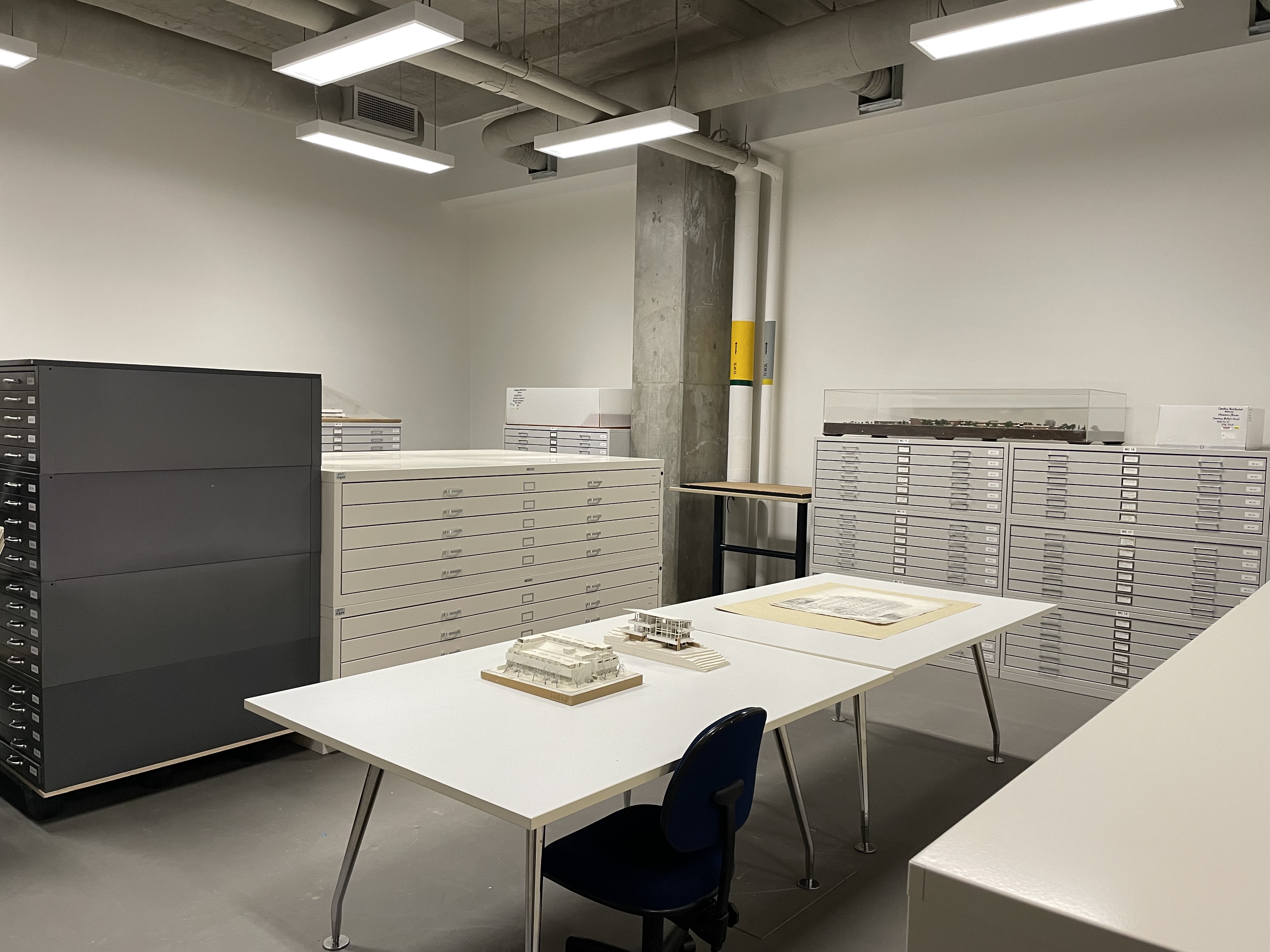
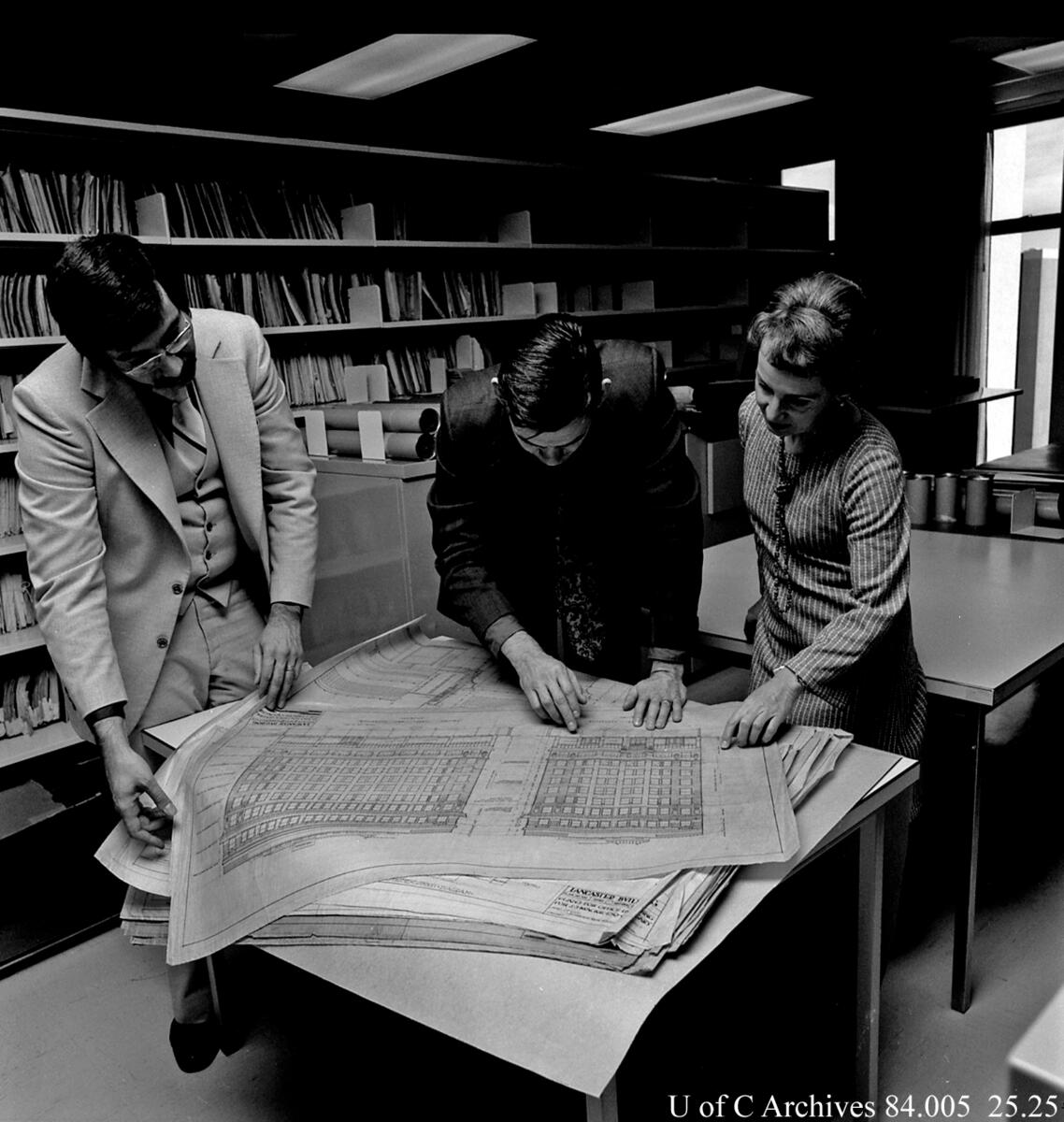
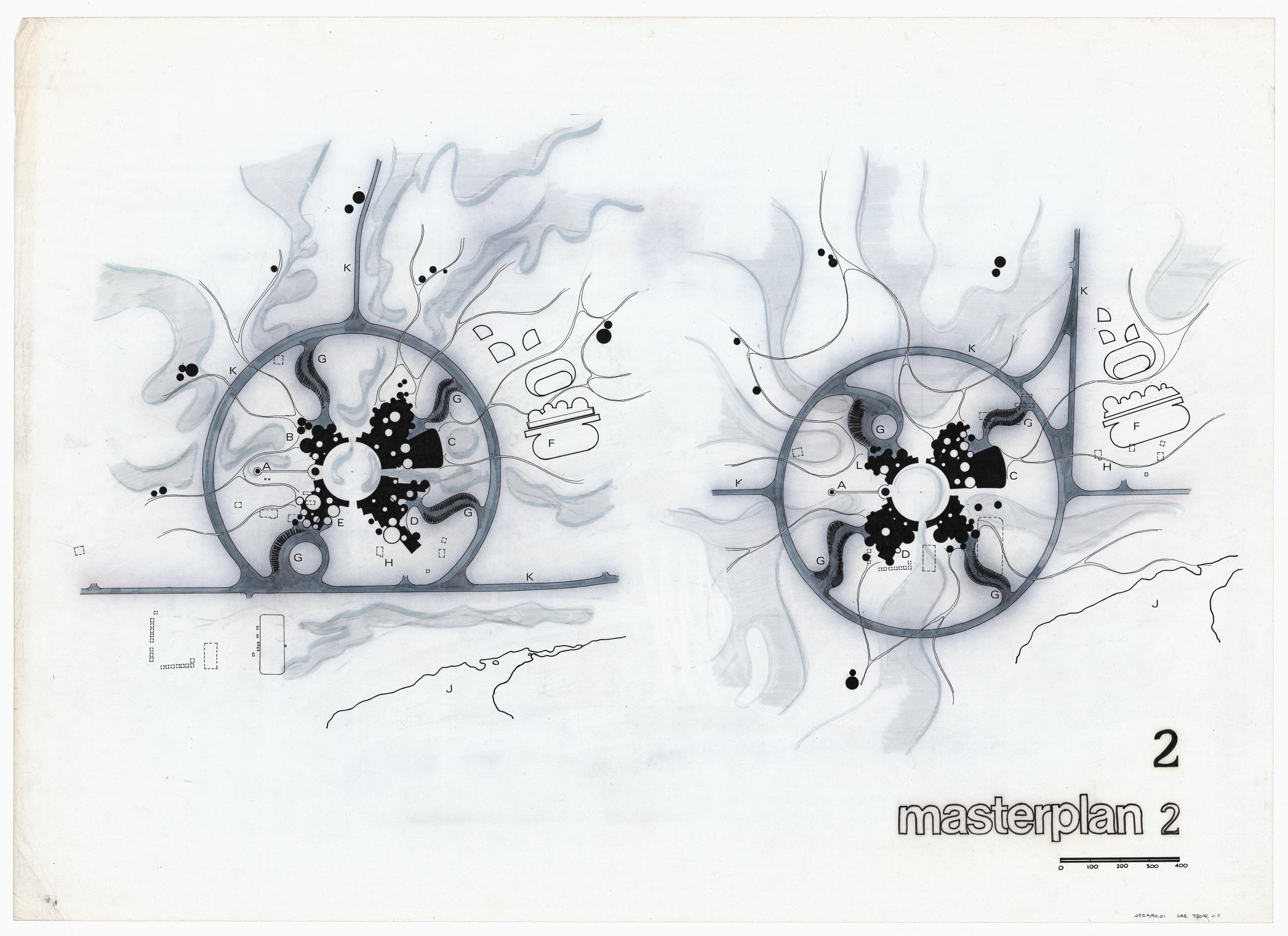
The CAA collection includes architectural drawings, photographs, models, correspondence, reports, contracts, oral histories and much more. The archive is where architects and designers have deposited the records of their work. The CAA is interested in documentation that spans the whole process of designing and constructing works of architecture, landscape architecture, and urban design. You can find initial sketches, beautiful presentation drawings, letters to clients, polished photographs of completed work, detailed specifications, and lengthy reports, among numerous other things.

Does the CAA have a lot of Alberta-related content? Can you name some Alberta people or buildings represented in the collection or associated with the CAA?
The CAA is national in scope but still largely Alberta-related in content. Over half of the collections are the work of Alberta-based architects. The development of modern architecture in Alberta is documented at the CAA like nowhere else. Some of the Alberta-based architects whose work is held at the CAA include Douglas Cardinal, Gordon Atkins, Rule Wynn Rule, Peter Hemingway, Jack Long, Jeremy Sturgess and Donald Bittorf. Researchers can access records about numerous Alberta buildings, for example the Provincial Historic Resource Knox United Church in Calgary, which is documented in the Stevenson Raines fonds, or the Prix du XXe siècle-winning Coronation Swimming Pool in Edmonton, which is documented in the Peter Hemingway fonds. There are countless Alberta buildings represented in the CAA.
What major collections/fonds does the CAA have?
The major collections are the work of Arthur Erickson, Douglas Cardinal, Ron Thom, Jerome Markson, Raymond Moriyama, McCarter Nairne, Thompson Berwick Pratt, Jeremy Sturgess, Bing Thom and the architectural photography firm Panda Associates.
Do you have a favourite item in the CAA collection, and if yes, what is it about that item that appeals to you?
My favourite item in the CAA is an Arthur Erickson sketch of the Dyde House, which is located outside Edmonton at the University of Alberta Botanic Garden. I recently watched the wonderful documentary Arthur Erickson’s Dyde House by director Colin Waugh and writers Max Amerongen and Jordan Bloemen. Hopefully the film will be released more widely to the public. The Dyde House project was one of Erickson’s early experiments with designing a residence. I love the way the sketch brings together Erickson’s brilliance in architectural design and landscape design.

Does the CAA have an online presence? Is it possible to search the collection online?
The CAA does have an online presence and is a good place to start to learn more and search the collection. The main webpage for Archives and Special Collections at the UofC, which includes the CAA, is also a resource. There are many collections that are not described online beyond an overview, so I would contact any archives, not just the CAA, through email if you don’t find what you are looking for online. To contact the CAA, email asc@ucalgary.libanswers.com.
Where is the CAA located? Is it open to the public?
The CAA is located at the University of Calgary in the Taylor Family Digital Library on main campus. The reading room where the public can access the CAA is called the Glenbow Western Research Centre (GWRC). The CAA is very much open to the public. All material in the CAA can be viewed in person at the GWRC. Although the CAA does not have an exhibition space, displays are occasionally mounted in the GWRC. Items are also loaned to other institutions – currently some are at the Canadian Centre for Architecture in Montreal – so you may be able to view material from the CAA collection elsewhere. Anyone can make an appointment to come visit the CAA during regular hours, Monday to Friday from 10 a.m. to 4:30 p.m.
So there you have it! The treasures of the Canadian Architectural Archives await you. Make sure you explore the holdings online or make time to visit the collection in person. Robb assures me that he is looking forward to hearing from anyone interested in the CAA holdings. Thank your for taking the time to answer my questions, Robb. I’m looking forward to learning more about some of your favourite CAA items in future RETROactive blog posts.
 RETROactive