

With the onset of spring, the attention of many Canadians turn to the perennial quest for the Stanley Cup, the storied challenge trophy, emblematic of hockey supremacy. Few realize that in Alberta one of Canada’s oldest sporting challenge trophies was established in 1909 by then Premier, Alexander C. Rutherford and is competed for until the present day. The history of the Rutherford Cup is as old as that of football’s Grey Cup and senior hockey’s Allen Cup all of which were established 106 years ago.
Alexander Cameron Rutherford, Alberta’s first Premier [1905-1910], distinguished himself not only as a legislator but also as an active participant in many aspects of Alberta’s developing society. Sporting activities featured prominently among Premier Rutherford’s many interests. He held executive positions with baseball, curling and football (what we now call soccer) clubs in Strathcona and established competitive trophies for the Strathcona Curling Club and the Strathcona Football Club. In 1909 Rutherford also established a challenge trophy to be vied for by senior high school soccer teams in central Alberta. The first competition for the cup culminated on the afternoon of Saturday October 16, 1909 at Edmonton’s Diamond Park in a match between Edmonton High School and Red Deer High School.
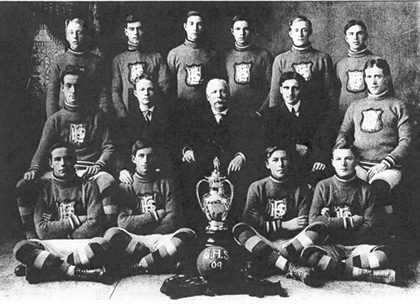
As reported by the Edmonton Bulletin, the first half of the inaugural championship match was fast and close with neither side scoring, but was marred by an unfortunate accident at the 15 minute mark. Red Deer full-back and team captain Carswell “came into violent collision” with an Edmonton forward while trying to prevent a shot on goal and broke his leg. The injured player was attended to by Dr. McGibbon and dispatched by ambulance to the Misericordia Hospital. Edmonton played an aggressive first half, giving the Red Deer goal keeper Hewson “plenty to do.” Half-back McLean played a strong game for Red Deer while on the forward line Krause and Slade “showed up well.” Hicks and Keffer starred for Edmonton, while Dean’s running and Hepburn’s shooting on goal were features of the game. Hepburn scored the game’s only goal for Edmonton after ten minutes of play in the second half with a very difficult shot. Red Deer was reluctant to concede defeat and pressed strongly in the last minutes of play with the final result “in doubt until the whistle blew for full time.” A reception was held that evening at Queen’s Avenue School with a short program of games, songs and recitations along with “dainty refreshments served by the girls of the school.” Brief addresses were given by Edmonton High School Principal William Rea, and Superintendent James McCaig, the trustee of the Rutherford Cup. Red Deer spokesman McLean stated that although defeated, his team was prepared to challenge for the trophy again and “contest its possession with the present holders.”
Determined to avenge its loss, Red Deer honed its skills during the spring of 1910 in preparation for a rematch with Edmonton. The Edmonton Journal announced that the Red Deer squad was coming to Edmonton to try to “lift the Rutherford Cup,” this time “much strengthened” and “confident of success”. The grudge match was played on Saturday April 23, 1910. The Red Deer squad was indeed much improved, the Journal noting that in the loose game they worked well together and back checked quickly. They appeared “to have had much more practice than the local boys,” were heavier and “knew how to use the weight.” Krause at centre was his team’s star, scoring the game’s solitary goal after only four minutes of play. Edmonton’s left winger Dean made spectacular individual rushes, bringing the ball down the field repeatedly, only to have the centre field man fail to score. Full-back Gillespie also played a “brilliant” game, working his position well and punting strongly, his quick checking preventing Red Deer from running up a much larger final score. Although attendance at the match was small. “fair co-eds were out in large numbers and cheered lustily for the Edmonton boys.”
The Edmonton press lamented the result of the match with partisan headlines: “Red Deer Grabs Rutherford Cup E.H.S. Pigskin Chasers Are Defeated by Students From the Half Way City.” The City of Red Deer celebrated that their boys had successfully journeyed to Edmonton and “annexed the handsome Rutherford cup” on the strength of Krause’s “doing the needful.” The Red Deer Advocate noted that the boys were “deserving of high praise for their clever play” and paid tribute to Edmonton’s hospitality. Following the match the competitors were royally received at a banquet hosted by Col. Robert Belcher, whose son captained the losing side.
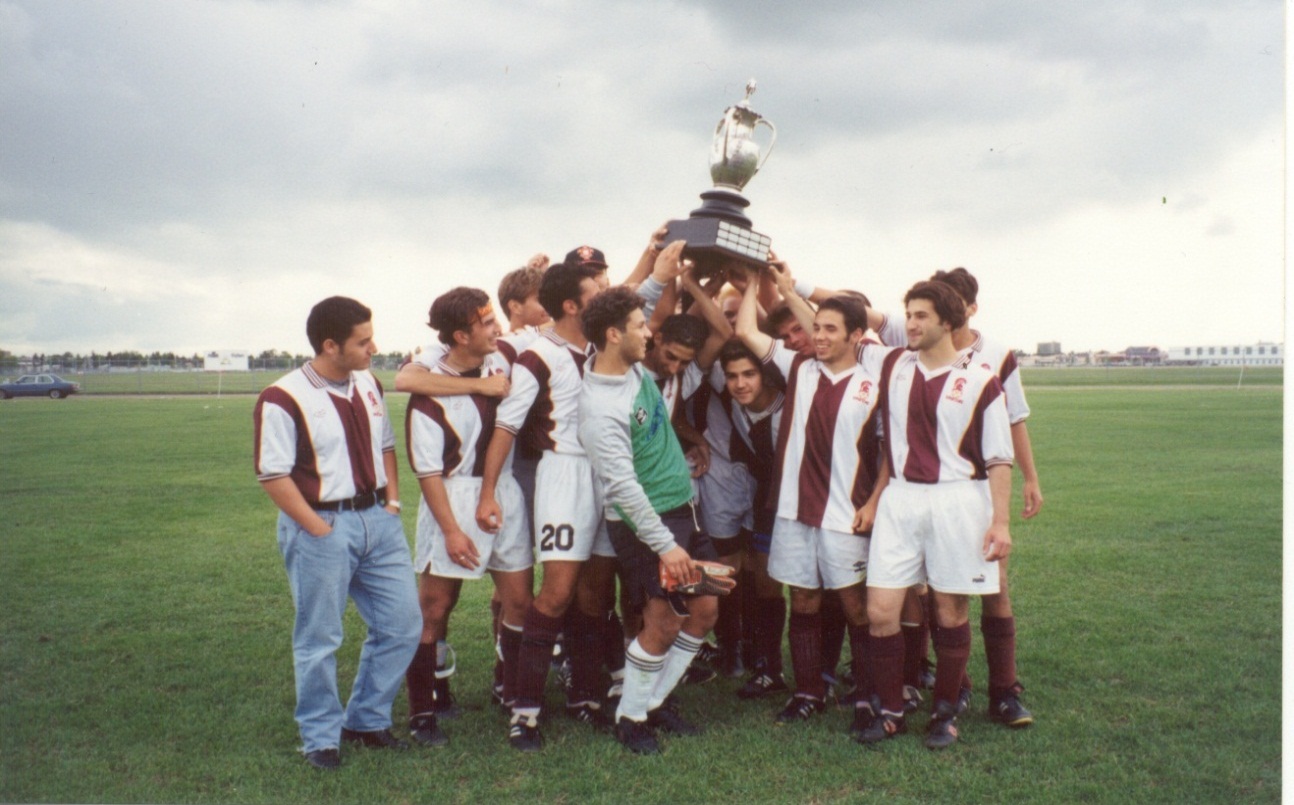
Since its inception in 1909 the Rutherford Cup has been competed for almost annually, making it perhaps Alberta’s oldest athletic competition. Until 1988 senior soccer teams from the Edmonton Public and Separate (Catholic) Schools Boards challenged each other for the cup. When these two boards discontinued their joint athletics board, the competition lapsed and since then only senior schools of the Separate system have competed for the cup within the Metro Edmonton High School Athletic Association which currently includes 51 member high schools from the Edmonton and Metro Edmonton area.
To follow the annual progress of play for the Rutherford Cup check the Metro Edmonton High School Athletic Association website at: http://metroathletics.ca/index.php.
The original version of this article appeared as “1909 Rutherford Cup – The Start of an Alberta Sporting Tradition” in Alberta Past, Vol. 11, No. 2, Spring, 1995.
Written By: Peter Melnycky, Historian, Historic Places Stewardship Section, Alberta Culture and Tourism.

 RETROactive