Managing Heritage: the City of St. Albert’s new plan

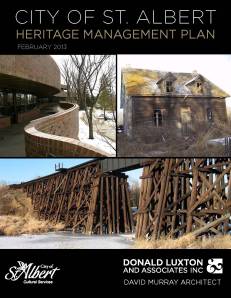
Heritage Management Plan Final Feb 2013_Page_01Over the past year, Municipal Heritage Services staff collaborated with City of St. Albert staff and the St. Albert Arts and Heritage Foundation on developing a municipal heritage management plan. A grant from the Alberta Historical Resources Foundation, through the Municipal Heritage Partnership Program, partially funded the planning process.

The City of St. Albert Heritage Management Plan includes many objectives. A few key elements of the plan include:

  • a list of strategies and objectives for sustaining a successful heritage program in St. Albert, including the appointment of a heritage advisory board for community members to advise the council;
  • it complements existing civic plans including the Municipal Development Plan, the Downtown Area Redevelopment Plan, the Cultural Master Plan and the Tourism Master Plan;
  • provides a process to add new qualifying places to the St. Albert Heritage Inventory; and
  • includes a process for nominating sites on the inventory for designation as Municipal Historic Resources, among other protective strategies.

The plan also includes a provision to establish a reserve fund that can be used to help finance conservation work on Municipal Historic Resources and for raising public awareness of St. Albert’s heritage.

We are excited to see St. Albert implement the plan over the next decade. If you’d like to discuss the possibility of developing a heritage management plan for your community feel free to contact MHPP staff.

Written by: Michael Thome, Municipal Heritage Services Officer
Barrier Free Access to Historic Places: the Little White School

At the 2012 Municipal Heritage Forum Ann Ramsden, Director of Heritage at the Musée Héritage Museum, provided a presentation on the conservation work completed at the Little White School. Specifically, she spoke about ensuring barrier free access. Thank you, Ann, for sharing this case study.

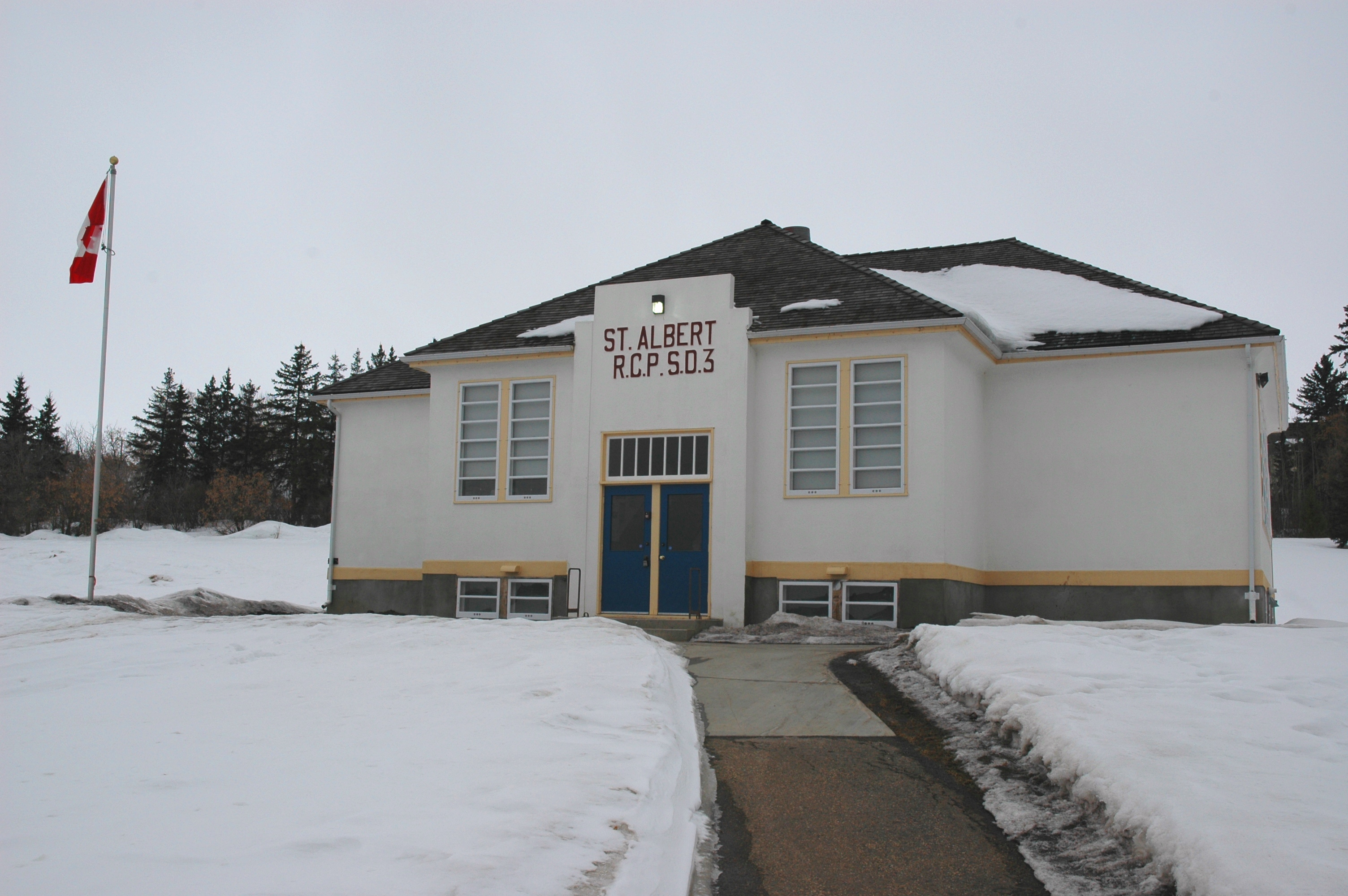
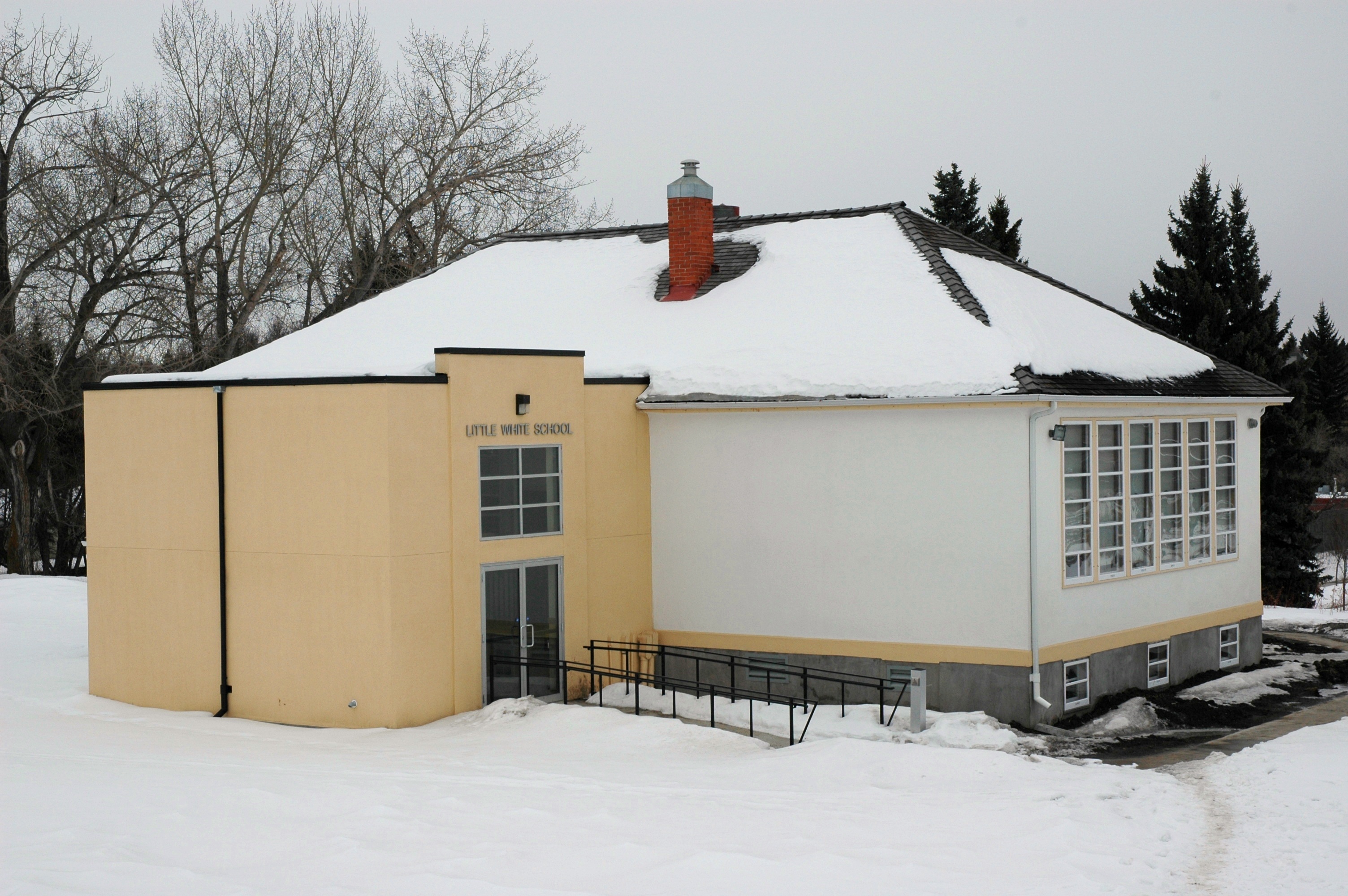
Little White School, St. Albert

The Little White School is a two-room schoolhouse in the City of St. Albert. It was constructed by the St. Albert Roman Catholic School District #3 in 1946 and used as a school until 1987. It was designated as a Municipal Historic Resource in 2009 because it is valued for what it can tell us about Roman Catholic public education in St. Albert. The school is now owned by the City of St. Albert and managed by the Arts and Heritage Foundation.

When the museum acquired the building, it needed some conservation work. The stucco, doors and windows needed to be rehabilitated. The shingles were replaced and a ventilation system was incorporated into the roof to prevent condensation. Water was also leaking into the basement through the foundation. The biggest challenge, however, was ensuring barrier free access to the building.

Rear view of the Little White School, St. Albert

The Standards and Guidelines for the Conservation of Historic Places in Canada not only provides advice on how to rehabilitate building elements like stucco, windows or a roof, it also provides advice on planning additions (or other alterations) needed to accommodate changing uses of a historic place. Historic places certainly do not lose their integrity by adding a means of barrier free access. Additions that are compatible with the historic place, yet visually distinguishable from and subordinate to it are welcome, especially if they help ensure the continued use of the place.

Classroom, Little White School, St. Albert

The Little White School gained an addition that contains a wheel-chair accessible entrance and elevator. This is now the main entrance and provides room for students who visit the school to store their coats and boots. The classrooms received a preservation treatment; one of the classrooms is now being interpreted as a 1940s era classroom. The Musée Héritage Museum invites primary school classes to the school to learn more about St. Albert’s history. Students can come and spend a day at the historic school and learn how students from the 1930s thru to the 1950s experienced school. (The Musée Héritage staff has developed several lesson plans around various themes in St. Albert history.)

Download Ann Ramsden’s presentation: Little White School, St. Albert.

Written by: Michael Thome, Municipal Heritage Services Officer
Wheatland County Lists Historic Resources on the Alberta Register of Historic Places

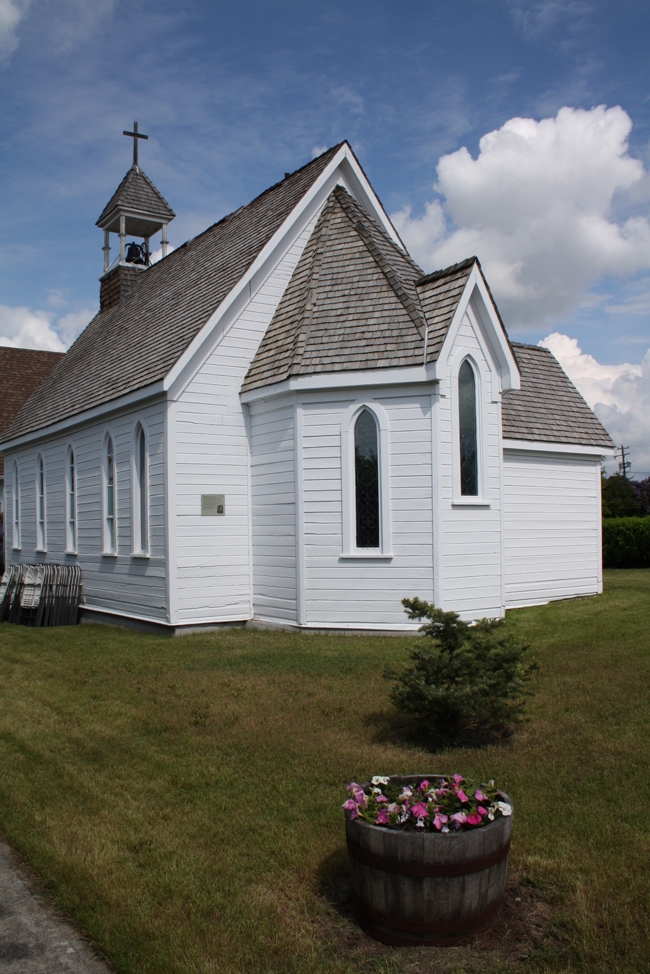
St. Andrew's Anglican Church_September 12 2012Wheatland County recently designated two Municipal Historic Resources that are now listed on the Alberta Register of Historic Places. You can find Wheatlead County a few kilometres east of the City of Calgary and adjacent to the Siksika Indian Reserve. The area was settled in the 1890s and the two sites reflect very different themes in Alberta’s history.

The St. Andrew’s Anglican Church is a small church located in the Hamlet of Gleichen, just north of Siksika Nation. It was built in 1885 by Anglican missionaries to the Blackfoot nation. The descendants of the Blackfoot people and the area’s settlers worship here to this day. This little chruch is quite likely one of the oldest Anglican churches in Alberta.

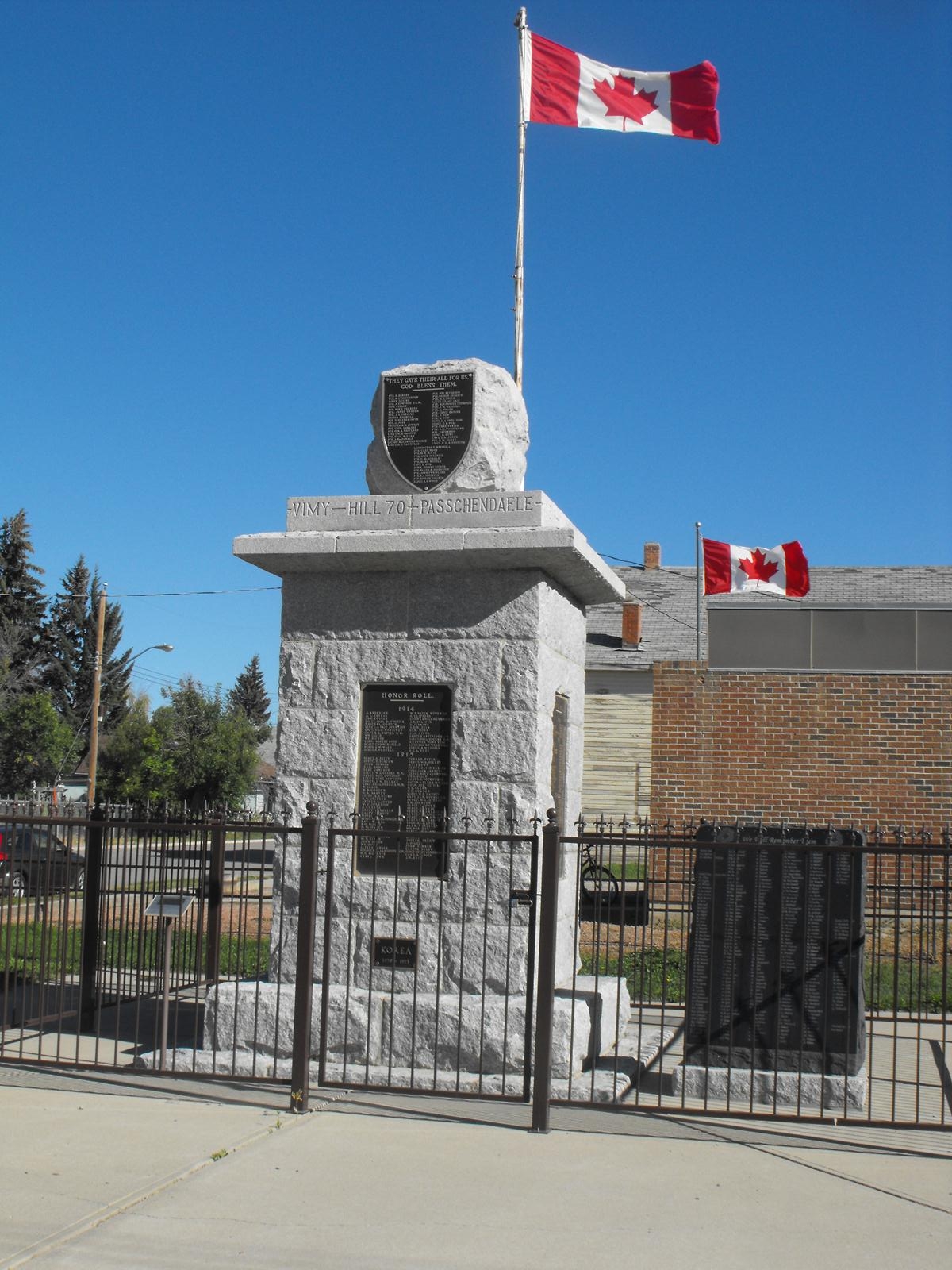
Cenotaph, Wheatland CountyThe Gleichen War Memorial Cenotaph is located in the Hamlet of Gleichen as well. Is was built in 1920 as a monument to the 51 men from the area who lost their lives while fighting for Canada in World War I. Plaques have subsequently been added to honour soldiers from the area who died during the Second World War, the Korean War and the mission to Afghanistan.

Written by: Michael Thome, Municipal Heritage Services Officer

County of Minburn: Conserving Ukrainian Canadian Historic Places

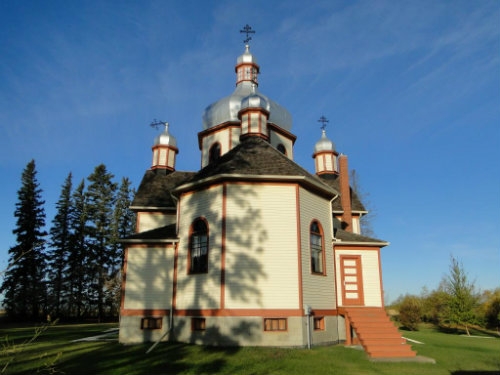
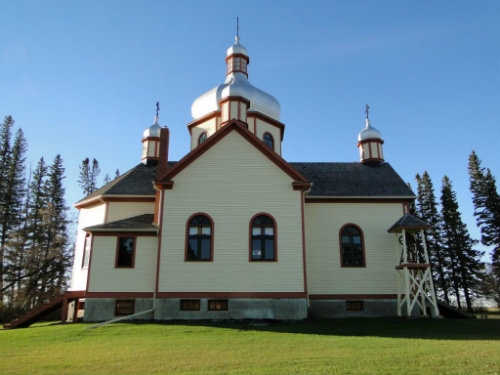
Sich-Kolomea Ukrainian Orthodox ChurchThe County of Minburn recently listed one of its newly designated Municipal Historic Resources on the Alberta Register of Historic Places. The Ukrainian Orthodox Church of the Dormition of St. Mary of Sich-Kolomea (otherwise known as Sich-Kolomea Ukrainian Orthodox Church) is one of the many historic resources that tell us about Ukrainian Canadian settlers.

Sich-Kolomea Ukrainian Orthodox ChurchThe Sich-Kolomea church is valued by the county because of what it conveys about the Ukrainian Canadians setters who built it. The church served the pioneer farmers of the area, and was the first church in what was to become the Vegreville mission district. It is also a beautiful example of the Canadian interpretation of the Byzantine style of church architecture seen in many eastern rite churches built on the Canadian prairies.

There are many municipal and provincial historic resources that tell us about the Ukrainian Canadian settlers in east-central Alberta. You can use the advanced search features of the Alberta Register of Historic Places to learn more about the places that form their legacy.

Written by: Michael Thome, Municipal Heritage Services Officer
Why can’t I list that on the Alberta Register of Historic Places?

A bit about exemptions.

Listing a Municipal Historic Resource on the Alberta Register of Historic Places is normally the last step in protecting a locally significant historic place. There are several types of historic places that cannot be listed on the register. Understanding which ones are ineligible will help you understand what a historic place is and understand the purpose of  designation under the Historical Resources Act.

Only sites that are protected because of the heritage value they possess are eligible for listing on the Alberta Register of Historic Places. The register is a database containing information on places that have been protected because of their historical or archaeological significance. The register is not a list of sites that are of historical interest – that would be the Alberta Heritage Survey Program database.

Some types of resources cannot be listed on the Alberta Register of Historic Places. Properties that cannot be listed include:

  • a property outside municipal jurisdiction;
  • a property that cannot be designated as a historic resource pursuant to the Historical Resources Act;
  • small movable objects;
  • human remains;
  • modern reconstructions, no matter how accurate, of a historic place; or
  • a building, structure or object situated in a historic park or village (like Heritage Park in Calgary).
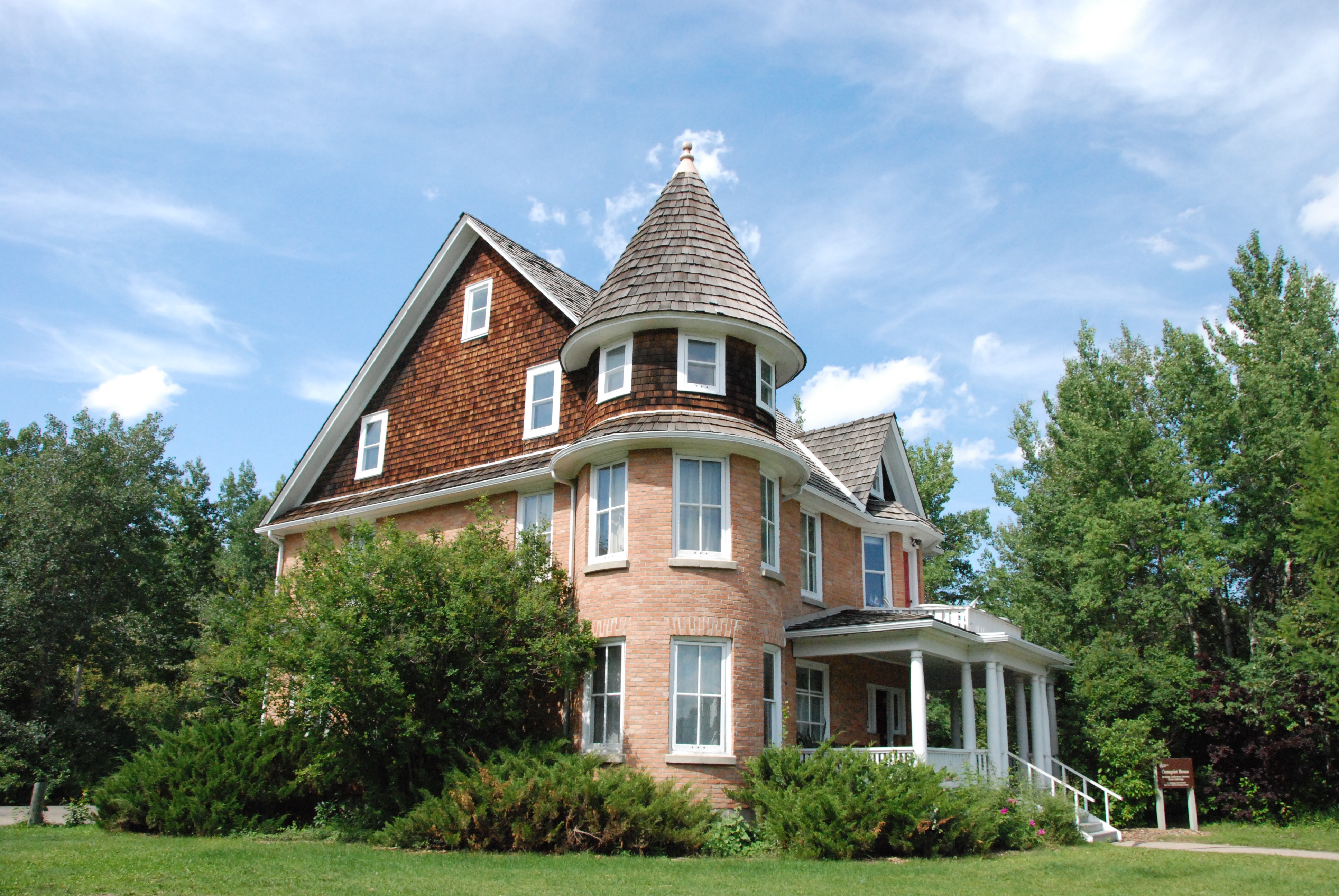
Cronquist House, protected by the City of Red Deer, is a Municipal Historic Resource.

What are some examples of these types of property? Sites owned by the Crown cannot be designated as municipal historic resources. So, post offices owned by Canada Post or a provincial court house cannot be listed. Certain types of property (such as cemeteries) are regulated under other provincial laws (such as the Cemeteries Act). Conflicts between the Historical Resources Act and other provincial statutes can occasionally annul the protective nature of designation. When this is the case, those sites cannot be listed because they are not, in practice, protected.

A historic place that clearly does not have heritage value cannot be listed on the Alberta Register of Historic Places. A contemporary reconstruction of a historic place, no matter how well executed, is by nature not a historic place. Reconstructions are built from the perspective of the present and use modern tools and materials. It’s unlikely that a reproduction will accurately reproduce a historic place in minute detail. Historic parks or villages are even worse in this respect. A historic park does not reproduce a historic streetscape in its original location. They are artificial groupings of buildings that have been created for purposes of interpretation.

These are only the most obvious exemptions. There are other more subjective exemptions, like birthplaces, moved resources and things less than 50 years old. I will discuss those exemptions in an upcoming blog post. If you’d like to know more about exceptions to listing on the Alberta Register of Historic Places, you can download the Evaluating Historic Places manual from the Municipal Heritage Partnership Program website.

Written by: Michael Thome, Municipal Heritage Services Officer
Surveying Delburne’s Historic Resources

I spent a day in the Village of Delburne earlier this month, training the village’s new heritage advisory board. They plan to survey buildings and structures in the village over the next six months, or so. They also plan to do some oral history work with local citizens and use all this information to develop a walking tour and some interpretive plaques. Delburne is preparing to celebrate the centenary of the village’s incorporation, in 2013.

I do all sorts of heritage planning projects with Alberta’s municipalities, but while preparing for this workshop I was struck by how few municipal heritage surveys I have worked on recently. Delburne’s project has reminded me just how useful heritage survey’s can be.

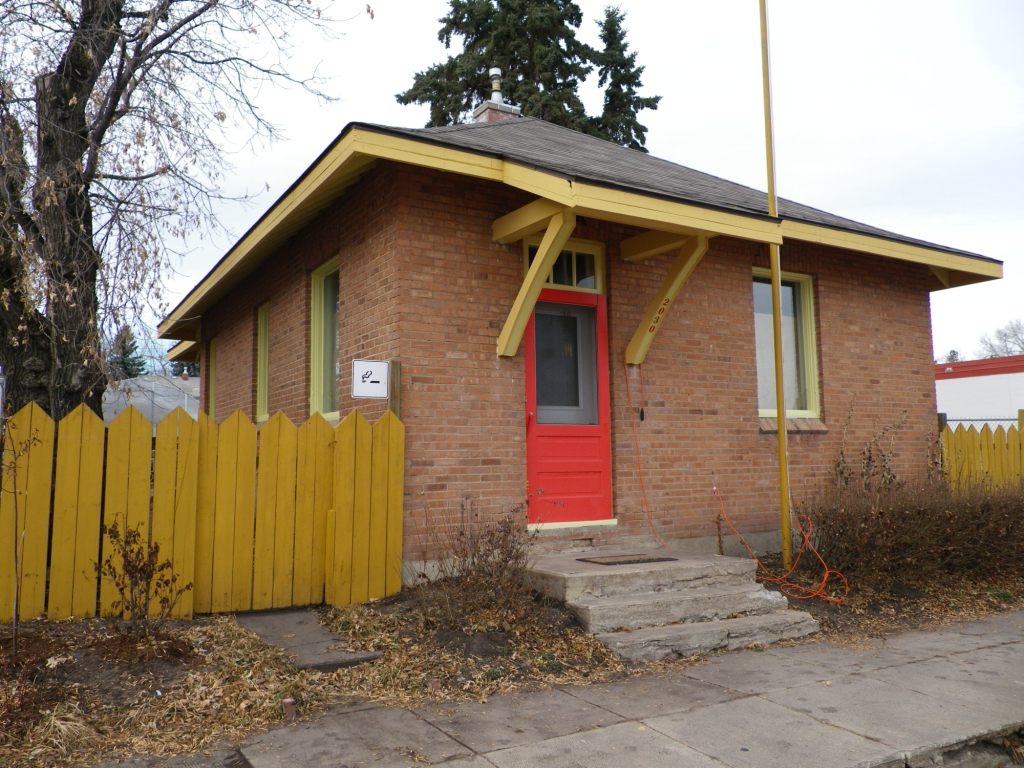
Delburne AGT Building, Municipal Historic Resource

A survey helps a municipality identify buildings and structures that may be significant, providing a basis to determine which places to evaluate further. The first step is for a community to select a geographic area to be studied. (Delburne is compact enough to be surveyed in one go). The survey team does some research to locate buildings and structures built before a cutoff date (usually 40 years ago). A fieldworker photographs each place’s facades (from the sidewalk and alley) using black-and-white archival-quality film. They will also make notes on each place’s design and general condition. This is combined with some historical information explaining how the building has been used over time. Together, this information forms a survey record.

The survey records are entered into the Alberta Heritage Survey database, part of the Heritage Resources Management Information System (HeRMIS). Each survey record is a snapshot of Alberta’s streetscapes and farmyards, showing us how they have evolved over time. The database can be searched in all sorts of ways—you can look for places made of a particular material, buildings that have certain design features and/or places associated with people or events.

The survey in Delbure will provide a sense of which places may be sufficiently significant to warrant further study and evaluation. Municipalities may choose to evaluate some of these places for heritage value, eventually develop management policies and possibly designate several places as Municipal Historic Resources.

Written by: Michael Thome, Municipal Heritage Services Officer
Town of Raymond Develops its Context

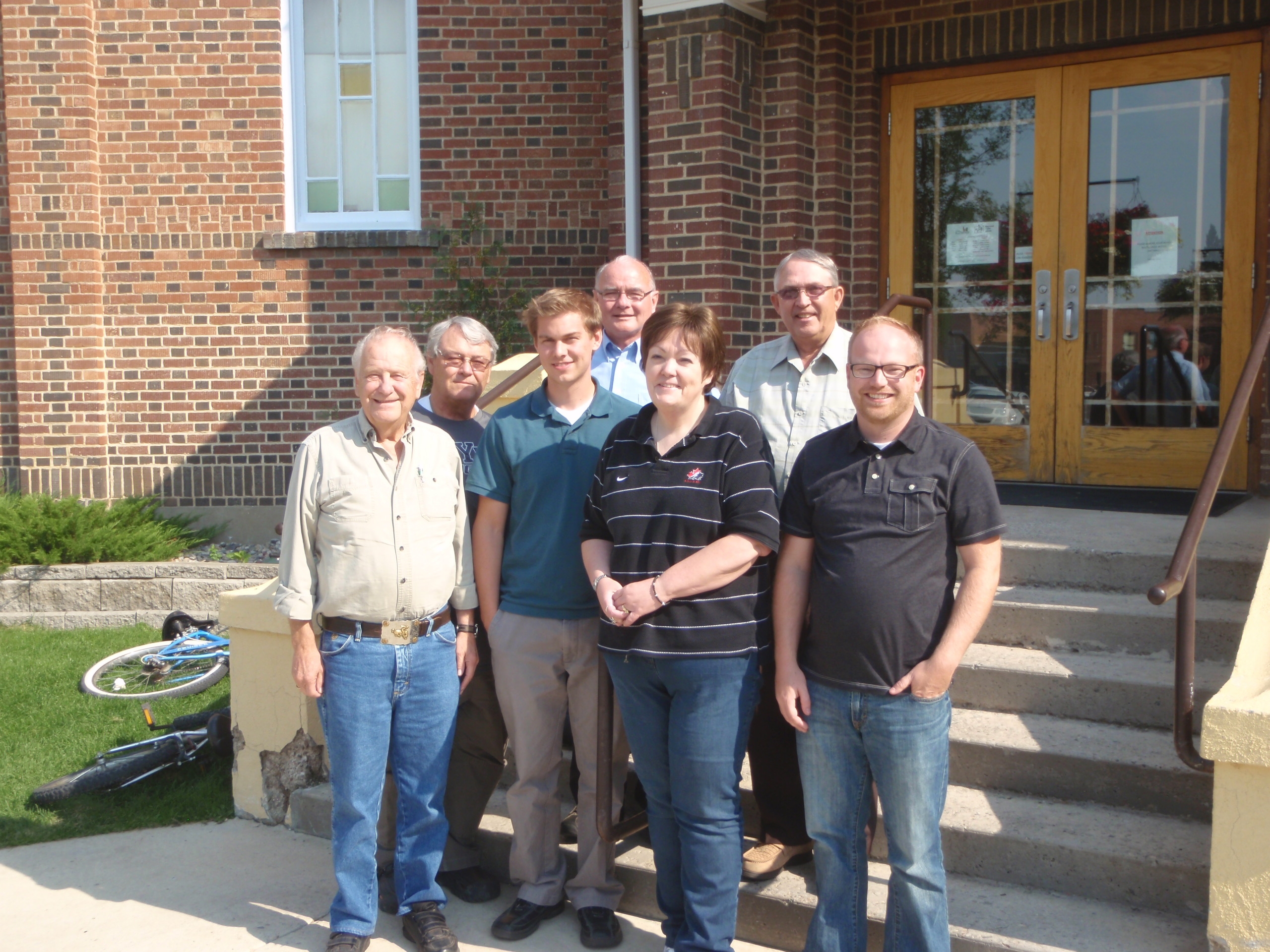
Raymond Historical Inventory Committee Members (L to R): Keith Hancock, Ross Jensen, Kyle Bullock (Municipal Intern), Jack Stone, Cathy Needham (Town Councillor), Richard Kiddle (Raymond Historical Society President).

I had the privilege of leading a workshop for the Town of Raymond’s Historical Inventory Committee on August 27, 2012. The committee has been appointed by town council to explore ways to identify and protect Raymond’s historic resources.

Writing a context paper for the community is an excellent first step. A community cannot evaluate places for significance without a well thought out context paper. A context paper explains how a community’s past shaped its streetscapes and landscape. Writing a context paper helps community members understand their heritage values.

The context paper describes key people, events and groups and explains what their impact was on the community’s development. A well written context paper can be used to distinguish places that the community feels have heritage value, from places that are just old.

After a morning spent listening to me talk, we spent the afternoon drafting an outline for what could be a context paper. We talked at length about the town’s history. Raymond was founded in 1901 by a group of Mormon settlers from Utah. Jessie Knight, a wealthy industrialist from Utah, purchased over 20 000 hectares of land in and around where Raymond is situated. Knight financed the farming of sugar beet  and built a sugar factory to provide the economic basis for the settlement. Raymond was incorporated as a village in 1902 and a town in 1903, and named for Jessie’s son Raymond. Raymond Knight was himself a community leader who, among other things, founded the Raymond Stampede, Alberta’s oldest annual rodeo.

We worked through a list of several themes:

  • Culture
  • Economy
  • Politics and Government
  • Religion and Spirituality

Each theme was a starting point to talk about individuals, groups and events that shaped Raymond. It was interesting to hear the stories. Raymond was founded and deeply influenced by members of the Church of Jesus Christ of Latter Day Saints, but has never been exclusively Mormon. Japanese Buddhists began arriving in the area in 1904. (Indeed they established a Buddhist temple in a former Latter Day Saints church acquired from the Mormons in 1929, which is designated as a Provincial Historic Resource). The people of Raymond are passionate about sports—when they built a new high school several years ago they raised extra funds to build a gymnasium large enough to accommodate all the fans. Raymond’s citizens also love the performing arts and Raymond has several amateur choirs and theatrical companies to prove it. I was particularly fascinated to learn about how the Raymond Stampede has grown from a rodeo to a homecoming event. Every year on July 1st, the community members open their homes to friends and relatives who return to take in the parade, rodeo and other homecoming festivities. It sounds like the population of Raymond probably doubles or triples that weekend.

Over the next few months, Raymond’s committee will begin exploring its heritage values. The result will be written up and presented to community members for their input. When it’s finalized, the context paper will give Raymond a means to evaluate individual sites for heritage value. This is turning out to be a really interesting project. I look forward to working with Raymond in the future as this project ramps up.

Written By: Michael Thome, Municipal Heritage Services Officer
Dutch Settlement

You have all probably seen them – large blue heritage markers located at highway rest areas or points of interest throughout Alberta. These interpretive signs tell of Alberta’s rich heritage. Come, travel Alberta and read a featured heritage marker:

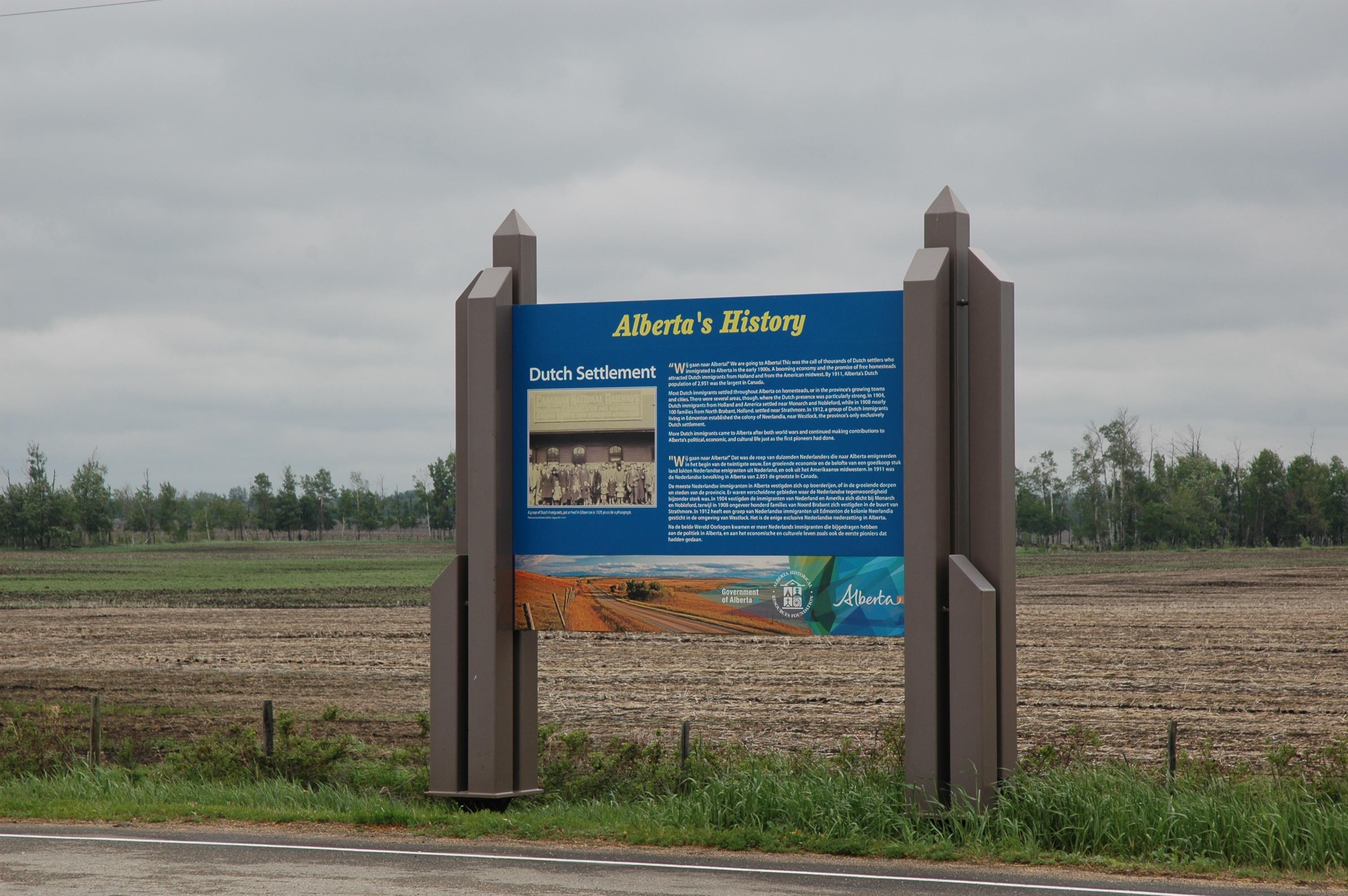
Driving westward on Highway 18, about 3 kilometers east of the intersection with highway 33 (near the Town of Barrhead) I came across a heritage marker commemorating Alberta’s first Dutch settlers. The sign is about 19 kilometers south of the Hamlet of Neerlandia. Why is Neerlandia special? The sign explains:

Dutch Settlement

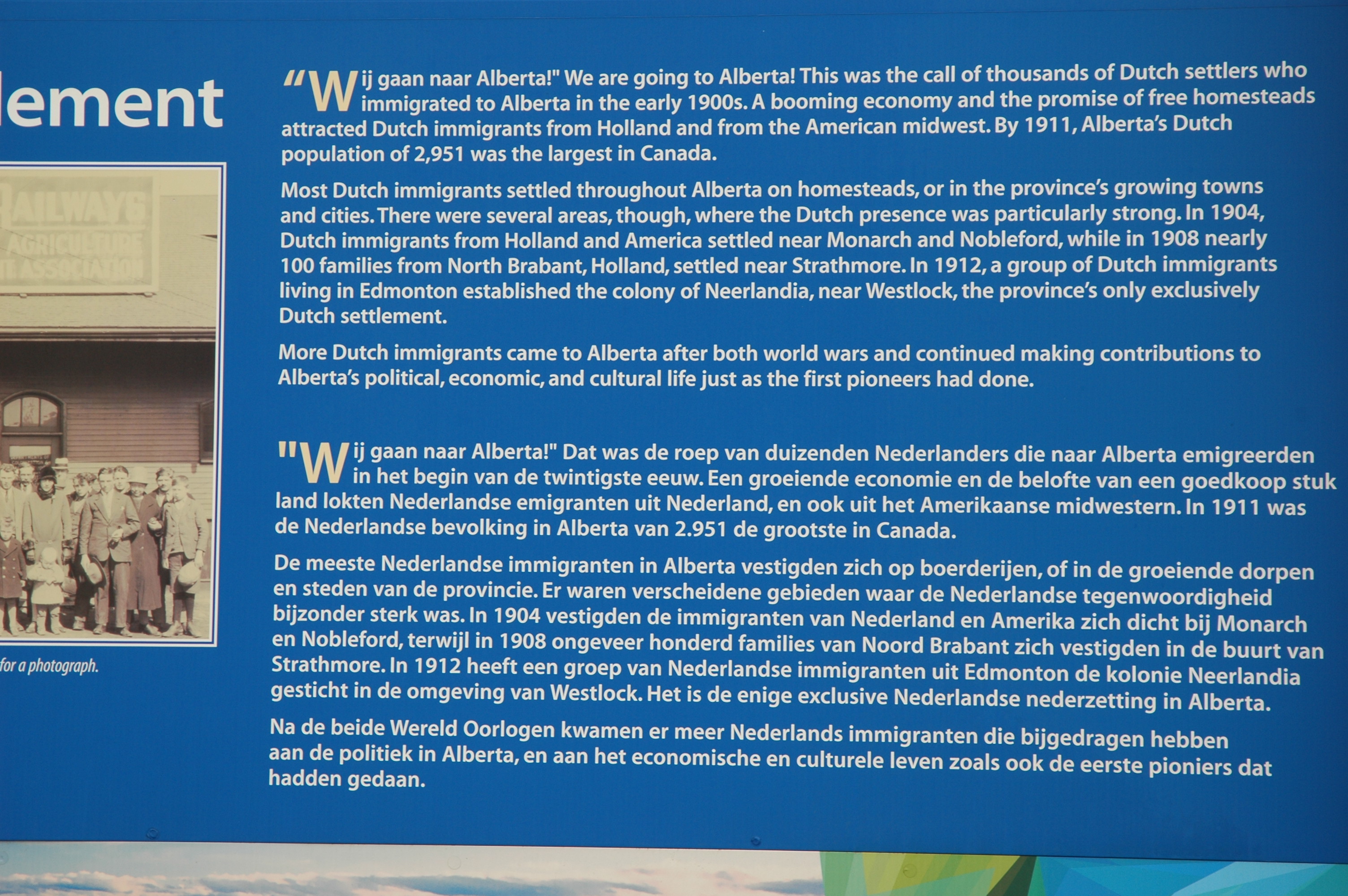
“Wij gann naar Alberta!” We are going to Alberta! This was the call of thousands of Dutch settlers who immigrated to Alberta in the early 1900s. A booming economy and the promise of free homesteads attracted Dutch immigrants from Holland and from the American Midwest. By 1911, Alberta’s Dutch population of 2,951 was the largest in Canada.

Most Dutch immigrants settled throughout Alberta on homesteads, or in the province’s growing towns and cities. There were several areas, though, where the Dutch presence was particularly strong. In 1904, Dutch immigrants from Holland and America settled near Monarch and Nobleford, while in 1908 nearly 100 families from North Brabant, Holland, settled near Strathmore. In 1912, a group of Dutch immigrants living in Edmonton established the colony of Neerlandia, near Westlock, the province’s only exclusively Dutch settlement.

More Dutch immigrants came to Alberta after both world wars and continued making contributions to Alberta’s political, economic, and cultural life just as the first pioneers had done.

Note: The text on the sign is repeated in Dutch. To view, click on the below photo.

Heritage Marker Location

On the north side of Highway 18 approximately 3 kilometers east of Highway 33, near the Town of Barrhead.

Alequiers is a Provincial Historic Resource located near Longview in the M.D. of Foothills, in southern Alberta. Although it’s not located near this sign, the property is associated with the well know painter Ted Schintz. Schintz migrated to Canada from Holland during the 1920’s.

Prepared by: Michael Thome, Municipal Heritage Services Officer
Planning a future for St. Albert’s Historic Places

The City of St. Albert is hard at work on a heritage management plan, with assistance from the Municipal Heritage Partnership Program. A heritage management plan will help St. Albert conserve its historic resources. Would you like to help? Please take a few moments and share your thoughts with St. Albert on the conservation of historic resources by completing their survey.

St. Albert, like many of Alberta’s communities, is growing rapidly. Growth is certainly not bad in itself, but it can threaten a community’s historic resources if there are no plans to identify and mange them. This is particularly true in a community like St. Albert: many of their historic places were built during the 1960s in modern architectural styles. We often overlook modern buildings when thinking about historic places, although they can tell us a great deal about a community’s past.

Understanding why a historic place is valuable, even protecting it through Municipal Historic Resource designation, are first steps. A community needs to encourage proper conservation and maintenance and ensure each historic resource has a contemporary use that requires minimal change.

The St. Albert heritage management planning project had its first open house with a few dozen residents at St. Albert’s Musée Héritage Museum on June 20th. You can view the presentation given that night (available on the City of St. Albert’s website as a PDF). You can take a look at the Heritage Management Plan page on the City of St. Albert’s website for more information.

Stay tuned for future updates.

Written by: Michael Thome, Municipal Heritage Services Officer
Save the Date! 2012 Municipal Heritage Forum

Our sixth annual Municipal Heritage Forum will be held on November 8 and 9 in Calgary. Save the date!

If you’re a municipal staff member, heritage advisory board member or council member and heritage conservation is part of your work you should plan to attend.

A formal invitation for you to join fellow professionals who work for or volunteer with Alberta’s municipalities on conserving locally significant historic places will be issued later this summer.

The Municipal Heritage Forum is an annual opportunity for municipal leaders interested in the identification, evaluation, protection, management and promotion of locally significant historic resources to meet with peers and learn about heritage conservation. We will have presentations from municipalities on aspects of their historic resource conservation program and various presentations from heritage professionals.

The 2012 Forum will be in Calgary, at the Glenbow Museum and the Calgary TELUS Convention Centre. Stay tuned for additional information.

Want to get a sense of what happens at the forum? Contact us, or check out the blog posts about last year’s forum.

Written by: Michael Thome, Municipal Heritage Services Officer
Stephen Avenue National Historic Site of Canada, Calgary