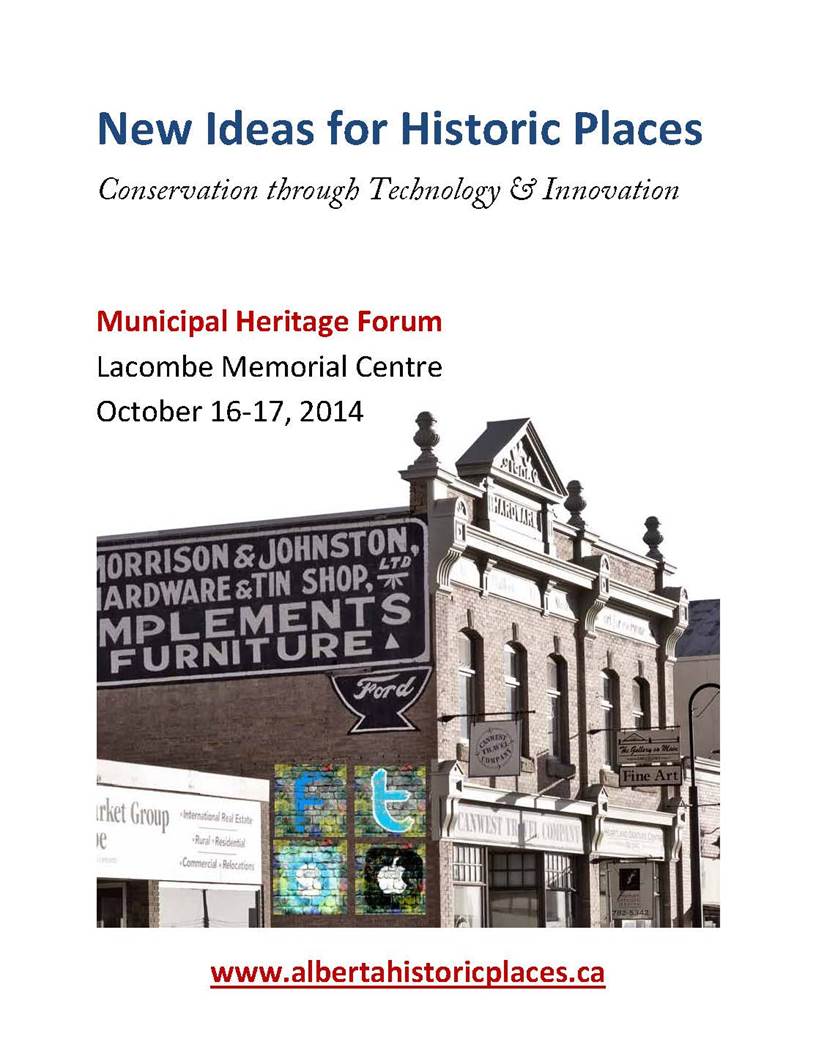
As previously announced, the 2014 Municipal Heritage Forum will be held on October 16th and 17th at the Lacombe Memorial Centre with sessions to be held in and around their award winning Main Street. The theme of this year’s forum is “New Ideas for Historic Places: Conservation through Technology and Innovation”. We are planning some exciting sessions to get you thinking about social media, mapping and documentation as well as workshops on using technology for building conservation. We hope to see you there! Registration will open and keynote speakers will be announced in June.
(Note: social media graffiti not actually real!)
For those of you who have attended past Forum’s you will be familiar with the Municipal Show and Tell sessions. Show and Tell is an opportunity for municipalities and volunteer groups to present projects they have been working on to their peers. It is a great way to learn about different heritage initiatives and to make valuable contacts for the future. The challenge we always have organizing Municipal Show and Tell is that you heritage conservationists are a humble group – many of you don’t realize how interesting your projects are and how much others can learn from you. Year after year we get feedback telling us how valuable the Show and Tell is to participants so we strongly encourage you to send us your ideas or recommendations! Presentations are approximately 15 minutes long, with time for questions included. If you would like to forward an idea for the Municipal Show and Tell e-mail us at albertahistoricplaces@gov.ab.ca.
This slideshow requires JavaScript.
Written by: Rebecca Goodenough, Municipal Heritage Services Officer
The Town of Sexsmith is now one step closer to completing their first Municipal Heritage Inventory. On April 30th the Town, in partnership with project consultant Donald Luxton and Associates Inc., held a public open house to present information on the Heritage Inventory project to the community. Approximately 14 residents attended the session to review possible themes related to the development of their community and to provide information on specific buildings.
The following day the Town’s Heritage Advisory Board (HAB) met to review the proposed Statements of Significance for 16 potential locally-significant historic resources within Town boundaries. Their local knowledge of the people and events from Sexsmith’s past provided the project consultant with valuable information. Revisions will be made to the Statements of Significance and we anticipate the final report will be presented for review by Town Council by the end of summer.
Participants in the Sexsmith Heritage Inventory Project (From left to right): Chelsea Dunk (Donald Luxton & Associates Inc.), James Obniawka (HAB), David Olson (resident), Larry Anderson (HAB), Vella Anderson (HAB), Carolyn Gaunt (Town of Sexsmith), Jean Rycroft, Sam Boisvert (Donald Luxton & Associates Inc.). Missing from photo: Grant Berg, Isak Skjaveland
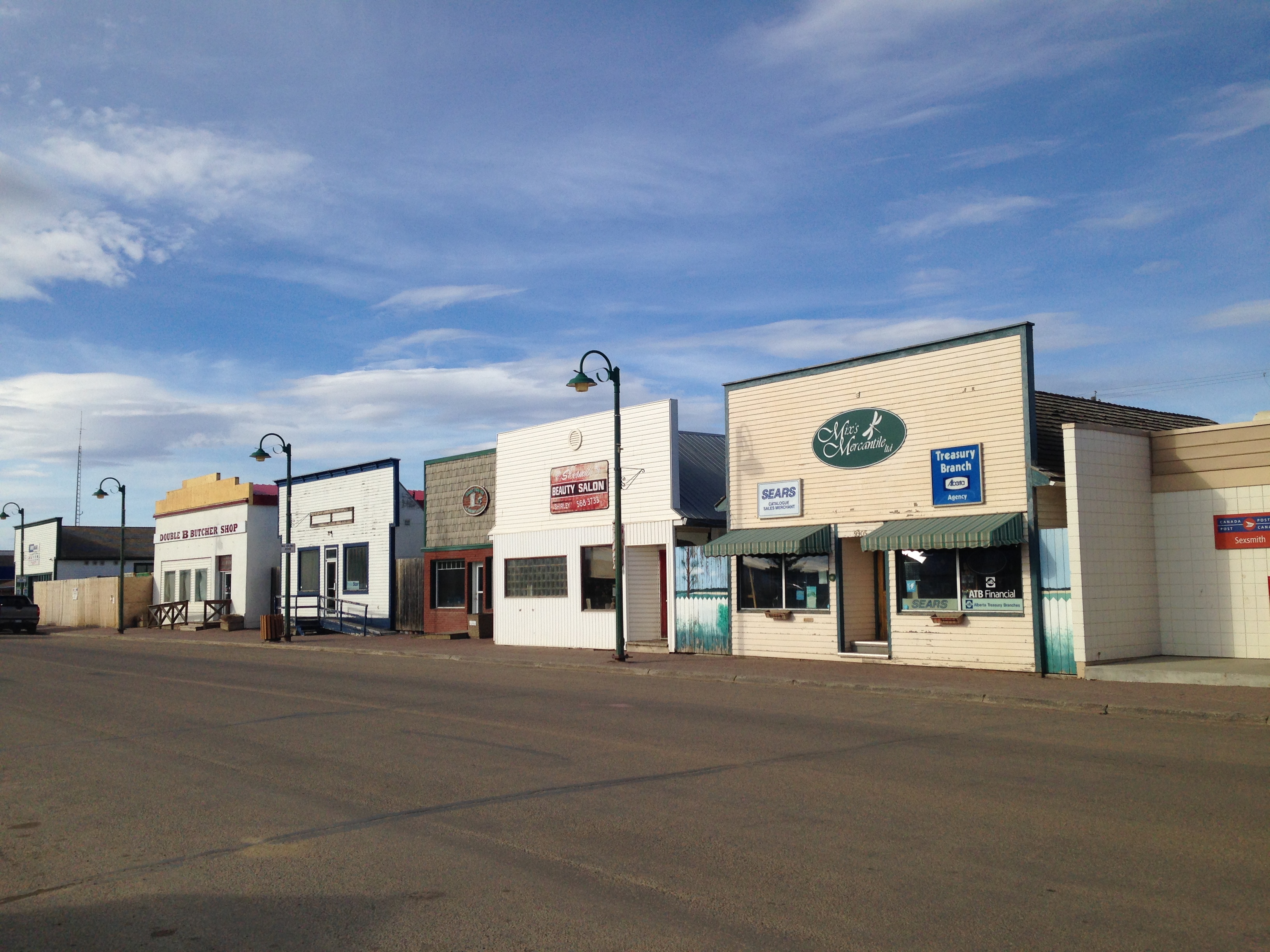
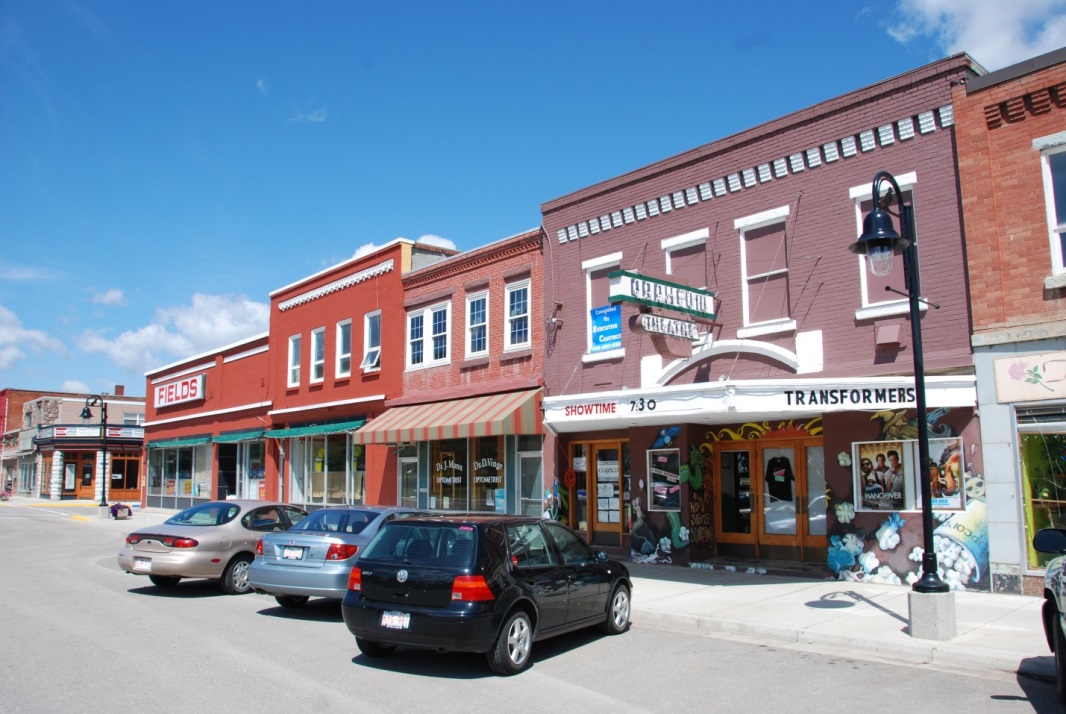
Originally known as Benville, Sexsmith was first settled in the early 1900s but experienced growth following the establishment of the ED&BC railway in 1916. The proximity of the community to the rail line caused expansion of agricultural production and established Sexsmith as a major hub for grain export. Sexsmith was once known as ‘The Grain Capital of the British Empire’ during the 1920s and 30s and at one time there were nine grain elevators situated adjacent to the railway. Today three remain and the Town is in the process of acquiring one for conservation purposes. The community is further characterized by its relatively intact boomtown commercial main street, located directly opposite of the rail line and by the presence of two Provincial Historic Resources: the Northern Alberta Railway Station and the Sexsmith Blacksmith Shop.
100 Street (Main Street), Sexsmith
Heritage inventory projects are supported by the Municipal Heritage Partnership Program and provide municipalities with the process and tools to assess possible historic sites within their boundaries for future municipal historic resource designation.
Written by: Rebecca Goodenough, Municipal Heritage Services Officer
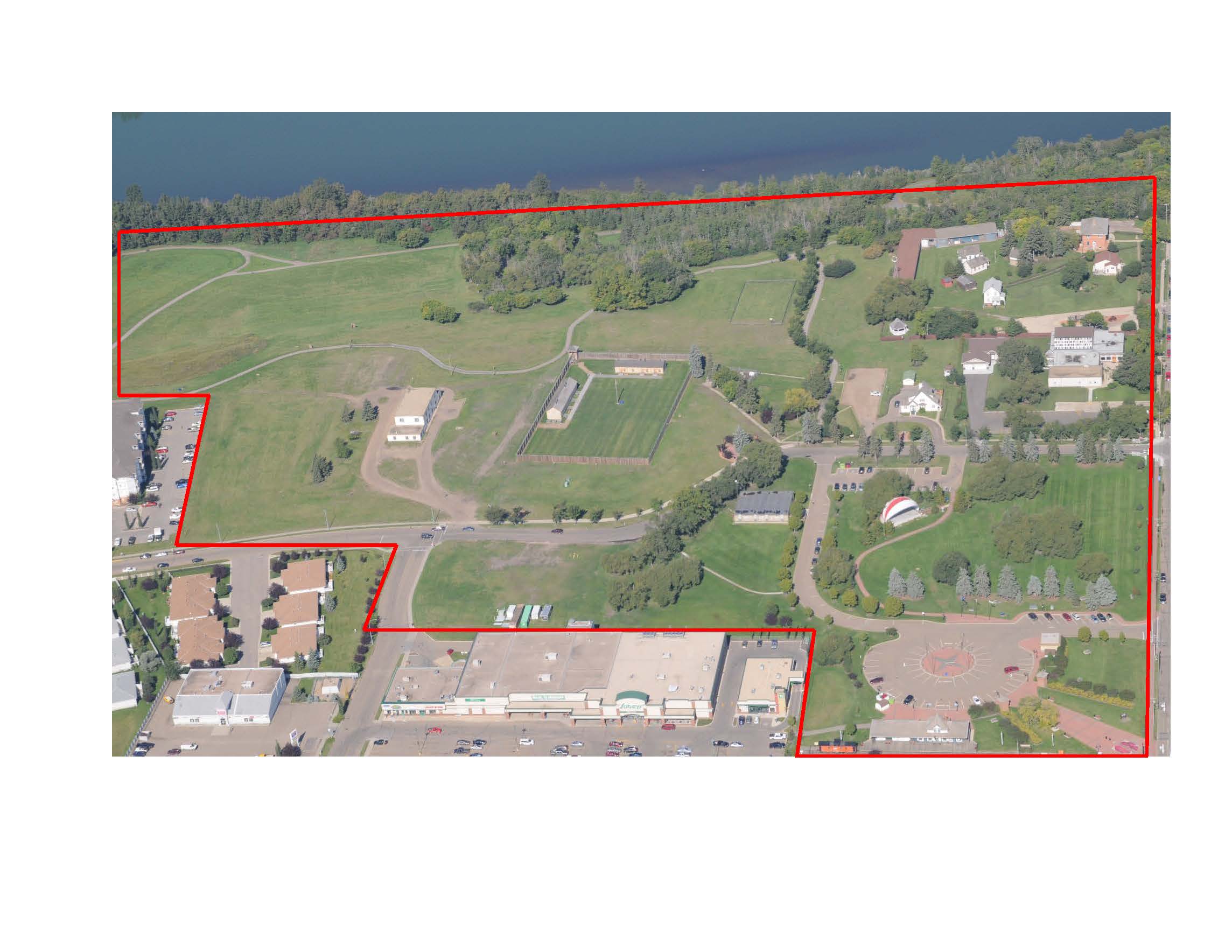
The City of Fort Saskatchewan is one step closer to realizing their vision for the development and interpretation of a significant community amenity through Council’s recent approval of the Historic Precinct Site Master Plan Guiding Document. Located adjacent to the City’s downtown and along the edge of the North Saskatchewan River, the Historic Precinct provides a unique opportunity to showcase the cultural history of Fort Saskatchewan and to develop a space for public learning and enjoyment.
Historic Precinct Area
The Approach
The Historic Precinct contains an array of man-made and natural elements that contribute to the telling of the story of Fort Saskatchewan. Project consultants EIDOS Consultants Inc. and Marshall Tittemore Architects approached the conceptualization of the space as a cultural landscape, wherein:
“An important part of the Precinct’s heritage value is found in the relics of law and order and public works, including buildings, structures, sightlines, earth mounds, plant materials and features that remain in situ. These relics constitute part of the heritage value of the area by providing tangible evidence of how it was transformed and used by the NWMP, Canadian Northern Railway, the Province and the City.” (Historic Precinct Site Master Plan, page 9).
The planning process sought to integrate local values into the final plan and therefore included public and stakeholder consultation through surveys, open houses and workshop sessions.
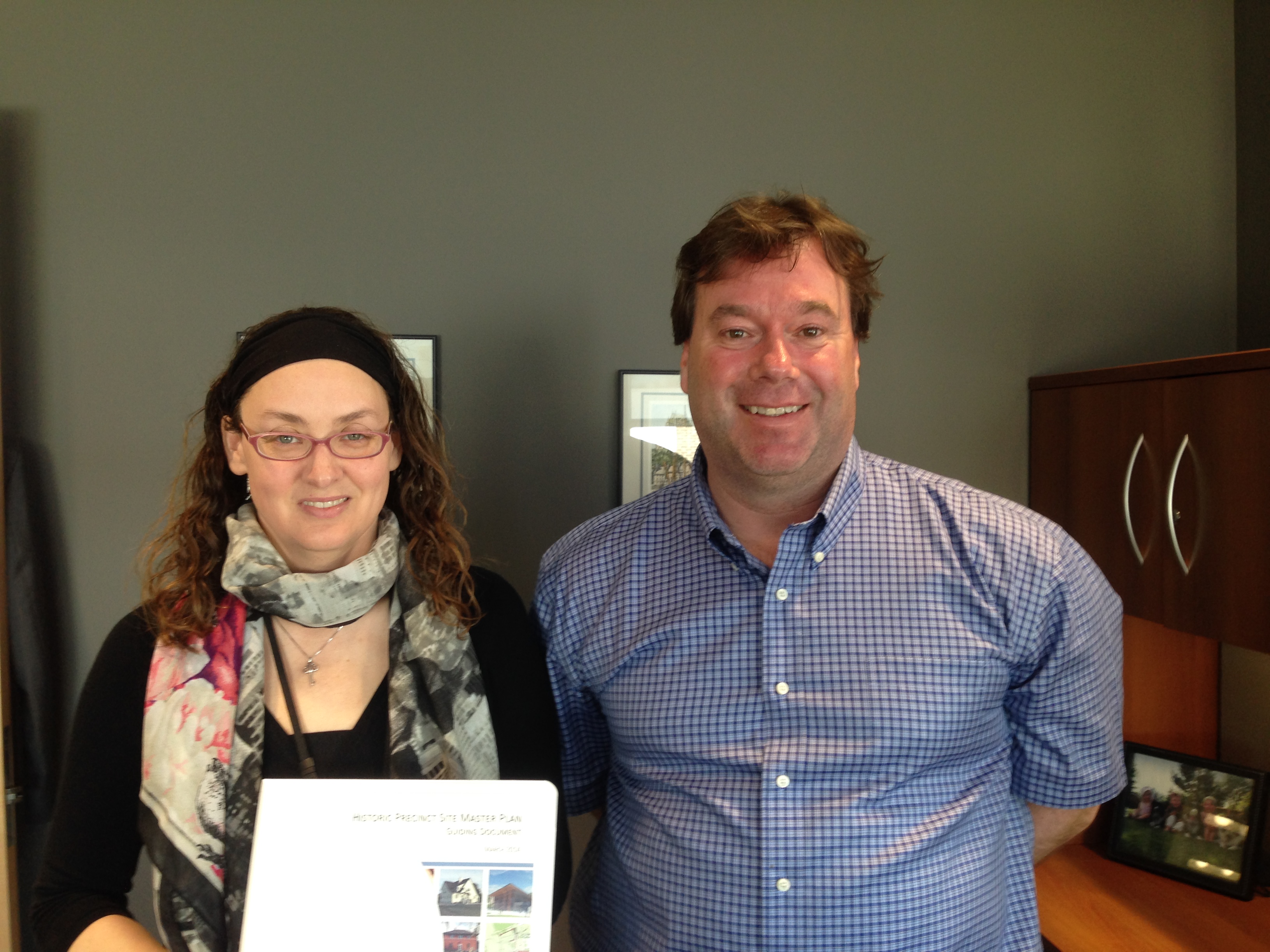
The City of Fort Saskatchewan’s Diane Yanch, Culture & Historic Precinct Supervisor and Richard Gagnon, Director of Culture Services display a copy of the completed Historic Precinct Master Plan
The Master Plan
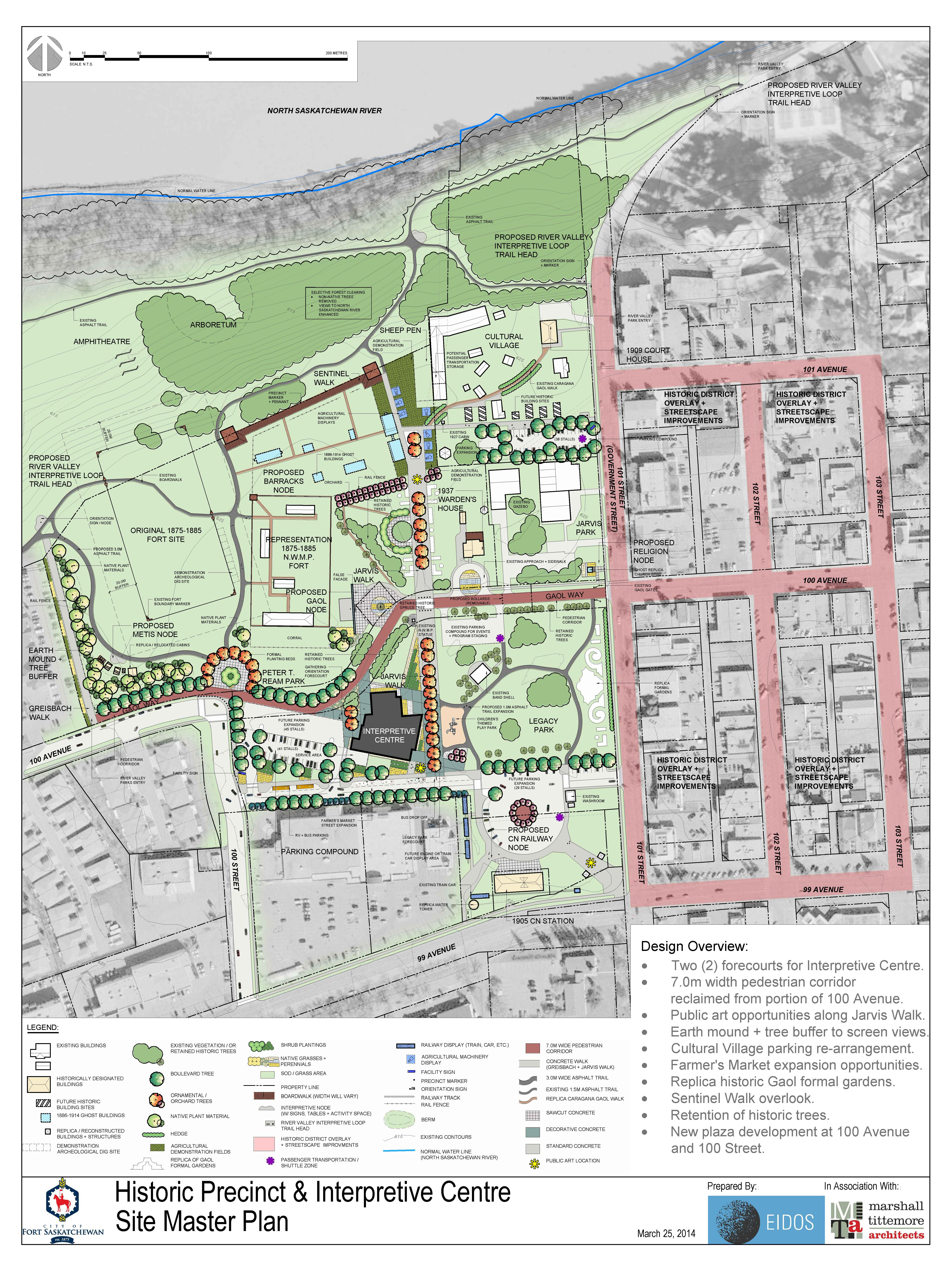
The Master Plan involved considering the long-term development and interpretation of the historic precinct, including integration of existing Provincial Historic Resources, recommendations for pedestrian circulation and way-finding, interpretation opportunities and development of a conceptual design for a new Interpretive Centre. A detailed phasing plan was also provided to allow the City to structure implementation in a coordinated and cost-effective manner.
Historic Precinct Site Master Plan
The uniqueness of the site is exemplified by the existence of three Provincial Historic Resources within its boundaries including the North West Mounted Police Post, the Fort Saskatchewan Museum (Courthouse), and the Canadian Northern Railway Station. These three historic resources are proposed to be key elements in the interpretation and programming of the Historic Precinct and are considered as Historic Precinct Nodes in the Master Plan.
Original 1875 Fort Site Node – This Provincial Historic Resource is presently an open native grass field and will remain untouched during development, with the long term goal of undertaking small scale research and public archaeology programs in partnership with interested academic institutions, archaeological societies and the Province of Alberta.
Fort Saskatchewan Museum and Cultural Village Node – The Fort Saskatchewan Museum (Courthouse) is a designated Provincial Historic Resource. The Master Plan calls for the land surrounding the Courthouse to be utilized as a ‘cultural village’ in which historic buildings and artifacts will be displayed.
Railway Node – The CNR Station will continue to be space for use by community groups. The area around the Station will be enhanced to include an opportunity to showcase other rail infrastructure, landscaping and opportunity to enhance access to the adjacent Legacy Park and farmer’s market plaza.
Other Historic Precinct Nodes proposed within the plan include a Gaol Node, Religion Node, MétisNode and First Nations Node.
Next Steps
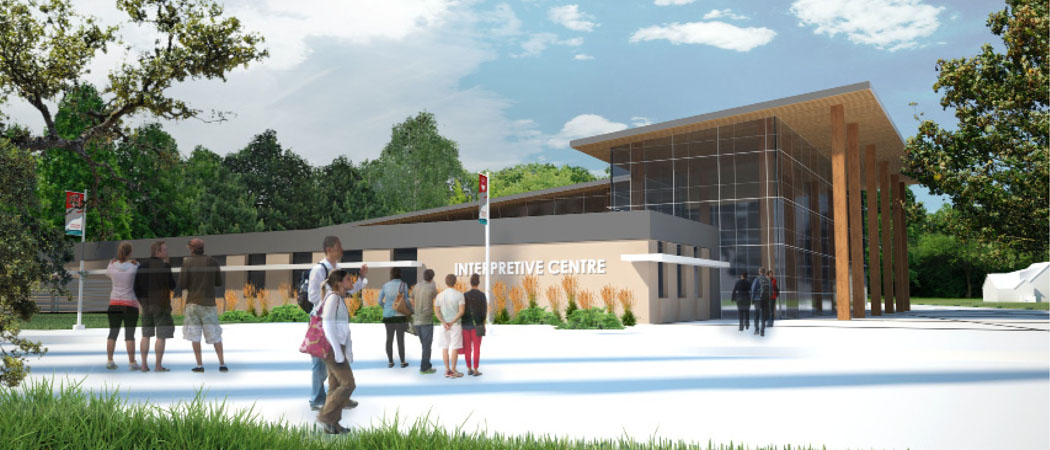
The City will continue with planning the programming for the future Interpretive Centre with hopes of breaking ground by the end of 2014. Conservation Plans have been prepared for the Courthouse/Museum and CNR Railway Station to ensure that on-going improvements and maintenance are consistent with accepted conservation practices. In accordance with the terms of designation, approvals will be obtained for any projects within the site that will affect the Provincial Historic Resources as well as work in the vicinity of the NWMP Police Post due to the high archaeological potential of the site.
Proposed General Concept Design of the Interpretive Centre
The Historic Precinct Master Plan was partially funded by the Alberta Historical Resources Foundation under the Heritage Management Plan grant category of the Municipal Heritage Partnership Program. Though Heritage Management Plans typically take the form of a document that outlines policy and a process for municipal designation, the grant category is flexible and can apply to projects that involve planning and policy development for the stewardship of historic resources more broadly. The Historic Precinct Site Master Plan is an example of how the program can be tailored to meet the unique needs of municipalities.
Written by: Rebecca Goodenough, Municipal Heritage Services Officer
The Municipality of Crowsnest Pass contains the communities of Coleman, Blairmore, Frank, Hillcrest and Bellevue. Crowsnest Pass has a rich history in coal mining and trade unionism, and therefore, has much to offer in the way of historic resources.
20th Avenue, Blairmore
As a result of this rich and varied history, the Municipality has acknowledged the importance of identifying places of significance in the community. Given the breadth of possible historic resources within the municipality’s boundaries, Crowsnest Pass determined that a three-phase heritage inventory would be required to comprehensively assess potential sites. The first phase was completed in 2013 and inventoried 31 sites in the Coleman area. The second phase is being completed in 2014 and is looking at historic resources in Blairmore and Frank. The third and final phase will look at historic sites in the Hillcrest and Bellevue area and is proposed to be undertaken in 2015.
55 residents attended a public open house held on April 23rd at the Blairmore Elks Hall to provide feedback on possible sites to be included in the second phase of the heritage inventory. Consultants Community Design Strategies Inc. presented 65 possible historic resources for residents to provide feedback on in terms of historical information and opinions regarding the significance of each site. The results of the open house will be reviewed by the Crowsnest Pass Municipal Historic Resource Board and refined to a list of 45 sites for further evaluation. These 45 sites will have Statements of Significance prepared for them and will be presented back to the community for further review and comment at a second open house to be scheduled later this year.
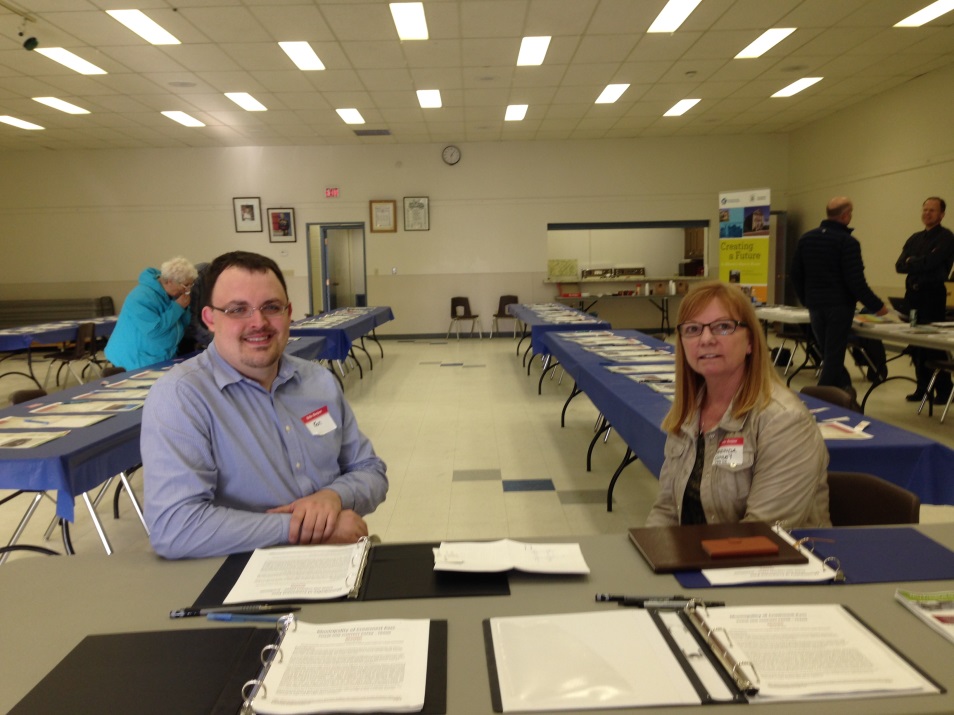
Ken Bourdeau, Development Officer with the Municipality of the Crowsnest Pass and Merinda Conley, Principal with Community Design Strategies Inc. ready to speak with residents at the open house.
The event provided residents and property owners the opportunity to comment on the 65 places of interest and to speak with representatives of the Municipality of Crowsnest Pass, the Municipal Historic Resources Board and Alberta Culture about the heritage inventory project and municipal historic resource designation in general.
Heritage inventory projects are supported by the Municipal Heritage Partnership Program and provide municipalities with the process and tools to assess possible historic sites within their boundaries for future municipal historic resource designation.
Written by: Rebecca Goodenough, Municipal Heritage Services Officer
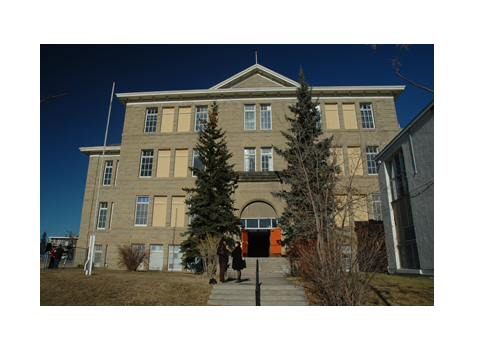
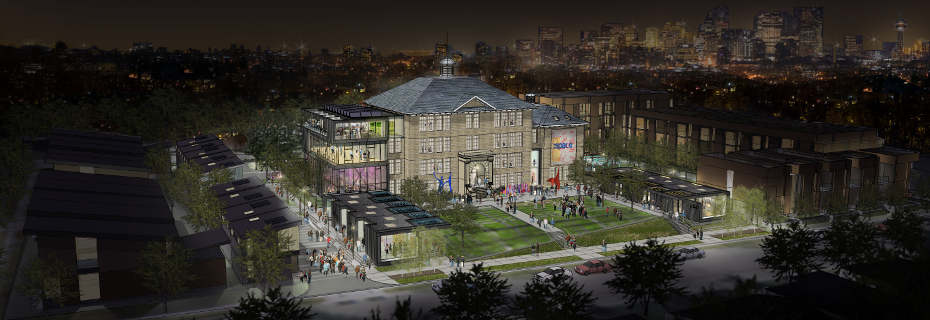
New Uses for Old Places is a RETROactive series in which we are looking at examples from around Alberta of historic sites that have found interesting new uses for spaces that were originally designed for other purposes. In this last installment we will be looking at King Edward School in the neighbourhood of South Calgary as an example of adaptive reuse project underway to repurpose the building as a mixed-use arts incubator (a place that nurtures the growth and development of artists and arts organizations).
The King Edward School was constructed in 1912 as a four-storey building that features a symmetrical design, rock-faced sandstone walls and a dressed sandstone front entrance. During its time as an institution of learning, the School also functioned as a community hub, hosting dances and other events. The school operated as versions of both King Edward Elementary/Junior High School and South Calgary High School. The school closed in 2001 and sat empty…until now.
In 2011, cSPACE Projects was established by the Calgary Arts Development Authority and the Calgary Foundation for the purpose of promoting opportunities for artist and non-profit arts/community groups. cSPACE became the new owners of the property and is now embarking on an ambitious rehabilitation effort.
The project involved the removal of a 1960s addition that was deemed to be non-character-defining to the historic value of the place as well as the construction of a new addition and two adjacent art studio pavilions. Modelled around the concept of providing a ‘creative commons’, ‘learning commons’ and ‘community commons’, the finished product will include facilities for artistic production, exhibition and rehearsal and will serve as home to a range of arts organizations and independent artists.
To learn more about this project, watch this video:
As part of the project the owner and the City of Calgary have entered into an agreement to ensure that the King Edward School will be designated a Municipal Historic Resource.
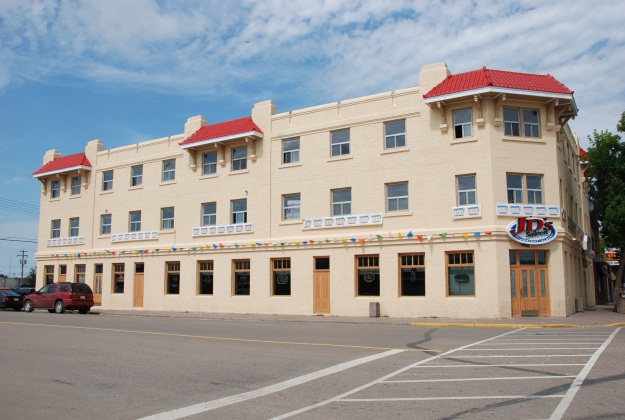
New Uses for Old Places is a RETROactive series in which we are looking at examples from around Alberta of historic sites that have found interesting new uses for spaces that were originally designed for other purposes. In this blog post we will be looking at a building that is part way through a three phase rehabilitation project, the Wainwright Hotel.
The Wainwright Hotel was constructed in 1929 as a three-story building utilizing poured-in-place concrete construction techniques. The hotel included nearly 60 rooms, a restaurant and a beer parlour. The development of the Hotel was influenced by its proximity to Buffalo National Park (closed in 1939) and the use of the Wainwright area as a filming location for a number of Hollywood westerns in the early 1920s. The Wainwright Hotel was designated as a Provincial Historic Resource in 2009. (For more information on the hotel’s past, check out this past post on RETROactive.)
Now owned by the Buffalo Park Foundation, the Wainwright Hotel is about to experience new life. The Foundation has been working closely with Heritage Conservation Adviser, Carlo Laforge to undertake work to establish as mixed-use facility that will contain the gallery, museum and archives of the Buffalo Park Centre as well as office and meeting space on the upper floors.
Preparatory work has been underway to renovate the building, with the removal of asbestos and the selective removal of materials to ready the building for Building Code improvements, including new electrical, mechanical, plumbing and sprinkler systems. The first phase will involve removing a 1960’s addition at the rear of the building and opening the main floor to accommodate the gallery and museum space. To date, the majority of the preparatory work has been undertaken by a team of dedicated community volunteers (with asbestos removal completed by a qualified contractor).
The second phase of the project will rehabilitate the second and third floors of the building to allow for office and meeting space. The upper corridors will be conserved and are a character-defining element of the building, whereas the rooms themselves will be modernized for functionality. The third phase will include a new addition on the ground floor, in the location of the previous addition, and will provide loading docks and archival storage.
Click on the following link to access a copy of a presentation on this project given by Gord Snyder of the Buffalo Park Foundation and Carlo LaForge, Heritage Conservation Adviser with the Historic Resources Management Branch at the 2013 Municipal Heritage Forum: Wainwright Hotel PowerPoint – 2013 Forum.
We look forward to seeing the results of this exciting project in years to come!
Written by: Rebecca Goodenough, Municipal Heritage Services Officer
New Uses for Old Places is a RETROactive series in which we are looking at examples from around Alberta of historic places that have found interesting new uses for spaces that were originally designed for other purposes. This week we will be looking at two examples of adaptive reuse projects that have involved the construction of additions to the historic fabric.
As previously discussed in this series, the Standards and Guidelines for the Conservation of Historic Places in Canada offer guidelines for rehabilitating and adaptively reusing historic places. The “S&Gs” include specific provisions for how decisions can be made that will allow for the modification of buildings over time. A tenant may require additional square footage to continue operations or to start a new business in a historic place. When these situations arise and building additions are required, the Standards & Guidelines provide guidance on how to proceed.
Standard
Conserve the heritage value and character-defining elements when creating any new additions to an historic place or any related new construction. Make the new work physically and visually compatible with, subordinate to and distinguishable from the historic place.
Standard
Create any new additions or related new construction so that the essential form and integrity of an historic place will not be impaired if the new work is removed in the future.
Guideline
Design an addition that is compatible in terms of materials and massing with the exterior form of the historic building and its setting.
Guideline
Design a new addition in a manner that draws a clear distinction between what is historic and what is new.
Guideline
Select the location for a new addition that ensures that the heritage value of the place is maintained.
Our first example, the Wetaskiwin Court House, was constructed as a three-storey, red brick building between 1907 and 1909 and served as a legal institution of regional importance for over 70 years. The court house was designated a Provincial Historic Resource in 1977 and the last court sitting was held in 1983.
A major rehabilitation project was undertaken in 2006 to convert the building to accommodate the offices and Council Chambers of the City of Wetaskiwin. As part of the rehabilitation, two new additions were added to either wing of the building. The project involved integration of older materials with new technologies, such as the tie in of the original cast iron radiators with the new geothermal heating and cooling system.
This slideshow requires JavaScript.
Our second example, the Strathcona Public Library in the Strathcona neighbourhood of Edmonton, is a two-storey brick structure that was constructed in 1913 and remains the oldest surviving public library in Edmonton. The Strathcona Public Library was designated a Municipal Historic Resource in 2004 and a Provincial Historic Resource in 2008.
Over the years the use had not changed but the needs of the institution grew and additional space and services became a requirement. A major rehabilitation project was undertaken to construct an addition at the rear of the building (the left portion as shown on the image to the right). The rehabilitated library was re-opened in 2007.
Click on the following link to access a copy of a presentation on this project given by Tom Ward, Manager of Heritage Conservation Advisory Services, at the 2013 Municipal Heritage Forum: Strathcona Library PowerPoint – 2013 Forum.
These projects exemplify that heritage need not be frozen in place. There are means by which to respect and care for the original fabric while allowing for the transformation of uses over time.
Written by: Rebecca Goodenough, Municipal Heritage Services Officer.
In this edition of New Uses for Old Places we are going to look at two Provincial Historic Resources on Calgary’s historic Stephen Avenue that are currently undergoing rehabilitation. The Bank of Nova Scotia and the Bank of Montreal Building are both slated to reopen with new uses this year.
In the early days of Alberta, banks were designed as statements of wealth, progress and confidence in a growing province. The buildings included lofty banker’s halls, adorned with fancy ornamentation — the ‘suits’ could look down on the tellers from the mezzanine above. The design was intended to impress investors and was conducive to the hushed conversation of financial matters.
But, what do you do with grand halls when the money managers move to a modern building? Historic banks can be difficult spaces to re-purpose due to challenges with acoustics, heating and the unconventional layout of the main floor. Nevertheless, for two former banks on Calgary’s Stephen Avenue, the commitment of the property owners and the selection of suitable tenants has resulted in the revitalisation of two very significant buildings on one of Calgary’s most active streets.
The Bank of Montreal building was constructed on Stephen Avenue in 1930-32 as a three-storey, steel-frame building clad in Tyndall limestone. The building replaced an earlier (1889) version of the building in an effort to modernize its image. The bank operated in this location until 1988. The most recent tenant, A&B Sound, left the building over a decade ago and it has since sat empty. Renovations are now under way to re-purpose the building to accommodate a restaurant/pub on the main floor, with 25,000 square feet of office space on the upper floors. The building was designated a Provincial Historic Resource in 2003.
This slideshow requires JavaScript.
Just across the street sits, the Bank of Nova Scotia. It was constructed in 1930 as a one-storey steel frame, brick and sandstone structure and operated as a bank until 1976. Since that time the building has been home to a range of restaurants and clubs and is now being renovated to contain a public house. The renovation will involve re-plastering of the walls and restoration of the marble flooring in the entranceway. The building was designated a Provincial Historic Resource in 1981.
This is the first installment of a new series of blog posts on RETROactive entitledNew Uses for Old Places. We will be highlighting examples from around Alberta of historic resources that have found interesting, new uses for spaces that were originally designed for different purposes. To start us off we are going to talk about the ubiquitous warehouse conversion.
This slideshow requires JavaScript.
One of the best ways to ensure a long and prosperous future for a historic place is to make sure that it is in use. Making certain that people are frequenting a site ensures that a historic resource stays relevant and in the forefront of public consciousness. This can be a challenge given that the purposes for which many of our historic places were originally designed for are now defunct. The conversion of a building to allow for a new use is known as adaptive reuse and it is a process that can require some creative thinking.
The values-based approach to heritage conservation recognizes the importance of activating our historic places and recognizes that alterations may be required to ensure the long-term sustainability of a site. The Standards and Guidelines for the Conservation of Historic Places in Canadaconsideradaptive reuse to be a rehabilitation conservation treatment. Rehabilitation is understood to be “the sensitive adaptation of an historic place or individual component for a continuing or compatible contemporary use, while protecting its heritage value” (Standards & Guidelines, page 16).
A popular form of adaptive reuse/rehabilitation is that of the warehouse conversion. More common in larger cities that once were home to warehousing and manufacturing sectors, warehouse districts are now often surrounded by non-industrial, higher density development and attract investors who see the potential in the character that the former industrial spaces have to offer. Warehouses make good candidates for adaptive reuse because they have large, relatively open floor plates, generous ceiling heights and numerous large windows. These features allow for the flexibility to subdivide the interior space for a variety of purposes without compromising the unique elements that make warehouses so charming (think freight elevators, bank vaults, exposed beams, etc.).
Edmonton and Calgary were home to the majority of manufacturing and shipping in Alberta. As such the majority of extant warehouse structures are located in these two cities, though there are others scattered in other communities across the province. A number of these structures have received historical designation at the municipal and/or provincial level and have been rehabilitated to accommodate a variety of new uses.
Written by: Rebecca Goodenough, Municipal Heritage Services Officer.
Click on the following links to find the listing on the Alberta Register of Historic Places for warehouse buildings featured in the slideshow:
We recently asked for your feedback regarding a possible joint conference with Heritage Canada The National Trust in 2015 and received over 100 responses. Here are the results (click on the image to enlarge).
How are you involved with heritage in your community?
Have you previously attended the Municipal Heritage Forum?
For those that attended, how were your travel costs covered?
Would you be interested in attending a joint conference?
For those not interested in attending, reasons for not wanting to attend included:
The content would be too extensive and/or not applicable to local needs
Unsure of the theme of the conference and if the content would be desirable
The expense of getting there
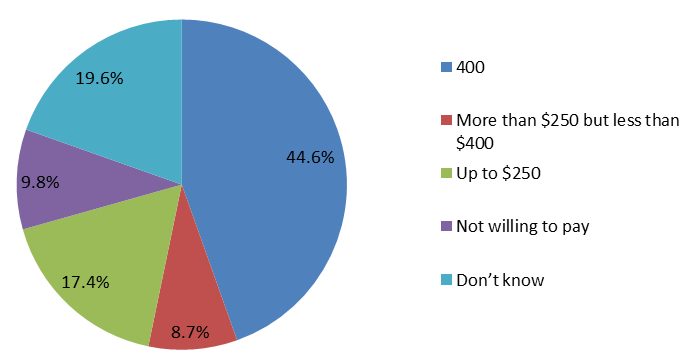
What would you/your employer/your organization be willing to pay to attend a joint conference?
Of those willing to pay $400, the majority of respondents work for municipalities (66%).
Of those willing to pay up to $400, the majority of respondents work for municipalities or are volunteers (38% each).
Of those not willing or able to pay, the majority of respondents are volunteers (63%)
Of those who don’t know what they could pay, the majority of respondents are volunteers (41%) followed closely by employees for private sector companies (35%)
When asked for additional feedback, respondents indicated that the joint conference would provide opportunities for networking and would widen the scope of knowledge in Alberta communities. There were some concerns about the content not being as applicable to Albertans and that the cost would be challenging to cover. Questions were asked about different types of rates (group rate, volunteer rate, student rate, conference grants) and whether there would be opportunities for Albertans to submit conference proposals.
Based on the feedback received we now know that there is a great deal of support and interest for a joint conference with Heritage Canada in 2015. We also have helpful information as to what different groups are willing and able to pay. We will use this information, as well as some of the suggestions brought forward, to proceed with our planning for the event.
Thanks once again for your contributions!
And last but not least, the winner of our draw for a 2014 Family Annual Pass to visit Alberta’s Provincial Historic Sites, interpretive centres and museums is Brian Vivian with Lifeways of Canada Ltd. Congratulations, Brian!
Written by: Rebecca Goodenough, Municipal Heritage Services Officer.





 RETROactive