Reader Rock Garden, Calgary

One advantage the major cities of the Canadian prairies had over their eastern counterparts was that, when they entered periods of frantic development in the early 20th century, they could see what pitfalls in urban planning the earlier established eastern cities had already encountered.  Urban design was, therefore, probably undertaken with a greater sensitivity towards landscaping and park space than would otherwise have been the case.  Though commonly regarded as unsophisticated towns of the wild west, both Edmonton and Calgary made sure they had ample space set aside for parks and gardens, in both their suburbs and their downtown cores, and planted trees along many of their streets, and, in many cases, provided extra spaces for flowers and lawns.  The two cities were thus able to avoid the image of an urban jungle which had initially prevailed in many industrial cities of the East.
In Calgary, the City created the position of Superintendent of Parks and Cemeteries in 1913.  For the position, it hired a horticulturalist from England, William Reader, who had recently been the gardener for Pat Burns and his commercial empire.  Reader had actually been trained as a school teacher, but he developed a personal interest in gardening, and designed the gardens of several large estates in England before migrating to western Canada in 1908.  Upon his appointment in Calgary, he embarked on a vast planting project, lining many of the streets with trees and expanding the park space from 520 to over 1,300 acres.  Over the next 29 years, he would create several public parks, such as Central Park, Tuxedo Park and Victoria Park.  He would also create a number of children’s playgrounds, golf courses, tennis courts and outdoor skating rinks.  His work occasionally took him out of Calgary as well, for example, his landscaping of the EP Ranch for the Prince of Wales.

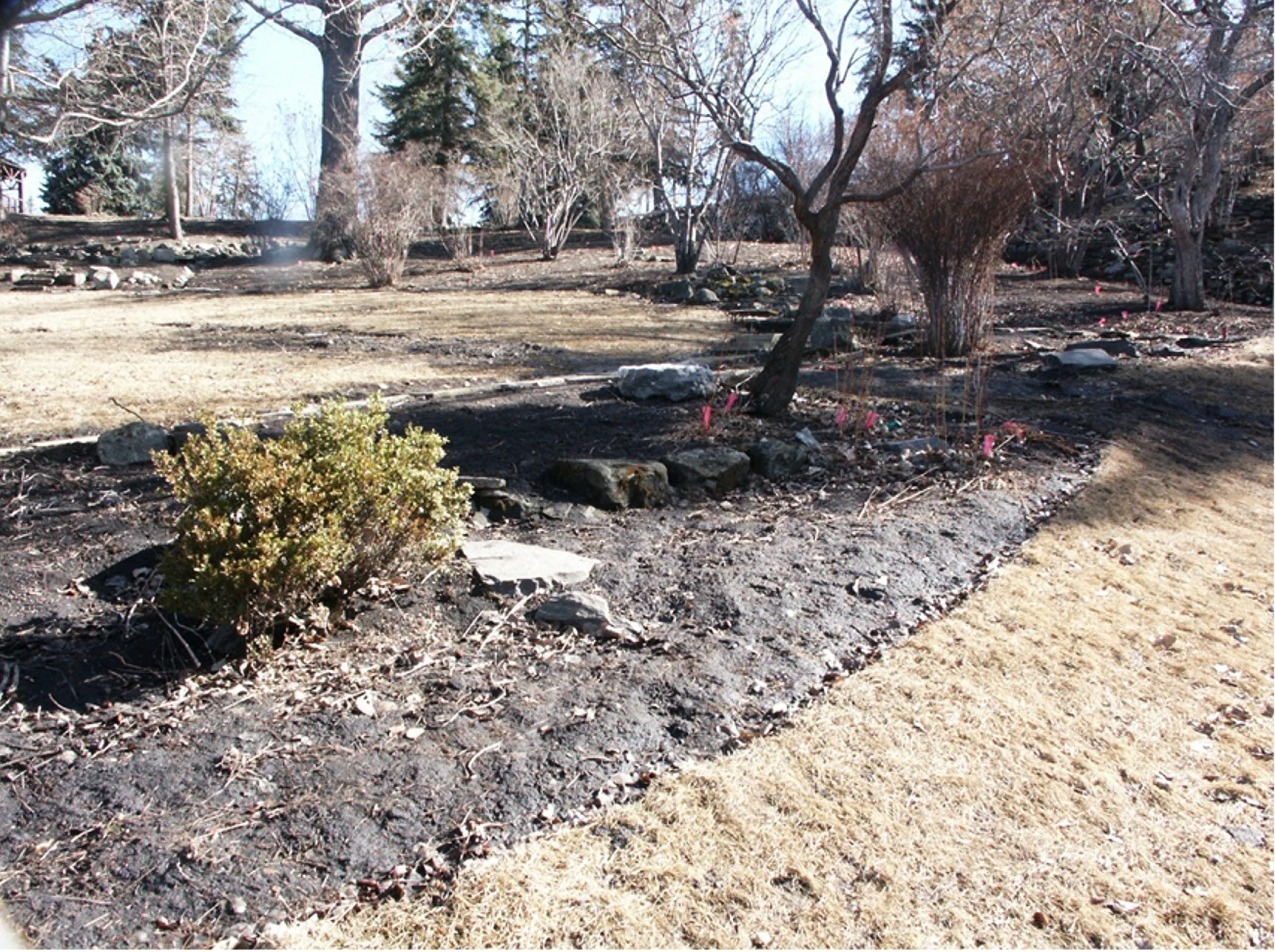
The project to which Reader is most closely associated, however, is called the Reader Rock Garden, which was built in his own back yard, which was City owned space at Macleod Trail and 25th Avenue SE.  The space included an area for the residence of the Superintendent of Parks & Cemeteries.  Reader was inspired by the City Beautiful movement which had taken hold in Europe and North America towards the end of the 19th century.  Envisioning Calgary as a “showplace city” he embarked on a plan to make the space next to his residence into a model garden, featuring a wide range of flowers, trees and other plant species.  Areas were spaced off with rock fences, with other colourful rocks also interspersed among the plants and trees.  Reader also experimented with plant and flower varieties, with his garden becoming part of the system of Dominion agricultural research stations.  As a result, his reputation grew with time, as seeds from his garden were used by a number of prestigious gardens in England and North America.

Most of Reader’s creative work was done during the 1920s.  The Depression did much to curtail park expansion and the landscaping of boulevards.  Reader himself was forced to retire in 1942 at age 67, and, the following year, he passed away.  In 1944, his garden was named in his honour, but its upkeep in the years that followed did not live up to his reputation.  His cottage was removed in 1944, and, in later years, furnishings and other buildings were removed.  Foreign and unsympathetic plants were allowed to invade the garden.  Recently, however, efforts were made to transform the site back to its original condition of horticultural excellence.  In 2006, the Reader Rock Garden was designated a Provincial Historic Resource.  Its historical significance lies in its representation of the efforts of its developer, William Reader, to transform the bustling City of Calgary from a sprawling western metropolis of office blocks and redundant suburbs into a showplace city filled with parks, landscaped boulevards and recreational facilities.

Written by: David Leonard, Historian

Visit the Alberta Register of Historic Places to learn more about the heritage value of the Reader Rock Garden in Calgary. In order for a site to be designated a Provincial Historic Resource, it must possess province-wide significance. To properly assess the historic importance of a resource, a historian crafts a context document that situates a resource within its time and place and compares it to similar resources in other parts of the province. This allows staff to determine the importance of a resource to a particular theme, time, and place. Above, is some of the historical information used in the evaluation of the Reader Rock Garden.
Insurance and Historic Places

“I’d like to see my house designated as a Municipal Historic Resource, but would that not make insuring it really expensive?” This is a common concern. Many believe that once a place is designated as a Municipal Historic Resources (or a Provincial Historic Resource) insurance premiums go up, but this is uncommon. If you are a homeowner with replacement-cost insurance, your current policy should cover the conservation work needed if something should happen.

Homeowners normally insure their property for its replacement cost. This means that your insurer is responsible to pay for repairing, or if necessary replacing, your home if it is damaged or destroyed in a way covered by the policy. Most home insurance policies cover replacement cost, making the insurance company responsible for repairing (or if necessary replacing) the insured property in “like kind and quality”.

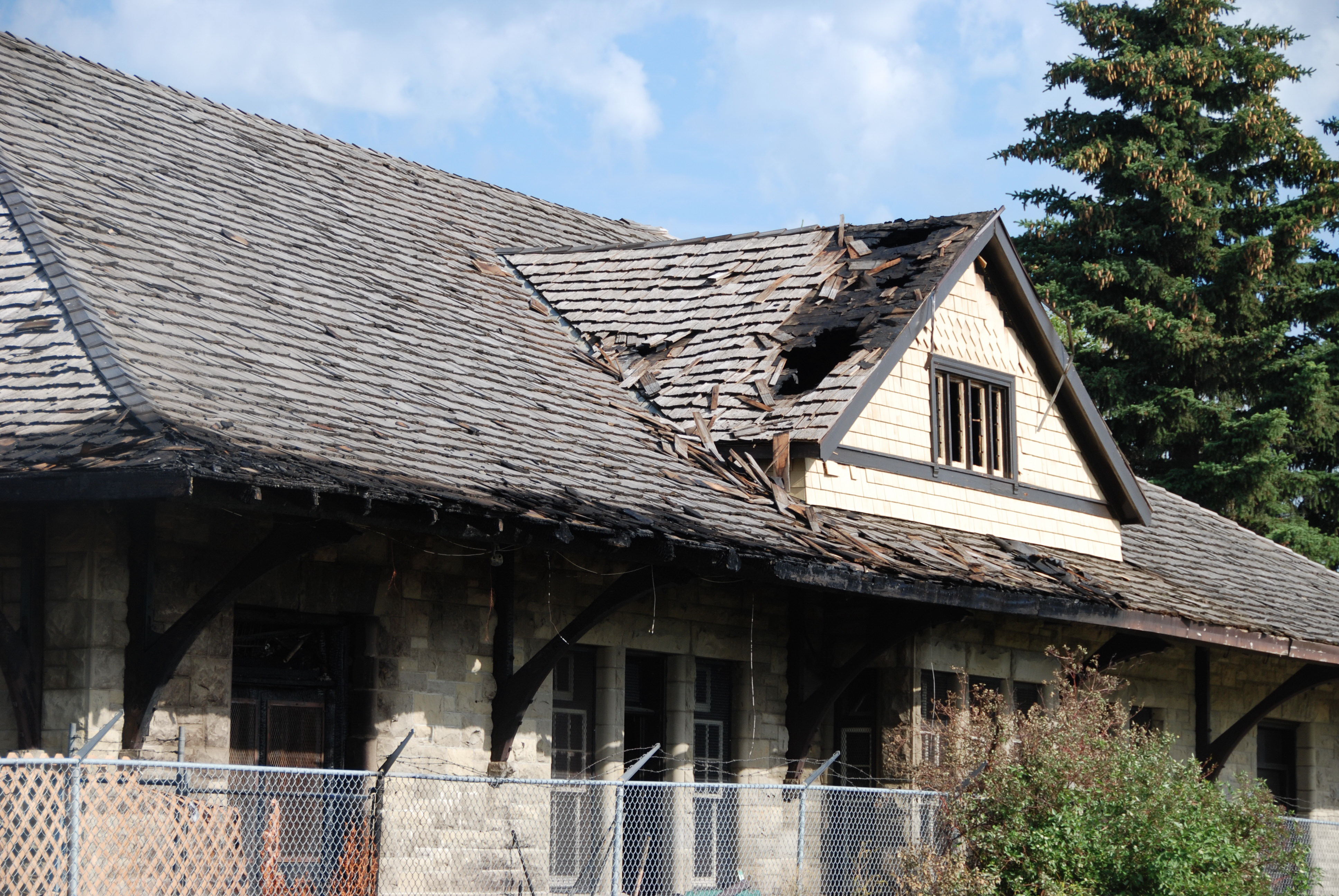
Designated as a Provincial Historic Resource, the Museum of the Highwood in High River was damaged by a fire in July 2010.

Insuring a historic place for its replacement value is important. Features that were once common can now be difficult and expensive to re-produce. Some once-common skills (like working with plaster) are now rare; many once ordinary and inexpensive materials (like hardwood) are now uncommon or expensive. Repairs to character-defining elements should match materials and design details. If you carry insurance that covers replacement in “like kind and quality” you likely have all the coverage needed. If a home is only partially destroyed, then ideally as much historic material as possible should be saved; unsalvageable elements should be reinstated as much as possible.

Your insurance premiums should not increase simply because your home is designated a Provincial or Municipal Historic Resource. Remember, when you originally purchased your policy and your insurance provider asked questions about the age of the home and the quality of the workmanship? The company was gathering information to assess what exactly they might have to repair or replace should a disaster occur. In fact, some companies now make visits to your home to note its features so there are no discrepancies at the time of a claim.

As always, reviewing the Statement of Significance for a designated site will help you understand why it is valued and what about it must be conserved. If you have specific questions, you can discuss the matter of insurance coverage with a Heritage Conservation Adviser.

Written by: Michael Thome, Municipal Heritage Services Officer

Wainwright Hotel

When the Grand Trunk Pacific Railway completed its line between Saskatoon and Edmonton in 1908, vast tracts of land in east central Alberta south of the Canadian Northern line were opened up for homesteading.  At key points along the line, the GTP erected stations and subdivided townsites.  One of these was near a small community called Denwood, where a post office and store had been opened in 1907.  The new townsite, to where Denwood residents and businesses now moved, was called Wainwright after the second vice-president of the GTP.  One of the structures moved from Denwood to Wainwright was the Denwood Hotel, which soon became the Wainwright Hotel.  It was owned by M.L. Forster, a strong community minded individual who served on the first village council and was mayor of Town of Wainwright from 1927 to 1935.

With rapid early growth, Wainwright became a village in July 1908, and a town with over 400 people in July, 1910.  The Wainwright Hotel was joined by another hotel, the Park, in about 1912, but the Wainwright remained the main hotel in town, with room created for a tavern.  Although business declined between 1917 and 1924, due to prohibition, the remodeled tavern did a lively business in the late 1920s under the management of a Mr. H.C. Link.

In 1929, the Wainwright Hotel was destroyed by fire, along with much of the business district.  Because of the relative prosperity of the late 1920s, most commercial structures in Wainwright were rebuilt, including the Wainwright Hotel, which was larger and built of poured concrete, no doubt to prevent another fire.  Most other commercial and public buildings were now built of brick.

Prosperity did not last, as the Great Depression of the 1930s saw grain prices tumble to such a degree that many district farmers did not bother to ship their grain to the Lakehead because they would loose money doing so.  Business in the tavern probably suffered also.  Not that people stopped going there, but, with the price of beer 10¢ a glass, people in rural Alberta were consuming less of the beverage.  Illegal stills, a holdover from prohibition, were noted to be reappearing in isolated spots.

Wartime restrictions on alcohol consumption also hindered rural hotels, but, with war’s end, hotels like the Wainwright began to recover.  With the advent of Ladies & Escorts sections in 1953, business probably improved.  In the late 1960s, mixed drinking was allowed, and, in 1971, the age for public drinking was lowered from 21 years to 18.  Many taverns could now entertain their customers with small local bands.

The Wainwright Hotel probably did a lively business during these years, and has remained standing since, serving the community and district as the main hotel for most of the 20th century.  Its tavern, its chief source of revenue, was also no doubt the favourite watering hole for local and district residents for much of this time.  In 2009, it was designated a Provincial Historic Resource.

Written by: David Leonard, Historian

Visit the Alberta Register of Historic Places to learn more about the heritage value of the Wainwright Hotel. In order for a site to be designated a Provincial Historic Resource, it must possess province-wide significance. To properly assess the historic importance of a resource, a historian crafts a context document that situates a resource within its time and place and compares it to similar resources in other parts of the province. This allows staff to determine the importance of a resource to a particular theme, time, and place. Above, is some of the historical information used in the evaluation of the Wainwright Hotel.

Doukhobor Prayer Home, Lundbreck

Among the fundamentalist groups from eastern Europe to seek a haven in western Canada in the early 20th century were the Doukhobors.  Unlike most others, such as Mennonites and Hutterites, the Doukhobors were culturally Russian and dissenters from the Orthodox faith.  Feeling persecuted under the regime of Tsar Nicholas II, about 7,400 of them sailed to Canada in the spring of 1898-99.  Most moved on to Saskatchewan, where they were joined by their spiritual leader, Peter Verigin in 1902.  Here, they were granted exemption from military service and allowed to educate their children in their own schools.  They sought to obtain homesteads near Yorkton, but, since gaining title to homestead land meant signing an oath of loyalty to the British (and Canadian) Crown, many abandoned their incipient farms and moved on to the southern interior of British Columbia, where, in 1908, Verigin was able to purchase, on their behalf, sizeable tracts of land at Brilliant (near Castlegar) and near Grand Forks in the Kootnay district, just north of the Washington State border.  The colonies eventually included about 6,000 members.  They called themselves the Christian Community of the Universal Brotherhood.

Because the colonies became so heavily populated, Verigin undertook to found other smaller colonies.  One of these was begun in 1915 in the Cowley-Lundbreck district of southern Alberta, and initially included about 50 people.  It was headed by Semeon Ivanovitch Verigin.  Here, individual quarter-sections were purchased in relative proximity to each other.  The spread-out colony was called “Bogatoi Rodnik,” or “Rich Spring,” and eventually totaled 13,500 acres with around 300 people.  It became divided into 13 units, which featured grain elevators, flour mills, blacksmith shops and other buildings, including prayer homes.  As a fundamentalist group, these people eschewed formalized churches.  There was one dwelling at Cowley reserved for Peter “The Lordly” Verigin, for, although usually absent, he remained the spiritual and administrative leader of the colony, with each small commune within the colony electing its own local leader.

One of the purposes of this colony was to supply flour and other grain products to the BC colonies which had become too heavily populated within their geographic parameters to sustain themselves agriculturally, with much of the hilly land there given over to ranching, fruit growing and lumbering.  Besides, being vegetarians, the Doukhobors required more than the normal amount of non-meat produce.  As the Cowley-Lundbreck Colony was located on the southern branch of the CPR, it was easier, and cheaper, to ship produce from there to Brilliant and Grand Forks than from the larger prairie colony of Verigin near Yorkton, Saskatchewan.  In return for the produce, fruit and lumber were sent from the BC colonies to Bogatoi Rodnik.

In 1924, Peter the Lordly Verigin was assassinated by a time-bomb which exploded in a train near Grande Forks, killing nine other passengers as well.  His son, Peter Petrovitch Verigin, who was living in Russia, was sent for to assume the position of leader.  However, another charismatic figure in Brilliant, Anastasia Holoboff, known as Anastasia Lords, a “close companion of the late leader,” let it be known that she had been specially tutored by Peter the Lordly to be his successor.  A rift then formed within the community.  Most Doukhobors, including those around Cowley and Lundreck, accepted Peter Petrovitch, but, in 1926, a group under Anastasia broke away and formed a new colony in the district of Shouldice, Alberta.

Due to financial straits and the loss of young people to mainstream society, the colony around Lundbreck continued to decline in the 1930s and 1940s.  Those who stayed began to work as private farmers.  In 1953, they erected a central prayer home which remains standing as a symbol of the Doukhobor faith as it persisted in southern Alberta during the mid and latter 20th century.  In March 2010, the Hall was designated a Provincial Historic Resource.

Written by: David Leonard, Historian

Visit the Alberta Register of Historic Places to learn more about the heritage value of the Doukhobor Prayer Home in Lundbreck. In order for a site to be designated a Provincial Historic Resource, it must possess province-wide significance. To properly assess the historic importance of a resource, a historian crafts a context document that situates a resource within its time and place and compares it to similar resources in other parts of the province. This allows staff to determine the importance of a resource to a particular theme, time, and place. Above, is some of the historical information used in the evaluation of the Doukhobor Prayer Home.

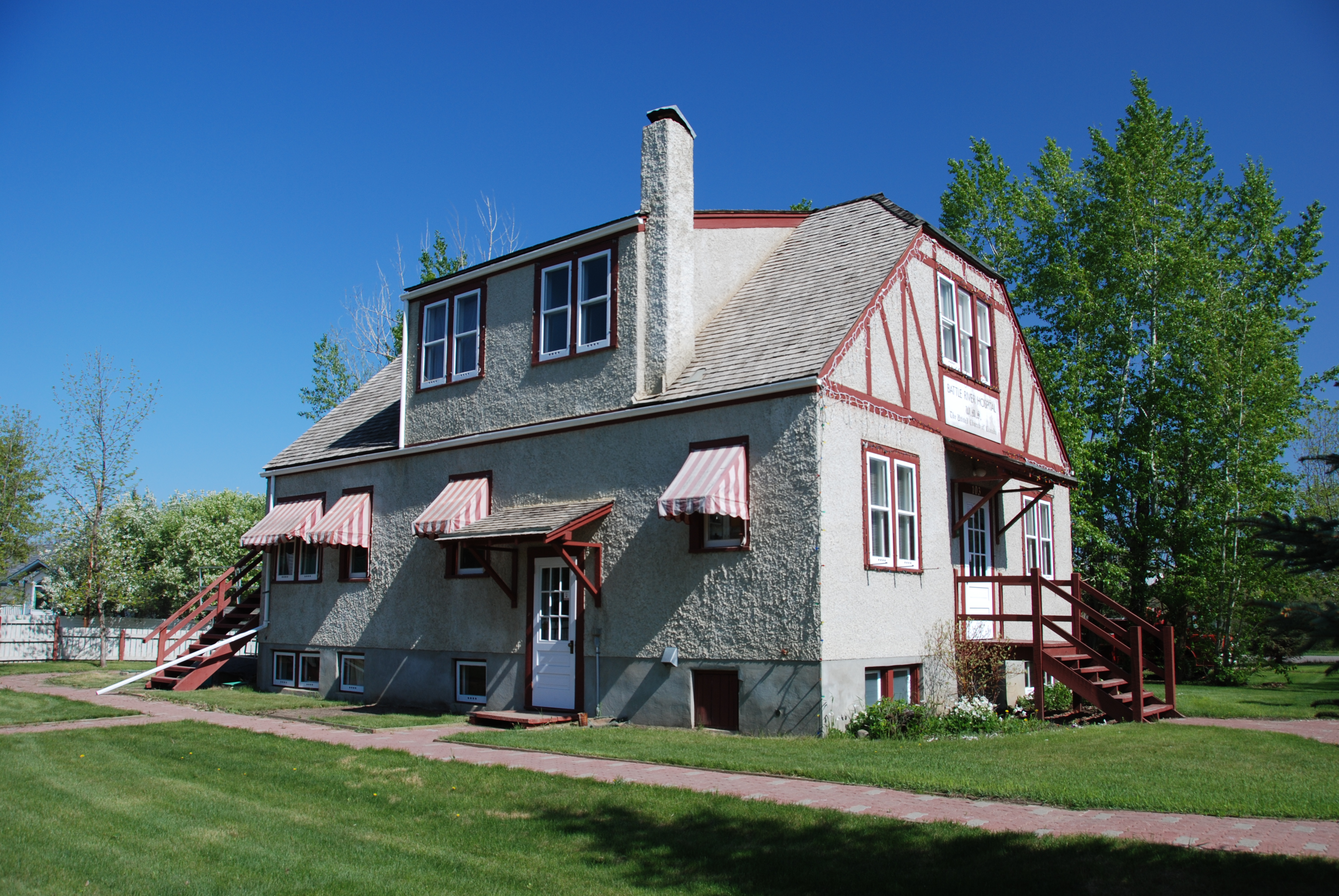
Battle River Hospital, Manning

In 1918, the Dominion government set up a Soldiers Settlement Board in order to secure employment for some of the vast number of soldiers expected to enter the workforce following their service in World War I.  Through the Board, many veterans were encouraged to settle on the Battle River Prairie, about 75km north of Peace River.  By 1921, the district had an estimated population of 500, while a tiny community called Battle River Prairie emerged off the Notikewin (formerly Battle) River.  In 1924, the store and post office was re-named Notikewin and moved to the site of present day Notikewin, some 8km to the north.

For supplies, most of the first settlers on the Prairie used the facilities at Peace River.  Commercial transportation on the River was common, while winter roads were opened for horse-drawn sleighs.  One major concern, however, was medical.  By the Public Health Nurses Act of 1919, visits were made by registered nurses with mobile clinics, but these could not accommodate emergency situations.  Throughout the 1920s, therefore, a demand began to grow for a regular physician to be assigned to some point on the Prairie.

In 1928, the provincial government decided to sponsor a permanent nurse for the district, with Mary Little moving to Notikewin.  In 1929, she was replaced by Dr. Mary Percy who was recruited from England.  In 1931, Mary Percy married Frank Jackson and moved to Keg River.  Several other nurses then followed until 1936, when Dr. Arthur Doidge became the first resident physician for the area.

The early 1930s had seen a continuing influx of settlers to the Prairie, many coming from the drought areas of southeastern Alberta.  As a result, there was growing pressure for a hospital.  Much of this came from the Women’s Missionary Society of the United Church of Canada, which began to collect promissory funds for a hospital in the area.  The government agreed to contribute the same amount as the WMS and appoint a physician if the WMS would build the hospital.  With support coming throughout the Prairie, sufficient funds were finally in place by the spring of 1936 to begin work on a facility large enough to serve the entire Prairie.

The site chosen for the hospital was on the bank of the Notikewin River, on the road midway between North Star and Notikewin.  The land was donated by John Robertson.  Work began that summer, with most of the labour and building supplies volunteered.  The Chair of the Building Committee was H.A. Inglis, while construction of the balloon frame structure was supervised by W.D.C. Buchanan.   Work continued throughout the winter, when possible, and into the following spring and summer.  Finally, on 4 September 1937, the new eight bed Battle River Hospital was officially opened.  It was an all inclusive facility, with space for an operating room, a waiting room, and a kitchen.  Electricity was provided by an external Delco gas engine.  The second floor was largely given over to living quarters for the three nurses, while Dr. Doidge lived in a separate cabin. Read more

Planes, Trains and Automobiles?

RETROactive is all about Alberta’s historic places. But what is a historic place: is it a home, a commercial building, a church or a baseball diamond? Could planes, trains or automobiles be historic places? The Standards and Guidelines for the Conservation of Historic Places in Canada defines a historic place as, “a structure, building, group of buildings, district, landscape, archaeological site or other place in Canada that has been formally recognized for its heritage value.” Does this mean any place in Alberta could be a historic place?

Not quite. For a place to be listed on the Alberta Register of Historic Places something must be  designated as a Provincial Historic Resource or a Municipal Historic Resource and  must meet one of the following significance criteria:

  • Theme / Activity / Cultural Practice / Event – a place directly associated with a theme, activity, cultural practice or event that has made a significant contribution to the broad pattern of provincial or municipal history.
  • Institution / Person – a place directly associated with a significant institution or with the life of a significant person in the province’s or municipality’s past.
  • Design / Style / Construction – a place displaying distinctive characteristics of a type, style, period or method of construction, or representing the work of a master, or expressing high artistic values.
  • Information Potential – a place yielding, or likely to yield, information important to a municipality’s or the province’s history, prehistory or natural history.
  • Landmark / Symbolic Value – a place particularly prominent or conspicuous, and that has acquired special visual, sentimental or symbolic value that transcends its function. A landmark contributes to the distinctive character of the province or municipality.

Note: The Historical Resources Act limits Municipal Historic Resource designation to real property. This means that while the province can designate a plane, train or an automobile, municipalities may only designate land and “immovables” (meaning buildings and other things permanently affixed to land). For additional information please see: Evaluating Historic Places and Designating Municipal Historic Resources.

So do historic places in Alberta include planes, trains and automobiles? I have searched the Alberta Register of Historic Places and this is what I have uncovered:

Planes: Hangar #14, Edmonton Municipal Airport

Hangar #14 is significant, “as a rare surviving Canadian example of hangar design from the World War Two period and as a symbol of Canada’s wartime experience.” It is also significant, “for its association with Wilfred R. May, one of Edmonton’s most significant aviation figures and the 418 City of Edmonton Squadron.” Hangar #14 is designated as both a Municipal Historic Resource and a Provincial Historic Resource.

Trains: Canadian National Railways Steam Locomotive 6060

The 6060 Locomotive (pictured above) is significant, “as an excellent representation of a late-era steam locomotive.” The engine currently services the Alberta Prairie Railway Excursions line, which runs between Stettler and Big Valley. It is designated as a Provincial Historic Resource.

Automobiles:  

Do you have any suggestions? Approximately 700 historic places are listed on the Alberta Register of Historic Places. Search the register to discover one that is associated with automobiles. Let us know what you find by submitting a comment at the bottom of this post.

Written by: Brenda Manweiler, Municipal Heritage Services Officer

The Leavings at Willow Creek (Oxley Ranch Site)

When the Montana cattle industry began to thrive in the aftermath of the American civil war, and the extension of railways to the western states, many cattle barons began to extend their activity north of the 49th Parallel.  Sensitive to the encroachment of American influence in western Canada, the Dominion government took several measures to ensure the “Canadianization” of this region.  A Department of the Interior was formed to oversee developments on the central prairies, a North-west Mounted Police force was formed to establish law and order, and a Dominion Lands Act was passed to see to the orderly disposition of Crown lands to British subjects, or those who would agree to become British subjects.  Plans were also put in place to extend a transcontinental railway through the region.

Another measure taken by the government to ensure the loyalty of the region to Canada was to encourage a ranching industry in the western foothills, with capital to be provided by eastern Canadian and British entrepreneurs.  For such Canadian or British cattle companies, vast tracts of land would be set aside as grazing leases.  By the early 1880’s, much of the southern foothills of what was to become Alberta was therefore given over to a few major cattle companies, including the Cochrane, Winder, Walrond, Northwest, Quorn, Stewart and Stinson Ranches.  Their success depended to a great extent on the arrival of the CPR, which reached the site of Fort Calgary in 1883.

Another major ranching operation was founded in 1882 by Alexander Staveley Hill, a Conservative Member of the British House of Commons, backed by Lord Lathan.  This was the Oxley Ranch, which came to base its operation on two vast tracts in the districts of present day Champion and Staveley, north of Fort Macleod.  This ranch flourished throughout most of the 1880’s and 1890’s, and, during much of this time, its success appears to have been due to the efficient management of John Roderick Craig.  An added benefit was the extension of the Calgary & Edmonton Railway from Calgary to Fort Macleod in 1892, which eliminated the necessity of making long cattle drives to Calgary.

By the end of the decade however, changes were in the air.  In order to provide a greater population base in western Canada, the new Liberal government of Sir Wilfrid Laurier began to curtail the predominance of many of the large ranches by not renewing the grazing leases on much of the range land.  The idea was to encourage smaller independent farms and ranches, which would specialize in mixed farming.  During the early 20th century, many of the large ranches went out of business, while others saw their scope of operation severely curtailed, including the Oxley Ranch.

During its heyday, the western portion of the Oxley Ranch had based its operation from headquarters on NE14 TP13 R28 W4.  On this site today there is a log house which was, no doubt, part of the Oxley Ranch operation at some point, and possibly the home of its manager, John Craig.  It is located next to a trail that extended from Fort Macleod to Calgary, but which went out of use after the C & E Railway to the east saw the center of activity also shift, when railway communities like Claresholm and Staveley emerged.  Near the house is a wood frame barn on a large concrete foundation built into a hillside which could also have been part of the Oxley Ranch.  The buildings are also spoken of as having been part of a North-west Mounted Police detachment, which existed in the district in the late 1880’s, but was moved to Claresholm shortly after the railway came through.

The Oxley Ranch buildings provide structural evidence of one of the biggest ranching operations in the southern Alberta foothills, prior to 1900.  They tell of both social and commercial activities of the ranch, and of the southern Alberta cattle industry in general during this time.   The buildings are also important in being close to the original cattle trail between Fort Macleod and Calgary, which was the major thoroughfare between these two centers prior to the coming of the railway in 1892.  In November 2006, they were designated a Provincial Historic Resource.

Written by: David Leonard, Historian

Visit the Alberta Register of Historic Places to learn more about the heritage value of the Leavings at Willow Creek (Oxley Ranch), near Claresholm. In order for a site to be designated a Provincial Historic Resource, it must possess province-wide significance. To properly assess the historic importance of a resource, a historian crafts a context document that situates a resource within its time and place and compares it to similar resources in other parts of the province. This allows staff to determine the importance of a resource to a particular theme, time, and place. Above, is some of the historical information used in the evaluation of the Leavings at Willow Creek.

Alberta’s Historic Places in the Space Age

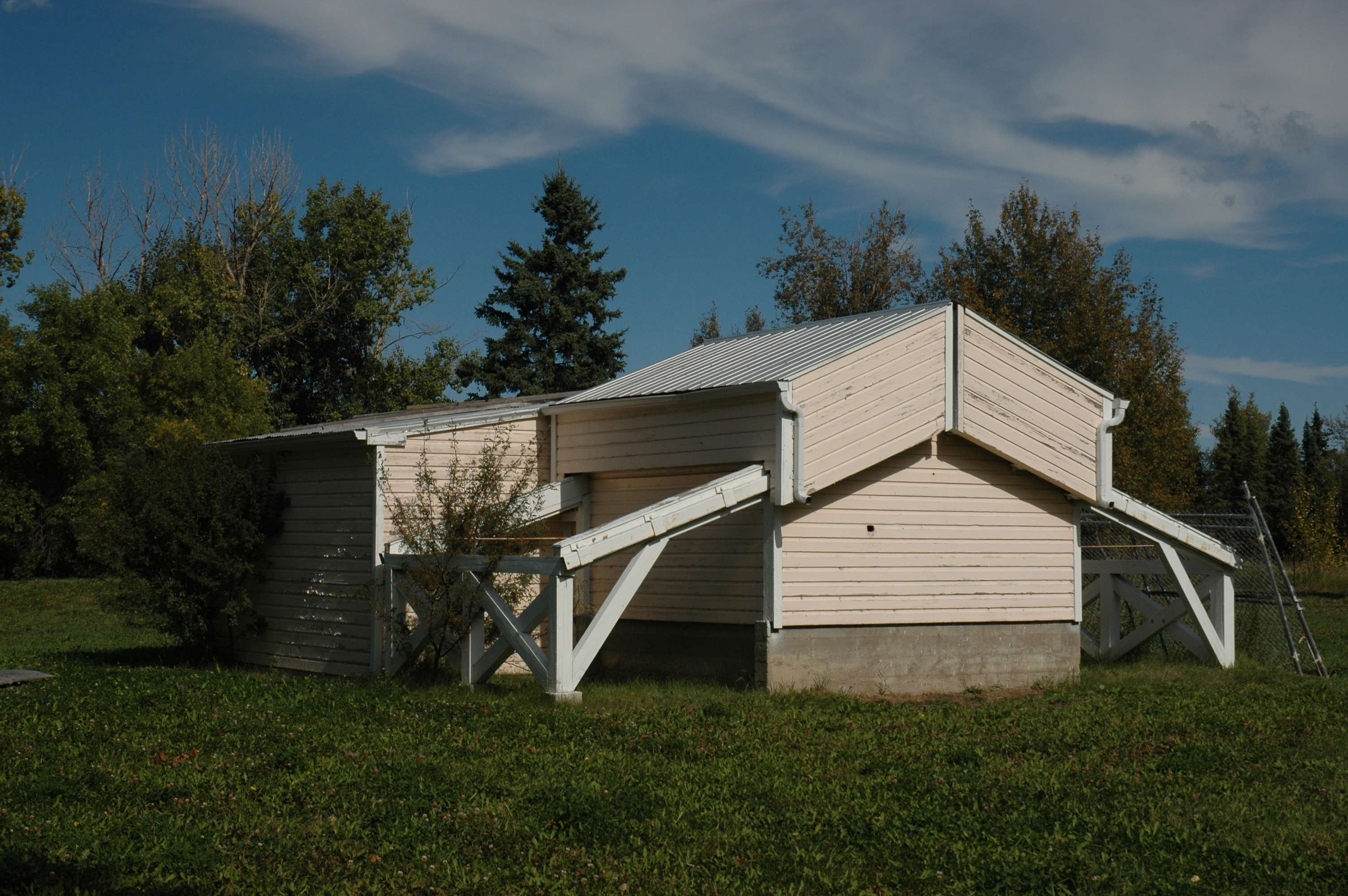
While it may not look like much from this 2006 photo, Alberta’s Newbrook Observatory played a key role in the “space race” of the twentieth century.

The field station’s listing on the Alberta Register of Historic Places recounts how on “October 4, 1957, the Union of Soviet Socialist Republics (U.S.S.R.) astounded the world by announcing the successful launch of Sputnik I, the first artificial satellite to be sent into space. Less than a week later, Art Griffen, resident scientist at the Newbrook Observatory, took the first North American photograph of Sputnik, confirming the Russians’ claim. The news of the launch sent shockwaves around the world.”

The Newbrook Observatory was designated in 1995 as a Provincial Historic Resource.

Written by: Matthew Francis, Manager of Municipal Heritage Services

Canadian Northern Railway Station, Fort Saskatchwan

When the Canadian Pacific Railway was planning for its continental line to the pacific coast during the 1870s, a favoured route saw the track proceeding northwest from Brandon, Manitoba through the Yellowhead Pass, crossing the North Saskatchewan River near the small Northwest Mounted Police community of Fort Saskatchewan.  In the end, the CPR chose the Kicking Horse Pass, and the line was extended past Fort Calgary in 1883.  Eight years later, a subsidiary of the CPR, the Calgary & Edmonton Railway, brought rail service directly to South Edmonton, and Edmonton soon emerged as a district metropolis.

In 1904, Edmonton became a city, and the following year it was named the capital of Alberta.  As this was taking place, the city was making preparations for the arrival of the Canadian Northern Railway, which would give it a direct rail connection with eastern Canada.

Somewhat ironically, the route chosen for the Canadian Northern was roughly that selected for the CPR in 1877, except that, after passing by Fort Saskatchewan, it was made to swing southwest to include Edmonton. Fort Saskatchewan thus received a railway as early as the fall of 1905.

Canadian Northern Railway Station Provincial Historic Resource

In anticipation of the arrival of the railway, Fort Saskatchewan began to grow rapidly.  In July 1904, it became a town with over 500 people.  It was, therefore, appropriate that the Canadian Northern construct a station befitting the largest community on its line between Edmonton and North Battleford.  While rail construction proceeded, work WAS begun on a wood frame station according to a newly devised 100-19 plan, which called for a long, vertical building, with an upper floor to accommodate the station agents and their families.  It was located just west of the town center and was completed in October, 1905.  In its immediate vicinity, a large water tower and a Brackman-Kerr elevator were erected at the same time.

Being in the center of a rich farming district, Fort Saskatchewan continued to grow after the arrival of the CNoR.  The railway bridge across the North Saskatchewan also served as a traffic bridge, giving the town direct automobile access to Edmonton some 20km away.  Several other elevators soon dotted the skyline near the station, and a stockyard was located nearby. Read more

Need help understanding your historic place? Develop a SoS

Many municipalities are busily writing Statements of Significance (SoS) for their historic places. Listing Municipal Historic Resources and Provincial Historic Resources on the Alberta Register of Historic Places requires a SoS, but that’s hardly the best reason to write one. Statements of Significance are not online plaques, histories or even calls for help.

A properly written SoS explains why we value a particular historic place, linking these values to physical, character-defining elements that manifest those values. If you would like to see an example of a SoS just look at the entry for any Municipal Historic Resource or Provincial Historic Resource listed on the Alberta Register of Historic Places, such as the SoS for the D.U. Ranchlands Cabin.

A Statement of Significance explains where a historic place is located (a quarter section in the M.D. of Pincher Creek), what you will find at the site (a one-room log cabin) and the reasons why the community feels the place is significant. A SoS does not describe a place’s history (such as who built it), it explains why the community values the place (as an example of an early 1900 homesteader’s cabin). A SoS relates these values to physical elements that must be conserved (wood log construction). Removing these character-defining elements would undermine the place’s significance; without these elements, the site would no longer be a historic place.

Without understanding historic places–why each is valued and how each exhibits its values–nobody can objectively determine how proposed alterations will affect a historic place. Many historic places have been scarred by well intentioned “repairs” that didn’t take into account why it was significant. A Statement of Significance may not be a call for help, but these documents do help in planning for and managing the effective conservation of historic places. 

Written by: Michael Thome, Municipal Heritage Services Officer