
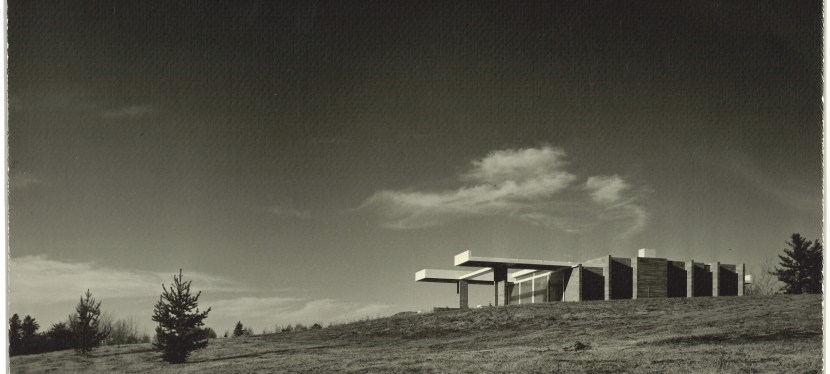
Arthur Erickson’s Dyde House: Rediscovering a hidden masterpiece

Editor’s note: The banner image of Dyde House above was taken by an unknown photographer, Edmonton, 1961-1962. Source: University of Calgary, Canadian Architectural Archives, Arthur Erickson fonds, CA ACU CAA F0002.

Written by: Robb Gilbert, Archivist, Canadian Architectural Archives

Dyde House, located a short distance outside Edmonton, is one of Canadian architect Arthur Erickson’s first notable projects in residential design. The house is located southwest of Edmonton, in Parkland County, on the grounds of the beautiful University of Alberta Botanic Gardens. The project was designed by Erickson in the Spring of 1960 and completed in late 1961 after returning from travels in Japan and Southeast Asia on a Canada Council for the Arts fellowship.

2024 marked the centenary of the birth of Erickson so I wanted to highlight one of his most important works from his early years as an architect: a rare Erickson project located in Alberta and a work that has recently been the subject of a documentary and an ongoing preservation campaign. The Canadian Architectural Archives at the University of Calgary houses the work of Erickson from 1953 to 1973 in the Arthur Erickson fonds. His archive includes thousands of original drawings and dozens of boxes of files documenting the design process behind his revered works of architecture.
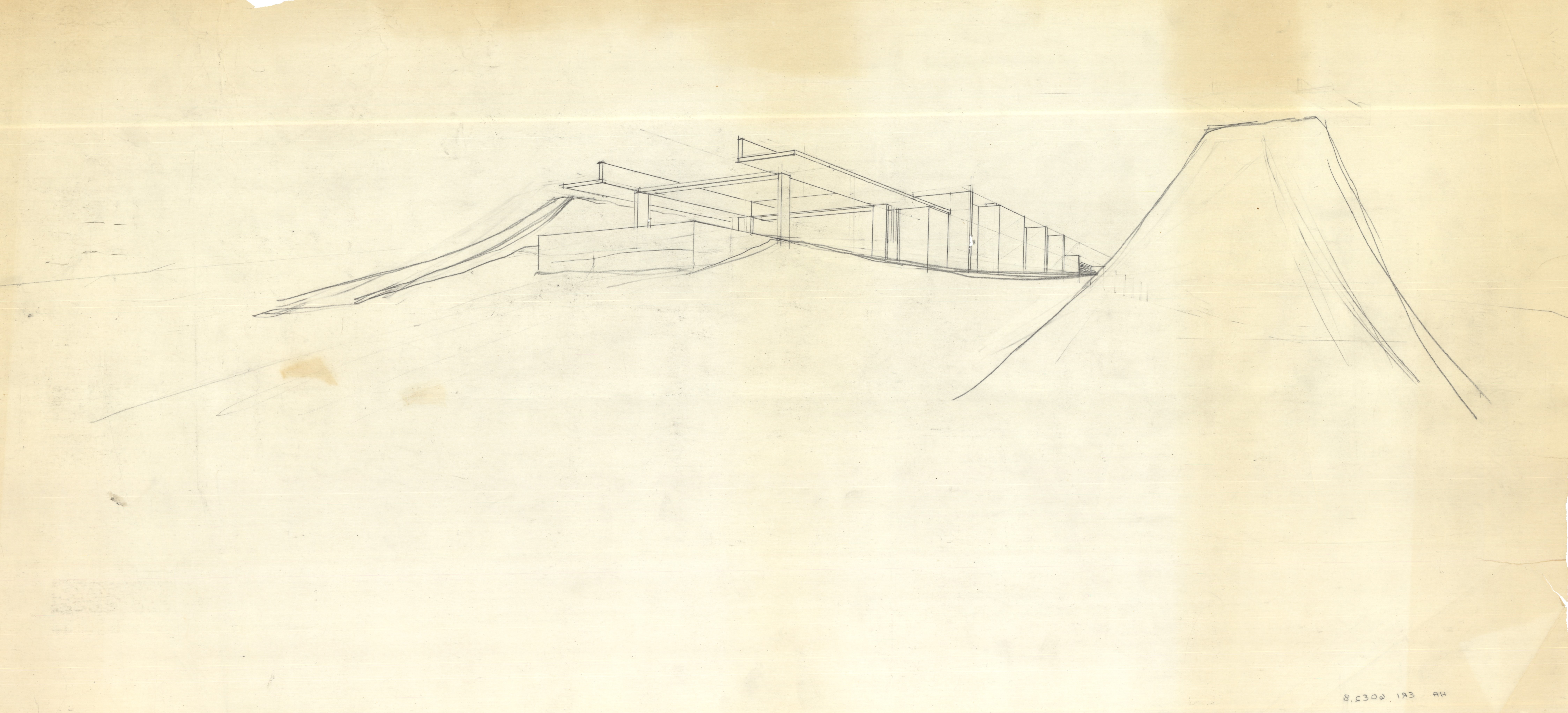
Arthur Erickson, Sketch of the Dyde Residence, Edmonton, [1960-1961]. Source: University of Calgary, Canadian Architectural Archives, Arthur Erickson fonds, CA ACU CAA F0002.
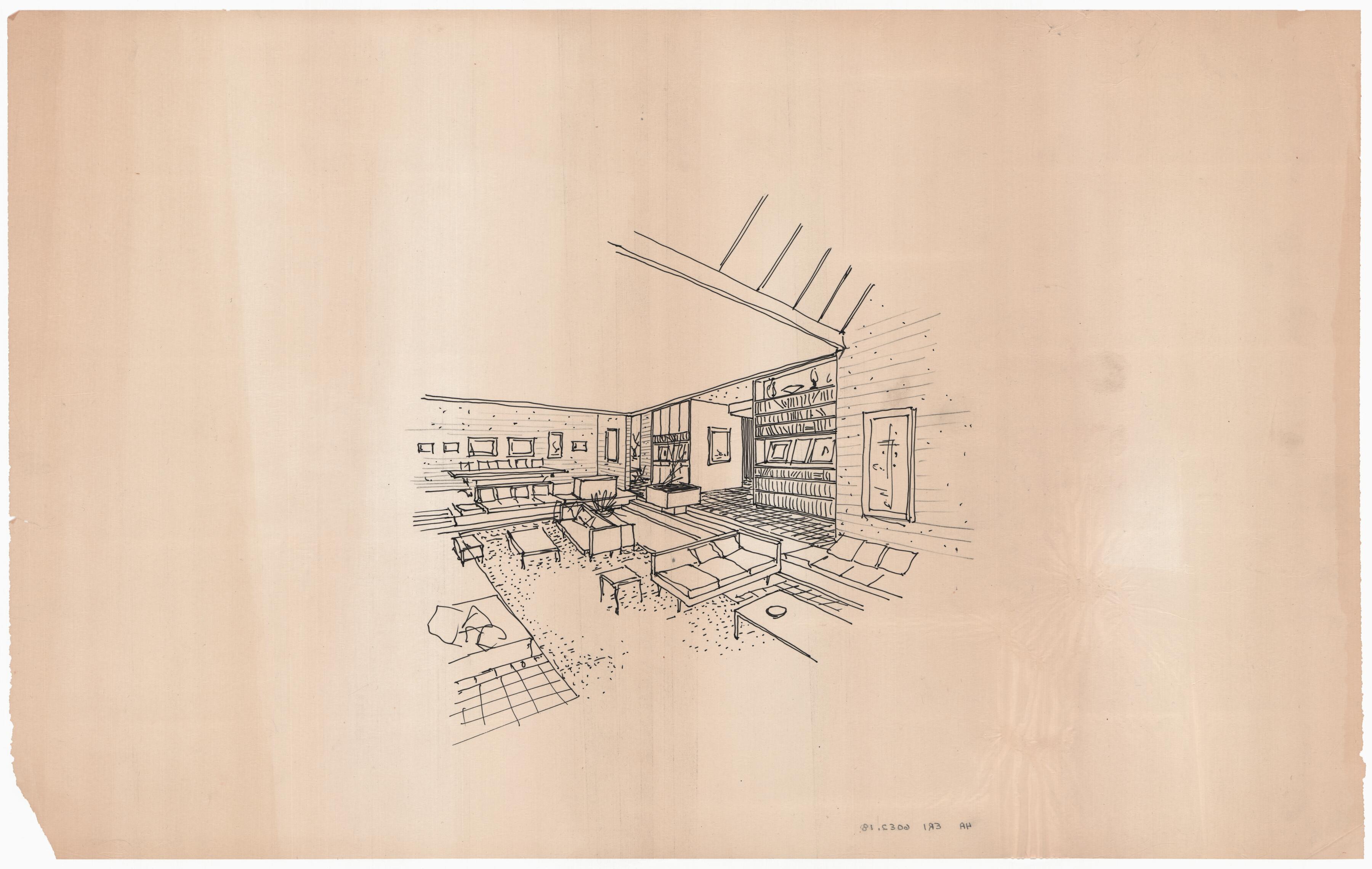
Arthur Erickson, Sketch of the interior of the Dyde Residence, Edmonton, [1960-1961]. Source: University of Calgary, Canadian Architectural Archives, Arthur Erickson fonds, CA ACU CAA F0002.

Erickson was born in Vancouver in 1924. He studied at the University of British Columbia and served overseas during World War II in India and Malaysia. Pursuing a career as an architect, he studied at McGill University and established his practice in Vancouver in the mid-1950s. In the span of the next 40 years, Erickson became Canada’s most renowned architect, nationally known but also the one of the few Canadian architects with an international reputation. His work includes icons of Canadian architecture such as Simon Fraser University, the University of Lethbridge, Robson Square and the Museum of Anthropology at UBC.

Read more
Architectural camaraderie: the friendship of Tanner, Wallbridge and Imrie

Editor’s note: Jillian Richardson is the curator of Labour and Industry at the Royal Alberta Museum (RAM) and worked on both the Doris Tanner Architecture Collection and Wallbridge & Imrie Architecture Collection there. Devon Owen Moar recently wrote his Masters thesis on Wallbridge & Imrie and worked as the cataloguer for the RAM’s Tanner Collection.

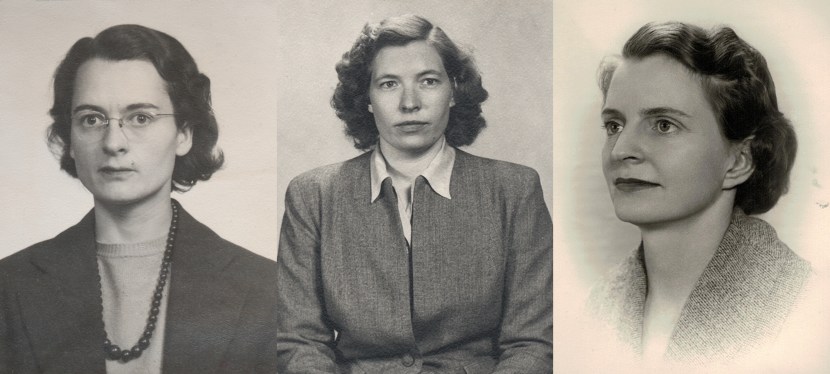
The banner image above is a composite image composed of portraits of the three architects. The portraits of Jean Wallbridge (left) and Mary Imrie (middle) are sourced from the private collection of Mary S. E. Wallbridge-Lillis. The portrait of Doris Newland Tanner (right) is sourced from Cheryl Mahaffy’s “Women Building Alberta” website.

Written by: Jillian Richardson and Devon Owen Moar

While cataloguing the Doris Newland Tanner architecture collection for the Royal Alberta Museum, we noticed something interesting. A few of Doris’s books and technical manuals were inscribed with the names of former colleagues, Mary Louise Imrie and Jean Louise Wallbridge. Finding these inscriptions made us wonder—were these books exchanged as references?  Left to Doris after Jean and Mary’s passings? Or, do they hint at an ongoing professional and personal dialogue that extended far beyond the drafting table? This discovery pointed towards the deeper connection between these three architects, beyond being professional acquaintances. The presence of Wallbridge & Imrie’s names in Doris’s books offers a rare glimpse into the professional and intellectual network of Alberta’s pioneering women in architecture at a formative moment in the province’s history and urban development. 

Exploring these materials raises broader questions about how museum and archival collections—including architectural tools, books, drawings and correspondence—can illuminate the network of support and influence among professional women. While this research is still in its early stages, this small but compelling kernel of evidence points toward a larger story—one of friendship, mutual mentorship, collaboration and lasting bonds.

Read more

Township maps at the Provincial Archives of Alberta

Written by: Michael Gourlie, Government Records Archivist, Provincial Archives of Alberta

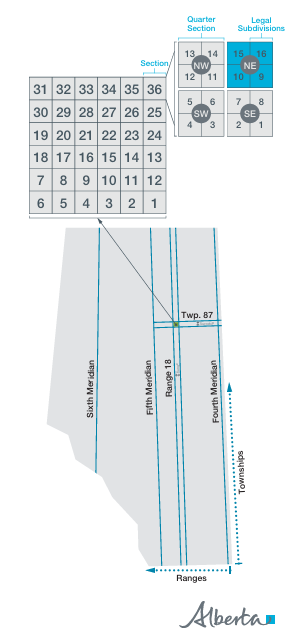
Township maps are a popular research source at the Provincial Archives of Alberta (PAA). An outcome of the Dominion Lands Surveys beginning in 1881 that captured most of what is now Alberta, the township maps document a grid system using meridians, ranges, townships and sections established by federal surveyors. Known as the Alberta Township System (ATS), this grid forms the basis of legal land descriptions used for Alberta land titles to the present day.

The original township maps were subsequently published in several editions, with the published maps used for a variety of operational purposes. They acted as a template or index for various offices to identify land uses for programs such as grazing leases, timber berths, mineral leases, land grants and homestead applicants. They also provided a standardized perspective to administer and oversee land use.

Read more