

Editor’s note: Jillian Richardson is the curator of Labour and Industry at the Royal Alberta Museum (RAM) and worked on both the Doris Tanner Architecture Collection and Wallbridge & Imrie Architecture Collection there. Devon Owen Moar recently wrote his Masters thesis on Wallbridge & Imrie and worked as the cataloguer for the RAM’s Tanner Collection.
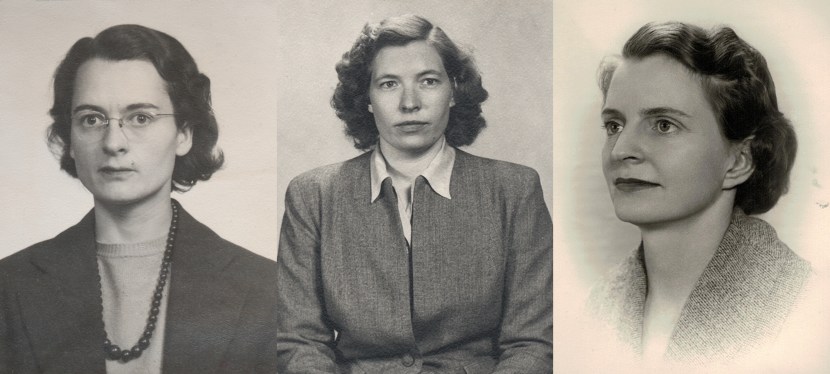
The banner image above is a composite image composed of portraits of the three architects. The portraits of Jean Wallbridge (left) and Mary Imrie (middle) are sourced from the private collection of Mary S. E. Wallbridge-Lillis. The portrait of Doris Newland Tanner (right) is sourced from Cheryl Mahaffy’s “Women Building Alberta” website.
Written by: Jillian Richardson and Devon Owen Moar
While cataloguing the Doris Newland Tanner architecture collection for the Royal Alberta Museum, we noticed something interesting. A few of Doris’s books and technical manuals were inscribed with the names of former colleagues, Mary Louise Imrie and Jean Louise Wallbridge. Finding these inscriptions made us wonder—were these books exchanged as references? Left to Doris after Jean and Mary’s passings? Or, do they hint at an ongoing professional and personal dialogue that extended far beyond the drafting table? This discovery pointed towards the deeper connection between these three architects, beyond being professional acquaintances. The presence of Wallbridge & Imrie’s names in Doris’s books offers a rare glimpse into the professional and intellectual network of Alberta’s pioneering women in architecture at a formative moment in the province’s history and urban development.
Exploring these materials raises broader questions about how museum and archival collections—including architectural tools, books, drawings and correspondence—can illuminate the network of support and influence among professional women. While this research is still in its early stages, this small but compelling kernel of evidence points toward a larger story—one of friendship, mutual mentorship, collaboration and lasting bonds.
Professional connections

The story of Wallbridge, Imrie and Tanner’s professional and personal connection begins with their early years in the field, working at one of Alberta’s most prominent architectural firms: Rule, Wynn and Rule in Edmonton. During the Second World War, with many male architects overseas, Peter Rule Sr. was granted a special certificate by the Alberta Association of Architects (AAA) to run the firm in the absence of its founding partners (John Rule, Gordon Wynn and Peter Rule). He hired numerous women during this period, including Jean Wallbridge, Mary Imrie and Doris Newland (later Tanner).
Jean Wallbridge graduated in 1939 from the University of Alberta’s Architecture program alongside Peter Rule Jr., and went on to work at Rule, Wynn and Rule from 1939 to 1940. She applied for and received her AAA membership in 1941, becoming only the third woman in Alberta to do so. Both Mary Imrie and Doris Newland followed a similar path. Doris recalled that she first met Mary while they were both University students—Doris at the University of Manitoba and Mary at the University of Toronto. Both, “worked at Rule [Wynn] and Rule in Edmonton in the summer of 1941” and continued working there between semesters (1941-1943), until they graduated in 1944. After earning their degrees, they both eventually returned to the firm, where they were each granted their AAA membership on the same day, December 7, 1944. Mary and Doris became the fourth and fifth women in Alberta to receive their licenses to practice architecture–the next two following Jean, who had been the third. By then, Doris had married Byron ‘Ches’ Chester Tanner, and her AAA certificate was registered under her ‘new’ name, Newland-Tanner.

Jean, Mary and Doris’s professional paths continued to intersect after working for Rule, Wynn and Rule. In 1945, Jean and Doris were both featured in the Edmonton Journal article, “Two Women Civic Architects Busy With Plans for Housing Units,” where they discuss their work at the Edmonton City Architects’ Office under Maxwell Dewar. The article offers intriguing insights into their perspectives on architecture and planning. Jean expressed a keen interest in town planning, stating, “I’m more interested in town planning than anything else,” while Doris remarked, “being an architect is fascinating and satisfying if you have a flair for ‘maths’ and don’t like English and history.”

By 1946, Imrie was working at the City Architects’ Office with Wallbridge and Newland-Tanner. Their projects included major public works like the expansion of Victoria Composite High School (now Victoria School for the Arts), which introduced extensive modernist design elements, most notably a new theatre (now the Eva O. Howard Theatre). A letter to Doris from Doris’s mother, Elsie Newland, suggests that Doris and Mary were considering starting an architectural firm together. The letter, dated Feb. 12, 1946, acknowledges that they, “might make a good stab at it,” but points out that Doris would then need to delay having children to focus on her career, or else, “it wouldn’t be fair to Mary”.
In the end, Doris chose a different path, giving birth to her first child in 1948. While the three continued working together, the City Architects’ Office underwent a dramatic restructuring in 1949. Many staff members—including Dewar, Wallbridge, Imrie and Tanner—departed, as the office was shifted into Edmonton’s newly-crowned Town Planning Department. This restructuring marked a pivotal moment in all of their careers. Jean and Mary left the Office, establishing their own firm, Wallbridge & Imrie, Architects, in 1950.
Meanwhile, Tanner followed Dewar into private practice, joining him at Dewar, Cawston & Stevenson, which oversaw the completion of projects begun at the City Architects’ Office, which included Victoria School’s expansion. Doris Tanner, “was very proud of her contribution to the acoustics of the performance hall at Victoria Composite High School,” a space that has been preserved in recent renovations. She even pursued further studies in acoustics at M.I.T., while her husband was a M.I.T. Sloan fellow in the mid-1950s. Later on, valuing her expertise, Wallbridge & Imrie often consulted her on acoustics for their own designs.
Doris would eventually have four children, balancing motherhood and architectural work in private practice, with work done in association with the Canadian Engineering Surveys (International) Ltd. Even after their professional trajectories diverged, the collaboration between Wallbridge, Imrie and Tanner continued. Examining the historical record provided by blueprints, books and other archival materials indicates their sustained support for one another throughout their professional and personal lives.
Blueprints, buildings, books and bonds

Although the three architects chose a different career path—Wallbridge and Imrie forming their own company, and Doris Tanner working on her own, the three continued to collaborate professionally. In 1954, the three architects worked on their first residential project together, a house on University Ave. built on-spec (elevations pictured above). The project was an attempt to make an extremely cost-effective and efficiently constructed modern house. Tanner recalled that it was the first home project for all of them: Tanner “bought the lot,” and co-designed and jointly built it with Wallbridge & Imrie. During the design phase, the house was referred to as, “Residence for Mrs. B.C. Tanner” (a reference to Doris under her married name). It was later sold to Mary’s sorority sister, Helen Peters and her husband. Wallbridge & Imrie built an addition onto the property at a later point, with the subsequent addition’s drawings referring to it as the, “Peters Residence.” This project was an early demonstration of their continued professional collaboration.
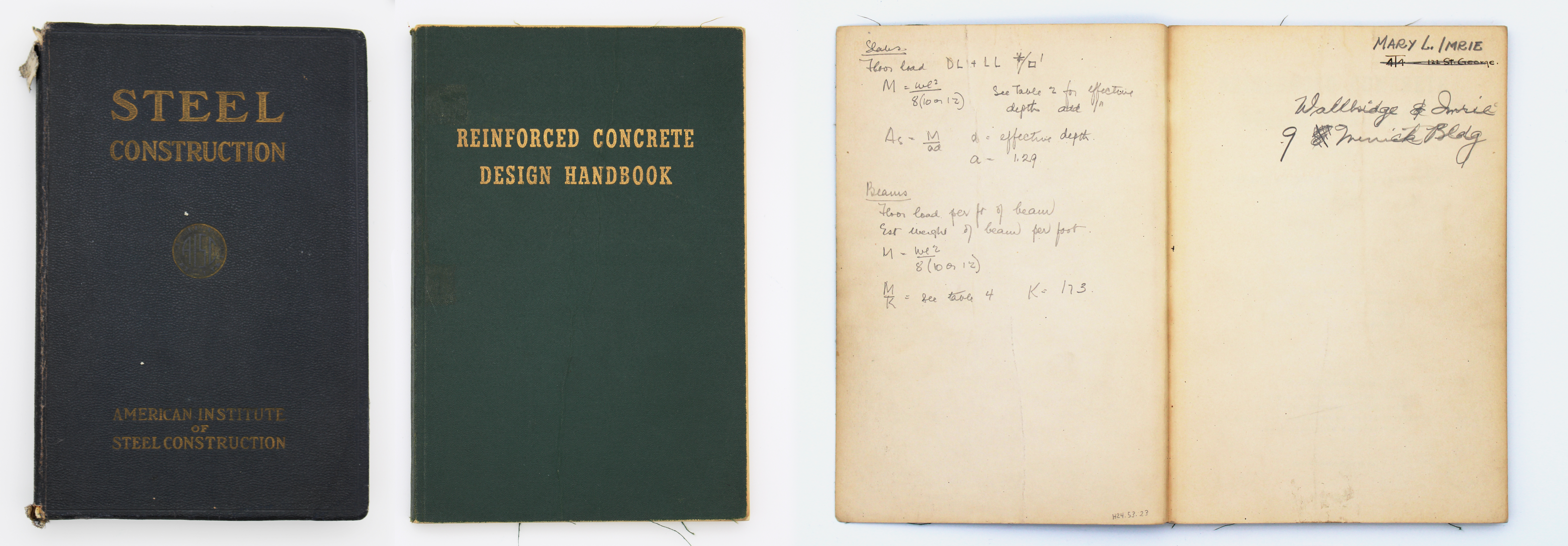
In addition to this blueprint, objects from the Doris Tanner collection at the Royal Alberta Museum speak to the ways that the three architects continued to collaborate and support one another professionally. There were four books among Doris’s possessions that have a clear connection to Wallbridge and Imrie. Two of these are technical manuals, one on steel construction and the other on reinforced concrete. Both belonged to Mary Imrie and bear handwritten inscriptions on the inside covers, including her name and addresses linked to her architectural education in Toronto. The Reinforced Concrete Design Handbook actually also has, “Wallbridge & Imrie, Architects” inscribed beneath the older information, which has been crossed out and replaced, along with the early office address for the Wallbridge & Imrie partnership at the Merrick Building, both 8 (crossed out) and then 9 Merrick Building.

The other two books in Doris’s collection are architectural monographs, one on German architect Ludwig Mies van der Rohe, and another on Brazilian architect,Oscar Niemeyer. These books are branded with the “Wallbridge & Imrie, Architects” stamp. All of these books would have been at one point part of Wallbridge & Imrie’s office library, most likely at Six Acres. Notably, the Wallbridge & Imrie imprint matches the one typically used on all of their architectural drawings, akin to the residential elevations shown earlier.
The presence of these books speaks to the nature of an architect’s library, which would always include technical references, such as structural handbooks for structural element sizing, rebar placement and material best practices. The architect’s library would also include works by contemporary architects, serving as inspiration and as a means of keeping up with architectural discourse. While Wallbridge, Imrie or Tanner may not have strictly adhered to the modernist dogma of Mies and/or Niemeyer, the presence of these books indicates a professional curiosity about their work. The Niemeyer book holds particular interest since Wallbridge and Imrie met him during their 1949-1950 travels in South America, which included travelling through Brazil, as recounted in their February 1952 RAIC Journal article, “South American Architects.” The books suggest that the architects, in addition to collaborating on projects, also shared technical information and creative architectural inspiration.
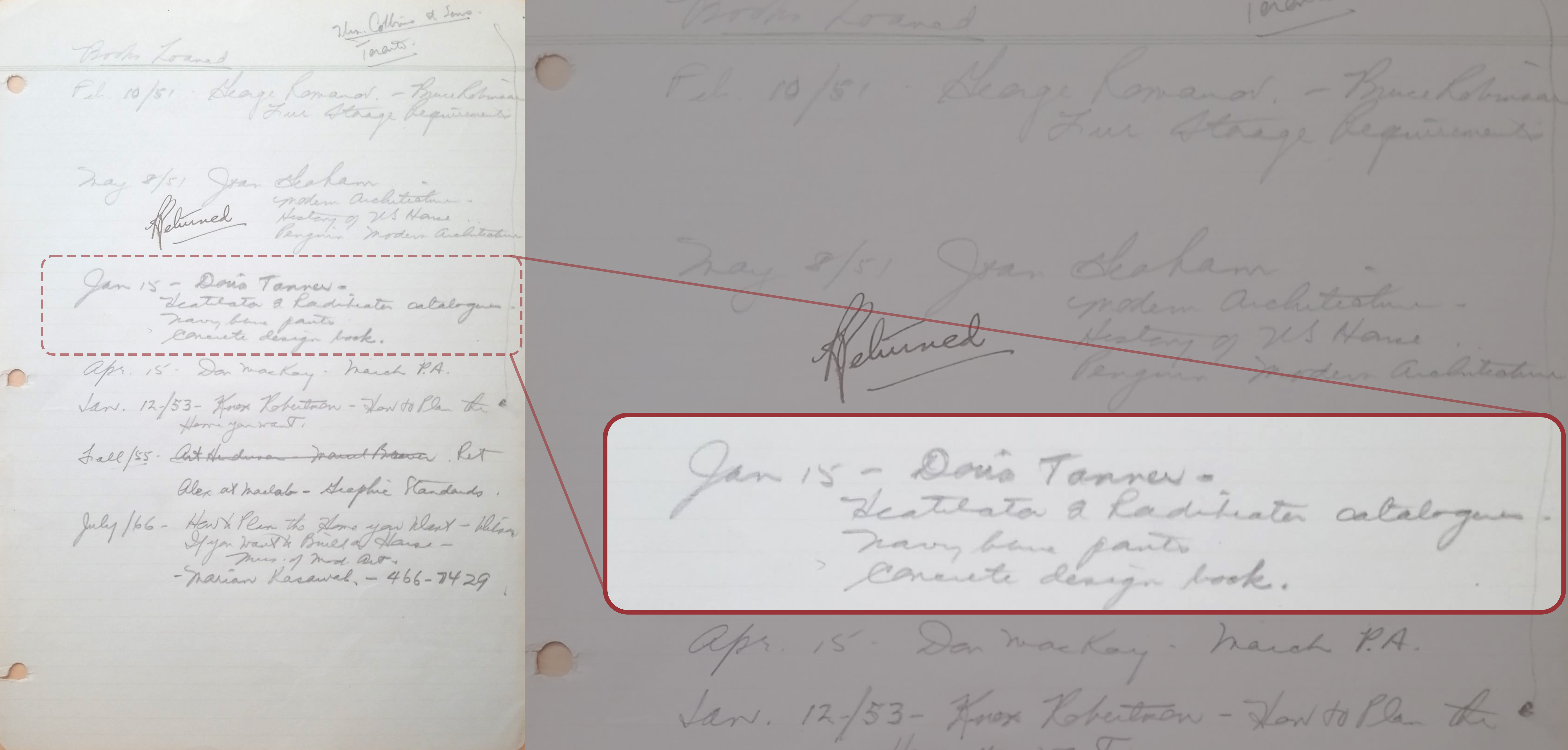
A note in the Wallbridge & Imrie fonds at the Provincial Archives of Alberta (PAA) attests to this sharing of technical resources as well as an enduring close friendship among the three architects. The first folder of the PAA’s Wallbridge & Imrie collection includes a list of their projects, along with a list of “Books Loaned.” This handwritten list covers books loaned from 1951 to 1966 and includes Doris Tanner’s name next to “Jan. 15” (possibly 1952, if list is in chronological order).
Among the listed items is a “Concrete Design Book,” almost certainly the Reinforced Concrete Design Handbook, now at the Royal Alberta Museum. Also listed are, “Heatilator & Rad-heater catalogues,” (arguably common architectural resources for products, in this case heating products/elements), and, curiously, “Navy blue pants.” The listing of “navy blue pants” offers an unexpected reference to the personal aspect within this professional network. Though the list does not mention what kinds of pants they were—Denim blue jeans? Blue suit pants? Work pants for site visits? The fact that they were sharing clothing suggests an intimacy beyond professional collaboration, something more akin to the relationship between sisters or very close friends.
Personal connections

In an interview conducted for Mary’s memorial service, Doris recalled many social outings to Mary and Jean’s home at Six Acres, including skating parties on the river: “the climb back up the hill was quite strenuous, but hot totties were ready by the time the skaters reached the top.” She observed that Mary was “extremely generous,” and she, “managed to be friends with all of her clients which is unusual […] usually some sort of dissagreement [sic.] occurs between some of the clients and their architect at some point, but Mary managed to win everyone over.”
Doris’s eldest daughter, Susan Tanner, told us that:
Mary and Jean were VERY important to Mom. She had few very close friends and she shared a similar aesthetic sense with them. I am sure that they also bonded because of the discrimination against women in the profession at the time but Mom would never say that [….] She also shared with Mary and Jean a very strong desire to combine beauty and practicality in all aspects of design—and a bit of nature if possible [….] Finally, Mary and Jean were socially aware as Mom was. When Mom got a contract to design public housing, she was determined to build homes that were not badly built (supervising construction and quality of materials) but also that they be attractive and liveable. She would say that “Everyone deserves a beautiful place to live. (S. Tanner, personal communication, January 16, 2025)
Doris’s daughter, Merrill Tanner, said:
It is true that she did not like coffee parties, gossip and small talk. Her female friends were always very intelligent women, most of whom worked before and after kids. She was completely herself with Mary and Jean. I would say they were her favorites because of their shared love of their profession. They would come over and have a great time together with Mom and Dad […. Doris] was a quiet feminist in her actions and the way she lived her life, but not loud, or brazen about it. (M. Tanner, personal communication, January 20, 2025)
What began as professional colleagues supporting one another in the male-dominated field of architecture had, over the course of 40 years, transformed into a deep and lasting friendship. This brief glimpse into the professional and personal exchanges between Tanner, Wallbridge and Imrie is just the beginning of what could be a much deeper study, extending to the objects and archival collections of additional women architects in Alberta. But, together, the object collections of Doris Tanner, Mary Imrie and Jean Wallbridge highlight the significance of museum and archival collections for investigating the networks of support woven throughout women’s professional histories.

Museum and archival collections do far more than preserve books and tools, drawings and documents: they have the potential to reveal the important relationships, collaborations and personal histories that helped shape Alberta’s built environment. We hope that the important contributions of Tanner, Wallbridge and Imrie are recognized and can be further studied and appreciated by future generations of Albertans and researchers.
Sources
Bonnemaison, Sarah. “Queer Architecture.” In The Routledge Handbook of LGBTQ Identity in Organizations and Society, by Julie A. Gedro and Tonette S. Rocco, 278–303, 1st ed. New York: Routledge, 2024. https://doi.org/10.4324/9781003128151-23.
“Wallbridge & Imrie Architects, Alberta, (Exhibition Boards Produced for Media Architecture Design Edmonton’s (M.A.D.E.) Event ‘IN SITU: Six Acres’),” September 8, 2022. https://livingarchitecturesystems.com/wp-content/uploads/Bonnemaison-Small-Exhibition-on-Wallbridge-and-Imrie_Sep-8_-2022.pdf.
Boxwell, Josephine. “Imrie House: Home of Canada’s First Female Architectural Firm.” Story Collection. Edmonton City as Museum Project (ECAMP), July 22, 2022. https://citymuseumedmonton.ca/2022/07/22/imrie-house-home-of-canadas-first-female-architectural-firm/.
Clark, Mary and Ontario Women Graduates in Architecture 1920-1960 Project. ‘For the Record, Ontario Women Graduates in Architecture 1920-1960 Exhibition Scrapbook: Mary Imrie Pages’, December 1988. B1989-0011/003, Ontario Women Graduates in Architecture 1920-1960 Project fonds. University of Toronto Archives, Toronto, Ontario, Canada.
Contreras, Monica, Luigi Ferrara, and Daniel Karpinski. “Breaking in: Four Early Female Architects.” The Canadian Architect 38, no. 11 (November 1993): p.18–23.
Dalhousie University Libraries, “Dalspace” (Online Repository). “Royal Architectural Institute of Canada Journals.” Accessed February 13, 2025. https://dalspace.library.dal.ca/communities/ce4408d1-a1c8-48da-a50a-5f3bddbbddf8.
Dominey, Erna. “‘Les Girls’.” In Edmonton: The Life of a City, by Bob Hesketh and Frances Swyripa, p.226–233 & p.354–355. Edmonton, AB: NeWest, 1995.
“Wallbridge and Imrie: The Architectural Practice of Two Edmonton Women, 1950-1979.” Society for the Study of Architecture in Canada Bulletin 17, no. 1 (March 1992): p.12–18.
Edmonton Journal. “Two Women Civic Architects Busy With Plans for Housing Units.” July 31, 1945, p.13. ProQuest Historical Newspapers: Edmonton Journal, Access provided by Edmonton Public Library.
Joynes, Jennifer R. “Women in the Architectural Profession.” Habitat II, no. 4 (1959): p.2–6.
Lemco van Ginkel, Blanche. “Slowly and Surely (and Somewhat Painfully): More or Less the History of Women in Architecture in Canada.” Society for the Study of Architecture in Canada Bulletin 17, no. 1 (March 1992): p.5–11.
Mahaffy, Cheryl. “Alberta’s Women in Architecture: Home Makers,” Legacy Fall (2001): 8–11.
“Architect Doris Tanner: What Did She Do? Work and Life in Fine Balance,” Edmonton City as Museum Project (ECAMP), 10 March 2021, https://citymuseumedmonton.ca/2021/03/10/architect-doris-tanner-what-did-she-do-work-and-life-in-fine-balance/.
“Doris Newland Tanner,” Women Building Alberta, March 30, 2016. https://womenbuildingalberta.wordpress.com/doris-newland-tanner/.
“Doris Tanner: Unsung Architect,” Legacy Winter (2004): 26–28.
“Jean Louise Emberly Wallbridge & Mary Louise Imrie.” Women Building Alberta, March 30, 2016. https://womenbuildingalberta.wordpress.com/jean-louise-emberly-wallbridge-mary-louise-imrie/.
“Women Building Alberta: Who Came First, and Why?,” Elevation West: The Magazine of the Alberta, Saskatchewan and Manitoba Associations of Architects Summer (2004): 10.
Moar, Devon Owen. “Six Acres: The Residence & Office of Edmonton Architectural Partnership, Wallbridge & Imrie.” Master of Architectural Studies, Carleton University, 2024. https://doi.org/10.22215/etd/2024-16163.
“Where Wallbridge & Imrie Lived and Worked: A Quick Guided Tour of Six Acres,” RETROactive (blog), March 5, 2025, https://albertashistoricplaces.com/2025/03/05/where-wallbridge-and-imrie-lived-and-worked-a-quick-guided-tour-of-six-acres/.
Newland, Elsie, and Hubert Newland. “Correspondence from Elsie and Hubert Newland to Doris and Ches Tanner,” February 12, 1946. Private Collections of the Tanner Daughters (Susan, Merrill, and Laura).
Private collections of Susan, Merrill, and Laura Tanner.
Private collection of Mary S.E. Wallbridge-Lillis.
Provincial Archives of Alberta (PAA). Erna Dominey Fonds (12 Audio Recordings of Interviews Conducted in 1991), PR1995.0016/1-12. Edmonton, Alberta, Canada.
Wallbridge & Imrie, Architects Fonds, PR1988.0290/1-1021. Edmonton, Alberta, Canada.
Recreation, Parks and Wildlife Foundation, Park Ventures Fund. “Notes from meeting with Doris Tanner Friday, July 28th” in “Notes from Interviews for Event & Tribute at Devon, AB for Mary Imrie,” 1 September 1989. Government of Alberta Records, Oxbridge Place, Edmonton, AB. Land Holdings Case Files.
Royal Alberta Museum (RAM). Doris Newland Tanner Architecture Collection, H24.53. Edmonton, Alberta, Canada.
Wallbridge & Imrie Collection, H23.61. Edmonton, Alberta, Canada.
Email Correspondence from Merrill Tanner to Jillian Richardson Regarding Her Mother’s (Doris Tanner) Specialization and Expertise in Acoustics, March 14, 2025.
 RETROactive
One thought on “Architectural camaraderie: the friendship of Tanner, Wallbridge and Imrie”