

Written by: Ronald Kelland, Geographical Place Names Coordinator
The Dr. McMillan Residence, a somewhat unprepossessing yet significant home in Claresholm, has recently been designated as a Provincial Historic resource and is now listed on the Alberta Register of Historic Places.
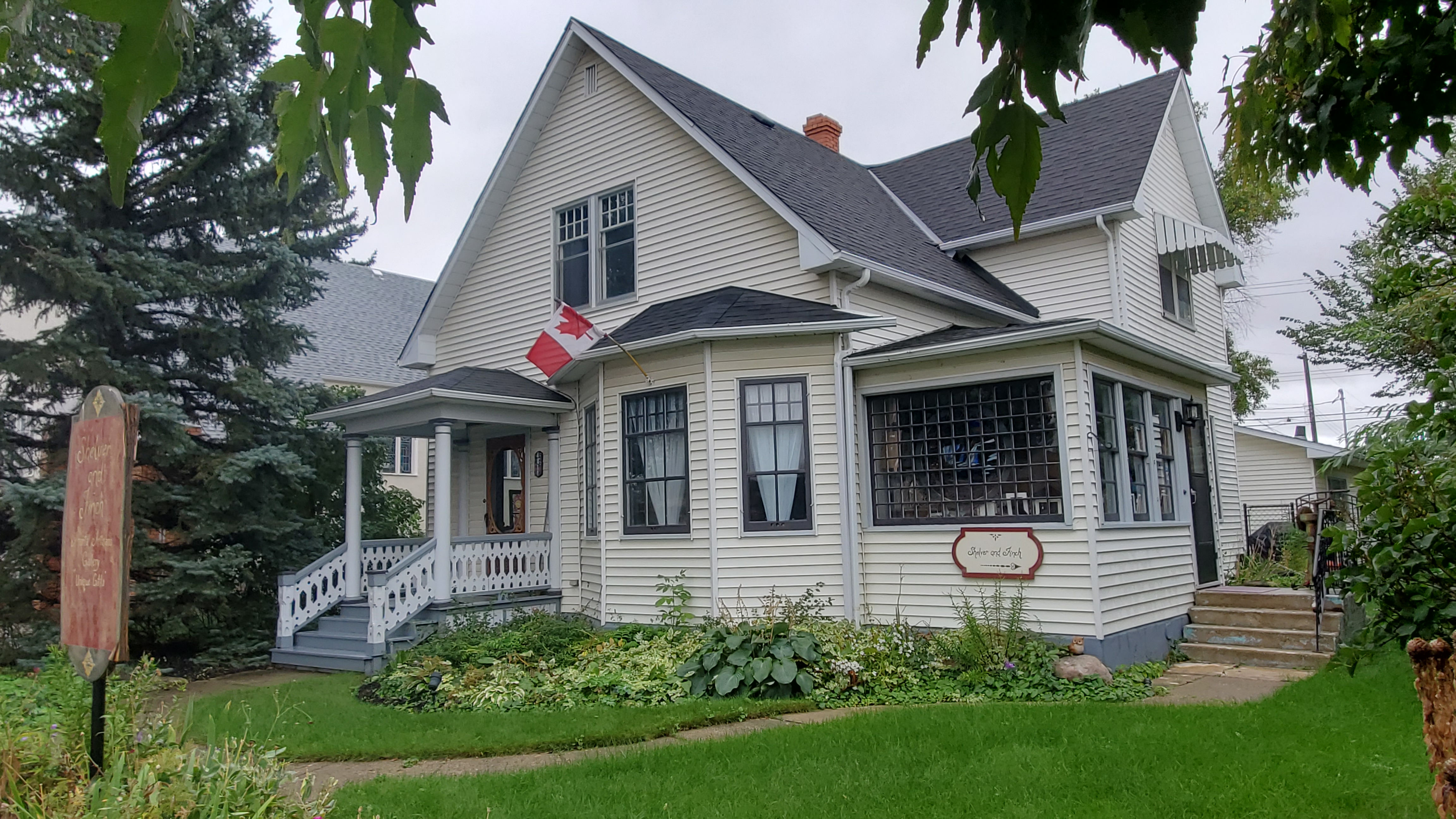
View of the Dr. McMillan Residence from the south, showing the main, residential entrance and the secondary, clinic entrance. Source: Historic Resources Management, Alberta Arts, Culture and Status of Women, 2024.
On Second Street West, at the western fringes of Claresholm’s downtown district, beside a church and amongst several more recent commercial buildings, stands the Dr. McMillan Residence. The house has provincial heritage significance for its association with the provision of medical services in Alberta and for its design, being a combination of private, residential space and professional, medical clinic space.
In nineteenth century Alberta, medical care was often provided by doctors through home visits. Through the early decades of the twentieth century, many doctors, particularly in smaller, urban areas, eschewed home visits and established clinics in their places of residence. New transportation and communication technologies and improvements to infrastructure made it easier for patients to speak to and travel to their doctors rather than the other way around. Additionally, home-based clinics allowed doctors created greater efficiency for doctors by eliminating the time lost through their own travel. The connection between the home clinics and their settings in residential neighbourhoods and homes also maintained to a degree the sense of domesticity that was an attractive feature of home visits, meaning that patients’ comfort and the sense of connection to their doctors was not completed sacrificed.
Home-based doctor’s offices were the main way in which primary medical care was delivered in Alberta in the early-1900s, particularly in Alberta’s town and villages. The Dr. MacMillan residence was the home and office for a series of doctors, starting with Dr. A.G. McMillan (1916-1929) and continuing with Dr. P.A.M. Lyster (1929-1934) and Dr. P.J. Carroll (1934-1940). The Dr. McMillan Residence was built for Dr. McMillan and appears to have been purpose built to have a home office. As a place of residence, it was a solid, middle-class type of home befitting a respected medical professional. It would also have fit with the overall residential streetscape. The Dr. McMillan Residence also demonstrates design elements one would typically find in a home-based doctor’s office. The office portion of the building included a reception and waiting areas as well as a consultation and operating rooms. While the office portion of the building possessed a home-like scale and aesthetic, there was also a clear separation between the residential and professional portions of the building through separate entrances for the home and office and an interior doorway adjoining the two.
Eventually, the home-based clinic model began falling out of favour. This change was brought about by population growth and doctors’ growing sense of their own social status and their wanting to establish a clearer distinction between their private and professional lives. Additionally, economics of scale made partnerships with other doctors and the creation of larger, multi-doctor clinics, sometimes with increased medical specialties a more attractive option. This transition occurred first and fastest in large urban centres but was occurring in Alberta’s smaller centres by the 1940s and 1950s. In Claresholm, Dr. Caroll closed his home office in 1940 and moved his practice to the new Medical Clinic building, although he continued to occasionally use his home office for emergency calls.

The Dr. McMillan Residence, 1974. Source: Alberta Heritage Survey, Alberta Arts Culture and Status of Women.
The era of the home-based doctor’s office is a significant theme in the evolution of medical services in Alberta and the Dr. McMillan Residence is an excellent example of those home-based offices. The Dr. McMillan Residence was designated as a Provincial Historic Resource on October 30, 2025. It is the third Provincial Historic Resource designated in the Town of Claresholm, joining the Canadian Pacific Railway Station and the Milnes Block.
Provincial Historic Resources embody the diversity of our province’s history and include medicine wheels, tipi rings, fur trading and mounted police posts, coal mines, farmsteads, ranches, railway stations, grain elevators, churches, schools, government offices, commercial blocks and private residences. As of November 2025, there are 396 places in Alberta designated as Provincial Historic Resources. Along with helping to provide economic, social, and cultural benefits, designation of Provincial Historic Resources helps to ensure that local landmarks will continue to help connect Albertans with their rich heritage. You can learn more by visiting the Provincial Historic Resource Designation program webpage.
Sources
Adams, Annmarie and Stacie Burke. “A Doctor in the House: The Architecture of Home-offices for Physicians in Toronto, 1885-1930.” Medical History 52 (2008): 163-94.
Claresholm History Book Club. Where the Wheatlands Meet the Range. Claresholm, 1974.
Shortt, S.E.D.. “Amateurs and Antiquarians: Reflections on the Writing of Medical History in Canada.” Medicine in Canadian Society: Historical Perspectives. Edited by S.E.D. Shortt. Montreal-Kingston: McGill-Queen’s University Press, 1981: 1-18.
Shumsky, Neil Larry, James Bohland and Paul Knox. “Separating Doctors’ Homes and Doctors’ Offices: San Francisco, 1881-1941.” Social Sciences and Medicine 23:10 (1986): 1051-57.
 RETROactive