

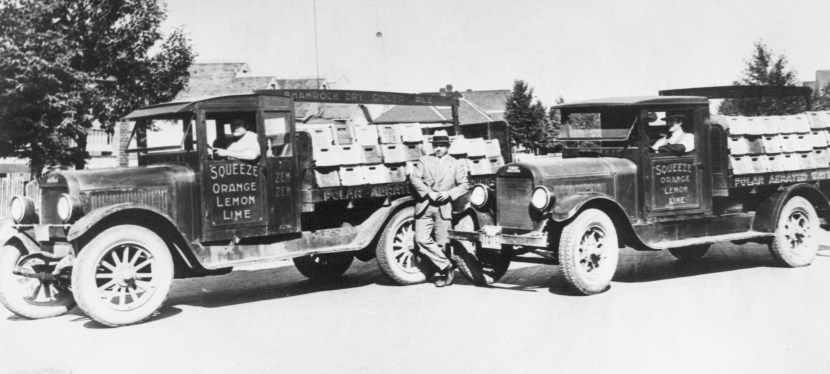
Editor’s note: The banner image above, courtesy of the Jewish Historical Society of Southern Alberta, depicts a polar delivery truck advertising its Squeeze and Shamrock Ginger Ale brands, 1928. Abe Pearlman is standing between the trucks.
Author Bruce Dawson holds a MA in History from the University of Saskatchewan and is presently the Manager of Historic Places Policy and Programs for the Ministry of Parks, Culture and Sport in Saskatchewan. He is also a long-time collector of soda pop memorabilia, with a particular interest in Polar Aerated Water Works and other bottlers from Calgary and Lethbridge. You can read the full version of Bruce’s article in Alberta History.
Written by: Bruce Dawson
Did you know that soft drink manufacturing in Alberta began over 135 years ago? Many of the early manufacturers were family-run businesses that developed a significant industry in the province while helping to shift the perception of soft drinks from being a medicinal or specialty product to being an indispensable item for the masses. A significant part of this story is Calgary’s Polar Aerated Water Works.
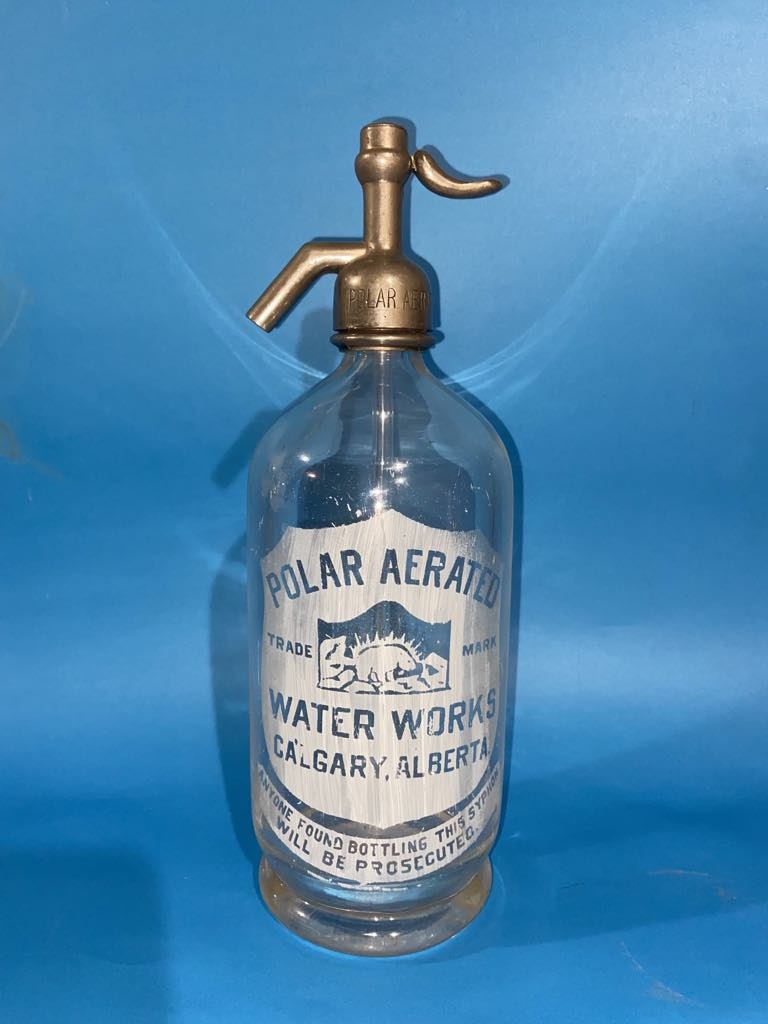
In 1914, William Denby and Gordon Goodison established a bottling plant at the corner of 11 Ave and 12 Street East. Their back cover advertisement on the 1914 Henderson’s Directory stated that they were a “manufacturer of all kinds of soft drinks and distilled waters.” By this time, soft drinks had transitioned from association with pharmacists and medical treatment to become a status symbol amongst the upper and middle class. Calgary had at least three soft drink manufacturers already, led by the Calgary Brewing and Malting Company, which had been producing soft drinks for over 20 years. The owners named their new company Polar Aerated Water Works and, by May of 1915, registered a patent for their logo, described as, “a representation of a polar bear on a float of ice with icebergs and setting.” The company used this logo for the remainder of its history. Denby left the firm in 1915 and Goodison stayed on as sole owner, with several family members working for the company over the next decade.
Polar was noted for its range of soda flavours, its distilled waters and its ginger beer, which was offered in a crockery bottle. Shamrock Dry Ginger Ale was the signature brand from the outset, but the company also produced several familiar flavours of soda, such as cream soda, root beer and grape, as well as flavours less common or absent today, such as Iron Brew, Lemon Sour, Cherry Vino and Loganberry. In 1921, Polar followed a growing trend of local bottlers entering into franchise agreements to bottle national and international brands by agreeing to bottle orange and lemon Squeeze, a brand created by the National Fruit Company in New Orleans. Then in 1922, Polar became a contract bottler for Hires Root Beer and Kist Sodas.
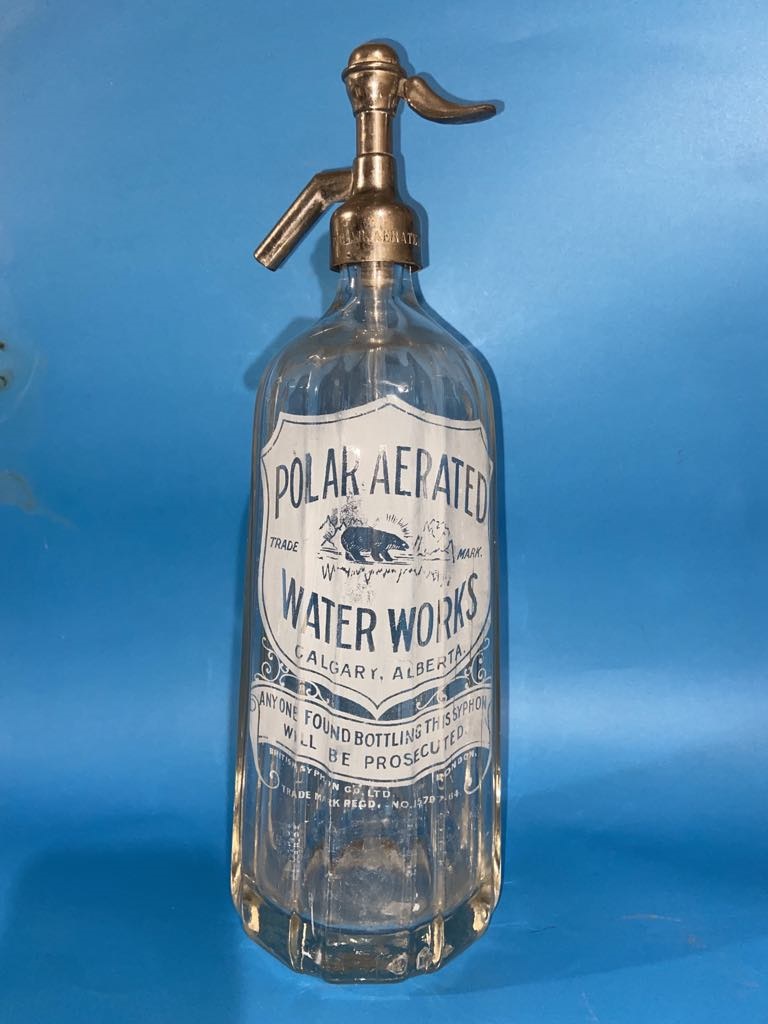
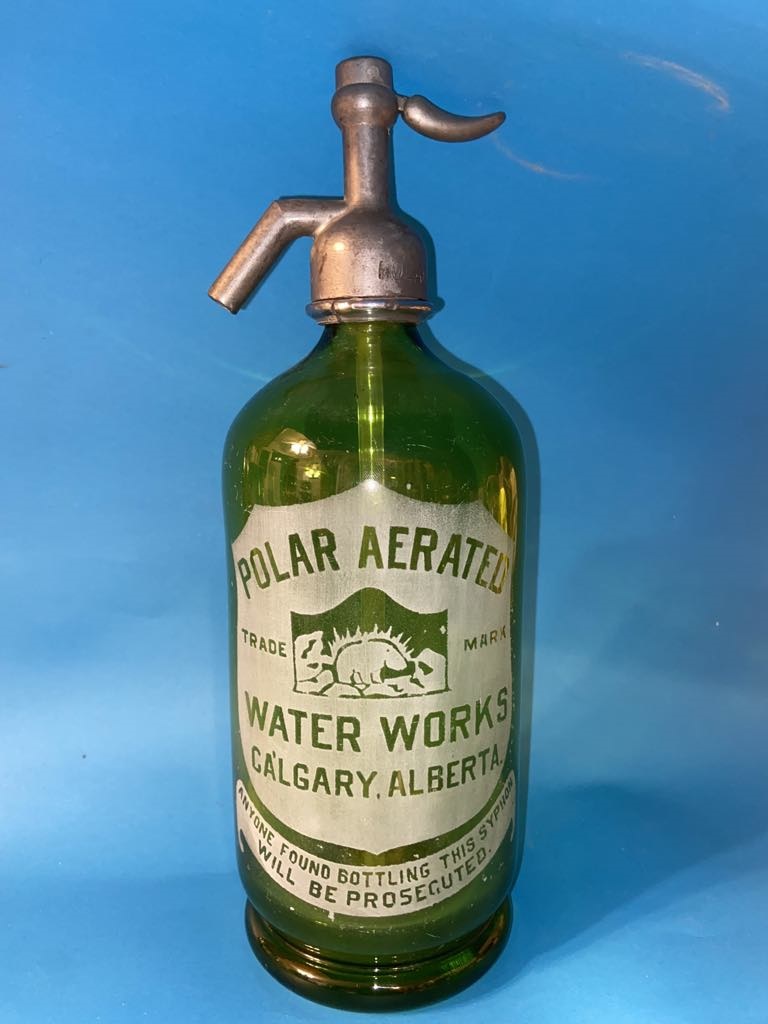
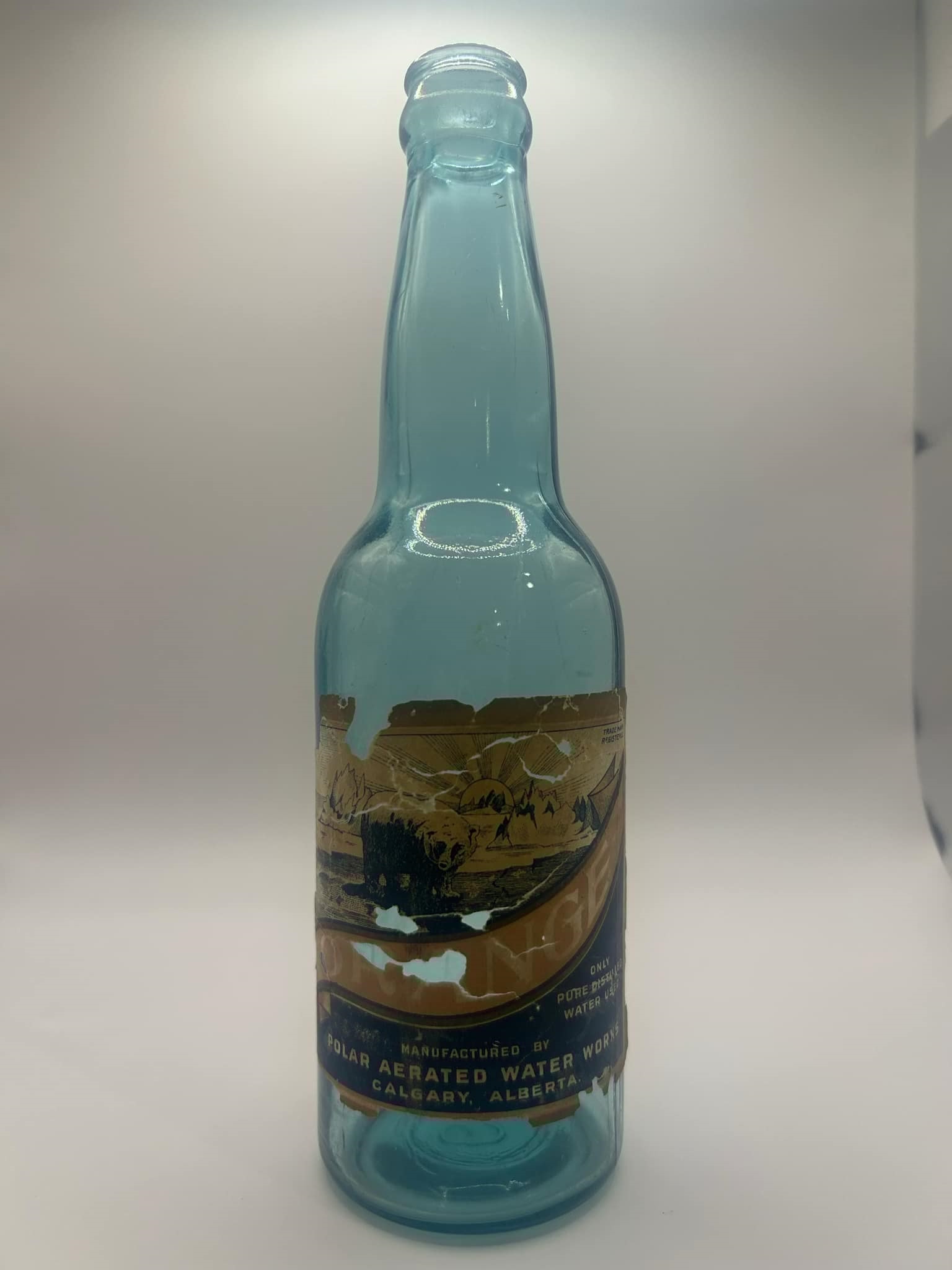
The most momentous change in the history of Polar took place sometime in late 1924 or early 1925 when brothers Abraham (Abe) and Benjamin (Ben) Pearlman acquired Polar Aerated Water Works. Before acquiring Polar, the brothers had previously owned a garage and tire retailer in Estuary, Saskatchewan. Ben had lived and is believed to have worked with his first cousins, the Boroditsky family of Winnipeg, who had been operating a soft drink factory since 1918.
As it had been under Goodison, the Pearlman brothers continued to operate Polar as a family business. Ben and Abe were joined by their brothers Herschel and Louis, the latter using his university training in medicine and chemistry to oversee syrup development. As well, several children of these four brothers worked at the plant between the 1930s and 1950s. These immediate family were complemented by many long-term employees, some serving over 40 years with the company. When reflecting on the staff relationships, Ben’s son Ron noted:
“Polar was a positive place to work. There was a good relationship between management and employees. Ben and Abe understood everyone’s contributions and employees were consulted on decisions for the company. They also made sure that the employees, especially the long-term ones, were respected and looked after.”
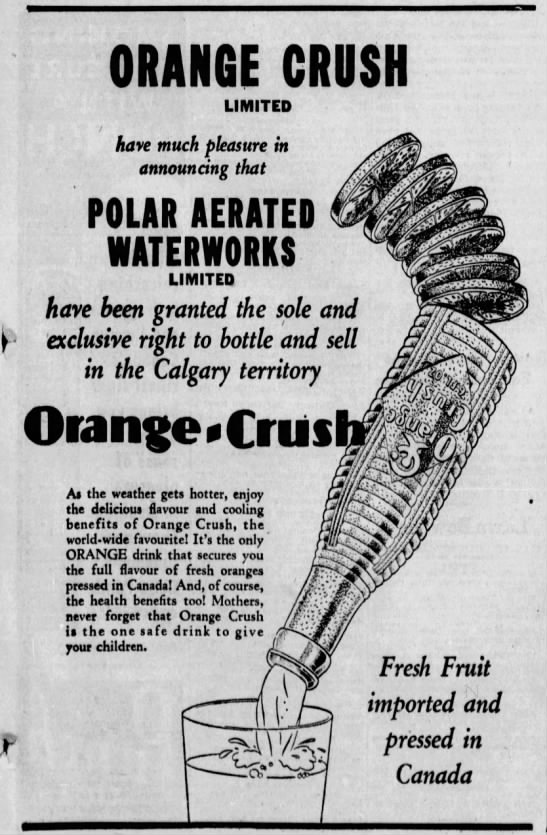
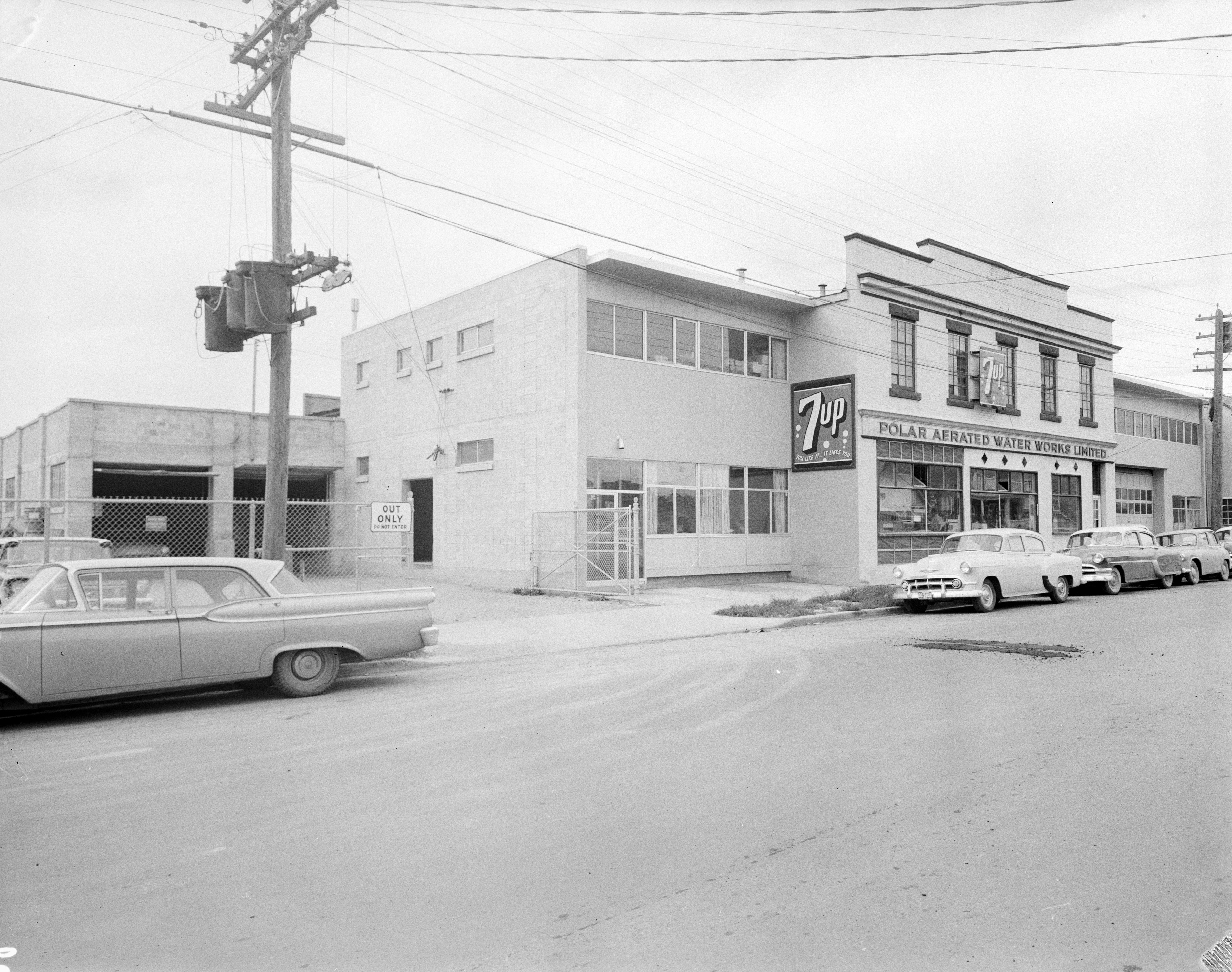
The public’s interest in consuming soda continued into the late 20s and demand for Polar’s products was sufficient to necessitate construction of a larger factory in 1929 at 129 3 Avenue East. This larger space enabled the Pearlmans to continue following the general trends in soft drink manufacturing. This included bottling an increasing number of national brand franchise products, including two major brands they added during the 1930s: 7-Up in 1935 and Orange Crush in 1939. Polar was one of the first companies in Canada to secure a franchise to bottle 7-Up, and the brand quickly became a top seller for the company. By 1953, 7-Up sales accounted for nearly 47 per cent of the company’s bottled pop sales; by 1966, that figure had increased to over 68 per cent of the nearly 376,000 bottles and cans produced by Polar. Initially, these national brands complemented Polar’s own flavour lines, which still accounted for 30 per cent of the bottles produced by the company in 1953. However, sales of Polar’s own flavours dropped dramatically through the decade and Polar ceased producing its own flavour lines in 1961.
The 1960s and early 1970s were a challenging period for family-run soft drink manufacturers. Increased competition from grocery store chains launching their own soda lines, improved highways and the growth of the more easily-shipped canned soda all contributed to a reduced need for local bottling plants. In 1960, there were 514 registered soft drink manufacturers in Canada, with 24 in Alberta. But by 1979, the national total had dropped by over half to just 253, with 15 in Alberta.
For Polar, this period was transformational. In 1960, Polar invested in constructing a factory in Lethbridge under the name Seven Up (Lethbridge) Bottling Company. This move improved service delivery to southern parts of the territory, which extended from the mountains east to Brooks and from Red Deer south to the US border. Then came the next generation into ownership of the family business as Sam Hamer, Abe Pearlman’s son-in-law, was set up as the manager. This move proved beneficial in the aftermath of Abe Pearlman’s passing in 1965 and Ben’s decision to retire. Despite offers from other bottlers in western Canada looking to expand, the family decided to retain Polar and by June of 1967 the company had been sold to Abe’s 3 sons-in-law Samuel Hamer, Ben Torchinsky and William (Bill) Tax.
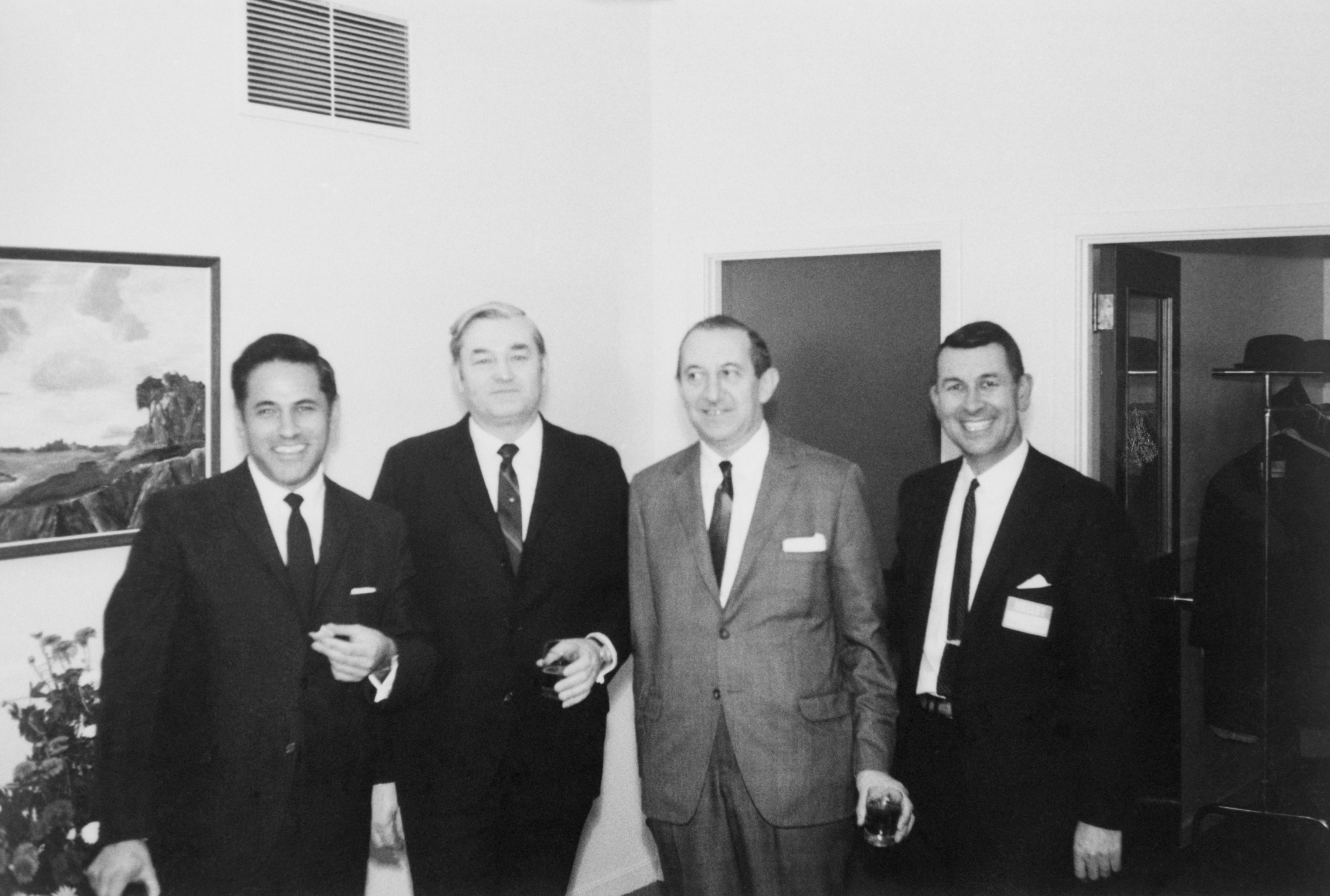
One of the first actions of the new owners was to begin planning for a new factory for what they were now publicly referring to as Polar Beverages Ltd. Construction on the facility proceeded quickly and by November 1968, the new 56,000 square-foot plant located at 1010 42 Avenue SE, was officially opened, featuring a new bottling plant and Southern Alberta’s first soda canning line. These moves enabled Polar to take on bottling a much larger range of national brands as well as contracts with most national brands to can their products for distribution in western Canada.
Early in 1969, Polar underwent another change in ownership as Ben Torchinsky acquired full control of the company from his two brothers-in-law through his company, AGRA Vegetable Oil Products Ltd. (AGRA) of Saskatoon. AGRA soon also acquired Sam Hamer’s Seven Up (Lethbridge) Bottling Company as well as Chinook Beverages, also in Lethbridge, to further solidify their position as a major soda manufacturer in southern Alberta. Through these acquisitions, AGRA held franchise and canning agreements for most national brands.
On the surface, the takeover of Polar by AGRA, a large and diversified corporation that had its roots in other industries, may be seen as the end of the family-run business. However, in the 1972 Annual Report, Ben Torchinsky indicated that the company still valued its familial roots in its operations:
“On the surface, AGRA may seem to consist of a widely assorted group of companies with no common ground, but there are in fact two common denominators. Firstly. all four of our operating divisions represent areas of activity where my associates and I, or my family, had established profitable operations long before these activities became part of AGRA. In bottling, for example, my father-in-law obtained the original Seven-Up franchise in Calgary in 1936…. My second point is that, without underrating the fact that special knowledge and skills are required in various commercial areas, I have found that successful results can be achieved in any business—if sound principles are followed.”
AGRA furthered its investment in soft drink manufacturing in 1973 through the acquisition of Blue Label Beverages of Calgary, who held the Pepsi and Schweppes franchises for southern Alberta. This move had significant impacts for Polar Beverages as, in 1974, AGRA consolidated its Calgary bottling operations at the Polar factory and decided to drop the public use of Polar Beverages in favour of the Blue Label brand. While ‘Polar’ lived on as a corporate entity under the AGRA umbrella, for the first time since 1914, the name was not being published on bottles in the Calgary area. It was the end of an era.
Polar epitomizes the small, family-run soft drink manufacturers that emerged in western Canada during the early 20th century. Prudent decisions by the owners allowed the company to capitalize on growing interest in soft drinks, be at the forefront of national brand franchising and soda canning in the Calgary marketplace and to incorporate the next generation of the family into business ownership so as to sustain family control in an era of consolidation. As a result, Polar-branded products were available to consumers in southern Alberta for 60 years.
 RETROactive