

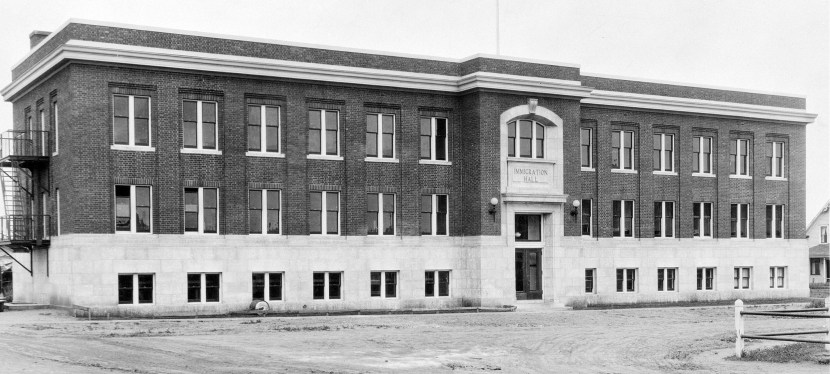
Editor’s note: The banner image above is a new Edmonton immigration hall completed in 1930. Source: Library and Archives Canada, Department of Public Works fonds, 1959-106 (PA-181012).
Written by: David Monteyne, Professor, School of Architecture, Planning and Landscape, University of Calgary
As noted in a previous RETROactive blog entry, Calgary’s 1885 immigration hall was the first in Alberta, and that was because the federal government tended to build them along the CPR mainline, closely following the progress of the Dominion Land Survey. The Calgary and Edmonton Railway soon stretched north, arriving in Strathcona on the south side river in 1891.
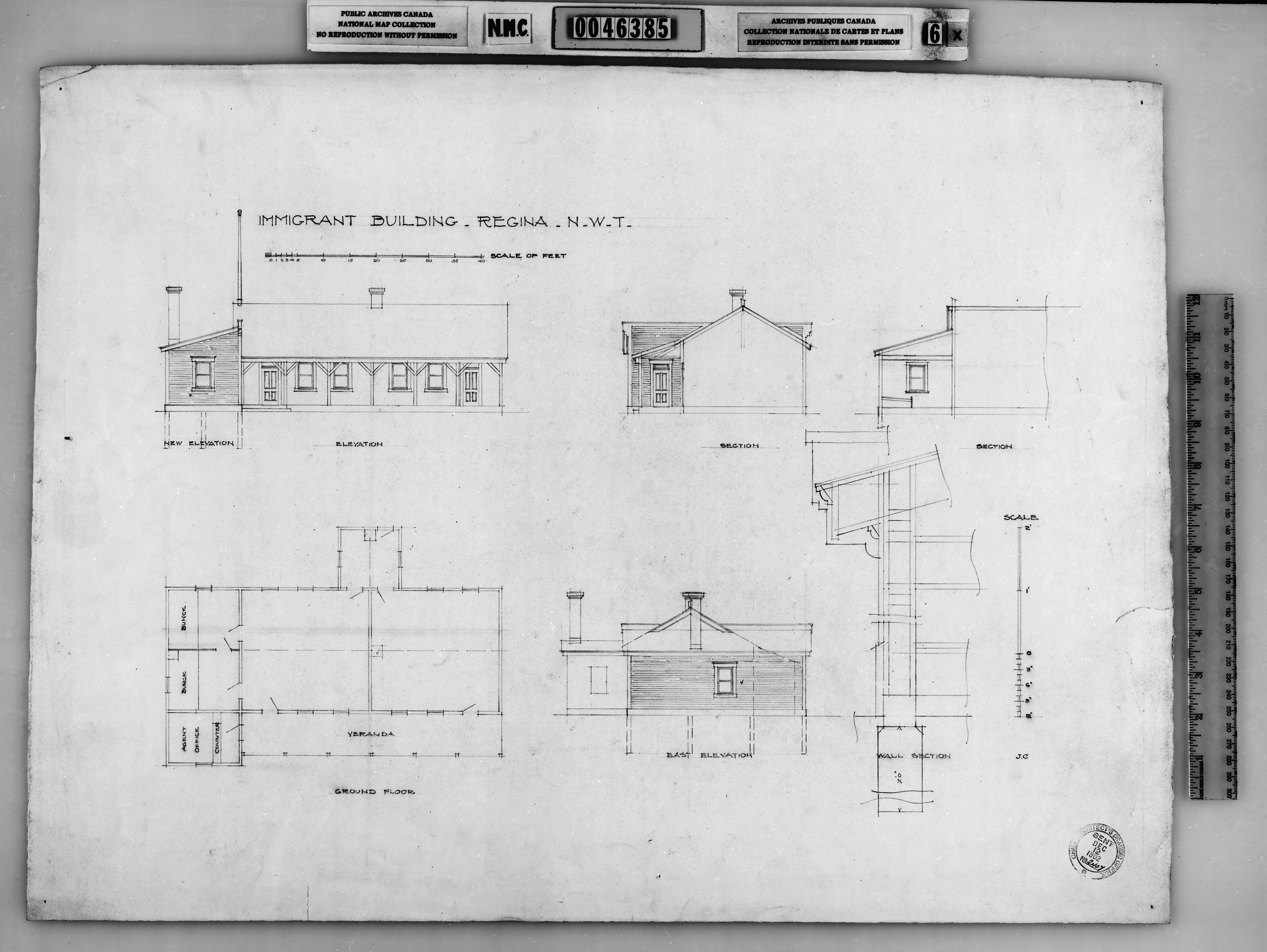
The first immigration hall there was erected the following year, just north of the terminus. Modeled on Regina’s first hall—designed by Canada’s Department of Public Works (DPW) and built two years earlier—this wood-frame Strathcona building had a single storey, two rooms sharing a wood stove, a kitchen bump-out at the back and an ell with rooms for luggage storage and a resident caretaker. A veranda stretched across the front of the building, with entrances at either end. As the government was concerned with sex segregation on the frontier, the two rooms of this small building did not have an interior connection.
This hall proved rather inadequate, particularly for segregation and privacy among immigrants. Because the rooms shared the wood stove, it was possible to see from one into the other. A French Catholic priest who guided group migrations, complained to immigration officials that the Strathcona hall was, “absolutely unfitted to receive and lodge the families” because they would be exposed to (especially) Eastern European immigrants who knew, “nothing at all of the laws of decency.” A government inspector would agree, noting that, “the better class of immigrants do not use the building” because, “men, women and children are mixed up without any chance of privacy.”

 RETROactive