


Editor’s note: The banner image above featuring James Hargrave family, Medicine Hat, Alberta ca. 1887-1888, is courtesy of the Glenbow Library and Archives Collection, Libraries and Cultural Resources Digital Collections, University of Calgary.
Author Julia Stanski is a scholar and recent MA History grad from the University of Alberta. Her research centers on western Canadian women’s history in the Victorian and Edwardian periods.
Written by: Julia Stanski
If you think about women’s history in relation to Alberta, the first thing that comes to mind is probably the Famous Five, a group of women whose activism earned Canadian women the legal status of “persons” permitted the rights and privileges of “qualified persons,” including the possibility of being appointed to the Senate. Emily Murphy, Nellie McClung, Louise McKinney: these are names that most Albertans have seen before, in social studies textbooks and on statues and parks. But today, I want to introduce you to another woman from Alberta’s past: Lillian Adkins.
She was not a famous author or speaker. There are no statues of her. But many Albertans can trace their roots to women like her. Lillian spent roughly five years of her youth working as a domestic servant in what became Edmonton.
Despite the strong “pioneering” ethos around Alberta’s heritage, not everyone who settled here was a farmer. Thousands of the people who arrived as immigrants settled in towns or cities and began their lives in Canada in working-class jobs; for generations of women, that meant domestic service. In the late 1800s and early 1900s, it was one of the only jobs available to working-class women in the prairie west. And during this time, settler populations on the prairies were growing quickly and creating a strong demand for servants. Ministers of the Interior Clifford Sifton (1897-1905) and then Frank Oliver (1905-1911) ran intense promotional campaigns to draw British and American settlers to western Canada. In 1871, the combined population of (what would become) Manitoba, Saskatchewan, and Alberta was 43,000. By 1911, it had ballooned to 1,328,000 and by 1921 it reached 1,956,000. And many of these settlers wanted or needed help running their households.
Of course, the lands to which they arrived were not empty. Indigenous people had lived in present-day Alberta for millennia. But during the late nineteenth century, the signing of treaties and the establishment of the reserve system displaced many First Nations’ people from their traditional territories and opened the way to mass Euro-Canadian settlement.
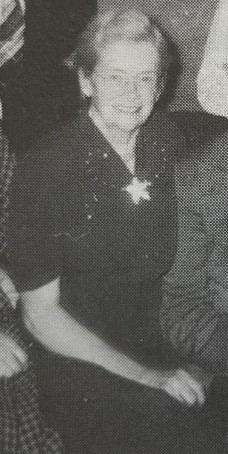
Like so many settler women of this time, Lillian was born in England. She arrived in Canada in 1906 at age 20, and within three months she was working as a servant for the Malone family in Strathcona. As a young, single, working-class woman, Lillian was typical in many ways of servants in Alberta in this period. More than 90 percent of domestic servants in Canada were female in this era, and most of them were between the ages of 14 and 25.
What did her life look like in this job? Domestic service was unregulated in this period, with no legal standards controlling hours of work, living conditions or minimum wage. So it would depend entirely on the people she worked for. The Malones only kept one servant, like most Canadian employers, so Lillian would have been a general servant. She may have cooked and served meals, washed dishes, swept, dusted, scrubbed floors, made beds, carried wood and water and waited on guests. She might also have done the family’s laundry (an exhausting and time-consuming task) and looked after their children. For all this, Lillian probably earned between 10 and 20 dollars a month.
Most servants in towns and cities lived in their employers’ homes, which could be both good and bad. It meant they didn’t have to pay rent or buy food for themselves, but it also made them dependent on their employers for the quality of their food and living space. Working in private homes also meant domestics were essentially invisible to anyone outside the household, leaving them vulnerable to both physical and sexual abuse.
Unlike most workers today, servants didn’t have formal working hours. They might have some time to themselves in the afternoons or evenings when they finished their daily tasks, but they were on call whenever their employers wanted them, and their workdays were almost always long. Especially in one-servant homes, domestics could also be very lonely. They were typically considered socially inferior to their employers, and they often had to wear a uniform, eat separately from the family and behave submissively. Their employers might even make rules about what they could do with their weekly afternoon or day off; many discouraged or outright banned their maids from having romantic relationships. Others forbade their servants from inviting friends or family to visit them on their days off.
We don’t know how the Malones treated Lillian, or whether she was happy in this job. All we know is that by June 1911, she was instead working for the Rutherford family (headed by Alexander Rutherford, Alberta’s first premier and founder of the University of Alberta). And in November 1912, she escaped from domestic service into the future envisioned for most servants; Lillian married Arthur Stanley, an English farmer living in Westlock. The couple eventually had five children and 12 grandchildren.
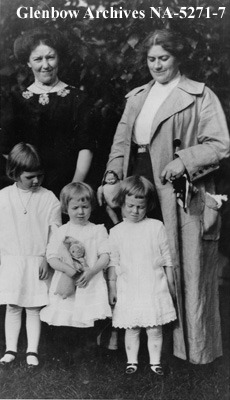
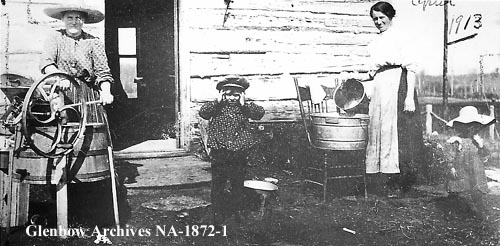
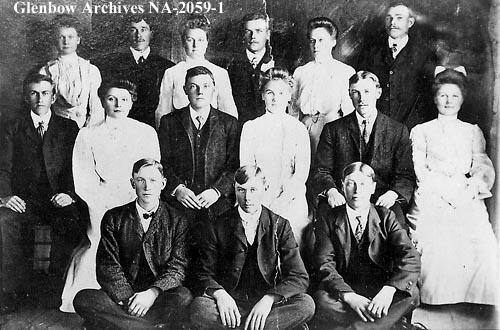
Why does her story matter? Because Alberta’s history is full of women like Lillian. Servants were all over the province in its early days, in wealthy and middle-class homes, on farms, working in hotels and boarding houses and hospitals. Their presence and labour (domestic, reproductive and otherwise) was just as important in building the province as the work of women like Nellie McClung, and even of “great men” like Alexander Rutherford. But because they were young, poor, single and female, doing domestic work that is still devalued today, shockingly few of their stories have survived and even fewer are widely known. Maybe it’s worth looking back into your own family tree; were your great-grandmothers or great-aunts part of the legions of women whose invisible household labour allowed wealthy men and women to campaign for social causes and found universities? Lillian’s life reminds us that the landscape of Alberta’s past is broader and more complex than it may seem, and that the diverse women who built our province have many stories still to tell.
Sources
Barber, Marilyn J. “Below Stairs: The Domestic Servant.” Material Culture Review 19, (spring 1984): 37-46. https://journals.lib.unb.ca/index.php/MCR/article/view/17193.
Calgary Weekly Herald, 1883-1901. Peel’s Prairie Provinces, University of Alberta. http://peel.library.ualberta.ca/newspapers/CWH/.
Carter, Sarah. Imperial Plots: Women, Land, and the Spadework of British Colonialism on the Canadian Prairies. University of Manitoba Press, 2016.
Fahrni, Magda. “‘Ruffled’ Mistresses and ‘Discontented’ Maids: Respectability and the Case of Domestic Service, 1880–1914.” Labour/Le Travail 39 (1997): 69–97. https://doi.org/10.2307/25144107.
Friesen, Gerald. The Canadian Prairies: A History. University of Toronto Press, 1984.
Grain Growers’ Guide, 1909-1919. Peel’s Prairie Provinces, University of Alberta. http://peel.library.ualberta.ca/newspapers/GGG/.
Lacelle, Claudette. Urban Domestic Servants in 19th-Century Canada. Ottawa: Environment Canada Parks, 1987.
Lenskyj, Helen. “A ‘Servant Problem’ or a ‘Servant-Mistress Problem’? Domestic Service in Canada, 1890-1930.” Atlantis 7, no. 1 (1981): 3-11.
Sager, Eric W. “The Transformation of the Canadian Domestic Servant, 1871–1931.” Social Science History 31, no. 4 (2007): 509-537. https://www.jstor.org/stable/40267952.
Salverson, Laura Goodman. Confessions of an Immigrant’s Daughter. University of Toronto Press, 1939.
Stanski, Julia. “Uncovering the Rutherford Maid: Gender, Class, and Representation in Living History.” Active History. Published March 8, 2024. https://activehistory.ca/blog/2024/03/08/uncovering-the-rutherford-maid-gender-class-and-representation-in-living-history/.
Sykes, Ella. A Home-Help in Canada. Smith Elder & Co., 1912. http://peel.library.ualberta.ca.login.ezproxy.library.ualberta.ca/bibliography/3656.html.
Westlock History Book Committee. 80 Years of Progress. Westlock History Book Committee, 1984.
Wolfe, Patrick. “Settler Colonialism and the Elimination of the Native.” Journal of Genocide Research 8, no. 4 (2006): 387-409.
 RETROactive