

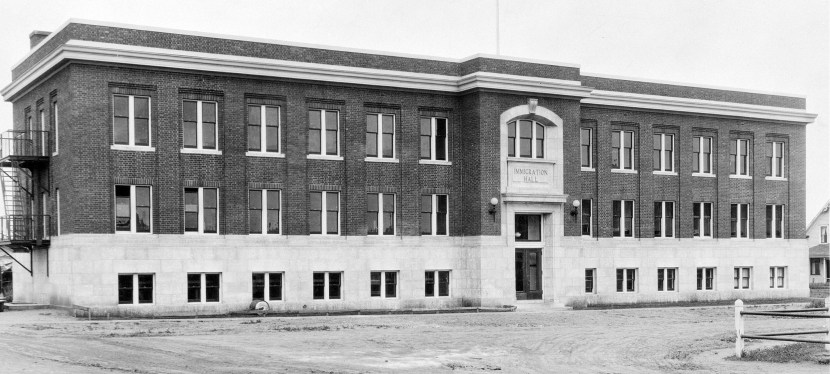
Editor’s note: The banner image above is a new Edmonton immigration hall completed in 1930. Source: Library and Archives Canada, Department of Public Works fonds, 1959-106 (PA-181012).
Written by: David Monteyne, Professor, School of Architecture, Planning and Landscape, University of Calgary
As noted in a previous RETROactive blog entry, Calgary’s 1885 immigration hall was the first in Alberta, and that was because the federal government tended to build them along the CPR mainline, closely following the progress of the Dominion Land Survey. The Calgary and Edmonton Railway soon stretched north, arriving in Strathcona on the south side river in 1891.
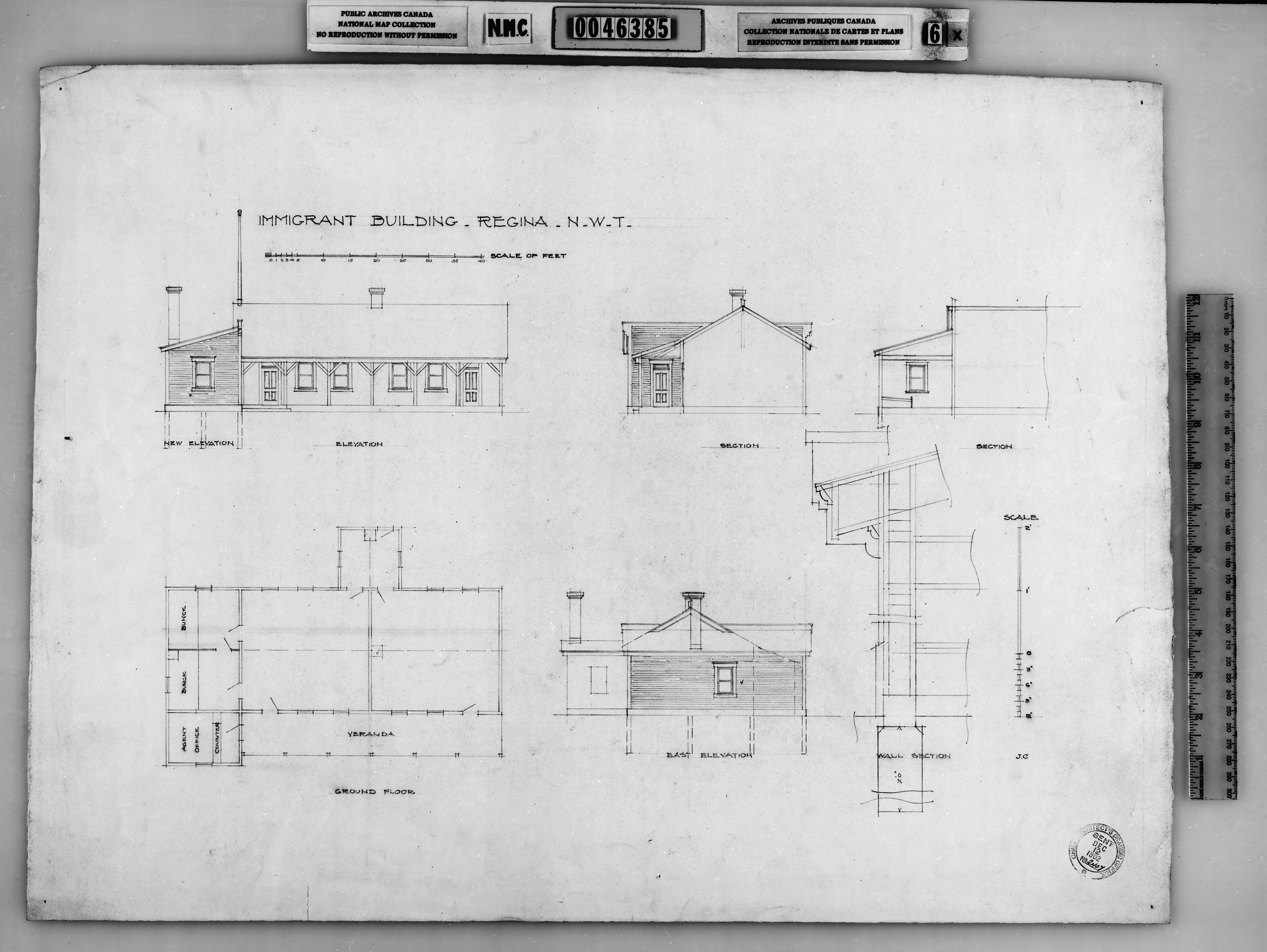
The first immigration hall there was erected the following year, just north of the terminus. Modeled on Regina’s first hall—designed by Canada’s Department of Public Works (DPW) and built two years earlier—this wood-frame Strathcona building had a single storey, two rooms sharing a wood stove, a kitchen bump-out at the back and an ell with rooms for luggage storage and a resident caretaker. A veranda stretched across the front of the building, with entrances at either end. As the government was concerned with sex segregation on the frontier, the two rooms of this small building did not have an interior connection.
This hall proved rather inadequate, particularly for segregation and privacy among immigrants. Because the rooms shared the wood stove, it was possible to see from one into the other. A French Catholic priest who guided group migrations, complained to immigration officials that the Strathcona hall was, “absolutely unfitted to receive and lodge the families” because they would be exposed to (especially) Eastern European immigrants who knew, “nothing at all of the laws of decency.” A government inspector would agree, noting that, “the better class of immigrants do not use the building” because, “men, women and children are mixed up without any chance of privacy.”
By 1899, the first hall was replaced with a new model, first rolled out in Dauphin, Manitoba, and used for several structures across the Prairie provinces. This new design was two storeys and five window-bays wide, with a single, central entrance and central stair. Stoves and chimneys on both sides of the central core now distributed heat more evenly. Inside, there were two common rooms on the ground floor, plus two dormitories and two family bedrooms upstairs. Although architectural plans from the DPW continued to label rooms by gender, immigration officials on the ground acknowledged that, “divisions for men and women will not be strictly adhered to.” Unique to Strathcona, which was becoming a major hub for immigrant reception at the time, a long annex to the rear of the new building housed a communal kitchen and dormitory above. After a change of government in 1896, Interior Minister Clifford Sifton had liberalized immigration policy, resulting in a huge influx of cash-poor homesteaders from Galicia (parts of present-day Poland and Ukraine) and elsewhere in continental Europe. Indeed, the Strathcona hall became a kind of community centre for Ukrainian-speaking settlers in the region and was fondly known as “The Emigrant.”
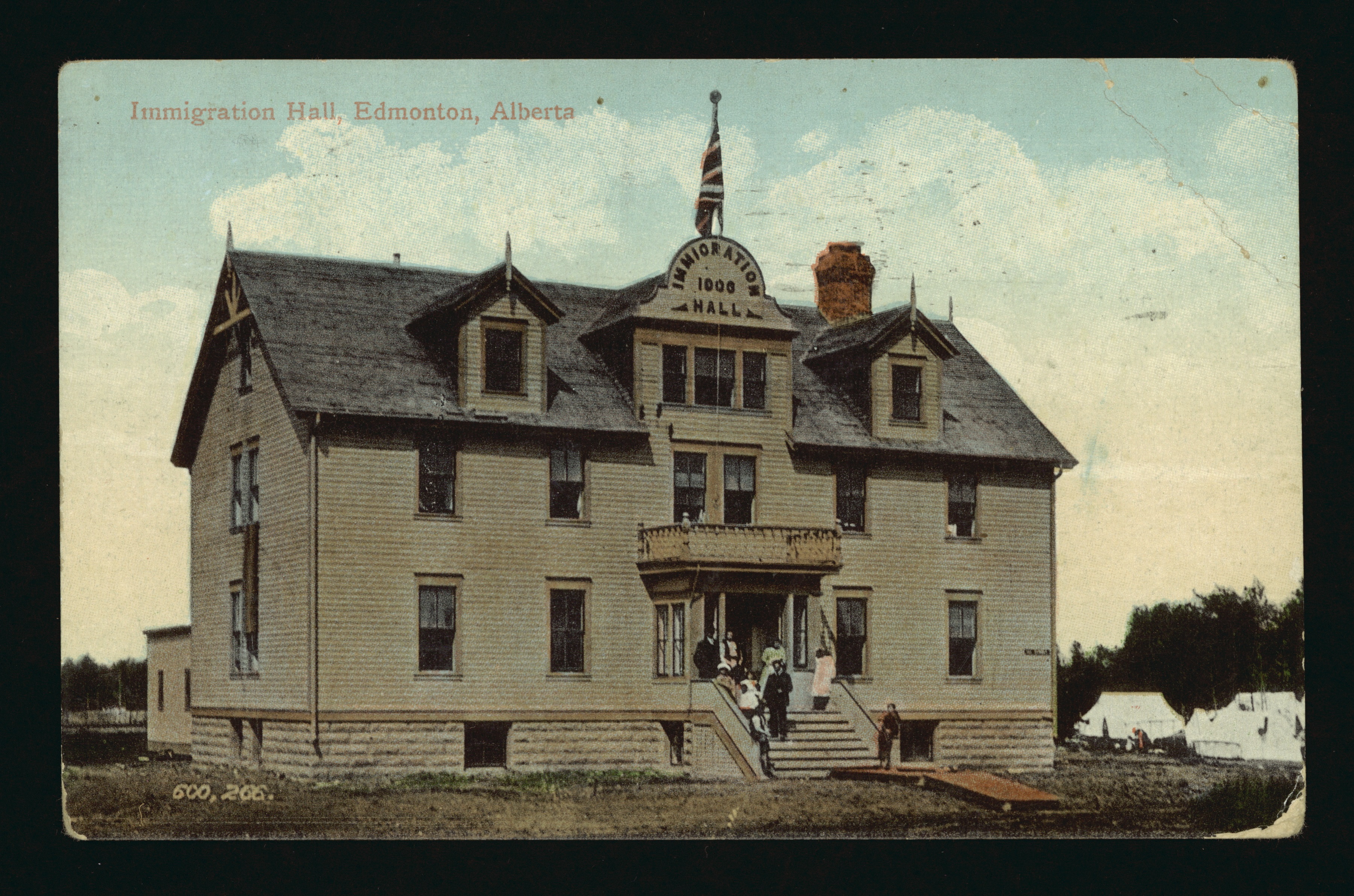
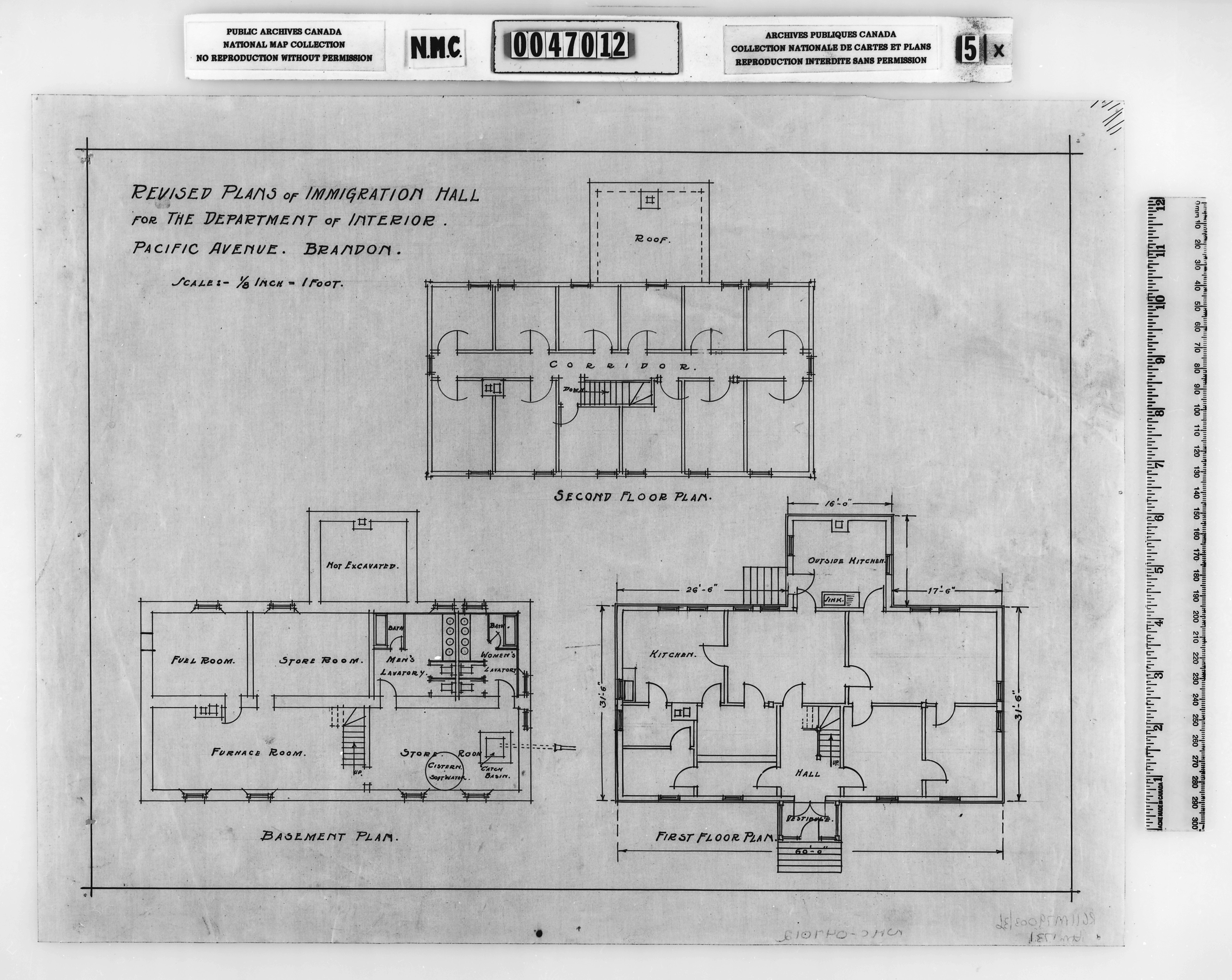
Many newcomers crossed over to the north side of the river looking for land and employment, and in the 1890s the government first rented space for use as an Edmonton immigration hall. With the arrival of the Canadian Northern Railway in 1905, Edmontonian boosters lobbied Ottawa for a new hall north of downtown. It didn’t hurt that local MP Frank Oliver became Minister of the Interior that year; by the following summer a new hall opened, and it was fancier than most. Although similar in form to the five-bay Strathcona hall, the Edmonton building boasted an attic story and a concrete basement with bathing facilities and a furnace – central heating being a big step up for immigration halls. The plan of this building was also more sophisticated than those built in Strathcona. An entrance foyer next to a caretaker’s suite helped control access and a series of common rooms and a communal kitchen wrapped around this lobby. Upstairs, large dormitories disappeared in favour of a dozen family-sized rooms arranged along a double-loaded corridor and in a pinch, the attic storey, marked by a series of decorative dormer windows, could accommodate an overload of single immigrants.
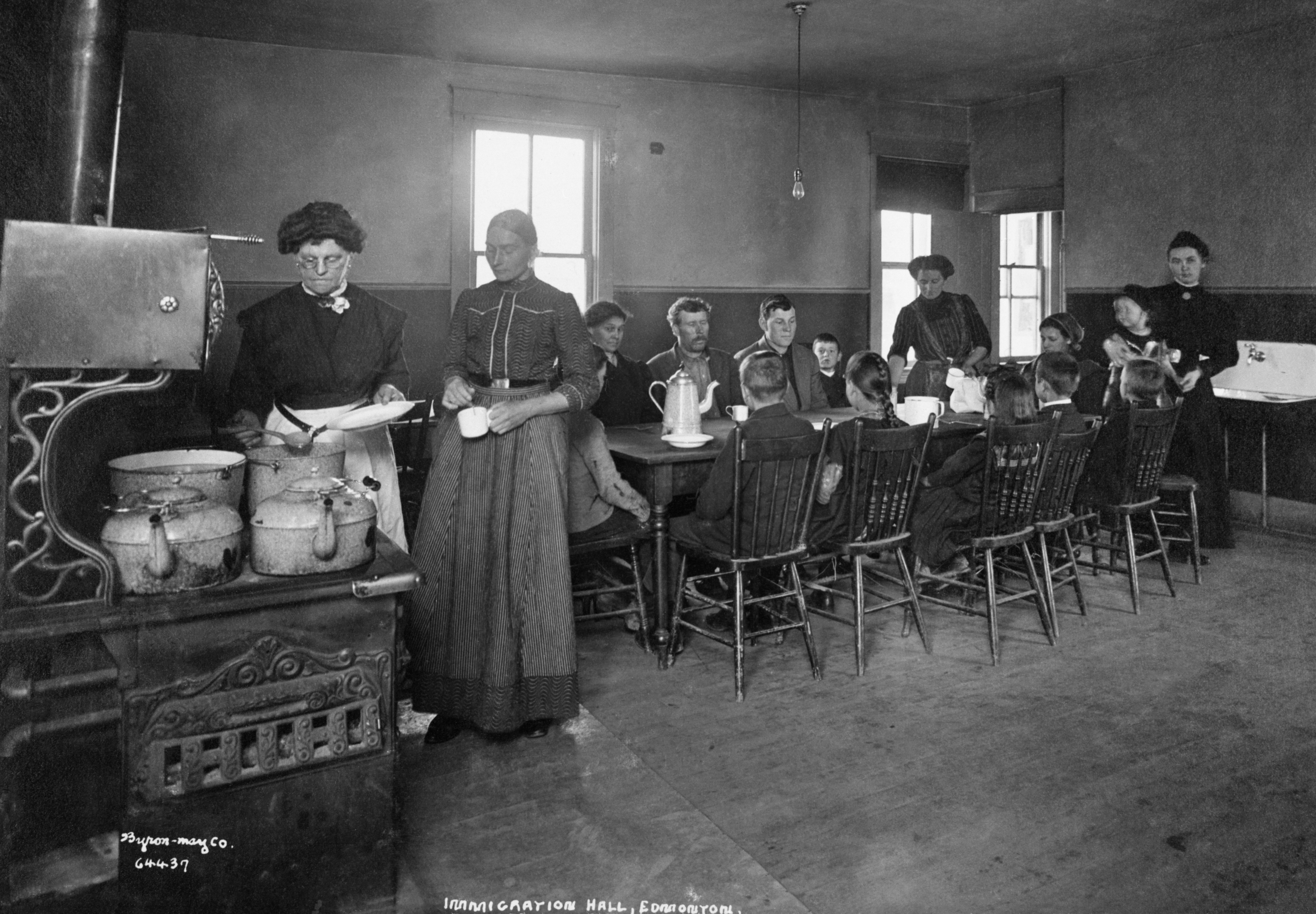
In the minds of immigration officials, this nice new hall would be reserved for, “English-speaking people” while the, “foreign speaking element” would be happy to accept the old hall in Strathcona. However, as with gender separation, ethnic segregation proved impossible to maintain due to the large number of arrivals. Even before construction commenced on the fancy new Edmonton hall, local immigration officials were warning that it would be too small for the traffic. Two slapdash additions were hastily erected in the first few years of its existence, connected by a kind of shed that sheltered the toilets. Moreover, the local press reported a gross “bungle” in the original contract let for the construction of the new hall, which somehow forgot to include the heating, plumbing and wiring. Overall, the building was a bit of a local embarrassment. (All the quotations in this entry can be found in my book.)
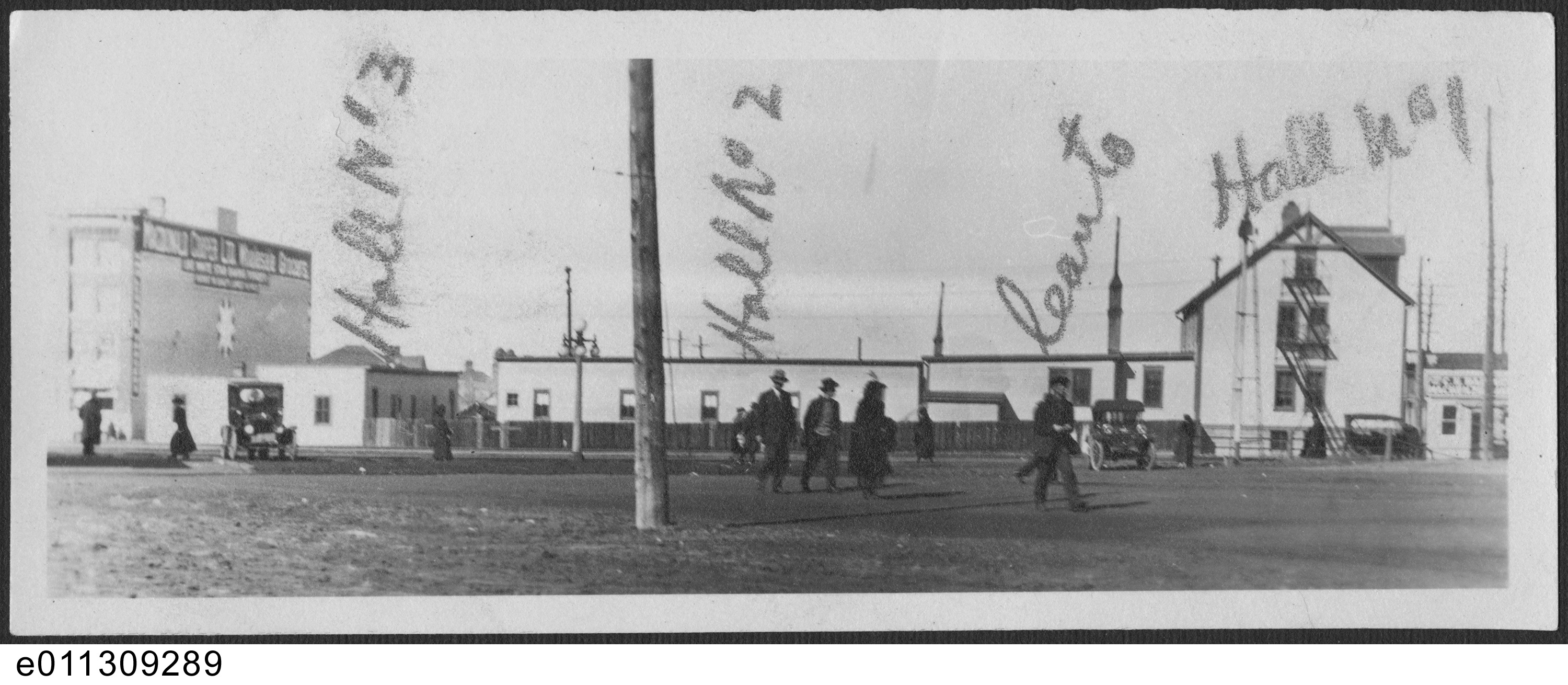
Despite the deficiencies of the Strathcona and Edmonton immigration halls, they continued to serve their purpose into the late 1920s. Before World War One, the immigration branch focused its architectural energies on smaller communities further west and north, such as Edson and Spirit River, and on a monumental headquarters building in Winnipeg. The war, influenza epidemic and a general recession in the early 1920s, reduced the pressure on immigration.
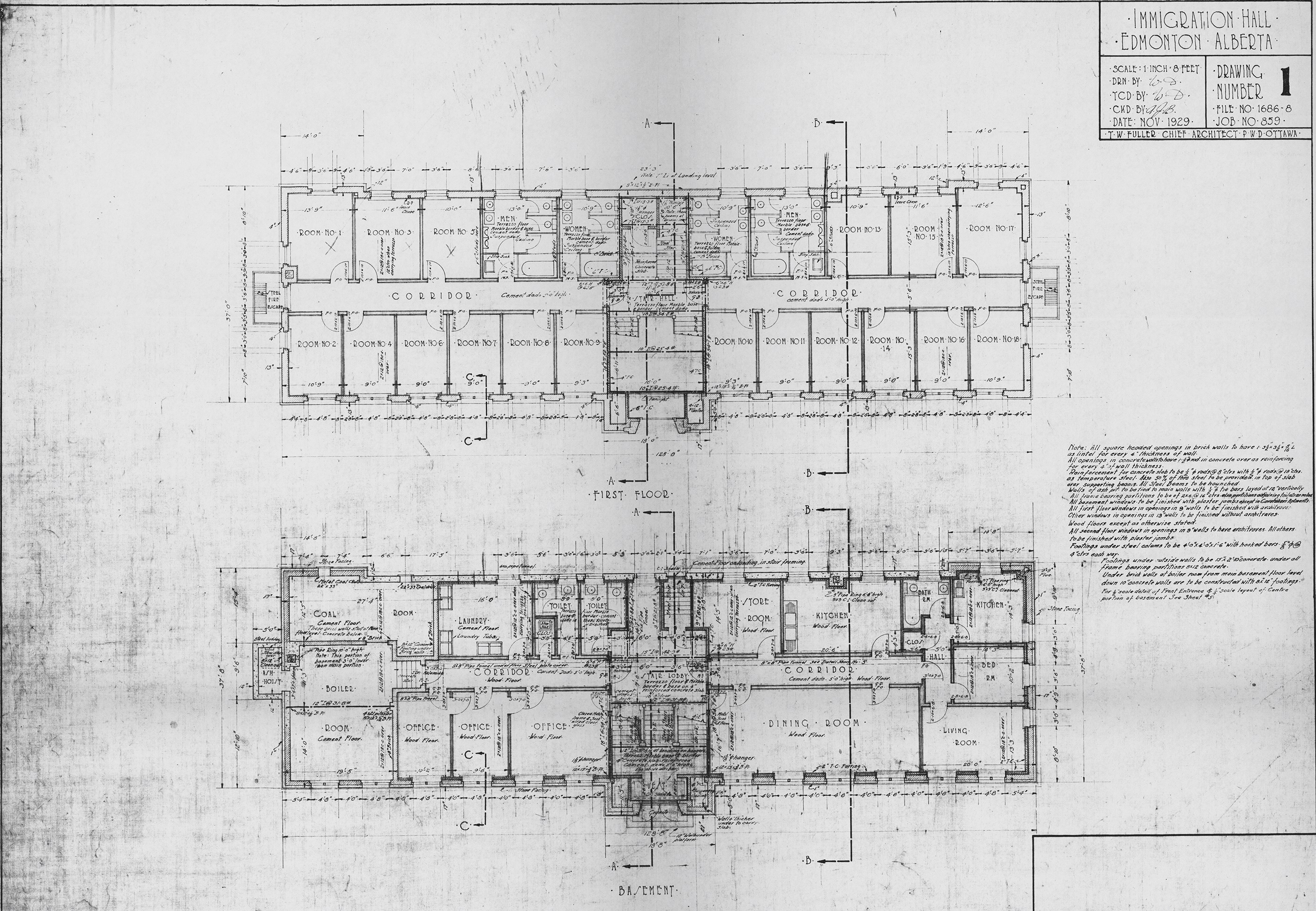
Immigration picked up again in the second half of that decade, particularly with the Railways Agreement which brought single farm, industrial and domestic labourers in great numbers. This led to the new construction of a few immigration halls in major distribution points, specifically Prince Albert, North Battleford and Edmonton. The country had developed, and the DPW had matured, so it was no longer specifying wooden sheds without architectural pretense. No, these three cities would receive proper brick and masonry government buildings with carved details and all modern conveniences. Prince Albert’s came first in 1927-28—it was, after all, the Prime Minister’s riding. Edmonton’s was the third of these three buildings. As its timing bumped up against the Great Depression and other factors, Ottawa nearly pulled the plug on the project; even immigration officials questioned the need for a new immigration hall. Nevertheless, construction proceeded with the building’s completion in late 1930. It hardly ever accommodated immigrants.
By 1929, the old Edmonton hall was occupied as a relief shelter for unemployed men, and there was pressure to use the new building for similar purposes. The Depression years, followed closely by the uncertainty of another war in Europe, curtailed immigration for a couple decades. By the 1950s, almost all of the Prairie immigration halls had disappeared: demolished, sold off or converted into government offices. The new Edmonton hall—with a 1954 addition at the back—served a brief uptick in immigration arrivals in the postwar period, before being converted to other government uses. Parts of the building became vacant in the 1970s. The renovations undertaken by Hope Mission in the 2010s have re-made it, appropriately, into another kind of transitional housing.
 RETROactive