
Castle Mountain to Mount Eisenhower and Back Again
In January 1946, General Dwight D. Eisenhower, Supreme Commander of the Allied Forces in Europe and future President of the United States of America, was on an official visit to Canada. Prime Minister Mackenzie King was seeking a fitting honour to bestow on the general. Sir Leonard Brockington, a friend and former aide of the Prime Minister’s, suggested that Banff National Park’s Castle Mountain be renamed in the general’s honour, adding, in a statement that proved to be astoundingly inaccurate, that because the mountain “was not named for any individual … no one could be offended by a change of name” (quoted in memorandum, Pickersgill to King, 7 January 1946). Reportedly against the objections of the Geographic Board of Canada, King announced the renaming during a state dinner on January 9. Recounting that the people of Scotland had recently presented Eisenhower with a castle, King said that
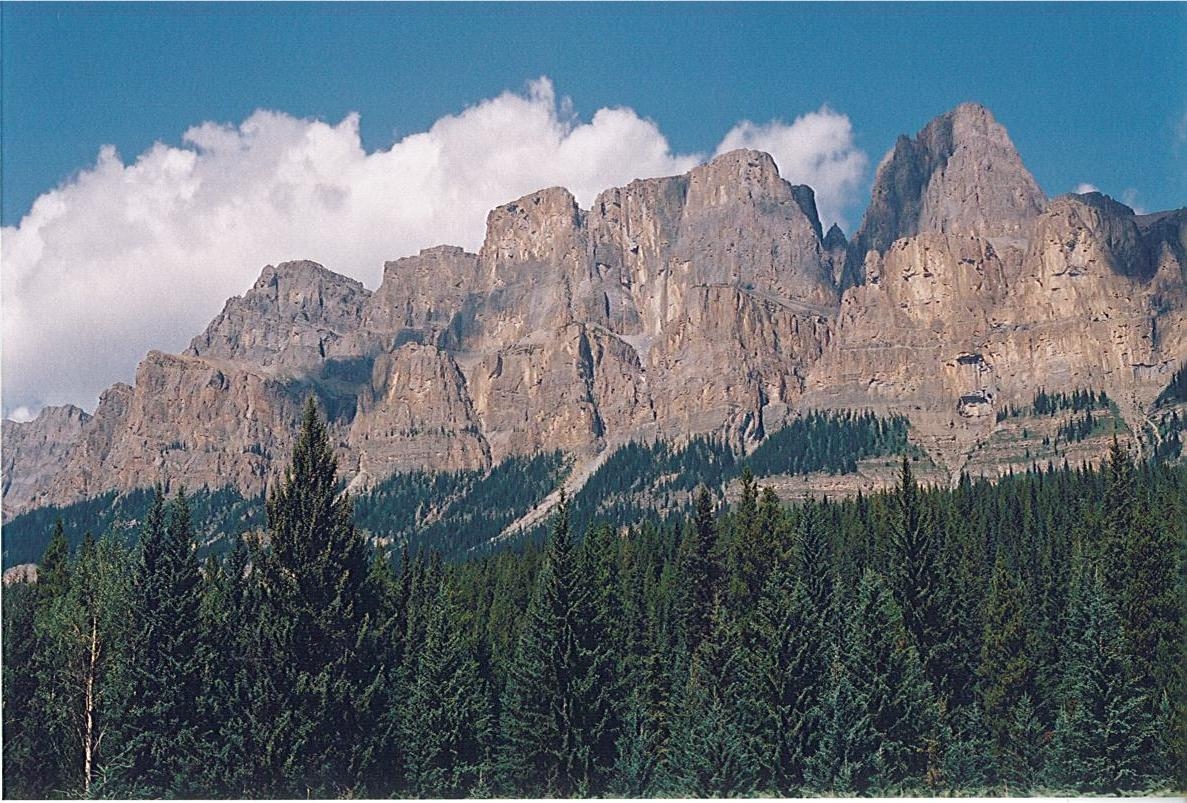
We have no ancient castles in this country, but we have other things that are even more enduring. We have ancient mountains. We can’t very well present you with a mountain, but we have this mountain named ‘Castle Mountain’ and it is the wish of the Government of Canada and of the people of Canada to change the name from ‘Castle Mountain’ to ‘Mount Eisenhower’.
Reportedly visibly moved, Eisenhower responded by saying that he was “touched by such a tribute that one man should be so honoured and his name so perpetuated in this way,” adding that “One day I am going to see that mountain. There is one thing, too, of which I am fairly certain – it must be a bald peak” (Ottawa Journal, 10 January 1946). The mountain became Mount Eisenhower and the junction of the two main roads in the area became Eisenhower Junction. Oddly, the Canadian Pacific Railway station in the area retained the name Castle Mountain.
Although the audience at the state dinner responded enthusiastically to the announcement, protests erupted from across Canada and even from the United States. The Vancouver Province wrote that
The gesture is a gracious one …it is a pity that the gesture will be futile. No one who has seen Castle Mountain can call it anything but Castle. The mountain named itself in the first instance. Its battlemented towers, its buttresses, its crenalated crags shout Castle, Castle, Castle, all day long. They can never be made to say Eisenhower [cited in the Banff Crag and Canyon, 18 January 1946].
The Banff Crag & Canyon wrote that “the man on the street is wondering why out of all the peaks and lakes in the Banff National Park, Castle Mountain should have been selected” [11 January 1946], and on 18 January added that
‘Residents of Banff were highly pleased when they learned Castle Mountain was to be called Mt. Eisenhower,” quotes one of the daily papers. Just which resident? … Letters and comments of protest are being published daily, which must sound a rather sour note to the supreme Allied commander as and if he reads them. Far be it for anyone to mean to belittle such a gesture, but two generations or more have known this mighty monarch of the Rockies as Castle Mountain, and it will take some educating to change its name. Surely the choice of another mountain would have been more in order [12 January 1946].
The Alpine Club of Canada wrote to the Prime Minister noting Eisenhower’s achievements, but lamenting the loss of the historic and uniquely descriptive name and also protesting the lack of consultation and the seemingly random selection of Castle Mountain to be renamed. Read more


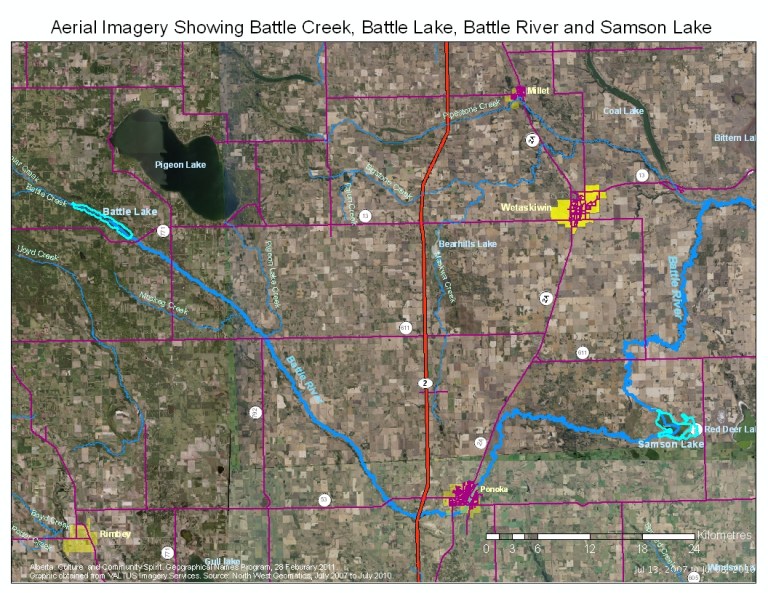 Battle Lake is fed by Battle Creek, which flows easterly into the lake at its north-westerly point. The creek was first recorded by the DLS as “Battle Lake Creek” in 1903. Two year later, the DLS shortened the name to Battle Creek, but the name was not officially adopted until 1960.
 RETROactive