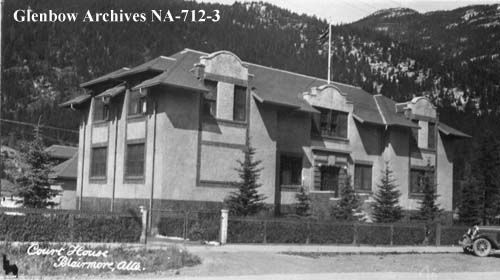
Peeling paint and powdering plaster were the first indications something was amiss at the Blairmore Courthouse, a Provincial Historic Resource in the Crowsnest Pass. A leak in the cedar shingle roof, replaced just the previous year, was immediately suspected. Detailing around the dormers in particular, part of the 1922 building’s distinctive Spanish Colonial Revival design by architect R.P. Blakey, is tricky and vulnerable to water penetration.
1920s view of Blairmore Courthouse from the southwest (Photo Credit: Glenbow Archives NA-712-3)
Nippon School of Technology, which owns the building and runs a technical school and exchange program for Japanese engineering students there, inspected the roof from the attic and found no active leaks. Puzzled, N.I.T. engaged a conservation architect to inspect the building and identify sources of moisture causing the paint and plaster failure. The findings were at once surprising and (in hindsight) credible. Read more →
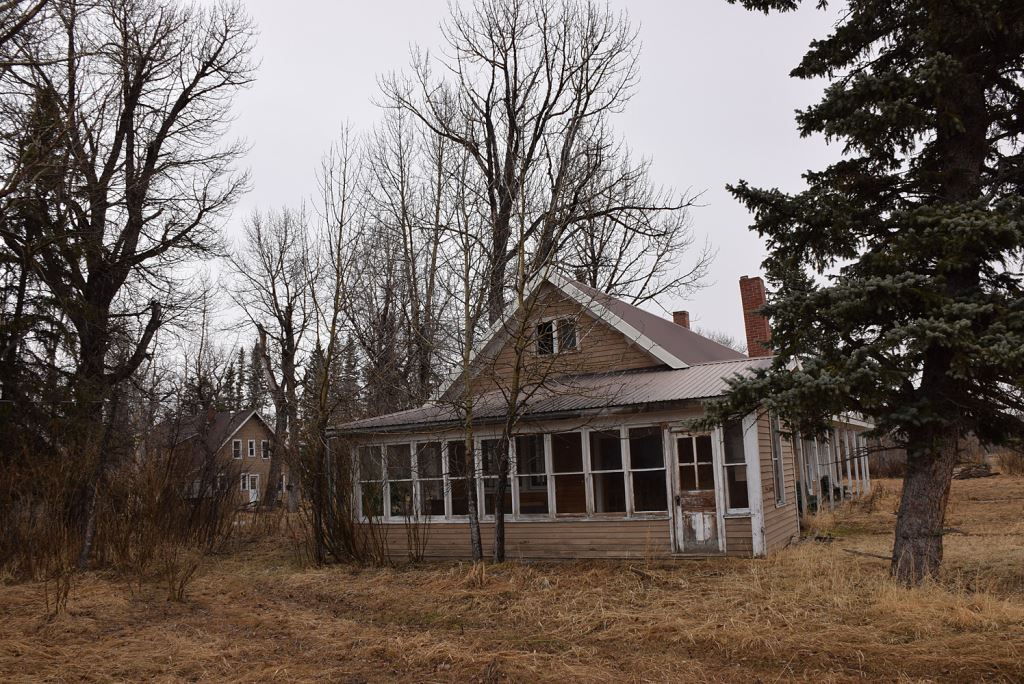
E.P. (Prince Edward) Ranch, established by the Bedingfeld family in 1886, is located in the foothills southwest of Calgary near the Bar U Ranch National Historic Site. In 1919, during a cross-Canada tour, the Bedingfeld’s ranch captured the fancy of His Royal Highness Edward, Prince of Wales, upon his visit to the area. Prince Edward purchased the ranch shortly thereafter from Frank Bedingfeld. Under Edward’s direction, the ranch developed a breeding program for sheep, cattle, and horses with livestock imported from the Prince’s breeding farms in the Duchy of Cornwall in England. Prince Edward, later King Edward VIII, visited the ranch in the 1920s and in the 1940s and 1950s, after his abdication, as the Duke of Windsor. Photographs in the Glenbow Archives show Edward and his wife Wallis Simpson, the Duchess of Windsor, strolling among the ranch buildings that still stand at the site today. The E.P. Ranch was designated a Provincial Historic Resource in 2004 for its association with Edward, who owned the site from 1919 to 1962. Fans of the 1992 movie Unforgiven will also recognize scenes shot on location at the ranch.
The main ranch (or Prince’s) house prior to restoration, April 2014.
In June 2013, the E.P. Ranch found itself at the epicentre of the torrential rains that flooded communities and historic sites across southern Alberta. Pekisko Creek overflowed its banks and swept through the site, turning grazing lands into a virtual river. While the large and distinctive horse barn was unaffected, four other buildings were damaged. Read more →
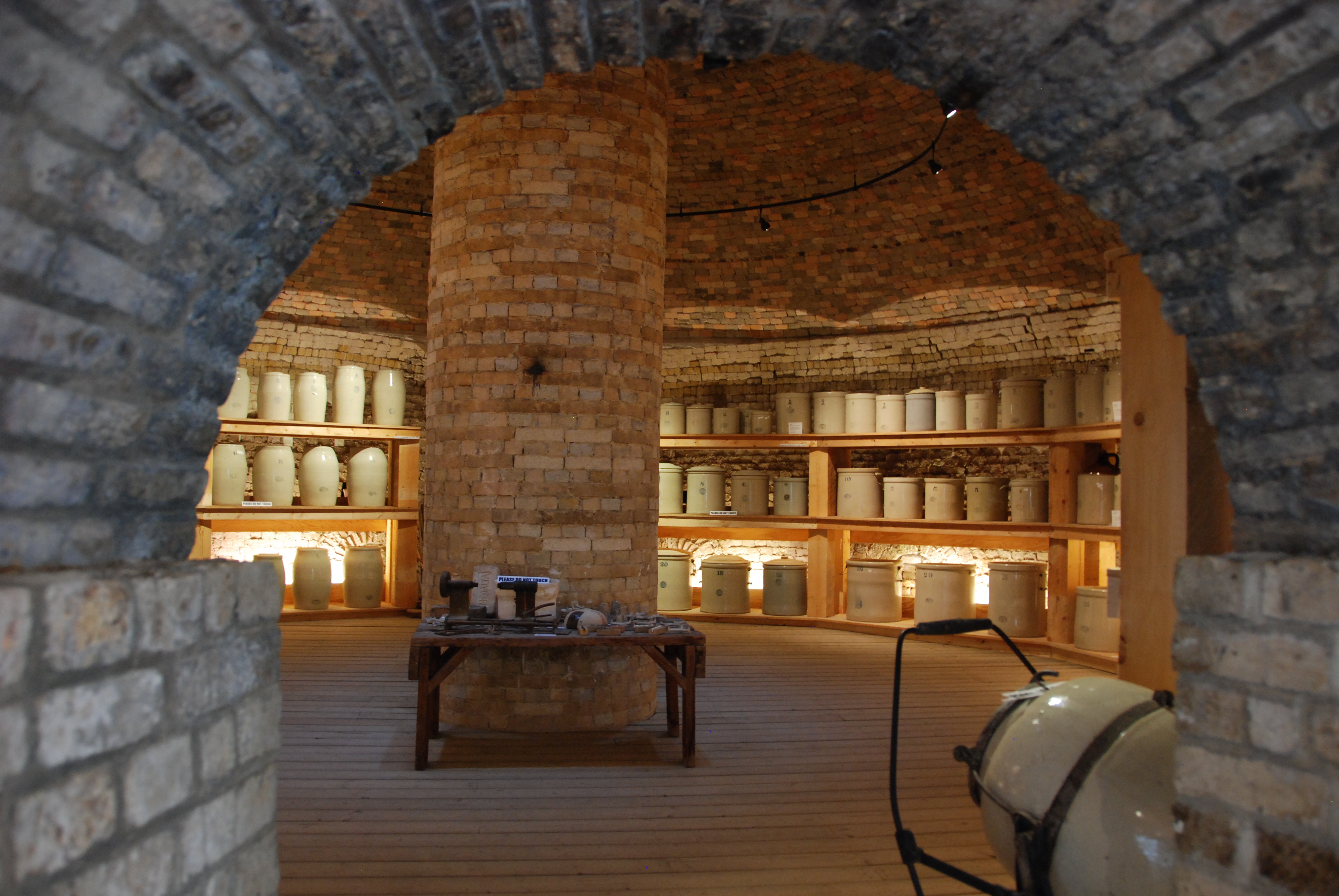
The first steps out onto the dome of the beehive kiln are a bit unnerving, with only a thin shell of tightly-fitted bricks supporting a small group of us above the void below. Domes structurally similar to this have been around since antiquity – many notable examples still survive – but it’s reassuring to know that scaffolding inside the kiln will prevent a painful and possibly career-ending collapse.
Kiln No. 2, one of four historic beehive downdraft kilns at Medalta Potteries, is a circular drum roughly ten metres in diameter with brick exterior walls surmounted by the dome and a tall central stack. Encircling the walls are wide adjustable bands of corroding steel which held the kiln together as it expanded and contracted and attest to the rigours of the firing process. Medalta’s beehive kilns historically fired a wide range of ceramic products and now serve as distinctive classroom and exhibit spaces.
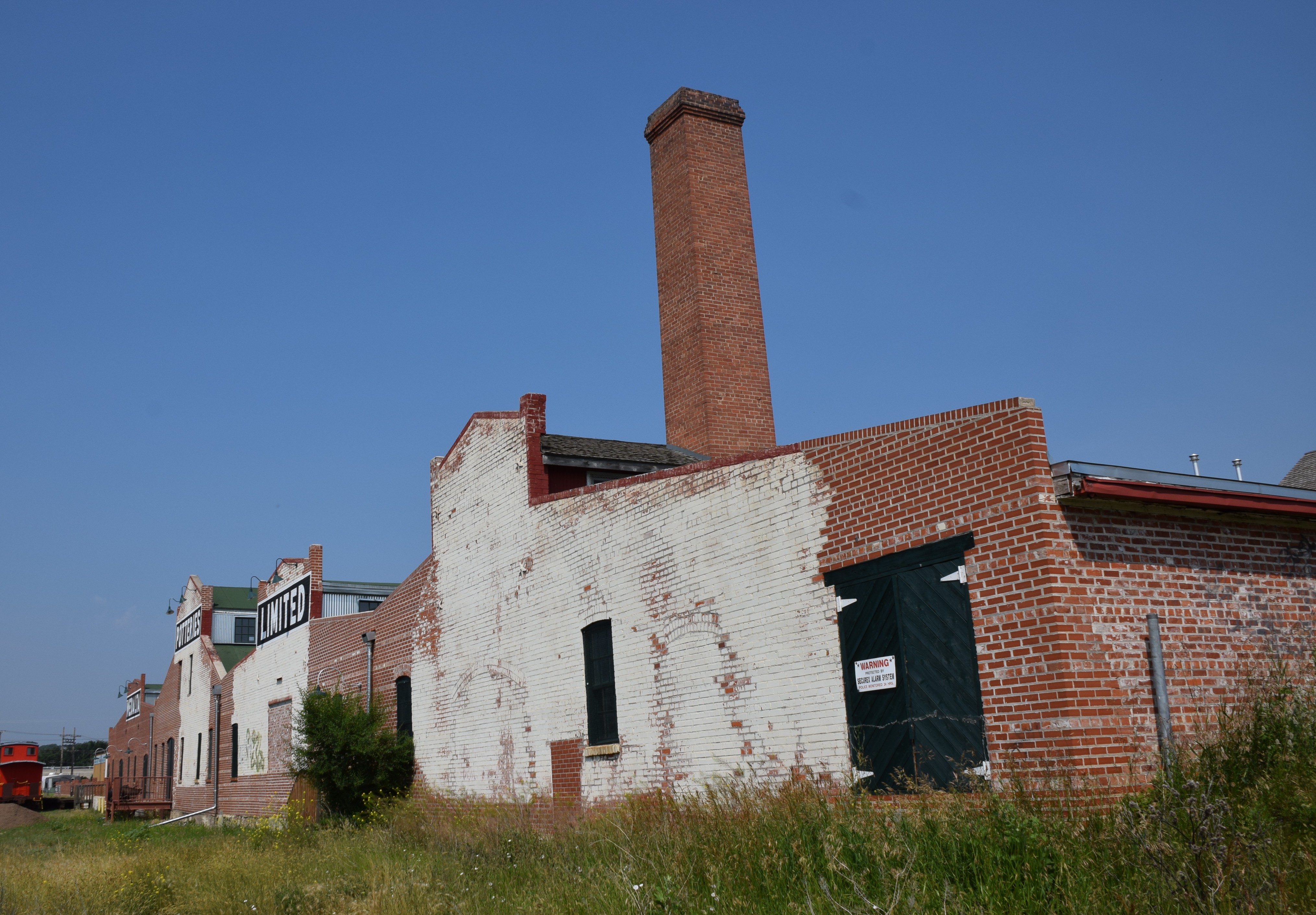
A massive brick chimney at Medalta Potteries towers six metres above the roof of “Building 10” and extends roughly the same distance from the roof to the dusty factory floor below. Two meters wide at its base, the chimney and accompanying boiler were vital in the production of clay products from the early decades of the twentieth century until the plant’s closure in the 1960s. Now a Provincial Historic Resource, Medalta Potteries in Medicine Hat has evolved into a vibrant community hub that includes the Medalta archives and interpretive centre, galleries and displays, a working pottery that reproduces classic Medalta ware, a contemporary ceramics centre for professional artists, and a venue for markets, weddings, concerts and other community events. The tall brick chimney and distinctive monitor roofs of the former factory buildings provide the iconic backdrop for these varied activities.
Medalta Potteries in 2014, looking west to Building 10 before rebuilding of the chimney.
Already leaning slightly to the south, the chimney developed a worrisome new tilt after the June 2013 southern Alberta floods, an event which inundated much of Medalta and the nearby residential neighborhoods. As soil conditions on site gradually normalized in early 2014, the chimney’s foundation shifted and subsided further into the clay-rich soil, raising concerns about its stability. The only practical long-term conservation option was to disassemble the chimney and rebuild it with the original, locally manufactured brick using traditional masonry materials and construction methods.
Conserving the chimney started with extensive photographs and measurements followed by disassembly by a contractor specializing in historic masonry conservation. Medalta’s staff archaeologist monitored and documented the process. As the chimney came down brick by brick, unexpected finds within the masonry included an old whisky bottle; fire bricks from Hebron, North Dakota; and a bizarre series of wasps’ nests occurring at roughly one metre intervals within the stack. This corresponds roughly with the work a team of masons would likely have completed in a typical day – a coincidence that begs further explanation. The chimney-dwelling wasps turned out to be quite blind and fortunately did not harass the masonry crew as dismantling proceeded.
The most intriguing relic, however, was a cluster of bricks inscribed with names and the inscription “IX 44”, presumed to represent a date. The names went unobserved until mortar dust from the disassembly process settled lightly onto the brick and highlighted the writing. Prisoners of war interned in Medicine Hat during the Second World War were recruited for work in local industries to offset the wartime labour shortage. Research now underway may reveal that some of these POWs, possibly even masons in their pre-war lives, helped repair the chimney at Building 10 in September of 1944.
Chimney rebuilding is nearing completion and will replicate its historic appearance — without the lean to the south. Glazed bricks set into the chimney mark the locations of the autographed bricks and, soon, visitors to Medalta will be treated to a new exhibit in Building 10 featuring the original bricks and an account of this chapter in the site’s remarkable history.
Written by: Fraser Shaw, Heritage Conservation Adviser
Prism glass: the stained glass used in storefront windows historically found in commercial buildings on main street. The shimmering, textured surfaces of original prism glass transom windows — running the width of a historic storefront above the main display windows — can be a rare treat when they’re intact.
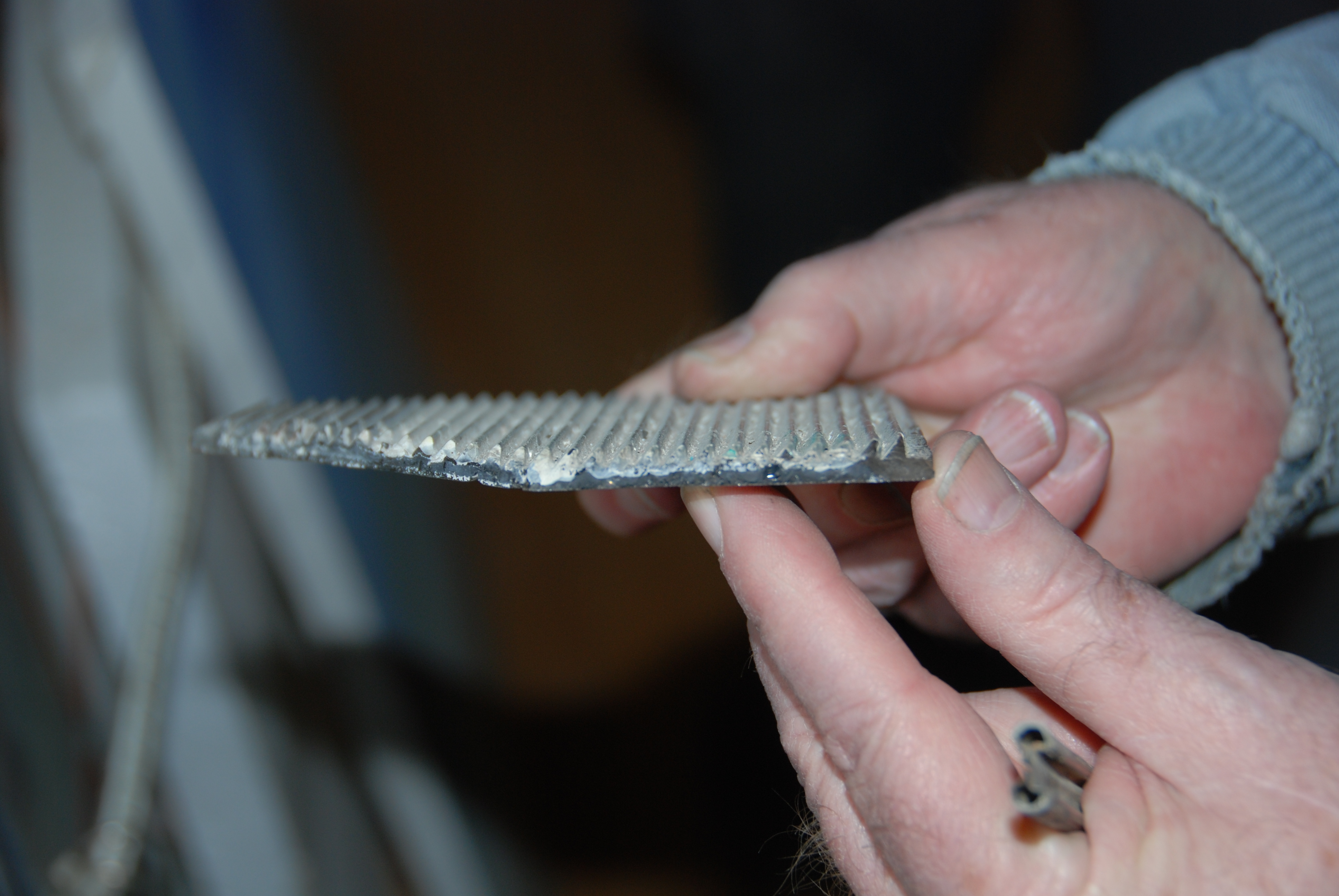
Sometimes referred to as clerestory windows, traditional transom windows on main street were sometimes equipped with special prism glass: sheets of glass composed of small panels, each roughly 15 cm square, featuring a distinctive prismatic or wedge-like pattern cast into the interior-facing surface (see photograph below). Some panels also featured patterns cast into the outer face too. Assembled into panels using cames, or narrow bars of lead or zinc, prism glass transom windows were popular in pre-World War I commercial buildings when interior electric lighting was relatively weak and inefficient. With sunlight free and plentiful, especially in Alberta, the prismatic panels were oriented in such a way as to capture incoming light and refract or deflect it deep into the store within.
A close-up of a piece of prism glass from the Renwick Building, a Provincial Historic Resource on Fort Macleod’s main street (Courtesy of Fraser Shaw, Historic Resources Management Branch).
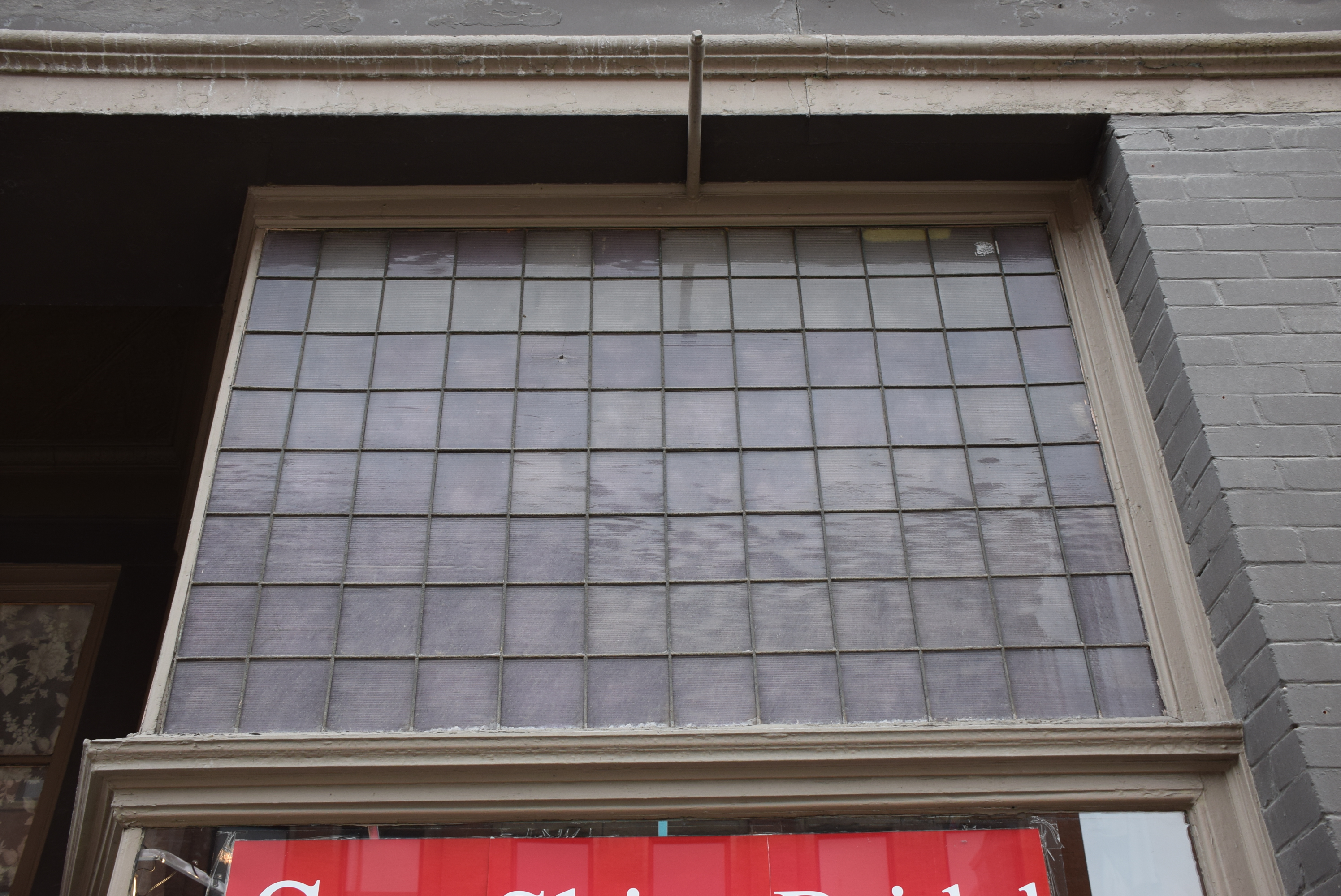
Given their relative rarity, the analogy to stained glass windows of churches and other buildings isn’t entirely out of place. Like stained glass, the glass itself is often coloured: manganese added during the manufacturing process to make the naturally green glass clearer often turned a purplish colour after decades of exposure to ultraviolet radiation in sunlight. (The colour also appears in some old telegraph line insulators and the now almost-vanished sidewalk “skylights” — which are a story of their own). You can spot prism glass in certain parts of Calgary and Edmonton and on some of Alberta’s historic main streets, although it is easily mistaken with so-called “reeded” glass, similar glass panels impressed with narrow ridges rather than the unique prismatic profile specially oriented to pull sunlight into store interiors. Sometimes only close inspection can distinguish the two.
Why is prism glass so rare now? Like many features of historic buildings, particularly in the commercial district, these components were subject to changing fashion, retailing trends and, of course, the rigours of our climate. The benefit of prism glass and transom windows declined as electric lighting improved in efficiency and affordability, particularly with the mid-century introduction of fluorescent lighting. Prism glass transom windows were traditionally paired with retractable awnings, which allowed the store’s proprietor to regulate the amount of light coming into the store. As awnings went out of fashion and were removed, the transom windows often pulled in so much sunlight that stores were often too brightly lit, hot and stuffy. The unrelenting sunlight would also fade display items.
An original prism (or possibly reeded) glass transom window on the Bell Block, a large late commercial style building on Macleod Trail in Calgary (Courtesy of Fraser Shaw, Historic Resources Management Branch).
Physical deterioration of course also played a part: decades of thermal expansion and contraction, exposure to moisture, and wind loading took its toll on the delicate assemblies, causing cames and soldered joints to fatigue or break, with the eventual result that many transom windows were removed or covered with painted plywood sheets. Changing retail fashion assisted the process: as automobile use increased throughout the twentieth century, so did the need for larger, illuminated signs. Prism glass and transom windows, having outlived their original purpose, were covered over or removed with “slip cover” remodeling of main street storefronts in the 1930s onward.
Today, historic transom windows, and especially those of rare prism glass, are coveted historic building elements that many building owners want to restore. Sometimes intact original windows are preserved behind later materials; often, however, they need extensive repairs. Where that’s the case, there are excellent resources to assist in restoration.
For information on conservation prism glass or other elements of a historic resource, contact your heritage conservation advisor.
Written by: Fraser Shaw, Heritage Conservation Advisor.
How do you determine whether or not a proposed change (what we call an intervention) is appropriate for a historic place? Would a fresh coat of paint preserve the heritage value of an old house? Does painting the brick affect its heritage value as a Municipal Historic Resource? How do I choose the colour of paint?
Answers to these questions and more are found in the Standards and Guidelines for the Conservation of Historic Places in Canada (or the S&Gs for short). Introduced in 2003 and revised extensively in 2010, the S&Gs are the definitive framework for heritage conservation in Canada, having been widely adopted by municipal, provincial, and federal authorities as a tool for determining how to conserve and manage change to historic places.
The S&Gs provide a foundation of conservation principles organized around fourteen standards, a standardized vocabulary of conservation terms, a straightforward decision-making process, and practical conservation guidelines for a wide range of resource types. Used in conjunction with Statements of Significance, the S&Gs also play a role in determining if work is eligible for conservation grants from the Alberta Historical Resources Foundation.
The presentation below, from the 2012 Municipal Heritage Forum, offers an overview of the S&Gs as a tool for municipalities to manage the historic places identified through surveys and inventories and subsequently protected as Municipal Historic Resources.
Winter is once again upon us, and ‘tis the season to shovel and de-ice snowy, slippery stairs and sidewalks.
But before you do, think twice about using salt and de-icing chemicals around historic buildings.
De-icing salts applied to a ramp likely contribute to this sandstone masonry failure.
Common rock salt and chloride-based de-icers such as calcium chloride and magnesium chloride are damaging in varying degrees to historic fabric, and especially to concrete and masonry. Salts (chlorides) dissolved in melt water are easily wicked into porous materials such as brick or stone. As the water evaporates, the remaining salts crystallize, exerting powerful expansive pressures within historic masonry and concrete. Over time, these microscopic but destructive expansive forces tear historic fabric apart from within, resulting in spalling concrete, disintegrating sandstone, and often leaving unsightly stains or “efflorescence” (see photograph).
To add insult to injury, salts have a natural affinity for water that enables them to attract and retain moisture within building materials. High moisture levels contribute to freeze-thaw damage during the winter and promote persistent dampness even in otherwise relatively dry summer conditions. Salts also enable the corrosion of steel reinforcement, anchors and ties within concrete and masonry.
(As a side note, these issues aren’t limited to de-icing salts: chemical lawn and garden fertilizers and even naturally occurring salts in the soil can cause similar problems.)
There’s a broad and bewildering variety of other, non-chloride de-icers. Among these are urea-based products and acetates, such as sodium acetate, calcium magnesium acetate and potassium acetate, as well as amide/glycol-based products, which are summarized here. The absence of chlorides, however, is no guarantee that building materials will be unaffected, and there are also potential effects on plants, pets, and the environment to take into consideration, along with costs and overall effectiveness.
From a building conservation perspective, it’s best to avoid or minimize the use of even apparently benign de-icers where possible, for several reasons:
– Any chemical applied to a surface that is subsequently absorbed into building materials becomes a relatively irreversible intervention – not unlike applying a stain to wood. Salts are very difficult to extract once they’ve contaminated historic fabric.
– Encouraging test results from modern concrete structures such as bridges and runways may not apply to historic masonry and concrete where different porosity and other properties may affect durability.
– Keep in mind that even “gentle” de-icing methods can aggravate freeze-thaw damage simply as a result of melting and subsequent saturation of building materials, along with potential shifting of the freezing point into a range where temperature fluctuations may be more frequent (depending on your location and climate) and conducive to frost damage.
The friendliest solution for a historic place is a combination of prompt snow removal to minimize ice buildup along with an application of grit such as sand, kitty litter, or other granular products that are intended to provide traction. (Clumping kitty litter containing bentonite clay may create a bit of a mushy mess once saturated.) Grit itself has no de-icing properties beyond the tendency for less reflective materials to absorb solar radiation and contribute indirectly to melting, although this warming may be significant on some south exposures. Be sure to lay floor mats at entrances to minimize the tracking of grit, snow and meltwater into building interiors.
Written by: Fraser Shaw, Heritage Conservation Adviser.
Property owners occasionally ask whether historic wood windows and trim can be clad in sheet metal to both eliminate maintenance and protect fragile historic material. As conservation advisers, we discourage cladding since it removes, in effect, a character-defining element from the building, and cladding raises maintenance issues of its own.
Tempting though it may be, simply covering up deteriorated areas can ignore the causes of deterioration, leaving underlying moisture or other problems to continue their destructive work within the structure.
Wood sills, as an example, may be weathered rather than actually rotted and can often be treated relatively easily and economically with wood epoxy repairs. Once repaired, the repainted wood is stable, rot-resistant and easily maintained.
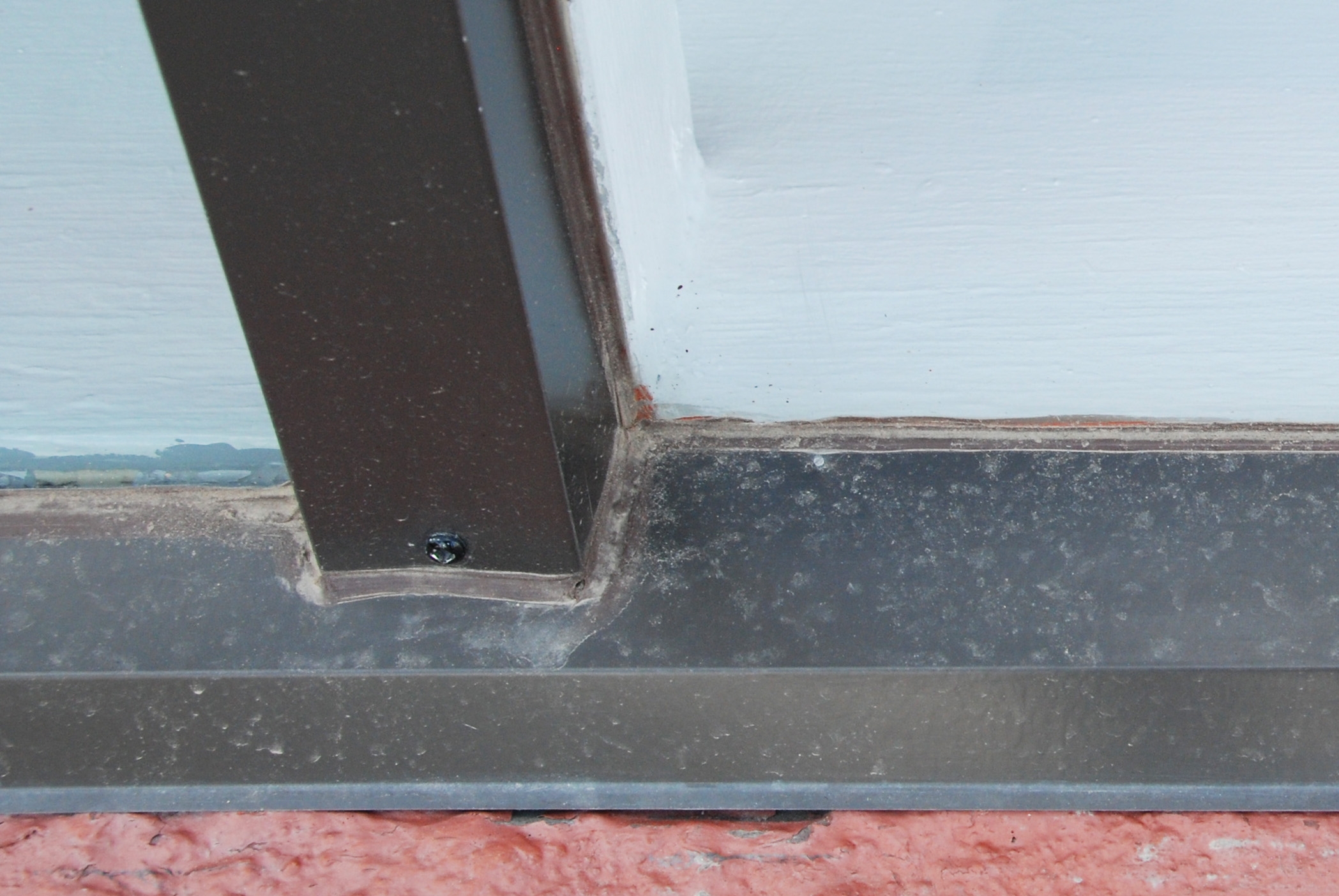
Sheet metal cladding, on the other hand, takes skill to properly detail, fit, and install so that it drains properly. Once installed, claddings often rely on caulking to seal open edges. Caulking can attract dirt and, like the painted surfaces it conceals, needs to be maintained and periodically replaced. Perhaps most important, clad wood is no longer exposed to the drying effects of the sun and circulating air, so that if water does gets beneath the cladding, as it likely eventually will, deterioration can occur rapidly and unnoticed. Better the devil you know…
This isn’t to say cladding is always inappropriate: it may be a valid means of adding a weather detail missing in the historic element while minimizing impacts on heritage value. In general, though, it’s preferable to have an authentic original material that you can appreciate and easily maintain.
Written by: Fraser Shaw, Heritage Conservation Adviser.




 RETROactive