The Big Four (Part 3 of 3)

The 100th anniversary of the Calgary Exhibition and Stampede came to a close this past Sunday, July 15, 2012. Today’s blog post will complete the short series about the Big Four and the geographical features named for them. The Big Four were the ranchers and businessmen that funded Guy Weadick’s 1912 wild west show and rodeo, which grew to become today’s Calgary Stampede. Part One of our series was posted on July 10, 2012 and featured Stavely area rancher George Lane and Lane Creek; Part Two was about A. E. Cross and Cross Creek. Today’s post will feature Calgary-based rancher and industrialist Patrick Burns.

Pat Burns: Rancher, Businessman, Industrialist and Senator 
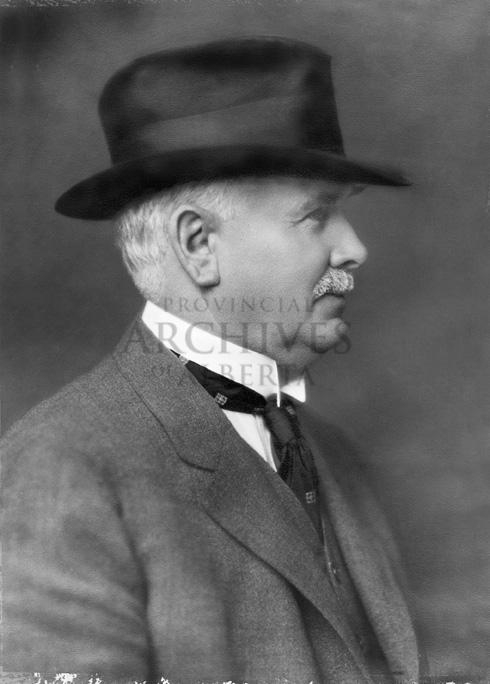
Senator Patrick Burns

Pat Burns is arguably the most successful and well-known of the Big Four. Pat Burns was born and raised in the Lake Simcoe region, near Oshawa, Canada East (later Ontario) in 1856. He migrated west in 1878 and tried his hand at homesteading in Manitoba. While homesteading, he acquired some oxen and hired himself out as a freighter. He also dabbled in livestock trading. Encouraged by the Canadian Pacific Railway, which wanted to prove the viability of long-distance livestock shipments, Burns bought six carloads of hogs and had them shipped east; the venture was profitable. Seeing greater opportunities in livestock trading, Burns abandoned the homestead in 1885 and began trading cattle full-time.

In 1887, Burns was contracted to provide meat to railway construction camps, and within two years he was supplying camps from Maine in the east to Calgary and Edmonton in the west. He established a slaughterhouse in Calgary in 1890 and established a ranch, the first of many, near Olds the following year. In 1902, Burns acquired from William Roper Hull a chain of retail stores and the associated the Bow Valley Ranche (now a Provincial Historic Resource) on Fish Creek south of Calgary. Burns’ company, P. Burns and Co., soon became one of Canada’s largest meat-packing companies, with production facilities and retail stores across the west. It also maintained up to 45,000 head of cattle on numerous ranches in central and southern Alberta, including the Bar U and the Flying E, which were acquired following the death of George Lane in 1927. Burns diversified his company’s investments by successfully expanding into dairy production and fruit and dry goods distribution and, less successfully into the American dairy market and into coal and copper mining and oil and gas exploration.

Burns was active in the community and was a noted philanthropist, providing funding to schools, hospitals, orphanages, old-age homes and widows’ funds. He was also known to send train loads of food to disaster stricken areas. Burns, a supporter of the Liberal Party, was appointed to the Canadian Senate by Conservative Prime Minister, R. B. Bennett; Burns sat as an Independent from 1931 until 1936, when he retired due to health reasons. Pat Burns died on February 24, 1937 at Calgary.

Two geographical features in Alberta are named directly for Patrick Burns, although four features bear his name (Confused? Bear with me).

Mount Burns

Mount Burns is an approximately 2,940 metre (9635’) mountain on the north side of the Sheep River about 40 km west of Turner Valley. In the 1910s, coal had been discovered in Sheep River Valley below this mountain and, in 1913, Pat Burns invested in a coal mine alongside the river. According to historian Grant MacEwan, Burns visited the mine site frequently. The Geological Survey of Canada recommended that the mountain be named Mount Burns, due to the nearby mine and its association with the Calgary businessman. The name was officially adopted by the Geographical Board of Canada On May 2, 1922 and began appearing on federal government maps, such as the 1926 Calgary Sectional Sheet, soon after that.

National Topographic System Map Sheet: 82 J/10 – Mount Rae

Latitude/Longitude: 50° 38’ 39” N & 114° 51’ 40” W

Alberta Township System: Sec 26 Twp 19 Rge 07 W5

Description: On the north side of the Sheep River Valley, approximately 40 km west of The Town of Turner Valley

Burns Creek
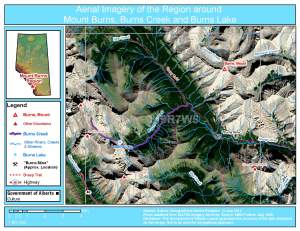
Burns Creek flows off the eastern slopes of the Mount Rae/ Mount Arethusa massif. The creek flows south-easterly off the mountain face into the northern end of a small, high altitude lake (Burns Lake) approximately 1.7 hectares (4.25 acres) in size. The creek exist the south side of the lake and proceeds south-east and then north-east until it meets Rae Creek to form the Sheep River. The creek is approximately eight km in length.

Not much is known about the naming of Burns Creek. The creek is named on the 1926 Calgary Sectional Sheet and it is most certainly named due to its association with the nearby mountain and coalmine. Mountains often lend their names to associated geographical features, such as creeks and lakes. Typically, these creeks run directly off the mountain. For example, Storm Creek runs off Storm Mountain and Warspite Creek runs off Mount Warspite. However, in the case of Burns Creek, the creek is not directly associated with Mount Burns, but is located on the opposite side of the sheep River Valley.

National Topographic System Map Sheet: 82 J/10 – Mount Rae

Latitude/Longitude: 50° 37’ 00” N & 114° 57’ 58” W (approximate location of head waters) to 50° 37′ 25″ N & 114° 53′ 25″ W (at confluence with Rae Creek and Sheep River)

Alberta Township System: SW ¼, Sec 19 Twp 19 Rge 7 W5 (approximate location of head waters) to NS ¼, Sec 22 Twp 19 Rge 7 W5 (at confluence with Rae Creek and Sheep River)

Description: Flows off the east face of Mount Rae and Mount Arethusa for eight km until it meets Rae Creek to form the Sheep River about 45 km west of the Town of Turner Valley. 

Burns Lake (1)

Burns Lake is both fed and drained by Burns Creek. It was not officially named until the 1980s. In the mid 1980s, Alberta Fish & Wildlife made plans to stock this lake with fish. Information about the lake would be published in the stocking program’s reports and possibly in tourist and angling literature. A Fish & Wildlife officer familiar with the region recommended that the name Burns Lake be officially adopted. This proposal met with the approval of the Citizens’ Action Committee on Kananaskis Country on March 5, 1985 and by the Alberta Historical Resources Foundation on November 14, 1986 and by the Minister of Culture on May 5, 1987.

National Topographic System Map Sheet: 82 J/10 – Mount Rae

Latitude/Longitude: 50° 36′ 16″ N & 114° 56′ 38″ W

Alberta Township System: Sec 29 Twp 31 Rge 27 W5

Description: On the south side of the Sheep River Valley, approximately 47 km west of the Town of Turner Valley. 

Burns Lake (2) 
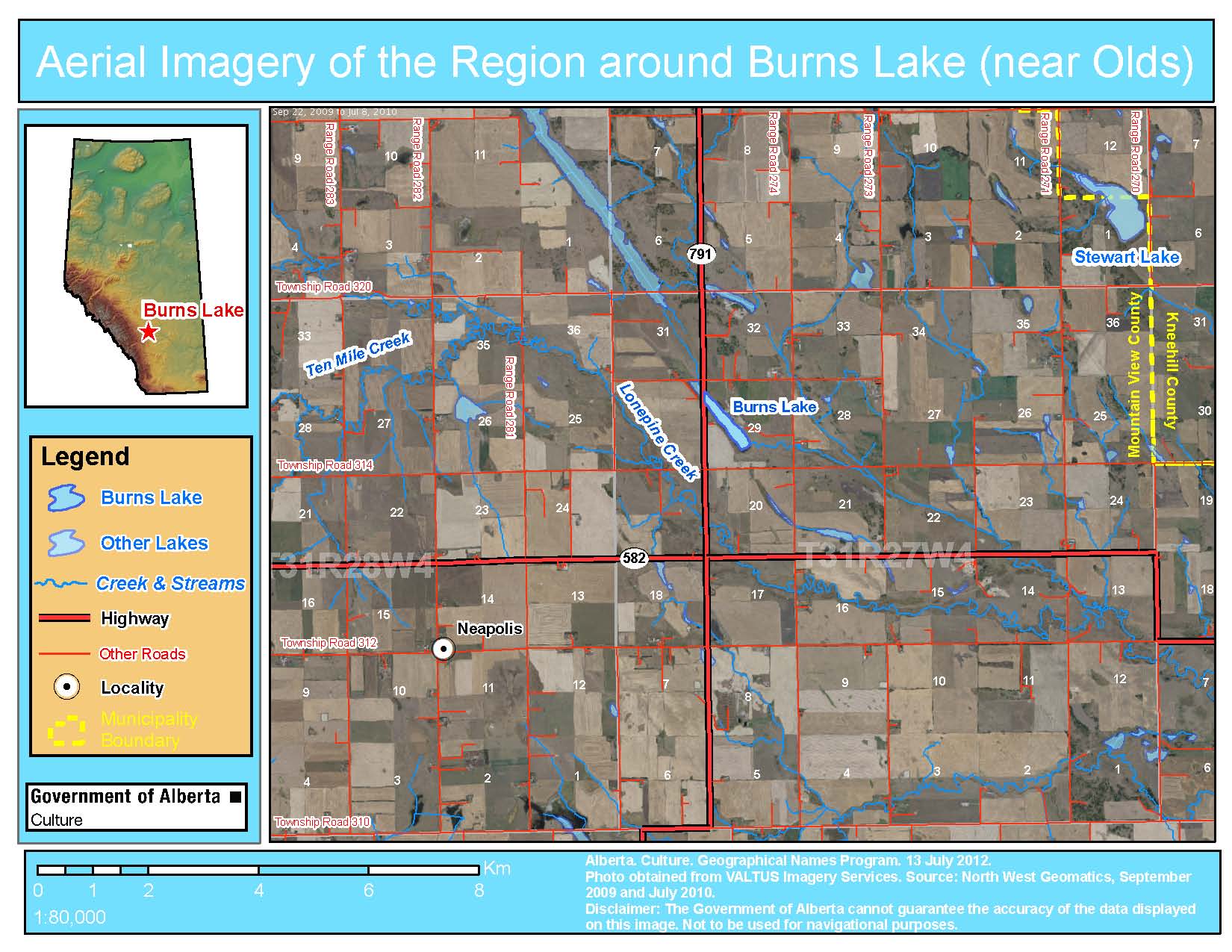
The second Burns Lake in Alberta is located near the Town of Olds. It is approximately 22 hectares (54 acres) in size. It is located in the County of Mountain View, about 25 km south east of the Town of Olds and 22 km east of the Town of Didsbury. Pat Burns operated ranches in the general vicinity of this lake. In 1922, S. L. Evans of the Dominion Land Survey recorded the name of the lake as Burns Lake on the plan he drew for Township 31-27-W4. The name was officially adopted by the Geographic Board of Canada for mapping purposes on January 20, 1955.

National Topographic System Map Sheet: 82 P/12 – Lonepine Creek

Latitude/Longitude: 51° 41′ 13″ N & 113° 48′ 09″ W

Alberta Township System: SW ¼, Sec 17 Twp 19 Rge 7 W5

Description: In Mountain View County, approximately 25 km south-east of the Town of Olds.

 Additional Resources:

 More information about Senator Pat Burns can be found at:

Elofson, Warren, “Burns, Patrick,” Dictionary of Canadian Biography Online, edited by John English and Réal Bélanger, Vol. XVI, available from http://www.biographi.ca/009004-119.01-e.php?id_nbr=8428&PHPSESSID=bcpbd4hg2slsgaa1bkv04sukr5.

“Senator Patrick Burns”, Calgary Business Hall of Fame, , available from http://www.calgarybusinesshalloffame.org/bio.php?page=laureates/2009/PatrickBurns.php.

MacEwan, Grant, Pat Burns, Cattle King, (Saskatoon: Western Producer Prairie Books, 1979)

Archie McLean

You may have noticed that this is a series about the Big Four, yet there were only three parts, George Lane and Lane Creek; A. E. Cross and Cross Creek; and Pat Burns and Mount Burns, Burns Creek and two Burns Lakes. What about the other member of the Big Four?

The other member of the Big Four that funded the Calgary Stampede was Archibald “Archie” McLean. McLean was arguably just as successful as his three contemporaries, he was a successful rancher in the Taber and Fort Macleod regions, was elected to the Legislative Assembly of Alberta in 1909, 1913 and 1917. However, unlike his three contemporaries, there are no geographical features named for Archie McLean. A bridge on Highway 864 crossing the Oldman River just outside of Taber is named for him (49° 48’ 48”N & 112° 10’ 15”W) and there is a small lake just east of Lethbridge that is locally known by some as “McLean Lake” (49° 41’ 47” N & 112° 45’ 22” W).

For information about Archie McLean can be found on a recent blog post by Lethbridge’s Galt Museum & Archives, which can be accessed at:

http://galtmuseum.blogspot.ca/2012_06_01_archive.html.

Written by: Ron Kelland, Historic Places Research Officer and Geographical Names Program Coordinator
The Big Four (Part 2 of 3)

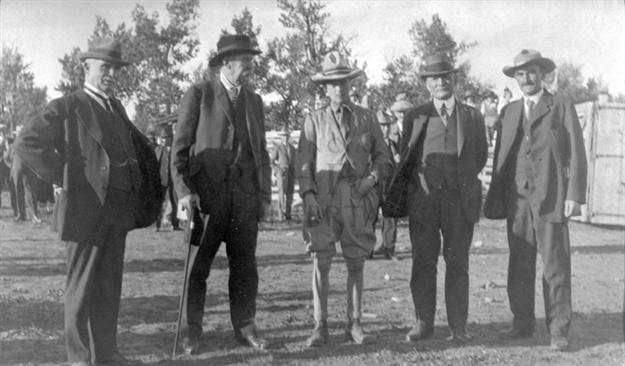
The Big Four with HRH Edward, Prince of Wales at the EP Ranch, 1923
LtoR: Pat Burns; George Lane; Edward, The Prince of Wales; Archie McLean; and A. E. Cross.
(Provincial Archives of Alberta, A2658)

During the Centennial year of the Calgary Exhibition and Stampede, we are posting a short series about the Big Four and the geographical features named for them. The Big Four were the ranchers and businessmen that funded Guy Weadick’s 1912 wild west show and rodeo, which grew to become today’s Calgary Stampede. Part one of our series was posted on July 10, 2012 and featured Stavely area rancher George Lane and Lane Creek.  Today’s post will feature Nanton area rancher and Calgary brewer A. E. Cross and Cross Creek.

A. E. Cross: Rancher, Politician, Oilman and Brewer 

Alfred Ernest Cross was influential in many aspects of Alberta’s economy. Cross was born in 1861 at Montreal. He trained as a veterinarian and came to the North West Territories in 1884 where he was employed as a veterinarian at the Cochrane Ranche (now a Provincial Historic Resource). He left the Cochrane about a year later and started his own operation, the A7 Ranche, on Mosquito Creek, just west of Nanton. For health reasons, Cross returned to Montreal for a time. During this period, he maintained control of the A7, but he also apprenticed as a brewer. He returned to Calgary in 1891 and founded the Calgary Brewing and Malting Company and established a chain of brewery-owned hotels across Western Canada. He was active professionally and socially in the Calgary region, being a founding member of the Ranchmen’s Club, the Calgary Board of Trade and the Western Stock Growers Association. He was elected to the Legislative Assembly of the North West Territories in 1898, representing East Calgary. Cross contributed to numerous charitable causes and was a noted philanthropist in southern Alberta. He was also instrumental in establishing Alberta’s oil and gas industry; in 1912, he was a founding partner of Calgary Petroleum Products, which would discover gas at Turner Valley a few years later. Despite all of these accomplishments, Cross’ lasting legacy is in the ranching sector. By 1919, the A7 Ranche had grown to control over 25,000 acres and was one of the largest ranches, possibly even the largest, in Alberta. A. E. Cross died in 1932. The A. E. Cross House in Calgary is a designated Provincial Historic Resource. As of 2012, the A7 Ranch continues to be operated by the Cross family.

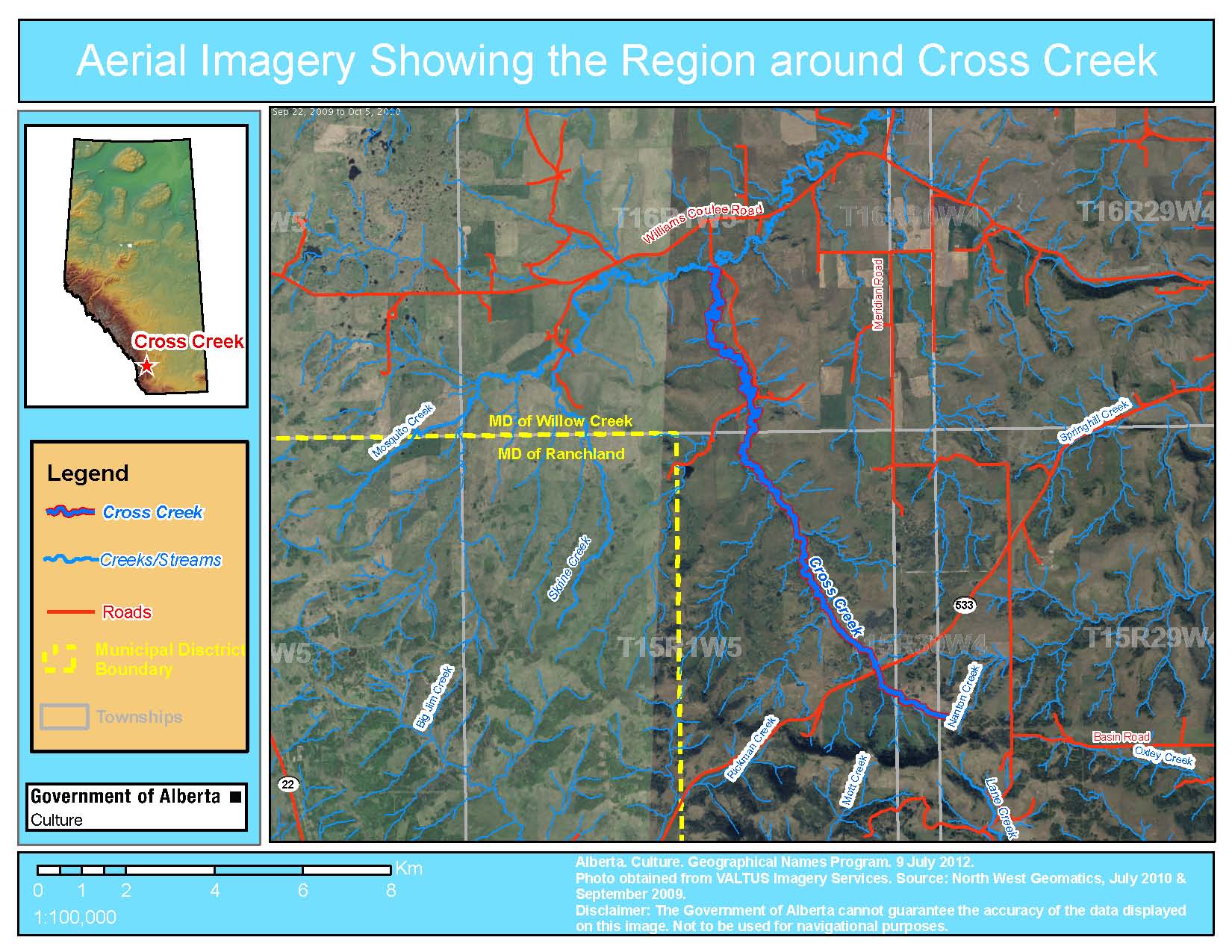
Cross Creek, a tributary of Mosquito Creek, is named for A. E. Cross. The creek flows generally north and enters Mosquito Creek in Section 15, of Township 16-1-W5, about 20 km west of the Town of Nanton. The creek flows through land that was owned and operated by A. E. Cross.

Historical recordings of Cross Creek are difficult to trace. Although a number of surveyors with the Dominion Land Survey (DLS) record the presence of a small spring fed creek in the general vicinity of Cross Creek, the creek does not appear on the DLS plans for Township 16-1-W5. However, on the plan for Township 15-1-W5, there is a feature noted as “Willow Creek” that corresponds partly to today’s Cross Creek. The name “Willow Creek” was likely abandoned in order to avoid confusion with the more substantial Willow Creek a short distance to the south.

In July 1938, a series of memos were sent between various officials and representatives of the Geographic Board of Canada (GBC) regarding the approval of names in the Stimson Creek region of southern Alberta. One of these memos concerned Cross Creek; F. P. DuVernet (a member of the federal topographical survey) suggested that the creek be named Cross Creek after “the well known family in the locality who owns or controls the land through which the creek flows.” The suggestion met the approval of the GBC, but concerns were expressed about getting the consent or opinion of the Government of Alberta. Alberta had not sent a representative to the GBC for most of the 1930s. The records of the Alberta Geographical Names Program do not include any communication with provincial officials in the 1930s, so it is not clear whether Alberta’s opinion or consent was ultimately secured. However, the name Cross Creek was officially adopted at the December 12, 1939 meeting of the Geographical Board of Canada.

Written by: Ron Kelland, Historic Places Research Officer and Geographical Names Program Coordinator
Location 

National Topographic System Map Sheet: 82 J/08 – Stimson Creek

Latitude/Longitude:

50° 15’ 50” N & 113° 59’ 30” W (approximate location of head waters) to

50° 20′ 36″ N & 114° 03′ 30″ W (at confluence with Mosquito Creek)

Alberta Township System:

NE ¼, Sec 13 Twp 15 Rge 30 W4 (approximate location of head waters) to

SS ¼, Sec 15 Twp 16 Rge 1 W5 (at confluence with Mosquito Creek)

Description:

Flows generally northerly for approximately 21 km (10 km straight line) until it joins Mosquito Creek about 20 km west of the Town of Nanton. 

Additional Resources

More information about A. E. Cross and the A7 Ranche can be found at:

“Alfred Ernest (A. E.) Cross”, Calgary Business Hall of Fame, , available from http://www.calgarybusinesshalloffame.org/bio.php?page=laureates/2007/AECross.php.

“A. E. Cross: Rancher and Jolly Brewer 1961-1932,” Trailblazers, available from http://www.cowboycountrytv.com/trailblazers/aecross.html.

“About the A7 Ranche: History of the Ranche,” A7 Ranche, available from http://www.a7ranche.com/about/

The Big Four (Part 1 of 3)

On the morning of July 6, 2012, the 100th Calgary Exhibition and Stampede roared into life. On the west side of Stampede Park, rising from the seething mass of carnival rides, concession stands and humanity that is the Stampede midway is the Big Four Building. This building is named for the Big Four – the four Southern Alberta ranchers and businessmen who funded Guy Weadick’s proposed rodeo and wild west show in 1912. Intended to be a one-time event, the show and rodeo grew to become the Calgary Exhibition and Stampede. To say that the Big Four influenced Calgary’s popular culture would be a great understatement.

The Big Four with HRH Edward, Prince of Wales at the EP Ranch, 1923
LtoR: Pat Burns; George Lane; Edward, The Prince of Wales; Archie McLean; and A. E. Cross.
(Provincial Archives of Alberta, A2658)

However, the legacy of the Big Four extends beyond the boundaries of Stampede Park. They left their mark not only in Calgary, but on the geography of the Province of Alberta.  Today’s blog post is the first in a short series that will look at the Big Four – George Lane, A. E. Cross, Archie McLean and Pat Burns – and the places named for them.

George Lane: An American in Calgary 

George Lane was born in 1856 just outside of Des Moines, Iowa. From there his life story reads like an adventure novel. As a teenager he and his father searched for gold in the Montana Territory. He then worked as a scout for the United States Army and as a ranch hand before coming to Canada in 1884 as a foreman at the Bar U Ranch (now a National Historic Site). He left the Bar U three years later and set himself up as a cattle trader, often working in partnership with the Winnipeg-based cattle company Gordon, Ironside & Fares. Lane acquired a number of ranches in the Porcupine Hills region of southwest Alberta, including the Flying E Ranch (previously named the Victor Ranch), the YT Ranch and the Willow Creek Ranch; in 1902, Lane and his partners acquired the Bar U Ranch. Lane became known as one of the most successful cattle traders in Western Canada and at one point was raising nearly 20,000 head of cattle on these ranches and adjacent leased crown lands.

Unlike many of Alberta’s ranchers, who saw the arrival of homesteaders as a threat to their way of life, George Lane saw the shifting agricultural frontier as an opportunity. He experimented with irrigation and raised herds of draft horses for sale to the west’s new farmers. Most notably, he switched large parts of his land holdings from cattle range to grain farms, becoming, by 1915, one of Alberta’s two top grain producers.

Lane served a short stint as a Member of the Legislative Assembly of Alberta, elected as a Liberal in 1913, but quickly resigning to make his seat available for a defeated cabinet minister. In 1919, Lane entertained Edward, Prince of Wales at the Bar U. The Prince was so taken with the region and the lifestyle that he soon purchased a neighbouring ranch, which became the E P Ranch (now a Provincial Historic Resource). In his later years, George Lane continued to promote settlement and investment in Alberta and occupied himself raising his prize winning Percheron horses. George Lane died at the Bar U Ranch on September 24, 1925.

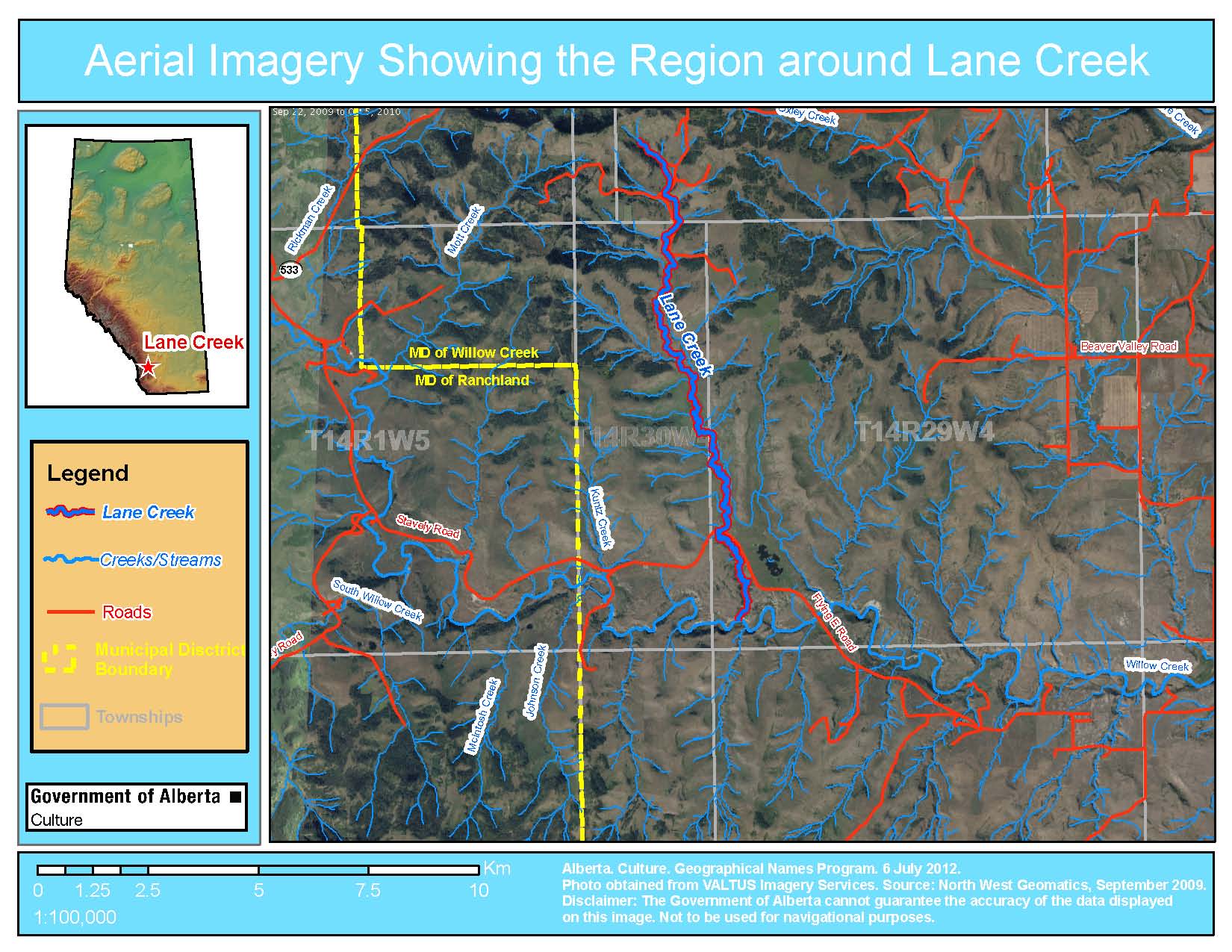
Lane Creek, a tributary of Willow Creek, is named for George Lane. The creek flows southerly and enters Willow Creek in Section 6, of Township 14-29-W4, about 23 km west of the Town of Stavely.

In 1883, John Francis of the Dominion Land Survey, surveyed the Township 14-30-W4. In Sections 13, 24 and 25 he recorded a spring fed creek that was approximately six feet wide and contained about eight inches of water. Francis did not name the creek. The first official recording of the name Lane Creek appears to be on the 1902 edition of the Macleod Sectional Sheet (No. 74), printed by the Government of Canada. The creek flowed through a substantial part of the land controlled by George Lane. The section where Lane Creek joins Willow Creek was co-owned by Lane and his partners Gordon, Ironside & Fares.

Although in use for over half a century, the name Lane Creek was not officially recognized as the name for that stream until May 1957.

Written by: Ron Kelland, Historic Places Research Officer and Geographical Names Program Coordinator
Location 

National Topographic System Map Sheet: 82 I/04 – Claresholm

Latitude/Longitude:

50° 14’ 22” N & 113° 58’ 52” W (approximate location of head waters) to

50° 08′ 28″ N & 113° 57′ 04″ W (at confluence with Willow Creek)

Alberta Township System:

SW ¼, Sec 7 Twp 15 Rge 29 W4 (approximate location of head waters) to

SW ¼, Sec 6 Twp 14 Rge 29 W4 (at confluence with Willow Creek)

Description:

Flows generally southerly from the for approximately 20 km (11 km straight line) until it joins Willow Creek about 22 km west of the Town of Stavely. 

Additional Resources 

More information about George Lane and his partnership with Gordon, Ironsides & Fares can be found in:

Evans, Simon M. “Lane, George,” Dictionary of Canadian Biography Online, edited by John English and Réal Bélanger, Vol. XV, available from http://www.biographi.ca/009004-119.01-e.php?BioId=41957&query=.

McCullough, A. B., “Winnipeg Ranchers: Gordon, Ironside and Fares,” Manitoba History, No. 41 (Spring/Summer 2001), accessed 9 July 2012, available from http://www.mhs.mb.ca/docs/mb_history/41/winnipegranchers.shtml.

The Butte Stands Guard: Stavely & District, Volume 1 (Stavely, AB: Stavely Historical Book Society, 1976), pages 14-20, 231-234.


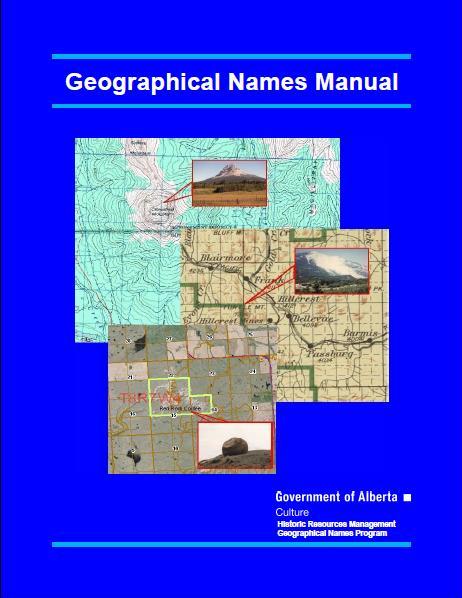
The New Geographical Names Manual: Bigger, Better, Faster, Stronger!

Hot off the virtual presses is the revised and updated Geographical Names Manual. It is now available on the Alberta Geographical Names Program website.

What is the Geographical Names Manual? 

The Geographical Names Manual is the guiding document for naming geographical features in Alberta. It contains a brief history of geographical naming in Canada and Alberta; it identifies and describes the legislation covering geographical naming; and it outlines the roles and responsibilities of the Alberta Historical Resources Foundation and the Alberta Geographical Names Program in geographical naming matters. It also outlines the research done by the Geographical Names Program and attempts to demonstrate the high standards of research and evidence that are required before names are adopted for use on official maps in Alberta.

Most importantly, the manual contains the “Principles of Geographical Names.” These principles are used by the Alberta Geographical Names Program to evaluate proposed names for geographical features and proposed changes to existing names before presenting naming proposals to the Foundation for consideration. The Principles are largely based on those used by the Geographical Names Board of Canada, which in turn are based on long-standing, international naming policies and procedures. These international standards have been developed since regulatory bodies were first established to oversee geographical names, more than a century ago.

Why do we need the Manual and its Principles and Standards?

Standardized principles and procedures for the adoption and revision of official names were developed to ensure a high a level of consistency in land-marking and map-making over time and across jurisdictions and cultures. Maps, whether paper-based or electronic, are an essential navigational tool. For this reason it is essential that the names that appear on these maps are accurate and consistent so that navigation is efficient and free of confusion. However, as human beings, it is also natural for us to want to name our surroundings, thereby affirming our place amongst our geography, identifying features important to us and commemorating our history and our evolving cultural values. The established standards, principles and procedures that have been developed over time are an attempt to balance the need for consistency with our desire to name the landscape.

Most people are unaware that there are naming standards and a process for the adoption of official names. The intention of the manual is to make the standards, principles and procedures available to the general public in a format that is accessible and understandable.

People considering making an application to have a new name adopted for a geographical feature or proposing a change to an existing name are encouraged to read the Manual, particularly the “Principles of Geographical Names” section. An understanding of the Principles can save substantial effort and make the process much clearer and easier to understand.

Why was the Manual updated?

The Geographical Names Manual was first published in 1987 (reprinted in 1989). A second revised edition was published in 1992 and a third edition in the early 2000s. Since the publication of the third edition, some of the basic information, such as the Department/Ministry name, Government of Alberta logos, etc. had become significantly outdated. As these details needed to be updated, the opportunity was ripe to give the entire Manual an overhaul. Revisions included:

  • Enhancing the format and style, making the document more attractive and interesting by taking advantage of current word-processing tools;
  • Expanding the Introduction section to include answers to some of the frequently asked questions about naming;
  • Expanding the History section to provide more context of how place naming in Canada and Alberta has evolved;
  • Minor editing of the “Principles of Geographical Names” to improve readability;
  • Expanding the Standards of Research section to provide more information about the importance of sources of evidence and to provide links to other guides and information;
  • Revising the Procedures section to better reflect the path taken by naming proposals from receipt of application to official rejection or adoption of the proposed name.

The most significant change was the addition of sections explaining naming procedures in areas where the Government of Alberta shares jurisdiction over naming matters – National Parks (with Parks Canada), Canadian Forces Bases (with the Department of National Defence), and Indian Reserves (with the Aboriginal and Northern Affairs Canada and the affected First Nations tribe, band or community). Also added were sections explaining the naming procedures for features that lie on or cross an inter-provincial boundary into Saskatchewan, British Columbia or the Northwest Territories or for features that cross the international border into the state of Montana.

So, there it is. The new and improved Geographical Names Manual is available as a PDF on the Geographical Names Program website.

We hope that all Albertans interested in our province’s naming heritage will find this revised edition of the manual useful, interesting and educational. In the near future the Geographical Naming Application form and the webpage itself will also be updated.

Written by: Ron Kelland, Historic Places Research Officer and Geographical Names Program Coordinator
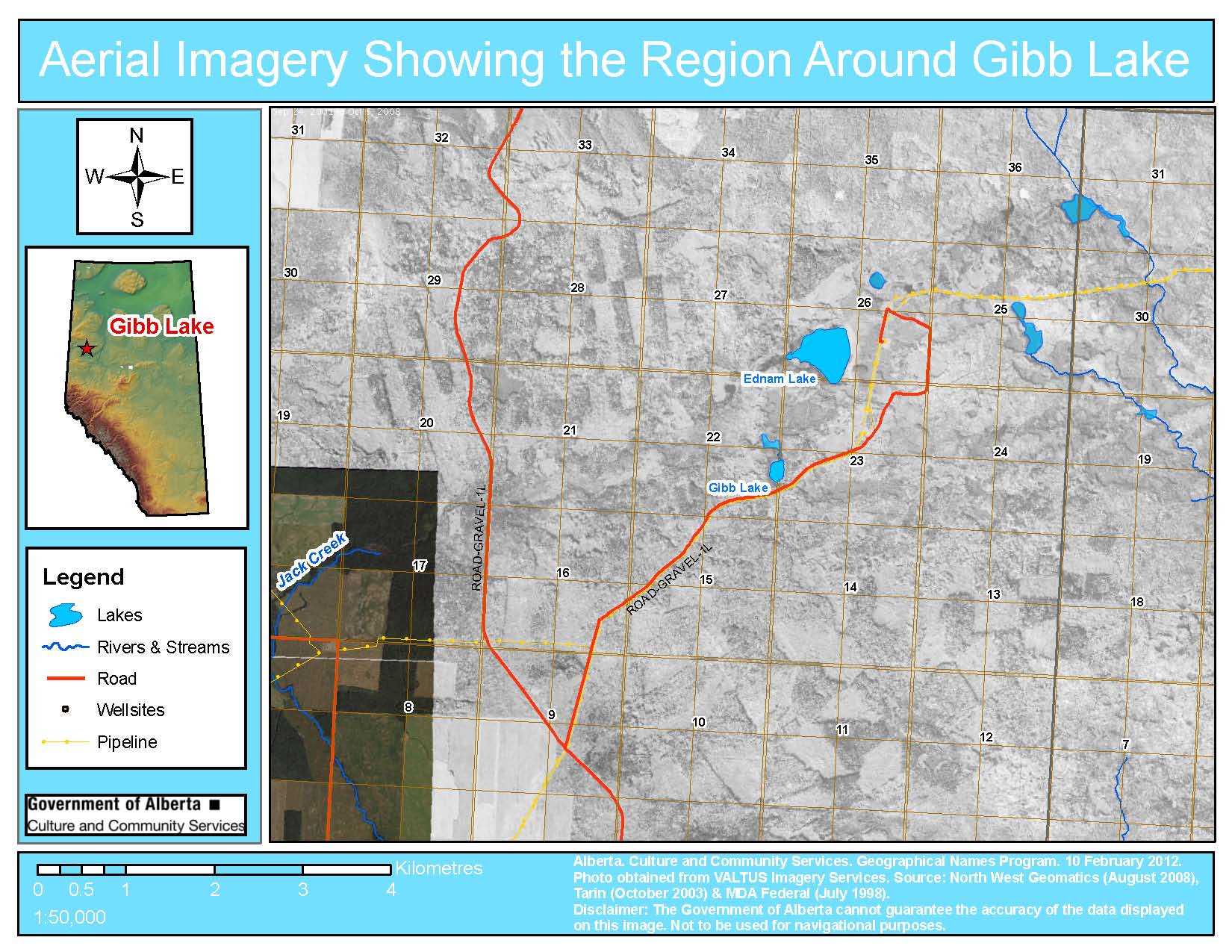
Gibb Lake: Honouring an Early Homesteading Family and a Wartime Sacrifice

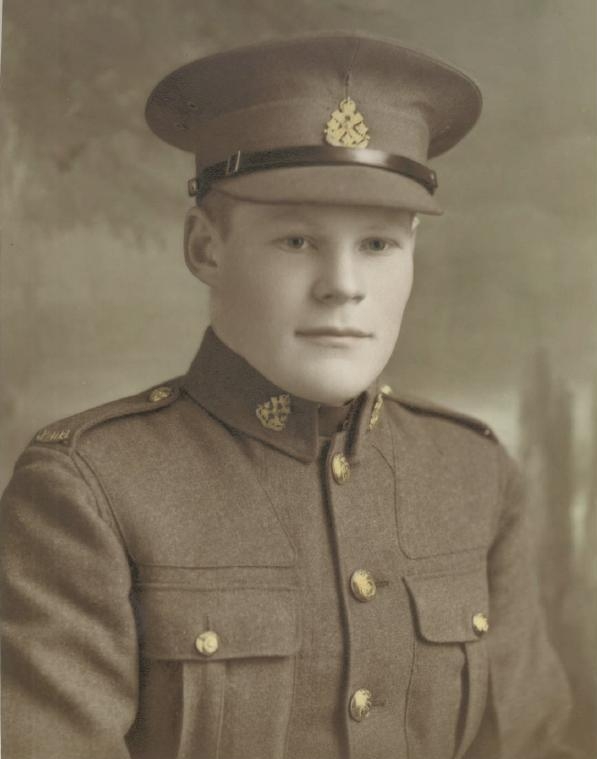
Stanley Gibb (Photo provided by the family.)

The Alberta Historical Resources Foundation and the Minister of Culture and Community Services has officially adopted the name Gibb Lake for a previously unnamed lake in Clear Hills County. The small lake is located approximately 16 kilometres north east of the Village of Hines Creek. The newly adopted name serves two commemorative purposes. Firstly, it commemorates the family of William and Christina Gibb, early homesteaders in the Hines Creek region. Secondly, it commemorates the service of their sons, many of whom served in the armed forces, particularly Private Stanley Alexander Gibb, Loyal Edmonton Regiment, R.C.I.C., who lost his life during the conflict.

William Gibb was born about 1899; he was raised in the Gordon district of the Scottish borderlands where he worked as a farmer or farm labourer. His wife Christina, who was born about 1901, was from Newtyle, Scotland. In 1925, they and their four sons (Charles Howard, aged 5; Stanley Alexander, aged 3; David William, aged 2; and three month old John William) immigrated to Canada aboard the Canadian Pacific liner SS Marburn. They arrived in Quebec on August 22 and immediately traveled to Wolseley, Saskatchewan where William was employed as a farm labourer in the employ of a Mr. Alex Callander.

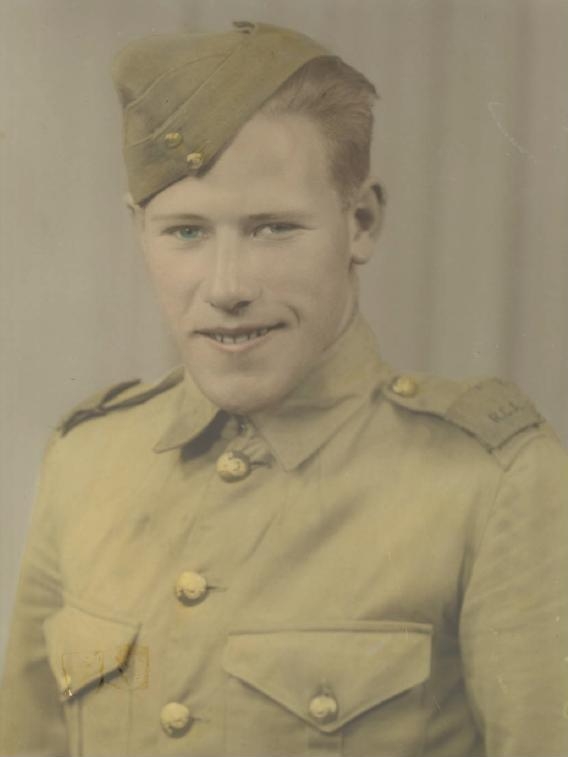
David Gibb (Photo provided by the family.)

The family moved to Fairview, Alberta in 1928 and William Gibb filed for a homestead in the relatively unsettled Hines Creek region (NE ¼, Section 5, Township 85, Range 4, West of the 6th Meridian). The family would grow to include eight children – Charles, Stanley, David, John, Marjorie, William and Chris. While proving up the homestead, William Gibb Sr. became an active member of the community. In addition to farming, he worked on regional road crews and served as a trustee for the Ednam School District No. 4359 (the school district being named for the market town of Ednam, Scotland, which was near William Gibb’s birthplace). According to a long-time resident of the region, the Gibb’s also provided entertainment at community gatherings with their singing (in Gaelic) and traditional Scottish dancing. Despite only clearing 10 of the required 30 acres, the Gibb family was granted title to their land in December 1935. The inspection agent determined that the Gibb’s land was extraordinarily difficult to clear and declared that the 10 acres was equal to 30 acres of cleared land elsewhere in the province.

With clear title to their land, the Gibb’s existence should have been more stable. However, their lives, like those of many Alberta families, were irrevocably disturbed with the outbreak of war in 1939. A number of the Gibb sons enlisted for service. It has not been possible to track down records for many of them, but Stanley’s service records indicate that he had two brothers (unnamed) serving, one with the Royal Navy and the other with the Royal Air Force. However, since the lake became officially named, more information has been revealed by a family member (William Gibb Jr.), which suggests strongly that Stanley’s Service Record may be inaccurate or incomplete.

According to William Gibb Jr., almost all of the Gibb sons did their part for their country either during or following the war:

– Charles Gibb enlisted in the Army and spent most of the war as a sergeant, training troops in England;

– David Gibb enlisted, but was released after six months due to having poor eyesight. He returned home, and worked on the construction of the Alaska Highway under the employ of the American Armed Forces;

– John Gibb enlisted later in the war and served with the Occupation Army in Germany during 1944-45;

– William Gibb served in the Canadian Merchant Navy and then as a seaman and helmsman on a hydrographical survey ship (CGS W. J. Stewart) on the Pacific Coast;[1]

– Chris Gibb served with the Royal Canadian Air Force from 1953 to 1956.

The Gibb’s second son, Stanley Alexander Gibb, had perhaps the most interesting and ultimately the most tragic experience. Stanley served as a Private with the Loyal Edmonton Regiment. In his enlistment papers he stated that he was employed as a farm labourer and expressed interest in training as either a mechanic or a railroad engineer. He also indicated that he collected stamps and enjoyed boxing and baseball (he played third base).  He trained in Calgary and embarked for Great Britain in August 1941 where he received further training, served garrison duties and was temporarily assigned to a Mechanical Transport Vehicle Reception Depot. In June 1943, Private Gibb was deployed to the Mediterranean. Soon after arrival in North Africa, he contracted malaria and spent three weeks in hospital.

The Loyal Edmonton Regiment was actively involved throughout the Italian campaign, but Private Gibb’s role in most of these engagements is not known. However, on October 22, 1943, The Regiment fought in a battle that became known as the Savio Bridgehead. The Loyal Edmonton Regiment and the Seaforth Highlanders of Canada launched supporting attacks to the Princess Patricia Canadian Light Infantry’s second attempt to cross the Savio River just north of Cesena and gain a foothold on the opposite bank. The attack began with an artillery barrage at 8pm. By 9pm, the Edmontons were in the fast flowing river and attempting to reach the other side. An early setback occurred when Major W. G. Longhurst, the commander of the first company to attempt the crossing, was killed. A second company joined the fight and the Edmontons recovered. The crossing continued until daylight, when they reached Case Gentili, a small hamlet west of the river. The Regiment received Battle Honours for their actions in this engagement. For most of the Regiment, the fight continued. However, during the crossing, Private Stanley Alexander Gibb had stepped on a landmine. According to his service record, he suffered the traumatic amputation of his right foot and severe wounds to both legs and both arms. He was evacuated to a field hospital and underwent surgery, having his right leg amputated at the knee and his right arm amputated above the elbow. His post-operative condition was listed as stable, but infection and fever set in the following day, from which he did not recover. Private Stanley Gibb died of his wounds on October 27, 1944. He is buried in the Cesena War Cemetery, in the Italian province of Forli.

During the war, William and Christina sold the Peace Country farmstead and relocated to Vancouver Island, where much of the family remains today.

The application to have Gibb Lake adopted as the official name for that lake was made by a member of the Clear Hills Watershed Initiative in September 2009. The proposal was supported by the Municipal Council of Clear Hills County and the local MLA. After considerable research, the proposal was presented to the Board of the Alberta Historical Resources Foundation during their December 3, 2011 meeting in Calgary, at which they agreed to accept the name. On January 31, 2012, the Minister of Culture and Community Services concurred with the board’s decision and the adoption of the name became official. Notification of the adoption of the name Gibb Lake was published in Alberta Gazette on February 29 and it was added to the Canadian Geographical Names Database, ensuring the name appears on new maps of the region produced by the federal and provincial governments.

This has been a very interesting naming proposal to work on. The name was made official following nearly two years of research. Since the name was officially adopted and media stories began to appear, new information has been received. Keep checking back to this blog, updates will be posted about the Gibb family’s record of service to their country as more information is discovered and verified.

Written by: Ron Kelland, Historic Places Research Officer and Geographical Names Program Coordinator
For location information and a list of additional resources:  Read more

The Royal Jubilee, Queen Elizabeth II and Place Names

Reigning heads of state, their siblings and children have been the inspiration behind many names. In Alberta there are places and features named for Queen Victoria, King Edward VII and Queen Alexandra, Princess Patricia and of course Princess Louise Caroline Alberta.

View of Maligne Lake and the Queen Elizabeth Ranges, 1938 (Mountains from LtoR are: Samson Peak, Maligne Mountain, Mount Paul, Mount Mary Vaux, Mount Charlton, and Mount Unwin). Provincial Archives of Alberta (Weiss Collection), A3088, photograph by Joe Weiss.

To have features and places named for these people provides a connection to our historical heads of state and Canada’s ties to the British Empire and the Commonwealth of Nations; but, what of our current head of state?

Queen Elizabeth II became queen upon the death of her father King George VI on February 6, 1952. Over the ensuing days, she received proclamations of allegiance from all of her realms – Canada being the first to do so, beating the United Kingdom by about two hours. However, the celebrations and honours that accompany the crowning of a new monarch did not begin in earnest until her coronation over a year later on June 2, 1953. During the coronation year, honours for the new Queen came from all corners of the Commonwealth. Not surprisingly, Canada offered a grand gesture to mark the occasion. What may not be so well known is that, this honour was proposed by the Province of Alberta in the form of a series of mountain ranges.

The Queen Elizabeth Ranges

The mountains known today as the Queen Elizabeth Ranges are located in Jasper National Park. They almost encircle Maligne Lake, bordering the lake on its east, south and south-west sides. During her 1908 expedition, Mary Schäffer visited Maligne Lake, possibly being the first non-native person to do so. As her party was travelling by raft down the lake, she wrote:

As we were rounding what was supposed to be our debarking point, there burst upon us that which, all in our little company agreed, was the finest view any of us had ever beheld in the Rockies. … those miles and miles of lake, the unnamed peaks rising above us, one following the other, each more beautiful than the last. …we wandered about to drink it all in. How pure and undefiled it was! We searched for some sign that others had been there, – not a tepee-pole, not a charred stick, not even tracks of game; just masses of flowers, the lap-lap of the waters on the shore, the occasional reverberating roar of an avalanche, and our own voices, stilled by a nameless presence.

During her 1908 and 1911 expeditions to Maligne Lake, Mary Schäffer named many of the surrounding mountains, but the mountain groups or ranges were never specifically given a name, although some considered them to be part of the vaguely defined Maligne or Brazeau Range.

In April 1953, the Geographic Board of Alberta (GBA) received a suggestion from the Alberta Travel Bureau to commemorate the coronation of Queen Elizabeth II. The Bureau proposed that the province “name the entire unnamed range [of mountains] along the eastern side of Medicine Lake and Maligne Lake region the Queen Elizabeth Range.” The Travel Bureau proposed that the range should include Leah Peak, Maligne Mountain, Mount Paul, Mount Warren, Mount Brazeau and Mount Henry MacLeod.

The GBA approved the proposal during its the April 18 and April 22 meetings. In the process it dropped Mount Brazeau from the list, but expanded the demarked area to include the unnamed peaks south east of Beaver Lake as well as Monkhead, Mount Warren, Mount Unwin, Mount Charlton, Llysfran Peak, Mount Mary Vaux, Replica Peak and Coronet Mountain. The support of Premier Ernest Manning was acquired and the proposal was forwarded to Ottawa for consideration, where it received the consent of both the Geographic Board of Canada and the Parks Branch. Finally, after receiving the consent of Buckingham Palace, an announcement was made on June 19 that

Her Majesty had been pleased to approve a proposal that mountains which practically encircle beautiful Maligne Lake, one of the most photographed bodies of water in the Rockies, be named the “Queen Elizabeth Ranges”…these ranges tower ten thousand feet or more into the cloud flecked heavens and the whole scene makes one of the most perfect pictures of Alpine grandeur – bold rocky forms, ice and snow gleaming against a blue sky, dark forests and a sapphire blue lake – a fitting memorial to the Queen.

Queen Elizabeth Provincial Park, Lac Cardinal

Even after naming a series of mountains in honour of Queen Elizabeth II, Alberta was not yet done; just over twenty years later, Alberta honoured the Queen with a provincial park.

In 1958, the Government of Alberta established Lac Cardinal Provincial Park. The park was located just west of Grimshaw on the shores of Lake Cardinal, from which it took its name. In 1912, Lake Cardinal, formerly known as “Bear Lake,” was named for Louis Cardinal, an early settler in the region.

In 1978, Edmonton hosted the Commonwealth Games. Part of the games’ festivities was a Royal Tour of Canada by the Queen and Prince Philip, along with their sons Prince Andrew and Prince Edward. The Royal family visited Grande Prairie and the Peace Country, including a stop at Lac Cardinal Provincial Park to meet Chief Chonkolay-Colo, who presented the Queen with gifts from his tribe. On August 1, 1978, the Government of Alberta renamed the park as Queen Elizabeth Provincial Park, Lac Cardinal in honour of her visit. Information and maps of Queen Elizabeth Provincial park, Lac Cardinal can be found on the website of Tourism, Parks and Recreation.

Mount Queen Elizabeth?

Interestingly, there is a mountain on the Alberta/British Columbia boundary west of Turner Valley named Mount Queen Elizabeth. Many people believe that it is also named for our current Queen. In actuality, it is not. This mountain was named in 1916 by the Interprovincial Boundary Commission. It commemorates Elisabeth, Duchess of Bavaria and Queen of the Belgians (and yes, the Boundary Commission got the spelling wrong).

A nearby mountain is named for Elisabeth’s husband, King Albert I of Belgium. These names were bestowed to commemorate Albert’s role as commander of the Belgian Army during the First World War and Elisabeth’s visits to the front lines to boost troop morale. Both names were officially adopted for mapping purposes in 1918.

Written by: Ron Kelland, Historic Places Research Officer and Geographical Names Program Coordinator
For location information and a list of additional resources: Read more

Meet the Names Guy

For all of you looking forward to learning something new about the wonderful and exciting world of geographical names, you may be disappointed by this post. Today you get to learn about me.

Taking the cue from two of my colleagues (Carlo Laforge and Michael Thome), who have introduced themselves in their own introductory posts; I have elected (been pressured) to do the same.

My name is Ronald Kelland, but most people call me Ron (actually, my family calls me Ronnie, but please don’t do that). I started working for the Government of Alberta on December 1, 2007 as an intern with Athabasca University’s Heritage Resources Management Program. While taking online classes with the university, I did research and some administrative tasks for the Historic Places Designation Program. This mainly consisted of researching the history of buildings and other cultural sites for designation as Provincial Historic Resources. Most of my duties consisted of writing Statements of Significance for these resources to explain why they are valued. Of the ones I have written, my favourite ones are the Canadian National Railways Locomotive 6060, the Northern Defence Radar Station near Cold Lake, and the Sunnyslope Sandstone Shelter (say that five time real fast!) near Three Hills. In July 2009, I left the intern program and became a proud member of the public service. It was at this time that I also became the Coordinator of the Geographical Names Program. In this position I research the origin and meaning of Alberta’s place names and I evaluate proposed new names for geographical features and advise the Alberta Historical Resources Foundation in their deliberations and decision-making on these names.  I also maintain the Alberta Geographical Names Database and other records about Alberta’s naming heritage. In December 2010, I assumed the role of primary historian for the Rutherford House Historic Site and Museum, researching the history of the house and the Rutherford family and using this information to aid in developing interpretive displays.

Prior to my current job, I worked for the Alberta Legislature Library. I was a researcher and writer for the book The Mantle of Leadership: Premiers of the North-West Territories and Alberta, 1897-2005, part of The Centennial Series (a four-volume set of books published by the Legislative Assembly of Alberta). Once that project wrapped-up, I worked as a researcher and report writer for the Committees of the Legislative Assembly, primarily the Public Accounts Committee and the Standing Committee on Government Services.

I was born in St. John’s and I still feel a strong connection to Newfoundland. I was raised in Alberta (primarily Red Deer) and have a great appreciation of the heritage and history of this province. I have been able to use my connection to both Newfoundland and Alberta to great advantage, successfully completing a Bachelor of Arts degree in History at the University of Calgary in 1998 (for which I concentrated on Western Canadian history) and a Master of Arts degree in History at Memorial University of Newfoundland in 2001 (for which I concentrated on Newfoundland’s history). Apparently one graduate degree was not enough to satisfy me, so I entered the Master of Library and Information Studies program at the University of Alberta, which I completed in 2010.

In my personal life I am married to an incredibly patient and understanding woman (I think that one has to be patient and understanding to be married to a historian – we do tend to go on about our work and research). We have three great kids (a five year old boy and three year old twin girls), making us a very happy, but very busy family. In my spare time I like to read (voraciously), cook (reasonably well), sing (badly) and play computer games (probably too much). I also build model cars and planes and am about to embark on a model railroading project in my garage (if it ever warms up again).

Back at my job, my priorities over the next year are to begin travelling the province more and meeting with local history groups and societies, spreading (and hopefully receiving) information about Alberta’s place names. I am also working on making the Alberta Geographical Names Database publicly available through the internet.

I welcome any inquiries about our province’s place names. So, if you ever wanted to know why we call that lake, creek, mountain or whatever by such-and-such a name, or if you are interested in proposing a name for a geographical feature, please feel free to get in touch with me or drop a comment into our blog. I hope that I will hear from many of you over the upcoming months.

Ron Kelland

Thar’s Hair on Them Thar Hills!

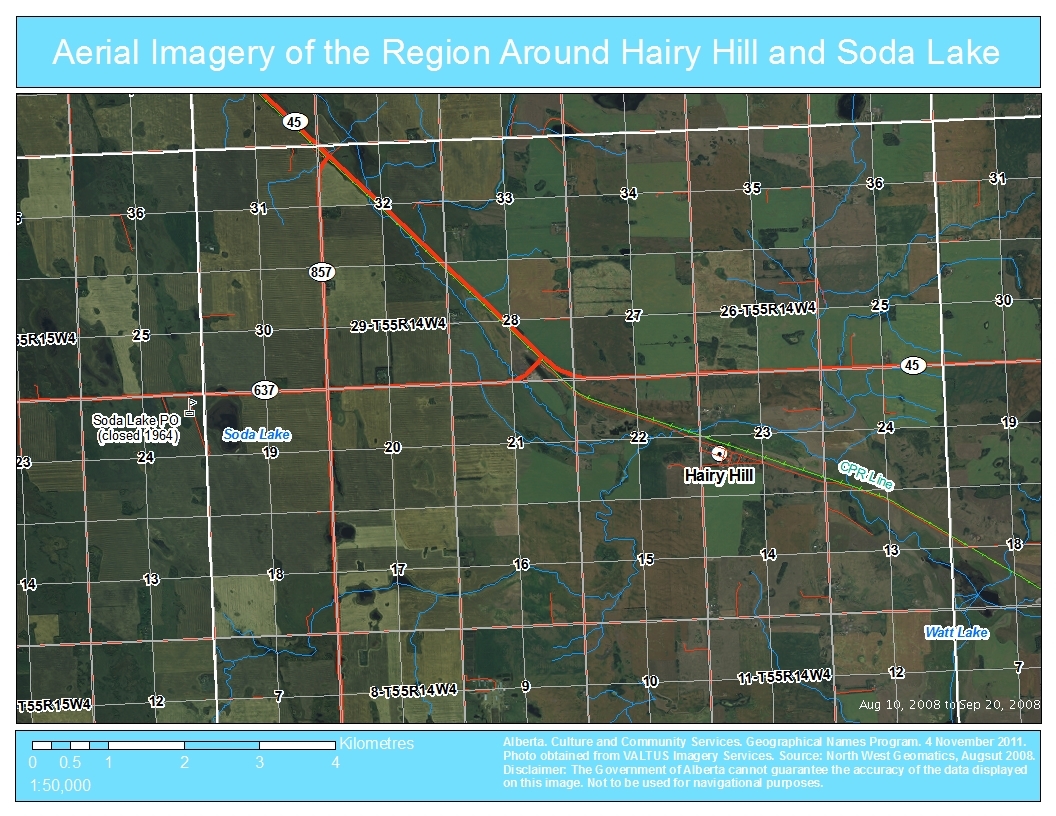
Origin of the name of the Hamlet of Hairy Hill

Recently the Edmonton Journal ran a photo essay and article about the Hamlet of Hairy Hill, which included the story about the origin of the name (see the Further Reading section below for links).  Hairy Hill is undoubtedly one of the most unusual place names in Alberta. It is a name that frequently raises questions, not to mention more than a few eyebrows.

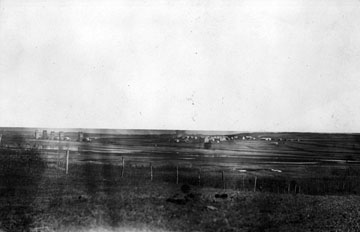
The region around what is now Hairy Hill has been historically known as both the Whitford District and the Soda Lake District.  In November 1903, a post office by the name of Soda Lake was established with A. E. Boutellier as the first postmaster. The post office name was in reference to a highly alkaline lake located nearby (which has since dried up). However, in February 1907, a new post office was opened closer to the lake. Probably in recognition of geographical realities and to avoid confusion, the new post office was given the name Soda Lake, meaning the older post office needed a new name. (Click on the above image for a larger view.)

The new name chosen for the post office was inspired by a strange phenomenon the region’s early settlers had observed. In the 1940s, folklorists recorded this story told by George Chrapka, an early resident of the area:

The first settlers, on moving into this district … chose the site for their new homes on a large flat hill.  This hill, however, was somewhat different from any other they had seen.  Everywhere they looked they saw large mats of hair covering the ground.  Naturally they were puzzled, but with the coming of the spring also came an answer.  One bright morning they saw a hundred or more buffalo roaming lazily along the slopes of the hill.  On going to the spot they found fresh mats of hair.  This solved the “hairy mystery,” and also suggested a name for the locality – Hairy Hill.

Many mammals grow a shaggy coat during the winter, which they shed in the spring. North American bison, commonly referred to as buffalo, are known to rub themselves on the ground and against foliage to rid themselves of their winter coats.  Jack Brink, a former archaeologist with the Alberta Archeological Survey and now a curator at the Royal Alberta Museum, has commented:

Bison, or buffalo as they are commonly known, have lived in central Alberta for thousands of years. The area around Hairy Hill would have been an especially attractive region because it straddles the boundary of two eco-zones: the plains to the south and the parkland and forest to the north. As such it offers access to and advantages of both regions. Hilly areas offered lush grass, greater moisture and some protection from extremes of weather. So it is reasonable to suggest that Hairy Hill was a popular spot for bison herds. This could account for the historic records of great amounts of buffalo hair found on the hill by early settlers.

Year after year, while there was still bison roaming the plains, they would return each spring to this hill, leaving new deposits of hair over its surface. The settlers called the place Hairy Hill. The unusual name stuck, gained a following and in 1907, the regional post office was given the name Hairy Hill.

As the writer of the Edmonton Journal article points out, Hairy Hill’s history is a common one for many of Alberta’s rural communities – a promising and optimistic start followed by disappointment and decline.  The population of Hairy Hill grew, slowly but steadily, over the first few decades.  In 1928, the Canadain Pacific Railway built an east-west line through the community. Soon after the completion of the rail line, Hairy Hill boasted a large school, numerous stores, and up to six grain elevators.  By 1946 the population had reached 235 and the community was erected as a village.  The population continued to grow, reaching a high of 250 in 1948 before beginning a steady decline, falling to 136 by the late-1960s.  The population dropped precipitously through the 1970s and 1980s, reaching a low of 54 people by 1993.  In 1996, the village was dissolved and Hairy Hill became a hamlet under the jurisdiction of the County of Two Hills No. 21.

Written by: Ron Kelland, Historic Places Research Officer and Geographic Names Program Coordinator

Location:

National Topographic System Map Sheet: 73 E/13 – Hairy Hill

Latitude/Longitude: 53° 45′ 48″ N & 111° 58′ 43″ W

Alberta Township System: Sec 23 Twp 55 Rge 14 W4

Description: Approximately 18 km northwest of the Town of Two Hills and 11 km southeast of the Village of Willingdon. 

Additional Resources: 

More information about Hairy Hill can be found in:

Chrapka, George. “How Hairy Hill got its Name,” Alberta Folklore Quarterly, Vol. 2 no. 1 (March 1946), p. 34, available from the Alberta Folklore and Local History Collection, University of Alberta Libraries http://www.ourfutureourpast.ca/folklore.html.

Lucas, John. “Gallery: Hairy Hill,” Edmonton Journal, 29 October 2011, Available from http://www.edmontonjournal.com/news/photos/Gallery+Hairy+Hill/5628500/story.html.  

Mah, Bill. “Hamlet of Hairy Hill Fading Slowly Into Alberta’s Past,” Edmonton Journal, 30 October 2011, Available from http://www.edmontonjournal.com/news/Hamlet+Hairy+Hill+fading+slowly+into+Alberta+past/5630654/story.html.   

Castle Mountain – King of the Castle? (Part 2 of 2)

Castle Mountain to Mount Eisenhower and Back Again

In January 1946, General Dwight D. Eisenhower, Supreme Commander of the Allied Forces in Europe and future President of the United States of America, was on an official visit to Canada. Prime Minister Mackenzie King was seeking a fitting honour to bestow on the general. Sir Leonard Brockington, a friend and former aide of the Prime Minister’s, suggested that Banff National Park’s Castle Mountain be renamed in the general’s honour, adding, in a statement that proved to be astoundingly inaccurate, that because the mountain “was not named for any individual … no one could be offended by a change of name” (quoted in memorandum, Pickersgill to King, 7 January 1946). Reportedly against the objections of the Geographic Board of Canada, King announced the renaming during a state dinner on January 9. Recounting that the people of Scotland had recently presented Eisenhower with a castle, King said that

We have no ancient castles in this country, but we have other things that are even more enduring. We have ancient mountains. We can’t very well present you with a mountain, but we have this mountain named ‘Castle Mountain’ and it is the wish of the Government of Canada and of the people of Canada to change the name from ‘Castle Mountain’ to ‘Mount Eisenhower’.

Reportedly visibly moved, Eisenhower responded by saying that he was “touched by such a tribute that one man should be so honoured and his name so perpetuated in this way,” adding that “One day I am going to see that mountain. There is one thing, too, of which I am fairly certain – it must be a bald peak” (Ottawa Journal, 10 January 1946). The mountain became Mount Eisenhower and the junction of the two main roads in the area became Eisenhower Junction. Oddly, the Canadian Pacific Railway station in the area retained the name Castle Mountain.

Although the audience at the state dinner responded enthusiastically to the announcement, protests erupted from across Canada and even from the United States. The Vancouver Province wrote that

The gesture is a gracious one …it is a pity that the gesture will be futile. No one who has seen Castle Mountain can call it anything but Castle. The mountain named itself in the first instance. Its battlemented towers, its buttresses, its crenalated crags shout Castle, Castle, Castle, all day long. They can never be made to say Eisenhower [cited in the Banff Crag and Canyon, 18 January 1946].

The Banff Crag & Canyon wrote that “the man on the street is wondering why out of all the peaks and lakes in the Banff National Park, Castle Mountain should have been selected” [11 January 1946], and on 18 January added that

‘Residents of Banff were highly pleased when they learned Castle Mountain was to be called Mt. Eisenhower,” quotes one of the daily papers. Just which resident? … Letters and comments of protest are being published daily, which must sound a rather sour note to the supreme Allied commander as and if he reads them. Far be it for anyone to mean to belittle such a gesture, but two generations or more have known this mighty monarch of the Rockies as Castle Mountain, and it will take some educating to change its name. Surely the choice of another mountain would have been more in order [12 January 1946].

The Alpine Club of Canada wrote to the Prime Minister noting Eisenhower’s achievements, but lamenting the loss of the historic and uniquely descriptive name and also protesting the lack of consultation and the seemingly random selection of Castle Mountain to be renamed. Read more

Castle Mountain (Part 1 of 2)

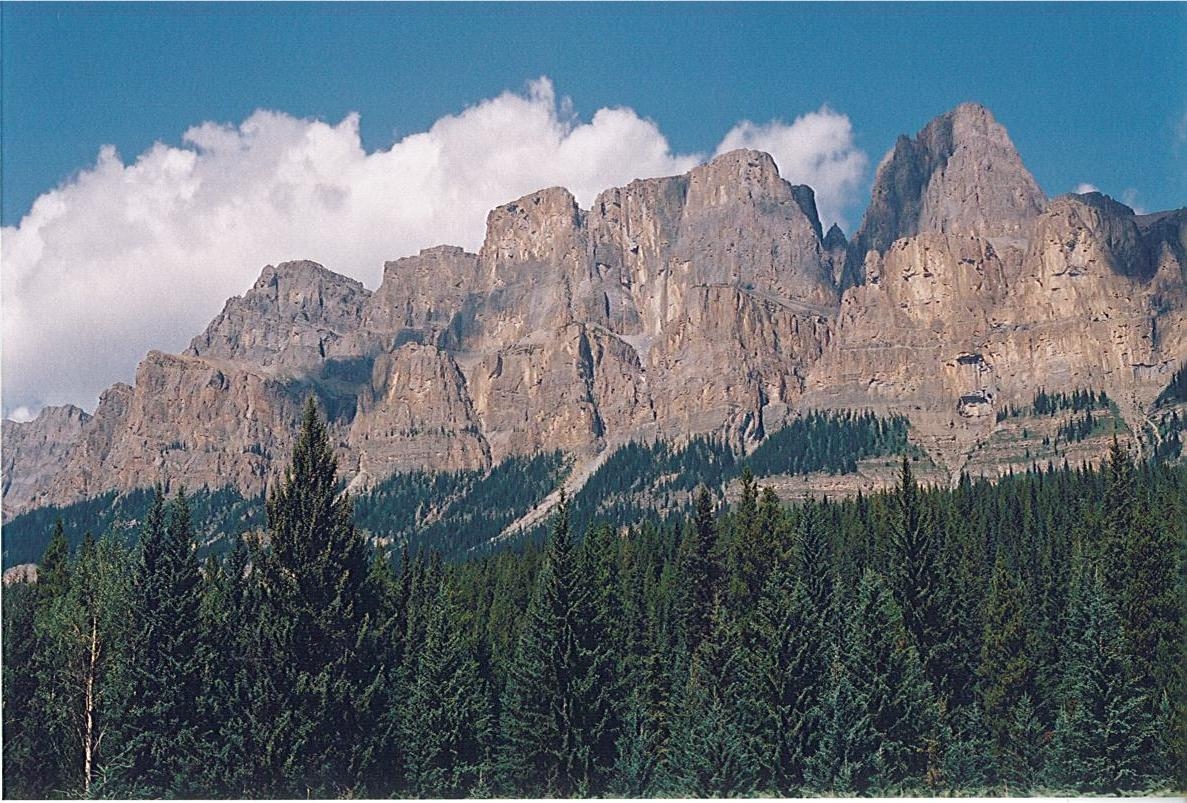
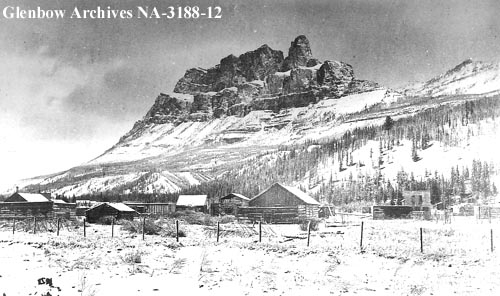
Castle Mountain is an approximately 2,860 metre (9,383’) mountain located in Banff National Park. It is in the Bow Valley and situated approximately 30km northwest of the Banff town site and 20 km southeast of the Lake Louise town site. The name is descriptive and comes from the fortress- or castle-like appearance of the mountain; its peaks and ridges give the impression of the towers and battlements characteristic of a medieval fortress or castle. The mountain appears to stand alone in the middle of the valley and, although it is not amongst the tallest of the mountains in the area, it is one of the most picturesque and well-known mountains in the Canadian Rockies. This prominence has made the mountain the subject of one of the greatest naming controversies in western Canadian history.

The origins of the name Castle Mountain are found with the Palliser Expedition, which explored western British North America from 1857 to 1859.  In August 1858, the expedition split up to cover more territory. Dr. James Hector, the expedition’s geologist, led a party westward from the Morley area up the Bow Valley. On August 17, 1858, Hector’s party entered a wide portion of the Bow Valley between the Sawback Range and the Bow Range. He recorded in this Journal that “[s]eeming to stand out in the centre of the valley is a very remarkable mountain, still at a distance of 12 miles, which looks like a gigantic castle.”  Hector spent the next two days camped near the mountain, which he named Castle Mountain. [Interestingly, on August 12, 1858, just five days prior to Hector’s naming of Castle Mountain in the Bow Valley, Lt. Thomas Blakiston, another member of the Palliser Expedition had bequeathed the name Castle Mountain to a mountain near Pincher Creek. In order to avoid confusion, Blakiston’s mountain was officially named Windsor Mountain in 1915].

On August 19, Hector and a party member named Sutherland attempted to climb Castle Mountain. Hector recorded the details of the climb in his Journal:

[W]e began to rise very rapidly. At 1,000 feet above the valley, before we had quite got out of the woods, we came to a cliff, about 80 feet high, composed of quartzite and indurated sandstone of a pinkish hue… . After this we reached the first of the cliff ranges that are so conspicuous from the valley below … . When 2,000 feet above the valley we passed round to the N. side of the mountain, and found that a deep valley separated it from a lower spur composed of splintery shale of a dull red colour. The mass of the mountain, which rose more than 2,000 feet above us, seemed to be composed of thick bedded limestones, and these breaking away as the soft shales below them have been destroyed has given rise to the castellated appearance.

Hector’s party left Castle Mountain the next day to continue their exploration of the Bow Valley. On September 3, he again noted the mountain, which could be seen from Kicking Horse Pass, at a distance of 15 to 20 miles.

On his second journey up the Bow Valley in 1859, Hector camped at the north end of Castle Mountain. During this trip he recorded observations that the mountains on the west side of the valley were characterized by strata of soft shale, while the mountains on the east side of the valley were composed of limestone. Geologically speaking, he wrote, Castle Mountain, with its heavy shale, belonged with the mountains on the west side of the valley, even though the course carved by the Bow River placed the mountain on the valley’s east side.

The Palliser Expedition wrapped up in 1859. In 1861, Hector was appointed as the director of the Geological Survey of Otago, New Zealand. He spent the rest of his life in New Zealand, where he died in 1907 at the age of 73 years. Despite only spending two short visits to Castle Mountain, Hector’s vivid descriptions of the mountain and the name he gave it lived on.

Silver City, at the base of Castle Mountain, ca. 1885

In 1883, the Canadian Pacific Railway established a station near the mountain. This station was listed as Castle Mountain in the railway’s timetables and maps. Also in 1883, a mining town known as Silver City was established in the mountain’s shadow. It quickly grew to over 2,000 people before disappearing in 1885 after the expected ore deposits failed to materialize.

In 1912, the Geographic Board of Canada officially approved the name Castle Mountain to identify the mountain on federal maps. During the First World War, the Castle Mountain Internment Camp was established to contain detainees, mostly recently-arrived immigrants from Eastern Europe. Castle Mountain also featured prominently in promotional literature produced by the Canadian Pacific Railway and Banff National Park. The mountain continued to dominate the landscape of the region and the minds and imaginations of those that viewed it. The name Castle Mountain appeared to be indelibly affixed upon the map. The events of 1946 changed that.

To read Part 2, click here.

Location:

National Topographic System Map Sheet: 82 0/5 – Castle Mountain

Latitude/Longitude: 51° 17′ 59″ N & 115° 55′ 21″ W

Alberta Township System: Sec 8 Twp 27 Rge 14 W5

Description: Approximately 30 km northwest of the Banff town site and 20 km southeast of the Lake Louise town site.

Written by: Ron Kelland, Historic Places Research Officer and Geographical Names Program Coordinator

Additional Resources:

More information about Castle Mountain and Dr. James Hector can be found in:

Dell, R. K. “Hector, James: 1934-1907, geologist, explorer, administrator,” Te Ara – The Encyclopedia of New Zealand, available from http://www.teara.govt.nz/en/biographies/1h15/1.

Kordan, Bohdan S. and Peter J. Melnycky. In the Shadow of the Rockies: Diary of the Castle Mountain Internment Camp, 1915-1917. (Edmonton: Canadian Institute of Ukrainian Studies Press, 1991).

Spry, Irene M. ed., The Papers of the Palliser Expedition, 1857-1860. (Toronto: Champlain Society, 1968), available from http://link.library.utoronto.ca/champlain/search.cfm?lang=eng. [Dr. Hector’s Journal for 1858 can be found on pages 286-469].