The Historical Resources Actgives authority to make geographical naming decisions jointly to the Alberta Historical Resources Foundation and the Minister of Culture and Community Spirit. However, over the last number of decades, the Government of Alberta has not generally been proactive in naming geographical features. The responsible authorities believe that it is more appropriate for the citizens of Alberta to play the key role in making naming proposals. So, how does a person suggest a name for a geographical feature? The short answer is to submit a proposal.
Applications or proposals to name a geographical feature are made to the Alberta Geographical Names Program. The application form is available on the program’s website along with the Geographical Names Manual, which will help guide applicants through the application process and provide some details about the research standards and principles that guide geographical naming in Alberta. It is highly recommended that applicants read the manual before starting the application to ensure that the proposed name is appropriate and meets the “Principles and Guidelines for Geographical Naming” (more on these in a future blog post).
On the application are a number of questions that should be completed as thoroughly as possible. This remainder of this blog post will walk you through the application form. Read more →
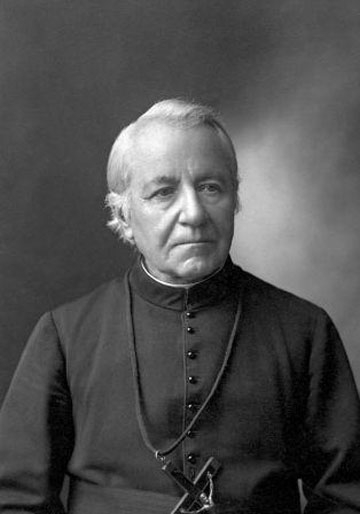
A previous RETROactive post notes that the City of St. Albert is celebrating its Sesquicentennial (150th) Anniversary in 2011. Such anniversaries are rare in Alberta, so St. Albert’s big year is worth at least one more post. St. Albert is one of the oldest communities in Alberta. It received its current name in 1861. Most people believe that the city was named for Father Albert Lacombe, OMI, and it was…kind of.
Portrait of Father Lacombe, ca. 1900, (A2283, Provincial Archives of Alberta)
Albert Lacombe was born in 1827 at Saint-Sulpice, Lower Canada (now Quebec). He was ordained in 1849 and was sent to Pembina, Dakota Territorywhere he met with and accompanied the Métis on their hunts. After a short posting in Lower Canada in 1851/52, he was sent to the Red River Settlement to assist Bishop Alexandre-Antonin Taché, who sent him to the Lac Ste. Anne Mission northwest of Edmonton. Although Lac Ste. Anne would be his base for the next seven years, Lacombe travelled throughout Central and Northern Alberta ministering to the Métis and native people of those regions. Due to its poor agricultural prospects, Lac Ste Anne had been deemed unsuitable as a permanent mission site and a search was made for a more promising location. On January 14, 1861, Father Lacombe and Bishop Taché arrived at “Big Lake Settlement,” a Métis community immediately northwest of Fort Edmonton on the shores of, you guessed it, Big Lake. The surrounding lands seemed ideal for agriculture and the settlement’s proximity to Fort Edmonton made it much easier to minister to the Cree and Blackfoot peoples trading at the post. Climbing a nearby hilltop, where they ate a meal of tea and pemmican, Bishop Taché reportedly stuck his staff in the snow and declared to Lacombe, “You were right. This sight is magnificent. I choose it for a new mission and I want it to be called St. Albert, in honour of your patron saint. Here you will build a chapel.”
Albert Lacombe’s patron, or name saint, was Saint Albert of Louvain. In 1191, Albert of Louvain was chosen to be Bishop of Liege (in Belgium), but his appointment was disputed by Emperor Henri VI of the Holy Roman Empire, who had been excommunicated by Pope Celestine III for imprisoning Richard I of England. Henri VI appointed his own candidate to the bishopric of Liege. Albert appealed to the pope and to Archbishop William of Rheims. Although Albert’s appointment was confirmed, he was accosted and murdered by Henry VI’s supporters. Albert of Louvain was later canonized and his feast day is acknowledged on November 21.
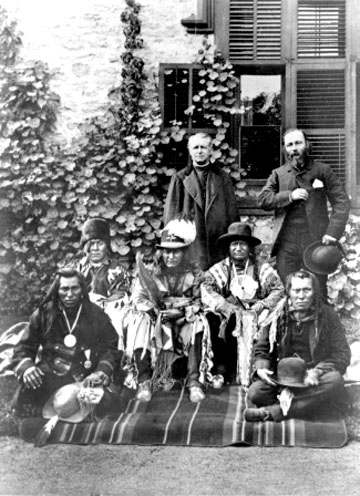
Father Lacombe with Chiefs at Earnscliffe (home of Sir John A. Macdonald), Ottawa, October 1886. Front Row, L to R: North Ax (Piegan), One Spot (Blood) Middle Row, L to R: Three Bulls (Blackfoot), Crowfoot (Blackfoot), Red Crow (Blood) Back Row, L to R: Albert Lacombe, Jean L’Heureux (P200, Provincial Archives of Alberta)
So, was St. Albert named for Father Albert Lacombe? In a way it was, but it is more correct to say that the City of St. Albert and Father Albert Lacombe are both named for the same person – St. Albert of Louvain. Incidentally, for many years it was believed that Albert Lacombe’s patron saint was a different Albert, namely Albertus Magnus, or St. Albert the Great, who was Bishop of Regensburg (1260-1262) and an advocate for the harmonization of science and religion. However, Albert the Great was not canonized, or elevated to the sainthood, until 1931 – 15 years after Father Lacombe’s death and 70 years after the establishment of the mission, making it unlikely that either the mission or the missionary would have been named for Albert the Great.
Father Lacombe had a relatively short connection with the mission at St. Albert. He did build a chapel along with a flour mill, a bridge across the Sturgeon River and a school near Fort Edmonton, but his stay at the new mission site was short. By 1865, he was tasked with establishing an itinerant mission to the east and south, living with, working with and more directly influencing the Cree and Blackfoot people. Over the next seven years he would travel from Rocky Mountain House in the west, Fort Victoria (Pakan) in the east, St. Albert in the north and Fort Benton, Montana Territory and St. Louis, Missouri in the south. In 1872, he was reassigned to the Red River Settlement. Although he returned to the west in 1882, he was more closely associated with southern Alberta for the rest of his career and life. Albert Lacombe died in Midnapore, now part of Calgary, on December 12, 1916.
The community of St. Albert grew slowly in stature and population through the years. A post office was established in 1880. It was erected as a village in 1899 and as a town in 1904. By 1911, the population had reached approximately 600 people. By 1971, the population had reached 11,800. Six years later, on January 1, 1977, St. Albert became a city with a population of about 24,000 people. St. Albert is currently the province’s sixth largest city with 60,138 residents.
Written by: Ron Kelland, Historic Places Research Officer and Geographical Names Program Coordinator
City’s Location
National Topographic System Map Sheet: 82 H/12 –St. Albert
Latitude/Longitude: 53° 38′ 13″ N & 113° 37′ 13″ W
Alberta Township System: Twp 25 Rge 25 W4
Description: Immediately north-west of Edmonton on the Sturgeon River.
Additional Resources
More information about Father Albert Lacombe, OMI can be found in:
The name Skrine Creek has been officially adopted for a previously unnamed creek in the Porcupine Hills. The name commemorates Walter and Agnes “Nesta” Skrine (pronounced “screen”), who were early operators of a medium-sized ranch in the region. The spring-fed creek rises in the Municipal District of Ranchland No. 66 and flows northerly into the Municipal District of Willow Creek, where it joins Mosquito Creek approximately 24 kilometres west of Nanton.
Walter Skrine was born in Somerset England in 1860. After receiving his education at Oxford University, he managed a coffee plantation in Ceylon until the early 1880s. In either 1883 or 1884, he to migrated to the Canadian northwest, where he began ranching along the Highwood River in the “Pekisko Hills” (Little Rolling Hills) region. After losing most of his cattle during the disastrous winter of 1886/87, he moved further west and established a ranch on Mosquito Creek. He chose the site due to the protection offered by the surrounding hills and the plentiful water supplied by the area’s creeks and springs. He settled first as a squatter, but later filed on a 160-acre homestead and leased nearly 16,000 acres of surrounding land. Starting with 200 head of cattle, he grew the herd to 700 head by 1898. Walter was active socially and politically within the ranching community. He ran, unsuccessfully, for the Territorial Assembly and, in 1885, the North-West Stock Association, a protest movement against the policies of the existing territorial stock association, was formed during a meeting at Skrine’s house in 1885.
In 1895, Walter travelled to Ireland where he married Agnes “Nesta” Shakespeare Higginson of County Antrim. Walter and Nesta travelled back to Canada, where she took an active role in the daily activities of the ranch. Nesta was a very well-educated young woman and a talented writer and poet. She was published throughout Europe, mainly in Blackwood’s Magazine, under the pseudonym Moira O’Neill. She also published a short novel, The Elf-Errant (1895) and two books of poetry, Songs of the Glens Antrim (1900) and More Songs of the Glens of Antrim (1920). Ranching life and the landscape of the Canadian West provided inspiration for much of her prose and poetry, notably a prose piece entitled “A Lady’s Life on a Ranche,” which has been republished in many anthologies about southern Alberta ranching history, and a number of poems in both of her published books.
Unlike many of their fellow ranchers, the Skrine’s welcomed the arrival of farmers into the region and assisted many of them in establishing themselves. However, the transition of the local economy from ranching to farming put pressures on many ranchers. In 1902, Walter and Nesta sold the Bar S Ranch to a neighbour and returned to Ireland. They settled at Ballyrankin House in County Wexford. In 1921, the house was burned by Irish patriots, one of many such attacks on English gentry during “The Troubles.” Undaunted, the Skrines, purchased the Newlands House, about a mile away and re-christened it as Ballyrankin House. Walter Skrine died here in 1930 following a hunting accident. Nesta Skrine died on January 22, 1955. As of 2011, the Bar S Ranch continues to operate on the same land originally selected by Walter Skrine in the 1880s.
The proposal to name this water feature Skrine Creek was received from Clay Chattaway, the current owner/operator of the Bar S Ranch in September 2009. The proposed name was supported by both Municipal Districts, the surrounding land-owners and descendants of the Skrine family living in Ireland. The proposed name received the approval of the Alberta Historical Resources Foundation in November 2010 and the Minister of Culture and Community Spirit in February 2011.
National Topographic System Map Sheet: 82 J/8 – Stinson Creek
Latitude/Longitude: 50° 16′ 56″ N & 114° 5′ 57″ W to 50° 19′ 37″ N and 114° 6′ 18″ W
Alberta Township System: Sec 20 Twp 15 Rge 1 W5 to Sec 5 Twp 16 Rge 1 W5
Description: Rises in the MD of Ranchland No. 66 and flows north into the MD Willow Creek No. 6. The creek flows northerly into Mosquito Creek, approximately 24 km WSW of Nanton.
Additional Resources
Additional information about Walter and Nesta Skrine and the history of the Bar S Ranch can be found in the following resources:
Skrine, Agnes, “A Lady’s Life on a Ranche,” In A Flannel Shirt and Liberty: British Emigrant Gentlewomen in the Canadian West, 1880-1914, edited by Susan Jackel, 95-110. Vancouver: University of British Columbia Press, 1982. Originally published in Blackwood’s Edinburgh Magazine vol. 163 no. 987 (January 1898).
Higginson, T. B. “Moira O’Neill in Alberta,” Alberta Historical Review vol. 5 no. 2 (Spring 1957): 22-25.
Klassen, Henry. “A Century of Ranching at the Rocking P and the Bar S.” In Cowboys, Ranchers and the Cattle Business: Cross-Border Perspectives on Ranching History, edited by Simon Evans, Sarah Carter and Bill Yeo, 101-122. Calgary: University of Calgary Press and Boulder: University Press of Colorado, 2000.
Blog Post Written by: Ron Kelland, Historic Places Research Officer and Geographical Names Program Coordinator
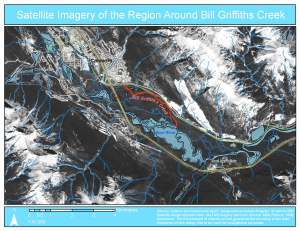
A previously unnamed creek in the Bow Valley near Canmore has recently been named Bill Griffiths Creek. The name commemorates William “Bill” Griffiths. The spring-fed creek rises just east of the TransCanada Highwayand just south of the town of Canmore. It flows south-easterly, generally parallel to the Canadian pacific Railway tracks, for approximately four kilometres before joining the BowRiver about three kilometres upstream from the hamlet of Deadman’s Flats.
Bill Griffiths was a fisheries biologist with Alberta Fish and Wildlife. He received a Bachelor’s degree from the Universityof Alberta and a Masters degree from the University of Canterbury in New Zealand. He worked for Alberta Fish and Wildlife briefly in 1976 and again from 1979 to 1983, this time as the Regional Fisheries Biologist based in Calgary. In this position he initiated new fisheries management strategies and regulations aimed at enhancing the Bow River’s trout fishery. He also did freelance consulting work in Burundi, Africa from 1983 to 1984, after which he returned to Alberta as an Environmental Assessment Biologist with Alberta Environment.
In 1985, he returned to Fish and Wildlife where he coordinated volunteer efforts to establish fisheries habitat enhancement programs. In 1987, he completed two major enhancement projects; one at Gap Lake in conjunction with the Sarcee Fish and Game Club and the other on a small creek near Canmore with the cooperation of the Upper Bow Valley Fish and Game Club. This second creek, which is the one that now bears his name, is now considered to be one of the most important spawning areas for brown trout in the BowRiver watershed. Due largely to his efforts, the Bow River has become recognized as a world-class trout fishery by scientists, writers and anglers.
Bill Griffiths died in 1988 and this creek has been locally known as “Bill Griffiths Creek” since that time. This name, now made official, commemorates his commitment to developing the brown trout fishery in the Bow River and his connection to this creek, which has become the subject of many studies and reports.
The naming proposal was made by former colleagues and students of Bill Griffiths. Local support was indicated by a petition. The Municipal District of Big Horn, the Town of Canmore and the management of the Kananaskis Country Provincial Parks all supported the proposed name. The Alberta Historical Resources Foundation approved the name during its November 27, 2010 meeting and the Minister of Culture and Community Spirit concurred with the decision on February 23, 2011. Notice of the decision was published in Alberta Gazette on April 15, 2011.
The geographical names we are familiar with today have come from many sources. Some are aboriginal names, but most are names that were given to features by explorers, fur traders, land surveyors, settlers and government officials. Many names throughout North America, particularly the western regions, developed on an almost ad hoc basis, with no overall guiding framework. Many features soon came to have numerous names and many different spellings and variations. Governments began to see the importance of establishing guidelines to ensure that consistent and reliable maps could be produced.
Oddly, the official naming of geographical features in Canada began in the United States with the establishment of the United States Board on Geographic Names in 1890. The board began making naming decisions for features located in Canada. As the names adopted by American government officials were accepted by other countries, Canadian government officials saw the need to exert Canada’s sovereignty over place names within its territories. In 1897, the Geographic Board of Canada (GBC) was established and given the authority to make naming decisions for geographical features within Canada. This board would go through periodic name changes – to the Canadian Board on Geographic Names in 1948, the Canadian Permanent Committee on Geographical Names in 1961, and the Geographical Names Board of Canada in 2001.
Starting in 1897, the federal government held complete authority over naming decisions in Canada. As years passed, the provinces began to gradually play a larger role in these decisions. In 1899, the existing seven provinces and the North West Territories were permitted to appoint a representative to the GBC. These provincial and territorial representatives could present the opinions of their respective jurisdictions on the appropriateness and spelling of names. In 1961, jurisdiction over naming was almost completely transferred to the provinces, but the federal government retained control over naming on federally controlled lands – National Parks, Indian reserves, military bases and in the territories. In 1979, geographical naming on federal lands became joint decisions between the province and the relevant federal department or agency. The territories did not gain the authority to name their own geographical features until 1984.
Today each province and territory has the authority to make its own geographical naming decisions. The Geographical Names Board of Canada (GNBC) still exists, but its mandate has changed. Today it serves mainly as a supporting body that aids the provincial and territorial programs. It does so by serving as a liaison between the provincial programs and federal departments, it co-ordinates policy regarding nomenclature and procedures, it advises on research, it promotes the use of official names through information-sharing, it represents Canada at international naming conferences and on naming bodies, such as the United Nations Group of Experts on Geographical Names and it maintains the Canadian Geographical Names Database, which is a registry of all official geographical names in Canada.
To be continued with “Part 2: Geographical Naming in Alberta.”
Written by: Ron Kelland, Historic Places Research Officer and Geographical Names Program Coordinator
Origin of the Names Battle Lake, Battle Creek and Battle River
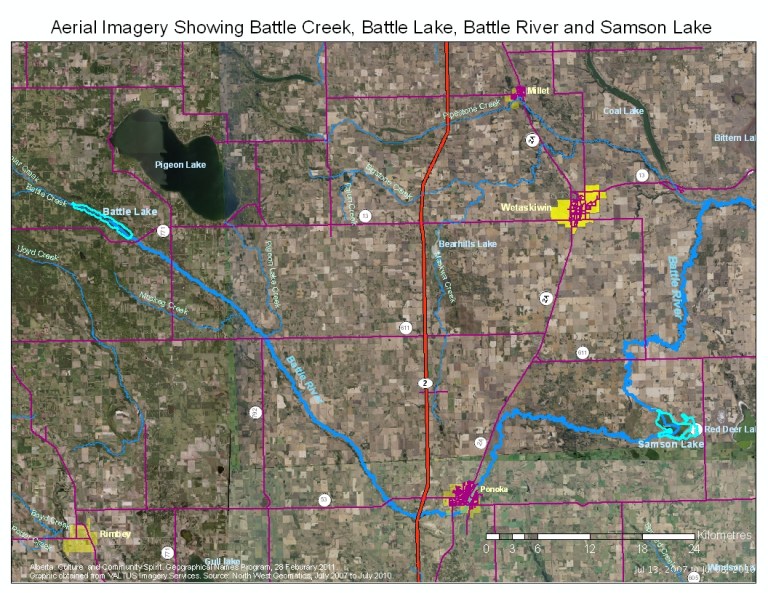
In February, we received a comment on our Facebook page about the origins of the name Battle Lake. This water feature is located approximately 53 km west of Wetaskawin. It is one of a series of water features in the area that are identified by the name Battle, including Battle Creek, Battle Lake and Battle River.
The name Battle Lake was first recorded in the 1883 field notes of Tom Kains of the Dominion Land Survey (DLS). He recorded it as “Battle River Lake” due to its location on the Battle River. He later shortened the name to Battle Lake and, in 1901, that form of the name was approved by the Geographic Board of Canada for use on maps.Battle Lake is fed by Battle Creek, which flows easterly into the lake at its north-westerly point. The creek was first recorded by the DLS as “Battle Lake Creek” in 1903. Two year later, the DLS shortened the name to Battle Creek, but the name was not officially adopted until 1960.
The name Battle River has a much longer history. The first recorded reference to the Battle River was by explorer Anthony Henday, who spent considerable time in the region during the 1750s. He referred to the river as “Chacutenah.” The inspiration and translation of that name is not currently known.
The name Battle River is first recorded by explorer Peter Fidler. In his journal entry of November 14, 1792, he writes that his party “came to the Battle or Fighting River, which is only about 3 yards wide & very little water in it, which runs in a very serpentine course thru a valley SE & NW & falls into the Saskatchewan river after receiving several small streams about 40 miles below Manchester House” [Note: Manchester House was a Hudson’s Bay Company post just east of present day Lloydminster].
The name Battle River is supposedly a translation of the Cree no-tin-to-si-pi and/or the Stoney kec-hi-sab-wapta, although it is also referred to by the Blackfoot as kinok-kxis-sis-ughty (little or half river). Traditional and local knowledge is that the river formed the boundary between the territories of the Blackfoot and the Cree peoples and that many battles occurred along its length.
Interestingly there was another Battle Lake located about 65 km to the south east. In 1914, it appeared on maps as Battle Lake. It was believed that having two lakes with the same name in such close proximity would cause confusion, so, by 1921, the name of this lake was changed to Samson Lake after Cree Chief Samson.




 Battle Lake is fed by Battle Creek, which flows easterly into the lake at its north-westerly point. The creek was first recorded by the DLS as “Battle Lake Creek” in 1903. Two year later, the DLS shortened the name to Battle Creek, but the name was not officially adopted until 1960.
 RETROactive