Finding Lulu: One man’s quest to find himself in his own city

Editor’s note: This article was originally published in The Yards Magazine in September 2018. It has been reprinted here with the author’s permission.

On May 12, 1922, Lulu Anderson tried to buy a ticket to ‘The Lion and The Mouse’ at the former Metropolitan Theatre on Jasper Avenue. Lulu was 36 and a member of the Black community. She enjoyed the theatre and had visited the Metropolitan many times with her friends. But May 12 was different. The theatre staff denied Lulu entry. Worse, they “assaulted” her, according to a column in the Edmonton Journal.

Lulu decided to stand up.

Few Edmonton residents know Lulu’s story. And to understand what happened to her downtown that night, in 1922, we need to back up a bit. For starters, despite many who still believe the opposite, Alberta was home to anti-black racism. Minstrel shows were extremely common in theatres; indeed, actors of the era routinely performed in blackface. In 1920, a minstrel parade was even held downtown. Segregation was also common across the city. From 1910 to 1950, Black Edmontonians were denied entry into theatres, swimming pools, bars and even hospitals. One more well-known example is from 1938, when a Black nurse was denied entry into nursing training at the Royal Alexandra Hospital.
Read more

Stephansson House: A piece of Iceland in Alberta

Author note: Five years ago, I visited Iceland and it sparked an excitement I thought could not be experienced anywhere else in the world. This was until a summer road trip to the hamlet of Markerville, an Icelandic settlement in Red Deer County. Historic Markerville is home to the Icelandic-Canadian Markerville Lutheran Church, Markerville Creamery, Fensala Hall and the Stephansson House Provincial Historic Site.

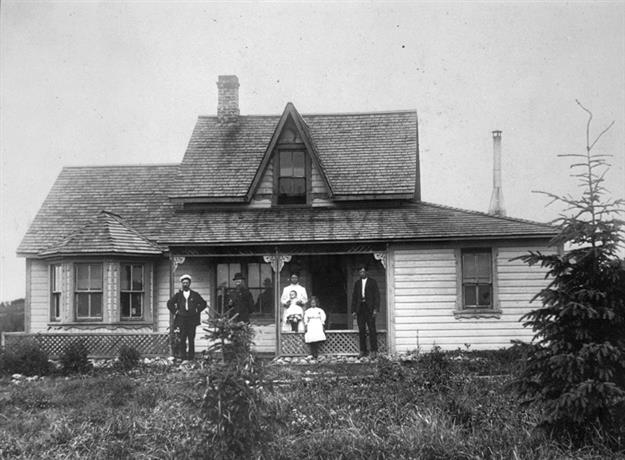
Stephansson House in Markerville
Stephansson House in Markerville. Image courtesy of the Provincial Archives of Alberta, A5007.

The Icelandic-Canadian, Stephan G. Stephansson, led a fascinating life. He was an immigrant, farmer, father and most notably a poet. In Icelandic and Icelandic-Canadian communities, Stephansson’s poems are well known for their evocative images of landscapes and homesteading as well as passionate portrayals of his personal beliefs and philosophies. In search of a better life, he came to Alberta and settled in the Markerville area, along with fifty other Icelanders.

Read more

Bread, salt and water: the history of Doukhobors in Alberta

Editor’s note: The following blog post is part one of a two-part series looking at the history and influence of Doukhobors in Alberta.

East of the Crowsnest Pass, nestled within the small community of Lundbreck, sits a simple white building clad in asbestos shingles and covered with metal roof. The structure looks utilitarian and spare; it could easily be mistaken for the kind of modest community halls one occasionally sees in Alberta’s small towns. While the building is almost entirely non-descript, the history that it embodies is extraordinarily rich.

The history of the Alberta Doukhobors is an essential chapter in the story of one of the largest experiments in communal living in North America. Approximately 7,500 Doukhobors came to Canada in 1899, at the time it was the largest mass migration in the country’s history. In stark contrast, at a 2018 meeting of Doukhobors in British Columbia, a grim question was posed: will there be any Doukhobors active in their faith by 2030? Between their noteworthy arrival at the end of the nineteenth century and their dwindling membership today, the Doukhobors have lived a tumultuous and compelling experience in Canada. This post attempts to explore the vision and roots of the Doukhobor community, and their early experiences in Canada.

Doukhobor Prayer Home in Lundbreck, 2013
The Doukhobor Prayer Home in Lundreck (also known as the Doukhobor Hall [dom or house]) is one of the few tangible reminders of one of the most remarkable communities of people to ever settle in this province.
Read more

Hello from the Other Side: The Occult Phenomena of Spiritualism in Central Canada

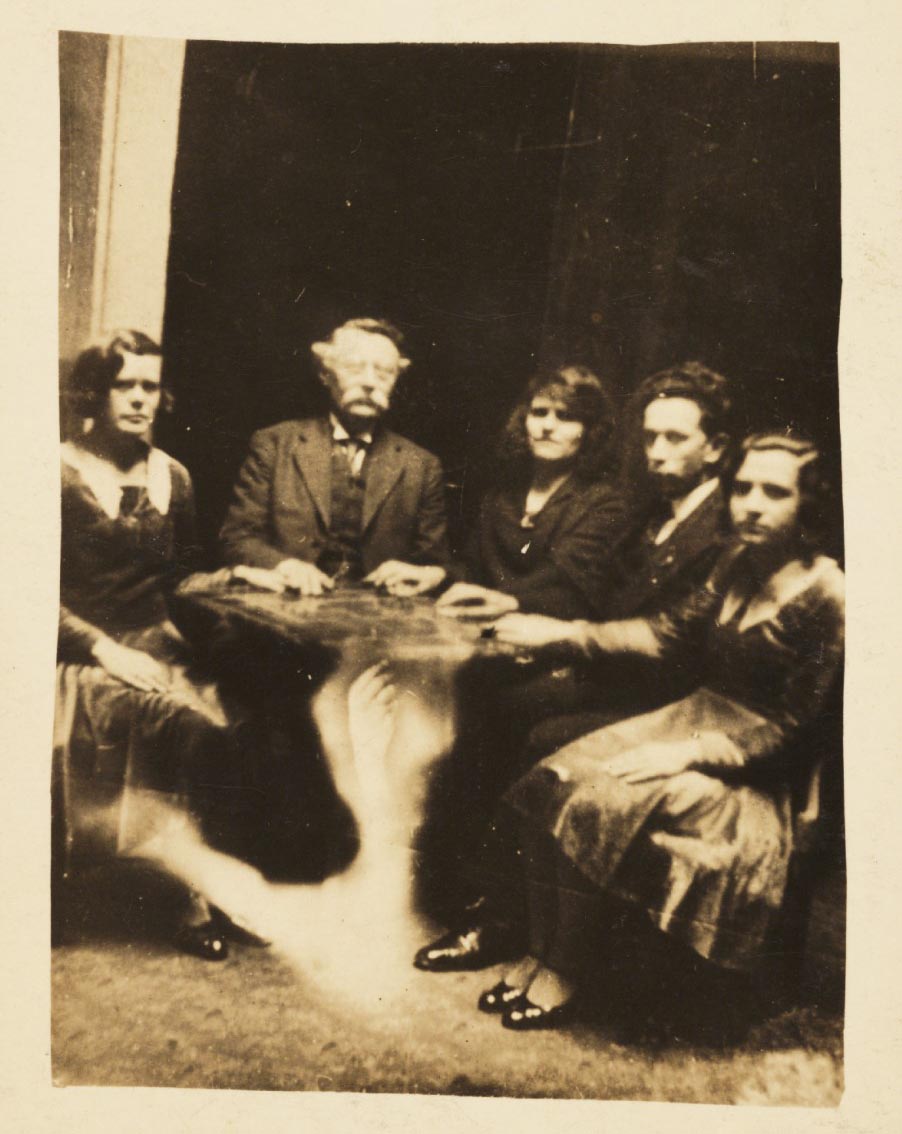
If you think back on any of the horror films you’ve seen recently, or the science fiction novels you’ve read, how many of these have themes or actions where people contact the dead or interact with ghostly apparitions? What about notions of an elaborate spirit world that interrelates with the laws of our physical world? Or individuals with superhuman abilities like mind-reading, clairvoyance, telepathy, or telekinesis? These themes are core aspects of the Spiritualist movement which have been hybridized and diffused, becoming the defining touch to horror, science fiction, and related genres. But where did this phenomena come from and why? While modern media portrayals of Spiritualism may involve Ouija boards and séances to foreshadow the horrific events that result from the release of evil spirits of the Beyond, the actual phenomena of Spiritualism is rooted in a complex network of socio-political interactions at the turn of the 20th century between the advent of science and technology, the women’s rights movement, and WWI.

The information accompanying the spirit album states that the table is levitating – in reality the image of a ghostly arm has been superimposed over the table through double exposure. Photograph 1920 by William Hope (1863-1933). National Media Museum Collection: 2002-5054/10. Public Domain.

Spiritualism arose at the turn of the 20th century, when North American society was dominated by Protestant and Roman Catholic churches. However, traditional beliefs were being challenged by the rise of sects and cults arriving in Upper Canada from the northern United States, including Unitarianism, Swedenborgianism, Universalism, Quakerism, and Shakerism. Many of these new sects adopted and incorporated what can be considered progressive beliefs into their doctrines, Read more

Alberta Culture Days 2018

Mark your calendars for September 28-30 – Alberta Culture Days is almost here! This event provides an opportunity for Albertans to discover, experience and celebrate our arts, heritage, diversity and community spirit. There are nearly 80 organizations in Alberta that have been selected as official celebration sites, but anyone can organize and host an event. A list of events and sites, and resources to plan and submit your own event can be found here. If you’re not in Alberta, don’t worry, there are events happening all across Canada. September 28-30 is also National Culture Days! A listing of events by city or province can be found here.

If you are interested in hosting your own event, add it to the National Culture Days calendar. You can find event planning guides, ideas for schools, customizable posters and ads on the Alberta Culture Days website to help you with your event.

Take a look and start planning your visit to one (or more) of the many celebration sites across the province. With over 350 events listed, there is something for everyone – art walks, cinema, scavenger hunts, brewery tours, screen printing and much, much more!

Happy Culture Days!

“Isn’t it good, Norwegian Wood?”

So, a colleague of mine here in the Historic Resources Management Branch recently returned from a course on wood conservation in Oslo, Norway.

While he didn’t find out why John Lennon lit a former lover’s house on fire as the song strangely suggests, he did attend the 2018 International Course on Wood Conservation Technology (ICWCT). A biennial course that gathers academics, professors and scientists from around the world (including two from Canada) to deliver lectures, ICWCT also combines this with field work and theory centered on the practice of wood conservation.

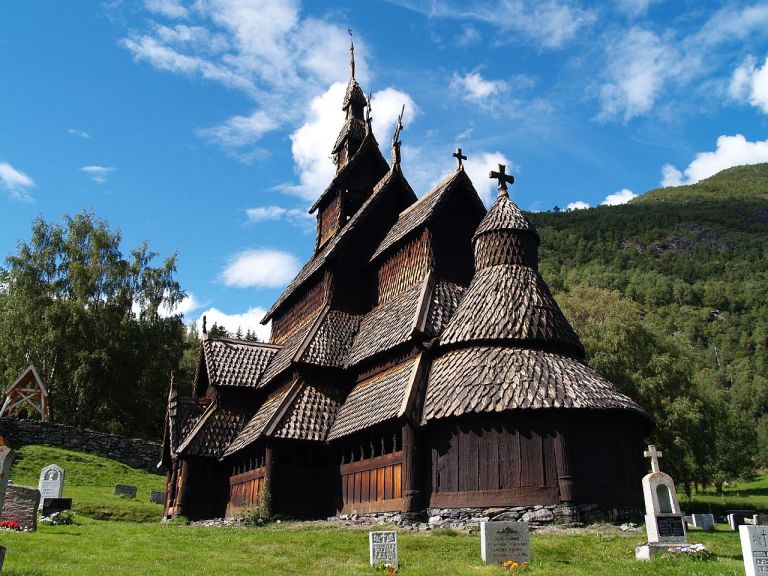
1280px-Borgund_Stavekirk,_Norway
The Borgund Stave Church in Lærdalen, Norway was built just before 1150. From the Middle Ages up until the beginning of the twentieth century the use of pine tar was restricted to the protection of churches, since it was both time-consuming  and expensive to produce. This goes a long way towards explaining why outdoor woodwork on the stave churches from the twelfth century which has been protected with pine tar is preserved in an excellent condition. Norwegian church accounts reveal that the local farmers and villagers were obliged to apply fresh tar to the external walls of the stave churches at ten yearly intervals*. Photo by: AzaToth

Heritage Conservation Technologist Evan Oxland went to Norway to learn more about technical and theoretical aspects of wood conservation, as well as what other contemporary international approaches there are out there. He was the only Read more

The Big Four and Alberta Place Names

This post was originally published on July 10, 2012 in honour of the 100th anniversary of the Calgary Stampede. It highlights the place names and geographical features in Alberta named after The Big Four – the ranchers and businessmen that funded Guy Weadick’s 1912 wild west show and rodeo, which grew to become today’s Calgary Stampede. Six years later, the Stampede is once again in full swing – a good excuse to revisit the legacy of the Big Four.

On the west side of Stampede Park, rising from the seething mass of carnival rides, concession stands and humanity that is the Stampede midway is the Big Four Building. This building is named for the Big Four – the four Southern Alberta ranchers and businessmen who funded Guy Weadick’s proposed rodeo and wild west show in 1912. Intended to be a one-time event, the show and rodeo grew to become the Calgary Exhibition and Stampede. To say that the Big Four influenced Calgary’s popular culture would be a great understatement.

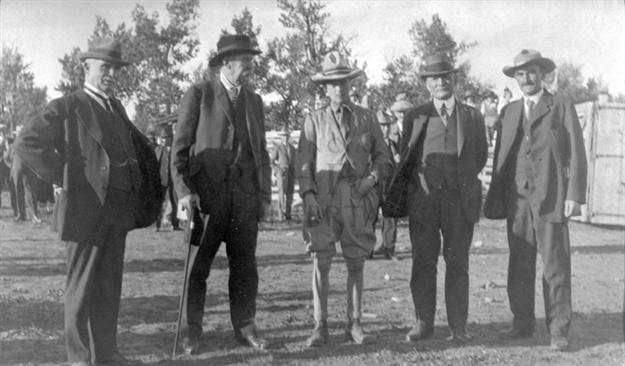
The Big Four with HRH Edward, Prince of Wales at the EP Ranch, 1923 LtoR: Pat Burns; George Lane; Edward, The Prince of Wales; Archie McLean; and A. E. Cross. (Provincial Archives of Alberta, A2658)

However, the legacy of the Big Four extends beyond the boundaries of Stampede Park. They left their mark not only in Calgary, but on the geography of the Province of Alberta. This blog post is the first of three that look at the Big Four – George Lane, A. E. Cross, Archie McLean and Pat Burns – and the places named for them. Read more

Every Place Has a Story

LC forfacebook 2
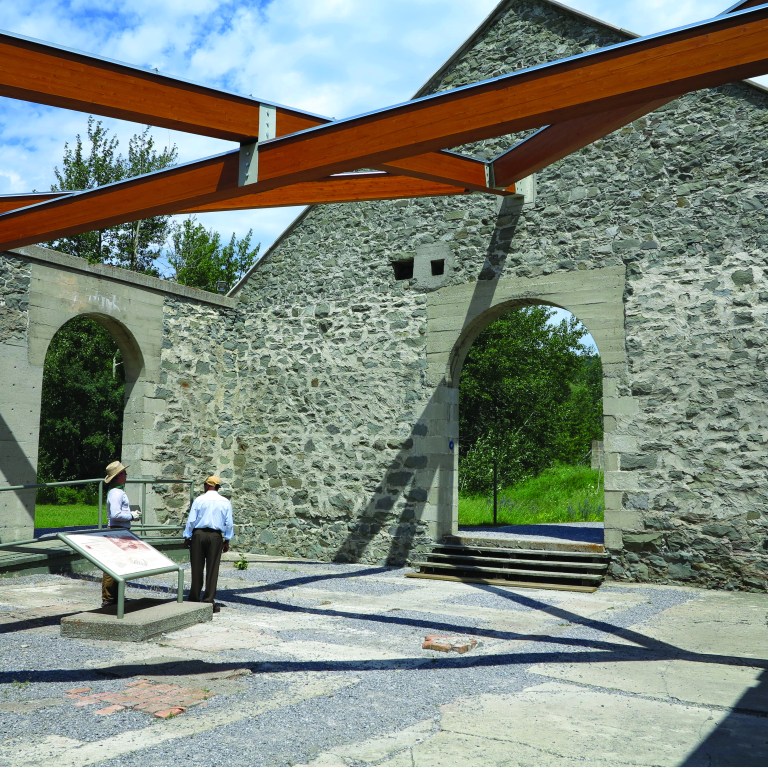
Strikes, war and untimely death are all part of the story of the ambitious mining venture at Leitch Collieries in the Municipality of Crowsnest Pass.

Saturday, July 7 is Canada Historic Places Day. Here in Alberta, you might be picturing a museum, an old Ukrainian farm house or that retrofitted old warehouse in downtown Calgary or Edmonton.

In reality, historic “places” can be much more than urban buildings or interpretive centres. They’re vast swaths of land where First Nations hunted or geological landmarks tens of thousands of years in the making.

Everyone across the province is invited to head out this weekend to learn about the stories, people and places that have shaped our province. We have more than 700 historic places designated under the province’s Historical Resources Act…maybe one of those is right in your neighbourhood!

When you’re out exploring Alberta’s historic places, share your stories on social media using the hashtag #HistoricPlacesDay. And head over to historicplacesday.ca to find out how a selfie could land you a chance to win $1,000.

Historic Resources and Flooding

During the past few weeks, areas of southern Alberta have been affected by overland flooding, and this week warnings were issued for areas in northern Alberta (https://www.alberta.ca/emergency.aspx). Floods can affect historic resources such as historic buildings, museum collections and archaeological sites. The June 2013 flood is an example of a flood event that had a large impact on historic resources, causing damage to some historic sites and buildings and exposing or washing away archaeological sites.

Flood damage from the June 2013 flood to the chicken coop at E.P. Ranch, photo taken April 2014.

If you are looking for information about how to deal with historic resources impacted by flooding, please refer to our ‘Flood Info’ page that features the following articles:

If you think you have come across an archaeological site that may have been exposed by flooding, please report your find to the Archaeological Survey of Alberta: https://www.alberta.ca/report-archaeological-find.aspx

If you think you have found a fossil, please report it to the experts at the Royal Tyrrell Museum: http://www.tyrrellmuseum.com/research/identify_fossil.aspx

Happy New Year 2018

Happy New Year, everyone! We are excited for 2018 and look forward to sharing more of Alberta’s history with our readers.

This past year was a great one for RETROactive. We had our most annual views ever with a total of 72,442, coming from more than 140 different countries. The countries where most of our views came from include Canada, United States, United Kingdom, Germany, Australia, France, South Korea, Mexico, Netherlands, and India. We published 48 new posts in 2017 and our busiest day of the year was April 19th when The Tale of a Rusty Revolver was published (this was also our most viewed post of the year).

Did you know that we also have a Facebook page and Twitter account? You can find us on Facebook at “Alberta’s Historic Places” and on Twitter at @ABHistoricPlace, or follow the links below.

Facebook: https://www.facebook.com/Albertas-Historic-Places-180887998609781/

Twitter: https://twitter.com/ABHistoricPlace?lang=en

Lastly, our Popular Posts page has been updated. This lists our top 10 posts of all time and is a great way to introduce new readers to our blog – please share the link with your friends, family, and colleagues!

Thank you to all our readers for your support. Here’s to a great 2018! Next week we will have a new post from the Heritage Art Series!

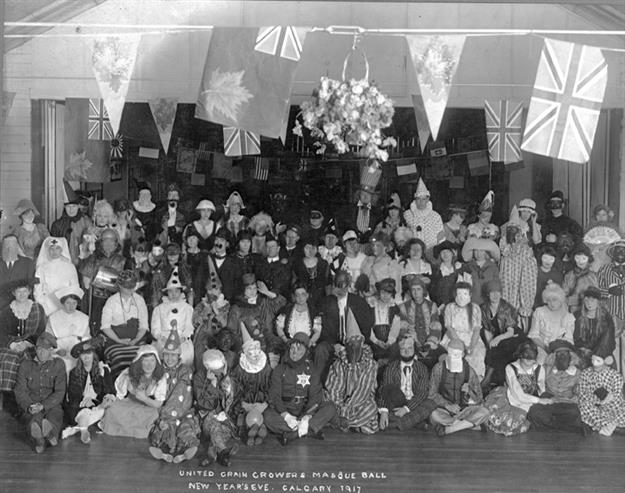
People in costume at United Grain Growers New Year’s Eve Masque Ball, Calgary, Dec. 31, 1917. Photo Credit: Provincial Archives of Alberta, A14708.