Bill Griffiths Creek

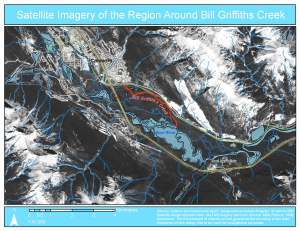
A previously unnamed creek in the Bow Valley near Canmore has recently been named Bill Griffiths Creek. The name commemorates William “Bill” Griffiths. The spring-fed creek rises just east of the TransCanada Highwayand just south of the town of Canmore. It flows south-easterly, generally parallel to the Canadian pacific Railway tracks, for approximately four kilometres before joining the BowRiver about three kilometres upstream from the hamlet of Deadman’s Flats.

Bill Griffiths was a fisheries biologist with Alberta Fish and Wildlife. He received a Bachelor’s degree from the Universityof Alberta and a Masters degree from the University of Canterbury in New Zealand. He worked for Alberta Fish and Wildlife briefly in 1976 and again from 1979 to 1983, this time as the Regional Fisheries Biologist based in Calgary. In this position he initiated new fisheries management strategies and regulations aimed at enhancing the Bow River’s trout fishery. He also did freelance consulting work in Burundi, Africa from 1983 to 1984, after which he returned to Alberta as an Environmental Assessment Biologist with Alberta Environment.
In 1985, he returned to Fish and Wildlife where he coordinated volunteer efforts to establish fisheries habitat enhancement programs. In 1987, he completed two major enhancement projects; one at Gap Lake in conjunction with the Sarcee Fish and Game Club and the other on a small creek near Canmore with the cooperation of the Upper Bow Valley Fish and Game Club. This second creek, which is the one that now bears his name, is now considered to be one of the most important spawning areas for brown trout in the BowRiver watershed. Due largely to his efforts, the Bow River has become recognized as a world-class trout fishery by scientists, writers and anglers.

Bill Griffiths died in 1988 and this creek has been locally known as “Bill Griffiths Creek” since that time. This name, now made official, commemorates his commitment to developing the brown trout fishery in the Bow River and his connection to this creek, which has become the subject of many studies and reports.

The naming proposal was made by former colleagues and students of Bill Griffiths. Local support was indicated by a petition. The Municipal District of Big Horn, the Town of Canmore and the management of the Kananaskis Country Provincial Parks all supported the proposed name. The Alberta Historical Resources Foundation approved the name during its November 27, 2010 meeting and the Minister of Culture and Community Spirit concurred with the decision on February 23, 2011. Notice of the decision was published in Alberta Gazette on April 15, 2011.

Aerial view of Bill Griffiths Creek

Creek Location

National Topographic System Map Sheet: 82 0/3 – Canmore

Latitude/Longitude: 51° 4′ 20″ N & 115° 20′ 0″ W to 51° 3′ 30″ N and 115° 17′ 30″ W

Alberta Township System: SW¼ Sec 27 Twp 24 Rge 10 W5 to SE¼ Sec 23 Twp 24 Rge 10 W5

Description: Flows south-easterly into the Bow River, approximately 3 km south east of Canmore and 75 km west ofCalgary.

Written by: Ron Kelland, Historic Places Research Officer and Geographical Names Program Coordinator
Where do all those Place Names come from?


Part 1: Geographical Naming in Canada 

The geographical names we are familiar with today have come from many sources. Some are aboriginal names, but most are names that were given to features by explorers, fur traders, land surveyors, settlers and government officials. Many names throughout North America, particularly the western regions, developed on an almost ad hoc basis, with no overall guiding framework. Many features soon came to have numerous names and many different spellings and variations. Governments began to see the importance of establishing guidelines to ensure that consistent and reliable maps could be produced.

Oddly, the official naming of geographical features in Canada began in the United States with the establishment of the United States Board on Geographic Names in 1890. The board began making naming decisions for features located in Canada. As the names adopted by American government officials were accepted by other countries, Canadian government officials saw the need to exert Canada’s sovereignty over place names within its territories. In 1897, the Geographic Board of Canada (GBC) was established and given the authority to make naming decisions for geographical features within Canada. This board would go through periodic name changes – to the Canadian Board on Geographic Names in 1948, the Canadian Permanent Committee on Geographical Names in 1961, and the Geographical Names Board of Canada in 2001.

Starting in 1897, the federal government held complete authority over naming decisions in Canada. As years passed, the provinces began to gradually play a larger role in these decisions. In 1899, the existing seven provinces and the North West Territories were permitted to appoint a representative to the GBC. These provincial and territorial representatives could present the opinions of their respective jurisdictions on the appropriateness and spelling of names. In 1961, jurisdiction over naming was almost completely transferred to the provinces, but the federal government retained control over naming on federally controlled lands – National Parks, Indian reserves, military bases and in the territories. In 1979, geographical naming on federal lands became joint decisions between the province and the relevant federal department or agency. The territories did not gain the authority to name their own geographical features until 1984.

Today each province and territory has the authority to make its own geographical naming decisions. The Geographical Names Board of Canada (GNBC) still exists, but its mandate has changed. Today it serves mainly as a supporting body that aids the provincial and territorial programs. It does so by serving as a liaison between the provincial programs and federal departments, it co-ordinates policy regarding nomenclature and procedures, it advises on research, it promotes the use of official names through information-sharing, it represents Canada at international naming conferences and on naming bodies, such as the United Nations Group of Experts on Geographical Names and it maintains the Canadian Geographical Names Database, which is a registry of all official geographical names in Canada.

To be continued with “Part 2: Geographical Naming in Alberta.”

Written by: Ron Kelland, Historic Places Research Officer and Geographical Names Program Coordinator

Fighting Words?

Origin of the Names Battle Lake, Battle Creek and Battle River

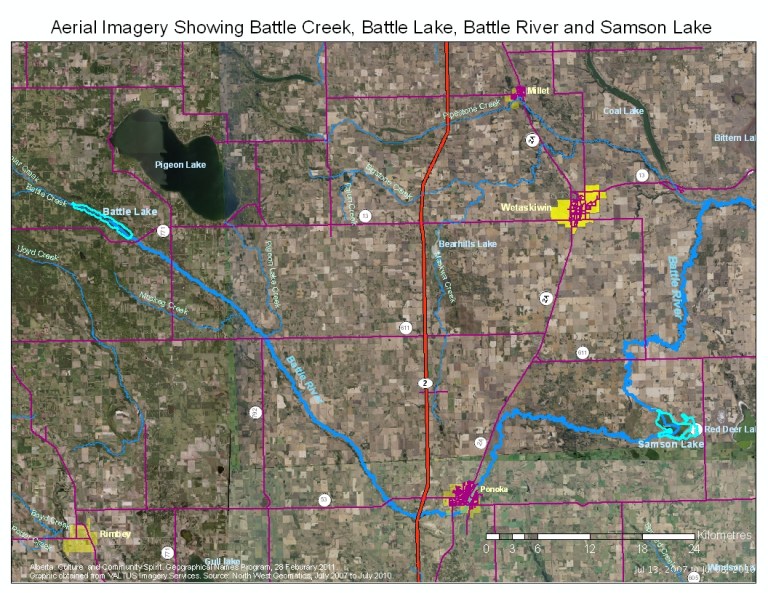
In February, we received a comment on our Facebook page about the origins of the name Battle Lake. This water feature is located approximately 53 km west of Wetaskawin. It is one of a series of water features in the area that are identified by the name Battle, including Battle Creek, Battle Lake and Battle River.

The name Battle Lake was first recorded in the 1883 field notes of Tom Kains of the Dominion Land Survey (DLS). He recorded it as “Battle River Lake” due to its location on the Battle River. He later shortened the name to Battle Lake and, in 1901, that form of the name was approved by the Geographic Board of Canada for use on maps.Battle Lake is fed by Battle Creek, which flows easterly into the lake at its north-westerly point. The creek was first recorded by the DLS as “Battle Lake Creek” in 1903. Two year later, the DLS shortened the name to Battle Creek, but the name was not officially adopted until 1960.

The name Battle River has a much longer history. The first recorded reference to the Battle River was by explorer Anthony Henday, who spent considerable time in the region during the 1750s. He referred to the river as “Chacutenah.” The inspiration and translation of that name is not currently known.

The name Battle River is first recorded by explorer Peter Fidler. In his journal entry of November 14, 1792, he writes that his party “came to the Battle or Fighting River, which is only about 3 yards wide & very little water in it, which runs in a very serpentine course thru a valley SE & NW & falls into the Saskatchewan river after receiving several small streams about 40 miles below Manchester House” [Note: Manchester House was a Hudson’s Bay Company post just east of present day Lloydminster].

The name Battle River is supposedly a translation of the Cree no-tin-to-si-pi and/or the Stoney kec-hi-sab-wapta, although it is also referred to by the Blackfoot as kinok-kxis-sis-ughty (little or half river). Traditional and local knowledge is that the river formed the boundary between the territories of the Blackfoot and the Cree peoples and that many battles occurred along its length.

Interestingly there was another Battle Lake located about 65 km to the south east. In 1914, it appeared on maps as Battle Lake. It was believed that having two lakes with the same name in such close proximity would cause confusion, so, by 1921, the name of this lake was changed to Samson Lake after Cree Chief Samson.

For a larger view of the above map, click here.

Written by: Ron Kelland, Historic Places Research Officer and Geographical Names Program Coordinator