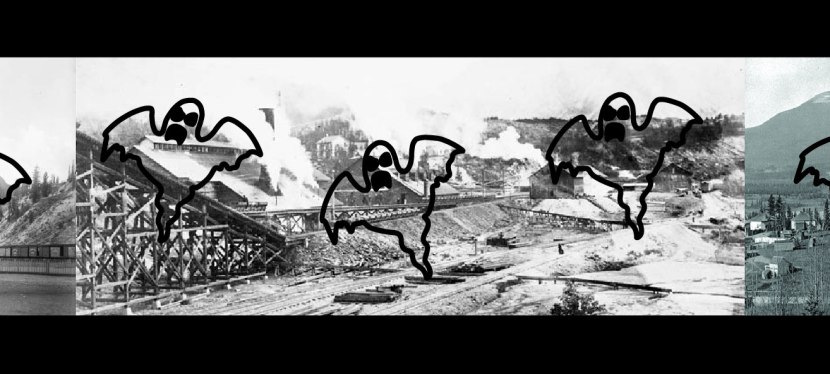
In keeping with the haunted heritage theme started last year, I thought it would be fun to look at some other spooky places in Alberta. Some of the most haunting places in our province are deserted ghost towns. Along any lonely stretch of highway, travellers are bound to come across the decaying remains of one of Alberta’s abandoned towns. Desertion of these small settlements occurred when local natural resources were depleted and transportation routes shifted elsewhere. With no reason for being, these towns became nothing more than crumbling relics of a bygone era. Read more →
October is Women’s History Month in Canada, when we celebrate the achievements of women throughout our past and use their stories to inspire Canadians today. The twentieth century saw women entering occupations previously the exclusive domain of men. A variety of circumstances combined to allow these advances, including the rise of public education, social activism culminating in universal suffrage, legal challenges that established women as “persons” and the upheaval created by two world wars. These changes are not sufficient to explain the careers of the three women described in this blog; it took determination, persistence, courage and intelligence for them to succeed and carve a place for themselves as professional women in these fields that were predominantly, if not exclusively, the preserve of men.
Diane Loranger, geologist, ca. 1946-1947. (Glenbow Archives, IP-14A-1470)
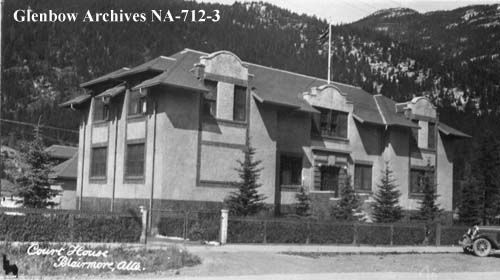
Peeling paint and powdering plaster were the first indications something was amiss at the Blairmore Courthouse, a Provincial Historic Resource in the Crowsnest Pass. A leak in the cedar shingle roof, replaced just the previous year, was immediately suspected. Detailing around the dormers in particular, part of the 1922 building’s distinctive Spanish Colonial Revival design by architect R.P. Blakey, is tricky and vulnerable to water penetration.
1920s view of Blairmore Courthouse from the southwest (Photo Credit: Glenbow Archives NA-712-3)
Nippon School of Technology, which owns the building and runs a technical school and exchange program for Japanese engineering students there, inspected the roof from the attic and found no active leaks. Puzzled, N.I.T. engaged a conservation architect to inspect the building and identify sources of moisture causing the paint and plaster failure. The findings were at once surprising and (in hindsight) credible. Read more →
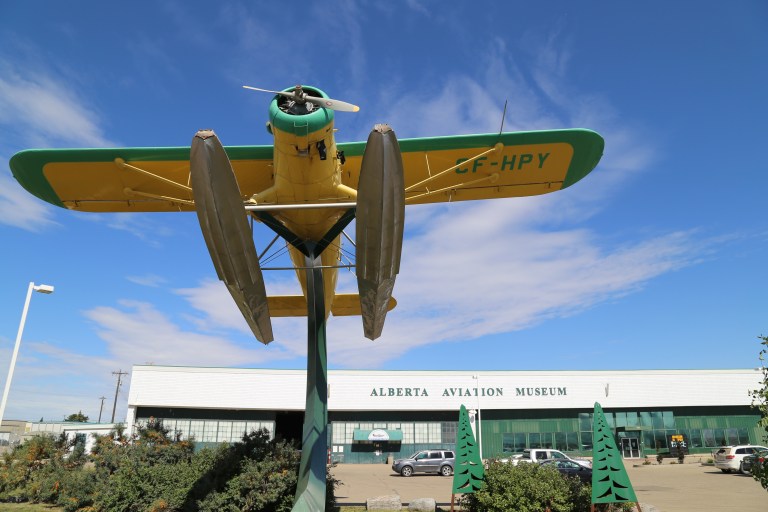
The British Commonwealth Air Training Plan (BCATP) is considered to be Canada’s primary contribution to the Second World War. Although the Plan was only in existence from 1940 to 1945, it left a lasting impact on Alberta and Canada as a whole. One of the most visible results of the Plan was the building construction that boomed during this time. There are examples of buildings produced during the BCATP period that are still in existence and the historical significance of these structures is evident today, one of which is Hangar 14, located at the former Blatchford Field and Municipal Airport site in Edmonton. This post will look at the foundation of the BCATP and summarize the distinct features of Hangar 14 that demonstrate the building’s significance as a provincial historic resource.
Hanger 14, the home of the Alberta Aviation Museum, Edmonton. (Erin Hoar, 2015)
E.P. (Prince Edward) Ranch, established by the Bedingfeld family in 1886, is located in the foothills southwest of Calgary near the Bar U Ranch National Historic Site. In 1919, during a cross-Canada tour, the Bedingfeld’s ranch captured the fancy of His Royal Highness Edward, Prince of Wales, upon his visit to the area. Prince Edward purchased the ranch shortly thereafter from Frank Bedingfeld. Under Edward’s direction, the ranch developed a breeding program for sheep, cattle, and horses with livestock imported from the Prince’s breeding farms in the Duchy of Cornwall in England. Prince Edward, later King Edward VIII, visited the ranch in the 1920s and in the 1940s and 1950s, after his abdication, as the Duke of Windsor. Photographs in the Glenbow Archives show Edward and his wife Wallis Simpson, the Duchess of Windsor, strolling among the ranch buildings that still stand at the site today. The E.P. Ranch was designated a Provincial Historic Resource in 2004 for its association with Edward, who owned the site from 1919 to 1962. Fans of the 1992 movie Unforgiven will also recognize scenes shot on location at the ranch.
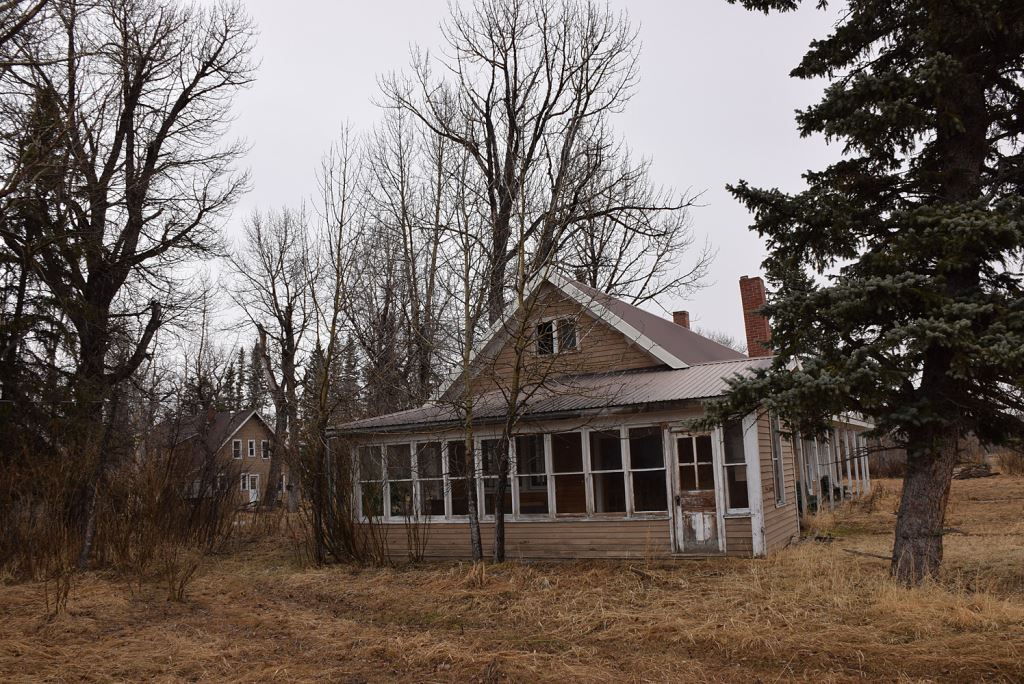
The main ranch (or Prince’s) house prior to restoration, April 2014.
In June 2013, the E.P. Ranch found itself at the epicentre of the torrential rains that flooded communities and historic sites across southern Alberta. Pekisko Creek overflowed its banks and swept through the site, turning grazing lands into a virtual river. While the large and distinctive horse barn was unaffected, four other buildings were damaged. Read more →
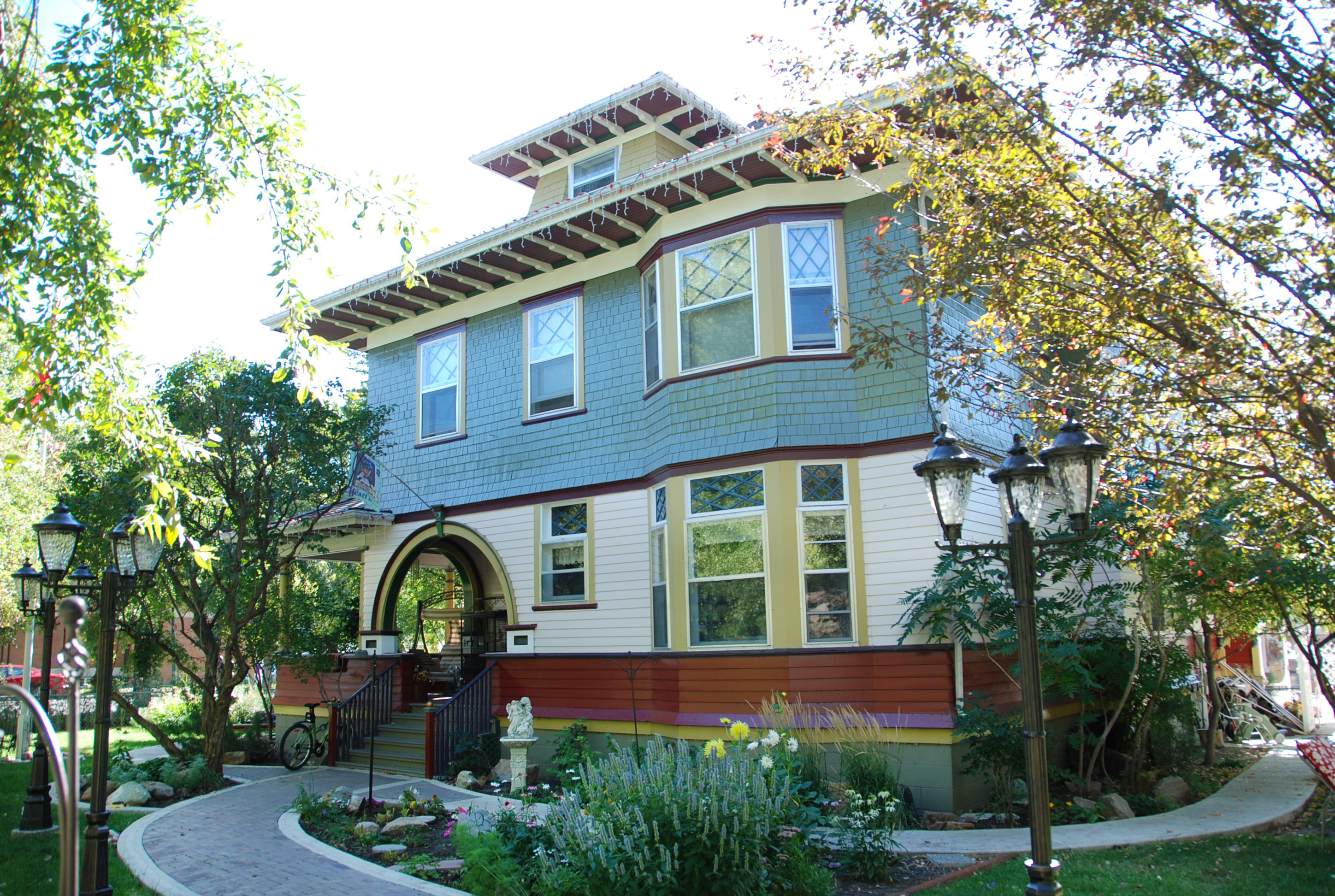
The residence known as Annandale, one of Lethbridge’s best known heritage homes, has been designated as a Provincial Historic Resource and is listed on the Alberta Register of Historic Places.
Exterior of Annandale in Lethbridge from the northwest, showing the entry porch with large arches, the wood shingle siding, bow windows and dormer window. September 2009. Alberta Culture and Tourism, Government of Alberta.
A recent Government of Alberta information bulletin announced a new Provincial Historic Resource. Check it out:
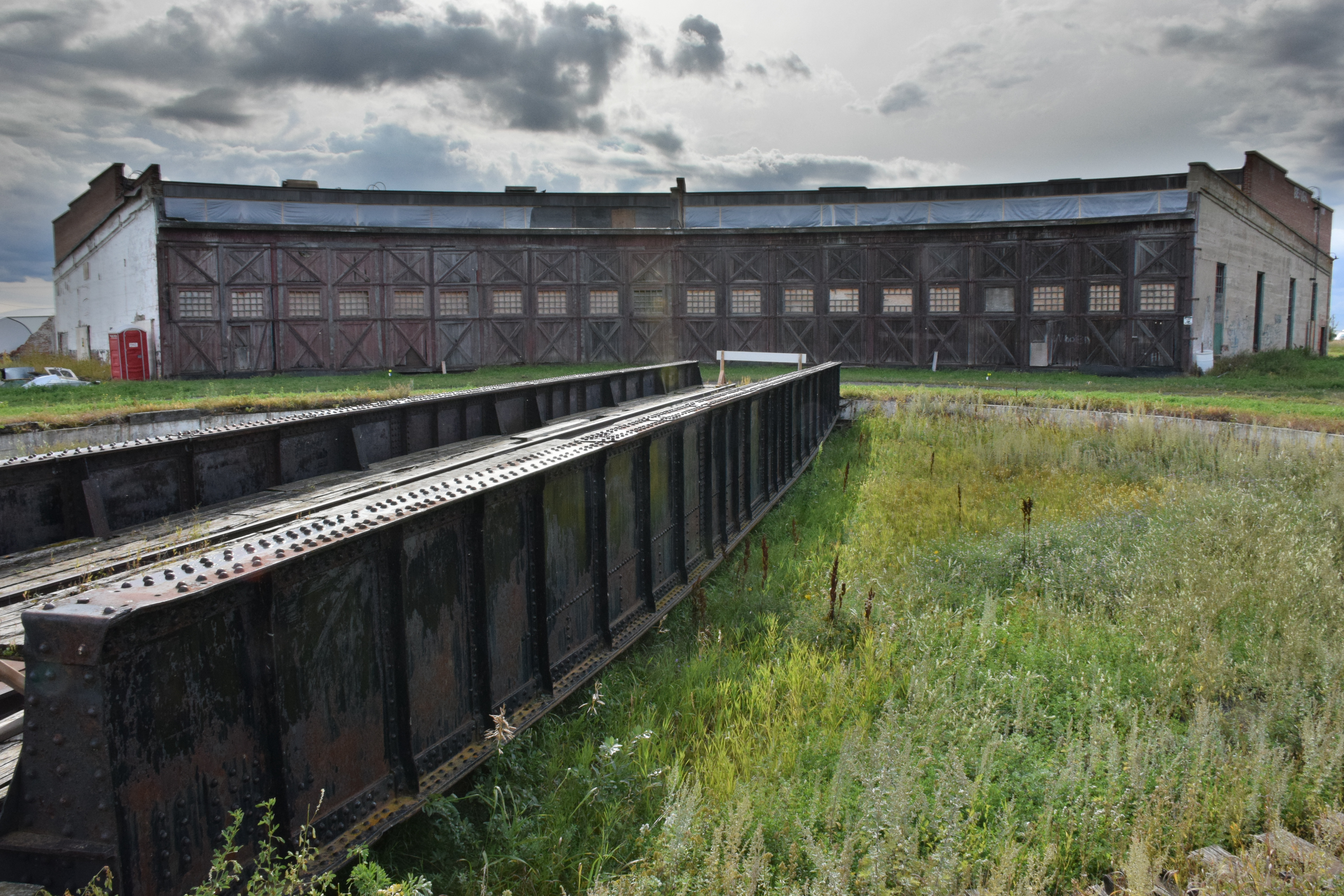
In August, 2015, a rare and important piece of Alberta’s railroading and transportation heritage has been designated as a provincial historic resource.
Exterior of the Canadian Northern Railway Roundhouse, showing the large, double doors, which provide access to the locomotive stalls. The turntable and bridge are in the foreground, September 2014. Alberta Culture and Tourism, Government of Alberta.
This post was originally published on RETROactive on March 6th, 2012. Farmers across the province will soon be busy with harvest so we thought it appropriate to highlight a previous post associated with Alberta’s agricultural past. Please note that these statistics are from 2012.
The twentieth century saw the rise and fall – literally – of the wooden country grain elevator in Alberta. As rail lines spread across the province, grain elevators sprouted like mushrooms after a spring rain. The high water mark for wooden country grain elevators was in 1934. New elevators were added in every decade, but this has been exceeded by the rate of demolition or closure ever since. Check out the following “index” of Alberta’s wooden country elevators, called “elevators” for short in this list.
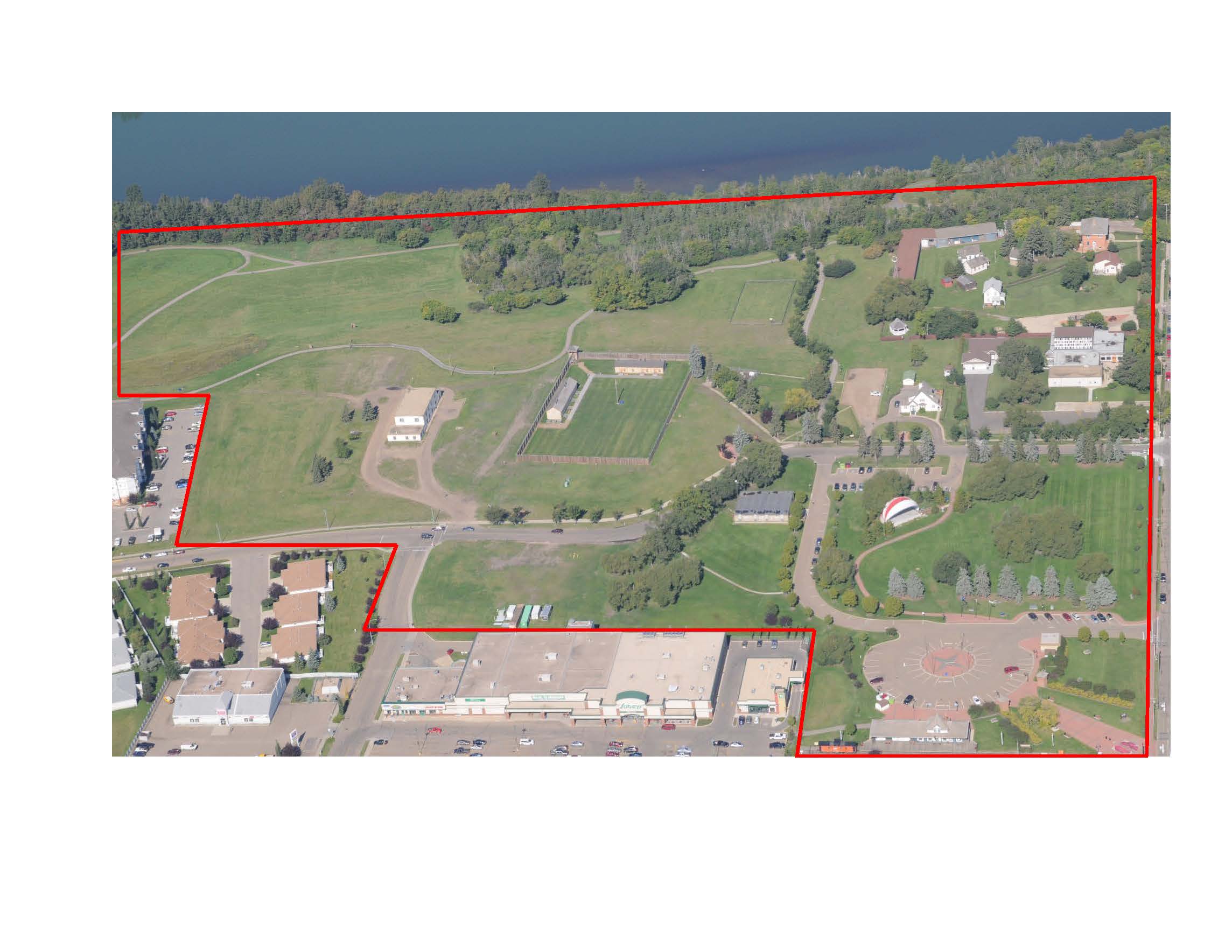
The City of Fort Saskatchewan is one step closer to realizing their vision for the development and interpretation of a significant community amenity through Council’s recent approval of the Historic Precinct Site Master Plan Guiding Document. Located adjacent to the City’s downtown and along the edge of the North Saskatchewan River, the Historic Precinct provides a unique opportunity to showcase the cultural history of Fort Saskatchewan and to develop a space for public learning and enjoyment.
Historic Precinct Area
The Approach
The Historic Precinct contains an array of man-made and natural elements that contribute to the telling of the story of Fort Saskatchewan. Project consultants EIDOS Consultants Inc. and Marshall Tittemore Architects approached the conceptualization of the space as a cultural landscape, wherein:
“An important part of the Precinct’s heritage value is found in the relics of law and order and public works, including buildings, structures, sightlines, earth mounds, plant materials and features that remain in situ. These relics constitute part of the heritage value of the area by providing tangible evidence of how it was transformed and used by the NWMP, Canadian Northern Railway, the Province and the City.” (Historic Precinct Site Master Plan, page 9).
The planning process sought to integrate local values into the final plan and therefore included public and stakeholder consultation through surveys, open houses and workshop sessions.
The City of Fort Saskatchewan’s Diane Yanch, Culture & Historic Precinct Supervisor and Richard Gagnon, Director of Culture Services display a copy of the completed Historic Precinct Master Plan
The Master Plan
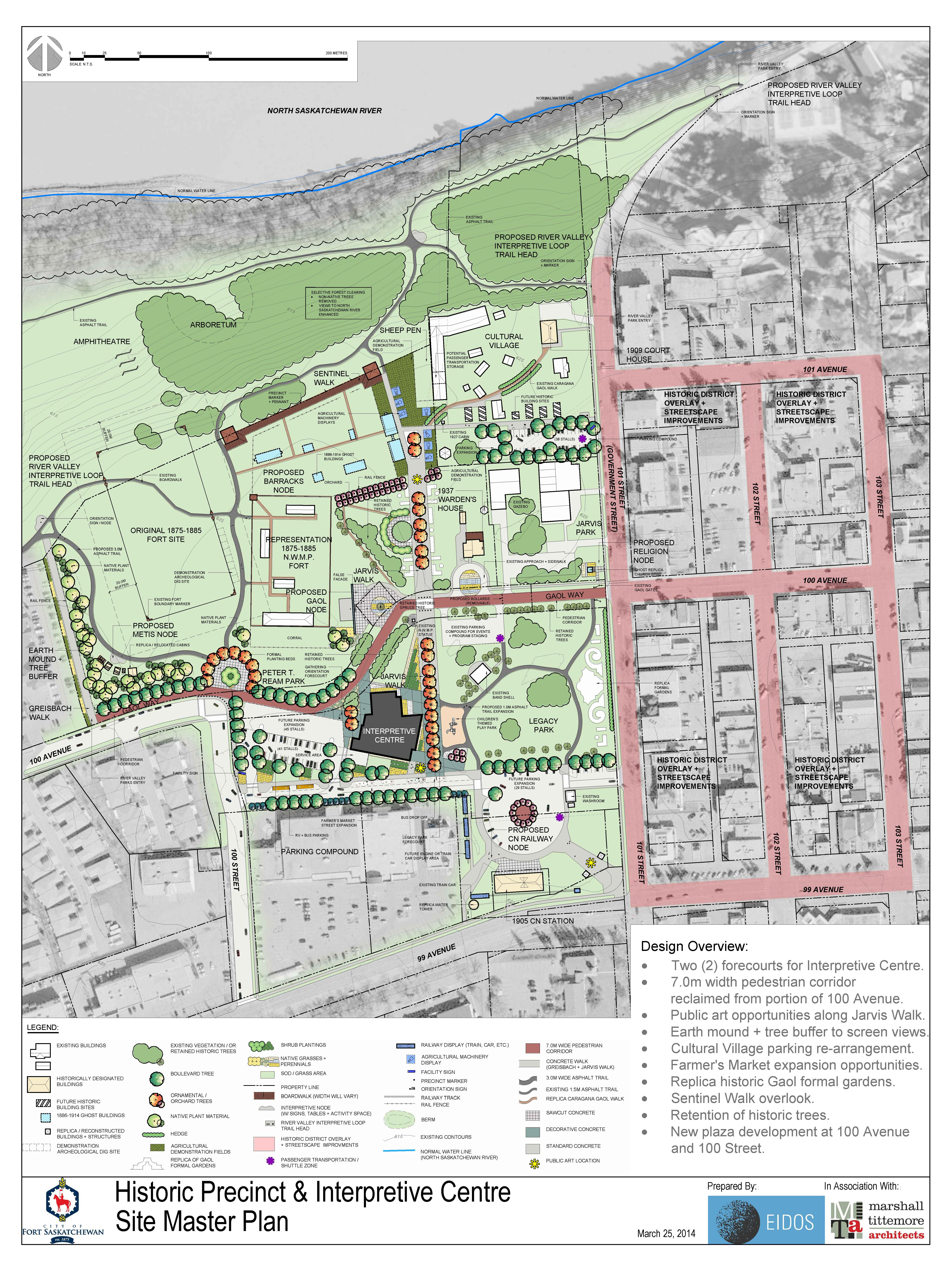
The Master Plan involved considering the long-term development and interpretation of the historic precinct, including integration of existing Provincial Historic Resources, recommendations for pedestrian circulation and way-finding, interpretation opportunities and development of a conceptual design for a new Interpretive Centre. A detailed phasing plan was also provided to allow the City to structure implementation in a coordinated and cost-effective manner.
Historic Precinct Site Master Plan
The uniqueness of the site is exemplified by the existence of three Provincial Historic Resources within its boundaries including the North West Mounted Police Post, the Fort Saskatchewan Museum (Courthouse), and the Canadian Northern Railway Station. These three historic resources are proposed to be key elements in the interpretation and programming of the Historic Precinct and are considered as Historic Precinct Nodes in the Master Plan.
Original 1875 Fort Site Node – This Provincial Historic Resource is presently an open native grass field and will remain untouched during development, with the long term goal of undertaking small scale research and public archaeology programs in partnership with interested academic institutions, archaeological societies and the Province of Alberta.
Fort Saskatchewan Museum and Cultural Village Node – The Fort Saskatchewan Museum (Courthouse) is a designated Provincial Historic Resource. The Master Plan calls for the land surrounding the Courthouse to be utilized as a ‘cultural village’ in which historic buildings and artifacts will be displayed.
Railway Node – The CNR Station will continue to be space for use by community groups. The area around the Station will be enhanced to include an opportunity to showcase other rail infrastructure, landscaping and opportunity to enhance access to the adjacent Legacy Park and farmer’s market plaza.
Other Historic Precinct Nodes proposed within the plan include a Gaol Node, Religion Node, MétisNode and First Nations Node.
Next Steps
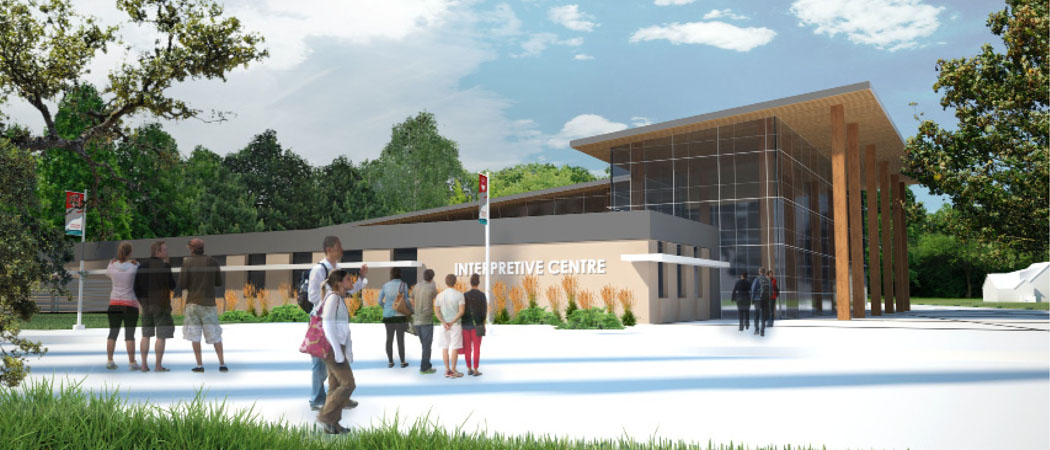
The City will continue with planning the programming for the future Interpretive Centre with hopes of breaking ground by the end of 2014. Conservation Plans have been prepared for the Courthouse/Museum and CNR Railway Station to ensure that on-going improvements and maintenance are consistent with accepted conservation practices. In accordance with the terms of designation, approvals will be obtained for any projects within the site that will affect the Provincial Historic Resources as well as work in the vicinity of the NWMP Police Post due to the high archaeological potential of the site.
Proposed General Concept Design of the Interpretive Centre
The Historic Precinct Master Plan was partially funded by the Alberta Historical Resources Foundation under the Heritage Management Plan grant category of the Municipal Heritage Partnership Program. Though Heritage Management Plans typically take the form of a document that outlines policy and a process for municipal designation, the grant category is flexible and can apply to projects that involve planning and policy development for the stewardship of historic resources more broadly. The Historic Precinct Site Master Plan is an example of how the program can be tailored to meet the unique needs of municipalities.
Written by: Rebecca Goodenough, Municipal Heritage Services Officer
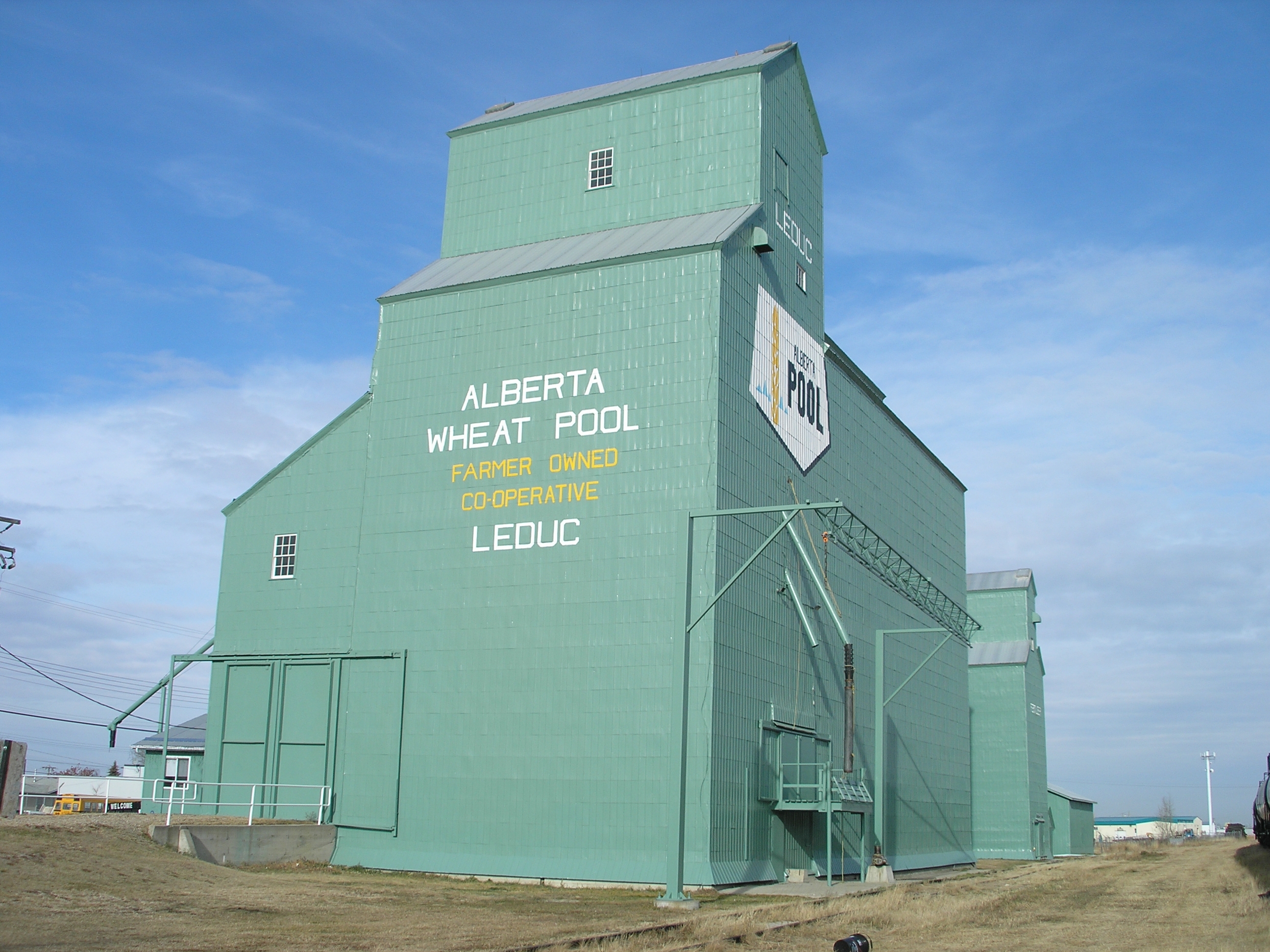
The story of the Alberta Wheat Pool Elevator at Leduc.
Leduc Grain Elevator in 2007. Photo by Judy Larmour, Courtesy of Alberta Legacy Development Society.
Have any elevator enthusiasts out there ever noticed that the former Alberta Wheat Pool Elevator at Leduc looks a little different? It is a unique low-profile version of the Pool’s single composite 130,000 bushel elevator built on a standard plan during the 1960s and 1970s. It’s also unique as the only grain elevator that lies directly under the flight path to the main runway of an international airport and therein lies a story.
In 1976 the Alberta Wheat Pool revealed its intent to build a new elevator at the siding in Leduc. It wanted an elevator that would have a large enough capacity to replace all their aging elevators on the row, allowing for easier and more efficient grain handling. A single composite elevator built to the standard design stood normally over 27 meters hight (approximately 90 feet). This was considered a navigational hazard for airplanes approaching the airport—too high to get clearance from Transport Canada. So the Alberta Wheat Pool engineers went back to the drawing board to adjust the design, reducing its height. Transport Canada was satisfied with the new design, gave the green light and Leduc issued a building permit. Work began under AWP construction foreman Jim Pearson in spring 1978.
All elevators were basically built the same way. First a hole was excavated, cement foundation pads were poured and the steel pan set flush in the pit. The crew began construction of the sturdy cribbed walls, built to withstand the weight of the grain. The cribbing timbers were laid flat and spiked together. The cribbing of the exterior walls continued in rounds, in step with the cribbing of the inside bins, so that the elevator rose at an even height. As the cribbing progressed the crew installed the leg to elevate the grain, the distribution spout or gerber, the hopper and scales on the work floor, and the loading spout to the track below. The cupola on top was put together with pre-cut wood studs and shiplap or plywood walls. Finally the driveway was added, and the whole structure was clad with wood siding.
At Leduc, as Pearson later explained, changes had to be made to the standard plan. Instead of the standard 67 foot walls, the walls and bins were cribbed up only 59 feet, and the cribbing strength was reduced proportionately to the overall height of the building. The standard rounds of 2 by 6 cribbing were reduced by 5 feet and the higher 2 by 4 cribbing by 3 feet. To partially compensate for the lost volume, the design incorporated an annex 10 feet longer than was standard, giving the structure a footprint of 38 feet by 100 feet.
Lowering the walls 8 feet was still not enough to meet the required height restrictions. Another factor came into play. Elevators compress when they are filled with grain. The term telescope is used to describe a number of ways to allow the building to move in response to changing loads without causing damage to the structure. Normally, the leg is in one piece, so the cupola must be high enough to clear it as the elevator compresses. The Pool, wishing to install two metal legs—one for receiving grain and one for shipping, as was common by the 1970s—had to devise special legs at Leduc. They were telescoped in the middle and moved with the elevator to allow a lower profile than the standard one piece leg. A floating pulley in the pit took up the slack in the belt inside the leg. This one-of-a-kind system designed by Pool engineers allowed them to construct the cupola thirty inches below the regular height. When the new elevator was complete it was about the same height as the three 1920s elevators that it replaced.
The flight path-friendly elevator, with a capacity of 121, 000 bushels, was more expensive than a standard elevator. It cost $592,752 to build and opened in December 1978—the official ribbon cutting deferred until April 1979. It proudly served the farmers of Leduc until July 2000. When its days were clearly numbered and it, too, was faced with demolition the newly formed Alberta Legacy Development Society sprang into action to ensure its survival. Designated as a Provincial Historic Resource in 2003 and with fresh coat of paint in September 2007, it flaunts the once familiar and omnipresent Alberta Wheat Pool crest and logo.
So the next time you fly over Leduc into Edmonton, just before landing, look down to spot Alberta’s special stubby, one of the last Alberta Wheat Pool single-composite elevators standing and still the tallest building in downtown Leduc.




 RETROactive