

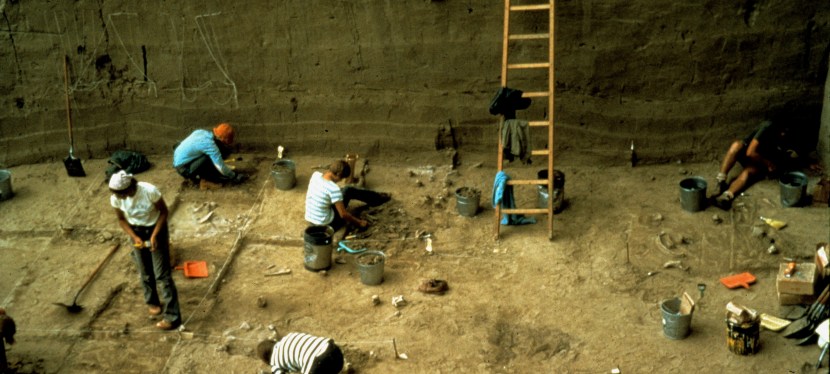
Editor’s note: The banner image above is courtesy of the Royal Alberta Museum.
Written by: Todd Kristensen, Archaeological Survey of Alberta and Dan Spivak, Head, Resource Management Program, Royal Tyrrell Museum of Palaeontology
This year, the Historical Resources Act (HRA or the Act) in Alberta celebrates its 50th anniversary. When it was passed in 1973, the Act provided a range of tools to manage historic resources across the province. This now includes archaeological sites, historic buildings, Indigenous traditional use sites of an historic character and palaeontological sites. It was a landmark achievement on a national scale because it stimulated the first stand-alone provincial department whose purpose was to ensure site protection during industrial development. Since inception, the Act has led to the documentation of over 42,000 archaeological sites, 110,000 historic structures, 7,200 palaeontological sites and 2,400 historical Indigenous traditional use sites. While the goals of heritage management in Alberta have evolved along with the Act, it continues to protect the past.
To recognize this milestone, RETROactive contributors will look at the legacy of the Act in managing historic resource sites, including archaeological, palaeontological, historic building and Indigenous traditional use sites. They will also explore the role of the Act in establishing the names of geographical locations across the province.
Archaeology
The destruction of historic resources in the province was being documented as early as the 1800s. In the late 1800s, and again during war efforts, bison bone was collected across the Plains for use as fertilizer, glue, ash for bone china, munitions or to refine sugar. Some bison bone beds associated with archaeological sites in Alberta (e.g., buffalo jumps) were also destroyed. An agricultural boom after 1870 brought immense but unintentional damage to historical resources (e.g., shallow archaeological sites) as thousands of acres of grassland were put under plough.
When Alberta became a province in 1905, there was no overarching federal legislation to protect historical resources and therefore, no transfer of responsibility to provincial authorities. Archaeologists conducting surveys in the 1930s and 40s noted that big sites continued to be looted as curious residents collected arrowheads and buffalo skulls. By the 1930s, the Government of Alberta had even begun purchasing land around Writing-on-Stone to protect the fragile rock art that was being defaced. Oil and gas development through the 1930s and 50s ushered in new infrastructure across Alberta that was also disturbing historical resources during construction.
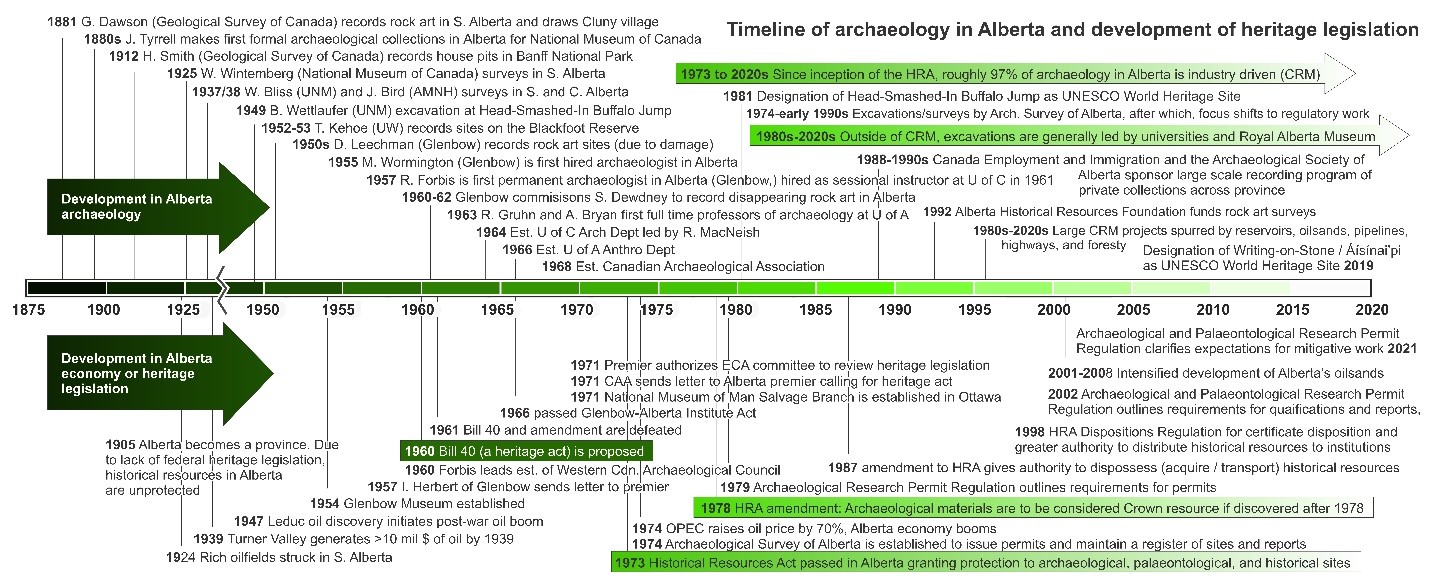
An important step in Alberta’s heritage management history was the creation of the Glenbow Foundation in 1954-55, with an interest in public education and the acquisition of museum collections. The Glenbow hired archaeologists Marie Wormington in 1955 and Richard Forbis in 1957 to conduct archaeological reconnaissance across Alberta. When J.D. Herbert, Executive Director of the Glenbow, was made aware of looting, destruction by industry and other disturbances to historical resources, he sent letters to the Premier of Alberta in the late 1950s recommending legislation. Forbis also furthered calls for salvage archaeology (recovering historical resources prior to destruction). At the federal level, the National Museum of Man conducted salvage excavations across the country in the 1950s and later established a salvage branch in 1971. However, it was widely known that, in the absence of legislation, significant pieces of Alberta’s past would continue to be destroyed during industry development.
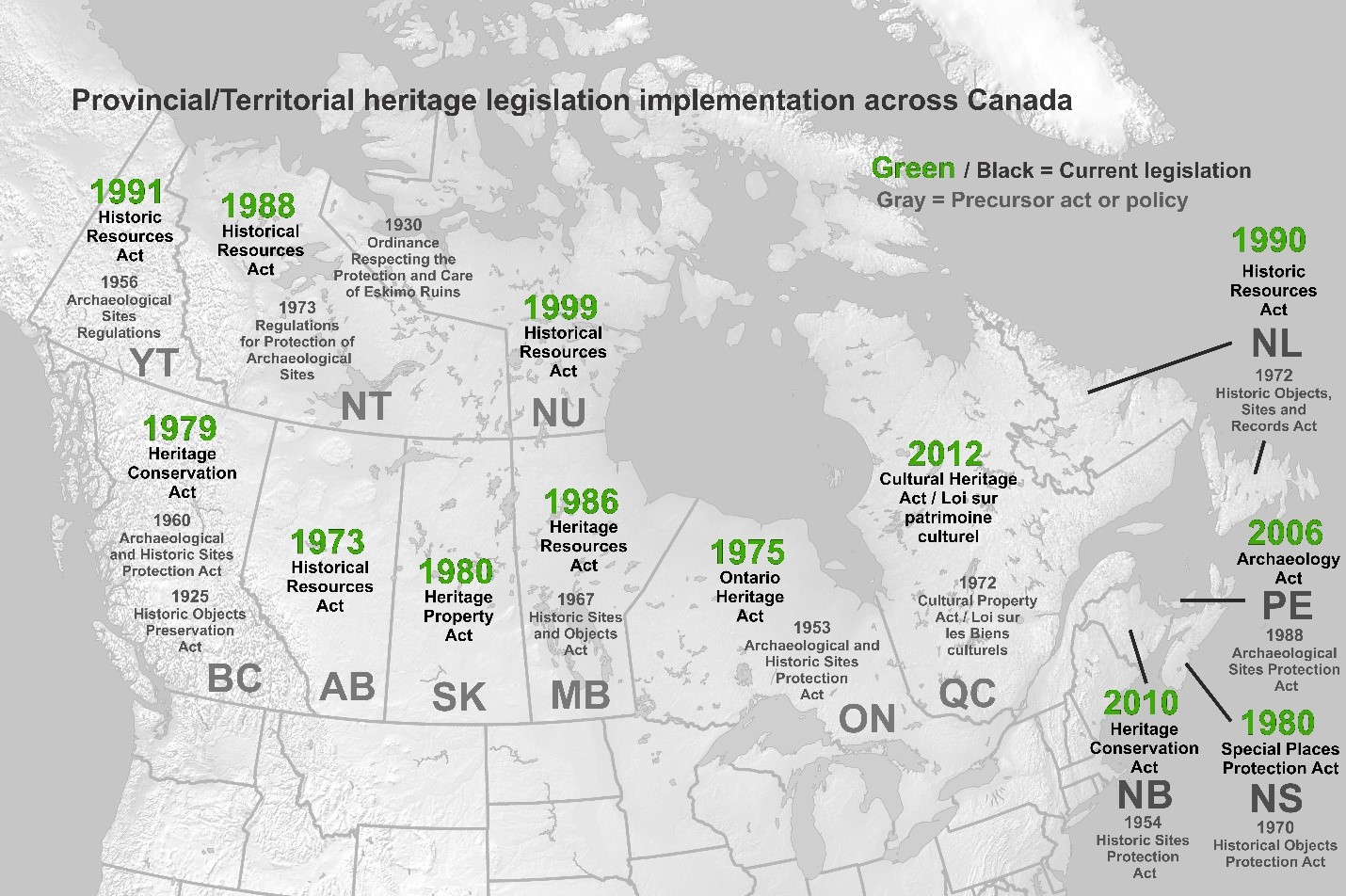
In 1960, the Western Canadian Archaeological Council formalized concerns about archaeological site destruction in Alberta (Glenbow Foundation 1960). The group supported British Columbia’s recently passed Archaeological and Historic Sites Protection Act, or Antiquities Act of 1960, and petitioned federal and remaining provincial governments to pass similar acts that would give government authority to require salvage work in advance of industry development.
Staff at the Glenbow Foundation (Forbis and Douglas Leechman) successfully lobbied a bill read by the Government of Alberta in 1961. Bill 40, An Act for the Protection of Historical, Archaeological, Palaeontological, Ethnic and Meteoric Sites and Objects, was not favourably received. The Bill (and an amended version) was attacked and rejected for a lack of accountability. Critics alleged that the government could confiscate material and lands without compensation and create endless advisory boards. Bill 40 and proposed amendments were perceived as an ill-defined hurdle to what was becoming a strong economy built on oil and gas, and the palate was weak for government intervention in what were considered matters of private property.
In the 1960s, archaeology assumed a greater importance in Alberta with the hiring of archaeologists in departments at universities in Edmonton and Calgary. The Glenbow continued to share archaeology with the public as did the Provincial Museum of Alberta that opened in 1967.
In 1971, Peter Lougheed was elected as Premier. At this time, the National Museum of Man in Ottawa was granted a large budget to oversee salvage projects, including several in Alberta. Forbis, who at the time was president of the Canadian Archaeological Association (formed in 1968), perceived a changing political climate and growing openness to heritage issues and sent letters to the provincial government in 1971 promoting heritage legislation. This accompanied growing concerns communicated by the Archaeological Society of Alberta in Edmonton and Calgary. As a result, representatives of the Government of Alberta successfully requested the appointment of a public advisory committee to initiate hearings about the ‘Conservation of Historical and Archaeological Resources’.
The committee issued a report and draft Act that was eventually passed in 1973 as the Historical Resources Act. The Act gave the Government of Alberta the authority to hold industry accountable for mitigating impacts to significant historical resources and resulted in the creation of the Archaeological Survey of Alberta to maintain a register of archaeological resources, issue permits, investigate sites and disseminate archaeological studies.

The Archaeological Survey of Alberta developed mandates that fell into two main classes: research and resource management. The former was needed to understand the latter. The Alberta model, with its focus on industry-supported, project-specific mitigative studies (mitigation in Cultural Resource Management [CRM] refers to the recovery and documentation of archaeological materials and information prior to unavoidable destruction), became an exemplar for jurisdictions across Canada.
The Act outlined legal requirements for industry to report archaeological discoveries and it provided legal authorization for the Government of Alberta to require archaeological investigations (historic resources impact assessments) in advance of developments that had a likelihood of disturbing archaeological sites. It also established a legal basis for an archaeological permit system, in which only qualified archaeologists were allowed to excavate sites.
An amendment in 1978 clarified that archaeological materials throughout Alberta (on private or Crown Land) were public (Crown) resources that couldn’t be privately owned, sold or transported outside the province. Beginning in the mid-1970s, the Government of Alberta issued requirements to some industry developers, namely for highway projects and pipelines, to complete archaeological work prior to construction. This stimulated the first large body of professional archaeologists in the province: CRM consultants. Since 1973, the Act has resulted in documentation of over 40,000 archaeological sites in Alberta.
The HRA has undergone minor amendments and has been associated with new regulations over the past 50 years, some of which clarified who could conduct archaeological work, how historical resources could be transferred, and expectations for archaeological documentation. It remains a powerful piece of legislation that protects historical resources, and all of the records of them, for future Albertans.
Palaeontology
While this year we mark 50 years since the Historic Resources Act was enacted, this year also marks the 45th anniversary of palaeontological resources (aka fossils) being added to the Act. Prior to being officially added on July 5, 1978, many significant fossils were collected in Alberta and shipped to museums and universities in eastern Canada, the United States and overseas. These fossils can still be seen today in museums such as the Canadian Museum of Nature, the American Museum of Natural History and the National Museum of Natural History (Smithsonian).
Through the 1970s, Albertans became aware of the cultural and scientific significance of the fossils buried beneath their feet and wanted a way to protect them and keep them in Alberta to be studied and enjoyed by future generations in the province. The solution was to add fossils to the Act, which afforded them the same legal protections as other historic resources. The same movement that resulted in the addition of fossils to the Act also led to the creation of the Royal Tyrrell Museum of Palaeontology in Drumheller, as a place to showcase Alberta’s amazing fossil heritage.

Forty-five years later, the legacy of legally protecting Alberta’s fossil resources under the Act continues to grow. There are now over 12,000 fossil sites known from the province and every year, new and exciting fossils are found by palaeontologists, amateur fossil collectors and industry. Now, these fossils remain in Alberta for Albertans and visitors to the province to appreciate and enjoy.
Alberta boasts two provincial museums to store and showcase this rich fossil heritage. The Royal Alberta Museum, in its location in downtown Edmonton, has a gallery exhibiting Alberta’s ice age mammals and other prehistoric creatures. The Royal Tyrrell Museum of Palaeontology, with one of the world’s largest collections of Late Cretaceous (approximately 100 million years ago to 66 million years ago) dinosaurs, continues to attract record numbers of visitors each year and inspires the young and old alike. Our rich fossil heritage is one of the things that makes our province such an amazing place and the Act helps to ensure that it is protected for generations to come.

Check RETROactive next week for part two of this series, as contributors reflect on the legacy of the Act in Alberta’s Indigenous heritage, built heritage, geographical names and provincial historic resource regulation.
 RETROactive
Terrific to see this well-researched and -presented review of historical developments leading to present day heritage conservation policy and practice. Thank you!