How fossils form

Written by: Royal Tyrrell Museum of Palaeontology staff

There are more than two million fossils in the Royal Tyrrell Museum’s Collections—and that number is growing. Every year, staff excavate and collect new fossils that are found through fieldwork, public finds and industry reports.

Although the Collection includes amazing fossils spanning roughly 3.5 billion years of Earth’s history, fossils are incredibly rare. Only a small fraction of the ancient organisms that ever lived become fossilized. Of those, only a small portion are discovered and collected.

Read more…

REMINDER: Nominations open for 2024 Heritage Awards

Previous recipients from the Heritage Awards are a testament to the varied range of individuals and groups who work to preserve and celebrate our province’s heritage. Alberta’s history is unique and diverse; the Heritage Awards are just one way to recognize and commend those who write about, research, advocate and celebrate Alberta history.

The Heritage Awards, presented by the Alberta government, help to honour the work of Alberta citizens, groups and communities helping to share protect, preserve and promote our province’s history. The awards recognize individuals, non-profit organizations, corporations, municipalities, First Nations and Métis settlements.

This year, the awards are broken down into three categories: Heritage Conservation, Heritage Awareness and Outstanding Achievement. Learn more about these categories and the nomination process.

Recipients will be recognized at an awards ceremony in September. Further details will come out during the next few months.

To nominate an individual or group, fill out a nomination form and drop off, mail, courier or email your nomination package to:

Heritage Awards Program
Old St. Stephen’s College Building
8820 112 Street
Edmonton, Alberta  T6G 2P8
Email: acsw.heritageawards@gov.ab.ca

Art-chaeology: visualizing the past through illustration

Written by: Jared Majeski, Historic Resources Management Branch

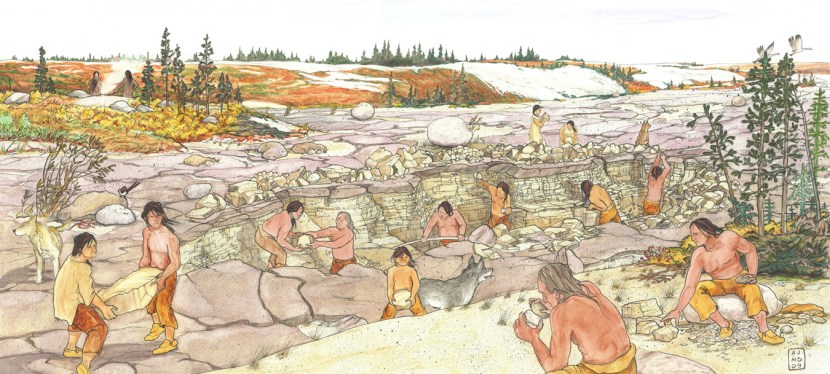
Look hard enough, and you can find artistic expression in many different occupations. The stone mason cutting and preparing a stone feature; a researcher distilling their raw data into a visually appealing infographic; or in the case of archaeologist Amanda J.M. Dow (B.A. Archaeology, University of Calgary), using pencils to represent archaeological research through illustrations. Whether you categorize it as art or archaeology, Dow’s illustrations help to put faces to names and context to places.

The following interview has been lightly edited for length and clarity. All images and illustrations below are courtesy of Amanda Dow.

Where do science and art meet and is there ever an uncomfortable junction?

Dow: There is always a strange dance between art and science.  It can be awkward and challenging but for the dance to work, there has to be a reciprocal understanding from both disciplines. I like to use the word “illustration” to help lend my artwork scientific credibility. I use the results of archaeology and research to make the art academic. But in the end, the illustration is just one person’s interpretation of an event.  What lends it credence is what informs the interpretation.  And if that information is scientific, then that weird dance can work.


Archaeologists tend to communicate in dry and what feels like uninteresting ways because that’s what they’re trained to do. What do you think of traditional archaeological reports, articles and books? Does this make you try to depict the past in more interesting ways?

Dow: There are different ways results of archaeological study are communicated.  In Alberta, the vast majority of archaeological study are presented as technical reports. That’s my day job, as a consulting archaeologist and I contribute to this type of “grey” literature presenting data without excessive interpretation. Technical reports are defined by budget, schedule and scope. It’s always a challenge to present data within those limitations without being too boring.

The opportunity to share more interpretation and provide people with more elaboration comes from other forms of communication.  This is where archaeologists have an opportunity to collect from the technical literature all the glamorous bits and create an interpretation the science supports.  This is where articles and books, presentations and alternative media are serving a greater public role.  And this is where I try to make artistic contributions.

What’s the most satisfying part of your job as an illustrator?

Being able to share a concept that makes someone pause for a moment to appreciate the genius of our ancestors.  I like taking an archaeological or historical record and putting a face on it. I like tweaking imaginations.

Read more

The history and conservation of the Colonel’s Cabin

Editor’s note: The banner image above is courtesy of the Glenbow Library and Archives Collection, Libraries and Cultural Resources Digital Collections, University of Calgary.

Cowritten by: Fraser Shaw, Heritage Conservation Advisor and Ronald Kelland, Geographical Names Program Coordinator

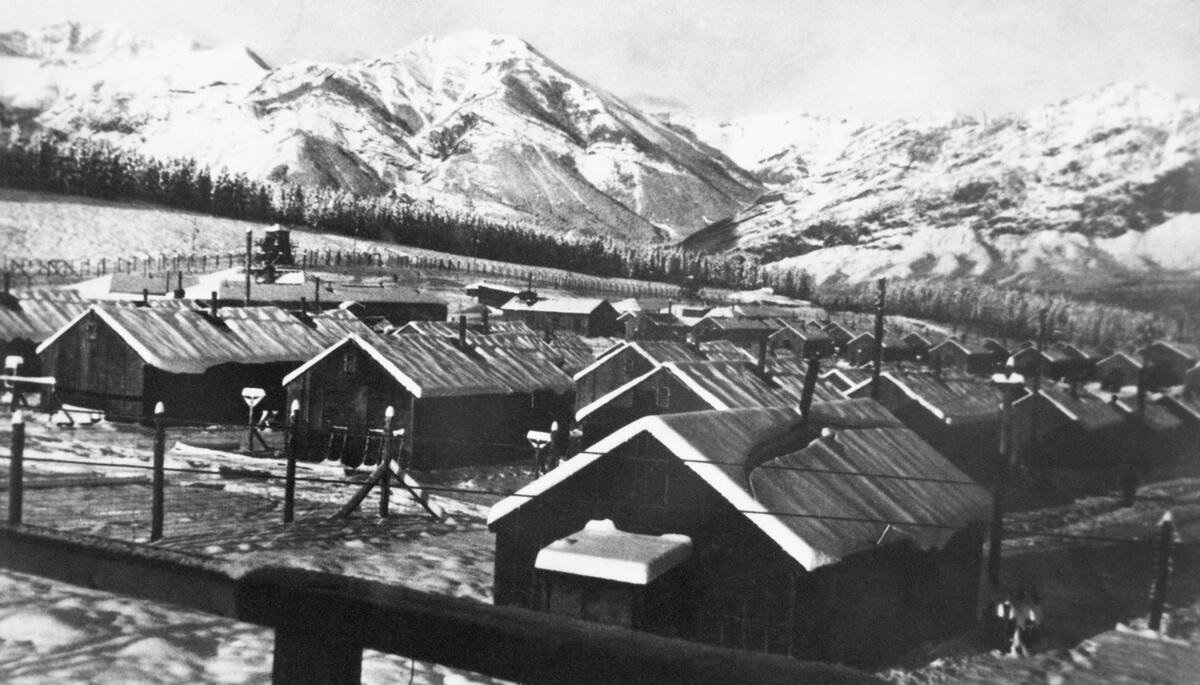
A panoramic 1945 photograph shows a snowbound mountain landscape in the grip of winter. Plumes of smoke rise from rows of tarpaper-covered buildings huddled behind barbed wire fences and guard towers. This is Camp 130, one of a series of Prisoner of War (POW) camps established across Canada during the Second World War. Outside the prisoners’ compound is a small, single-story log cabin occupied by the camp commandant. Built in 1936, the “Colonel’s Cabin” was protected as a Provincial Historic Resource in 1982 as one of few remaining structures in Alberta directly linked to the internment of prisoners of war and to recognize the site’s earlier association with the Kananaskis Forest Experimental Station.

Camp 130 Prisoner of War Camp, winter 1944 or 1945. Source: Glenbow Library and Archives Collection, Libraries and Cultural Resources Digital Collections, University of Calgary, CU1128370 (NA-4824-2os).

During the Great Depression, Canada’s middle-class, political and economic elites were concerned about the large number of unemployed men roaming the country and how that long-term unemployment might result in moral degradation, petty criminality and the fostering of revolutionary communist ideology. Under pressure from religious organizations and municipal and provincial governments, the Dominion government established a series of temporary work camps for single, unemployed men to be administered by the Department of National Defence. By 1936, camps had been established at Acadia, New Brunswick; Valcartier, Quebec; Petawawa, Ontario; Duck Mountain, Manitoba; and Kananaskis, Alberta. Ostensibly created to engage unemployed and homeless men in work that was seen as being necessary for their physical, psychological and spiritual betterment, the camps also kept these unemployed, transient men out of sight and far from transportation routes and urban centres.

Read more