

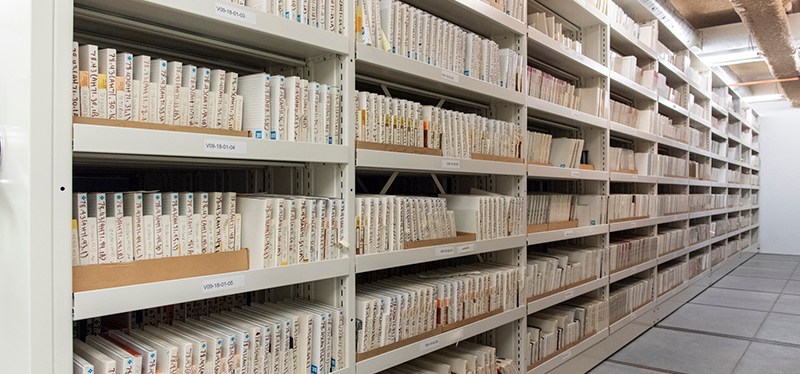
Editor’s note: The author would like to give special thanks to Quinton Crow Shoe for his contribution to this post. As well, the banner image above features audio reels at the Provincial Archives of Alberta. Source: Provincial Archives of Alberta.
Written by: Mikaela LeBlanc, TRC Archivist Intern
The Provincial Archives of Alberta (PAA) acquires, preserves and makes records available to researchers. These includes government records, which are records created by agencies, boards and commissions as well as departments within the Government of Alberta, and private records, which are records created by individuals, families and organizations. The records come in many formats and can include letters, photographs, drawings, audio recordings, journals, newspapers and maps, among others. Within these records are also a wide variety of materials that were created by and about Indigenous people and communities.
The PAA first released an “Aboriginal Resource Guide” finding aid in 2006, which listed records identified as being about Indigenous communities in Alberta. This guide provided the building blocks for archival research to become more user-friendly when accessing Indigenous related records. The hearings and report of the Truth and Reconciliation Commission (TRC) and Calls to Action related to archives and the heritage sector identified ways in which the PAA could make improvements in access to records by Indigenous creators and about Indigenous communities. This coincided with the PAA’s move to a new collections management database webpage Access to Memory (AtoM), and saw the release of the Indigenous Resources Guide (IRG) in April 2023. The guide identifies records that relate to Indigenous people and communities in Alberta that are currently in PAA’s holdings.
In this newly updated Indigenous Resource Guide, records are organized into categories that reflect the subject of the records held at the archives, rather than just the creator of the records. The categories include communities and residential schools, as well as subjects such as Education, Healthcare, and Histories and Storytelling from Indigenous people. In the database, most of these subject categories lead to descriptions where researchers can then browse the files that are prepared by adding IRG search tags, such as “IRG_Education” or “IRG_Treaty 6.” The IRG continues to be updated as the PAA acquires and describes new records.

Under the subject Filmmaking, Audio, and Creative Records in the IRG, are references to records consisting of videos, such as documentaries and audiotapes like Indigenous oral histories. Earlier this year, there was an inquiry from a staff member at Head-Smashed-In Buffalo Jump World Heritage Site (HSIBJ) about oral history tapes that were recorded when the interpretive centre at the site was in development. The audio recordings on the tapes are of interviews with First Nations Elders and other members of the community, as well as stories and information about HSIBJ site. These interviews were conducted between 1983 and 1985 and had been recorded on audio cassettes. The oral history tapes had to be digitized in order to be accessible, and copies were then provided to HSIBJ. HSIBJ is creating new displays in the interpretive centre and needed the tapes to do so.
Receiving the recordings has allowed us to revisit the past and gain a deeper understanding of the site and the stories shared by our elders, who are no longer with us. It is truly special to gain clarity on the storyline—most of all, to hear the elders speaking the Blackfoot language, very inspiring” -Quinton Crow Shoe, of site marketing and special events, HSIBJ.

The finding aid for these tapes can be found on the PAA database under the description Head-Smashed-In Buffalo Jump Interpretative Centre research records. There are many other oral history tapes at the PAA that document Indigenous peoples and communities in the province. Information about the tapes and their access can be found in the IRG or by connecting with a reference archivist.
Archives preserve records for present and future generations to access. The Indigenous Resource Guide available online identifies the wide variety of Indigenous records, either created by or about the Indigenous people of the province and presents a subject guide to these holdings. The IRG is meant to help facilitate the entry points into archival research, and to give researchers tools to start their own search. The IRG is a valuable resource for researchers that contributes to improved accessibility to the records.
 RETROactive