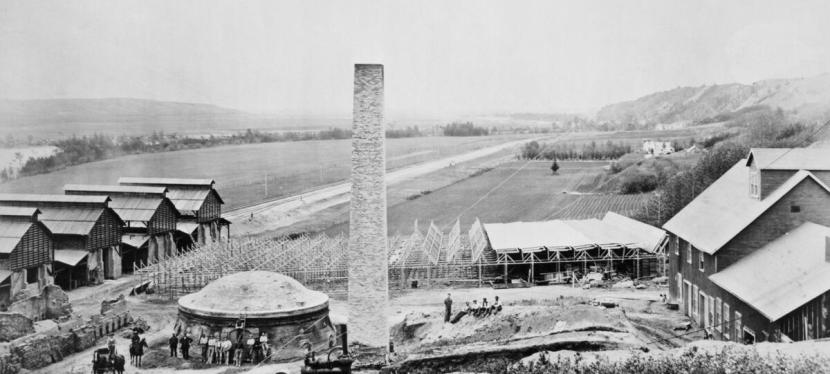
Editor’s note: The banner image above is the Calgary Pressed Brick and Sandstone Company plant, Brickburn, Alberta (ca. 1916-1920 [CU1136164] by unknown). Image courtesy of Glenbow Library and Archives Collection, Libraries and Cultural Resources Digital Collections, University of Calgary.
Written by: Sam Judson and Lindsay Amundsen-Meyer, Department of Anthropology and Archaeology, University of Calgary
To most Calgarians, Edworthy Park is nothing more than a city park with a large and popular off-leash area for dogs, rocky ‘beaches’ along the Bow River and meandering biking and walking trails that folks enjoy throughout the year. What most users of the park do not realize is that Edworthy Park has a remarkable history: numerous pre-contact Indigenous archaeological sites within the park; the presence of a Métis winter camp in the late 19th century; the eventual establishment of one of the Calgary area’s earliest homesteads by Thomas Edworthy; and Edworthy’s operation of a sandstone quarry on the land in the early 20th century. There was even a 20th century brick factory within the park and its associated village (Brickburn) to the west. As you’ll learn, the students and staff of the University of Calgary archaeology field school and Public Archaeology Program discovered these many layers of history are present across much more of Edworthy Park than previously known.
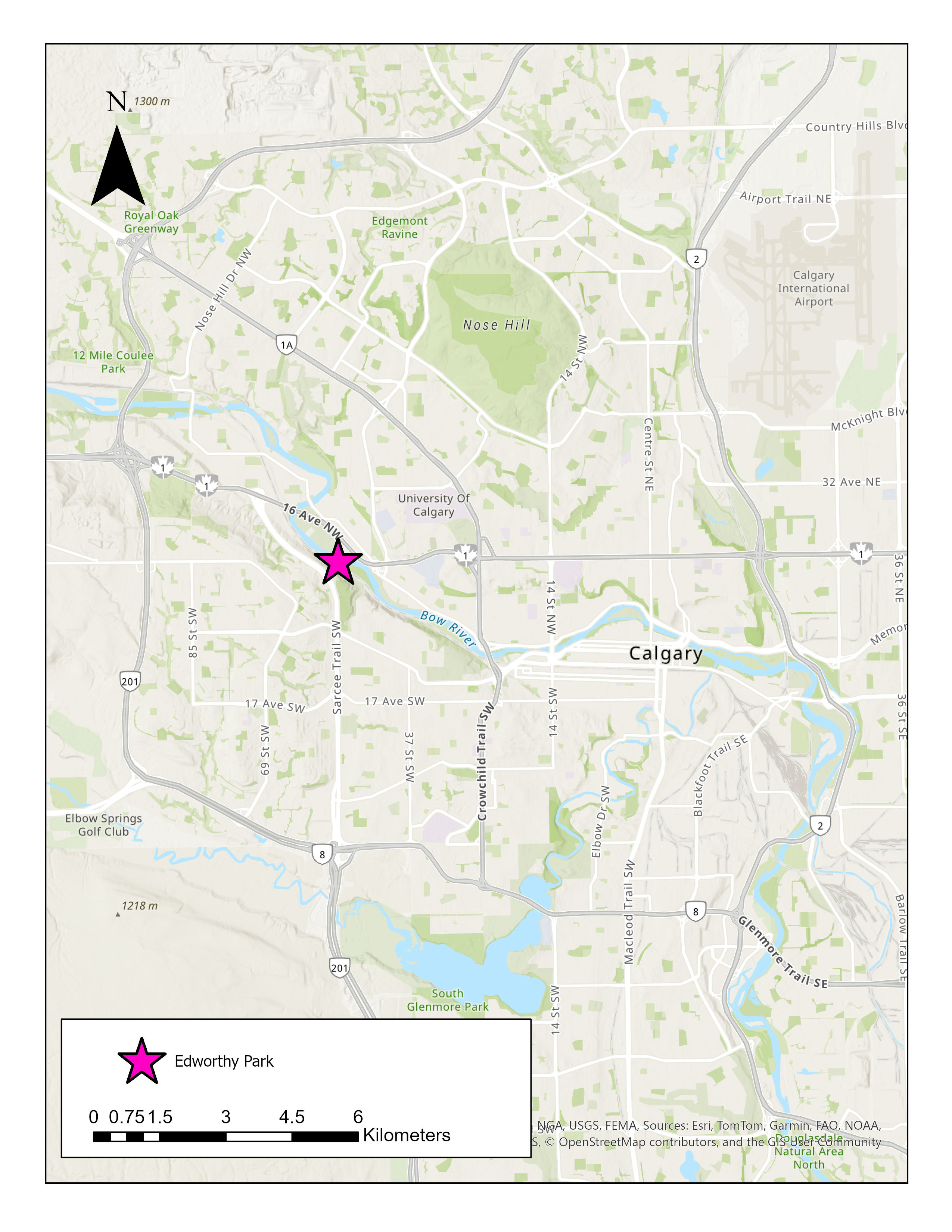
Location of Edworthy Park, within the City of Calgary. Source: Lindsay Amundsen-Meyer.
Written by: Ronald Kelland, Geographical Place Names Coordinator
Remembrance Day, November 11, is the day Canadians honour and memorialize those who gave their lives while in military service. While honouring all Canadian service personnel this Remembrance Day, this year RETROactive is drawing attention to a few geographical features named to commemorate casualties of the Second World War. Following the Second World War, the Province of Alberta, through collaboration between the Geographic Board of Alberta and the Geographic Board of Canada began naming geographical features, mostly lakes, for decorated military personnel from Alberta that were casualties of the Second World War. This is the story of two of those individuals.
Located approximately 35 kilometres northwest of Bonnyville is Conn Lake.
The lake is named for Leading Steward James Conn. Born at Hillcrest, Alberta on December 7, 1914, Conn was the son of John Robert (died 1921) and Lillian Maude Conn (died 1916). At some point, James and his siblings moved to Quebec and by 1932 James Conn was living on University Street (now Robert-Bourassa Boulevard) in Montreal.
At the outbreak of the war, James Conn was a waiter with the Canadian Pacific Railway. Conn enlisted in the Royal Canadian Naval Volunteer Reserve in August 1943 and trained at Navy Reserve Divisions HMCS Montreal (now HMCS Donnacona) and at Winnipeg with HMCS Chippawa and at Ottawa with HMCS Carleton. He served a short stint on HMCS Stadacona, a steam yacht that had been acquired by the Royal Canadian Navy in 1915 and was used as a home waters patrol vessel during the Second World War. On October 17, 1944, he reported to HMCS Esquimalt at the rank of Leading Steward.
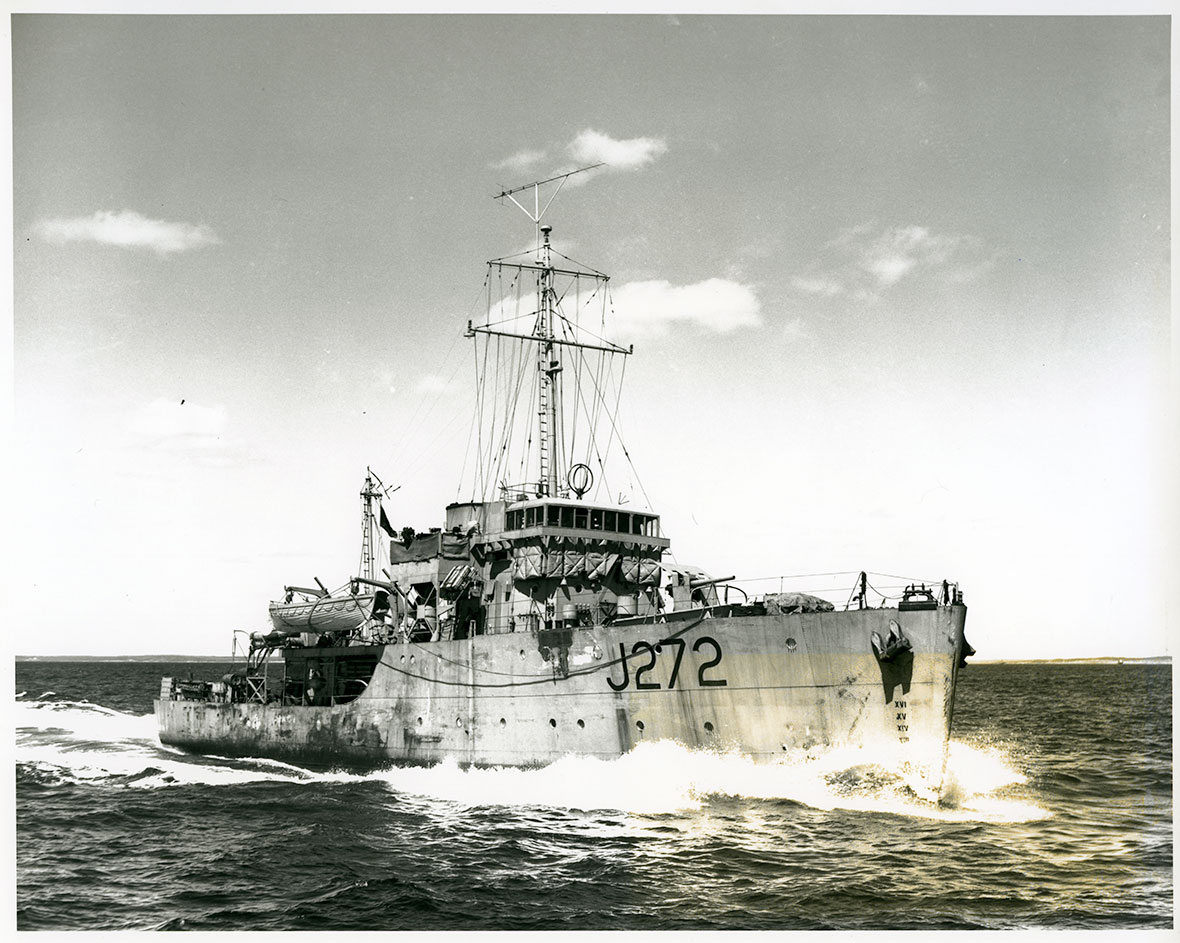
HMCS Esquimalt was a Bangor-class minesweeper operating out of the port of Halifax to hunt enemy submarines and keep approaches to the harbour clear of mines. Named for the Township of Esquimalt on Vancouver Island, she was launched in 1941 and was originally assigned to patrol duties off Newfoundland and was transferred to Halifax in September 1944. On 15 April 1945, Esquimalt sailed on a patrol to hunt a German U-boat that was suspected to be in the waters near Halifax. At approximately 6:30 a.m. on the morning of April 16, with the lights of Halifax visible on the horizon, a torpedo from German U-boat U-190 struck Esquimalt on its starboard, flooding the engine room and causing a loss of power. In less than five minutes, and before a distress call could be sent, Esquimalt rolled onto her starboard side and sank beneath the surface.
Sources differ regarding the number of sailors lost in the sinking of HMCS Esquimalt, with a range of 39 to 44 crew perishing that night either going down with the sinking vessel or of exposure in the frigid waters awaiting rescue. Six hours after the sinking, survivors were picked up by Esquimalt’s sister ship, HMCS Sarnia. Twenty-seven of Esquimalt’s crew survived. Leading Steward James Conn was not one of them
HMCS Esquimalt, 1944. Source: Department of National Defense.
Over the past year, I’ve been volunteering with the Labour & Industry curatorial team at the Royal Alberta Museum (RAM). What began as a project to help process recent architectural acquisitions—related to Wallbridge & Imrie and Doris Newland Tanner—has gradually expanded into something much broader. I’ve since been fortunate to assist with other newly acquired collections, each object offering its own intriguing story and mystery to unravel.
In particular, individual pieces have caught my attention not only for their craftsmanship but for the stories embedded in them. Each one—whether an architectural tool, scale model or illustration—becomes a small but meaningful window into Alberta’s working and community past.
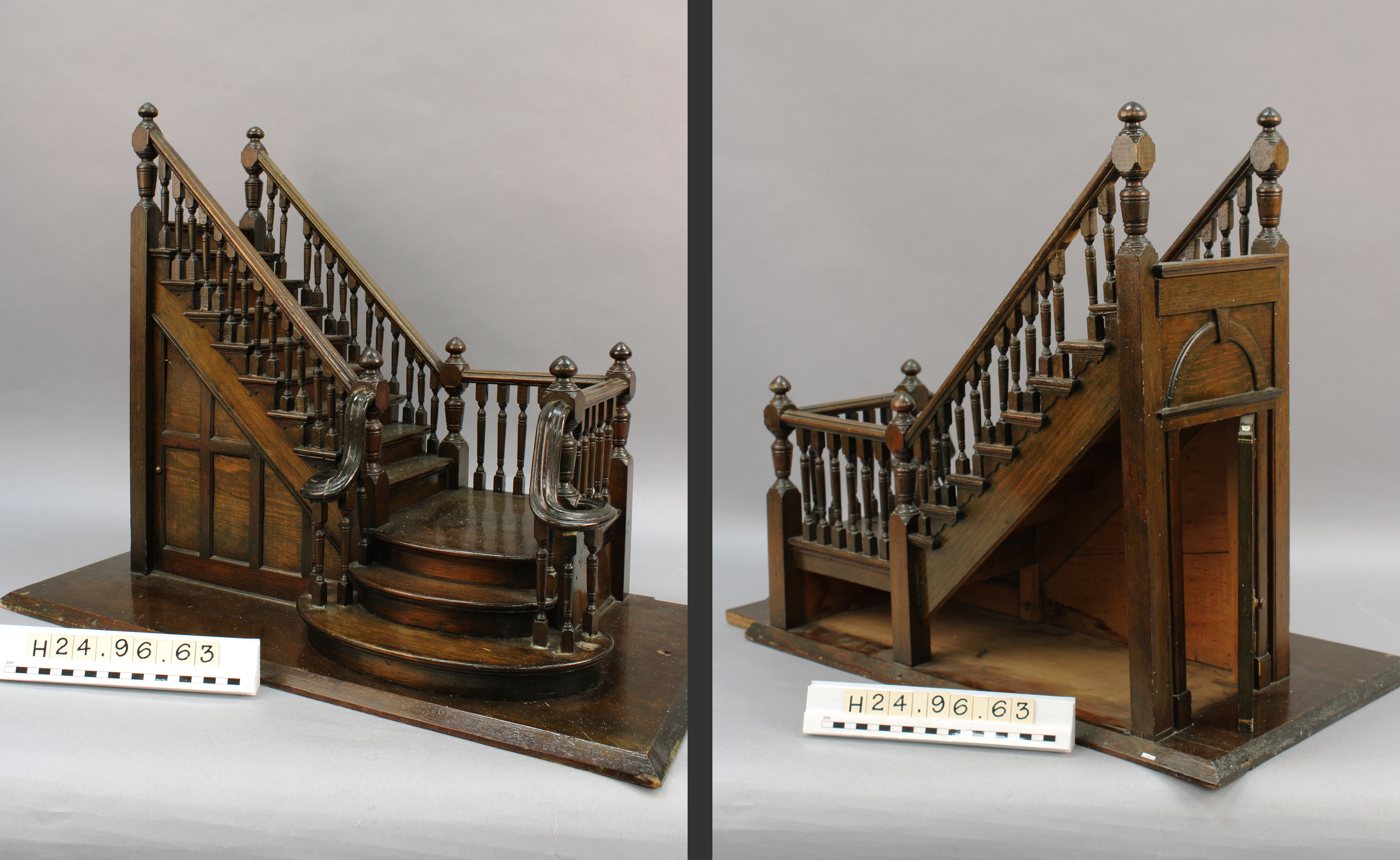
Among the recent acquisitions at the RAM was a particularly appealing object: a 100+ year old scale model of a staircase from the Town of Vegreville. The model was obtained by the RAM in 2024 after the Vegreville Regional Museum ultimately closed its doors.
Curators from the RAM’s history programs—including Labour & Industry, Daily Life & Leisure and Military & Government History—travelled to Vegreville to identify and help preserve objects of historical value within the RAM’s permanent collection. The staircase model was among those selected and is now part of the Labour & Industry collection.
This remarkable scale model is constructed primarily of wood and mounted on a plywood base. It was most likely built to a scale of 1″: 1′ (i.e., one inch equals one foot). Though small compared to its full-scale counterpart, it’s meticulously crafted—complete with turned balusters, a square landing and even a functioning door with tiny hinges and a wooden knob. The design reflects the restrained character of early twentieth-century domestic interiors, where craftsmanship and proportion met simple, elegant ornamentation. From the graceful curve of the lower steps and railing to the careful shaping of each newel post, every element has been thoughtfully made, likely by hand woodworking tools, and with the aid of early woodworking machines.
Despite being over a century old, the model has survived in remarkably good condition. A few balusters are missing and there are signs of minor repairs, but significantly, the overall integrity of the piece remains. The varnished surfaces retain their warmth, while the hidden undersides reveal the maker’s practical side—unfinished wood, tool marks, and the occasional nail or screw added probably long after its creation. Together, these details hint at a life of use and care, and a level of craftsmanship that continues to impress.
Front (left) and Back (right) Three-quarter Views of a 100-year-old Miniature Wooden Staircase. Source: Royal Alberta Museum, H24.96.63.


 RETROactive