

Written by: Ronald Kelland, Geographical Place Names Coordinator
Remembrance Day, November 11, is the day Canadians honour and memorialize those who gave their lives while in military service. While honouring all Canadian service personnel this Remembrance Day, this year RETROactive is drawing attention to a few geographical features named to commemorate casualties of the Second World War. Following the Second World War, the Province of Alberta, through collaboration between the Geographic Board of Alberta and the Geographic Board of Canada began naming geographical features, mostly lakes, for decorated military personnel from Alberta that were casualties of the Second World War. This is the story of two of those individuals.
Located approximately 35 kilometres northwest of Bonnyville is Conn Lake.
The lake is named for Leading Steward James Conn. Born at Hillcrest, Alberta on December 7, 1914, Conn was the son of John Robert (died 1921) and Lillian Maude Conn (died 1916). At some point, James and his siblings moved to Quebec and by 1932 James Conn was living on University Street (now Robert-Bourassa Boulevard) in Montreal.
At the outbreak of the war, James Conn was a waiter with the Canadian Pacific Railway. Conn enlisted in the Royal Canadian Naval Volunteer Reserve in August 1943 and trained at Navy Reserve Divisions HMCS Montreal (now HMCS Donnacona) and at Winnipeg with HMCS Chippawa and at Ottawa with HMCS Carleton. He served a short stint on HMCS Stadacona, a steam yacht that had been acquired by the Royal Canadian Navy in 1915 and was used as a home waters patrol vessel during the Second World War. On October 17, 1944, he reported to HMCS Esquimalt at the rank of Leading Steward.
HMCS Esquimalt was a Bangor-class minesweeper operating out of the port of Halifax to hunt enemy submarines and keep approaches to the harbour clear of mines. Named for the Township of Esquimalt on Vancouver Island, she was launched in 1941 and was originally assigned to patrol duties off Newfoundland and was transferred to Halifax in September 1944. On 15 April 1945, Esquimalt sailed on a patrol to hunt a German U-boat that was suspected to be in the waters near Halifax. At approximately 6:30 a.m. on the morning of April 16, with the lights of Halifax visible on the horizon, a torpedo from German U-boat U-190 struck Esquimalt on its starboard, flooding the engine room and causing a loss of power. In less than five minutes, and before a distress call could be sent, Esquimalt rolled onto her starboard side and sank beneath the surface.
Sources differ regarding the number of sailors lost in the sinking of HMCS Esquimalt, with a range of 39 to 44 crew perishing that night either going down with the sinking vessel or of exposure in the frigid waters awaiting rescue. Six hours after the sinking, survivors were picked up by Esquimalt’s sister ship, HMCS Sarnia. Twenty-seven of Esquimalt’s crew survived. Leading Steward James Conn was not one of them
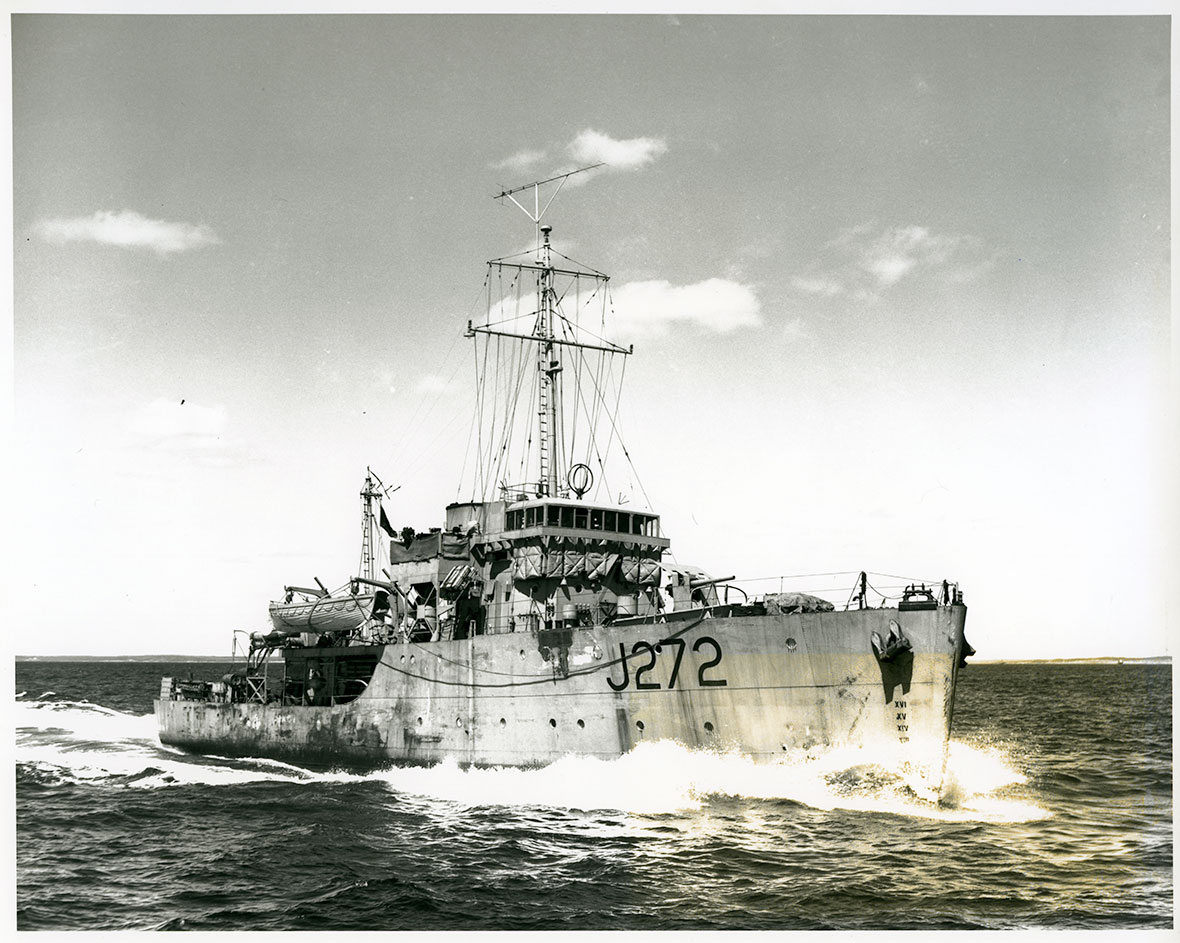
For his actions during the sinking of Esquimalt, James Conn was Mentioned in Despatches, meaning that he was singled out for meritorious actions or bravery in a superior officer’s report. To be Mentioned in Despatches is a military honour. The notice of the honour was published in the January 1, 1946, issue of the London Gazette and the January 6, 1946, issue of the Canada Gazette and reads:
Leading Steward Conn showed exceptional courage in remaining in the upper mess deck helping others to get up from the lower mess deck despite the fact that HMCS Esquimalt was obviously sinking fast. When last seen, he was still thus engaged and it is presumed that he went down with the ship.
Following the rescue of the survivors by HMCS Sarnia, Conn was reported as missing. On May 7, the Royal Canadian Navy informed his next of kin that his body had not been recovered. Leading Steward James Conn is commemorated on the Halifax Memorial at Point Pleasant Park, a memorial dedicated to members of the Royal Canadian Navy buried or lost at sea.
In September 1950, the Chief Cartographer of the Department of Mines and Technical Surveys, Government of Canada sent a draft map of the Pinehurst Lake area (NTS Map 73 L/11) to the Government of Alberta requesting the verification of place names appearing on the map and asking if other features should also be named. The Secretary of the Geographic Board of Alberta responded saying that three lakes on the map could be named for military personnel. On February 7, 1951, one of those lakes, located approximately 40 km northwest of Bonnyville was named Conn Lake in commemoration of Leading Steward James Ralph Conn.
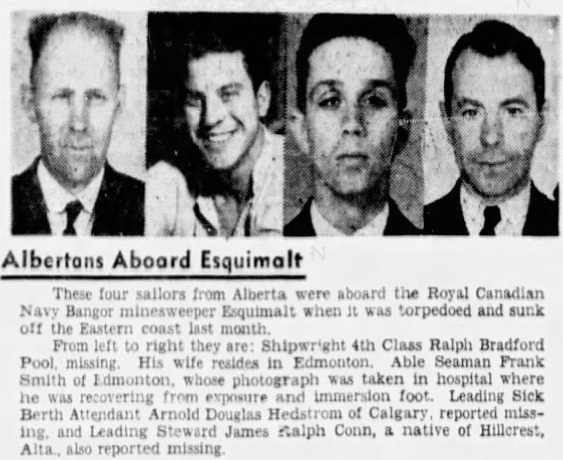
HMCS Esquimalt was the last Royal Canadian Navy vessel sunk during the Second World War. U-190 survived the war, surrendering to HMCS Victoriaville off Cape Race, Newfoundland on May 11, not quite a month following its sinking of HMCS Esquimalt. Following the end of the war, U-190 was commissioned into the Royal Canadian Navy as HMCS U-190 and was used a training vessel until July 1947. U-190 was towed to the location of Esquimalt’s sinking and was sunk in a combined aerial and naval target practise exercise.
Located approximately 30 kilometres east of Lac La Biche is Dabbs Lake.
The lake is named for Pilot Officer Howard Earl Dabbs. Born in Forestburg on April 28, 1922, he was the son of William and Florence Dabbs. At his time of enlistment, Dabbs gave Daysland as his place of residence and listed his occupation as being a student and a farm labourer. It appears that he initially attempted to enlist at Brandon, Manitoba on July 29, 1940, but ultimately enlisted at Edmonton on February 6, 1941. His recruitment officer described him as being a, “Nice quick type of young man, deliberate and quite forceful. Good Pilot Material.”
Dabbs underwent training at Regina (No. 2 Initial Training School), Edmonton (No. 16 Elementary Flying Training School) and Saskatoon (No. 4 Service Flying Training School). He completed his training in September 1941 and received his commission in 1942. On arrival in Great Britain, he was assigned to Royal Air Force Squadrons, firstly 109 (RAF) Squadron from November 1941 to August 1942 before being transferred to 101 (RAF) Squadron. He initially flew Avro Anson multi-role aircraft and Vickers Wellington medium bombers but began flying Avro Lancaster heavy bombers while with 101 (RAF) Squadron.
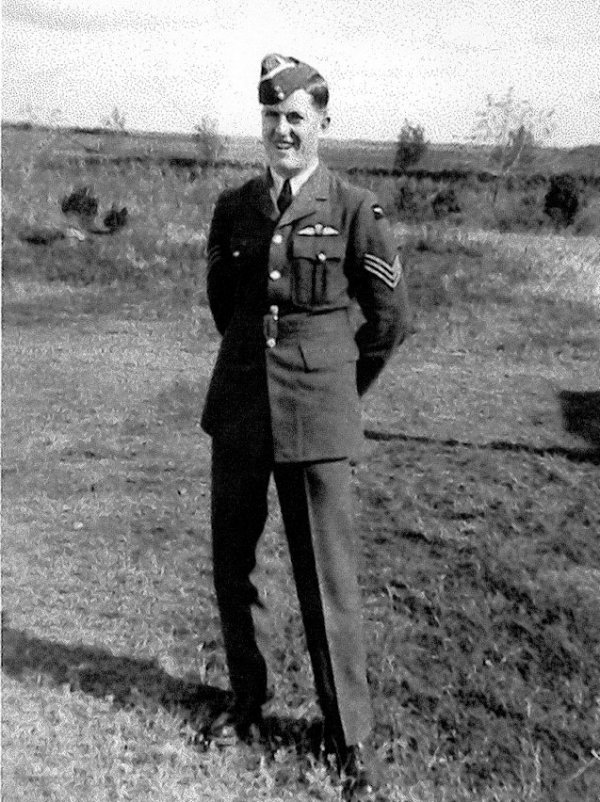
Late in the afternoon of December 6, 1942, Lancaster bomber ED322 left its base at Holme-on-Spalding Moor, Yorkshire, England with Pilot Officer Dabbs at the controls. Also on board were:
Royal Air Force Volunteer Reserve
- Sergeant James Hughes of (Flight Engineer)
- Sergeant William Thomas Warren (Air Gunner)
Royal Canadian Air Force
- Flight Sergeant Leonard Roy Anderson of Manitoba (Navigator)
- Flight Sergeant Robert Gordon Smith of Toronto (Air Bombardier)
- Flight Sergeant Robert Middleton of Toronto (Wireless Operator/Air Gunner)
- Flight Sergeant Stefan Franchuk of Kenora, Ontario (Air Gunner)
Lancaster ED322 was one of 272 bombers conducting a nighttime raid on Mannheim, Germany. The raid was unsuccessful. Cloud cover over Mannheim made accuracy impossible and prevented most aircraft from dropping their payloads. The primary target, the Mannheim railyard, was unharmed and the city suffered minimal damage and no loss of life. However, 12 of the raiding aircraft were shot down and three more were lost to crashes on return to England, including ED322.
Dabbs’s Lancaster crashed into Carmarten Bay near Tenby, Pembrokeshire, Wales with the loss of all crew. Howard Dabbs’s body washed ashore on December 9. His cause of death was determined to have been from drowning. Howard Dabbs was buried at the St. Mary New Churchyard cemetery in Carew, Pembrokeshire, Wales. The reasons for the crash of ED322 are not known. It was flying more than 3,000 miles off course, yet Flight Sergeant Leonard Roy Anderson was known to have been a highly capable and reliable navigator. Lancaster ED322 was a new and not fully checked out aircraft that had just been delivered to 101 Squadron. It was not assigned to be part of the Mannheim raid, but Dabbs selected it for use after another, older Lancaster had been deemed unusable.
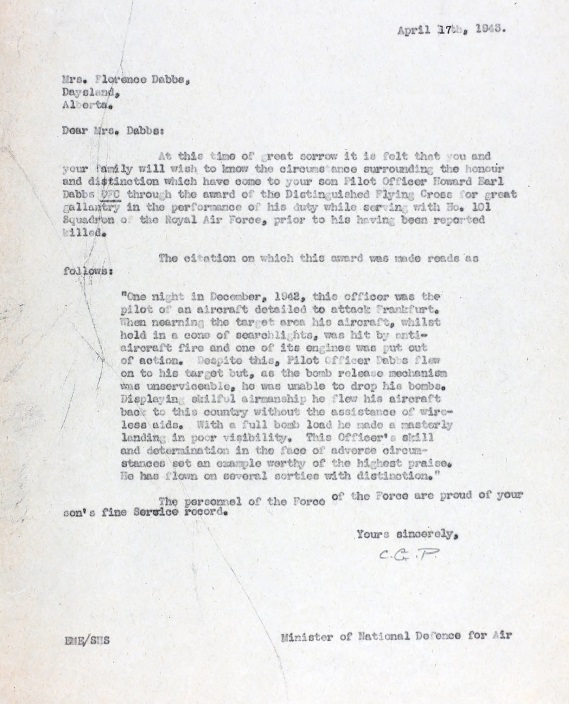
Following his death, Pilot Officer Howard Dabbs was posthumously awarded the Distinguished Flying Cross for his actions on a previous operation on December 2 and 3, 1942. His citation was published in the December 18, 1942, issue of the London Gazette. The text of his citation can be read in the letter below.
Like Conn Lake, in September 1950, the Chief Cartographer of the Department of Mines and Technical Surveys asked Geographic Board of Alberta for comments on a draft map of the Touchwood Lake region (NTS 73 L/14). The Geographic Board of Alberta requested that one of the lakes be named for Pilot Officer Howard Dabbs. The Geographic Board of Canada accepted the request and on February 7, 1951, the lake’s name became official.
Sources
“06/07.12.1942 No. 101 Squadron Lancaster I ED322 SR-T P.O. Howard Earl Dabbs DFC,” [webpage] Aircrew Remembered, available from https://aircrewremembered.com/dabbs-howard.html
“Dabbs, Howard Earl P/O(P) J15608 D.F.C.,” [webpage] RCAF Association, available from https://www.rcafassociation.ca/heritage/history/fallen-aviators/rcaf-casualties-second-world-war/dabbs-to-deakin/.
“Dabbs, Howard Earl (Pilot Officer), [webpage] Canadian Warplane Heritage Museum, available from https://caspir.warplane.com/personnel/unit-search/p/600004548
“James Ralph Conn, M.I.D.” For Posterity’s Sake: A Royal Canadian Navy Historical Project, [website], available from https://www.forposterityssake.ca/CTB-BIO/MEM007179.htm
“Monday 7 December 1942,” [webpage] Aviation Safety Network, available from https://aviation-safety.net/wikibase/301703.
Bowers, Alex, “The U-Boat Menace Returns: HMCS Esquimalt Sunk in Canadian Waters.” Legion: Canada’s Military History Magazine, 17 April 2024, available from https://legionmagazine.com/the-u-boat-menace-returns-hmcs-esquimalt-sunk-in-canadian-waters/.
Department of National Defence, HMCS Esquimalt, modified 18 March 2021, available from https://www.canada.ca/en/navy/services/history/ships-histories/esquimalt.html.
Fisher, Robert C. “Within Sight of Shore – The Sinking of HMCS Esquimalt,” CFB Esquimalt Naval & Military Museum, no date, available from The Internet Archive, https://web.archive.org/web/20131123215117/http://www.navalandmilitarymuseum.org/resource_pages/ships/esquimalt.html
Morton, Desmond, A Military History of Canada: From Champlain to the Gulf War. 3rd ed. (Toronto: McClelland & Stewart, 1992)
Veterans Affairs Canada, Canadian Virtual War Memorial, [website], (Ottawa: Government of Canada), available from https://www.veterans.gc.ca/en/remembrance/memorials/canadian-virtual-war-memorial.

