Some Changes to AHRF’s Grant Program: February 1, 2012

The Alberta Historical Resources Foundation (AHRF) continues to find strategies to strengthen its ability to meet its mandate. One strategy is to adopt some changes to the funding policies of the Heritage Preservation Partnership Program. These changes will become effective for the next application deadline: February 1, 2012.

To manage the demand for historic resource conservation grants, the maximum grant for conservation of Provincial Historic Resources will be capped at $100,000. Currently, there is no grant ceiling set for these historic resources. Other grant ceilings remain the same: $50,000 for the conservation of Municipal Historic Resources, $5,000 for Local Historic Resources, and $25,000 for architectural/engineering studies/reports/plans.

Applicants may only submit one application for conservation and one application for architectural/engineering studies/reports/plans per historic resource per calendar year. The February 1st deadline is still the primary deadline.

To support the Municipal Heritage Partnership Program’s goal of strengthening the municipality’s role in historic place management, Provincial Historic Resources and Municipal Historic Resources will have the same opportunity for funding – Provincial Historic Resources are not given priority.  The awarded level of funding will continue to be determined using criteria which include: grant ceilings, project scope, resource’s conservation priorities, grant program’s budget and applicant’s ability to complete the project.

The second deadline for the Roger Soderstrom and Heritage Trades Scholarships will be moved from September 1st to October 1st to give more time for students to prepare their applications.

New funding guidelines and application forms will be released in time for the next application deadline.  For more information, click here or contact the Grants Program Coordinator at 780-431-2305.

Written by: Carina Naranjilla, Grant Program Coordinator

Win a Prize!!

Test your knowledge of Alberta’s historic places and enter a chance to win a great prize. Simply click on the link below and answer the following skill-testing questions:

https://hermis.alberta.ca/arhp/

  1. What monumental Calgary civic building designated as a Municipal Historic Resource, a Provincial Historic Resource, and a National Historic Site of Canada, is celebrating the centennial of its completion this year?
  2. Which municipality is home to Alberta’s most northern Municipal Historic Resource? What is it? (Hint: Which municipality in Alberta covers the largest geographic area?
  3. In the Alberta Heritage Survey Program database, how many sites are listed under the “Social and Recreational: Sport or Athletic Building” Site Type category?
  4. Which municipality has the most Municipal Historic Resources?

Be the first to submit correct answers and you will receive a prize package designed to help you discover Alberta’s historic places.

Each month we will post a new quiz, so stay tuned!


Municipal Heritage Forum 2011

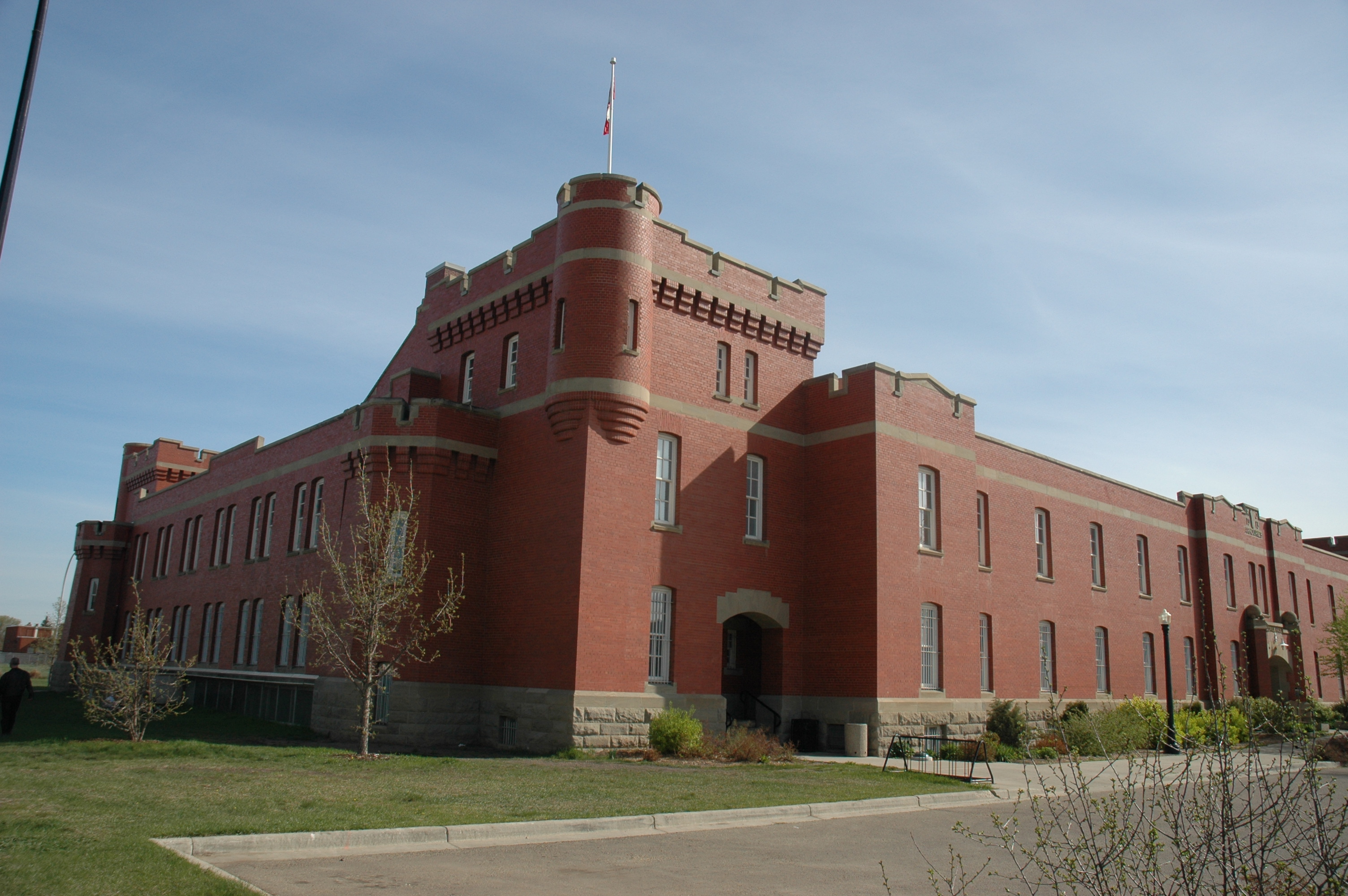
You are invited to our 5th annual Municipal Heritage Forum,“Roadmap to Success!” It is scheduled for October 27th and 28th Ÿin Edmonton, at the Prince of Wales Armouries.

This event is intended for municipal staff, councillors and heritage committee members interested in learning how to identify and protect local historic places. Registration is free, but we only have room for the first 100 registrants at the Forum, and the first 75 for the evening reception – so please register early!

Click here for event details and a copy of the registration form.

The keynote presentation will be, “The Other Side of the Rockies: BC’s Experience with Community Heritage Context Planning” by Berdine Jonker, Senior Heritage Planner. Berdine Jonker is Senior Heritage Planner with the BC Heritage Branch, Ministry of Forests, Lands and Natural Resource Operations. She has worked in the heritage conservation field since 1998, focusing primarily on building local government capacity for heritage conservation planning. Berdine has also worked with groups such as Smart Growth BC to further develop the connection between heritage conservation and healthy community development. She holds a Bachelor of Arts (Art History) (1998), a Diploma in Cultural Resource Management (2003), and a Master’s Degree in Public Administration (2010) from the University of Victoria.

We look forward to seeing you at the Forum in October!

Heritage Conservation in the Spotlight!

On Thursday, August 11, 2011, Access Television’s current affairs program, Alberta Primetime, aired a segment on the preservation of historic buildings in Alberta. A webcast of this segment can be found here.

The segment included a panel discussion consisting of me (Larry Pearson, Director of the Historic Places Stewardship Section), Darryl Cariou, the City of Calgary’s Senior Heritage Planner and Edmonton architect Shafraaz Kaba, Senior Partner with Manasc Issac Architects. Our discussion explored the benefits of adaptively reusing heritage buildings and some of the funding support available to their owners.

During the panel discussion, I noted that there are approximately 700 historic places listed on the Alberta Register of Historic Places. Of these, 508 are designated as Municipal Historic Resources or Provincial Historic Resources. These places are legally protected under Alberta’s Historical Resources Act and are eligible for funding from the Alberta Historical Resources Foundation. Beginning with the February 1, 2012 grant deadline, Provincial Historic Resources will have an annual eligibility for up to $100,000 in cost shared funding to support eligible conservation work. For Municipal Historic Resources, the annual eligibility will be $50,000. Darryl Cariou outlined the City of Calgary’s grant funding and illustrated how other strategies, such as defering tax increases that would normally occur when a building is signficantly upgraded, could be used to support the rehabilitation of historic places legally protected by the City.

In exploring the benefits of adaptivly reusing historic places, the panel illustrated how heritage conservation is an excellent example of “sustainable developmant”. The reuse of existing buildings is environmentally sustainable. Shafraaz noted that the “greenest building is the one that is already built”.  This is because the reuse of an existing building saves a landfill from the waste created by demolition and conserves the energy that was invested by a previous generation during its construction. A study prepared for the Government of Alberta showed that the rehabilitated historic Lougheed Building in Calgary would use about 10% less energy than a typical new building of similar size. The study also revealed that the overall energy saved was equivilant to the annual energy use of 1,591 homes. Recycling historic places also contributes to “economic sustainability”. A higher percentage of the money invested in rehabilitation projects represents labour costs rather than material costs. The labour investment reflects the work of skilled tradesman and, because it is spent locally it is also more likely to stay in the community. Heritage conservation also helps a community maintain its sense of place, therefore, it supports cultural tourism and contributes to viable communities and a high quality of living.

For more information on the heritage programs of the Government of Alberta, click here.

Information about the City of Calgary’s heritage programs can be found here.

Written by: Larry Pearson, Director of Historic Places Stewardship

Vulcan: A Regional Collaboration

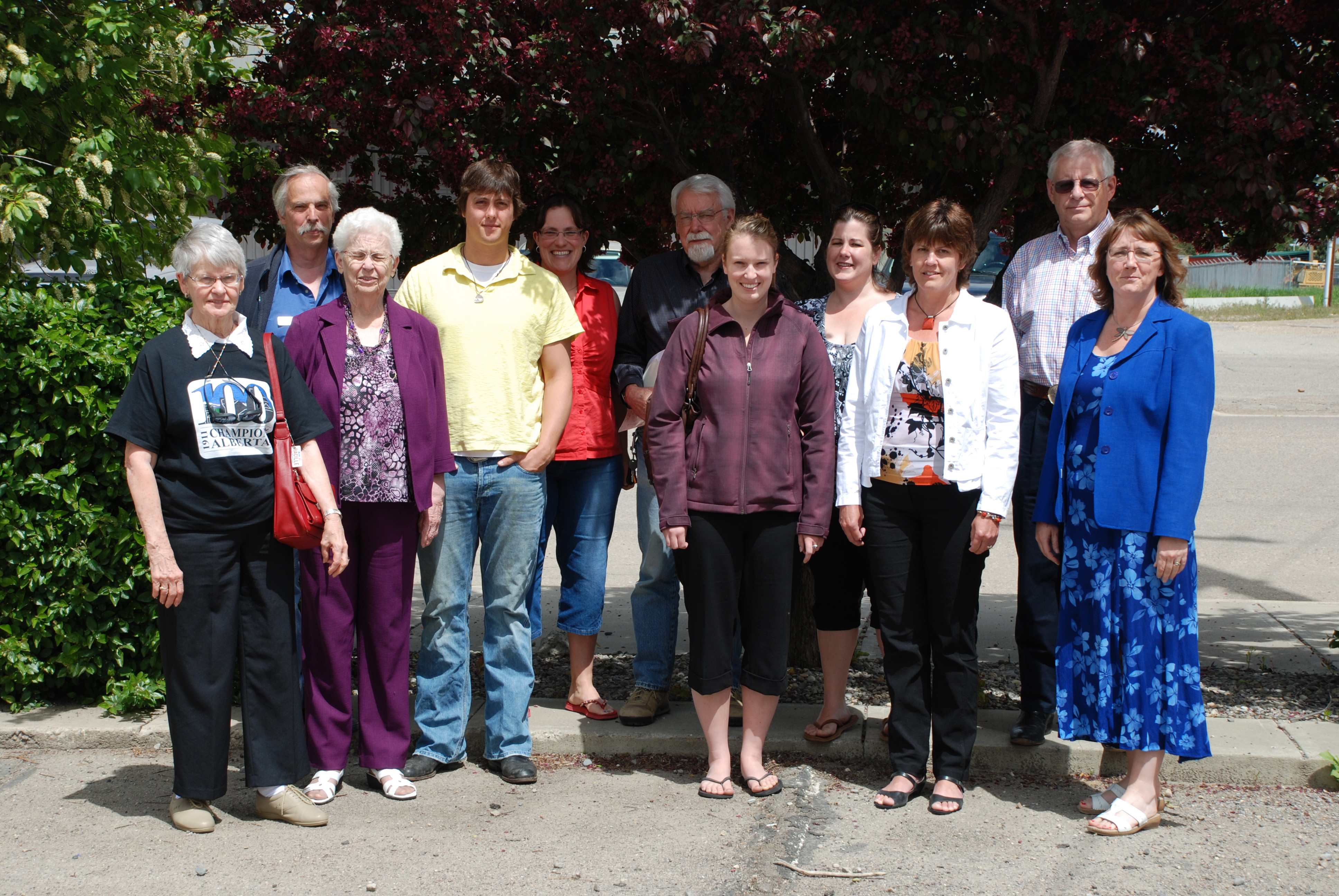
Over the next nine months the Vulcan region will be a hive of activity. Vulcan County has partnered with the Town of Vulcan and the villages of Carmangay, Champion and Milo to complete both a Municipal Heritage Survey and a Municipal Heritage Inventory. Working collaboratively, and with the services of a heritage consultant, a range of potential historic places within these municipalities will be documented and a number of places of interest will also be evaluated for eligibility, significance and integrity.

Completing these projects will allow municipal staff, councillors and residents to better understand the older places that make their communities unique and livable. From this understanding, municipal officials will be able to make informed decisions about which sites may merit protection and conservation for the benefit and enjoyment of future generations.

Pictured from Left to Right: Racille Ellis, Champion Community Representative; Paul Taylor, Town of Vulcan Councillor; Marjorie Weber, Vulcan and District Historical Society; Cody Shearer, Vulcan Business Development Society; Katie Walker, Village of Milo Councillor; Richard Lambert, Vulcan and District Historical Society; Amy Rupp, Village of Champion CAO; Kym Nichols, Village of Carmangay Mayor; Leslie Warren, Vulcan Business Development Society; William Roebuck, Kirkcaldy Community Club; Liza Dawber, Vulcan County. Missing: Bill Lahd, Milo Community Representative.

Written by: Brenda Manweiler, Municipal Heritage Services Officer

Reader Rock Garden, Calgary

One advantage the major cities of the Canadian prairies had over their eastern counterparts was that, when they entered periods of frantic development in the early 20th century, they could see what pitfalls in urban planning the earlier established eastern cities had already encountered.  Urban design was, therefore, probably undertaken with a greater sensitivity towards landscaping and park space than would otherwise have been the case.  Though commonly regarded as unsophisticated towns of the wild west, both Edmonton and Calgary made sure they had ample space set aside for parks and gardens, in both their suburbs and their downtown cores, and planted trees along many of their streets, and, in many cases, provided extra spaces for flowers and lawns.  The two cities were thus able to avoid the image of an urban jungle which had initially prevailed in many industrial cities of the East.

In Calgary, the City created the position of Superintendent of Parks and Cemeteries in 1913.  For the position, it hired a horticulturalist from England, William Reader, who had recently been the gardener for Pat Burns and his commercial empire.  Reader had actually been trained as a school teacher, but he developed a personal interest in gardening, and designed the gardens of several large estates in England before migrating to western Canada in 1908.  Upon his appointment in Calgary, he embarked on a vast planting project, lining many of the streets with trees and expanding the park space from 520 to over 1,300 acres.  Over the next 29 years, he would create several public parks, such as Central Park, Tuxedo Park and Victoria Park.  He would also create a number of children’s playgrounds, golf courses, tennis courts and outdoor skating rinks.  His work occasionally took him out of Calgary as well, for example, his landscaping of the EP Ranch for the Prince of Wales.

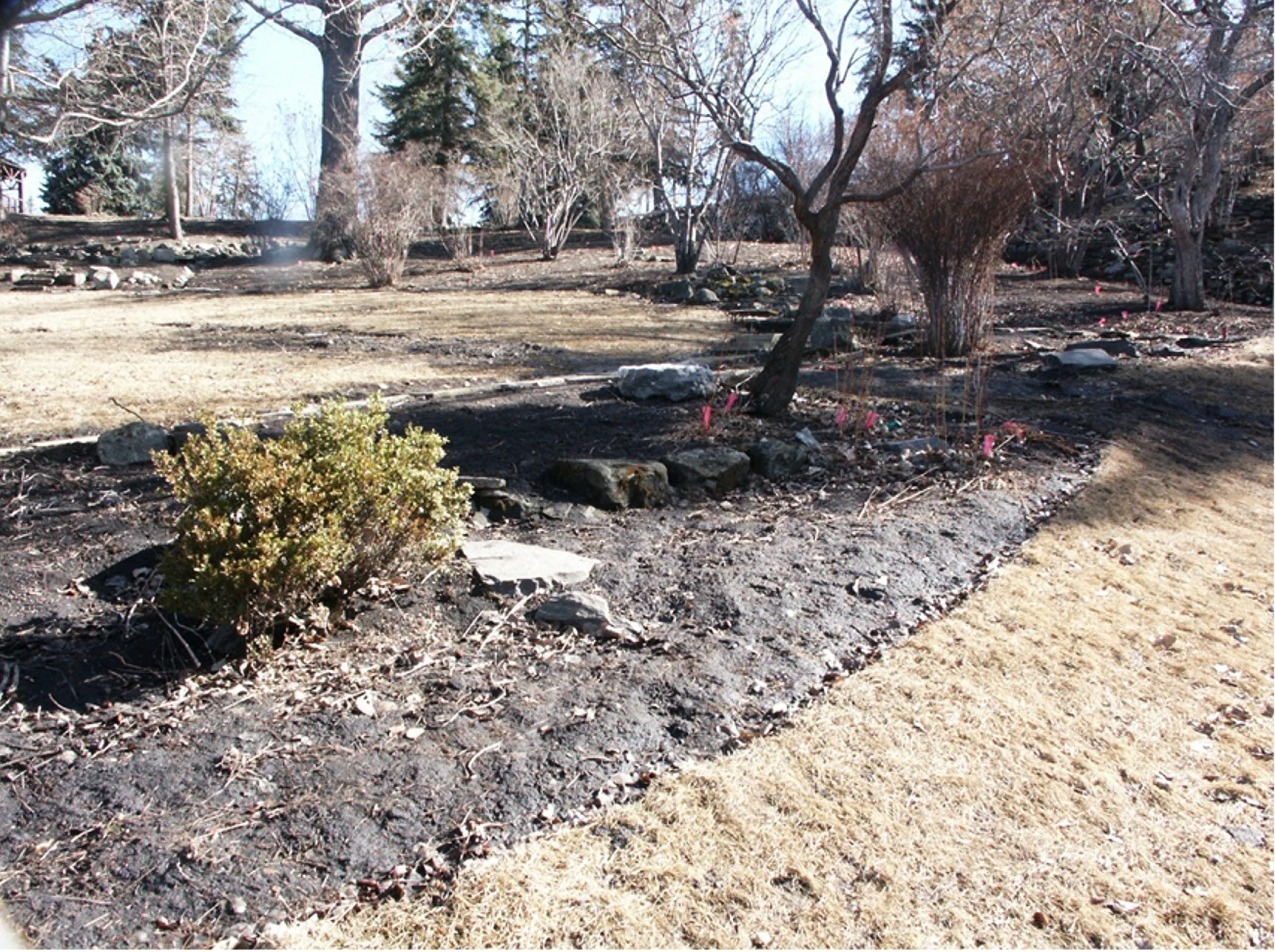
The project to which Reader is most closely associated, however, is called the Reader Rock Garden, which was built in his own back yard, which was City owned space at Macleod Trail and 25th Avenue SE.  The space included an area for the residence of the Superintendent of Parks & Cemeteries.  Reader was inspired by the City Beautiful movement which had taken hold in Europe and North America towards the end of the 19th century.  Envisioning Calgary as a “showplace city” he embarked on a plan to make the space next to his residence into a model garden, featuring a wide range of flowers, trees and other plant species.  Areas were spaced off with rock fences, with other colourful rocks also interspersed among the plants and trees.  Reader also experimented with plant and flower varieties, with his garden becoming part of the system of Dominion agricultural research stations.  As a result, his reputation grew with time, as seeds from his garden were used by a number of prestigious gardens in England and North America.

Most of Reader’s creative work was done during the 1920s.  The Depression did much to curtail park expansion and the landscaping of boulevards.  Reader himself was forced to retire in 1942 at age 67, and, the following year, he passed away.  In 1944, his garden was named in his honour, but its upkeep in the years that followed did not live up to his reputation.  His cottage was removed in 1944, and, in later years, furnishings and other buildings were removed.  Foreign and unsympathetic plants were allowed to invade the garden.  Recently, however, efforts were made to transform the site back to its original condition of horticultural excellence.  In 2006, the Reader Rock Garden was designated a Provincial Historic Resource.  Its historical significance lies in its representation of the efforts of its developer, William Reader, to transform the bustling City of Calgary from a sprawling western metropolis of office blocks and redundant suburbs into a showplace city filled with parks, landscaped boulevards and recreational facilities.

Written by: David Leonard, Historian

Visit the Alberta Register of Historic Places to learn more about the heritage value of the Reader Rock Garden in Calgary. In order for a site to be designated a Provincial Historic Resource, it must possess province-wide significance. To properly assess the historic importance of a resource, a historian crafts a context document that situates a resource within its time and place and compares it to similar resources in other parts of the province. This allows staff to determine the importance of a resource to a particular theme, time, and place. Above, is some of the historical information used in the evaluation of the Reader Rock Garden.

Wainwright Hotel

When the Grand Trunk Pacific Railway completed its line between Saskatoon and Edmonton in 1908, vast tracts of land in east central Alberta south of the Canadian Northern line were opened up for homesteading.  At key points along the line, the GTP erected stations and subdivided townsites.  One of these was near a small community called Denwood, where a post office and store had been opened in 1907.  The new townsite, to where Denwood residents and businesses now moved, was called Wainwright after the second vice-president of the GTP.  One of the structures moved from Denwood to Wainwright was the Denwood Hotel, which soon became the Wainwright Hotel.  It was owned by M.L. Forster, a strong community minded individual who served on the first village council and was mayor of Town of Wainwright from 1927 to 1935.

With rapid early growth, Wainwright became a village in July 1908, and a town with over 400 people in July, 1910.  The Wainwright Hotel was joined by another hotel, the Park, in about 1912, but the Wainwright remained the main hotel in town, with room created for a tavern.  Although business declined between 1917 and 1924, due to prohibition, the remodeled tavern did a lively business in the late 1920s under the management of a Mr. H.C. Link.

In 1929, the Wainwright Hotel was destroyed by fire, along with much of the business district.  Because of the relative prosperity of the late 1920s, most commercial structures in Wainwright were rebuilt, including the Wainwright Hotel, which was larger and built of poured concrete, no doubt to prevent another fire.  Most other commercial and public buildings were now built of brick.

Prosperity did not last, as the Great Depression of the 1930s saw grain prices tumble to such a degree that many district farmers did not bother to ship their grain to the Lakehead because they would loose money doing so.  Business in the tavern probably suffered also.  Not that people stopped going there, but, with the price of beer 10¢ a glass, people in rural Alberta were consuming less of the beverage.  Illegal stills, a holdover from prohibition, were noted to be reappearing in isolated spots.

Wartime restrictions on alcohol consumption also hindered rural hotels, but, with war’s end, hotels like the Wainwright began to recover.  With the advent of Ladies & Escorts sections in 1953, business probably improved.  In the late 1960s, mixed drinking was allowed, and, in 1971, the age for public drinking was lowered from 21 years to 18.  Many taverns could now entertain their customers with small local bands.

The Wainwright Hotel probably did a lively business during these years, and has remained standing since, serving the community and district as the main hotel for most of the 20th century.  Its tavern, its chief source of revenue, was also no doubt the favourite watering hole for local and district residents for much of this time.  In 2009, it was designated a Provincial Historic Resource.

Written by: David Leonard, Historian

Visit the Alberta Register of Historic Places to learn more about the heritage value of the Wainwright Hotel. In order for a site to be designated a Provincial Historic Resource, it must possess province-wide significance. To properly assess the historic importance of a resource, a historian crafts a context document that situates a resource within its time and place and compares it to similar resources in other parts of the province. This allows staff to determine the importance of a resource to a particular theme, time, and place. Above, is some of the historical information used in the evaluation of the Wainwright Hotel.

Pop Quiz – Win a Fabulous Prize!

Want to test your knowledge of Alberta’s historic places? Are you eager to explore the Alberta Register of Historic Places and learn about Alberta’s rich heritage? Click on the link below and answer the following skill-testing questions:

https://hermis.alberta.ca/ARHP/Default.aspx?DeptID=1

  1. How many buildings that were historically used as fire stations have been designated as historic resources?  (Hint – use the Functional Type Historic search feature)
  1. How many designated historic resources are located within the municipal boundaries of the Town of Fort Macleod?
  1. A scientist at which designated historic resource in Alberta captured the first North American photographs of the Sputnik I satellite?
  1. Which Edmonton resident garnered international acclaim for her pioneering work as a meteorologist?
  1. How many designated historic resources can be found on a road trip between Daysland and Hardisty?
  1. Which internationally-renowned inventor is the community of Nobleford named after and what was the invention for which he is best known?

Be the first to submit correct answers and you will receive a prize package designed to help you discover Alberta’s historic places.

Each month we will post a new quiz, so stay tuned!

Quiz written by: Matthew Wangler, Manager of Historic Places Research and Designation Program

Doukhobor Prayer Home, Lundbreck

Among the fundamentalist groups from eastern Europe to seek a haven in western Canada in the early 20th century were the Doukhobors.  Unlike most others, such as Mennonites and Hutterites, the Doukhobors were culturally Russian and dissenters from the Orthodox faith.  Feeling persecuted under the regime of Tsar Nicholas II, about 7,400 of them sailed to Canada in the spring of 1898-99.  Most moved on to Saskatchewan, where they were joined by their spiritual leader, Peter Verigin in 1902.  Here, they were granted exemption from military service and allowed to educate their children in their own schools.  They sought to obtain homesteads near Yorkton, but, since gaining title to homestead land meant signing an oath of loyalty to the British (and Canadian) Crown, many abandoned their incipient farms and moved on to the southern interior of British Columbia, where, in 1908, Verigin was able to purchase, on their behalf, sizeable tracts of land at Brilliant (near Castlegar) and near Grand Forks in the Kootnay district, just north of the Washington State border.  The colonies eventually included about 6,000 members.  They called themselves the Christian Community of the Universal Brotherhood.

Because the colonies became so heavily populated, Verigin undertook to found other smaller colonies.  One of these was begun in 1915 in the Cowley-Lundbreck district of southern Alberta, and initially included about 50 people.  It was headed by Semeon Ivanovitch Verigin.  Here, individual quarter-sections were purchased in relative proximity to each other.  The spread-out colony was called “Bogatoi Rodnik,” or “Rich Spring,” and eventually totaled 13,500 acres with around 300 people.  It became divided into 13 units, which featured grain elevators, flour mills, blacksmith shops and other buildings, including prayer homes.  As a fundamentalist group, these people eschewed formalized churches.  There was one dwelling at Cowley reserved for Peter “The Lordly” Verigin, for, although usually absent, he remained the spiritual and administrative leader of the colony, with each small commune within the colony electing its own local leader.

One of the purposes of this colony was to supply flour and other grain products to the BC colonies which had become too heavily populated within their geographic parameters to sustain themselves agriculturally, with much of the hilly land there given over to ranching, fruit growing and lumbering.  Besides, being vegetarians, the Doukhobors required more than the normal amount of non-meat produce.  As the Cowley-Lundbreck Colony was located on the southern branch of the CPR, it was easier, and cheaper, to ship produce from there to Brilliant and Grand Forks than from the larger prairie colony of Verigin near Yorkton, Saskatchewan.  In return for the produce, fruit and lumber were sent from the BC colonies to Bogatoi Rodnik.

In 1924, Peter the Lordly Verigin was assassinated by a time-bomb which exploded in a train near Grande Forks, killing nine other passengers as well.  His son, Peter Petrovitch Verigin, who was living in Russia, was sent for to assume the position of leader.  However, another charismatic figure in Brilliant, Anastasia Holoboff, known as Anastasia Lords, a “close companion of the late leader,” let it be known that she had been specially tutored by Peter the Lordly to be his successor.  A rift then formed within the community.  Most Doukhobors, including those around Cowley and Lundreck, accepted Peter Petrovitch, but, in 1926, a group under Anastasia broke away and formed a new colony in the district of Shouldice, Alberta.

Due to financial straits and the loss of young people to mainstream society, the colony around Lundbreck continued to decline in the 1930s and 1940s.  Those who stayed began to work as private farmers.  In 1953, they erected a central prayer home which remains standing as a symbol of the Doukhobor faith as it persisted in southern Alberta during the mid and latter 20th century.  In March 2010, the Hall was designated a Provincial Historic Resource.

Written by: David Leonard, Historian

Visit the Alberta Register of Historic Places to learn more about the heritage value of the Doukhobor Prayer Home in Lundbreck. In order for a site to be designated a Provincial Historic Resource, it must possess province-wide significance. To properly assess the historic importance of a resource, a historian crafts a context document that situates a resource within its time and place and compares it to similar resources in other parts of the province. This allows staff to determine the importance of a resource to a particular theme, time, and place. Above, is some of the historical information used in the evaluation of the Doukhobor Prayer Home.

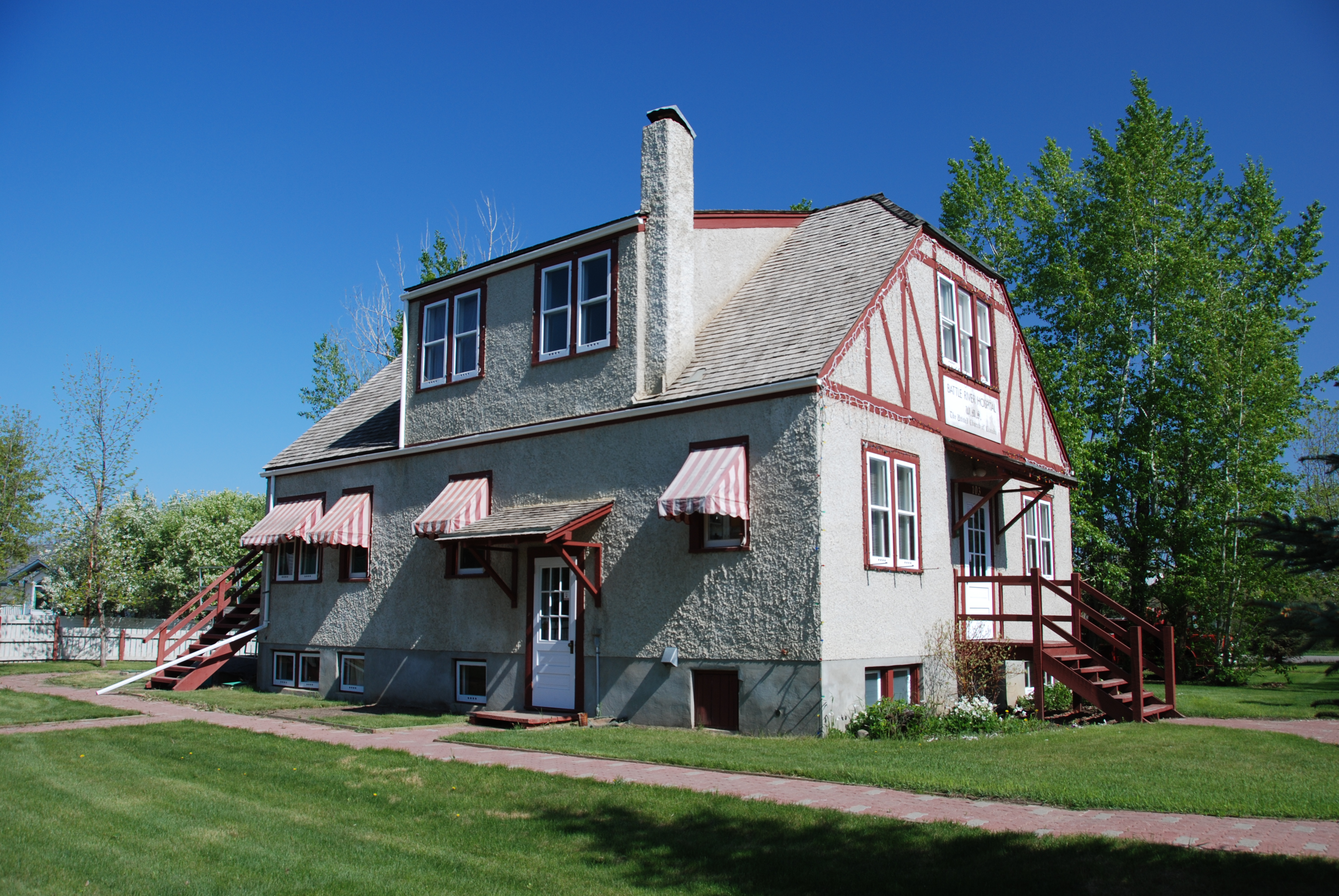
Battle River Hospital, Manning

In 1918, the Dominion government set up a Soldiers Settlement Board in order to secure employment for some of the vast number of soldiers expected to enter the workforce following their service in World War I.  Through the Board, many veterans were encouraged to settle on the Battle River Prairie, about 75km north of Peace River.  By 1921, the district had an estimated population of 500, while a tiny community called Battle River Prairie emerged off the Notikewin (formerly Battle) River.  In 1924, the store and post office was re-named Notikewin and moved to the site of present day Notikewin, some 8km to the north.

For supplies, most of the first settlers on the Prairie used the facilities at Peace River.  Commercial transportation on the River was common, while winter roads were opened for horse-drawn sleighs.  One major concern, however, was medical.  By the Public Health Nurses Act of 1919, visits were made by registered nurses with mobile clinics, but these could not accommodate emergency situations.  Throughout the 1920s, therefore, a demand began to grow for a regular physician to be assigned to some point on the Prairie.

In 1928, the provincial government decided to sponsor a permanent nurse for the district, with Mary Little moving to Notikewin.  In 1929, she was replaced by Dr. Mary Percy who was recruited from England.  In 1931, Mary Percy married Frank Jackson and moved to Keg River.  Several other nurses then followed until 1936, when Dr. Arthur Doidge became the first resident physician for the area.

The early 1930s had seen a continuing influx of settlers to the Prairie, many coming from the drought areas of southeastern Alberta.  As a result, there was growing pressure for a hospital.  Much of this came from the Women’s Missionary Society of the United Church of Canada, which began to collect promissory funds for a hospital in the area.  The government agreed to contribute the same amount as the WMS and appoint a physician if the WMS would build the hospital.  With support coming throughout the Prairie, sufficient funds were finally in place by the spring of 1936 to begin work on a facility large enough to serve the entire Prairie.

The site chosen for the hospital was on the bank of the Notikewin River, on the road midway between North Star and Notikewin.  The land was donated by John Robertson.  Work began that summer, with most of the labour and building supplies volunteered.  The Chair of the Building Committee was H.A. Inglis, while construction of the balloon frame structure was supervised by W.D.C. Buchanan.   Work continued throughout the winter, when possible, and into the following spring and summer.  Finally, on 4 September 1937, the new eight bed Battle River Hospital was officially opened.  It was an all inclusive facility, with space for an operating room, a waiting room, and a kitchen.  Electricity was provided by an external Delco gas engine.  The second floor was largely given over to living quarters for the three nurses, while Dr. Doidge lived in a separate cabin. Read more