Public archaeology in Nose Hill Park

Written by: Sam Judson and Lindsay Amundsen-Meyer, Department of Anthropology and Archaeology, University of Calgary.

Calgary was incorporated as a Canadian city in 1884 and, since then, has grown to be a city of more than 1.5 million people. Although the City of Calgary is less than 150 years old, people have lived in this area, called this place home, and taken care of these lands for thousands of years. This long history is told through the numerous archaeological sites within and beyond Calgary’s city limits. Examples such as the Hawkwood site, Everblue Springs site and Mona Lisa Site demonstrate that this part of Alberta has been inhabited for approximately 8,000 years.

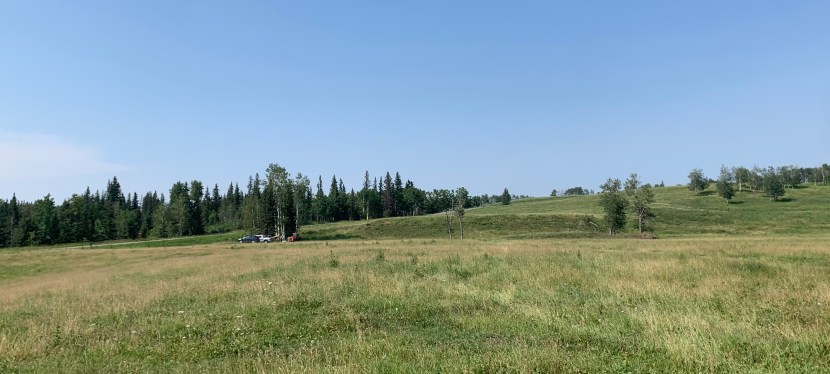
Nose Hill is a testament to Alberta’s long-standing Indigenous history. More than 40 recorded Precontact Indigenous archaeological sites are known within this City of Calgary park space, most first recorded by archaeologists in 1978 ahead of the creation of the park. The majority of these are camp sites made up of one or many stone circles, but kill sites and lithic scatters are also present. Not only was Nose Hill utilized frequently by Indigenous groups before contact, but it was also extensively used by citizens in the early days of Calgary’s existence as a settler municipality. Animals grazed on Nose Hill, northern areas of the hill were cultivated for crops, and a gravel pit was active on Nose Hill for several years. Despite these modern activities, Nose Hill Park remains one of the largest undisturbed grasslands in the Calgary area. As a result, the archaeological sites of Nose Hill are remarkably well preserved and tell a story of thousands of years of human occupation and connection with this prominent landform.

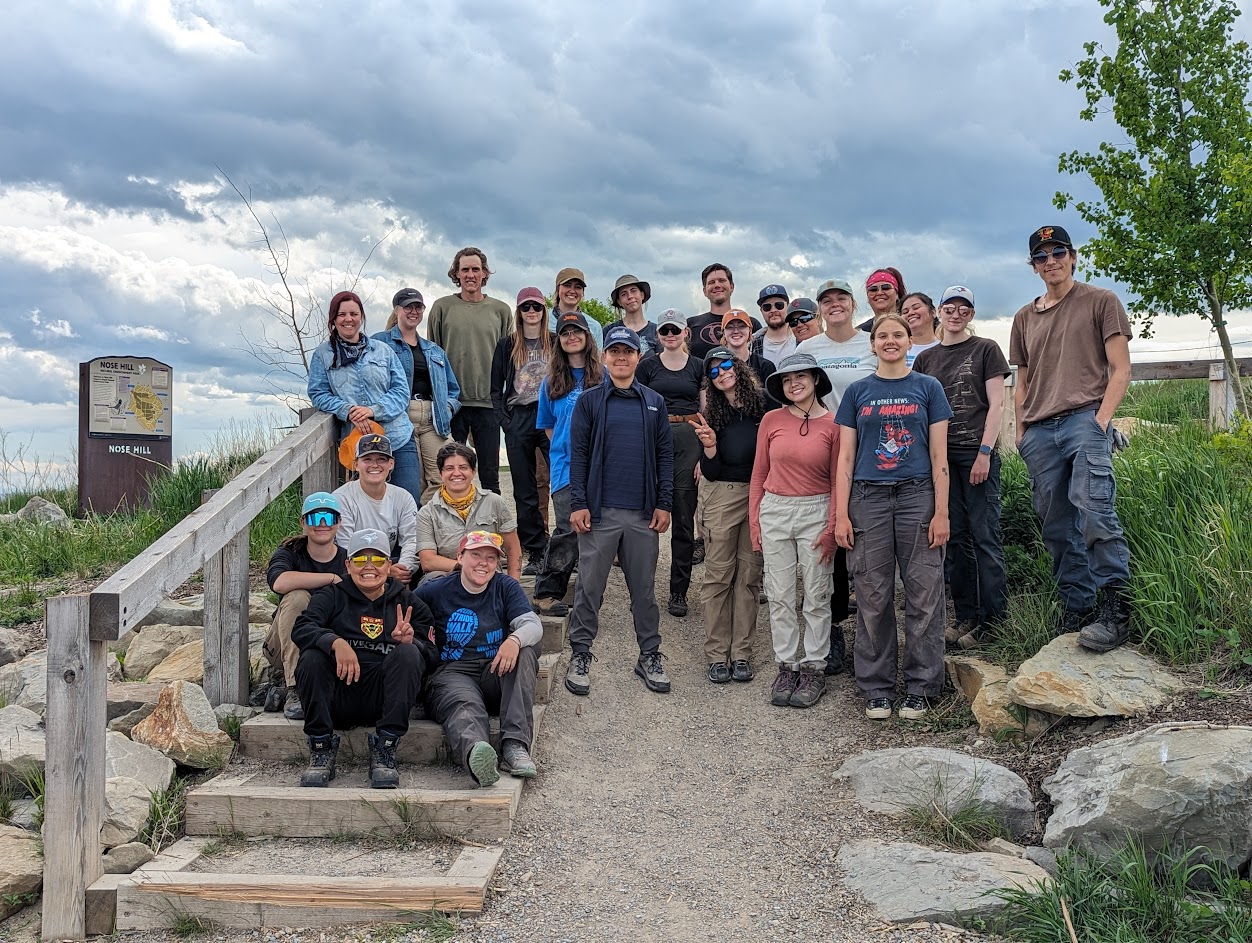
University of Calgary Staff and Students at Nose Hill Park, Calgary. Source: Lindsay Amundsen-Meyer.
Read more

Bringing Buddhism to southern Alberta

Editor’s note: This article was originally published on the RAM Blog, the official blog of the Royal Alberta Museum.

Written by: Chihiro Iwamoto, Administrative Assistant, Royal Alberta Museum

When Canada declared war on Japan in 1941, people of Japanese ancestry were met with intense discrimination. The Canadian government ordered the removal of Japanese Canadians from the West Coast of British Columbia in 1942, and within two months, approximately 22,000 Japanese Canadians, about three-quarters of whom were born in Canada, were forced to leave their homes and their properties were confiscated.

Most male Japanese Canadians were sent to labour camps to work on road construction, while their families were sent to internment camps in interior British Columbia. 

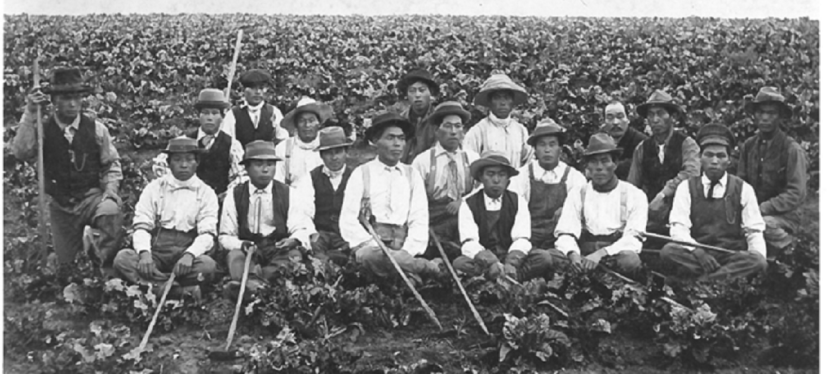
Around this time, Alberta’s sugar beet industry struggled to secure labour due to the heavy, harsh, labour-intensive nature of sugar beet cultivation. A group of 560 Japanese families agreed to move to Southern Alberta by 1943, where they signed a labour contract to work in the sugar beet fields because it allowed the families to stay together. One of the communities they were relocated to was the small town of Picture Butte, about 27 km north of Lethbridge.

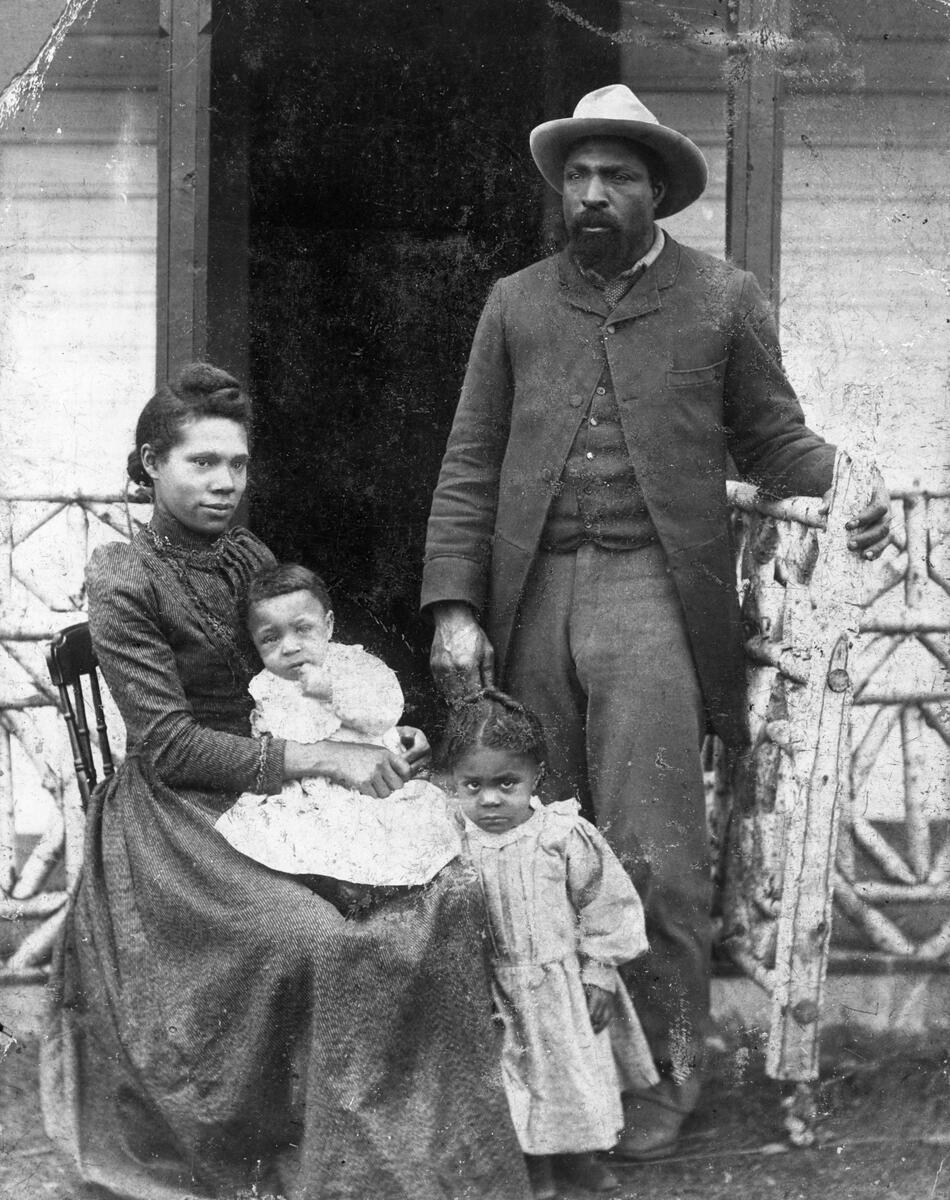
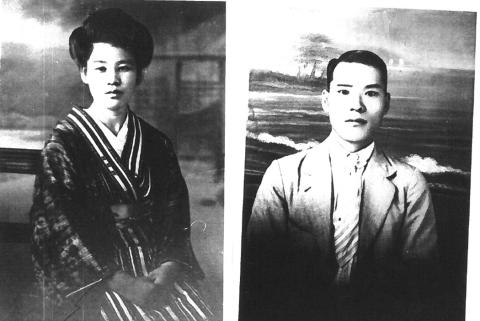
Black and white portrait photographs of a woman and man, Nobuichi Takayasu and his wife Shizuyo
Nobuichi Takeyasu and his wife Shizuyo.
Read more

Coal Mining History and Heritage Conservation at the Bellevue Mine

Written by: Fraser Shaw, Heritage Conservation Advisor and Allan Rowe, Historic Places Research Officer

The Crowsnest Pass is a landscape of remarkable history and exceptional natural beauty in southwest Alberta. Highway 3 winds through the mountain corridor past the former site of the West Canadian Collieries Mine, where an enormous tipple once straddled rail spurs on what is now the highway. The tipple and above-ground operations were dismantled after the mine’s closure in 1961 but the distinctive concrete portals remain and are clearly visible from the road. Now a historic site, the Crowsnest Pass Ecomuseum Trust Society owns and operates an interpretive facility and maintains a portion of the main tunnel where public tours and thousands of visitors experience an underground mine that historically extended for kilometres along the coal seams.

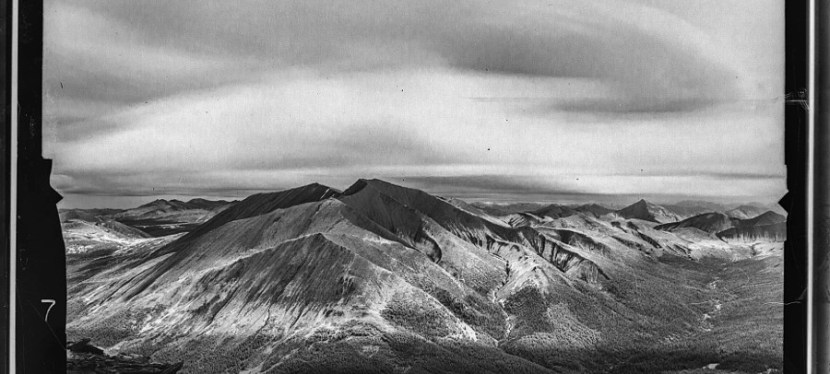
The Bellevue Mine in June 2024 retains its distinctive paired portals with the name and construction date cast into the concrete facade. The portals and tipple walkway, a remnant of which survives beside the portal today (arrows), both appear in a 1951 photograph in the Provincial Archives of Alberta looking south from the escarpment (above right). Above left, an image of West Canadian Collieries from the collection of the Crowsnest Archives looks north to Bellevue, with stairs ascending the steep slope from the tipple and portal complex (not visible) to the wash house on the ridge above. Source: Historic Resources Management Branch.

Designated as a Provincial Historic Resource in 2011, the former mine exemplifies the early mining history of the Crowsnest Pass and represents industrial practices and technologies at one of Alberta’s most significant underground mining operations in this important historic coal-producing region.

Read more

Season of the Birch: Continuing Practices of Woodland Cree First Nation

Editor’s note: Tansi! June is National Indigenous History Month, the opportunity to learn about the unique cultures, traditions and experiences of Indigenous communities in what is now Alberta and across Canada. This month also marks the 125th anniversary of the signing of Treaty 8, which encompasses a land mass of approximately 840,000 kilometres and includes portions of Alberta, British Columbia, Saskatchewan and the Northwest Territories. In Alberta, much of Treaty 8 territory is delineated by the Athabasca River extending north. Treaty 8 territory also includes the north shore of Lac La Biche extending northeast to the Saskatchewan border, as well as portions of Jasper National Park.

The banner image above is courtesy of Laura Golebiowski.

Written by: Laura Golebiowski (Indigenous Consultation Adviser) in collaboration with Woodland Cree First Nation.

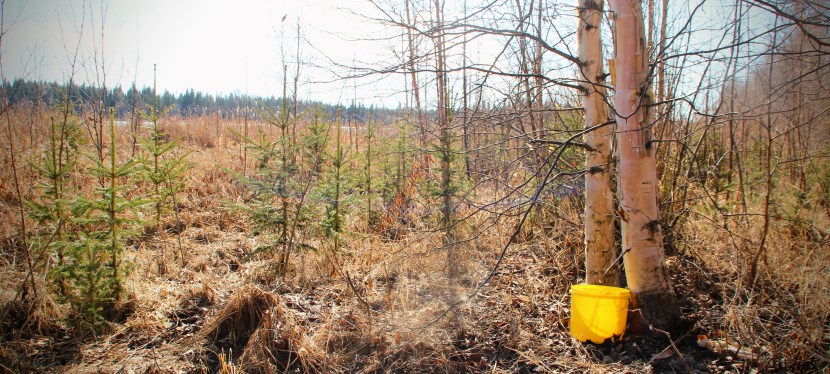
“I believe Spring speaks its truest word when you can see the women setting out pails to get that sap from the birch tree,” Chief Dan George narrates in the 1973 film Season of the Birch. The short documentary focuses on intangible heritage knowledge and practices that are still present in Cree communities in Treaty 8 today: the tapping of birch trees and the making of birch syrup.

The window for birch tapping is incredibly narrow. The waskwayâpoy (birch sap) runs best in the early spring when the snow has melted, but before the tree leaves appear. At the kind invitation of Lawrence Lamouche, Traditional Lands Manager, I visited Woodland Cree First Nation in late April, to witness this centuries-old practice and learn how Knowledge-Keepers harvest waskwayâpoy and make birch syrup.

Read more

Love and Marriage at the Provincial Archives of Alberta

Editor’s note: The banner image above is from the wedding of Sandy and Diane Weir, November 1974. Photo courtesy of the Provincial Archives of Alberta.

Written by: Heather Northcott, Government Records Archivist, Provincial Archives of Alberta

Showcasing a variety of archival records and images, the Provincial Archives of Alberta (PAA) is pleased to present its latest exhibit “Love and Marriage.”

The exhibit was inspired by the often joyful and sometimes sad stories that fill the archival vaults waiting for discovery. Visitors to the exhibit will first encounter images and letters about love blossoming before exploring narratives of engagement and marriage. The arc of romance and marriage leads naturally to anniversaries, divorce and death. The exhibit would not be complete without addressing who is missing – the groups or communities not well represented by the archival documents – and putting a call out for records donations.

Read more

How fossils form

Written by: Royal Tyrrell Museum of Palaeontology staff

There are more than two million fossils in the Royal Tyrrell Museum’s Collections—and that number is growing. Every year, staff excavate and collect new fossils that are found through fieldwork, public finds and industry reports.

Although the Collection includes amazing fossils spanning roughly 3.5 billion years of Earth’s history, fossils are incredibly rare. Only a small fraction of the ancient organisms that ever lived become fossilized. Of those, only a small portion are discovered and collected.

Read more…

REMINDER: Nominations open for 2024 Heritage Awards

Previous recipients from the Heritage Awards are a testament to the varied range of individuals and groups who work to preserve and celebrate our province’s heritage. Alberta’s history is unique and diverse; the Heritage Awards are just one way to recognize and commend those who write about, research, advocate and celebrate Alberta history.

The Heritage Awards, presented by the Alberta government, help to honour the work of Alberta citizens, groups and communities helping to share protect, preserve and promote our province’s history. The awards recognize individuals, non-profit organizations, corporations, municipalities, First Nations and Métis settlements.

This year, the awards are broken down into three categories: Heritage Conservation, Heritage Awareness and Outstanding Achievement. Learn more about these categories and the nomination process.

Recipients will be recognized at an awards ceremony in September. Further details will come out during the next few months.

To nominate an individual or group, fill out a nomination form and drop off, mail, courier or email your nomination package to:

Heritage Awards Program
Old St. Stephen’s College Building
8820 112 Street
Edmonton, Alberta  T6G 2P8
Email: acsw.heritageawards@gov.ab.ca

Art-chaeology: visualizing the past through illustration

Written by: Jared Majeski, Historic Resources Management Branch

Look hard enough, and you can find artistic expression in many different occupations. The stone mason cutting and preparing a stone feature; a researcher distilling their raw data into a visually appealing infographic; or in the case of archaeologist Amanda J.M. Dow (B.A. Archaeology, University of Calgary), using pencils to represent archaeological research through illustrations. Whether you categorize it as art or archaeology, Dow’s illustrations help to put faces to names and context to places.

The following interview has been lightly edited for length and clarity. All images and illustrations below are courtesy of Amanda Dow.

Where do science and art meet and is there ever an uncomfortable junction?

Dow: There is always a strange dance between art and science.  It can be awkward and challenging but for the dance to work, there has to be a reciprocal understanding from both disciplines. I like to use the word “illustration” to help lend my artwork scientific credibility. I use the results of archaeology and research to make the art academic. But in the end, the illustration is just one person’s interpretation of an event.  What lends it credence is what informs the interpretation.  And if that information is scientific, then that weird dance can work.


Archaeologists tend to communicate in dry and what feels like uninteresting ways because that’s what they’re trained to do. What do you think of traditional archaeological reports, articles and books? Does this make you try to depict the past in more interesting ways?

Dow: There are different ways results of archaeological study are communicated.  In Alberta, the vast majority of archaeological study are presented as technical reports. That’s my day job, as a consulting archaeologist and I contribute to this type of “grey” literature presenting data without excessive interpretation. Technical reports are defined by budget, schedule and scope. It’s always a challenge to present data within those limitations without being too boring.

The opportunity to share more interpretation and provide people with more elaboration comes from other forms of communication.  This is where archaeologists have an opportunity to collect from the technical literature all the glamorous bits and create an interpretation the science supports.  This is where articles and books, presentations and alternative media are serving a greater public role.  And this is where I try to make artistic contributions.

What’s the most satisfying part of your job as an illustrator?

Being able to share a concept that makes someone pause for a moment to appreciate the genius of our ancestors.  I like taking an archaeological or historical record and putting a face on it. I like tweaking imaginations.

Read more

The history and conservation of the Colonel’s Cabin

Editor’s note: The banner image above is courtesy of the Glenbow Library and Archives Collection, Libraries and Cultural Resources Digital Collections, University of Calgary.

Cowritten by: Fraser Shaw, Heritage Conservation Advisor and Ronald Kelland, Geographical Names Program Coordinator

A panoramic 1945 photograph shows a snowbound mountain landscape in the grip of winter. Plumes of smoke rise from rows of tarpaper-covered buildings huddled behind barbed wire fences and guard towers. This is Camp 130, one of a series of Prisoner of War (POW) camps established across Canada during the Second World War. Outside the prisoners’ compound is a small, single-story log cabin occupied by the camp commandant. Built in 1936, the “Colonel’s Cabin” was protected as a Provincial Historic Resource in 1982 as one of few remaining structures in Alberta directly linked to the internment of prisoners of war and to recognize the site’s earlier association with the Kananaskis Forest Experimental Station.

Camp 130 Prisoner of War Camp, winter 1944 or 1945. Source: Glenbow Library and Archives Collection, Libraries and Cultural Resources Digital Collections, University of Calgary, CU1128370 (NA-4824-2os).

During the Great Depression, Canada’s middle-class, political and economic elites were concerned about the large number of unemployed men roaming the country and how that long-term unemployment might result in moral degradation, petty criminality and the fostering of revolutionary communist ideology. Under pressure from religious organizations and municipal and provincial governments, the Dominion government established a series of temporary work camps for single, unemployed men to be administered by the Department of National Defence. By 1936, camps had been established at Acadia, New Brunswick; Valcartier, Quebec; Petawawa, Ontario; Duck Mountain, Manitoba; and Kananaskis, Alberta. Ostensibly created to engage unemployed and homeless men in work that was seen as being necessary for their physical, psychological and spiritual betterment, the camps also kept these unemployed, transient men out of sight and far from transportation routes and urban centres.

Read more

Making sense of the Victoria Settlement census

Editor’s note: The banner image above is of the school children of Pakan in 1910, the year before the 1911 census. Image donated by Rev. Metro Ponich.

Written by: Sarah Mann, Master’s student in Anthropology, University of Alberta

The Canadian census is something most Canadian adults have experienced. While the survey is often looked as tedious, it can hold a myriad of information and questions. My work around Victoria Settlement Provincial Historic Site was done as part of a Community Service Learning (CSL) internship with the Heritage Division of the Government of Alberta. This work involved looking at what information and further research plans can be drawn from the Victoria Settlement censuses using supplemental materials from community history books from around Alberta. From the census data, I created two spreadsheets tracing the changes and differences in the various censuses done in Victoria Settlement. Comparisons of the 1881, 1891 and 1901 censuses show several inconsistencies and allow us to ask many questions about life in the area.

Victoria Settlement, northeast of Edmonton along the North Saskatchewan River, was settled in 1862 when George McDougall founded the Methodist mission on the site of a traditional Indigenous camping ground. Then in 1887, the area became known as Pakan after the name of the local post office, which in turn was named for Cree Chief Pakan (James Seenum). The settlement was abandoned in 1922 when the railroad bypassed the community, instead being built through the town of Smoky Lake, approximately 15 km to the north. The eras examined in the censuses are the periods of 1881-1911, as there is a national census every 10 years. In between the years of 1891 and 1901 a large Ukrainian population settled in the area, but my study focused on the Métis elements of the community.

1891 census. Source: Library and Archives Canada.
Read more