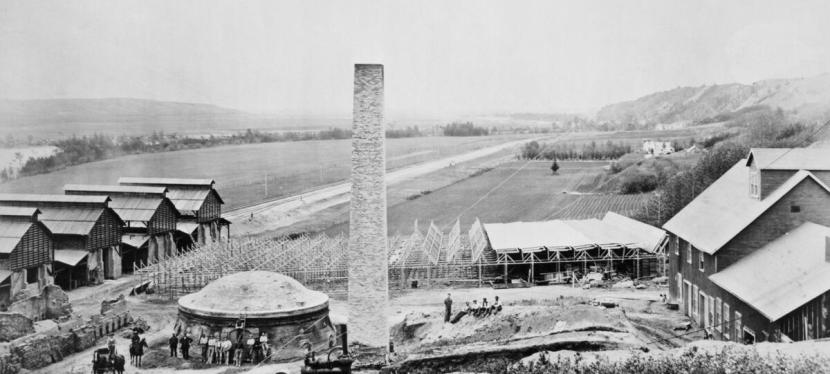
Editor’s note: The banner image above is the Calgary Pressed Brick and Sandstone Company plant, Brickburn, Alberta (ca. 1916-1920 [CU1136164] by unknown). Image courtesy of Glenbow Library and Archives Collection, Libraries and Cultural Resources Digital Collections, University of Calgary.
Written by: Sam Judson and Lindsay Amundsen-Meyer, Department of Anthropology and Archaeology, University of Calgary
To most Calgarians, Edworthy Park is nothing more than a city park with a large and popular off-leash area for dogs, rocky ‘beaches’ along the Bow River and meandering biking and walking trails that folks enjoy throughout the year. What most users of the park do not realize is that Edworthy Park has a remarkable history: numerous pre-contact Indigenous archaeological sites within the park; the presence of a Métis winter camp in the late 19th century; the eventual establishment of one of the Calgary area’s earliest homesteads by Thomas Edworthy; and Edworthy’s operation of a sandstone quarry on the land in the early 20th century. There was even a 20th century brick factory within the park and its associated village (Brickburn) to the west. As you’ll learn, the students and staff of the University of Calgary archaeology field school and Public Archaeology Program discovered these many layers of history are present across much more of Edworthy Park than previously known.
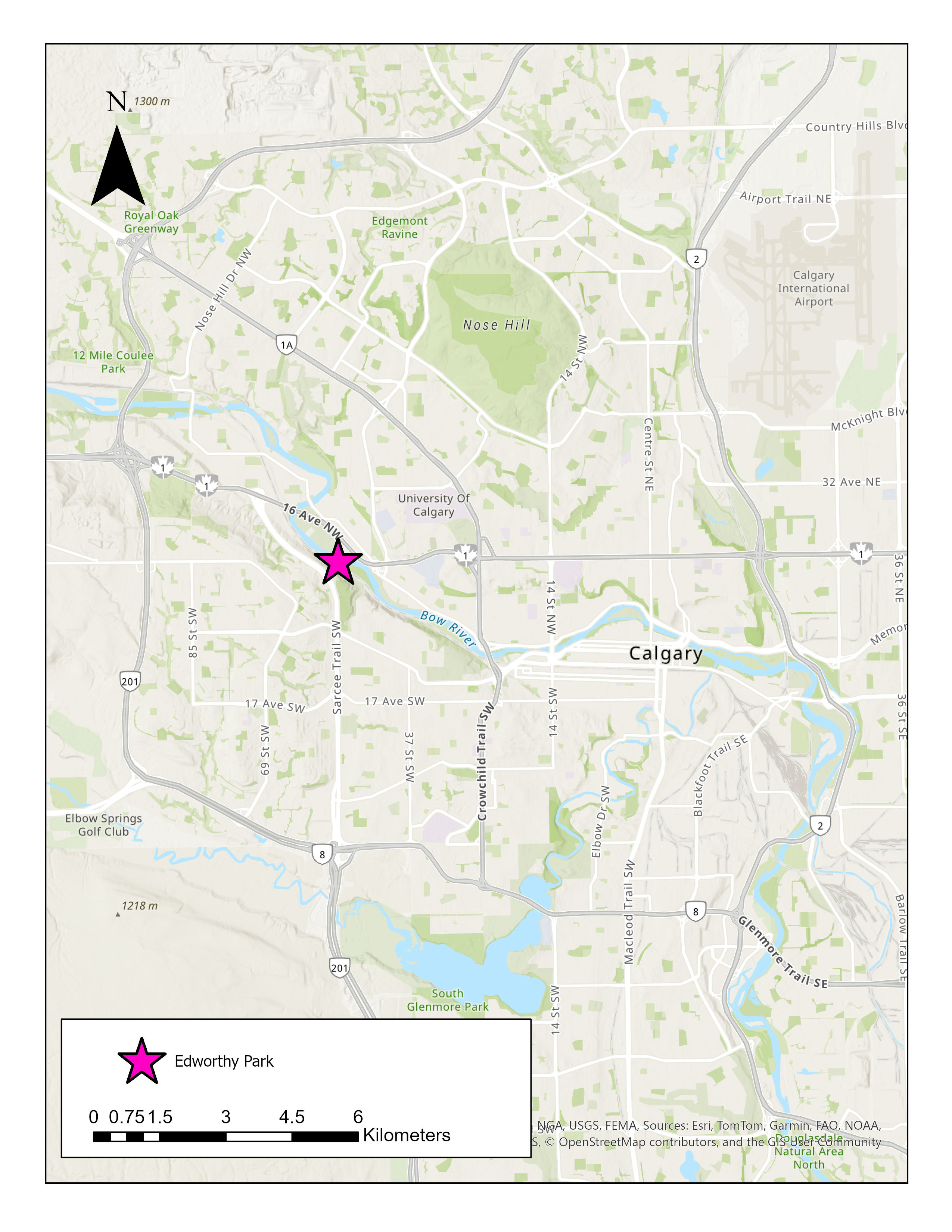
Location of Edworthy Park, within the City of Calgary. Source: Lindsay Amundsen-Meyer.
Written by: Ronald Kelland, Geographical Place Names Coordinator
Remembrance Day, November 11, is the day Canadians honour and memorialize those who gave their lives while in military service. While honouring all Canadian service personnel this Remembrance Day, this year RETROactive is drawing attention to a few geographical features named to commemorate casualties of the Second World War. Following the Second World War, the Province of Alberta, through collaboration between the Geographic Board of Alberta and the Geographic Board of Canada began naming geographical features, mostly lakes, for decorated military personnel from Alberta that were casualties of the Second World War. This is the story of two of those individuals.
Located approximately 35 kilometres northwest of Bonnyville is Conn Lake.
The lake is named for Leading Steward James Conn. Born at Hillcrest, Alberta on December 7, 1914, Conn was the son of John Robert (died 1921) and Lillian Maude Conn (died 1916). At some point, James and his siblings moved to Quebec and by 1932 James Conn was living on University Street (now Robert-Bourassa Boulevard) in Montreal.
At the outbreak of the war, James Conn was a waiter with the Canadian Pacific Railway. Conn enlisted in the Royal Canadian Naval Volunteer Reserve in August 1943 and trained at Navy Reserve Divisions HMCS Montreal (now HMCS Donnacona) and at Winnipeg with HMCS Chippawa and at Ottawa with HMCS Carleton. He served a short stint on HMCS Stadacona, a steam yacht that had been acquired by the Royal Canadian Navy in 1915 and was used as a home waters patrol vessel during the Second World War. On October 17, 1944, he reported to HMCS Esquimalt at the rank of Leading Steward.
HMCS Esquimalt was a Bangor-class minesweeper operating out of the port of Halifax to hunt enemy submarines and keep approaches to the harbour clear of mines. Named for the Township of Esquimalt on Vancouver Island, she was launched in 1941 and was originally assigned to patrol duties off Newfoundland and was transferred to Halifax in September 1944. On 15 April 1945, Esquimalt sailed on a patrol to hunt a German U-boat that was suspected to be in the waters near Halifax. At approximately 6:30 a.m. on the morning of April 16, with the lights of Halifax visible on the horizon, a torpedo from German U-boat U-190 struck Esquimalt on its starboard, flooding the engine room and causing a loss of power. In less than five minutes, and before a distress call could be sent, Esquimalt rolled onto her starboard side and sank beneath the surface.
Sources differ regarding the number of sailors lost in the sinking of HMCS Esquimalt, with a range of 39 to 44 crew perishing that night either going down with the sinking vessel or of exposure in the frigid waters awaiting rescue. Six hours after the sinking, survivors were picked up by Esquimalt’s sister ship, HMCS Sarnia. Twenty-seven of Esquimalt’s crew survived. Leading Steward James Conn was not one of them
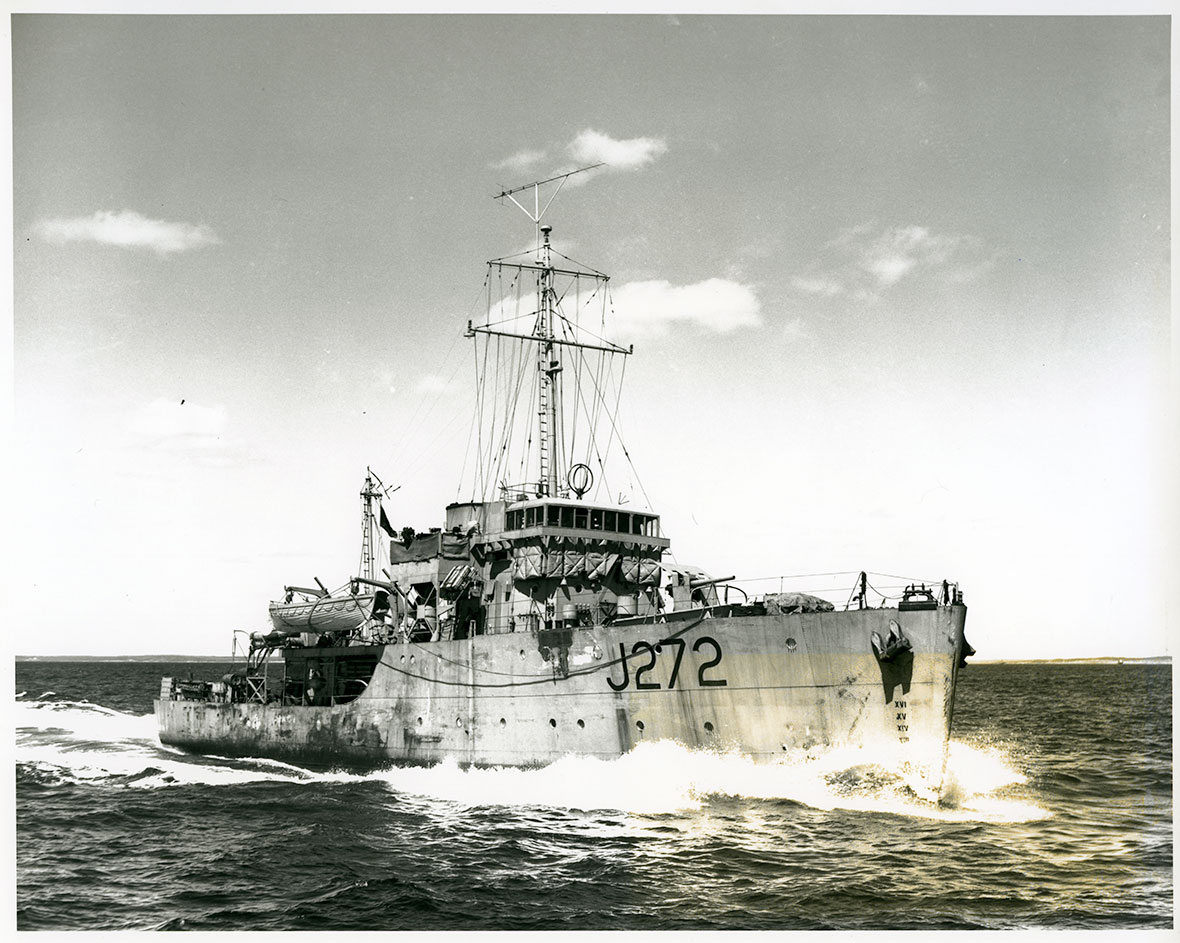
HMCS Esquimalt, 1944. Source: Department of National Defense.
Over the past year, I’ve been volunteering with the Labour & Industry curatorial team at the Royal Alberta Museum (RAM). What began as a project to help process recent architectural acquisitions—related to Wallbridge & Imrie and Doris Newland Tanner—has gradually expanded into something much broader. I’ve since been fortunate to assist with other newly acquired collections, each object offering its own intriguing story and mystery to unravel.
In particular, individual pieces have caught my attention not only for their craftsmanship but for the stories embedded in them. Each one—whether an architectural tool, scale model or illustration—becomes a small but meaningful window into Alberta’s working and community past.
Among the recent acquisitions at the RAM was a particularly appealing object: a 100+ year old scale model of a staircase from the Town of Vegreville. The model was obtained by the RAM in 2024 after the Vegreville Regional Museum ultimately closed its doors.
Curators from the RAM’s history programs—including Labour & Industry, Daily Life & Leisure and Military & Government History—travelled to Vegreville to identify and help preserve objects of historical value within the RAM’s permanent collection. The staircase model was among those selected and is now part of the Labour & Industry collection.
This remarkable scale model is constructed primarily of wood and mounted on a plywood base. It was most likely built to a scale of 1″: 1′ (i.e., one inch equals one foot). Though small compared to its full-scale counterpart, it’s meticulously crafted—complete with turned balusters, a square landing and even a functioning door with tiny hinges and a wooden knob. The design reflects the restrained character of early twentieth-century domestic interiors, where craftsmanship and proportion met simple, elegant ornamentation. From the graceful curve of the lower steps and railing to the careful shaping of each newel post, every element has been thoughtfully made, likely by hand woodworking tools, and with the aid of early woodworking machines.
Despite being over a century old, the model has survived in remarkably good condition. A few balusters are missing and there are signs of minor repairs, but significantly, the overall integrity of the piece remains. The varnished surfaces retain their warmth, while the hidden undersides reveal the maker’s practical side—unfinished wood, tool marks, and the occasional nail or screw added probably long after its creation. Together, these details hint at a life of use and care, and a level of craftsmanship that continues to impress.
Front (left) and Back (right) Three-quarter Views of a 100-year-old Miniature Wooden Staircase. Source: Royal Alberta Museum, H24.96.63.
Written by: David Monteyne, Professor, School of Architecture, Planning and Landscape, University of Calgary
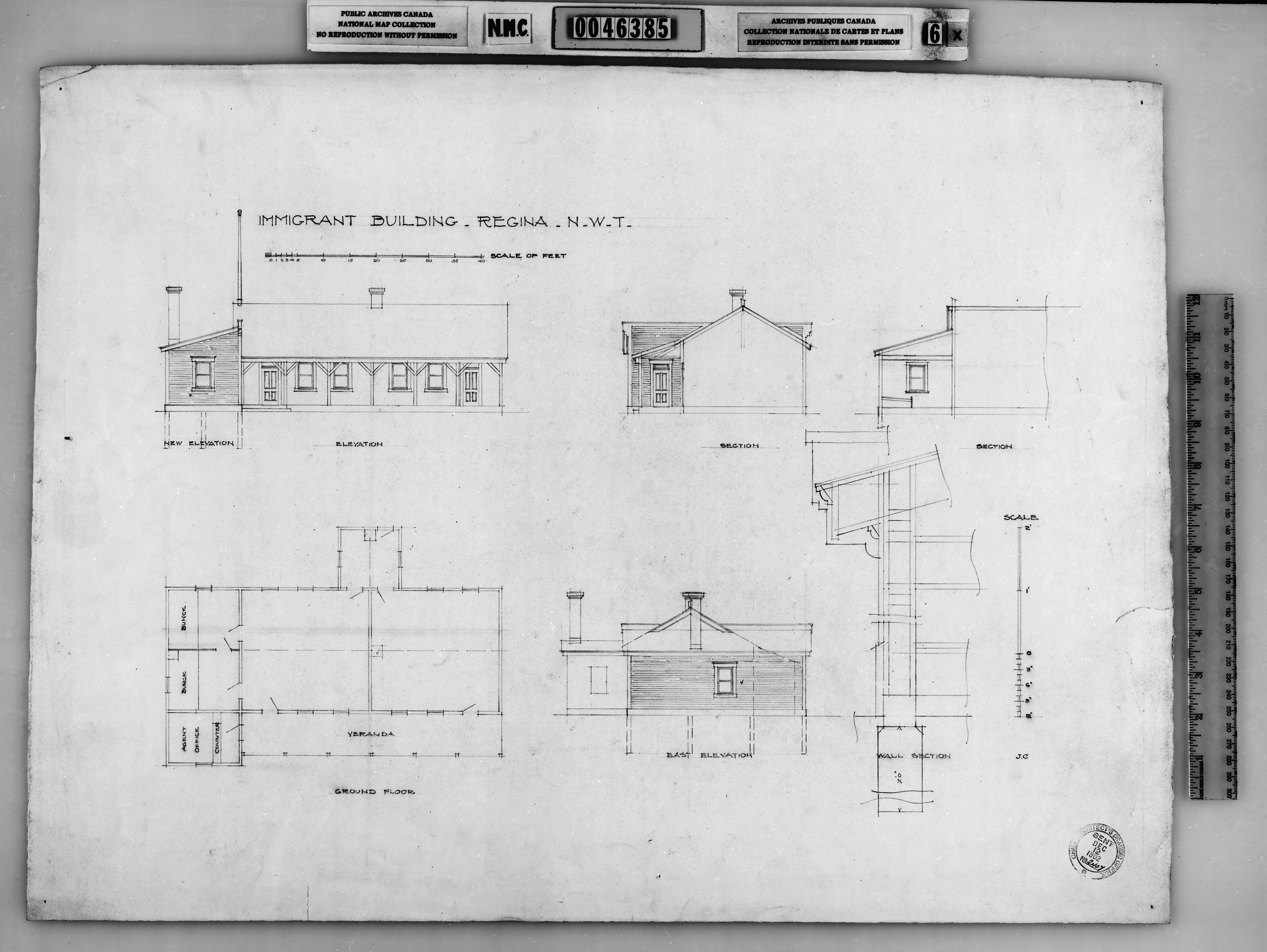
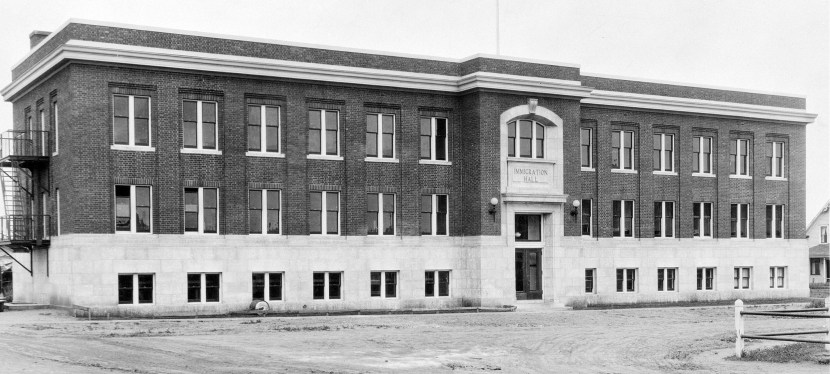
Between 1885 and 1930, the Dominion government built and operated about a dozen immigration halls in Alberta (and rented space for this purpose in a dozen more towns), from Lethbridge and Medicine Hat in the south to Grande Prairie and Peace River in the north. But what, exactly was an “immigration hall”?
An immigration hall was a place where the federal immigration branch provided free accommodations as well as advice to new arrivals from Europe, the United States and even eastern Canada. These prairie immigration halls were part of a nationwide building program, described in my recent book, for which the federal Department of Public Works designed and built: pier buildings in ports like Quebec City and Halifax (Pier 21, now the Canadian Museum of Immigration); immigrant detention hospitals; and quarantine stations on both coasts. Of all of these, the immigration halls were the most numerically significant, with more than 50 buildings erected across the three prairie provinces. The immigration hall was a newly invented building type, unique to Canada.
An immigrant’s late-1890s sketch of the immigration hall at Calgary, which was built in 1885 and used until 1913. Source: Library and Archives Canada, Department of the Interior fonds, Immigration Branch, RG 76, volume 20, file 180, part 1.
The deadline for applications for the Roger Soderstrom scholarship is fast approaching!
The Roger Soderstrom Scholarship honours the late Roger Soderstrom’s work and career with the Government of Alberta in encouraging preservation and interpretation of Alberta’s heritage.
The applicant must be a permanent Alberta resident enrolled in a graduate or extended study program with a proposed research project at that level, in the following fields, but not limited to:
architectural preservation
urban or area planning and conservation
historic resource management
archaeology
history
palaeontology
The research project must have significant Alberta content and will help with the preservation or understanding of Alberta’s heritage.
Guidelines for the scholarship, along with instructions on how to apply, are available on Alberta.ca.
Editor’s note: The banner image above is of Áísínai’pi/Writing-on-Stone. Source: Laura Golebiowski.
Blair First Rider is a Kainai (Blood Tribe) Elder and Horn Society grandparent, and an Indigenous Consultation Adviser with the Historic Resources Management Branch. Thank you Blair for sharing your grandfather’s stories. Suukapi!
Written by: Blair First Rider and Laura Golebiowski, Indigenous Consultation Advisers
In a previous RETROactive blog post, we discussed the seasonal round: the Niitsitapi (“the real people,” how the Blackfoot refer to themselves) concept that structures the year and our relationship to the land and one another. In this post, we learn some of the ways the Niitsitapi spent time during the hot summer months at the turn of the century.
This knowledge was shared by George First Rider, Blair’s paternal grandfather. George was born in 1904 on the Kainaiwa (Blood Tribe) reserve. His father was Dog Child and his mother was The Only Handsome Woman, also known as Catching Another Horse.
George First Rider was a kipita-poka: a grandparent’s child. Deeply loved and cared for by his family, he was afforded a lifestyle of traditional knowledges and practices. He was also a member of the Horn Society and other age-grade Societies (the complex social and ceremonial system that Niitsitapi men participate in from the age of seven or eight to adulthood. Niitsitapi women participate in the Motokis Society). Through ceremonial transfers, George learned many songs and earned the ability to conduct many ceremonies.
Dog Child, a North West Mounted Police scout, and his wife, The Only Handsome Woman, members of the Blackfoot Nation.” [ca 1890]. Credit: Trueman and Caple / Library and Archives Canada / PA-195224.“George First Rider, Blood.” [1925-02-21] (CU 187940) by Atterton. Courtesy of Glenbow Library and Archives Collection, Library and Cultural Resources Digital Collections, University of Calgary.Read more →
Editor’s note: Alberta’s heritage sector and the Heritage Division of Arts Culture and Status of Women recently lost two dedicated and long-serving colleagues – former Historic Conservation Advisor Rino Basso and former historian and provincial archivist David Leonard.
Written by: Ronald Kelland, Geographical Names Program Coordinator and Fraser Shaw, Heritage Conservation Advisor
Rino Basso
Rino Basso was born at Nordegg, Alberta on July 22, 1946, to Pietro “Pete” Basso, a coal miner with significant carpentry skills and Barbara Basso (nee Sieben), who was a notable volunteer in her community and church and had some nursing training. The Basso family moved to Red Deer in 1947 where Pete Basso started Basso Construction and built houses. Being born in the historic mining community of Nordegg and having a carpenter and a homebuilder as a father may have set Rino on a career path in historic resources management from an early age.
Rino attended Red Deer Catholic Separate Schools, graduating from St. Thomas Aquinas High School in 1965 then enrolling in the Architectural Technology Program at the Northern Alberta Institute of Technology. In the early-1970s, Rino began working with the Government of Alberta as Senior Preservation Advisor in the Historic Sites Service and, as it is known today, Historic Resources Management. There is probably not a single Provincial Historic Resource designated between the 1970s and 2010s that has not seen his involvement. It seems like his name can be found on every file in Historic Resources Management’s records. Rino used to jovially remark that he had probably driven on every byway, stayed in every motel, eaten at every bakery and visited every city, town and village in the province from Edmonton and Calgary to the proverbial “Cucumber Corner,” his shorthand, all-inclusive term for the small communities and rural areas across the province whose history and heritage he dedicated so much of his career to preserving.
Rino was delighted to find that this structure, one of only two known extant, historic sod houses was still standing, 2013. Even after more than three decades working with historic places, he was enthralled when encountering a new site or building.
Editor’s note: The author would like to give special thanks to Quinton Crow Shoe for his contribution to this post. As well, the banner image above features audio reels at the Provincial Archives of Alberta. Source: Provincial Archives of Alberta.
Written by: Mikaela LeBlanc, TRC Archivist Intern
The Provincial Archives of Alberta (PAA) acquires, preserves and makes records available to researchers. These includes government records, which are records created by agencies, boards and commissions as well as departments within the Government of Alberta, and private records, which are records created by individuals, families and organizations. The records come in many formats and can include letters, photographs, drawings, audio recordings, journals, newspapers and maps, among others. Within these records are also a wide variety of materials that were created by and about Indigenous people and communities.
The PAA first released an “Aboriginal Resource Guide” finding aid in 2006, which listed records identified as being about Indigenous communities in Alberta. This guide provided the building blocks for archival research to become more user-friendly when accessing Indigenous related records. The hearings and report of the Truth and Reconciliation Commission (TRC) and Calls to Action related to archives and the heritage sector identified ways in which the PAA could make improvements in access to records by Indigenous creators and about Indigenous communities. This coincided with the PAA’s move to a new collections management database webpage Access to Memory (AtoM), and saw the release of the Indigenous Resources Guide (IRG) in April 2023. The guide identifies records that relate to Indigenous people and communities in Alberta that are currently in PAA’s holdings.
This story begins with the discovery of hundreds of artifacts that were uncovered during the dismantling of the interior of the original Pendennis Hotel in Edmonton in 2006. The Pendennis Hotel, located at 9660 Jasper Avenue, dates to the late 1890s when it was formerly named the California Rooming House. The earliest photo of the building is dated 1898.
Pendennis after 1904. This building was incorporated into the 1911 hotel expansion. Source: Provincial Archives of Alberta, B4328.
Editor’s note: The banner image of Dyde House above was taken by an unknown photographer, Edmonton, 1961-1962. Source: University of Calgary, Canadian Architectural Archives, Arthur Erickson fonds, CA ACU CAA F0002.
Written by: Robb Gilbert, Archivist, Canadian Architectural Archives
Dyde House, located a short distance outside Edmonton, is one of Canadian architect Arthur Erickson’s first notable projects in residential design. The house is located southwest of Edmonton, in Parkland County, on the grounds of the beautiful University of Alberta Botanic Gardens. The project was designed by Erickson in the Spring of 1960 and completed in late 1961 after returning from travels in Japan and Southeast Asia on a Canada Council for the Arts fellowship.
2024 marked the centenary of the birth of Erickson so I wanted to highlight one of his most important works from his early years as an architect: a rare Erickson project located in Alberta and a work that has recently been the subject of a documentary and an ongoing preservation campaign. The Canadian Architectural Archives at the University of Calgary houses the work of Erickson from 1953 to 1973 in the Arthur Erickson fonds. His archive includes thousands of original drawings and dozens of boxes of files documenting the design process behind his revered works of architecture.
Arthur Erickson, Sketch of the Dyde Residence, Edmonton, [1960-1961]. Source: University of Calgary, Canadian Architectural Archives, Arthur Erickson fonds, CA ACU CAA F0002.
Arthur Erickson, Sketch of the interior of the Dyde Residence, Edmonton, [1960-1961]. Source: University of Calgary, Canadian Architectural Archives, Arthur Erickson fonds, CA ACU CAA F0002.
Erickson was born in Vancouver in 1924. He studied at the University of British Columbia and served overseas during World War II in India and Malaysia. Pursuing a career as an architect, he studied at McGill University and established his practice in Vancouver in the mid-1950s. In the span of the next 40 years, Erickson became Canada’s most renowned architect, nationally known but also the one of the few Canadian architects with an international reputation. His work includes icons of Canadian architecture such as Simon Fraser University, the University of Lethbridge, Robson Square and the Museum of Anthropology at UBC.