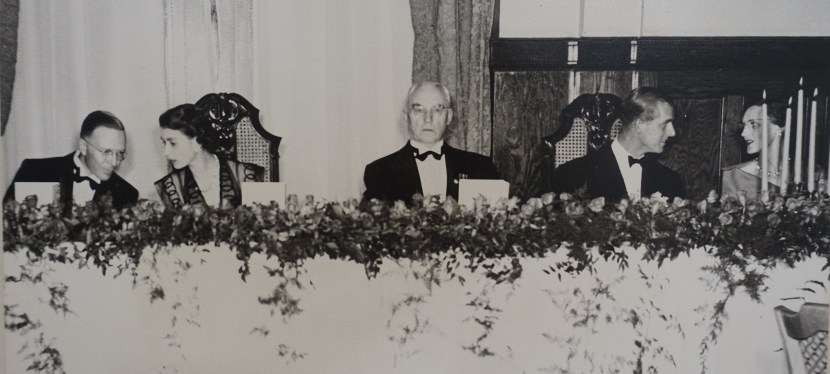
J.J. Bowlen, the Vice-Regal Cowboy of Alberta

Written by: Sara Bohuch, BA Archaeology (Simon Fraser University) , MSc Conservation Practice (Cardiff University)

The philosopher Cicero once said that memory is the treasury and guardian of all things. It is also a fleeting feature of the brain, so people have attempted to capture their memory in a physical format for as long as humans have existed.

If these physicalized memories are still considered a treasury, then the place where they are stored becomes less a place to stash random material and more of a bank. If you get enough memory kept in the same place, that bank can start to reflect and inform the identity of a people.

Read more

How to sell the Prairies: photography at the Glenbow Library and Archives

Editor’s note: The banner image above is courtesy of the Glenbow Library and Archives Collection, Libraries and Cultural Resources Digital Collections, University of Calgary

Written by: Sara Bohuch, BA Archaeology (Simon Fraser University) , MSc Conservation Practice (Cardiff University)

At the turn of the 20th century, the government of Canada continued to look for ways to convince people to move to the country and transform the land there into profitable resources. The government tried many different strategies to achieve this over the years, and some of the more successful tactics were old-fashioned advertising campaigns. Polished ads were produced that depicted Canada (and the prairies within it) as the best sort of fresh start, with bountiful potential and the opportunity to forge your own community.

However, for many prospective immigrants, Canada was not exactly the landscape as advertised. It was not a vast empty expanse rich with resources, as many of the campaigns described. It seemed that the numerous harsh realities of making a living on the prairies were quietly glossed over by the various advertisements.

So how do you sell the Prairies in particular, over other parts of Canada?

In the early 1800’s the propaganda campaign of the “Glorious Canadian West” was accompanied by artwork and slogans depicting bustling communities and vast farmland. During the latter half of the century, the invention of the camera upgraded the medium of the message, though the imagery stayed similar. The new technology offered a way to capture the “truth” of a place and was able to communicate that truth to an increasingly wider audience quickly.

One of the most well-known providers of such promotional material for the government was the Canadian Pacific Railway (CPR). The CPR began to use photography to document the Canadian landscape in the late 1880s and continued with its usage well into the 20th century. They used the images captured by their photographers to promote not only a certain image of the country, but also their own operations within Canada.

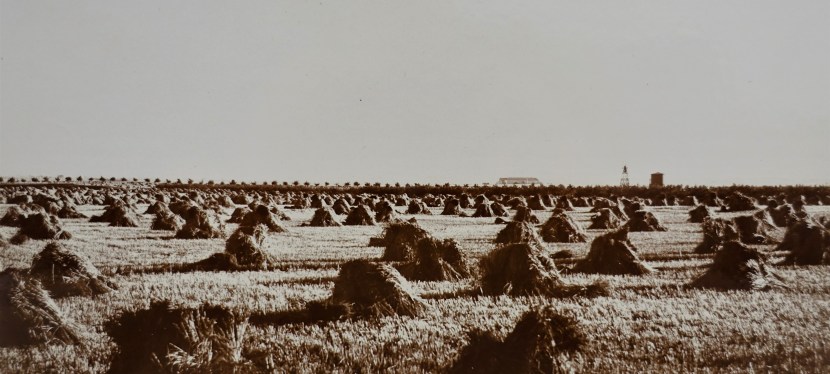
In the Glenbow’s Archives and Special Collections there is a series of these types of photographs, dating from the 1900s and documenting the landscape around the Albertan line. Even knowing the history and reason that these photos were taken in the first place, it is still undeniable that these early photographers were very good at what they did. The images that were captured showcased an Albertan landscape bursting with natural beauty and bountiful acres of farmland.

All images courtesy of the Glenbow Library and Archives Collection, Libraries and Cultural Resources Digital Collections, University of Calgary.

Click the link below to view the gallery.

Read more

Flight as entertainment: a brief history of barnstorming

Written by: Sara Bohuch, BA Archaeology (Simon Fraser University) , MSc Conservation Practice (Cardiff University)

In 1903, the New York Times predicted that it would take a million years for humanity to be able to fly. Two months after this opinion was published, the Wright Brothers successfully launched their homemade aircraft in North Carolina, beginning the rise of North America’s aviation age. The lesson to take from this is, of course, to never completely write off the human race’s capacity to discover, innovate and possess a deep desire to see their siblings launched off of things. 

Aviation, being a handy way of exploring wide open places, made its way north of the border into Canada swiftly after. The idea to use flying these machines to entertain the masses came about at almost at the same time.

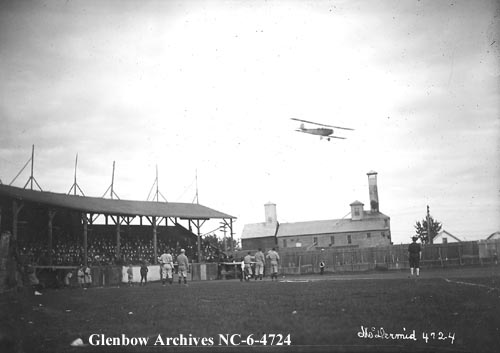
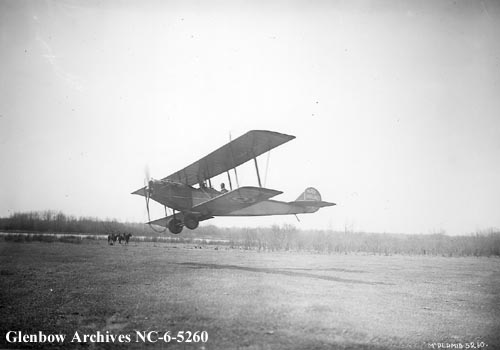
The term ‘barnstorming’ refers to a style of stunt flying where pilots would perform tricks in an airplane to the amazement of a crowd below. The style gained huge popularity after the First World War when many newly trained pilots came back to North America. This was before large-scale commercial aviation, and jobs in the aviation industry were few and far between. Performing to crowds in whatever airplane they could scrounge up was one of the only ways aviators could make money, and the crowds loved it. Not many had even seen an airplane let alone someone do aerial tricks in one. 

This curiosity about aircraft became key for drumming up business for a practicing barnstormer. The pilots would fly their aircraft low over a small rural town and, when they had gotten the attention of the people, would land in a nearby farmer’s field. After negotiating with that farmer to use their property as a runway, the barnstormer proceeded to offer airplane rides to interested townsfolk or offer them flight shows filled with stunts like the good old loop-de-loop. Once the show was done, it was off to the next town.  

Read more

A giant aircraft carrier made of ice? A giant aircraft carrier made of ice.

Written by: Sara Bohuch, BA Archaeology (Simon Fraser University) , MSc Conservation Practice (Cardiff University) 

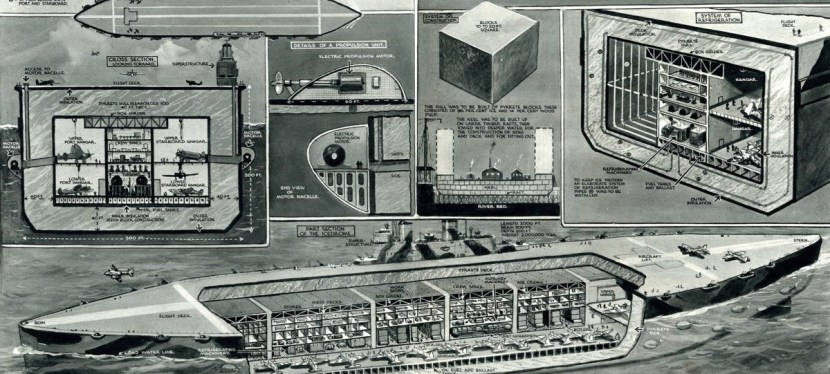
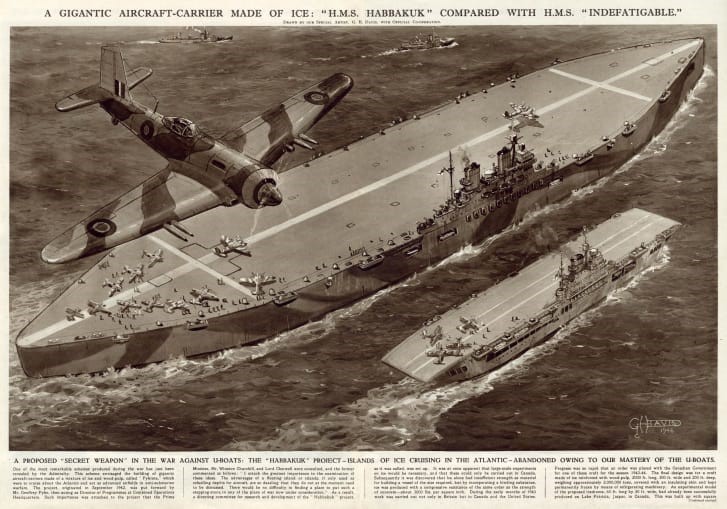
In terms of places rich with classified war time projects and military intrigue, Alberta is rarely the first spot that people think of. But history holds no bias in terms of where it takes place, and Alberta had its own part to play in the eccentric branch of the military arms race circa WW2. This was in part due to the plentiful excess of one of Canada’s most abundant and hated elements: ice. 

In 1943, the Chief of Combined Operations for the British War Office had a point to prove about ice. His name was Lord Mountbatten, and he sincerely believed that ice could be used to defeat the Nazi menace during WW2. To establish his argument, he brought two huge chunks of it into the 1943 Quebec Conference. The secret conference was host to the likes of Winston Churchill, Franklin D. Roosevelt and William Lyon Mackenzie King, and Mountbatten had to justify the validity of his ice-related project to the leaders and their staff.

In front of a skeptical crowd of WW2 brass, he set up two ice blocks right next to each other. The first block was pure ice, while the block next to it was a new manmade composite mixture of ice and wood pulp. He retreated to the other side of the room, removed his gun, and shot a bullet into the first ice block. It predictably shattered to pieces. Mountbatten then reloaded his gun, took aim at the second block, and fired. This time, the bullet could not penetrate the ice, instead ricocheting completely off the block, flying through the pant leg of a nearby admiral, and ending up in the wall. The new material remained remarkably intact.

Artist’s rendering of what would be Project Habbakuk. Source: cnn.com.
Read more