

Written by: Devon Owen Moar
Over the past year, I’ve been volunteering with the Labour & Industry curatorial team at the Royal Alberta Museum (RAM). What began as a project to help process recent architectural acquisitions—related to Wallbridge & Imrie and Doris Newland Tanner—has gradually expanded into something much broader. I’ve since been fortunate to assist with other newly acquired collections, each object offering its own intriguing story and mystery to unravel.
In particular, individual pieces have caught my attention not only for their craftsmanship but for the stories embedded in them. Each one—whether an architectural tool, scale model or illustration—becomes a small but meaningful window into Alberta’s working and community past.
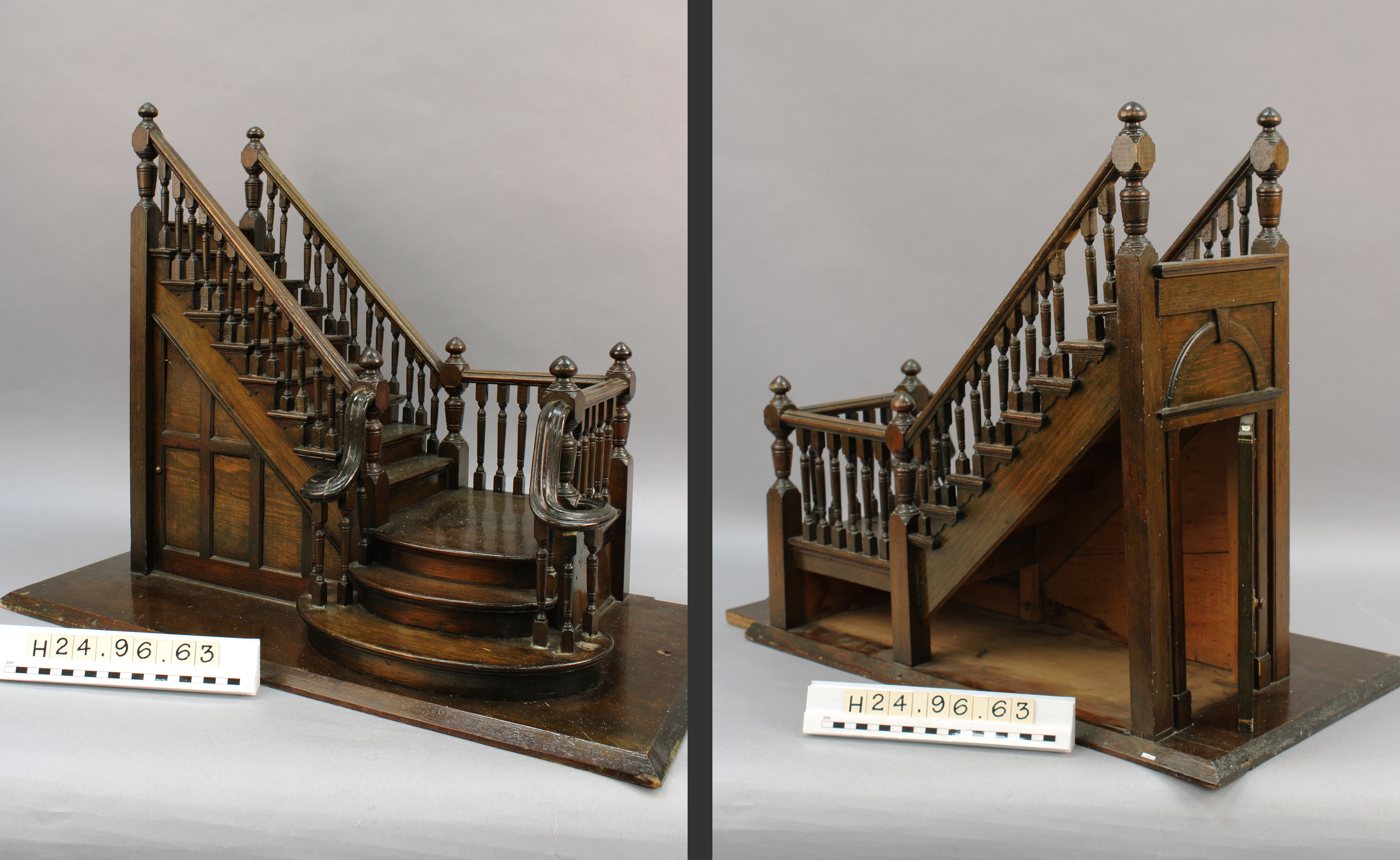
Among the recent acquisitions at the RAM was a particularly appealing object: a 100+ year old scale model of a staircase from the Town of Vegreville. The model was obtained by the RAM in 2024 after the Vegreville Regional Museum ultimately closed its doors.
Curators from the RAM’s history programs—including Labour & Industry, Daily Life & Leisure and Military & Government History—travelled to Vegreville to identify and help preserve objects of historical value within the RAM’s permanent collection. The staircase model was among those selected and is now part of the Labour & Industry collection.
This remarkable scale model is constructed primarily of wood and mounted on a plywood base. It was most likely built to a scale of 1″: 1′ (i.e., one inch equals one foot). Though small compared to its full-scale counterpart, it’s meticulously crafted—complete with turned balusters, a square landing and even a functioning door with tiny hinges and a wooden knob. The design reflects the restrained character of early twentieth-century domestic interiors, where craftsmanship and proportion met simple, elegant ornamentation. From the graceful curve of the lower steps and railing to the careful shaping of each newel post, every element has been thoughtfully made, likely by hand woodworking tools, and with the aid of early woodworking machines.
Despite being over a century old, the model has survived in remarkably good condition. A few balusters are missing and there are signs of minor repairs, but significantly, the overall integrity of the piece remains. The varnished surfaces retain their warmth, while the hidden undersides reveal the maker’s practical side—unfinished wood, tool marks, and the occasional nail or screw added probably long after its creation. Together, these details hint at a life of use and care, and a level of craftsmanship that continues to impress.
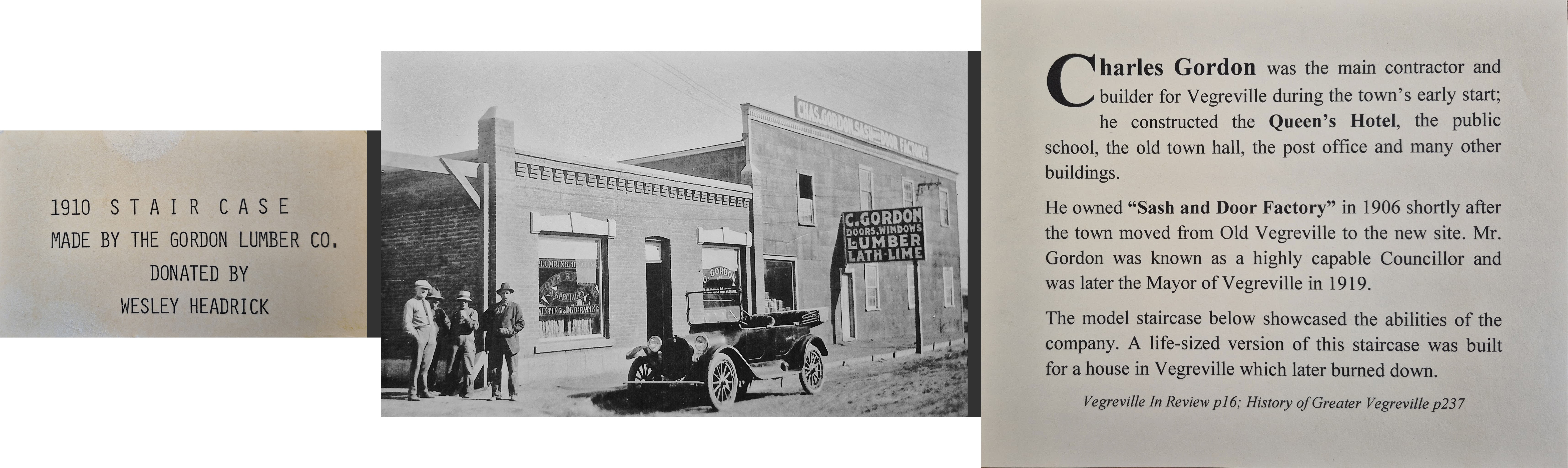
The miniature staircase came to the RAM with a few intriguing pieces from its former display at the Vegreville Museum. Together, they offered some initial information to help piece together the story behind it. A small display card identified the piece simply: “1910 Stair Case, Made by the Gordon Lumber Co., Donated by Wesley Headrick.”
Alongside it was a black-and-white photograph of the Gordon Sash & Door Factory itself, its bold signage prominently visible. The image captures not only the physical state and site of the factory, but also the industrious spirit and small-town ambition of early twentieth-century Vegreville.
The last item was a brief description providing more context about the factory and its owner, Charles Gordon, described as, “the main contractor and builder for Vegreville during the town’s early start.” Gordon was credited with constructing several of the town’s most notable early buildings and later served as Vegreville’s mayor for a number of years. The statement also noted that, “the model staircase below showcased the abilities of the company,” explaining that a full-scale version had once been built for a local home that was later lost to fire.
These modest but revealing remnants — a label, a photograph and a brief description — helped to answer some key early questions: Who made it? Where was it built? Who was the initial donor? They became invaluable clues in tracing the staircase’s provenance and the people behind it—Charles Gordon, his factory and the long-time employee who donated the model decades later, Wesley Headrick—all of whom helped shape Vegreville and its early built landscape.
Gordon’s Sash & Door Factory was established in 1907, at a time when Vegreville’s newly founded townsite was still finding its identity. The factory quickly became one of the community’s most important early industries.
Located prominently on a corner lot along First Avenue, it would eventually span the full block along First Street (between First Avenue and Railway Avenue). The site occupied an entire end of a town block close to the railway station. A 1916 fire insurance plan reveals just how developed the property had become: the complex included the main sash and door works, an attached office, a dry kiln and storage areas for doors and windows, dressed lumber, coal and shavings. According to the plan, Gordon’s operation was powered by electricity and heated by steam.

From its earliest days, the Sash & Door Factory advertised itself as a local hub for craftsmanship and construction. A July 10, 1907 advertisement in the Vegreville Observer proudly announced the business’s opening.
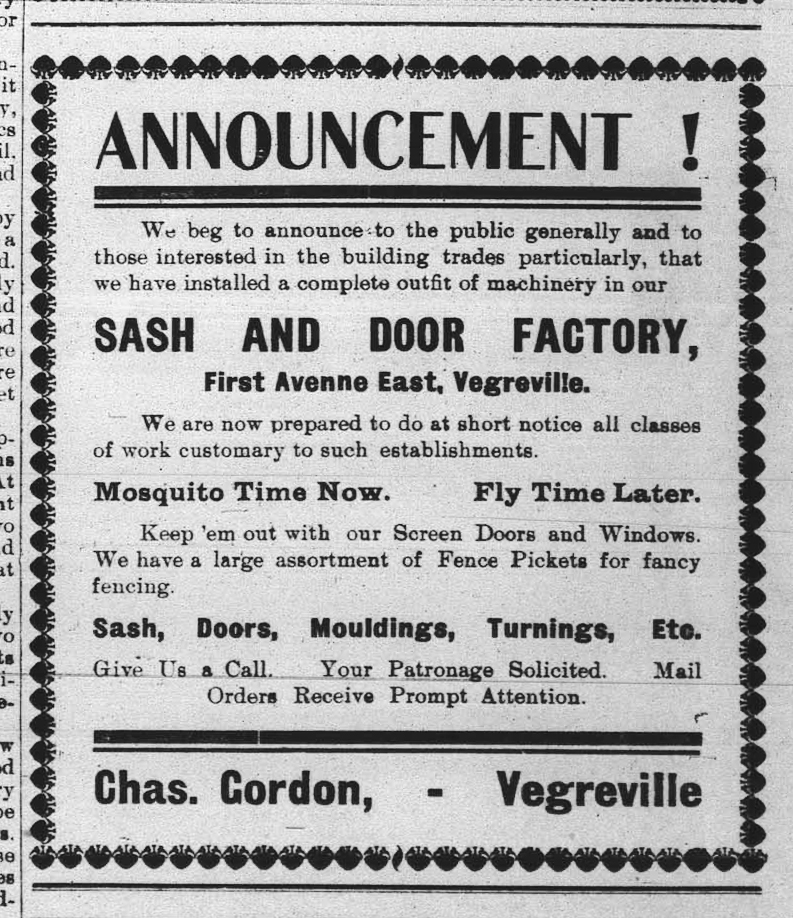
This early ad marks the beginning of what would become one of Vegreville’s most enduring enterprises. Within just a few years, the Vegreville Observer described Gordon’s factory as, “Vegreville’s most imposing industry.” This 1910 feature praised Gordon’s, “close application to business” and stated that his, “knowledge of what people want and the knowing how to provide for wants are the keys to success,” noting that his products could compete with those of long-established firms in Edmonton. The same article detailed the remarkable pace of growth—from a modest 3-horsepower gasoline engine in 1907 to a powerful 90-horsepower steam engine by 1910—and the installation of a new dry kiln and fire suppression system.
By 1912, the Vegreville Observer reported that the factory was running both day and night shifts to meet demand. “Orders are coming in so rapidly,” it noted, that the factory was, “one of the busiest spots in Vegreville at the present time and one which will likely continue to be.” The business regularly employed between 10 and 15 men, providing steady local employment by producing millwork and supplying building materials for Vegreville and surrounding communities along the railway lines.
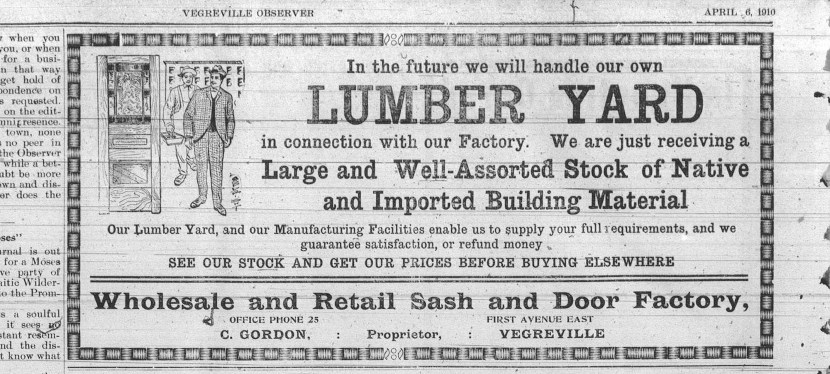
Over time, Gordon expanded his enterprise beyond millwork to include a lumber yard and other building materials (e.g., lath, shingles, lime, wood fibre, cement, brick, glass, paper, roofing and coal). From its headquarters in Vegreville, the company established additional lumber yards in Chipman, Mundare, Ranfurly, Willingdon and Two Hills between 1907 and 1929. In the 1930s, Gordon sold his operations to the Imperial Lumber Company of Edmonton, which continued to occupy the same site in Vegreville for decades.
The factory building itself survived into the mid-20th century. When it was finally demolished in the 1960s to make way for a new Imperial Lumber Co. structure, its removal marked the end of an era. This place had stood as a symbol of local ingenuity and enterprise—an enduring reminder of the town’s early builders.

Born in Middlesex County, Ontario, in 1877, Charles Gordon learned the carpenter’s trade as a young man before heading west in 1898, working across Manitoba and North Dakota along the way. He arrived in Alberta in the early 1900s, first settling briefly in Edmonton and Fort Saskatchewan before moving to Vegreville in 1905—the same year the Canadian Northern Railway reached the town. A skilled builder and enterprising craftsman, Gordon quickly became one of the community’s most prominent contractors.
Soon after his arrival, Gordon founded the Sash & Door Factory, which grew into one of Vegreville’s leading industries and the cornerstone of his expanding business network. Beyond his business ventures, Gordon was a well-known public figure—serving 15 years on Vegreville’s town council, four as mayor, and also served as president of the Union of Alberta Municipalities. He is remembered as a “merry scrapper” in local politics and a driving force in community development. Gordon embodied the optimism and industrious spirit of early Vegreville. He passed away in 1936, leaving a legacy seemingly built as much in lumber, industry and enterprise as in civic service.
Wesley Andrew Headrick was born in Renfrew County, Ontario, on August 18, 1891. Around 20 years later, in 1911, he joined the Charles Gordon Company, beginning a remarkable lifelong association with the same business that would span more than half a century. Headrick became one of Vegreville’s longest-serving figures in the lumber industry and by the 1960s, when the old Gordon Sash & Door Factory was demolished to make way for a new Imperial Lumber building, he was still managing the Vegreville branch—his name seemingly inseparable from the site’s long history.
During the First World War, Headrick served overseas with the 61st Battery, 15th Brigade, Canadian Field Artillery. His military records list his civilian occupation simply as “lumber merchant,” a detail that quietly affirms how deeply tied his identity was to the industry he devoted his life to.
Outside of work, Headrick was active in community life as well. He served as president of the Chamber of Commerce and, like many of Vegreville’s early leaders, was an avid curler. A 1912 Vegreville Observer account records him playing on a local team skipped by Charles “Chas” Gordon—perhaps an early snapshot of their friendship beyond business. In many ways, Headrick personified the lasting thread between Vegreville’s pioneering builders and the community that grew from their efforts.
Among the small discoveries that bring history to life, few have been as satisfying as finding a single sentence in a century-old newspaper that ties so much together. Again in the Vegreville Observer on October 5, 1910, a brief note described one of the standout displays at the local, “Eighth Annual Fair,” organized by the Vermilion Valley & Beaver Lake Agricultural Society:
C. Gordon had a handsome showing of the fine work which is turned out from his factory. A miniature stair case, complete, was particularly admired by everyone.
Whether or not the staircase model preserved today at the RAM is the one mentioned in the article, the connection feels almost certain and, more importantly, it illustrates the kind of craftsmanship and community pride that defined Chas Gordon’s enterprise. These kinds of fairs and exhibitions were important social gatherings; they were showcases of progress, industry and local businesses and ingenuity—an affirmation of what small towns like Vegreville were capable of building, quite literally in this case, with their own hands.

That the model survived at all—kept, perhaps cherished, and ultimately donated to the Vegreville Museum by Wesley Headrick is truly remarkable. Why Headrick held onto it remains an open question: was it a keepsake from his early years with Gordon’s firm, a symbol of shared accomplishment or simply an object too finely made to discard? Whatever the reason, its survival speaks to an intrinsic sense of value. Objects like this staircase remind us how easily things like everyday craftsmanship can slip from memory, and how vital small-town museums, and now the RAM, are in safeguarding those traces. Through careful research and preservation, these connections re-emerge, transforming a simple miniature staircase into a story of place, persistence and the people who built Vegreville’s community from the ground up.
Sources
Blue, John. Alberta, Past and Present : Historical and Biographical. With Snell Library Northeastern University, Chicago, Ill. : Pioneer Historical, 1924. Internet Archive, http://archive.org/details/albertapastprese03blue.
Library and Archives Canada. HEADRICK, WESLEY ANDREW (3 Digital Object(s)), Genealogy / Military / First World War Personnel Records, RG 150, Accession 1992-93/166, Box 4206 – 27, 453382, 25 Nov. 2016, https://recherche-collection-search.bac-lac.gc.ca/eng/home/record?app=pffww&idnumber=453382&ecopy=B4206-S027.
— — —. Vegreville, Alta., on the Canadian Pacific Railway, 72 miles east of Edmonton, second survey 8th September 1916, Charles E. Goad Company fonds / e008445311, https://recherche-collection-search.bac-lac.gc.ca/eng/home/record?idnumber=3806015app=fonandcol&ecopy=e008445311-v8&.
“Eighth Annual Fair: Vermilion Valley & Beaver Lake Agricultural Society Scores Big Success Last Friday—Excellent Showing in All Departments.” Vegreville Observer [Vegreville, AB.], Volume V, No. 27, 5 Oct. 1910, p. 1. University of Calgary, Calgary, Alberta. Canada., Libraries and Cultural Resources Digital Collections, Early Alberta Newspapers Collection, (CU11388061), from microfilm reel 303, Image 303 (1910-10-05), https://digitalcollections.ucalgary.ca/asset-management/2R3BF17V53DN.
“Gordon’s Sash and Door Factory.” Vegreville Observer [Vegreville, AB.], Volume V, No. 29, 19 Oct. 1910, p. 1. University of Calgary, Calgary, Alberta. Canada., Libraries and Cultural Resources Digital Collections, Early Alberta Newspapers Collection, (CU12487927), from microfilm reel 319, Image 319 (1910-10-19), https://digitalcollections.ucalgary.ca/asset-management/2R3BF1O0RFYQO.
Hardin, Samuel H., editor. History of Greater Vegreville. Samuel H. Hardin, 1968.
Martynowych, Orest T., et al. The Ukrainian Bloc Settlement in East Central Alberta, 1890-1930 : A History, Including Bibliography with Annotations. With University of Alberta Libraries, [Edmonton] : Alberta Culture, 1985. Internet Archive, http://archive.org/details/ukrainianblocset00mart.
Medicine Hat Genealogical Society. “Alberta South & Central 1908-1949.” Phonebook Records, Alberta South & Central 1908-1949, https://mhdgs.ca/historical-records/phone-books/alberta-south-central-1908-1949/.
Pinon, Michelle. “Town of Vegreville Seeking Assistance to Dispose of Museum Artifacts.” The News Advertiser [Vegreville, AB.], Volume 77, Issue 7, 14 Feb. 2024, p. 3. https://issuu.com/thenewsadvertiser/docs/vna_february_14_2024_-_web/s/44076758.
— — —. “Vegreville Regional Museum Society Turns Assets Over to the Town.” The News Advertiser [Vegreville, AB.], Volume 73, Issue 36, 2 Sept. 2020, p. 15. https://issuu.com/thenewsadvertiser/docs/vna_september_02__2020_-_web/s/10943618.
“Ready For A Freeze-Up: Curlers Select Rinks For the Season, and Now Await The Ice.” Vegreville Observer [Vegreville, AB.], Volume VII, No. 28, 23 Oct. 1912, p. 1. University of Calgary, Calgary, Alberta. Canada., Libraries and Cultural Resources Digital Collections, Early Alberta Newspapers Collection, (CU11533354), from microfilm reel 1161, Image 1161 (1912-10-23), https://digitalcollections.ucalgary.ca/asset-management/2R3BF1J9UK_U.
Royal Alberta Museum (RAM). Vegreville Museum Collection, H24.96. Edmonton, Alberta, Canada. Specifically H24.96.63 (Miniature Staircase) and this collection’s (H24.96) Accession File Folder.
“Sash and Door Factory Busy: Running Day and Night Shift at the Factory. Busiest Season on Record.” Vegreville Observer [Vegreville, AB.], Volume VII, No. 32, 20 Nov. 1912, p. 1. University of Calgary, Calgary, Alberta. Canada., Libraries and Cultural Resources Digital Collections, Early Alberta Newspapers Collection, (CU11396076), from microfilm reel 1193, Image 1193 (1912-11-20), https://digitalcollections.ucalgary.ca/asset-management/2R3BF17NIR0L.
University of Calgary. Vegreville Observer Collection, Libraries and Cultural Resources Digital Collections, Courtesy of Early Alberta Newspapers Collection; includes 6 groups: Vegreville Observer “1906-03-19 – 1909-12-22”, “1910-01-05 – 1913-11-26”, “1913-12-03 – 1917-07-18”, “1917-07-25 – 1920-12-29”, “1921-01-05 – 1924-07-30”, and “1924-08-06 – 1928-02-29”; https://digitalcollections.ucalgary.ca/Package/2R3BF1SS5EQHO.
Vegreville & District Historical Society. Vegreville in Review: History of Vegreville and Surrounding Area, 1880-1980. Vegreville & District Historical Society, 1980.
Vegreville, Alta Board of Trade (author). For You!: A Few Facts about the Vegreville District in Central Alberta. Board of Trade (Vegreville, Alta.), 1910. University of Alberta Library, Edmonton, Alberta, Canada, Peel’s Prairie Provinces – Books & Other Print Materials, Internet Archive, http://archive.org/details/P003505.
— — —. The Vegreville District, Central Alberta, Canada: Handbook of Reference. [Vegreville Observer] ([Vegreville, Alta.]), 1912. University of Alberta Library, Edmonton, Alberta, Canada, Peel’s Prairie Provinces – Books & Other Print Materials, Internet Archive, http://archive.org/details/P003826.
“Who’s Who in Vegreville and Why, Charles Gordon.” Vegreville Observer [Vegreville, AB.], Volume VI, No. 49, 27 Mar. 1912, p. 7. University of Calgary, Calgary, Alberta. Canada., Libraries and Cultural Resources Digital Collections, Early Alberta Newspapers Collection, (CU12488252), from microfilm reel 920, Image 920 (1912-03-27), https://digitalcollections.ucalgary.ca/asset-management/2R3BF1O0RPOU9.
 RETROactive
Great story about the miniature staircase and the Sash and Door Factory. Loved it!
Thank you! John Chalmers Edmonton