Written by: Colby Parkkila, Senior Historical Interpreter, Rutherford House Provincial Historic Site
A bibliophile is described as, “a person who collects or has a great love of books.” Alexander Cameron Rutherford, the first Premier of Alberta (1905 – 1910) and founder of the University of Alberta, certainly matches this description. His personal collection comprised more than 4,000 individual titles and was regarded as one of the “finest Canadiana collections in western Canada.” In addition to his expansive collection—which found its way into nearly every corner of the Rutherford family home, much to the chagrin of his wife Mattie—Rutherford’s love of literature was illustrated through his support of other literary initiatives and organizations, including the Canadian Authors Association (CAA).
Founded in Montreal on March 14, 1921, the CAA was Canada’s seminal writing association for authors and writers. Established with the goal of lobbying for authors’ rights and copyright protections, the CAA’s focus quickly broadened to include initiatives such as encouraging Canadians to read more Canadian literature via Canadian Book Week and providing financial assistance to emerging authors through the Canadian Writers’ Foundation. Among its early membership, the CAA counted many leading Canadian writers and literary advocates, including John Murray Gibbon—the organization’s first president—Emily Murphy, Ralph Connor and Bernard Keble (B.K.) Sandwell.
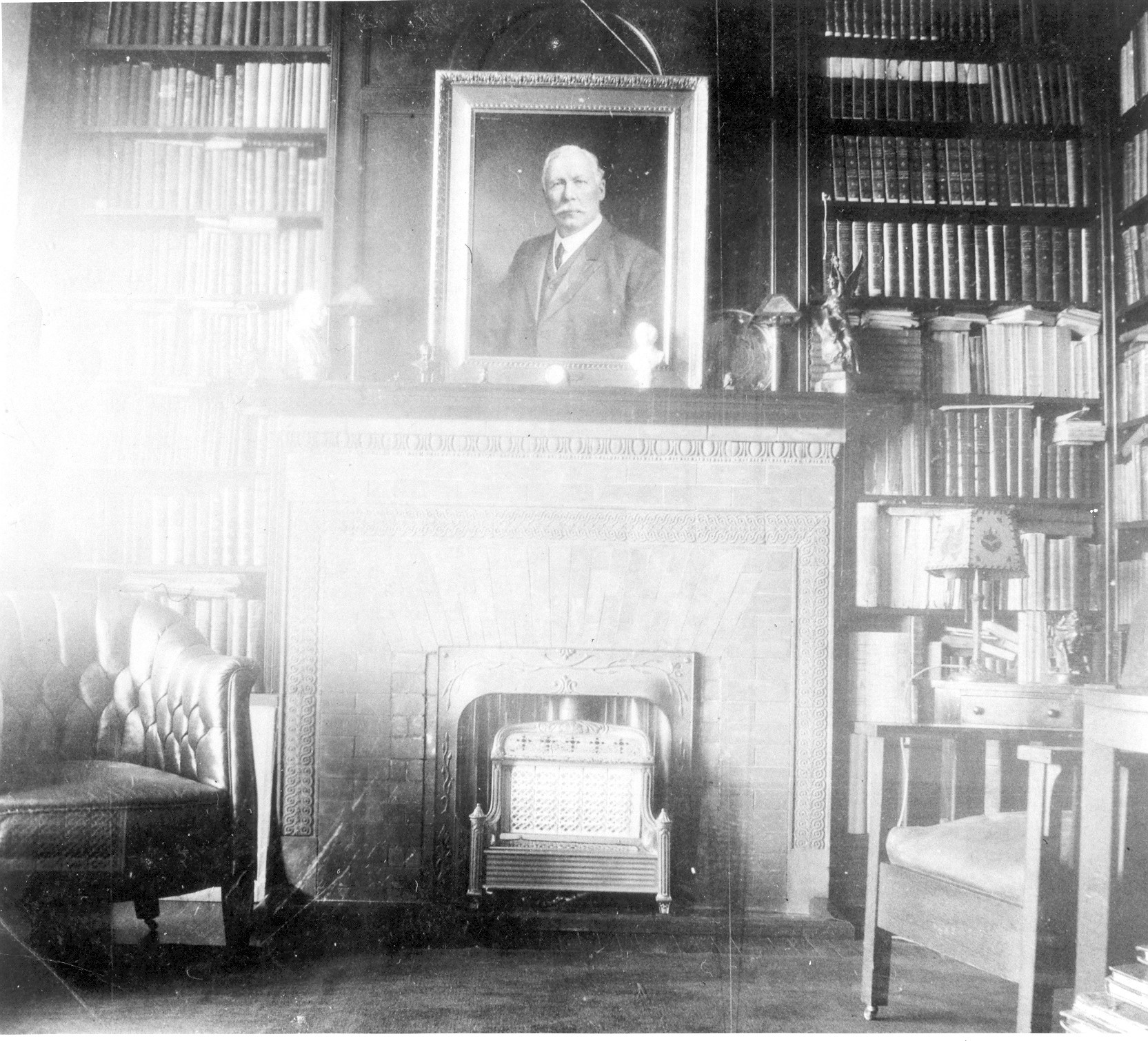
Library of Rutherford House, c.1920s. Source: Rutherford House Provincial Historic Site
The CAA was initially composed of a national body and 10 smaller branches, including one in Edmonton. Inaugurated on April 26, 1921, the Edmonton branch was established during an elaborate banquet at the Hotel Macdonald. Among those in attendance were prominent local authors and politicians, such as Nellie McClung, Lieutenant Governor Dr. R. G. Brett, Frank Oliver, Alberta Premier Charles Stewart and Dr. Henry Marshall Tory, President of the University of Alberta. Alexander Rutherford, although not in attendance on the night of the branch’s inauguration, joined the branch shortly thereafter, later obtaining official membership with the CAA as an Associate Member in January 1922.
Intensely active in the branch’s functions and in supporting its literary endeavours, Rutherford hosted numerous meetings and special events at Rutherford House, including a talk on “Collecting as a Hobby.” In recognition of his service to the branch—and likely his work as Premier in fostering the development of educational and literary institutions in Alberta—he was elected as Honourary President of the Edmonton branch in April of 1925, a position he held until his death in 1941.
The Edmonton branch was a productive organization that focused on increasing public appreciation for, and engagement with, the literary arts through hosting talks by Canadian authors and visiting dignitaries, organizing essay competitions for students and raising money for charitable causes. During the branch’s April 29, 1930 meeting the branch decided to embark on a new venture – the creation of a “chapbook” of poetry from a competition among amateur Alberta poets. The inspiration for the chapbook was the perceived lack of interest and appreciation of the “verse-makers craft … in Alberta.” The success of a similar chapbook published annually by the Montreal branch of the CAA since 1925—and the competition’s advertisement in Edmonton area newspapers in February 1930—was undoubtedly another motivating factor. Nevertheless, the Edmonton branch hoped their competition would, “inspire Canadian writers to make use of the vast wealth of western Canadian material which lies before them,” and ensure that Alberta did not remain “songless.”
A committee composed of Rutherford, Reverend W. E. Edmonds, Harold Russell Leaver and Agnes (née MacDougall) Acheson was formed at the April 29, 1930 Edmonton branch meeting to oversee the chapbook’s publication. Although records of the committee’s work are unavailable, it is clear that they undertook this task with vigor, as on September 25, 1930—following the branch’s inaugural meeting of the 1930-1931 season—the competition was launched to the public in Alberta newspapers.
To ensure a fair competition, strict rules were implemented for submissions:
Poems must not exceed forty lines; only three may be sent from each competitor, from which only one will be published; manuscript must be signed by a nom de plume, the real name to be inclosed in a sealed envelope and attached to the manuscript, which must be typed; …Poems already published in book form not admitted to contest.
Professional authors and poets were barred from entering to encourage a broader engagement with, and appreciation for, the literary arts among the general Albertan public. As an additional incentive to prospective poets, modest cash prizes were promised: $10 for first prize, $5 for second and $3 for third – roughly equivalent to $180, $90 and $55 in 2026 dollars.
Submissions for the inaugural Alberta Poetry Year Book were accepted from late September until November 1 to allow sufficient time for submissions, selection, editing, publication and, most importantly, distribution in time for Canadian Book Week. During the submission window, 295 poems from over 80 individuals were received. Of these poems, 30 were selected for publication by the competition’s judges, handpicked by the chapbook committee: Evelyn Gowan Murphy, an accomplished author; Donald Ewing Cameron, the first librarian of the University of Alberta; and Mrs. Edna (née Brown) Baker, the wife of Alberta’s education minister Perren Baker (1921-1935). Ida Alberta (née Srigley) Scouten, the branch’s secretary, was selected to edit the chapbook, while Murphy penned the introduction commenting on the quality of the poems submitted. A preface written by Magistrate Emily Murphy also accompanied the chapbook.
On December 8, 1930, the Alberta Poetry Year Book debuted to the Alberta public—just in time for Canadian Book Week and Christmas. Retailing for 30 cents (approximately $5.50 in 2026 dollars), the Alberta Poetry Year Book was well received by the Albertan public. Over 200 copies of the chapbook were sold before Christmas despite a limited distribution network.
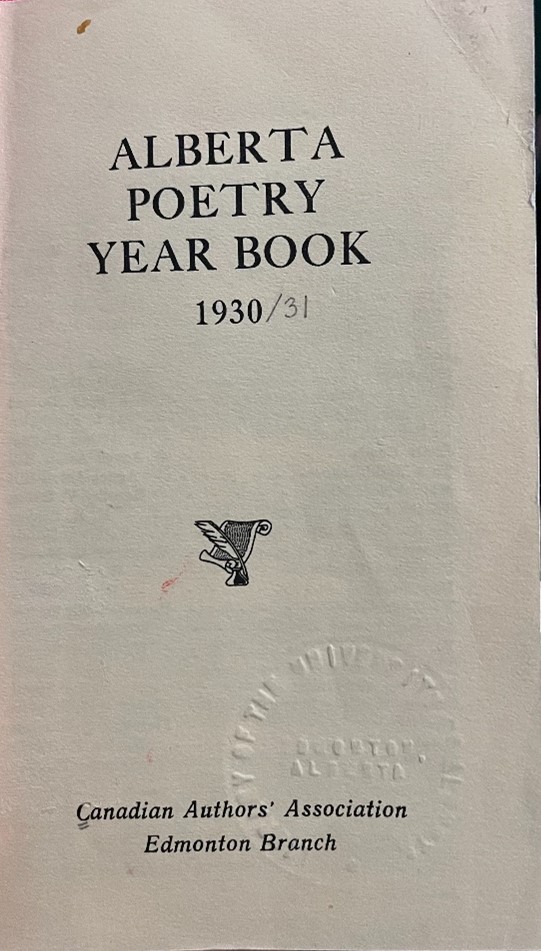
Cover for Inaugural Alberta Poetry Year Book. Source: Rutherford House Provincial Historic Site.
From a literary standpoint, the Alberta Poetry Year Book was viewed as an invaluable contribution to the development of Alberta’s literary voice and heritage. The Calgary Albertan, for example, heralded its debut as, “one of the best cultural movements initiated in the province.” Emily Murphy similarly remarked on the chapbook’s importance, noting that the submission of many works of “high merit” illustrated the public’s desire to contribute to the development of Alberta’s literary voice, necessitating the continuance of the competition and for the Edmonton branch to, “definitely continue in the rôle (sic) of foster father to the versifiers.”In her comments from the judging panel, Emily Gowan Murphy spoke favourably of Alberta’s poetic fortunes, although she noted that there was still much room for improvement, as some submissions were “frankly doggerel.”
The strong public reception inspired the continuation of the Alberta Poetry Year Book. Rutherford and the chapbook committee continued their work diligently throughout the 1930s, making several notable changes to subsequent editions. For instance, a Junior Poetry contest for students attending public or high schools in Edmonton or Calgary and a Short Story competition for amateur Alberta authors were introduced in 1931. Notably, beginning in 1933, submissions were accepted from across the Prairies and British Columbia, significantly broadening the scope of who could apply. In 1941, the contest was expanded further to permit submissions from, “all residents of the Dominion [of Canada].” Despite the democratization of access to the contest, the Junior Poetry and Short Story contests remained open to Alberta residents only.
While the introduction of new contests and acceptance of submissions from outside of Alberta were driven by a desire to encourage an even broader engagement with the literary arts, another significant change was not the result of a decision by the chapbook committee, but of public outcry. In 1937, feedback from judges was removed from the Alberta Poetry Year Book following the profoundly negative comments of judge Annie Osborn in 1936 on the quality of submissions. Osborn, an Australian journalist and author living in Edmonton, was harshly critical of the quality of poems submitted, lamenting, “the toil of reading much crude material” and sourly noted that, in her judgment, many, “[literary] flaws, more or less serious” were present in most submissions, demonstrating, “palpably evidence of careless work.” Osborn’s comments provoked a lively public firestorm that raged in the “Letter Box” column of the Edmonton Journal for months after the release of the 1936 Alberta Poetry Year Book, ultimately leading to the decision to remove feedback from subsequent editions. Judges’ commentary was reinstated in 1941, although the feedback by judge A. H. Sutherland was decidedly more measured and positive than Osborn’s.
Despite the controversy surrounding Osborn’s incendiary comments, the Alberta Poetry Year Book continued to enjoy success, with an average number of submissions by individual authors exceeding 200 by 1935, and rising to over 350 by 1941. This, as Edmonton branch President Frank Gilbert Roe noted, was “heartening” and evidence of a deep poetic interest amongst the public, as “while Alberta teems with people who desire to make her laws,” there were also, “many who would strive more nobly to make her ballads.”
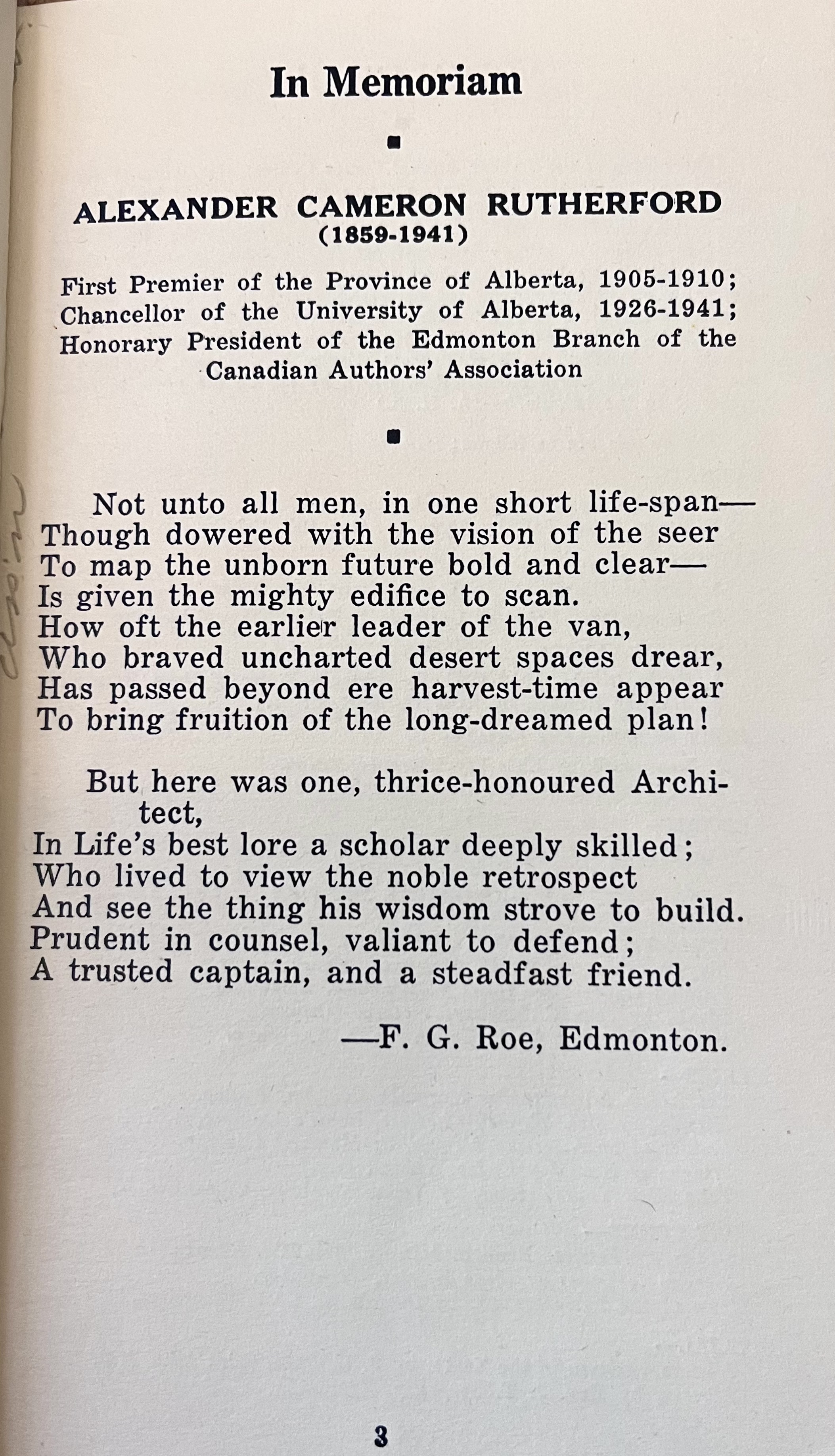
Although Rutherford did not pen any “ballads” for the Alberta Poetry Year Book, he remained intimately involved in the chapbook’s production and served as Honourary President of the Edmonton branch until his passing. In recognition of his contributions to the Alberta Poetry Year Book, his role championing the Edmonton branch of the CAA, and his broader impact on Alberta and its education system, the 1941 edition of the chapbook was dedicated in Rutherford’s honour. An untitled poem about Rutherford’s life, penned by branch President Frank Roe, opened the chapbook. The poem, deeply personal in nature, comments on Rutherford’s life, including his work as Premier, the founding of the University of Alberta and his personality:
Memorial to Alexander Cameron Rutherford in Edmonton Branch of the Canadian Authors Association, Alberta Poetry Year Book 1941-1942 (Edmonton: The Institute Press Ltd., 1941), 3. Source: Rutherford House Provincial Historic Site.
The Edmonton branch organized the Alberta Poetry Year Book competition annually for a total of 60 years. Ultimately, declining submissions and dwindling membership contributed to its cancellation in 1990. To celebrate and memorialize the Alberta Poetry Year Book, an anthology entitled Sixty Singing Years: An Anthology of Canadian Verse Chosen from Selections First Published in the Sixty Editions of the Alberta Poetry Yearbook, comprising “the best” poems from the chapbook, was published in 1990, serving as an apt epilogue to an immense literary endeavour.
Although the Alberta Poetry Year Book ceased publication in 1990, it certainly lived up to the Edmonton branch’s lofty goal that it would, “inspire Canadian writers to make use of the vast wealth of western Canadian material which lies before them.” Thousands of new poems, many about Alberta, were created as a direct result of the venture. Beyond the sheer number of poems produced, the chapbook also served to launch and advance the careers of numerous individuals, including Irma Clow Raver, Agnes Aston Hill, Bertha Miller Alexander and, most notably, journalist Lotta (Lotie) Caldwell Dempsey—an acclaimed reporter who interviewed many influential figures including singer Bing Crosby, actor George Murphy and Nina Kukharchuk, the wife of then Soviet leader Nikita Khruschev.
While the Alberta Poetry Year Book is no longer in publication, its impact is lasting. Over its 60 year run, more than 10,000 poems were submitted for consideration and countless amateur poets bravely entered the literary field. As we celebrate and reflect on National Poetry Month this April, perhaps a revival of this important competition may even be considered for the future. Indeed, although the Alberta Poetry Year Book is no longer in publication, the Alberta Writer’s Guild (founded in 1980) and other organizations continue to support Albertan authors and poets through literary grants and prizes, such as the Stephan G. Stephansson Award for Poetry. For the time being, then, we can rest assured that Alberta has not remained “songless.”
Sources
Calgary Albertan
Edmonton Branch of the Canadian Authors’ Association. Alberta Poetry Year Book 1930-1931. Edmonton, AB: The Institute Press Ltd., 1930.
—. Alberta Poetry Year Book 1935-1936. Edmonton, AB: The Institute Press Ltd., 1935.
—. Alberta Poetry Year Book 1936-1937. Edmonton, AB: The Institute Press Ltd., 1936.
—. Alberta Poetry Year Book 1941-1942. Edmonton: The Institute Press Ltd., 1941.
Edmonton Bulletin. Various issues.
Edmonton Journal. Various issues.
No Author. “New Members of the C.A.A.” The Canadian Bookman 4, no. 5 (1922): 146.
The Calgary Daily Herald.
Babcock, Douglas R. Alexander Cameron Rutherford: A Gentleman of Strathcona. Calgary: University of Calgary Press, 1989.
Fisher, Carolyn Davis. Lotta Dempsey: The Lady Was a Star. Toronto: Beltsen Publishing, 1995.
Melnyk, George. The Literary History of Alberta: From Writing-on-Stone to World War Two, Volume 1. Edmonton, Alberta: University of Alberta Press, 1998.
My Cousin Ric McWilliam-1958-1964- University Alberta- DU House at Rutherford House—-
Times were different and things were different—-Ric’s taste in music was trumpeter Henry Mancini (Baby Elephant Walk),Al Hirt’s trumpet declaring Mardi Gras is open and Bert Kamphfert’s (Wonderland by Night et al.) and of course Mr. Acker Bilk on that clarinet (Stranger on the Shore). Besides great music Ric was observed assisting Colette La France on more than one occasion with her Grade 11 Math problems —Ric was a good teacher in addition to being very understanding. I have often thought Ric would have made an excellent philosopher- wide range of topics and Ric addressed all matters succinctly and with eloquent reasoning.
That Delta Upsilon Fraternity House ( That old Rutherford house (mansion) was a classic structure and the porch had 4 large white columns to make an impressive entrance. However during Christmas tide 1962 a rival fraternity painted red circular stripes down these columns giving it the appearance of having 4 Huge Candy Canes at its entrance. Once inside the House—it was a large one—in the basement was a pop vending machine but the contents within was Calgary and Lethbridge beer—this fridge came in handy when supplies ran low at home or an impromptu get together was transpiring at the La France residence—after hours need for addition fortification was never a threat the year Ric lived with us—great times—each and every day !
Ric was quite active in the social world and as for that adversarial fraternity who painted Rutherford’s white pillars to appear as Candy canes—Big ones ! . Revenge was called for and to this day I can not confess openly who did it but I somehow sense it was –“you know who” This fraternity had supposedly had a BIG Saturday Night Social Event and it was recorded in the Edmonton Journal under the Social Column —this fraternity’s entertainment was provided by Hilda Barron—-this caused a real raucous among the elite at University of Alberta—the Dean and others occupying the Governor seats —and they were not amused because —- Hilda —well— she was a well known “lady of the evening” and this Edmonton Journal feature in the Society column did not rest well with the University establishment –one bit. Likewise the adversary fraternity later claimed they had had NO such event—the entire story was Wrong—my oh my—that fake news again—did it begin here–honestly?
“It’s not the house that matters but the people who live in that house-“ ==================== John La France




Dear Jared:
Rutherford House circa 1960 was the Delta Upsilon Fraternity and as a lad of 11 sure thouht tie interior was a marvellous house and had character.
John La France ________________________________
My Cousin Ric McWilliam-1958-1964- University Alberta- DU House at Rutherford House—-
Times were different and things were different—-Ric’s taste in music was trumpeter Henry Mancini (Baby Elephant Walk),Al Hirt’s trumpet declaring Mardi Gras is open and Bert Kamphfert’s (Wonderland by Night et al.) and of course Mr. Acker Bilk on that clarinet (Stranger on the Shore). Besides great music Ric was observed assisting Colette La France on more than one occasion with her Grade 11 Math problems —Ric was a good teacher in addition to being very understanding. I have often thought Ric would have made an excellent philosopher- wide range of topics and Ric addressed all matters succinctly and with eloquent reasoning.
That Delta Upsilon Fraternity House ( That old Rutherford house (mansion) was a classic structure and the porch had 4 large white columns to make an impressive entrance. However during Christmas tide 1962 a rival fraternity painted red circular stripes down these columns giving it the appearance of having 4 Huge Candy Canes at its entrance. Once inside the House—it was a large one—in the basement was a pop vending machine but the contents within was Calgary and Lethbridge beer—this fridge came in handy when supplies ran low at home or an impromptu get together was transpiring at the La France residence—after hours need for addition fortification was never a threat the year Ric lived with us—great times—each and every day !
Ric was quite active in the social world and as for that adversarial fraternity who painted Rutherford’s white pillars to appear as Candy canes—Big ones ! . Revenge was called for and to this day I can not confess openly who did it but I somehow sense it was –“you know who” This fraternity had supposedly had a BIG Saturday Night Social Event and it was recorded in the Edmonton Journal under the Social Column —this fraternity’s entertainment was provided by Hilda Barron—-this caused a real raucous among the elite at University of Alberta—the Dean and others occupying the Governor seats —and they were not amused because —- Hilda —well— she was a well known “lady of the evening” and this Edmonton Journal feature in the Society column did not rest well with the University establishment –one bit. Likewise the adversary fraternity later claimed they had had NO such event—the entire story was Wrong—my oh my—that fake news again—did it begin here–honestly?
“It’s not the house that matters but the people who live in that house-“ ==================== John La France