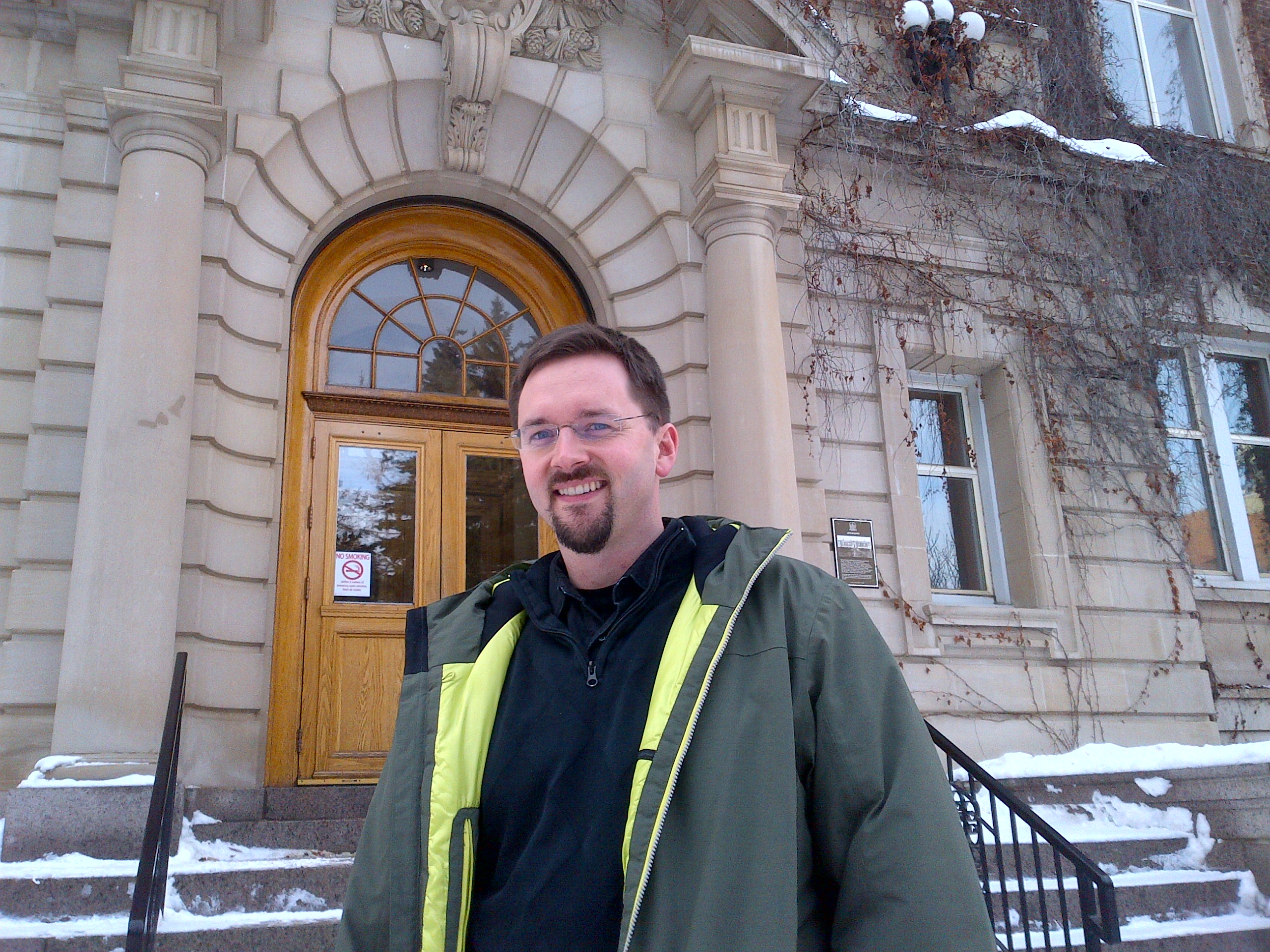
Kayla Jonas Galvin is deeply involved in creating social media content. She tweets at @jonaskayla and has her own blog Adventures in Heritage. Kayla works as the Heritage Operations Manager at Archaeological Research Associates where she runs the Twitter (@araheritage), Pintrest (ARAHeritage) and LinkedIn Accounts. She sits on the board of the Architectural Conservancy of Ontario, which focus on heritage education and advocacy in Ontario. There she is the social media manager for their Facebook and Twitter (@arconserve) accounts and Editor of their ACORN magazine. Her previous employment at the Heritage Resources Centre at the University of Waterloo involved managing their social media and communication, as well as developing Building Stories, a crowd-sourced survey of historic places across Canada.
Kayla will be speaking about how social media can assist in the conservation of local historic sites. Kayla will explain the power of social media to conserve local heritage places and how you can tap into it. She will give a brief introduction to the social media sites of Facebook and Twitter as well as introduce Building Stories, a crowd-sourcing site. Drawing on her experience managing multiple platforms for businesses and not-for- profit organizations she will share practical lessons on how to use each effectively to engage your community.
Larry Laliberté
Larry Laliberté is a librarian with over ten years’ experience working with GIS and spatial data. Currently he is the GIS Librarian at the University of Alberta where much of his work revolves around analyzing and synthesizing spatial information at many scales, across many disciplines, in various formats. Over the last decade, he has developed and maintained an online collection of historical maps of Manitoba and recently, taken a great interest in developing best practices for the long term preservation of digital geospatial data.
Larry’s presentation will focus on how Historical GIS can be used to link collections. Over the past ten years, many historical library collections have been digitized (textual, numerical, photos, maps) and made available online; however, they often exist on standalone platforms isolated from other digital collections. Using the 1913/14 Fire Insurance Plans of Edmonton as an example, Larry’s presentation will highlight how thinking spatially about local digital collections and combining the power of GIS and geovisualization can open up interesting ways of linking collections.
Please join us October 16th and 17th in Lacombe to hear these heritage advocates share their knowledge.
Written by: Rebecca Goodenough, Municipal Heritage Services Officer
Matthew Francis, Manager of Municipal Heritage Services, describes his role this way: “I manage all of the Government of Alberta’s work with municipalities to protect their historic places.” One focus of his job is running the Alberta Main Street Program. The other is leading the Municipal Heritage Partnership Program (MHPP). Both are done with the help of two Municipal Heritage Services Officers.
Matthew Francis, Manager, Municipal Heritage Services.
The Municipal Heritage Partnership Program was established in 2006 to give municipalities across Alberta the training and tools to start up and run their own heritage conservation programs in a way that “represents the best practice of what the Historical Resources Act requires.”
Matthew, who joined the branch the year before, has worked with this program from its start. He explains: “Municipalities in Alberta had been empowered since 1978 to designate their own historic places, but most of them didn’t know about that. Only a handful of communities—Calgary, Edmonton, Banff, Red Deer—had ever designated something at the local level. [The others thought,] ‘This is something we have to go to the Province [to do]’.”
“So the first several years were really about building awareness. I spent almost 100 days on the road in 2006 going all over Alberta—small towns and cities, and everywhere. We were able to tell them, this can be done locally around the council table, and through a bylaw, and we gave them the background on that, and the training, the tools.”
MHPP staff members lead workshops for local government staff, volunteers, and sometimes elected officials as well, to train them in how to protect locally significant historic places by using recognized tools. The main identification tools are surveys: research projects that gather basic historical and architectural information on possible historic resources. Conducting a survey can be a first step toward developing a comprehensive heritage conservation program. MHPP also offers workshops on heritage inventories: projects that helps a community identify places of outstanding local significance and develop a deep understanding of each place that will help the municipality determine how to protect and conserve it.
The Alberta Historical Resources Foundation offers matching grants to municipalities in Alberta that are undertaking surveys or heritage inventories or that are developing heritage management plans. MHPP staff often help municipalities craft viable survey or inventory projects that are likely to be funded by the Foundation. The MHPP also helps to evaluate grant applications, making funding recommendations to the Foundation’s Board of Directors.
Sometimes staff must overcome scepticism or even hostility of those who think heritage conservation is anti-progress. Matthew responds: “A lot of people when they think about their historic buildings, they think about the past, and we’re more concerned about saying, does that place have a future? That’s the conversation that we’re trying to have.”
Ideally, each municipality will first establish what the MHPP calls a Heritage Advisory Board (HAB), although it may have a different name locally. If the local government decides to seriously pursue the conservation of its historic resources, MHPP staff will meet with the board and others to explain that process and make sure they understand the three key aspects of evaluation: eligibility, significance, and integrity. Heritage consultants—historians, planners, or others with a conservation-related background—typically do the survey or inventory work under the direction of the advisory board.
As a central part of this work, the consultant will produce a document called a Statement of Significance for each historic place, which describes why the community values the place and what about it needs protection to preserve its significance. The HAB must be able to assess the quality of each Statement of Significance, making sure that each document accurately describes the significance and integrity of the historic resource(s) discussed. The HAB will make a recommendation on designation to the municipal council.
“Our place is not to intervene in [designation decisions],” Matthew says. “Municipalities in Alberta can designate whatever they want. They’re empowered to do that. It’s the community that has the local knowledge, and that’s what we’re trying to draw out.” But, ideally, the local government will learn how to make good decisions about heritage designation—decisions that are consistent across the community and also consistent with the best practices that are in use throughout Alberta. Municipalities may also establish their own regulations for the protection of their designated historic places.
“I really love working with the Heritage Advisory Boards.” Matthew reflects. “They’re volunteers for the most part, and they’re there for a reason—it’s usually because they have some sort of personal connection to these historic places that are meaningful to them in their community. A really enjoyable part of the work is getting to hear some of those stories.”
Today, MHPP staff members usually work with a municipality by invitation, although sometimes they’ll contact a local government proactively. This may be initiated by inquiries from private citizens concerned about protecting a specific historic place. When that happens, the MHPP staff member will urge them to contact their local government, but then will follow up with government staff to discuss the option of historic resource designation to protect the resource. “And from there we’ll say, ‘Have you thought more comprehensively about taking a look at all your historic places?’”
The annual Municipal Heritage Forum, a project of Municipal Heritage Services, supports these efforts. “Before 2007 people doing heritage conservation locally in different communities had very little connection with each other,” Matthew recalls. The first forum in 2007, called a Summit for Stakeholders, had about 40 participants. “It was basically just bringing the people together and giving them some information,” Matthew says. “But [we saw that] it’s the sharing of information [that’s important]. It’s really great to see the local knowledge increase and for that information to be shared peer-to-peer.” The forum now attracts about 125 attendees each year, and has become an eagerly anticipated event for heritage professionals and advocates across Alberta.
The Municipal Heritage Partnership Program has now worked with more than 100 municipalities, and it continues to help “repeat customers” as well as communities that are new to heritage conservation. The MHPP keeps evolving, along with the communities it serves. “We’ve worked with communities now that have been through the awareness cycle, so they know how to do [heritage designation], and they’re taking a high degree of ownership for this, which is what we always intended,” Matthew explains. The next step, he says, is helping them integrate heritage conservation into other urban planning initiatives—“not [treating it] like an appendage or an afterthought. Two of the flood-impacted communities we work with—High River and Medicine Hat—are working on major initiatives with their downtown planning, and I think they are leading the way on some of this.”
Municipalities have evaluated well over 1,000 historic places across Alberta since the program’s beginnings, “and that’s the number we keep an eye on,” Matthew says. “Not all of those places have been or will be designated or be protected,” he adds, “but at least they’re known. We know about them, and the communities know about them—and that’s really what matters most.”
The Edmonton and District Historical Society is holding their 18th annual Historic Festival & Doors Open event series! The festival runs from July 6th to 13th and includes museums, archives, historic sites as well as many bus and walking tours. This is an excellent opportunity to take part in the Edmonton region’s diverse heritage. More information and a full schedule of events can be found here.
Below are a few of the places operated by Alberta Culture that are participating in this week-long event.
The Provincial Archives of Alberta will be giving behind the scenes tours of areas that are not usually open to the public, including the vaults and conservation lab. Tours will take place on July 12th at 10am, 11am, 1pm and 2pm.
Interpreters at the Father Lacombe Chapel are offering guided tours of the site and will have historic stories, photos and artifacts to complete the experience. Tours are available all week between 10am and 5pm.
The Ukrainian Cultural Heritage Village is inviting visitors to learn about the restoration process while conservators work on Morecambe School. The tour will be given by our own Jim Nakonechny, a Conservation Technologist with the Historic Resources Management Branch, from 2pm to 4pm, July 8th-10th.
The Rutherford House Provincial Historic Site will be hosting ‘hear the voices of the domestic help’ with different activities planned for each day, including gardening Wednesday and bake day Saturday. The events will show the daily life of the help who served at Rutherford house during the early 1900s. This series runs July 7th-13th and is open 10am to 5pm.
Written by: Erin Hoar, Historic Resources Management Branch Officer.
The Alberta Historical Resources Foundation is seeking nominations to the Heritage Awards to honour individuals, organizations and municipalities who have demonstrated outstanding contributions in heritage preservation.
Awards are presented in four categories: Heritage Conservation, Heritage Awareness, Municipal Heritage Preservation and Outstanding Achievement. The Heritage Conservation category has been expanded to include nominations for projects involving the conservation and interpretation of palaeontological and archaeological resources. Self-nominations are also now accepted.
The awards will be presented to awardees on October 16 in Red Deer to be held in conjunction with Alberta Culture’s Municipal Heritage Forum reception.
For a copy of the guidelines and nomination form, click here or contact Carina Naranjilla, Program Coordinator at 780-431-2305.
Written by: Carina Naranjilla, AHRF Grant Program Coordinator
The Alberta Historical Resources Foundation awarded 82 grants worth over $1.48 million. The Heritage Preservation Partnership Program approved 81 grants to assist individuals, municipalities and organizations in preserving and interpreting Alberta’s heritage. Project grant categories are: historic resource conservation, heritage awareness, publications and research, as well as the Roger Soderstrom Scholarship. As well, the Municipal Heritage Partnership Program awarded a grant to the City of Edmonton to complete a heritage inventory of the Calder neighbourhood.
The next application deadline for the Heritage Preservation Partnership Program is September 2, 2014.
Click here for a complete list of the funded projects.
Have a happy Canada Day everyone!
Written by: Carina Naranjilla, Grant Program Coordinator, Alberta Historical Resources Foundation
We are pleased to announce that registration for this year’s Municipal Heritage Forum is now open!
The Forum is being held on October 16th and 17th at the Lacombe Memorial Centre in the City of Lacombe. The theme for this year’s Forum is “New Ideas for Historic Places: Conservation through Technology and Innovation”.
Our keynote speakers for this year include Kayla Jonas Galvin of Archaeological Research Associates in Kitchner, Ontario and Larry Laliberté, GIS Librarian at the University of Alberta. Kayla specializes in social media and will be speaking about how you can use social media to conserve local historic places and Larry will be presenting his research on the application of Geographical Information Systems and geovisualization to linking local digital collections.
Kayla Jonas GalvinLarry Laliberté
A preliminary version of the Forum schedule is available here. Registration is available online. Space is limited so please register today.
We look forward to seeing you in beautiful Lacombe!
Back in the 1970s and 80s, the Archaeological Survey of Alberta published a highly-regarded series of occasional papers, known affectionately in archaeological circles as the “Blue Series,” for its characteristic cover colour.
Occasional Paper No. 1, published in 1976.
Robin Woywitka, Cultural Land Use Analyst with the Historic Resources Management Branch commented on how this rich collection of literature has become a coveted resource, with well-worn copies sought after by professional archaeologists and others interested in the field.
Woywitka observed, “The two series were established in the 1970s and 1980s to help disseminate the results of archaeological work conducted in the Province. Thirty five Occasional Paper volumes and 17 Manuscript Series volumes were issued from 1976-1994. These volumes cover the entire breadth of human history in Alberta, from the late glacial to the recent past, and from the Great Plains to the Rocky Mountains into the Parkland and Boreal Forest.”
It’s now online!
As it turns out, the series is not just a relic of the past, but has stood the test of time. Now, by popular demand, the whole series is available online free for download! Jared Majeski, Heritage Division Web Assistant, collaborated with Woywitka to see the project through to completion. Many avid archaeologists have requested this, and those requests have been heard.
Robin Woywitka, Cultural Land Use Analyst, and Jared Majeski, Heritage Division Web Assistant, proudly display a copy of one of the Occasional Paper series, now online.
In addition, the series is being revived! New contributions to the Occasional Paper series are welcome. The new series will focus on the annual review style volumes that were a hallmark of the original Occasional Papers. Please consider submitting a manuscript on topics of Alberta archaeology (submission guidelines are here). The deadline for submissions for the 2014 annual review volume is January 31, 2015. Ideas for edited thematic volumes that stretch beyond the confines of Alberta are also welcome.
Written by: Matthew Francis, Manager, Municipal Heritage Services.
The Historic Resources Management Branch of Alberta Culture works with Aboriginal communities to help preserve and protect their cultural heritage sites. Alberta Culture also recognizes the benefit of working collaboratively with Aboriginal communities on the promotion and interpretation of Aboriginal cultural heritage and welcomes inquiries from communities who would like assistance in this regard.
June 21 is National Aboriginal Day, a day for all Canadians to celebrate the cultures and contributions to Canada of First Nations, Metis and Inuit peoples. The history of National Aboriginal Day harkens back to 1982 when the National Indian Brotherhood (now the Assembly of First Nations) called for the creation of National Aboriginal Solidarity Day to be celebrated on June 21. Thirteen years later in 1995, the Royal Commission on Aboriginal Peoples recommended that a National First Peoples Day be designated. National Aboriginal Day is now part of a series of Celebrate Canada days, beginning with National Aboriginal Day and followed by the National Holiday of Quebec on June 24, Canadian Multiculturalism Day on June 27, and concluding with Canada Day on July 1.
The word ‘Okotoks’ translates from the Blackfoot language as ‘Big Rock.’ The name was given by the resident indigenous people to a very large boulder that is known as a glacial erratic – boulders that have been moved from their original location by glacial ice. Okotoks is by far the largest erratic in Alberta; it is about the size of a two-story house and is estimated to weigh nearly seven million kilograms. The Big Rock is a well-known landmark in southern Alberta. It is a designated provincial historic resource owned by the Government of Alberta, and is accessible to the public by means of a hiking trail, signage and a parking lot. What is not well-known is that the Okotoks Big Rock has a great deal of Aboriginal rock art painted on its surfaces.
Okotoks Big Rock Erratic
Rock art includes pictographs (paintings) made with a red paint composed of iron-rich hematite (red ochre). The existence of a few red ochre images on the Big Rock has been known for decades, but the revolution in digital photography and image enhancement has brought to light a whole lot more art on the Okotoks erratic than previously known. Specifically, we now know that some areas of the rocks were extensively rubbed with red ochre. Since these red areas lack definable rock art figures like humans and animals, it was long believed that the red blotches were simply part of the rocks’ natural colour. Through enhancement we can now pick out hand prints and finger swipes, telling us these red blotches were indeed made by human beings.
Rock art at Okotoks Big RockPhoto-enhanced areas of red ochre smeared on Okotoks Erratic. Note hand prints at top.
All rock art sites are sacred to Native people; rock art represents communication between human beings and the spirit world. Blackfoot people still visit the Okotoks site, conduct ceremonies, and hold the site in great reverence. Thus, it is all the more sad and frustrating that the Okotoks erratic has been subjected to extensive and increasingly frequent bouts of vandalism. As the site is operated by the province and is open to the public, there comes a point where some action needs to be taken. It is an eyesore, an embarrassment and severely disrespectful to the Blackfoot beliefs about the sacred character of the rock. But what can be done with a massive rock surface covered with graffiti that underneath lies fragile, precious painted pictures that tell stories of ancient Aboriginal people?
In the past few years, serious incidences of graffiti were washed off the rock face using a high pressure water sprayer. More recently, an environmentally friendly paint stripper had been used with good success. But critical to any graffiti removal has been potential impact to underlying rock art. We realized that we could never properly manage the site until we had a high-quality “map” of the rocks that plots the complex rock structure and the locations of all the rock art images. We realized that the best way to make a physical record of the Big Rock was to record it in 3D using a portable laser scanner. While documentation won’t stop vandalism at Okotoks, it will make us much better prepared to deal with future instances in a way that protects significant historical resources.
This slideshow requires JavaScript.
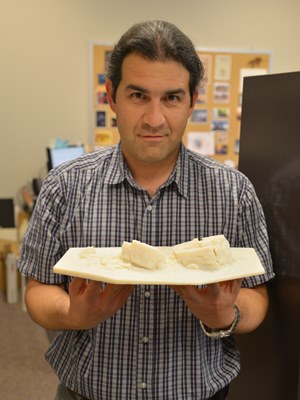
A partnership with the internationally respected organization CyArk was formed. CyArk is a nonprofit organization dedicated to digital recording and preservation of the world’s most significant sites. Among their credits are 3D recordings of the statues of Easter Island, Pompeii, ancient Thebes, and Mt. Rushmore. CyArk also digitally stores the 3D information for each site, serving as a world archive of heritage data. CyArk retained a local service provider to assist with the equipment and expertise to conduct the laser scanning. In early October 2013 the entire external surface of the Okotoks Big Rock, including the tops of the rocks and some internal crevices, was scanned during two days of field work. The result is a strikingly accurate rendering of the Okotoks erratic in both its geometric shape and the plotting of all known rock art images. The project also resulted in production of an accurate 1:200 scale model of the Rock that will be useful for planning and educational purposes.
3D rendering of point cloud data from laser scan at Okotoks with enhanced photography overlaid. Red areas are red ochre paint; note square-bodied human figure at upper left.
In addition to the rendering and scale model, the project also raised awareness about negative impacts associated with graffiti and heightening understanding of the value and importance of historic resources to the community. Further Alberta Culture now has a sophisticated tool to use for site management.
Alireza Farrokhi holding 1:200 scale model of the Big Rock
Sadly, the rocks have already been subjected to more graffiti in the months since our project ended; however, we now have accurate information on the type and location of rock art that will assist in graffiti removal efforts. There are other threats to the cultural and natural significance of the Okotoks erratic. It has long been a favoured place for climbers, subdivisions are rapidly encroaching on the site, and public visitation is increasing. There are many challenges ahead in the long-term management of the Big Rock, but thanks to the careful recording conducted through Innovation Program funding we have a solid baseline of information about this very special place that will guide future management.
Written by: Jack Brink, Curator, Royal Alberta Museum and Alireza Farrokhi, Head of Conservation and Construction Services, Historic Places Stewardship
The National Main Streets Conference is a big event. This year over 1,400 people attended the conference and there were approximately 75 sessions to choose from. Needless to say it was difficult to choose which sessions to attend. Of the sessions that I attended two stood out for me as being really helpful for our Main Street members: “The Naked Truth about Well-Dressed Windows” and “Main Street Makeover – Surviving and Thriving during Construction”.
Storefront Windows
Store owners only have a few seconds to convince a passerby to enter their establishment. The quality and interest of store window displays goes a long way in enticing potential shoppers. “The Naked Truth about Well-Dressed Windows” provided by Seanette Corkill of Frontdoor Back, a retail consultant based out of Vancouver, Washington, included a lot of practical advice on how to plan for and manage your window displays.
Seanette covered planning and investment for window dressings and stressed the importance of budgeting for lighting and props to build a collection that can be used over time. The decision on what type of backdrop to use is important and you can choose from full disclosure (store is visible behind the display), partial disclosure (where the store is partially visible but separated from the display) and closed (display blocked from the rest of the store). Decals are a good addition to storefront but they should be modest in size, not interrupt sightlines and placed to direct the eye to the display itself. Lighting is immensely important and should consist of tracked lighting that will light the top and front of the product on display.
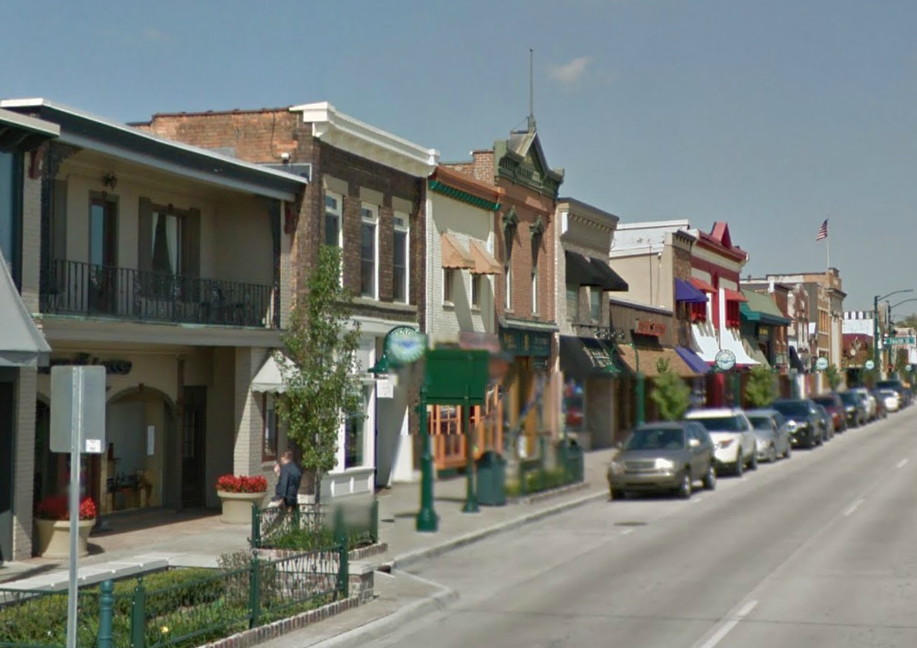
Switching topics from the pretty to the dirty, Kristi Trevarrow’s session on “Surviving and Thriving during Construction” drew on her role with the Rochester Downtown Development Authority in coordinating a main street upgrade project in Rochester, Michigan. The project involved a complete overhaul of the roads, underground services and streetscape and affected their downtown main street for several months. Her responsibility was to minimize the impact of the construction project on local businesses.
According to Kristi, the key to managing business during a successful construction project is pre-planning and communication. In her case, Kristi started holding information meetings two years in advance of the construction and met with everyone she could think of including business owners, residents, local organizations, major employers, property owners and adjacent municipalities. Communications for the project included a project website with regular updates; a brochure with frequently asked questions for businesses to hand out to their patrons; a comprehensive media engagement strategy; social media updates; a field office on the main street for the project (which they built into the project contract); monthly community meetings throughout the duration of the project; and last but not least, a presence on the street every day during construction to field questions and respond to concerns. There were still hiccups that occurred along the way but the high level of planning and engagement by the Development Authority minimized negative experiences.
Both high quality window displays and infrastructure renewal projects can go a long way to ensuring your main street is looking top notch. These sessions were helpful in teaching the ins and outs of how to schedule and manage aesthetic projects from the small to large.
Written by: Rebecca Goodenough, Municipal Heritage Services Officer









 RETROactive