The First Heritage Landmark Built on University Grounds

Old St. Stephen’s College sits on the grounds of the University of Alberta near the bus loop. Did you know that it is the oldest building on campus? Designed in the early 1900s by Herbert A. Magoon, the building is a collegiate Gothic style that can be seen among early British universities. The college emulates a castle-like appearance and there are very few other examples like this in Alberta or even western Canada.

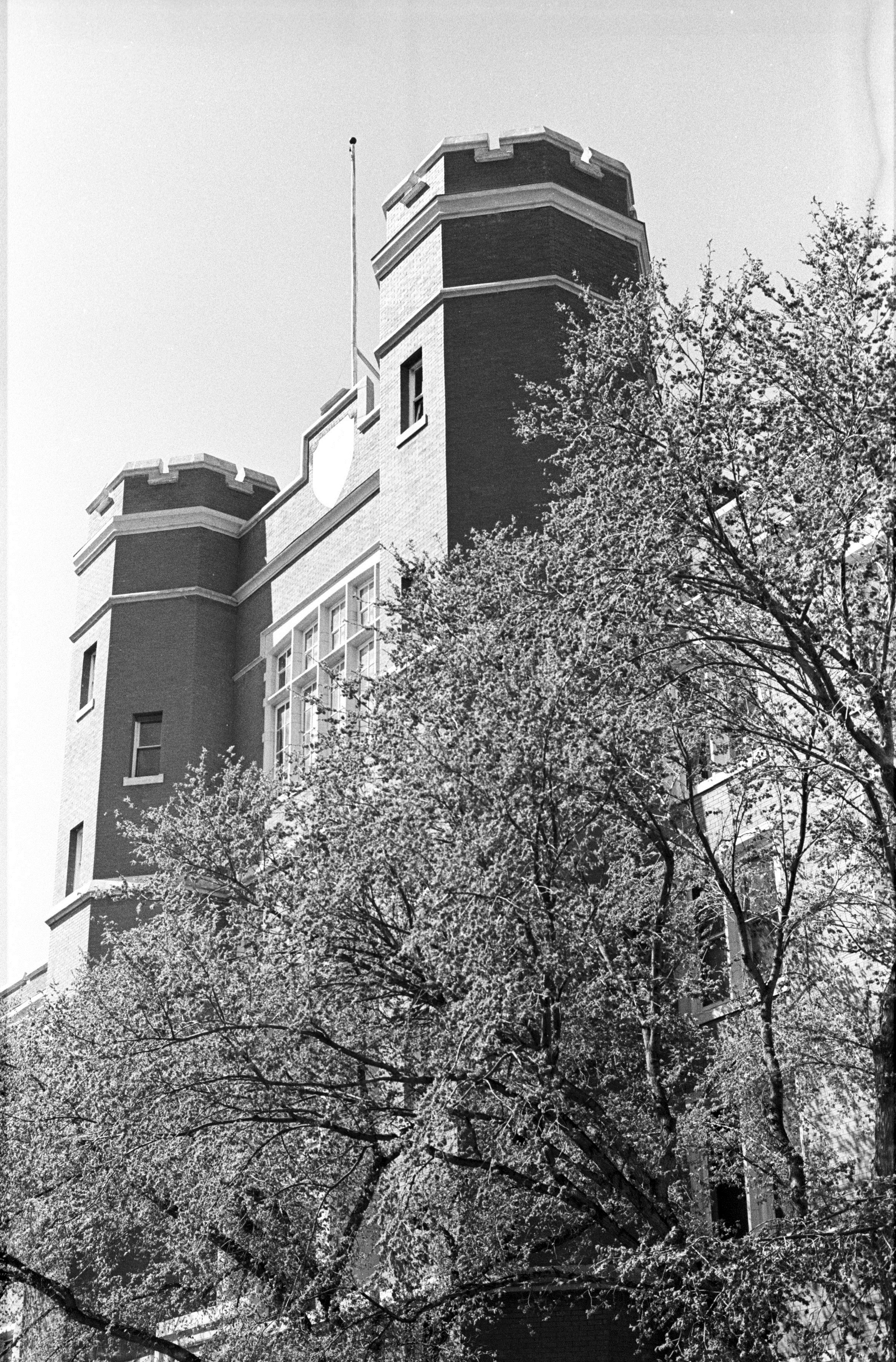
Over a century has passed since St. Stephen’s was constructed and the elm trees that were planted during the college’s early years have now grown to almost completely cover the building’s façade. This is a testimony of its endurance and the college’s longevity continues to contribute to its interesting history. This post will look at the unique construction of this structure and detail the notable features that make the Old St Stephen’s College a significant historic resource.
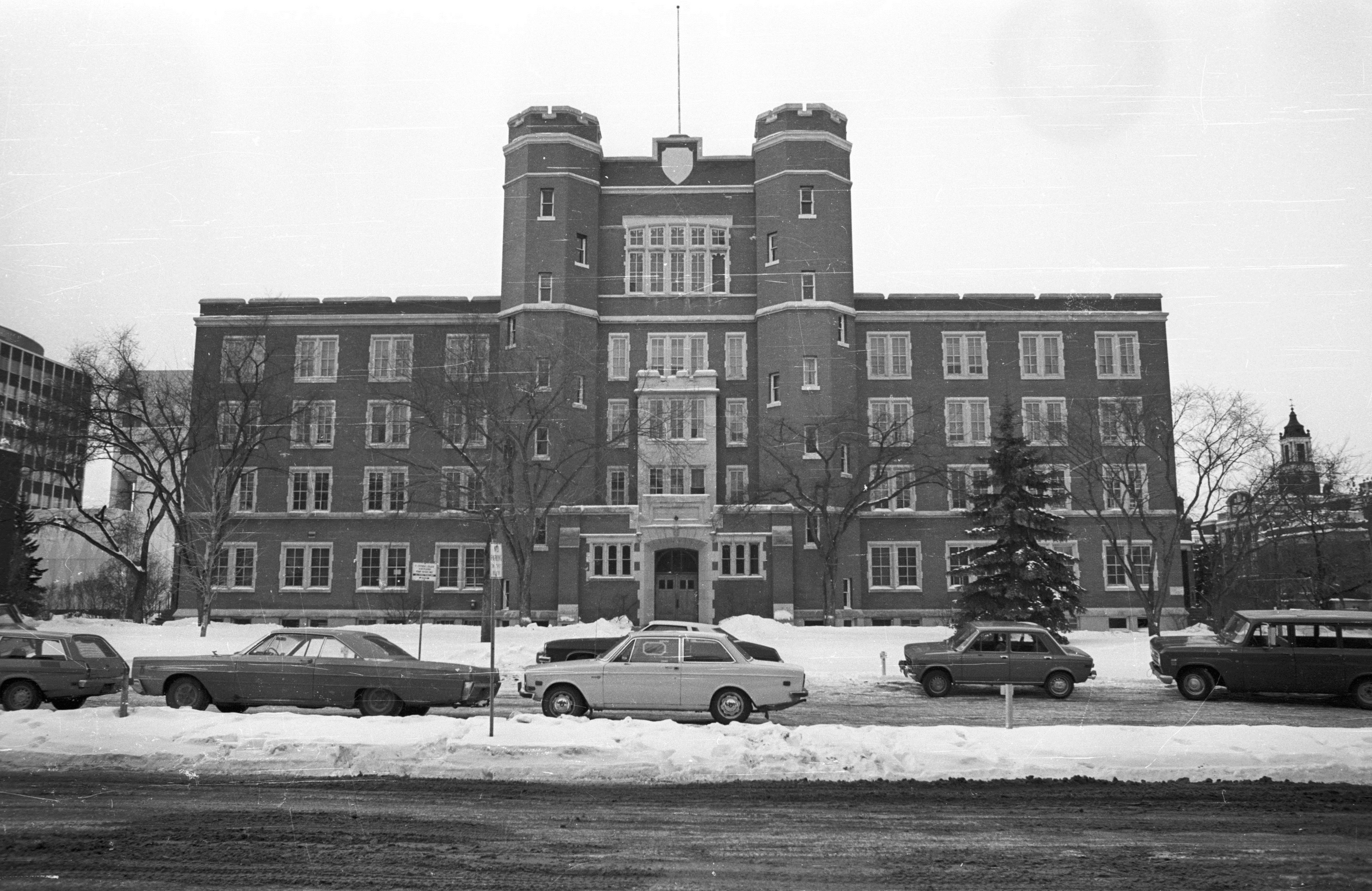
Old St. Stephen’s College, 1974 (Historic Resources Management Branch, 70-R30L-01-M).

The construction of Alberta College South, as the building was first known, began in 1910 on the University of Alberta campus and welcomed 41 theology students the following year. The college first functioned as a non-denominational theological school and co-ed residence, offering the basics in biblical scholarship and trained students to become ministers. Church history, biblical languages, systematic theology and homiletics are just some of the courses that were available. Within a decade of the school’s opening, the theological program began to attract students from all over Canada and other parts of the world.

By the early 1900s, Edmonton was home to Alberta College South, a seminary of the Methodist Church, and a Presbyterian instructional college known as Robertson College. In 1925, the Methodist, Presbyterian and Congregational Churches merged, forming the United Church of Canada. Around this time, the Government of Canada passed the United Church of Canada Act, declaring there to be an amalgamation when two or more colleges doing the same classwork were situated in the same locality. The outcome of this had the Robertson College relocate to Alberta College South and the institution was renamed the United Theological College. Two separate boards remained, one for the Methodist church and one for Robertson College, until 1927 when the two boards united and settled on the name St. Stephen’s College.
Old St. Stephen’s College, 1971 (Historic Resources Management Branch, 71-R0001-34).

A new building was built immediately south of the original building in 1952. Old St. Stephen’s College (as it was henceforth called) continued to be used as a student dormitory, while the new St. Stephen’s College held classrooms and offices. By the 1970s, there was an increase in student housing around the university area and less students were choosing to reside at the college. Within a few years, Old St. Stephen’s was vacant and in danger of becoming a parking lot, until considerable protest was mounted by members of the public. Demolition was averted in 1979 when the Government of Alberta leased the property from St. Stephen’s College as office space for the Historical Resources Division of Alberta Culture. The building is now owned by the Government of Alberta and houses many employees of the Heritage Division. This past September, we celebrated 35 years of residency in the historic building.

Old St. Stephen’s College was designed by one of Edmonton’s first architects, Herbert A. Magoon. In the early 1900s, Magoon moved to Western Canada where there was an increasing amount of city development. He eventually settled in Edmonton and quickly became one of the city’s most reputable architects. Magoon was involved in designing a number of buildings that are now Alberta historic resources, including the Knox Presbyterian Church, the Metals Building, the H.V. Shaw Building in Edmonton and the Old Town Hall in Wainwright. A number of Magoon’s designs are of similar style to buildings found in Chicago, where he worked and studied architecture, indicating that he was influenced from his time spent there.

In the spring of 1910, H. A. Magoon was commissioned to design the future St. Stephen’s College. St. Stephen’s was inspired by the architectural style that was popular in Europe in the early twentieth century. The design of the building is consistent with the collegiate gothic style that was common to many colleges and universities built across North America during this time. This design was favoured because it emulated a British tradition found among some early universities. There are subsequent buildings on campus that are in line with the appearance of St. Stephen’s, including the Rutherford Library and St. Joseph’s College.
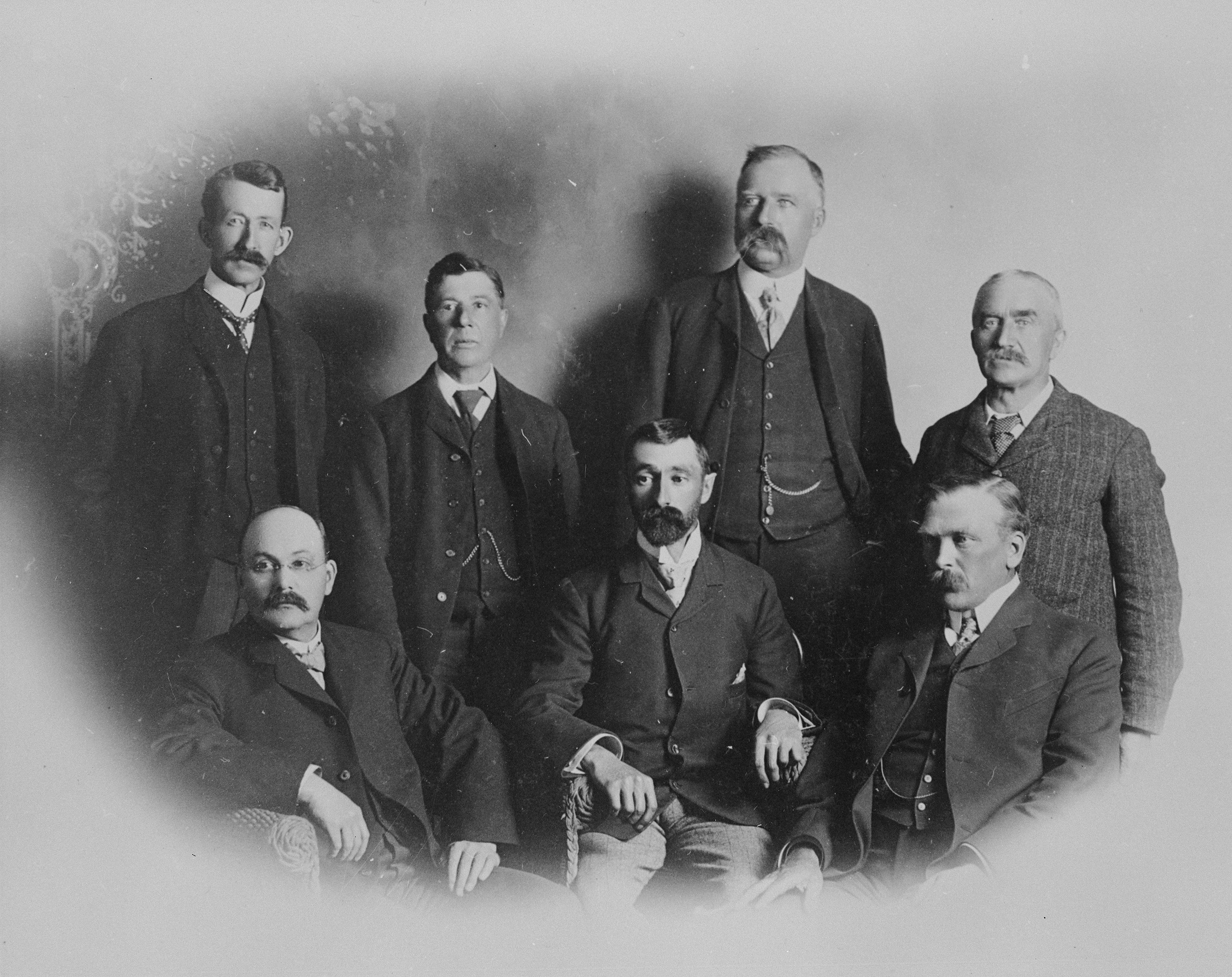
Alberta Association of Architects, ca. 1906.   Back row: Hopkins, R. P. Barnes, J. Wise, H. D. Johnson, Front row: A. Magoon, F. X. Deggen-Dorfer, A. Pirie.  (Provincial Archives of Alberta, A1998).
Alberta Association of Architects, ca. 1906. Back row: Hopkins, R. P. Barnes, J. Wise, H. D. Johnson, Front row: A. Magoon, F. X. Deggen-Dorfer, A. Pirie (Provincial Archives of Alberta, A1998).

The exterior’s notable features are its red brick veneer, octagonal towers and battlemented fortifications, which give the structure a castle-like appearance. The overall design of the building fit with the vision of the principal to-be of Alberta South College, John Henry Riddell. Riddell wanted a building that would “stand out, conspicuous against the horizon…appearing so clearly…as to challenge every passer-by.” The resulting structure was an impressive brick building that has drawn comparison to St. James’s Palace in London.

The interior of Old St. Stephen’s has a number of distinguishing features that make the building unique, such as an entrance foyer with oak detailing, a fireplace in the former Dean’s office, a vault and the remnants of a gymnasium on the top floor. When the building was first constructed, it featured 65 bedrooms, a 300 person capacity assembly hall, faculty residences and a dining hall. In 1935, a classroom was converted into a chapel with stained glass windows, which still remains in the north wing of the first floor. The chapel contains the original wooden pews and pulpit that were crafted by a former St. Stephen’s student.
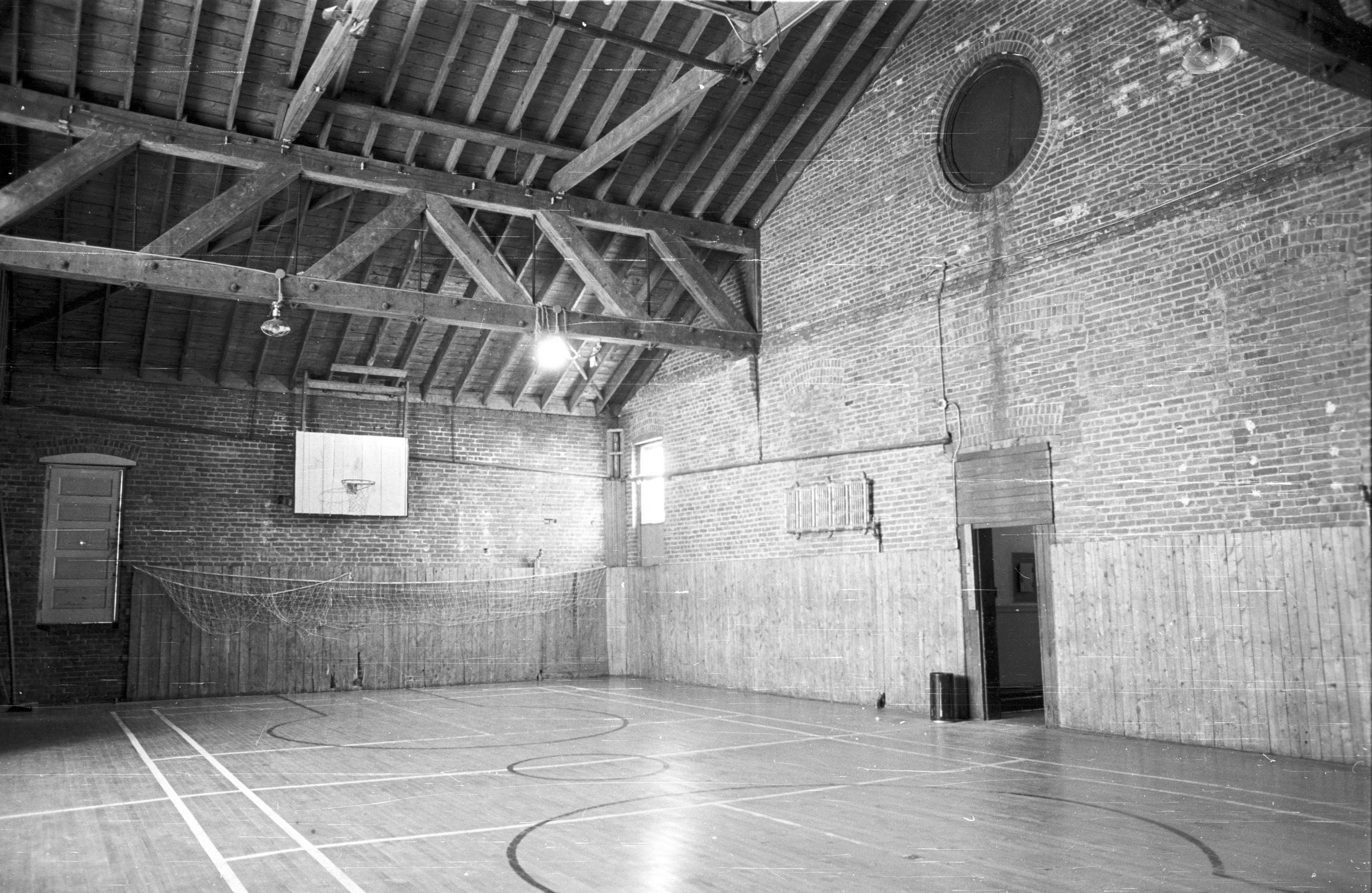
The gymnasium on the 5th Floor, 1974 (Historic Resources Management Branch, 70-R30L-12-M).
The gymnasium on the 5th Floor, 1974. The gym is no longer in use and now serves as a mechanical room for the building (Historic Resources Management Branch, 70-R30L-12-M).

This is the oldest building to be constructed on the grounds of the University of Alberta, the province’s first post-secondary institution. Although separate from the University, the college has become integrated into the campus over the past century and has served as a recognized landmark in the university area. Old St. Stephen’s is an example that historic buildings need not necessarily be demolished, but they can successfully be reused, thus continuing the preservation of Alberta’s built heritage.

Written by: Erin Hoar, Historic Resources Management Branch Officer

Sources:

Alberta Register of Historic Places. “Old St. Stephen’s College.” (Accessed September 10, 2014).

Biographical Dictionary of Architects in Canada 1800-1950. “Magoon, Herbert Alton.” Accessed January 9, 2015.

Designation File # 132, in the custody of the Historic Resources Management Branch.

“Old St. Stephen’s College.” Alberta Past 2, no. 2 (August 1986): 1.

Simonson, Gayle. Ever-Widening Circles: A History of St. Stephen’s College. Edmonton, Canada: St. Stephen’s College, 2008.

St. Stephen’s College, Edmonton: Report #428. Alberta Culture, Historical Resources Division, Historic Sites Service, 1979.

University of Alberta. “University of Alberta: St. Stephen’s College.” (Accessed September 10, 2014).

Ski Flyers

“If you get the right angle to float on top of the pressure of the wind you get more distance.” (Clarence Sverold, Canadian Olympian)

The huge metal ski jump at the Stoney Creek Valley in Camrose is an impressive sight. It is the legacy of the daring Norwegian flyers who made Camrose the birth place of ski jumping in Alberta. Adolph and Lars Marland, P. Mikkelson and the Engbretonson brothers formed the Fram Ski Club there in 1911. It was named for the Fram, meaning “forward” in Norwegian, the ship that carried Roald Amundsen on his famous expedition to Antarctica.

The Fram Ski club began construction in the fall of 1911 on a fifty-foot scaffold tower with a long slide in the Stoney Creek valley. Anticipation mounted for the club’s first ski jump tournament held in January 1912. People came from miles around in sleighs and cutters and happily paid the 25 cents entry fee. Adolph Marland soared seventy-four feet through the air to be acclaimed the winner.

Ski tournament, Edmonton, Alberta, 1914 (Glenbow Archives, NC-6-1308).

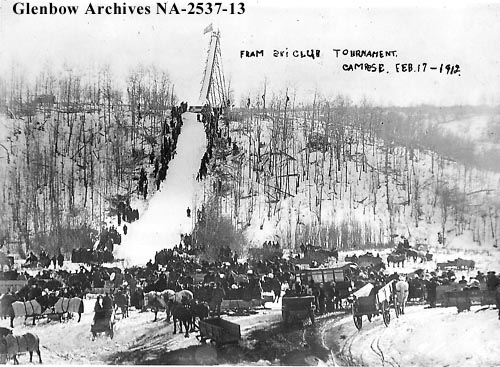
The Fram Ski Club soon had competition. Not to be outdone, Edmonton also formed a club in 1911, and built a bigger jump at Connor’s Hill for the 1912 season. Camrose hosted the first tournament between the two clubs on February 17th 1912. Edmonton’s John Hogan outdistanced the Camrose team with a jump of 87 feet. On the same day the Fram and Edmonton Ski Clubs formed the National Ski Association of Western Canada. Its purpose was to “to create, develop and sustain interest in the sport of ski running and ski jumping.” It set out the rules and scoring system for combining points for length of ski jump, landing, and aspects of style to determine the overall winner. The distance is still measured today from the edge of the take-off to where the jumper touches the landing slope below.

A week later the two clubs held a return competition at Connor’s Hill and John Hogan once again made the longest jump. “The spectator would gasp,” noted The Edmonton Journal, “as a skier came whizzing down the long wooden slide, hit the take off platform, doubled up like a jack-knife and then flew out into space, landing on both feet in the snow, and speeding down the hill.”

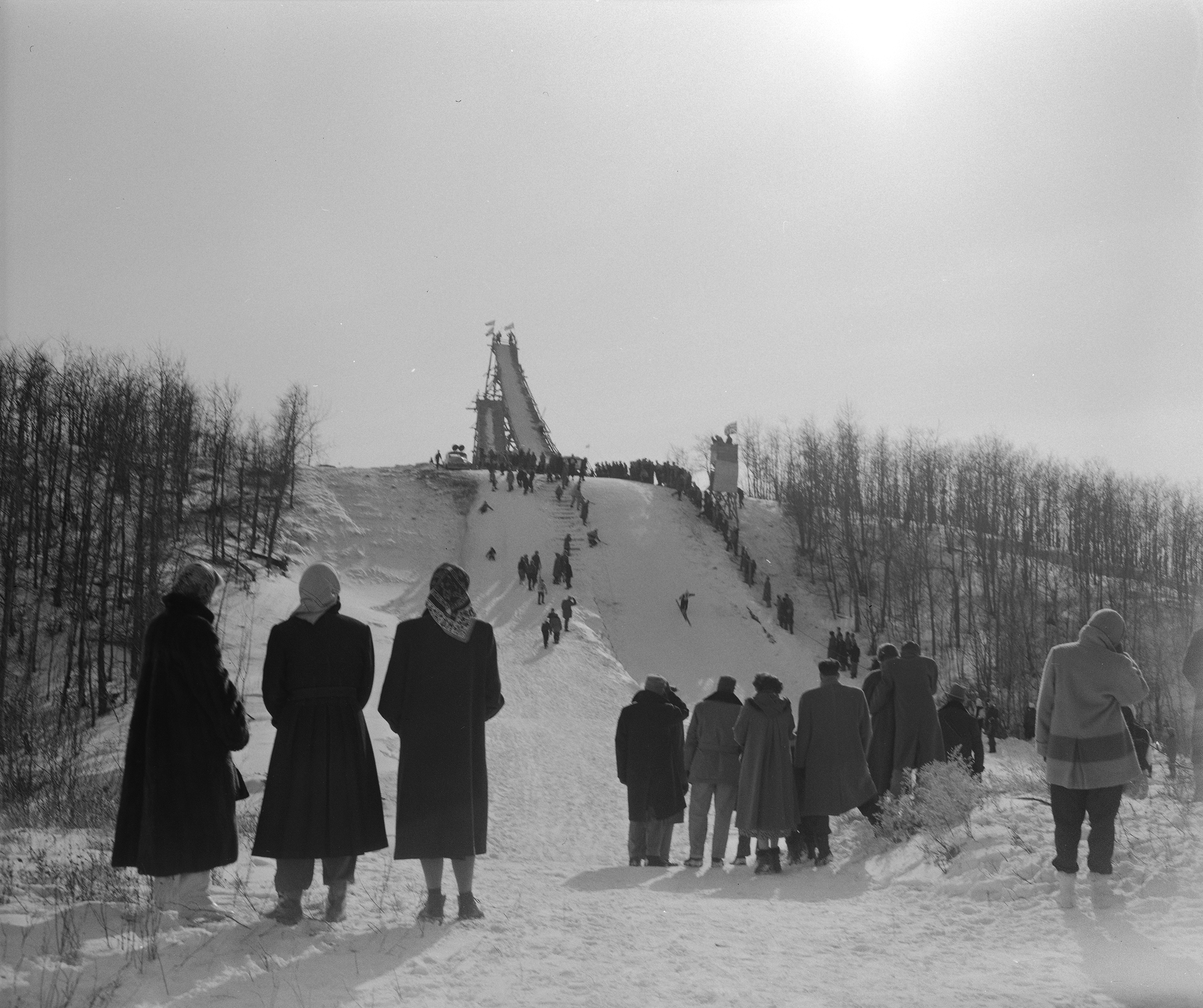
Spectators at Camrose Ski Jump, 1954 (Provincial Archives of Alberta, PA237.1).

Although ski running, soon known as cross country skiing (or Nordic skiing) was becoming popular, it was ski jumping that captured the public’s imagination. In 1913 over 5,000 spectators watched John Hogan set a new Canadian record with a jump of 109 feet at Connors Hill. It was a major event attended by the Lieutenant Governor Bulyea, Mayor McNamara, and the Norwegian consul.

The ski clubs often had to repair or replace the first ski jumps because they were generally built from wood and deteriorated quickly. Although the Connor’s Hill jump survived the 1915 flood on the Saskatchewan River, it gradually weakened. Finally deemed unsafe by the City, it was dismantled in 1926. The Edmonton Ski Club rebuilt it in 1935. When the first jump at Camrose blew down, it was replaced in 1924. This in turn was replaced by a third one in 1930, in time for the western Canadian Championships in 1932.

The Camrose Ski Club Club, as the Fram became known, remained at the heart of ski jumping in Alberta through the 1950s. The Servold brothers, Clarence and Irwin, who represented Canada at the 1956 and 1960 Olympics, continued the tradition of those early Camrose jumpers who mentored them. Nevertheless, despite club ski jumps at Devon and Athabasca, ski jumping fell somewhat out of vogue during the 1960s. The Camrose ski jump was taken down, and Edmonton’s last ski jumping tournament was held on Connor’s Hill in 1975, although the jump remained as a city landmark until 1978.

Fram ski club tournament, Camrose, Alberta, February 17, 1912 (Glenbow Archives NA-2537-13).
Fram ski club tournament, Camrose, Alberta, February 17, 1912 (Glenbow Archives, NA-2537-13).

As a spectator sport ski jumping had less appeal than alpine competition through the 1970s. There was a resurgence of interest during the 1980s when a large concrete ski jump took shape at Calgary Olympic Park as the city prepared to host the Olympic Winter Games in 1988. Clarence Sverold designed a new ski jump constructed from welded pipes with a wooden slide surface for the Alberta Winter Games held in Camrose in1990. Because athletes’ ability and equipment has advanced so much, longer landing lanes are needed than in 1990. The Camrose jump does not meet current standards and is no longer used. The largest jump at Canada Olympic Park is no longer used for the same reason. The national ski jumping team still trains on the smaller ski jumps.

Today, the International Ski Federation holds events in three types of ski jump competitions: normal hill, large hill and ski flying hill on which incrementally longer distances have been achieved. The current Ski Flying World Record of 246.5 metres (809 feet) was set by Johan Remen Evensen of Norway in 2011—well over ten times the distance flown a hundred years earlier by Adolph Marland of Camrose.

Passionate about Polo

Polo became the passion of the ranchers who worked the extensive corporate grazing leases in southwestern foothills of the Rockies by the late 1880s and quickly developed into a sport of daring horsemanship and exploits. Polo Clubs were initially organized by the wealthy owners and managers of the large ranches, former mounted police officers, and remittance men from well-to do landed families in Britain and Ireland. Recreational polo blurred social boundaries. These socially upper class men played on teams alongside small ranch operators, cowboys, and farmer-settlers, and even store clerks. In a time when everyone rode and in a place where ranchers bred thousands of potential mounts, polo offered social and business connections as well as thrills (and spills) for rider and spectators alike.

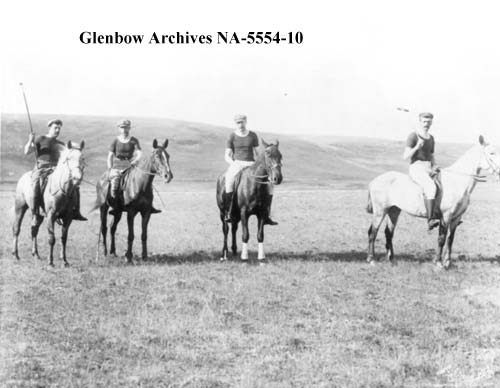
Polo team, southern Alberta, ca. 1890s (Glenbow Archives, NA-5554-10).
Four of Alberta’s legendary polo players: Left to right George Ross; Francis MacNaghten; Oswald Critchley; Addison Hone, ca. 1890s (Glenbow Archives, NA-5554-10).

Polo had ancient origins in Persia. It had only come to the British Isles, via its colonial connection with India in the 1870s. Popular among British military officers, it became an organized sport. A small number of early ranchers in the foothills had some experience or had seen the game before coming to Canada. One of those who participated in informal pickup games in the 1880s was Captain E.M. Wilmot of Chinook Ranch, credited with founding the first polo club at Pincher Creek in 1889.

Mostly, it seems, Alberta’s players found time to learn the rules, then adapted and honed their range land skills to the game played on hay meadows. Alberta’s tough agile little cow ponies, accustomed to herding cattle in quick response to commands, made steadfast partners. As the Fort MacLeod Gazette noted in 1892, “the qualities that go to make a good polo player—dashing horsemanship, courage, quickness and sureness of eye, and strength of wrist and arm, are those which are especially dear to the western heart.”

Overall polo is played in a way reminiscent of hockey. On a 300 yard long ten acre field, mounted competitors, four to a side, galloped up and down using mallets to drive a ball into the opponents’ goal. Polo is a positional game: a designated player number four, or back, plays defense, a designated number one player plays well ahead, and numbers two and three play mid-field. The ponies had to gallop hard: each rested after one or two seven and ½ minute periods called a “chukker.” The player could change ponies several times during a game. The ponies made hard contact shoulder to-shoulder as players attempt to “ride-off” their opponents and take control of the ball.

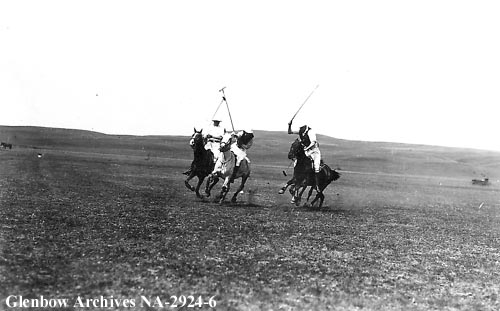
Polo players at Cochrane, Alberta, ca.1913 (Glenbow Archives, NA-2924-6).
Polo match at Cochrane, Alberta, ca. 1913. Left to right: Dick Brown, Fish Creek; O.A. Critchley and Gilbert Rhodes, Cochrane (Glenbow Archives, NA-2924-6).

Two mounted referees, and a third on the sidelines, enforced the rules that mainly pertain to riding infractions and dangerous maneuvers that interfere with flow of the game or can lead to violent collisions. The ball kept in continuous play so the excitement was non-stop during the four, and later six, chukkers that made a game.

The first polo games were played between teams formed within each club, but polo tournaments caught on quickly. Fort McLeod organized the first tournament in June 1892. Four club teams, Calgary, Fort McLeod, Pincher Creek and High River, competed for a cup donated by Colonel James McLeod, former Commissioner of the North West Mounted Police. The Calgary Challenge Cup, presented at the first Calgary tournament in September 1892, has been in continuous play since. The same year a team travelled from Calgary to challenge polo players on the west coast, bringing their ponies described by a Victoria newspaper as “strong close-knit little brutes.”

Organizing and attending tournaments took work: ponies had to be ridden to the rail line, loaded in a box car, and feed arranged. Club finances and skilled teams were sustained by wealthy enthusiasts. Within a few years clubs formed at Cochrane, De Winton, Fish Creek, Millarville, High River, Peisko at the Bar U Ranche, Cowley, and Pine Creek.

As the twentieth century began club rivalry intensified. New trophies, including the Sheep Creek Challenge Cup (awarded to the winner of the annual Millarville tournament beginning in 1903) and the Fish Creek Challenge Cup (first awarded in 1906), were sought after. Most clubs had enough riders to mount several teams. For club play team configurations shifted constantly as senior and junior levels or A and B teams formed, while the best teams played at tournaments. The club allegiance of expert players became uncertain: they moved club as it suited them. A professional aspect became apparent; individuals and teams from Alberta played at tournaments across Canada and were popular at the Coronado Polo Club near San Diego.

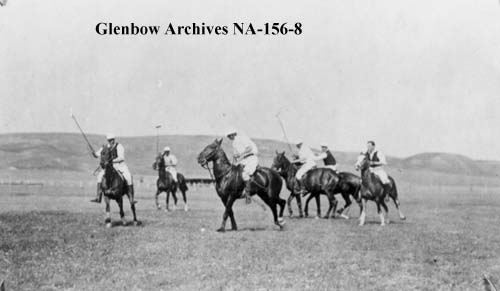
Polo game, Cochrane, Alberta - Millarville versus Cochrane, ca. 1900-1903 (Glenbow Archives, NA-156-8).
Polo game, Cochrane, Alberta – Millarville versus Cochrane, ca. 1900-1903 (Glenbow Archives, NA-156-8).

It seemed that everyone was passionate about polo and polo players. Games were avidly followed by the press and tournaments were family outings. High River and Calgary hosted dinner dances after tournaments that were major society events. In 1903 a hundred guests attended Calgary’s polo ball. In June 1905 the town of High River shut down and everyone set out to the polo grounds about a mile from town for the day as the Calgary team arrived on the train accompanied by 100 supporters. Polo hit its high as a spectator sport at the Calgary Exhibition of 1907 where 20,000 people watched a game.

Seven years later the flame was extinguished. Polo teams fell apart in Alberta as war took many players to the European front. After World War I the great ranching communities declined and the heyday of the horse drew to a close. Attempts to revive the game with fewer polo teams were on-going and women took up and promoted the game during the 1920s. The downturn of the 1930s and World War II, however, resulted in the Calgary Polo Club being the only club surviving by 1945. The days of the ranch cow pony doubling as polo pony were long over. As polo slowly revived during the 1950s, it was evident that horses and polo playing had become the preserve of the well-to-do. J.B. Cross, son of A. E. Cross (a founding member of the Calgary Polo Club and grandson of Colonel James McLeod), provided new grounds for the Calgary Polo Club east of the Millarville in 1960. From the late 1970s the Fish Creek Challenge Cup was back in play after a decades-long hiatus.

Today, the Calgary Polo Club covers about 300 acres with nine playing fields, about a dozen professional players and numerous amateurs call it home. Two other clubs in Alberta are active, Grande Prairie Polo Club, an established club prior to World War I, and Black Diamond Polo Club founded in 1999. The traditions and rules of play for polo have remained constant in Alberta. From June through early September club matches, local, and interprovincial tournaments are open for spectators to enjoy one of Alberta’s earliest sports.

Hooked on Movies

It’s been over a hundred years since movies first came to the towns and cities of Alberta. Early short black and white silent motion pictures carried subtitles or inter-titles, frames of script interspersed with the action. The 10 to 15 minute reels shown on hand-cranked projectors started up jerkily and ended with a flapping sound as they flew off the reel at the finale. While the managers of “legitimate” theatres, as the newspapers dubbed them, believed the movies would never compete with live shows, their comparatively low price soon made them popular.

Despite the reputation of movies as “low-brow” entertainment, specialized movie houses sprang up in urban areas. The movie business was a competitive one from the outset: by 1913 there were twelve theatres in Edmonton that showed movies. Soon dubbed nickelodeons, after the 5 cent admission price and the Greek word for theatre, they proved to be financially successful. Edmonton’s Bijou that opened downtown around 1908 in converted retail premises filled its tightly-packed rows of wooden seats. Offering a two reel show using a hand cranked projector, each screening featured an educational reel with a short comedy followed by a full reel length feature. The manager Bill Hamilton explained the action on the screen and a small orchestra or pianist played during intermissions as the projectionist rewound the reels. In 1910 the Bijou rushed in a reel of King Edward’s funeral from London and played it for six days, accompanied by Chopin’s Funeral March on the piano.

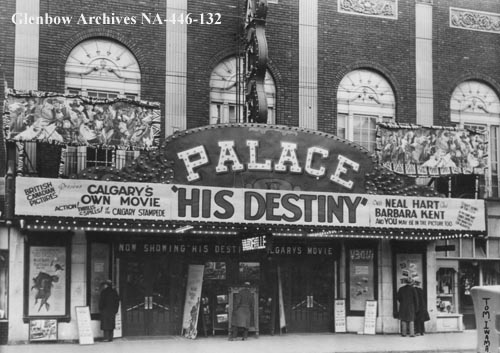
Palace Theatre, Calgary, Alberta, ca. 1925 (Glenbow Archives, NA-446-132).
Palace Theatre, Calgary, Alberta, ca. 1925 (Glenbow Archives NA-446-132).

Albertans were hooked on movie going from the start. The experience ranged from hard kitchen chairs in the plain Innisfail Opera house to plush seating in lavishly decorated theatres. In Calgary, the Canadian chain of Allen Theatres built Alberta’s first “real picture palace” in 1913. The Allen Theatre, later known as the Palace Theatre, had 840 luxurious seats, a large balcony and an organ for musical interludes. By 1915 movie goers in Edmonton could enjoy a similar experience in plush seats under lavishly decorated plaster friezes and painted tableaus in the marble-fronted Princess Theatre.

Competition from the movies pushed the Pantages, Edmonton’s highbrow vaudeville palace, into near bankruptcy in 1920. It was reborn in 1921 as the Metropolitan, advertised as “a high-class motion picture theatre,” with continuous performances from 11 am to 11 pm. Admission prices ranged from 10 cents for a children’s matinee to 45 cents for adult evening ticket in lounge or box seating.

Rural Albertans also developed a taste for the movies. Itinerant projectionists travelled between villages and towns to show movies in schools and community halls. By the 1920s busy towns boasted their own cinema, such as the Crowsnest’s Grand Theatre in Frank and the Orpheum in Blairmore. These cinemas played the same movies as in urban centres, but offered fewer screenings.

During the silent movie decade of the 1920s movie goers showed a preference for American movies. Despite the Allen chain’s promise of “Canadian Pictures for Canadian People,” American films dominated Canadian screens. Nevertheless, Calgary movie-goers relished the low budget, locally produced movie His Destiny. It stared Barbara Kent of Gadsby, Alberta, alongside Neal Hart, screen star of silent westerns, and was shown at the Palace in 1928, thanks to the introduction of a preferential quota for films made in the British Empire, which was ultimately unsuccessful. Elsewhere in Alberta His Destiny was not a hit. From the outset movie-goers decided what they wanted to see and theatres provided it.

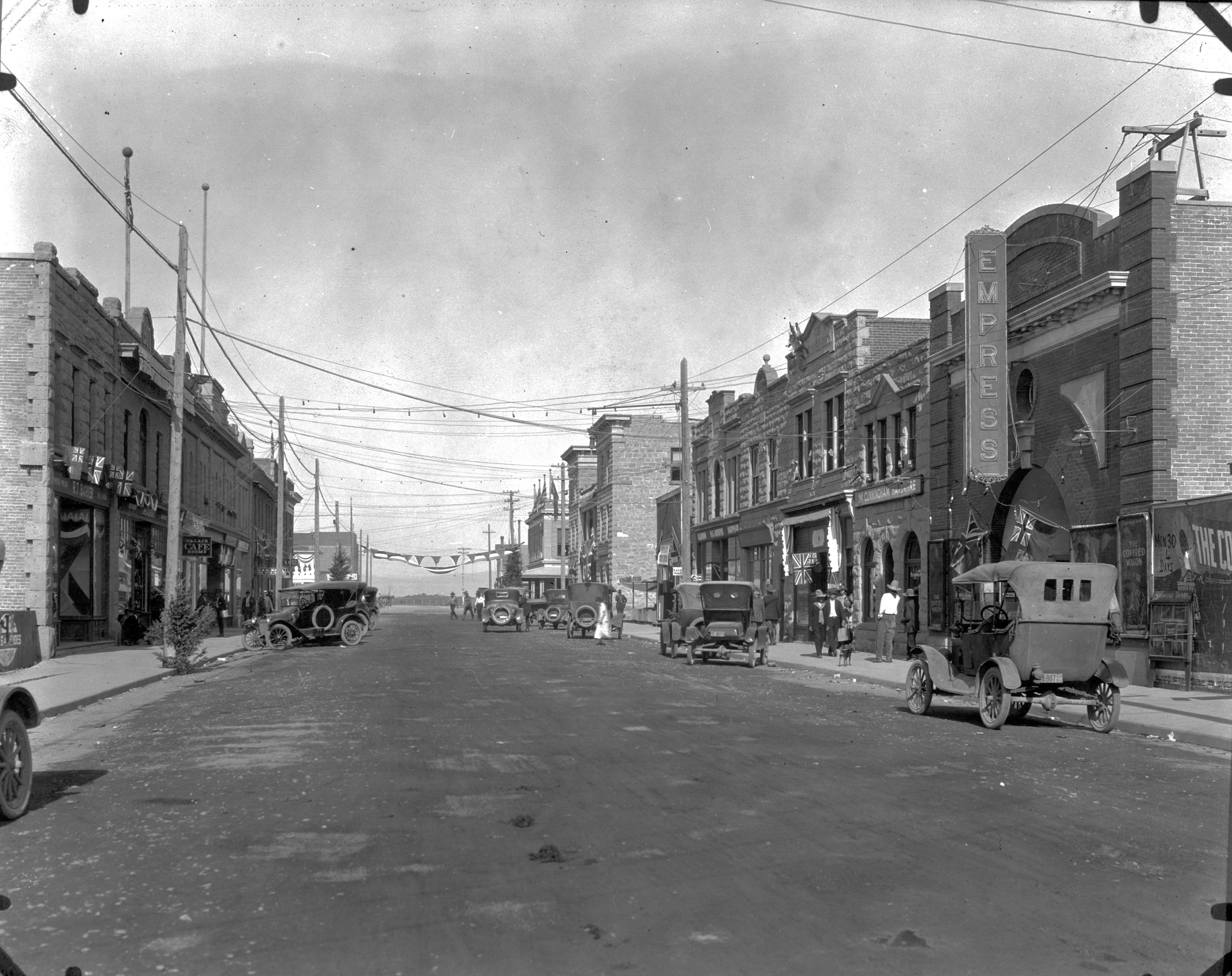
The Empress Theatre on Main Street, Fort Macleod, 1924 (Provincial Archives of Alberta, A5462).
The Empress Theatre on Main Street, Fort Macleod, 1924
(Provincial Archives of Alberta, A5462).

And then came the excitement of the “talkies,” the first motion pictures with sound. First introduced in New York in 1926 by Warner Brothers, they took urban audiences in Alberta by storm two years later. The world was never the same as movies came into their own. The expectations and experiences of movie goers were transformed, much as we have been by the internet. Theatres invested in expensive sound equipment, which needed constant attention and adjustment for optimum results. In Edmonton the Princess theatre showed the first talkie; crowds lined up in August 1929 to see The Canary Murder Case. By November 1929 when Edmonton’s Dreamland installed sound, the Journal provided detailed explanation of how it worked, noting the city’s theatres were “100 per cent Talkie Now.”  By 1930 no one in Alberta wanted silent movies and theatres ceased showing any live performance along with motion pictures in the same program. The golden age of movies had begun.

Through the 1930s movie-going offered Albertans, many of whom were out of work, something to do for a few cents, and it was a way to forget harsh economic reality and miserable weather. The movie houses lowered their prices and used a number of tactics to encourage patrons to part with their limited funds. Raffles, gimmicks and prizes lured movie goers. Posters and advertising for films carried melodramatic flare, whether they offered romances, comedies, tragedies, westerns or mysteries. Elaborate front-of-house themed installations on sidewalks stopped passers-by and at night flickering tracer lights beckoned.

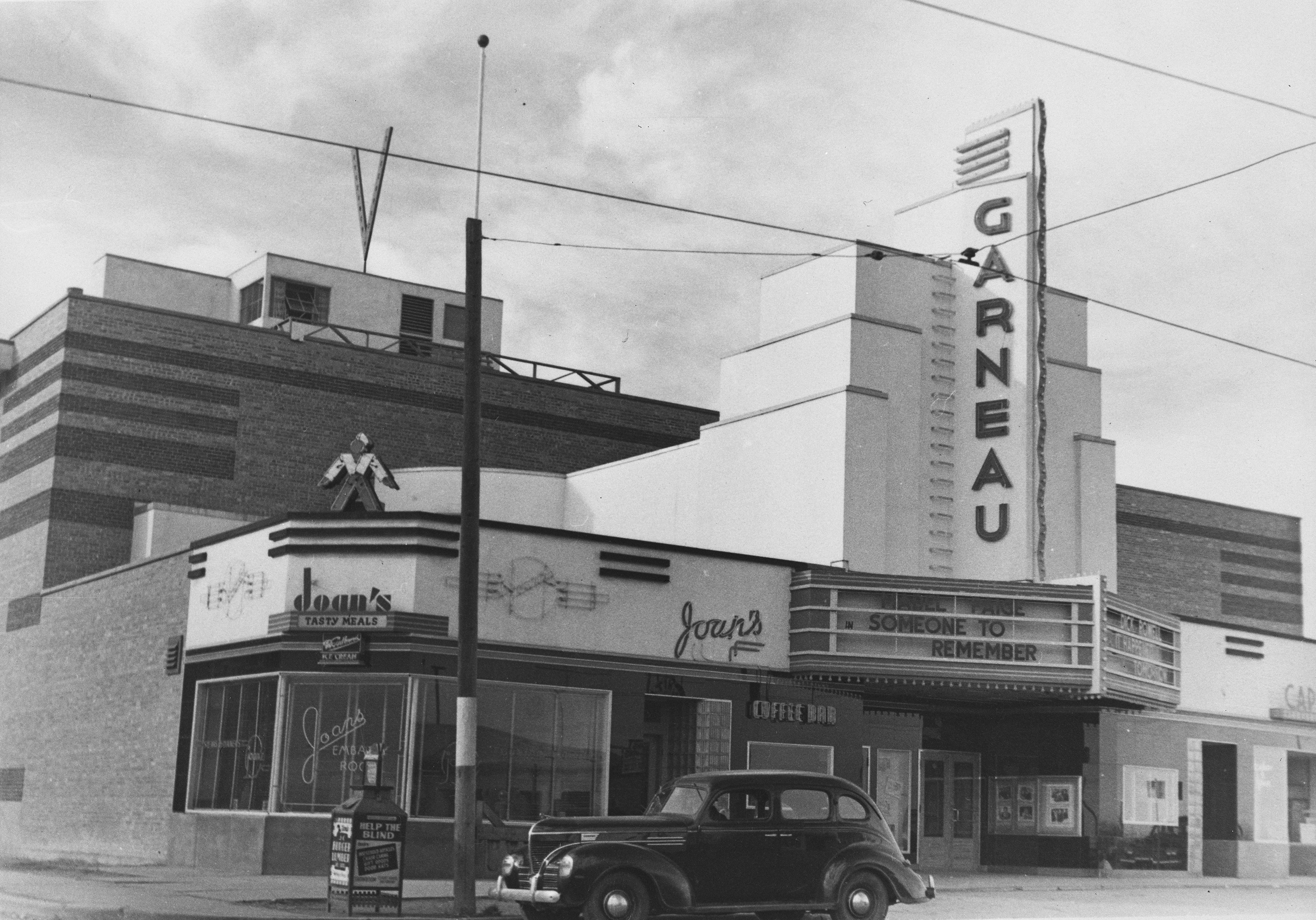
The Garneau Theatre, Edmonton, 1943 (Provincial Archives of Alberta, A6885).

By the 1940s the wartime economy fueled the love of cinema to greater heights. Surviving older multipurpose theatres such as the Empress Theatre in Fort McLeod experienced a new lease on life as a movie theatre. Bashaw’s Majestic Theatre, built in 1915, which had operated as a silent picture house through the 1920s but subsequently fell on hard times, reopened in 1945 as the Dixy. At the same time cinemas began to move out of the downtown core. In Edmonton two rival theatres appeared on the south side in 1940, the Varscona and the Garneau Threatre, both designed specially as cinemas in the modernist Art Deco style that was emerging in the city and across the province. At the Garneau fashionably uniformed ushers escorted patrons to their seats, which included a new twist—“two’s company” love seats for young couples.

Movie theatres continued to evolve in architectural style (or lack thereof ) and taste in films changed, too, over the next decades. Technology has brought us ever more exciting experiences. But the buzz is still the same—on a Saturday night it’s clear that Albertans are still hooked on movies.

Written by: Judy Larmour.

Rapid Rail to St. Albert

Edmontonians have been talking about extending the LRT system for a while now. The completion of the Metro line as far north as NAIT is the first segment of a planned extension past the city limits and into St. Albert. It’s still on the drawing board, but it’s worth remembering it’s been done almost a hundred years ago. Yes, believe it or not, there was a commuter rail line to St. Albert before the Great War.

In 1910 Financier Raymond Brutinel, who had a home on the St. Albert Trail and an eye to make a buck in real estate along the route, acquired a charter for the all-electric Interurban Railway. The company reorganized in 1912 through an agreement with the Franco-Canadian Corporation; the vice president was well-known Edmontonian J.H Picard. The Interurban Railway thought big—not only was there to be a line to St. Albert, but other lines to Beaver Lake and Tofield, Pigeon Lake, and Namao.

Construction to St. Albert began in 1912 and by late summer, seven miles had been graded. The Interurban track was nearing completion by mid-summer 1913. Sidings were constructed every mile or mile and a half, to be used for the loading and unloading of freight, and to provide passing points for the cars. A car barn was erected at Queen Mary’s Park near 137th Avenue and 124th street. By the time the company was ready to go into operation it could not afford the electric grid. Instead it ordered a number of unusual hybrid-drive rail cars.

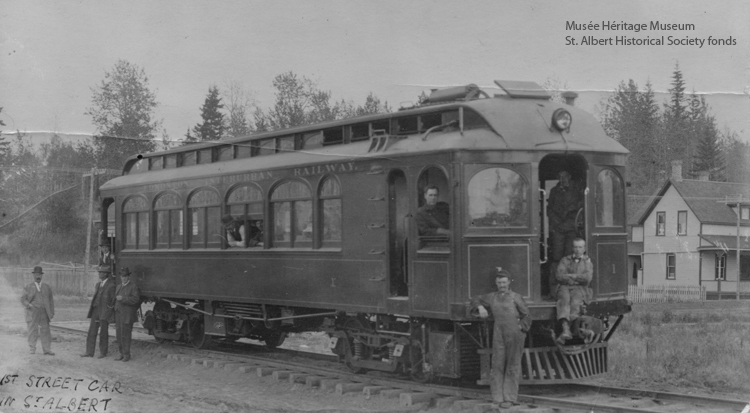
The first of these was a Drake. Built in Chicago, it was a gas-electric trolley car with its own gasoline engine and generator. It ran at about 35 miles an hour. Passengers could expect a deluxe experience as it was panelled in oak, and the seats upholstered in dark green plush. A second type of car, designed by McEwan Pratt and Company of London, England, was ordered from Baguely Cars (who took over McEwan Pratt in 1911). This gas hydraulic-drive car was reported to use the innovative Hele-Shaw hydrostatic transmission. It was 33 feet long and 8 ½ feet wide with a seating capacity of 36, “provided in rattan covered cross seats, with central aisle.”

Interurban railway, ca. 1913-1915 (Musée Héritage Museum, St. Albert Historical Society fonds, 2003.01.795).

The Drake arrived in August 1913 and its initial runs included carrying prospective real estate buyers to their Summerland subdivision located along the route. Although the second car had not yet been shipped from England, by December 1913 the Interurban was running on a full schedule of 5 round trips a day, with 5 stops along the route. From the Hill Top Stop south of St. Albert, according a newspaper report, “a wire cable handled by a donkey engine [a steam-engine powered winch] is attached to the car for the greater safety of the passengers on the off chance that there might be at some time be a failure of the brakes to work perfectly and on the car’s return the cable is again fastened to the car at the foot of the hill for the same reason.”

The route, which took 45 minutes each way, connected with Edmonton Radial Railway street cars at 24th Street and Alberta Avenue. One could get on the interurban in St. Albert, travel to the terminus at 124th Street and then transfer to the Edmonton Radial Railway’s red and green line, whose route eventually went over the Low Level Bridge to Whyte Avenue and returned over the High Level Bridge.

The Interurban Railway was touted as the key to the vision of St. Albert as a bucolic suburb, complete with its scenic vistas, historic buildings, and recreational possibilities on the Sturgeon River and Big Lake. As the St. Albert News noted April 1912 “this ideally located dreamy hollow [is] in our mind’s eyes, the thriving suburb of what is believed will be one of the West’s greatest cities—Edmonton.”

Unfortunately, the Interurban was destined to be short lived. The service was not profitable: the hybrid car suffered breakdowns, making the schedule unreliable. Passengers transferring at 124th street often had a long wait. Soon after it was up and running Edmonton plunged into economic recession. The Interurban limped along until a fire on April 1, 1914 destroyed the Drake in the barns at St. Mary’s Park. The Twin City Transfer Company saw an opportunity and quickly offered auto bus jitney (taxi) service from Edmonton to St. Albert. The Interurban Railway Company, still without a second car, talked about rebuilding to operate with electricity, but the economic climate and war precluded such a vision.

In 1916 the Edmonton Radial Railway took over a portion of the tracks to serve the Calder yards. Plans to get the Interurban running again were last floated in 1917, as the Franco Canadian Corporation was in a better position to bargain with the City of Edmonton. “The city council is likely to be quite tractable and reasonable. Our main lever in securing an advantageous agreement is the fact that we are now renting to the City 1.4 mile[s] of our track, where the development of the traffic to Calder has been so great that the city would not now interfere with a service that has become a public necessity.” Nothing ever came of it and the remainder of the line was torn up. St. Albert commuters still rely on the bus, their eye on the future when electric rail will finally be realized.

An interesting post script to this story is that while the Drake burned in the 1914 fire, the McEwan Pratt car, when it eventually arrived in Alberta, ended up on the Lacombe and Blindman Valley Electric Railway (like the Interurban it was never electrified). The details of this transfer of ownership are a little mysterious, but it was hauling passengers to Gull Lake by 1917. Evidently not very successful on that line, it was replaced by 1919. It resurfaced in the historical record in 1928—in the Canadian Pacific Railway Ogden Yards in Calgary on its way to be scrapped. Unfortunately, although CPR workers noticed its unusual design, no one thought to preserve it as an Alberta rail anomaly.

Written by: Judy Larmour.

Mewata Armoury, standing guard for nearly a century

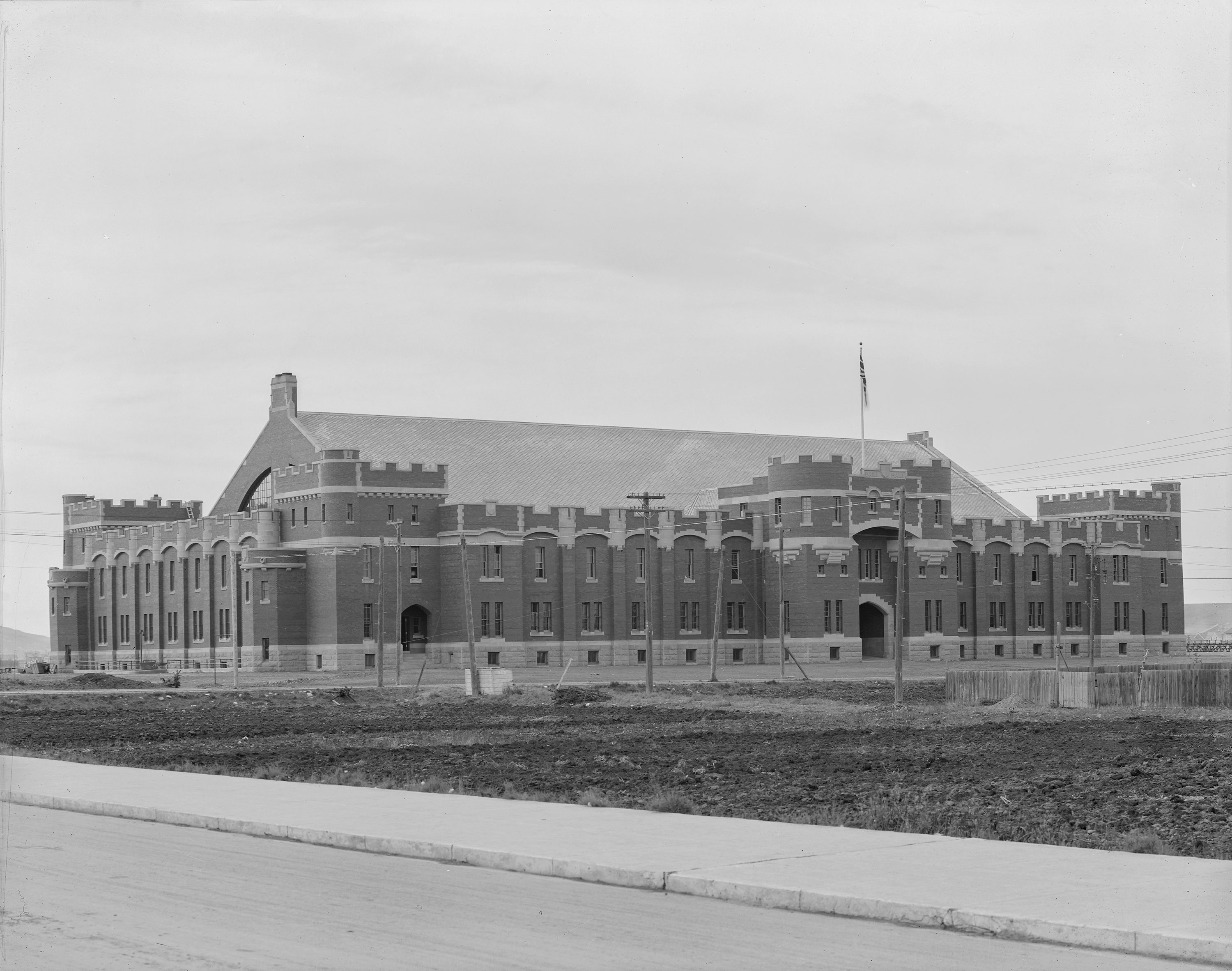
Mewata Armoury (Provincial Archives of Alberta, P.4017).

Plans for an elaborate armoury in Calgary were well underway prior to the outbreak of the First World War, as the need for a permanent, military training structure was apparent within the first decade of the twentieth century. The story of the construction of Calgary’s own armoury was a drawn out affair that lasted to nearly the end of the Great War. There were problems from the very beginning, including fierce opposition to the cost and chosen site of the armoury, a shortage of building materials and ultimately the outbreak of war. In the end, the result was a state of the art facility with a central drill hall surrounded by 117 rooms and complete with dining hall, shooting gallery and even a bowling alley. This post will examine the Mewata Armoury, a building that was established during the First World War, and its place as a significant symbol of military heritage in Alberta.

In the early 1900s, the Canadian military underwent a number of reforms to modernize it and establish permanent facilities for the army. The federal government set the ambitious goal to establish 350 new drill halls and the decision to construct these served a dual purpose. These structures were to foster a sense of military pride amongst Canadians while boosting recruitment and create a closer connection between civilians and soldiers. Calgary was considered part of Ottawa’s military expansion plan early on and the city became the headquarters for Military District No. 13 in 1907, which covered all of Alberta and the district of MacKenzie (a portion of the Northwest Territories at the time). This declaration was significant since it meant that the area was deemed to be an important part of the future of the Canadian military.

It was nevertheless the local military regiments, and not the federal government, that took it upon themselves to push for the construction of a new armoury. Calgary was growing rapidly in the early twentieth century and they felt they needed a facility to house their growing regiments. The city’s military organizations wanted a building that would better accommodate their soldiers and approached the federal government for approval to build an armoury in Calgary. Potential sites for the location were suggested over the next few years, but were all deemed insufficient and plans for the armoury were soon shelved.

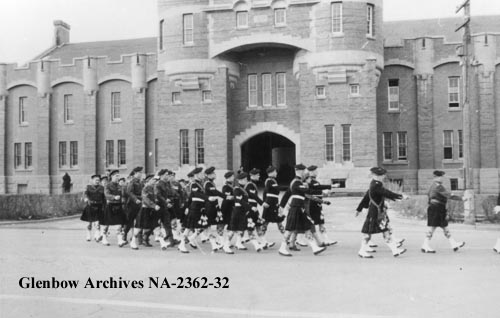
Calgary Highlanders pipe band parading by Mewata Armoury, Calgary, date unknown. (Glenbow Archives, NA-2362-32).

It was not until Sam Hughes was appointed Canada’s Minister of Militia and Defence in 1911 that Ottawa’s plans for a modern militia were put in motion. Hughes undertook the responsibility of reforming Canada’s military and his ambitious agenda included the construction of armouries and drill halls across the country. Hughes promoted the volunteer soldier as the foundation of the Canadian military and believed that volunteerism was the most viable form of recruitment. He was also a strong supporter of building a shared place for civilians and soldiers. This belief was reinforced by the need for an armoury, as it would serve as a visible presence to foster civic pride, and in turn, increase the number of soldiers who enlist. In addition to providing an adequate space for training, the new structures were to be a permanent symbol of Canada’s military reform program.

Another supporter of this vision was the Calgary Conservative MP, Richard Bedford Bennett. Bennett agreed with Hughes’ plan for an elaborate military structure and wanted Calgary to have its own armoury. One of Bennett’s first decisions upon taking office was to lobby the federal government to establish such a facility. Although the city already held a number of rented military buildings for training purposes and used school grounds for parades, these sites were spread throughout Calgary and it was considered more practical to consolidate these into a single location. The city also remained without a permanent indoor space for military training during the winter months. Bennett considered this to be inadequate for a growing city and the proposal for an armoury was revisited. It took minimal lobbying on Bennett’s behalf to convince Hughes that Calgary was worthy of a magnificent armoury and the funds were soon allotted to begin building.

When it came to deciding on the location for Calgary’s armoury, Bennett had just one area in mind, Mewata Park. The site was already being used as an athletic field and had originally been designated a civic park for the people of Calgary. The site was centrally located, which meant that it would be impossible for the structure to be missed by many Calgarians during their daily commute downtown.

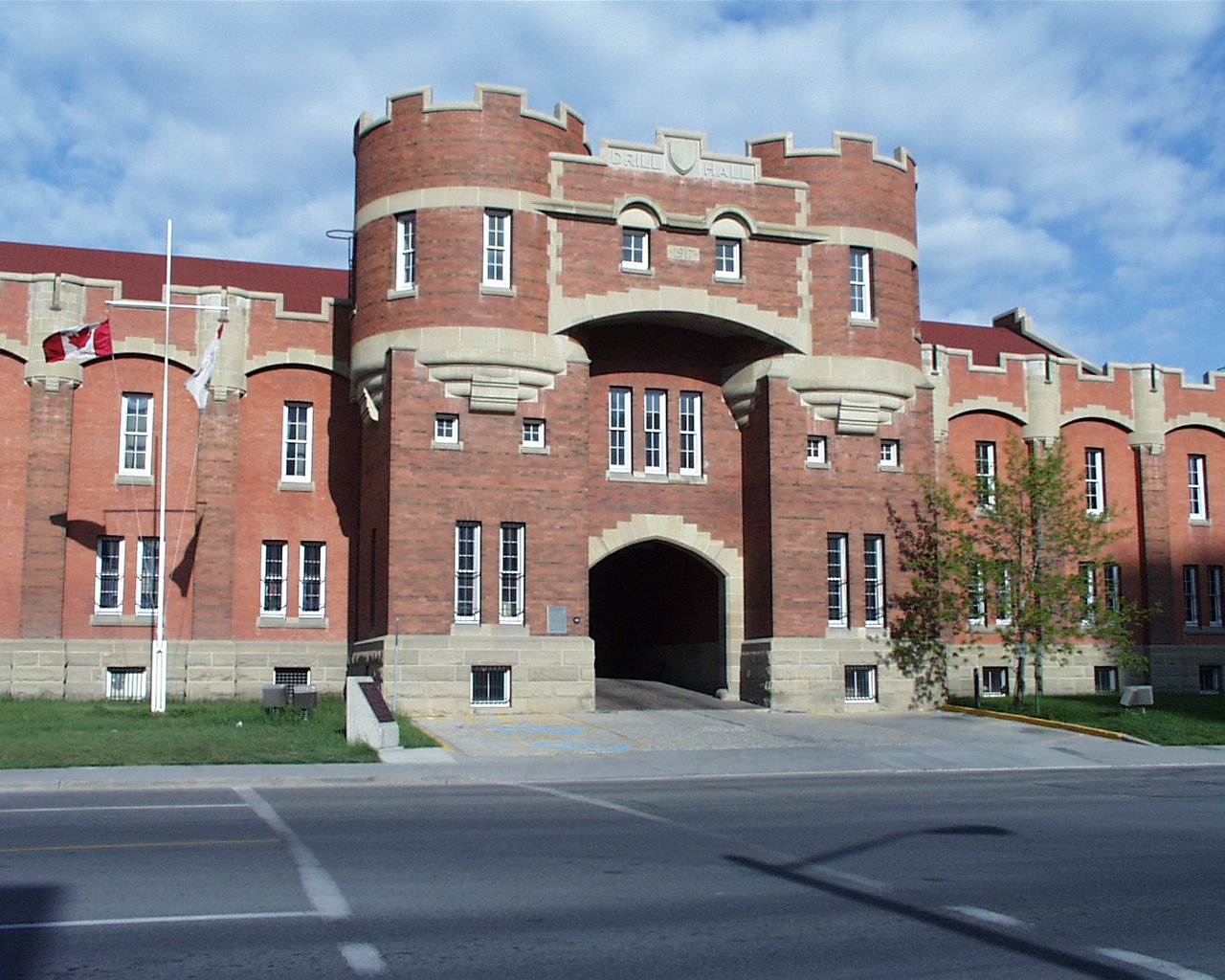
Mewata Armoury Provincial Historic Resource, Calgary. (Alberta Culture, Historic Resources Management Branch, 2000).

As the plans for the new armoury proceeded, the project was met with opposition, notably from Alberta Liberals, who felt that the federal government had no right to devote public land to a military institution. They also raised concern over the cost that would be incurred to construct the new building. The daily pro-Liberal newspaper, Morning Albertan, voiced their opinion against the construction of an armoury, citing that “an expenditure of such an amount would be a lavish and inexcusable waste of money.” However, this did not appear to be the sentiment of the majority of the citizens of Calgary. The opposition was soon squashed by people who came out in strong support of the armoury during the 1913 municipal election. This was a heated election issue that year and included a question on the ballot enquiring if citizens wanted to see the project move forward. More than 70% of voters were in favour of constructing an armoury at Mewata Park, indicating their support for the local military. In 1916, supporters were granted their request and the City of Calgary donated the land to the federal government to build the armoury.

The First World War erupted in August of 1914 and the armoury’s construction was therefore delayed for a few years. This was due to the city’s resources being allocated to more necessary and immediate projects for the war efforts. A brick shortage contributed to construction being deferred even further. Building was eventually underway in September, 1916 and was finalized in the fall of 1918. Once completed, the armoury was used as a training centre and demobilization depot for soldiers returning from WWI. Although it was too late for the armoury to be fully utilized for the war, the construction of an impressive military facility helped to encourage pride among its citizens.

Although the armoury’s interior has been remodelled substantially, the exterior has retained its original appearance as constructed in 1916. The building is one of only two similar structures in the province (the other being the Prince of Wales Armoury in Edmonton). The architectural design is a classic example of the gothic and Tudor revival, which was built to look like a fortress with its four corner towers and six smaller side towers. What makes the Mewata Armoury unique is its castle-like style, massive size and the use of brick and sandstone construction. This is one of the last buildings in Calgary that was created with sandstone.

Mewata Armoury remains a long-standing military landmark and shows the federal government’s commitment to a militia-presence in Calgary. A number of regiments have called the armoury home over the years, including the Calgary Regiment’s First Battalion (currently the Calgary Highlanders), the Second Battalion (now the King’s Own Calgary Regiment) and various cavalry units. Mewata Armoury has primarily been used as a military facility, but has also been a training centre for the police, a base for numerous Cadet Corps and is the headquarters for the Southern Alberta Militia District. Various sporting events have been held at the armoury and Mewata Park was still used as an athletic field. The armoury remains an important site, as it was constructed to connect the military with the civilian population, amidst the First World War.

This was the third part of a series commemorating the First World War. This series will look at a range of topics that will show Alberta’s involvement in this historic event.

Written by: Erin Hoar, Historic Resources Management Branch Officer

Sources:

Designation File # 177, in the custody of the Historic Resources Management Branch.

Lackenbauer, P. Whitney “Partisan Politics, Civic Priorities, and the Urban Militia: Situating the Calgary Armoury, 1907-1917.” Urban History Review 33, no. 2 (2005): 45-60.

Mewata Armoury” Alberta Register of Historic Places. HeRMIS. (Accessed August 12, 2014).

Rowe, Allan “Historical Context Paper Mewata Armoury (Calgary),” Historic Resources Management Branch, Des. File #177. (April 25, 2014).

Why I Miss the Local Elevator

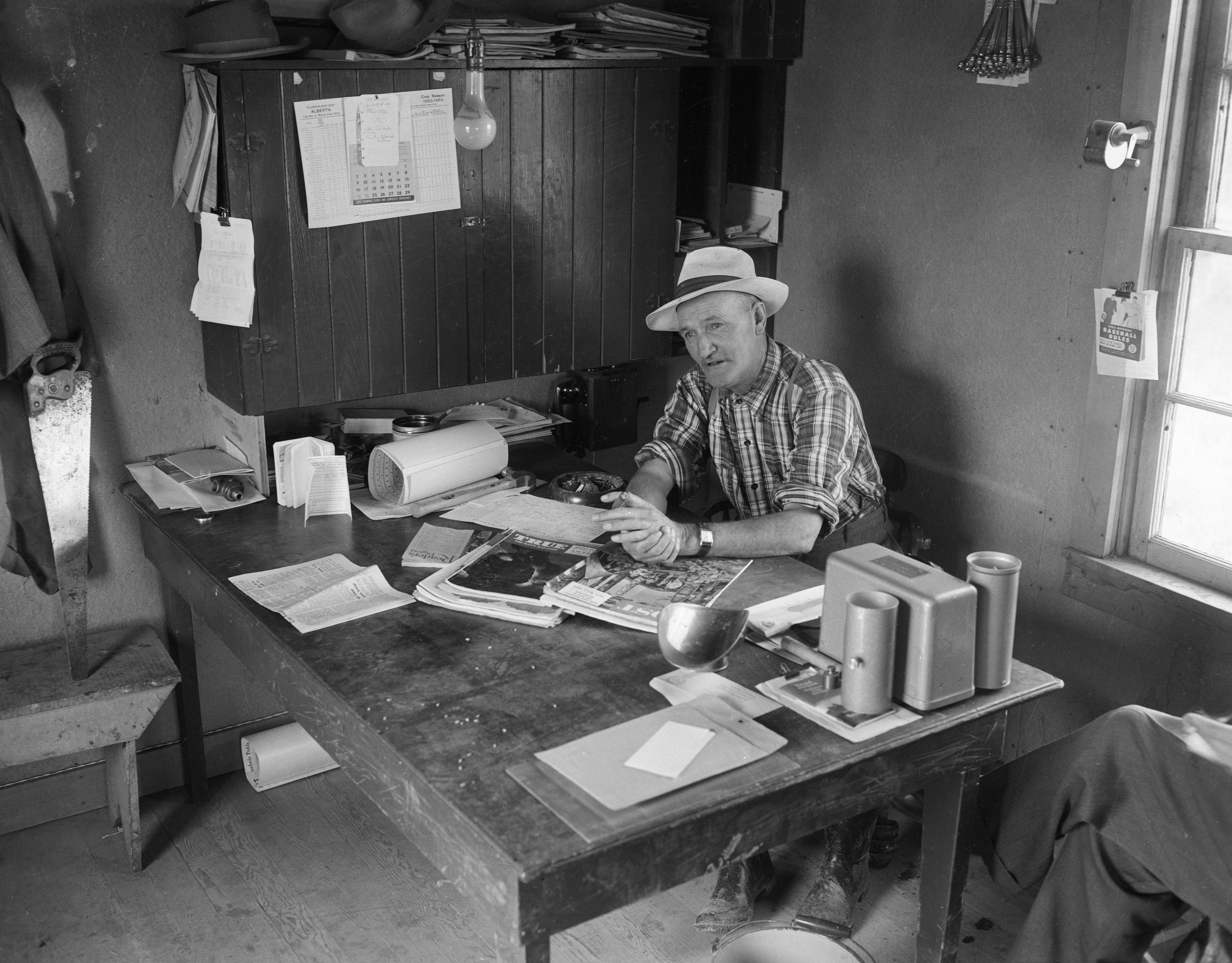
The elevator agent in his office was at the heart of the community, 1950s. (Glenbow Archives, Photo: Glenbow Archives, NA-4510-707.)

It’s when the grain is ripe for harvest in late August or early September that I miss going to our local Alberta Wheat Pool elevator the most. Jumping off the combine and going to the elevator to have its friendly agent, Bill, run a moisture test on a grain sample and discuss the state of the crop was one of my jobs on the farm. When I arrived in Alberta in the 1980s, drinking coffee and shooting the breeze with the neighbours while the elevator agent was busy, was part of the culture, but the old-timer grain farmers could smell change the air. How right they were.

Our closest local elevator, a single composite wood crib facility constructed in 1963, at Eckville, closed in 2001. Since then we rarely visit an elevator. Now we have our own moisture tester, analysis market conditions using the internet, and have our grain trucked from the bins in the yard to the inland terminal at Lacombe or further afield—selling grain over the phone and having it trucked to a concrete silo is not much fun!

Alberta Wheat Pool at Eckville, (Photo courtesy of the Alberta Heritage Survey 79-R0240-13.
Alberta Wheat Pool at Eckville (Photo courtesy of the Alberta Heritage Survey, 79-R0240-13.)

In past decades farmers were in and out of the elevator office in a rhythm that reflected the farmer’s seasonal activity. A major reason to go to the elevator was to update the permit book, which kept a record of the type, quantity and grade of grain delivered as well as the number of acres seeded to various grains, and the acreage assigned to each grain for quota purposes. Canadian Wheat Board regulations required that all grain sales, even to local users, be recorded in the permit book.

The permit book had its origins in the quota system on cereal grains introduced during the Second World War. Beginning with the crop year 1941-1942, farmers were only able to deliver limited amounts of grain, based on their acreage, at certain times. The quota system, administered by the Wheat Board, was designed to prevent the clogging of the grain handling system at a time when production exceeded available markets. It continued after the war in an attempt to give each producer an equal opportunity to sell his or her grain at the Wheat Board price for the crop year.

A farmer’s pay check and hence his loyalty to one grain company over another was ultimately determined by whether he could get space in the elevator to deliver his quota of grain. If there was room, some farmers preferred to haul to the Alberta Wheat Pool or United Grain Growers elevator, lured by the promise of patronage dividends on deliveries in relation to the companies’ profits for the year.

Many farmers made a point of being at the elevator office often, not only to find out what was going on but to establish a good relationship with the agent. They sometimes helped out when the agent was especially busy. In years when the harvest was plentiful, railway box cars were often in short supply and elevator storage space was limited, bonds of friendship, along with a reputation for reliable delivery and honesty might ensure one’s grain would be taken in before the neighbour’s.

There were a thousand and one reasons why a farmer might be at the elevator other than when he was delivering grain. He bought coal and flour throughout the year, seed in the spring and from the 1950s, fertilizer. He might be in to check prices, find out if there was space in the elevator for his grain or pick up a cheque for grain previously delivered. Farmers needed the use of the scale at the elevator for inter-farm grain sales, and the elevator agent usually obliged.

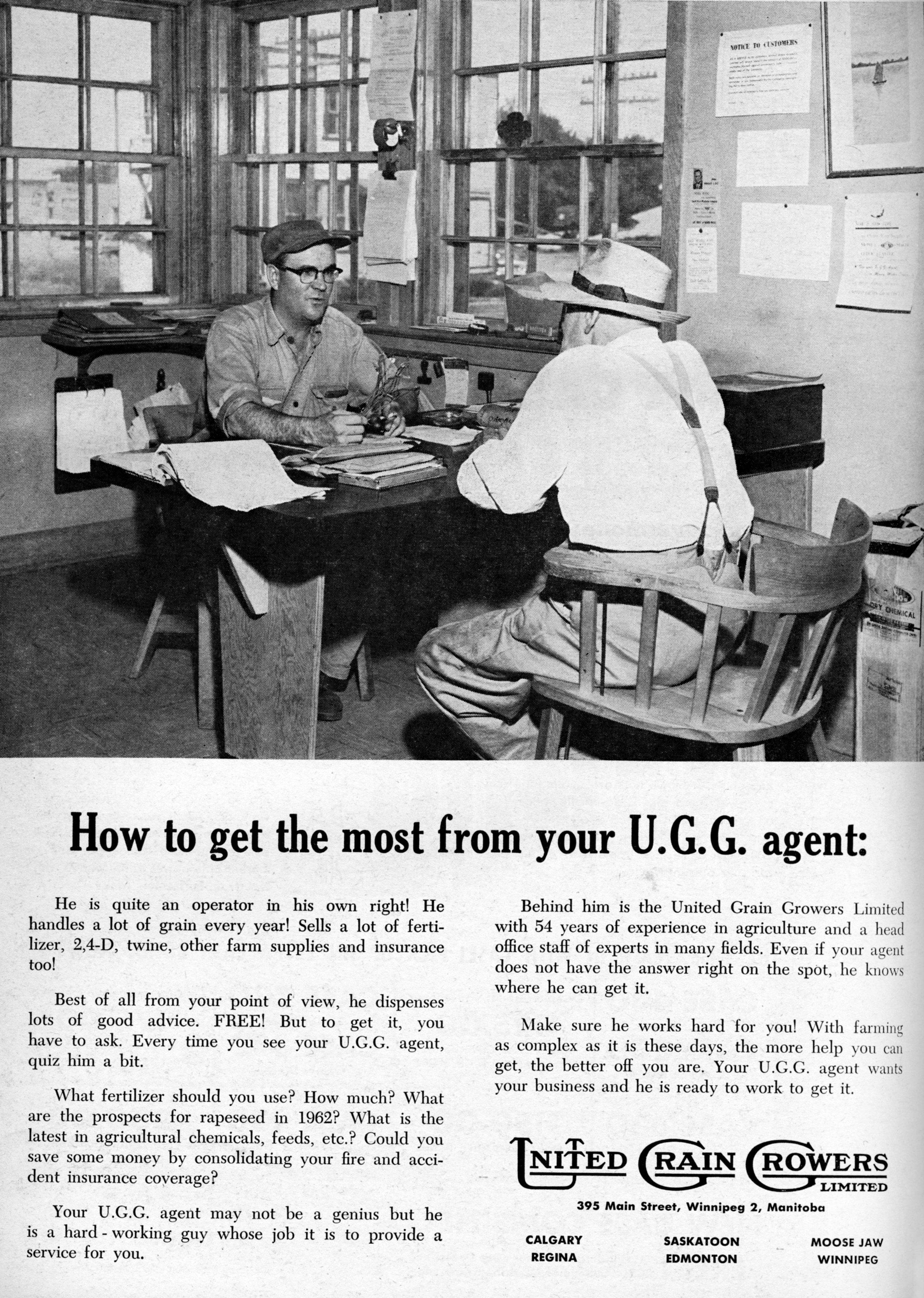
UGG promoted a new image of their agents as the dispenser of free advice: “How to get the most from your UGG agent,” Country Guide, August 1961, pag e 41. (Reproduced with the permission of the Glenbow Archives.)

There was no need for a business excuse to go to the elevator. On wet days farmers dropped in to see who else was there, play crib or just to complain about the weather. The elevator office was a good place to catch up on local gossip: who had bought a new tractor, who was selling out, who was renting land from who, and to gauge the relative condition of neighbouring crops, as well as shifting land and machinery auction prices.

Farmers gravitated towards the elevator they dealt with and elevator agents played host to groups of farmer-customers in their cramped offices during visits to town. The elevator agent, urged on by his company to network and increase sales, was part of the community, involved in social and sporting events. At Forshee, a long forgotten elevator siding between Rimbey and Bentley, Harry Proudfoot, a U.G.G. agent from 1946-1968, was a member of several athletic teams, and helped his farmer neighbours during haying season and other times when grain deliveries were slow.

Back in the 1930s when elevator agents often had the only radio in the district, broadcasts were a lure for farmers, who might hope to catch more than the day’s grain prices. In the 1990s farmer went to the elevator to catch the farm weather cast and to watch world-wide commodity trading on cutting-edge computers. The farmers gathered whiled away hours discussing every farming topic under the sun. The agent would go off to receive a load or two of grain, and they would often still be there when he returned from the driveway.

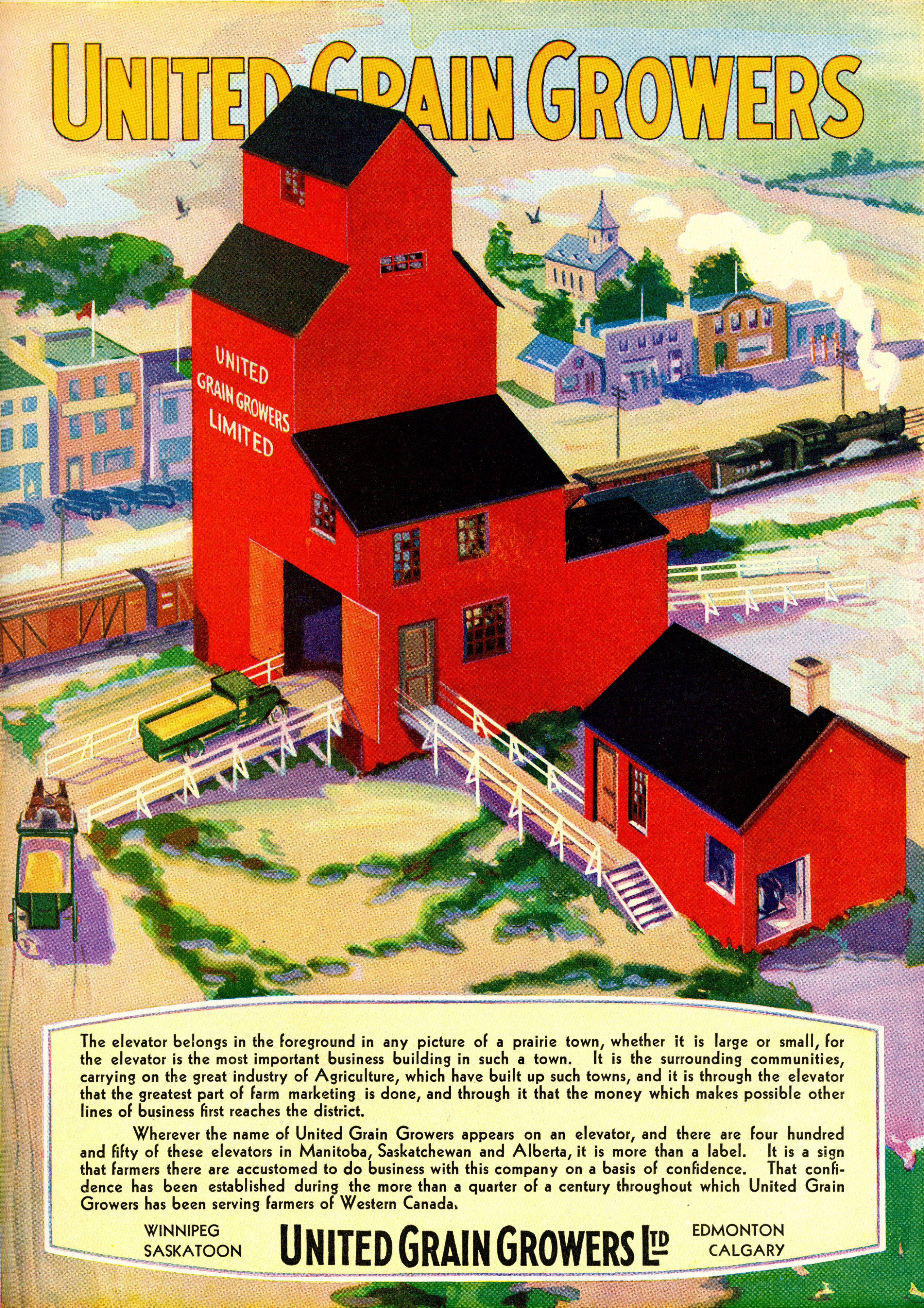
A somewhat idealized artistic perspective on the importance of the grain elevator to the business of the prairie town. Country Guide, March, 1933, page 10, (reproduced with the permission of the Glenbow Archives.)

From the mid-twentieth century, much of the farmer’s economic news, social connections, information about the latest cropping practices, and even family activities and entertainment came through the elevator office as grain companies vied to be foremost in the farmers’ lives and keep their business. All grain companies, especially the farmer-owned Alberta Wheat Pool and United Grain Growers, pushed the image of the grain elevator as the stable symbol of rural life.

It ended for us in 2001. We knew it would happen. We saw elevators topple all over the province after 1995. When Eckville went down in a cloud of dust we did not go to watch. Now in 2014, the Canadian Wheat Board is no more: there are no quotas, no permit book. We market our own grain. Like so many others in the farming community we have lost a connectedness with fellow grain producers and direct involvement with the grain handling system that really was centred in the elevator office.

Written by: Judy Larmour.

Trick or Treat, Halloween in Alberta

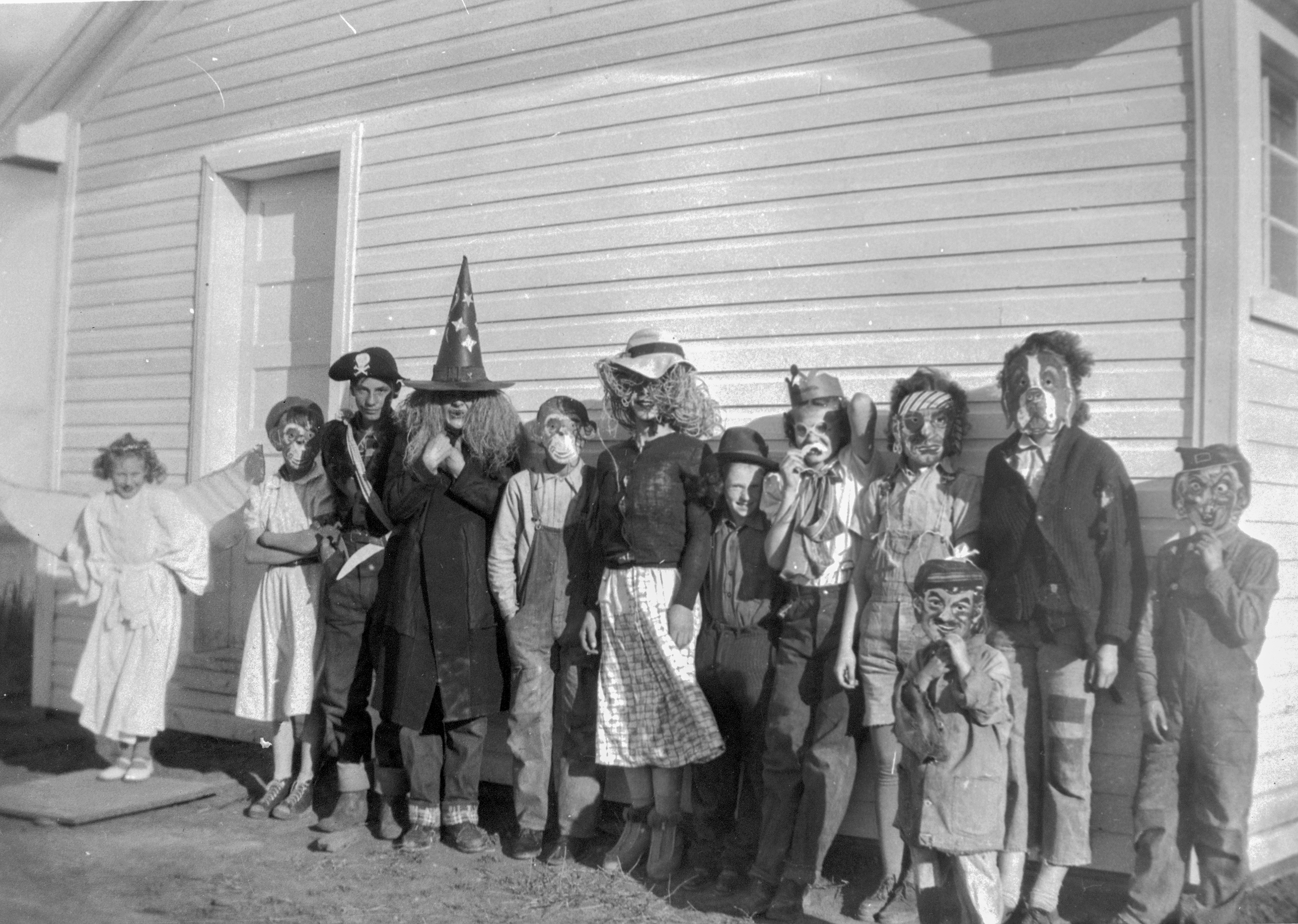
Halloween is tomorrow. I wanted to take this opportunity to look back at the different ways Halloween has been celebrated in Alberta since the late nineteenth century. Early newspapers offer a fascinating window into how we celebrated Halloween, ranging from private and public parties, to ‘trick-or-treating’ and pranking.

Halloween at the Wineglass Ranch near Brocket (1907-08). Courtesy of the Glenbow Archives, NA-4035-188.

Like most holidays, Halloween is a fusion of ancient and modern traditions. Halloween traces its origins back thousands of years to the Celtic festival of Samhain (October 31 – November 1), which marked the start of the Celtic New Year. It was believed that the boundary between the physical and supernatural worlds broke down during Samhain, and spirits, ghosts and fairies could cross over and walk the earth. The festival was Christianized in the ninth century becoming ‘All Hallows Day’ (November 1, now generally called ‘All Saints Day’). Though Christianized, many of the customs associated with Samhain endured, particularly among the Celtic peoples of Ireland, Scotland and Wales. These cultural traditions were brought to North America by waves of immigrants and evolved into what we know today as Halloween.

From the start Halloween in Alberta was marked by “general nuisance” and “sundry pranks,” such as soaping windows, unhinging gates, or moving property. Reporting on Halloween in Innisfail in 1897, the Calgary Herald noted that “several small buildings took the usual trot around town during the evening.” Generally speaking, these items were left where they could be found – the goal was to create a nuisance, not to steal. Occasionally, however, people were left searching for their property the next day. In 1925, a farmer posted a notice in the Red Deer News requesting that the “Halloween revellers” who removed his garden gate “kindly return the same forthwith or indicate…where they have taken it.” Carriages and cars were also popular targets for Halloween pranksters, who enjoyed taking them for a joyride. Such tricks occasionally had unforeseen consequences: One prankster in Rockyford, for example, got more than he bargained for in 1919 when he took a car for a joyride, only to find that there was a baby asleep in the backseat. After a frantic half-hour of searching, the car was found abandoned at the town’s bank, and the baby was found “fast asleep as if nothing had happened at all.”

Aftermath of Halloween pranking in Airdrie (1930s). Courtesy of the Glenbow Archives, NA-598-12.

The boundaries of acceptable behaviour on Halloween were quite clear – pranks that could be rectified with minimal expense or effort were considered harmless fun, but any destruction of property was strongly condemned. The Edmonton Bulletin commented in 1912 that Halloween was a “recognized night of immunity from punishment” for pranksters, provided that “no serious depredations were committed.” Similar comments from newspapers across Alberta suggest a broad tolerance for relatively benign pranks, though it is also clear that this tolerance had limits. Halloween in Edmonton in 1917, for example, was marked by significant destruction of property – Chinese laundries were targeted for vandalism, sidewalks were torn up, and many fences and outbuildings were heavily damaged or destroyed. The Edmonton Bulletin expressed indignation at the night’s events, denouncing revellers as “youthful marauders” and commenting that their actions had “quite passed the limits of joking.” The Raymond Recorder struck a similar tone in a 1932 editorial pleading for a “Sane Halloween.” “Why is there any amusement in destroying private property?” asked the clearly frustrated editor, who issued a rather ominous warning to potential troublemakers: “any person who is the victim of meddlesome pranks on Halloween night…is quite within the law in protecting his property, and if anyone is hurt, the trespasser is entirely at fault.”

It is also clear from newspaper coverage that different standards of behaviour were expected from boys and girls. Minor social disorder on Halloween was clearly viewed as a by-product of youthful exuberance and a rite of passage –for boys. Most newspapers were very clear that Halloween pranks had been carried out by “the boys of the town” or “the male portion of the population.” In 1914, the Didsbury Pioneer urged the “boys and girls” to “conduct themselves properly in their fun and not damage other peoples’ property,” but such statements explicitly suggesting that girls participated in pranking are very rare. The extent to which girls actually took part in Halloween disorder is unclear, but such behaviour would clearly have not been socially acceptable.

Trick-or-treating near Little Smokey River (ca. 1950). Courtesy of the Provincial Archives of Alberta, A15910.

For those Albertans who wanted no part in pranking, Halloween offered many other opportunities for celebration. Archival photographs and newspaper stories reveal that private costume parties have been a part of Halloween fun in Alberta since the late nineteenth century. Similarly, a wide range of clubs and societies hosted costume parties for their members. The Edmonton Caledonian Society pointed with satisfaction to the Celtic roots of the holiday, inviting its members in 1908 to “celebrate this old-fashioned Scottish festival” (as late as 1919, the city’s Scots were promoting Halloween as a “peculiarly Scotch night”). During World War One, Halloween balls doubled as fundraisers for causes associated with the war effort, such as the Red Cross and the Returned Soldiers’ Fund. Such events offered people a respectable way to celebrate Halloween, free from any association with pranking or social disorder.

The most famous activity associated with Halloween, of course, is ‘trick-or-treating.’ The practice of going door-to-door in costume asking for food may echo cultural traditions that date back hundreds of years to the British Isles. The use of the term ‘trick-or-treat’ – and the implied promise that giving youth a treat will stop them from taking your carriage for a joyride – appears to be a North American phenomenon. “The kids are expected to be out in full forces on their quest for Halloween treats” remarked the Western Globe in 1938, “and the old cry of ‘Trick or Treat’ will be the password.” The popularity of ‘trick-or-treating’ took off after World War Two, and the annual custom anchored itself as the most characteristic practise associated with Halloween night.

From the ancient customs of Celtic Britain to the practise of dressing up and collecting candy from strangers, Halloween has undergone a significant transformation over the past several thousand years. However you choose to observe the day, have a safe and happy Halloween!

Written by: Allan Rowe, Historic Places Research Officer.

Sources and Further Reading

Peel’s Prairie Provinces, Digitized Newspaper Collection.   http://peel.library.ualberta.ca/newspapers/

Rogers, Nicholas. Halloween: From Pagan Ritual to Party Night. New York: Oxford University Press, 2002.

Santino, Jack. “Halloween in America: Contemporary Customs and Performances.” Western Folklore 42,1 (January 1983), 1-20.

Preserving the Past at Writing-on-Stone

Writing-on-Stone Provincial Park is nestled into the winding valleys and coulees along Milk River in Southern Alberta. Painted and carved on its fragile sandstone walls are one of the largest collections of rock art in North America. Appropriately named, Writing-on-Stone is a rocky canvas of ancient and historic art that spans many centuries.

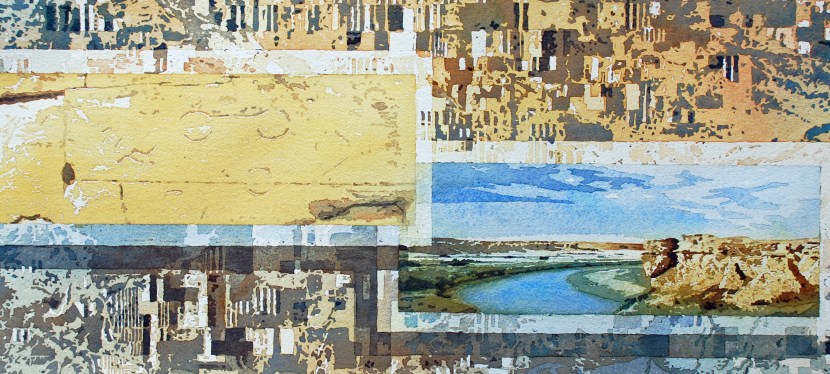
To increase awareness of this unique piece of the past and to encourage the preservation of sensitive historic resources, a collaborative team of the Historic Resources Management Branch, the Royal Alberta Museum, and the University of Alberta initiated the Heritage Art Series project. The goal is to create artwork, like the piece depicted above, that captivates the public in order to encourage the appreciation and protection of Alberta’s past.

Rock Art in Alberta

Alberta’s rock art includes pictographs (paintings), petroglyphs (engravings), carved boulders, and effigies (rocks arranged to form shapes). Art that was applied to rock walls has a variety of functions and there are six major types in Alberta.

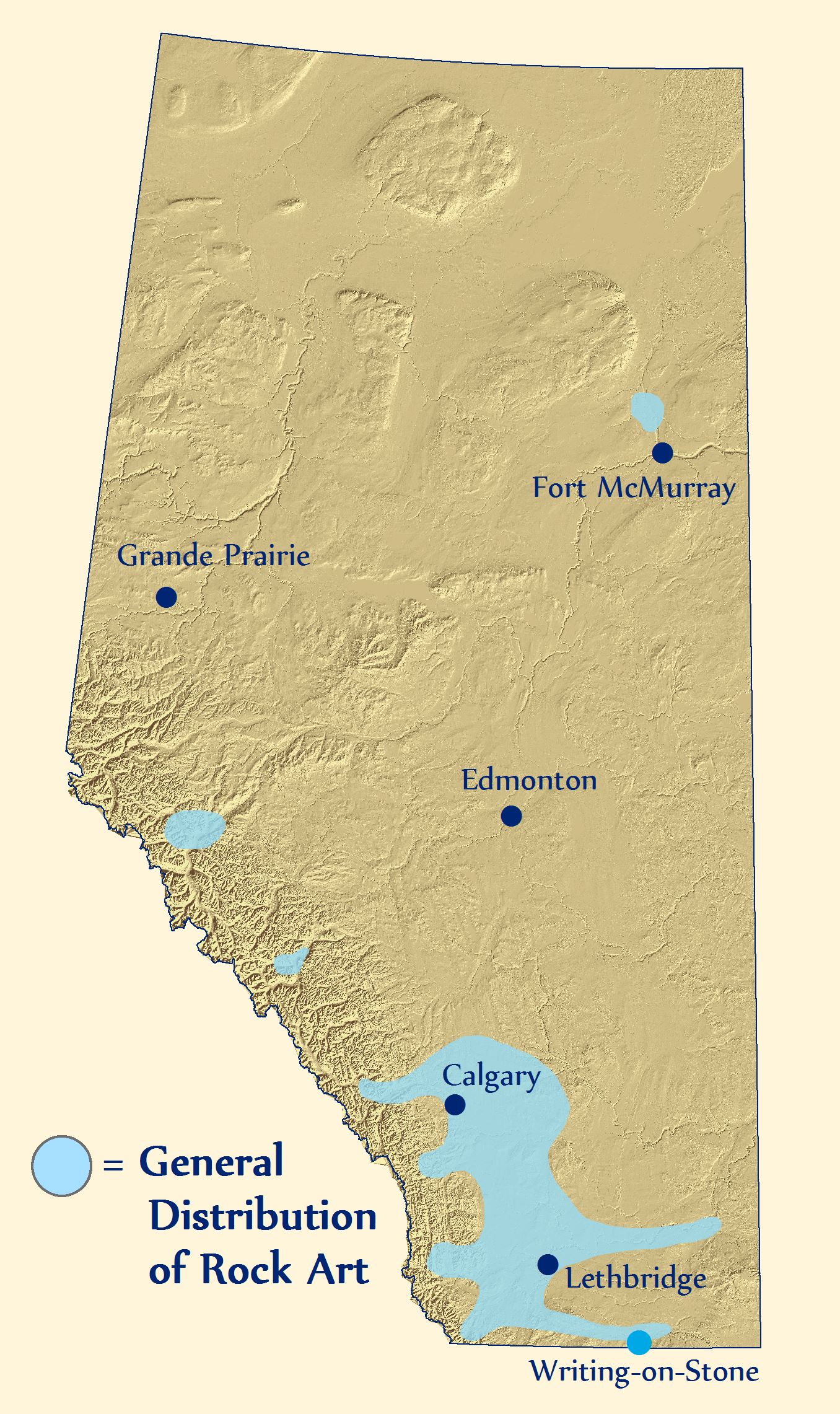
Rock Art Map
This map depicts the general extent of recorded First Nations rock art in Alberta.


‘En Toto Pecked’ involves figures that were entirely pecked out of the rock wall and this tradition of art appears in Alberta from 2500-1500 years ago. It is thought to have originated in Wyoming.

‘Vertical Series’ may be a type of rock art that acted as a communication system that related events and actors. It may be ideographic (like Egyptian hieroglyphs) with name glyphs like the Mayans of Central America.

‘Columbia Plateau’ refers to vision quest or hunting ritual art thought to be made by people originally from interior B.C. This style of rock art ranges from a few hundred to several thousand years old.

‘Foothills Abstract’ is a rock art style that consists of enigmatic shapes and motifs that may be the work of religious figures. Subjects include handprints, animals (and their tracks), and stylized humans.

‘Plains Biographical’ refers to rock art that documents events, important figures, or tallies of things acquired/exchanged by the Blackfoot and their ancestors.

Lastly, ‘Plains Ceremonial’ refers to spiritually important rock art that is still of great significance to modern Blackfoot Nations. Out of respect for the power of these and other rock art images to modern First Nations, photographs of the various styles of rock art are not included here.

The Milk River Valley Through Time

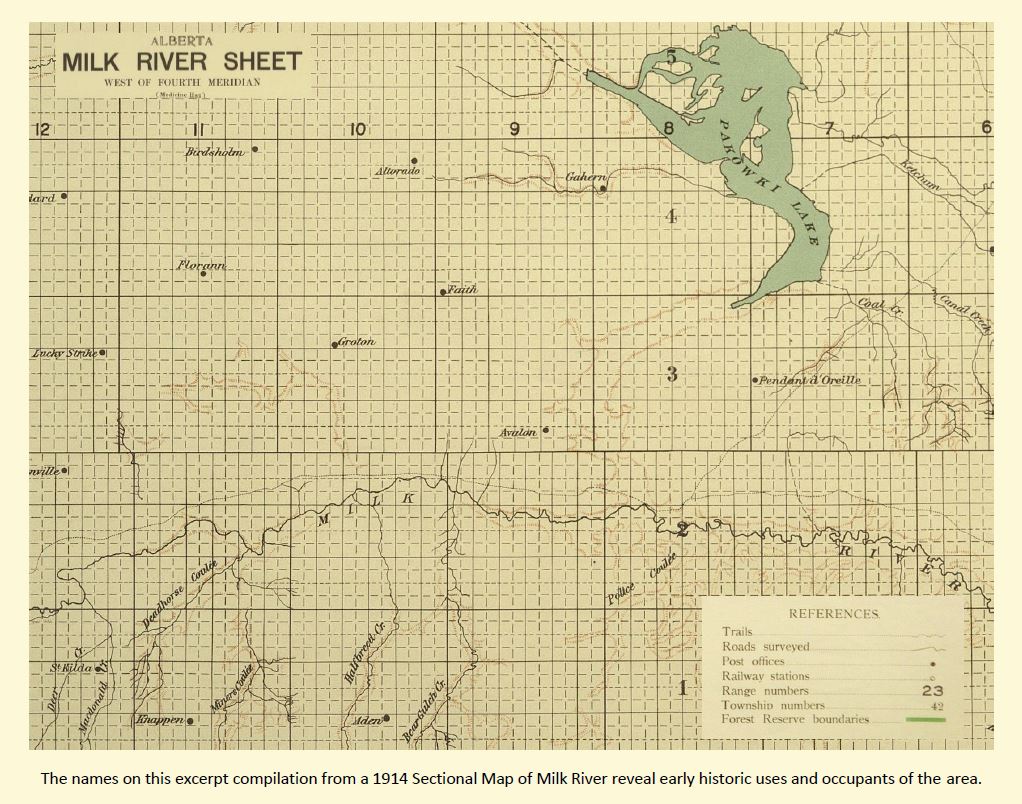
First Nations pursued buffalo herds in the Milk River region and view the valley as a sacred place where stories and dreams were recorded on the rock walls. The earliest Europeans included a mix of traders, coal miners, and Northwest Mounted Police, the early history of which is still recorded in modern place names.

Milk River valley map


Milk River Valley photograph

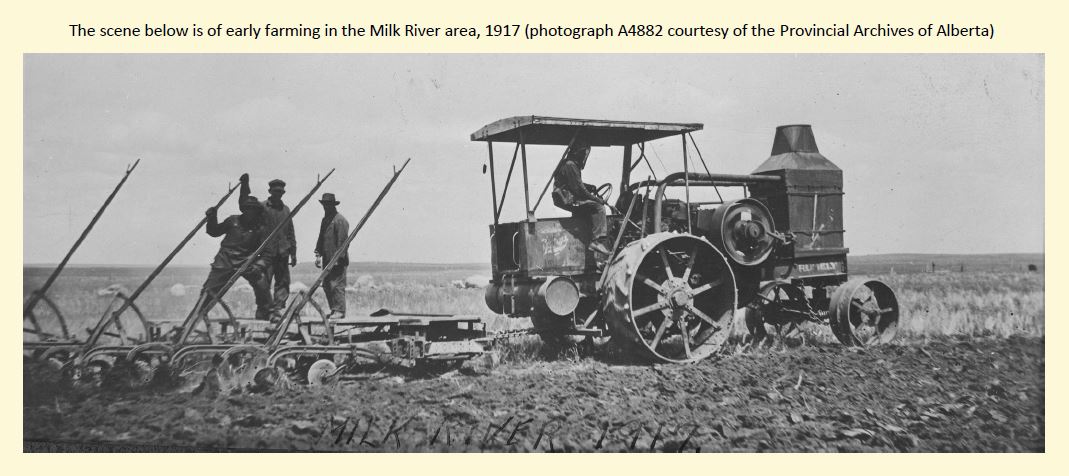
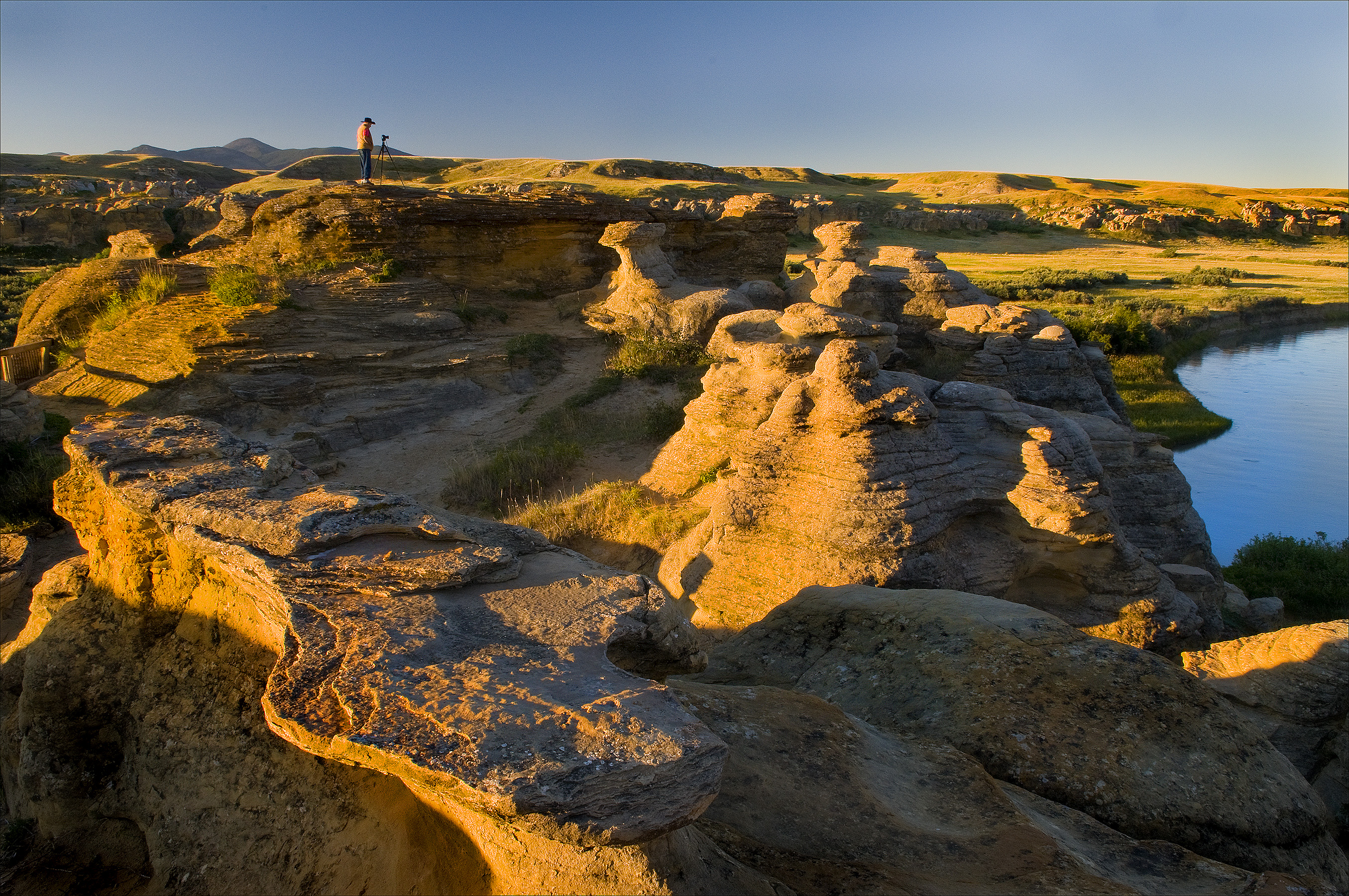
Cattle quickly replaced a vacancy left when buffalo were eliminated in the late 1800s. In addition to ranchers, new irrigation techniques and canals opened up the area to more intensive cultivation. Modern users of the Milk River landscape include farmers, Kainai First Nations, oil and gas operators, ranchers, and people in the tourism industry associated with Writing-on-Stone Provincial Park and National Historic Site (the photograph below is of the morning light on the park’s sandstone hoodoos, courtesy of Robert Berdan). Just as the uses of the Milk River region have changed in the past, they will continue to evolve in the future.

Writing-on-Stone photograph

The above painting by Anne McCartney is a textured narrative of landscape change in the Milk River Valley. The background is from an aerial photograph showing irrigated fields creeping to the valley’s edge. At lower right is a looming sandstone cliff that has witnessed a steady flow of First Nations, traders, miners, explorers, and farmers passing through the valley. In the upper left is a rock art panel depicting a battle scene from the deep past. Recent vandalism of that very panel highlights the need to protect and appreciate the landscape of Writing-on-Stone.

Protecting Rock Art Landscapes

The evocative and significant collection of art at Writing-on-Stone is under constant threat. Sadly, vandalism and graffiti have defaced some of the park’s art but through education and restricted access, much of the vandalism has now been curtailed. Instilling visitors with a healthy respect for the spiritual importance of the area to the modern Blackfoot will help ensure that the landscape is protected. Natural erosion, however, is unstoppable.

Much rock art has disappeared over the centuries from weathering of soft sandstone. New technologies are helping to better document the art and may lead to long term methods that slow rates of erosion. The park has been a key site in North America for experimentation with techniques to protect rock art.

Laser scanner
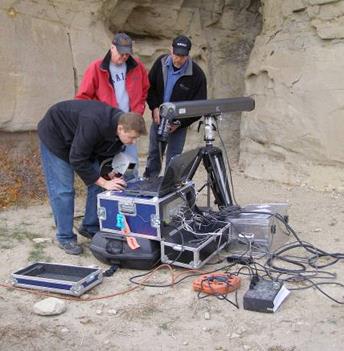
Archaeologists use laser scanners to accurately record rock art panels.

Portable laser scanners have been used to record high-quality images and to produce near-perfect replicas. Artificial drip-lines and plastic caps are diverting water from some exposed panels and a consolidant has been applied in experimental non-rock art locations to test the ability to strengthen rock and prolong the life of rock art images. Note that none of the preservation measures will be applied directly to ancient images without thorough review and cooperation with the Blackfoot people. Rock art left in its natural setting will eventually be lost, but there is much that can be done to enable a prolonged period of appreciation and enjoyment from viewing the hopes and dreams of early artists.

Written by: Todd Kristensen, Northern Archaeologist, and Jack Brink, Royal Alberta Museum

Radway’s Once Thriving Flour Mill

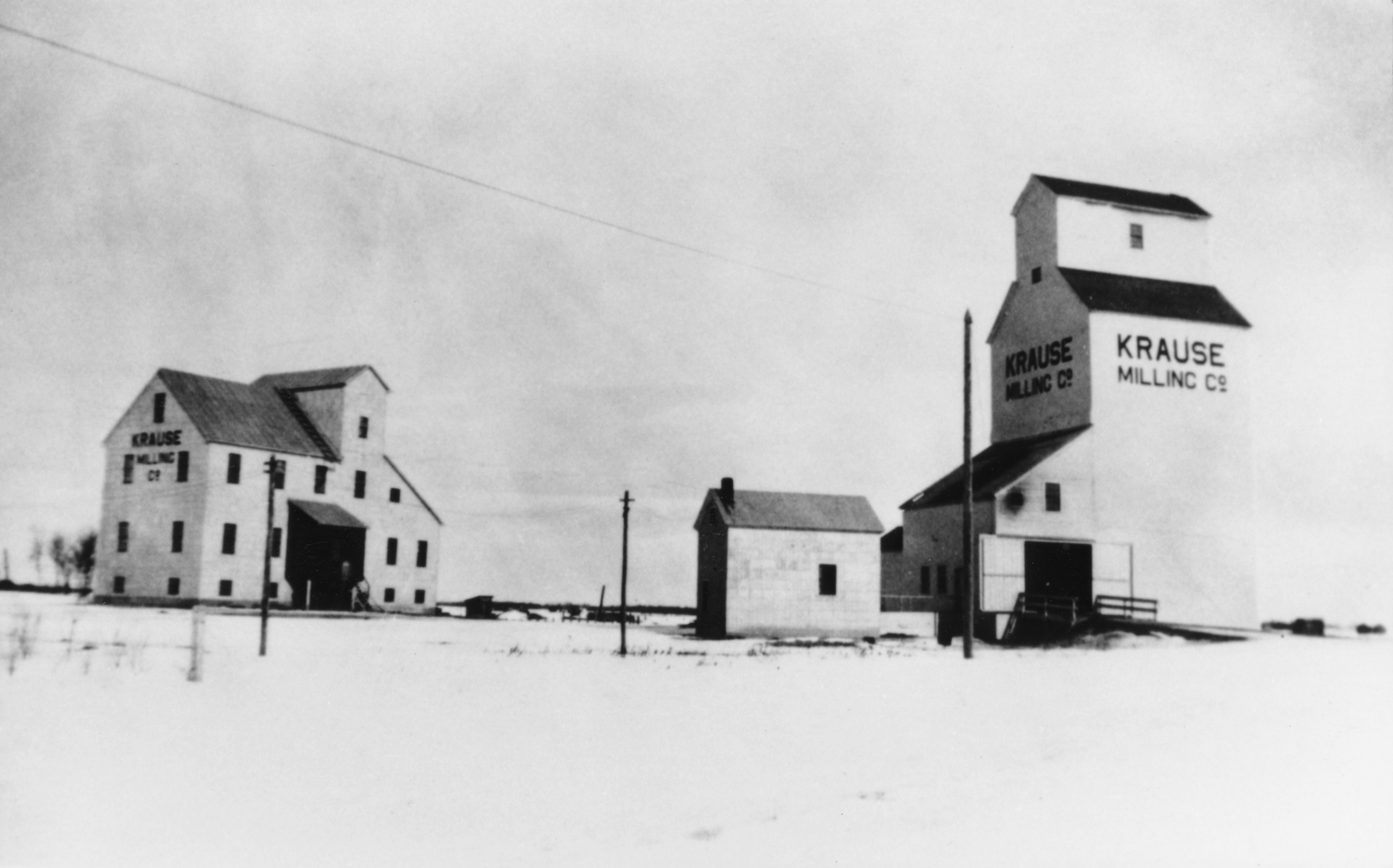
Radway is home to the 1929 Krause Milling Company Grain Elevator. Beside the elevator are the foundations of a once thriving flour mill: together with the elevator it was part of a grist mill operation located on a spur line from the main C.N. line. The mill exemplified the independent local flour milling industry that accounted for nearly one third of Alberta-milled flour in 1937. It was first licensed to produce 125 barrels (11,136 kg) of No. 1 flour per day.

The Krause Milling Company Elevator and Flour Mill, at Radway. (Photo courtesy of the Radway and Area Historical Archives Association Archives.)

Withold Krause, a second generation Alberta grain buyer and miller, who owned several other elevators and a flour mill in Leduc, built the elevator to his own design, and then began construction of the mill, which opened in 1931.The mill was a sturdily-built rectangular three-storey frame building clad with tin sheeting painted white. A basement addition on the northeast corner housed the diesel engine that ran the machinery and the steam boiler that heated the mill. The main line shaft to drive the roller mills ran beneath the first floor.

Withold Krause designed the flow line (machinery layout) inside the mill to give a flow of about 25 bushels of wheat an hour. The first floor, with solid 3 by 10 plank Douglas fir flooring, housed the tempering bin, the roller mills, and also the bagging chutes where the refinedflour ultimately finished its journey. Bags of flour were stacked for sale or collection on the east side of the first floor. The entrance to the mill and the loading platform were on the south side facing the elevator. On the second floor were the scourer and the centrifugal cloth sifters. The third floor housed a holding bin for wheat, the cylinder where the wheat was washed, and the final sifter.

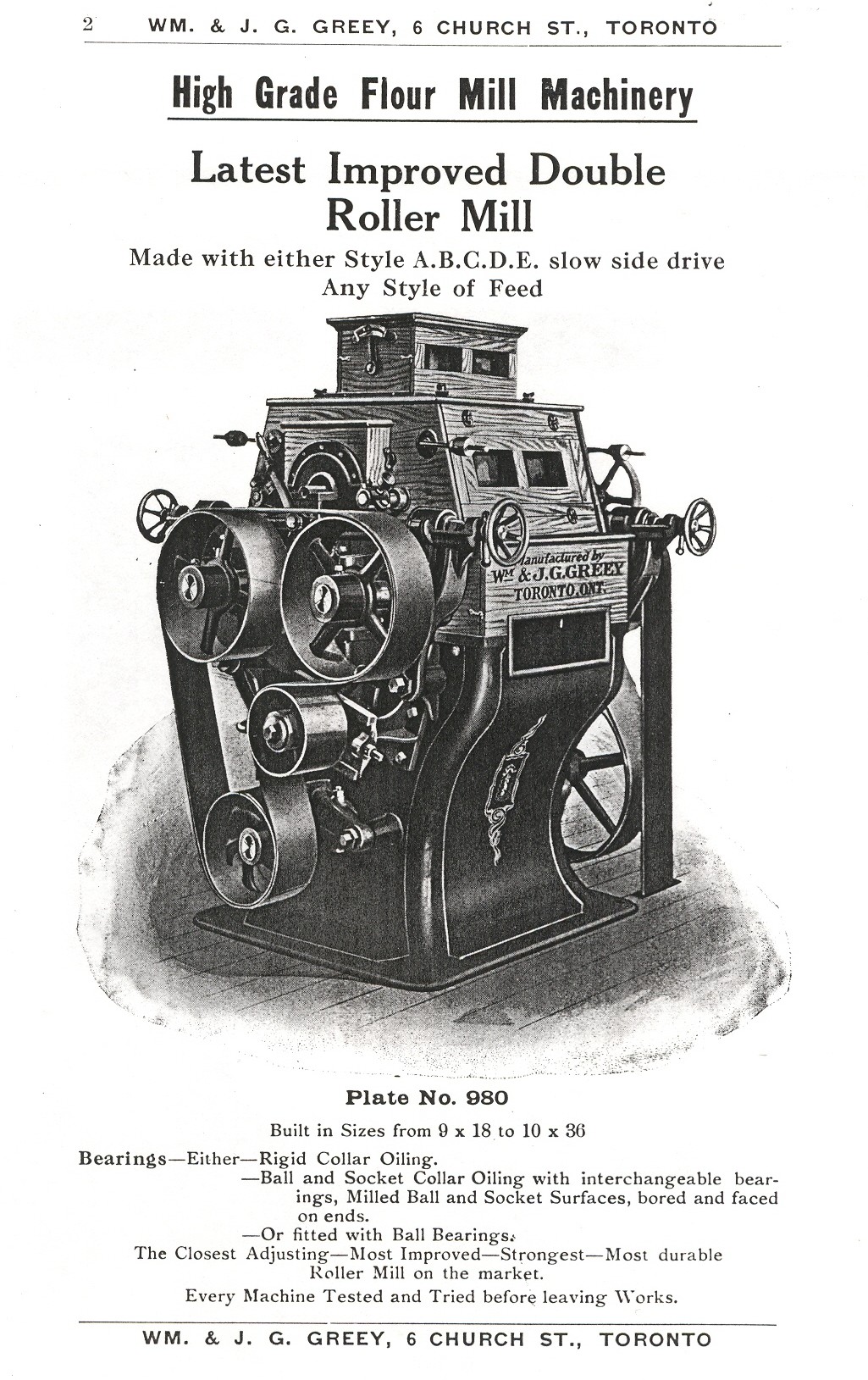
Roller mills of the type used in the Radway Mill. (Image courtesy of the Radway and Area Historical Archives Association Archives.)

Milling involved a number of steps before flour was produced. Wheat cleaned in the elevator was hauled to the mill to be scoured, washed, tempered and sent to the roller mills. The wheat was run through five roller mills referred to as breaks: each ground the wheat more finely. Each roller mill was connected with a sifter for bolting (refining) the stock (the wheat after the first break). A system of numerous small elevators (cups attached to webbing fabric moving inside wooden chutes), moved the stock between machines and from floor to floor. The flour produced was given a final sifting and bagged. Krause ordered plan white bags without the company’s logo during the height of the depression as so many people wanted to reuse the fabric for clothing.

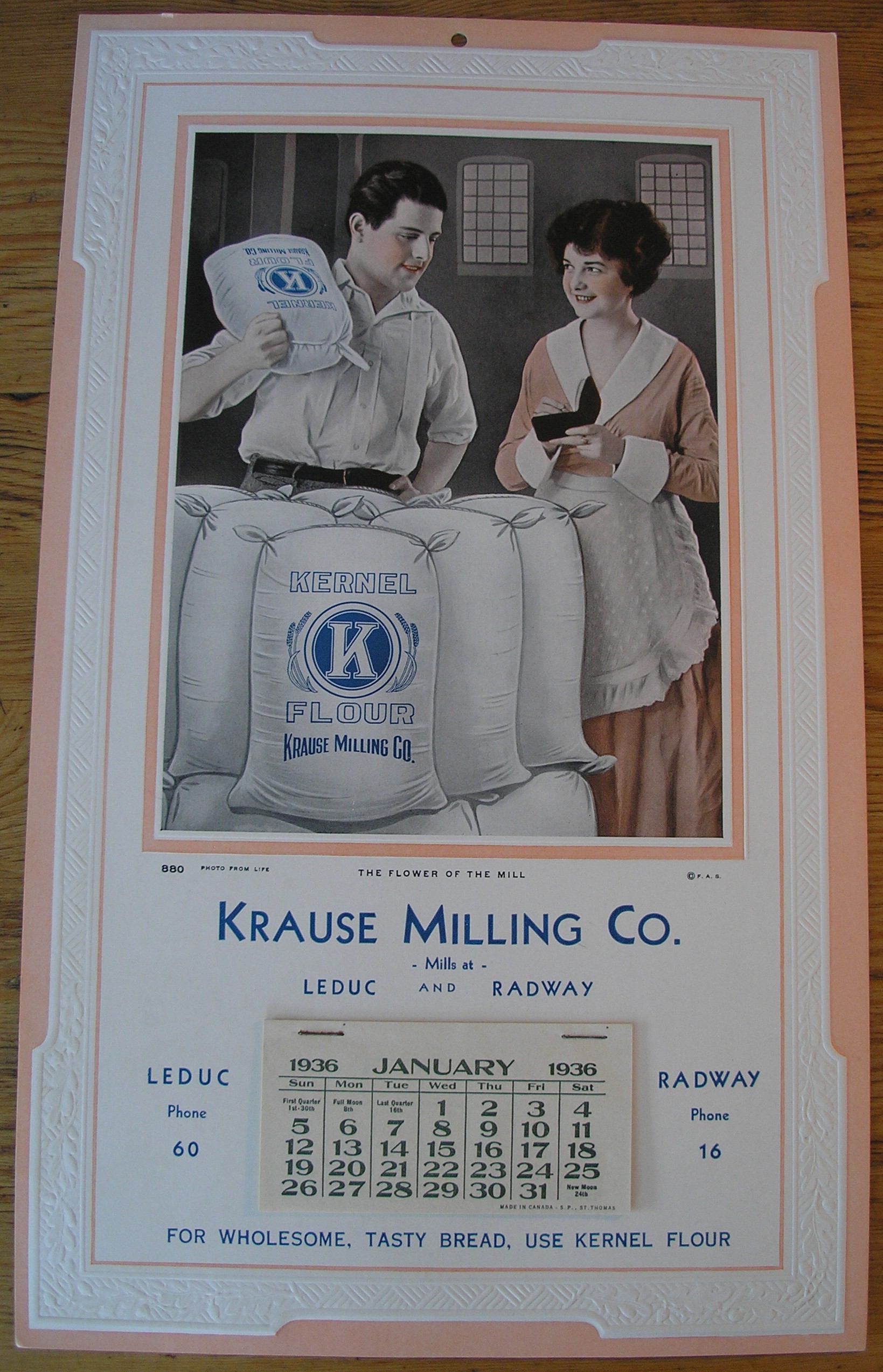
In the 1930s Krause operated mainly as a grist mill; he took in farmers’ grain at his elevator and they took home its value in flour and by-products such as shorts and bran, picked up at the mill door. Swapping wheat for flour appealed to farmers in a cash-strapped economy. At Radway the farmer did not actually get his own wheat ground. His load of wheat, weighed and graded at the elevator, was given a value in terms of Number 2 Northern Wheat (milling grade) and he was entitled to the flour products from this amount of wheat less a gristing charge of 25 cents per bushel. In his best years, 1932-1933, Krause cleaned about 50,000 bushels of wheat in his elevator and milled it into number one “Kernel” flour and “Creamo,” cream of wheat cereal.

Withold Krause promoted Kernel brand as just as good as the purest of white flours produced by the large milling companies. (Image courtesy of the Radway and Area Historical Archives Association Archives.)

Krause operated the mill during the day time, which was just as well for the village as the mill was powered by a thundering Fairbanks-Morse two-cylinder, two-cycle, 120 horsepower diesel engine. As the engine burst into life, Krause’s son, Vernon recalls  “the whole town would shake.”

During World War II, as flour mills in Europe shut down and flour was urgently needed for the war effort, Krause and other millers had limited access to wheat. The Canadian Wheat Board allowed small millers a subsidy on flour sold domestically to compensate, so Krause concentrated on milling for sale, selling in Edmonton and from the mill door.

After the war Krause sold the mill. From 1949 Fred Weder operated the elevator and flour mill business under the banner of the International Grain Company and Radway Flour Mills, respectively. There was a big change in how the mill was operated. Weder ran the mill 24 hours a day, six days a week, producing 140 pound (64 kg) jute bags of low quality unbleached flour for export to countries in the Far East starving due to the ravages of World War II.. Weder shifted the huge diesel engine aside and installed an electric motor. The mill started up at the flick of a switch, and ran quietly ensuring Radway residents got some sleep!

Three two-man teams—a miller and a helper/bagger—operated the mill in eight hour shifts around the clock. More workers were needed to haul clean wheat from the elevator to the mill and load the bags into railcars. The mill crew, mostly local young men, lived in a bunk house nearby. They pushed out at least three box cars of flour a week, over triple the production of the Krause years.

This new level of production took its toll on the flour mill. By 1953 the milling rollers had been pushed to their limit and all the equipment was in need of overall. Fred Weder closed the operation and put the mill up for sale. There were no buyers, and eventually it was dismantled for salvage. Today, the Krause elevator, the only remaining country elevator in Alberta that is associated with the flour milling industry, stands alone next to the foundations of the mill that it once supplied.

Written by: Judy Larmour.