Written by: Todd Kristensen, Archaeological Survey of Alberta
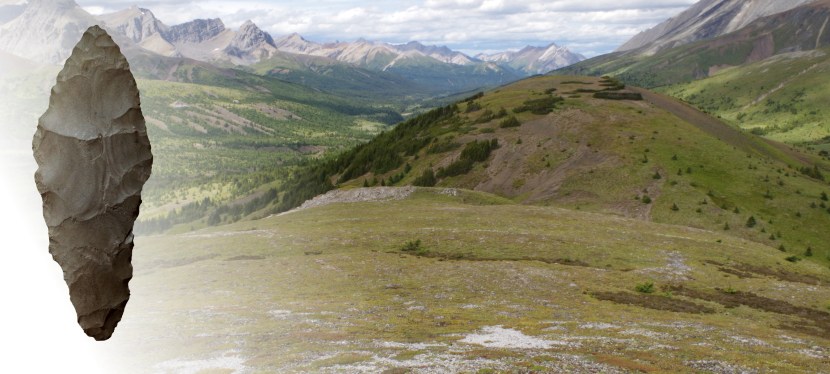
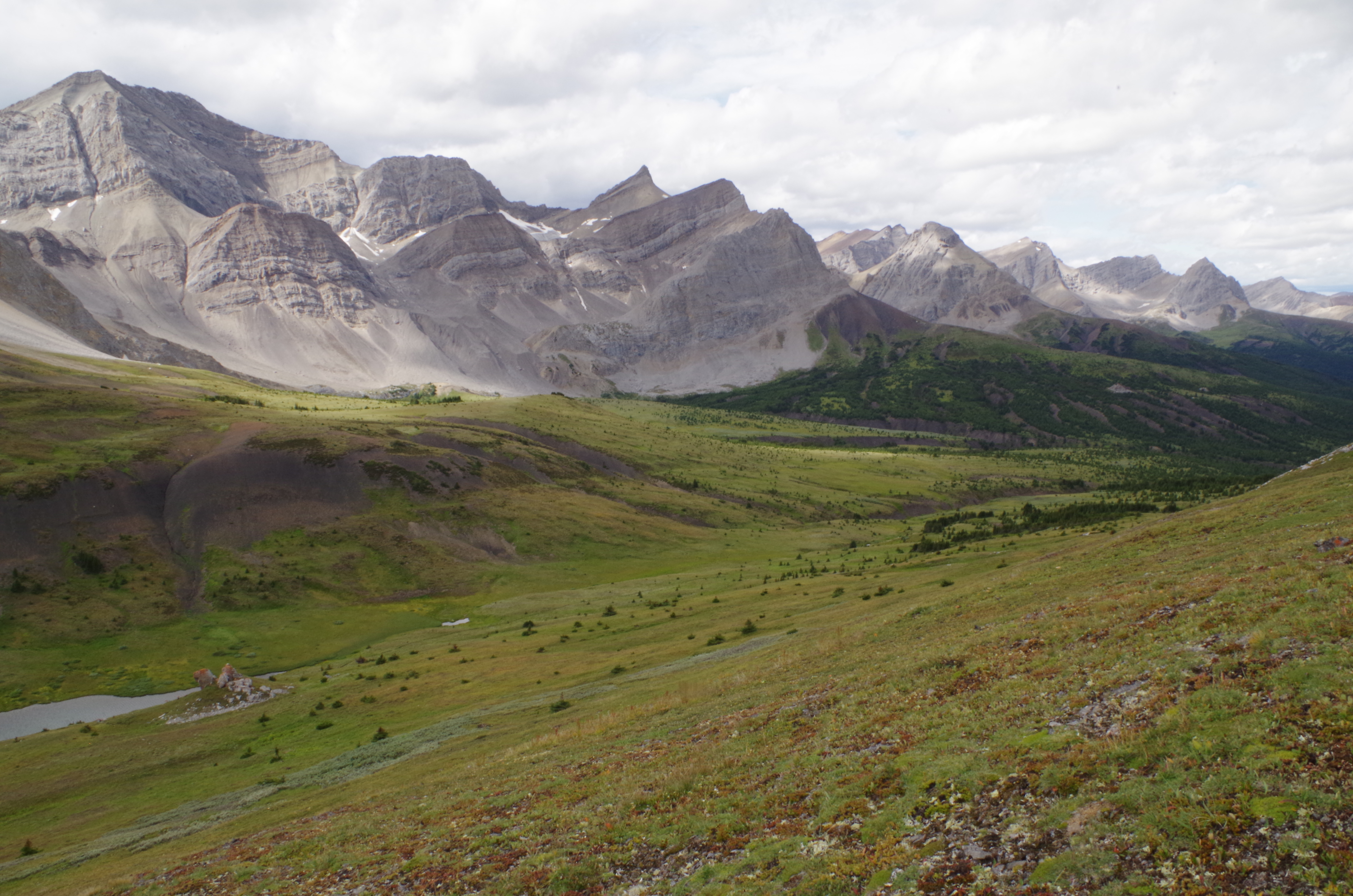
Jasper National Park and Willmore Wilderness Park include some of the most rugged and remote mountains in Alberta; and for over 10,000 years, people have called these places home. A high alpine pass at the north edge of Jasper and south edge of Willmore holds clues of an important resource that ancient people visited year after year, in a place that nowadays only hardy back-packers and horseback visitors can reach.
Glacier Pass contains a quarry of stone that people used to make spear heads, knives, scrapers and other tools. The quarry was discovered by archaeologists B.O.K. Reeves and J. Elliot in the early 1970s. The rocks found there are what geologists call ‘concretions’ that were picked up as rounded cobbles by people long ago. Recent archaeological research tells us that the round rocks were then hammered to get rid of certain pieces and expose the best quality stone for making tools.
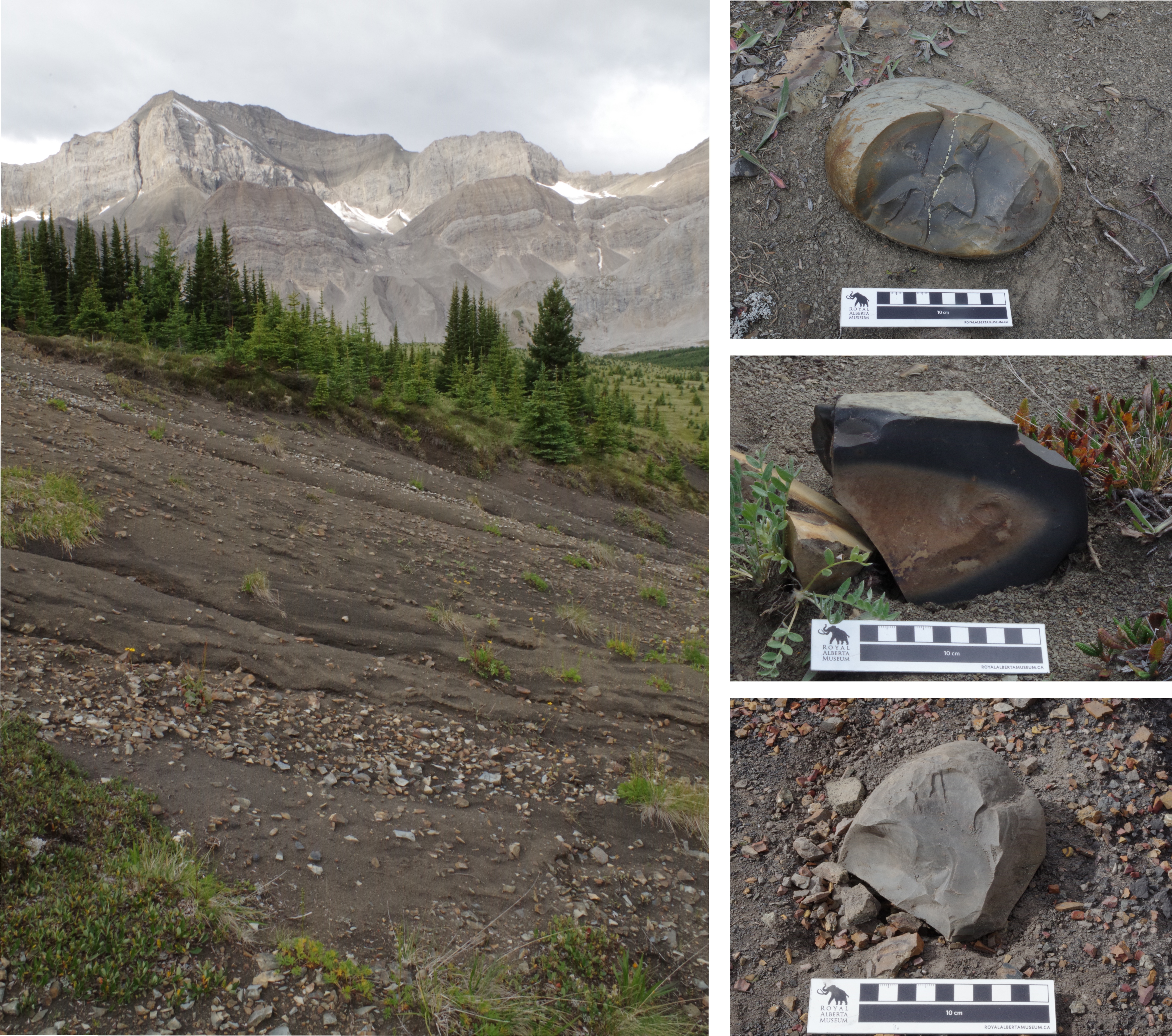
Stone cobbles like the ones here at Glacier Pass were picked up and worked into spear heads, knives, scrapers and other pre-contact tools. Source: Todd Kristensen.
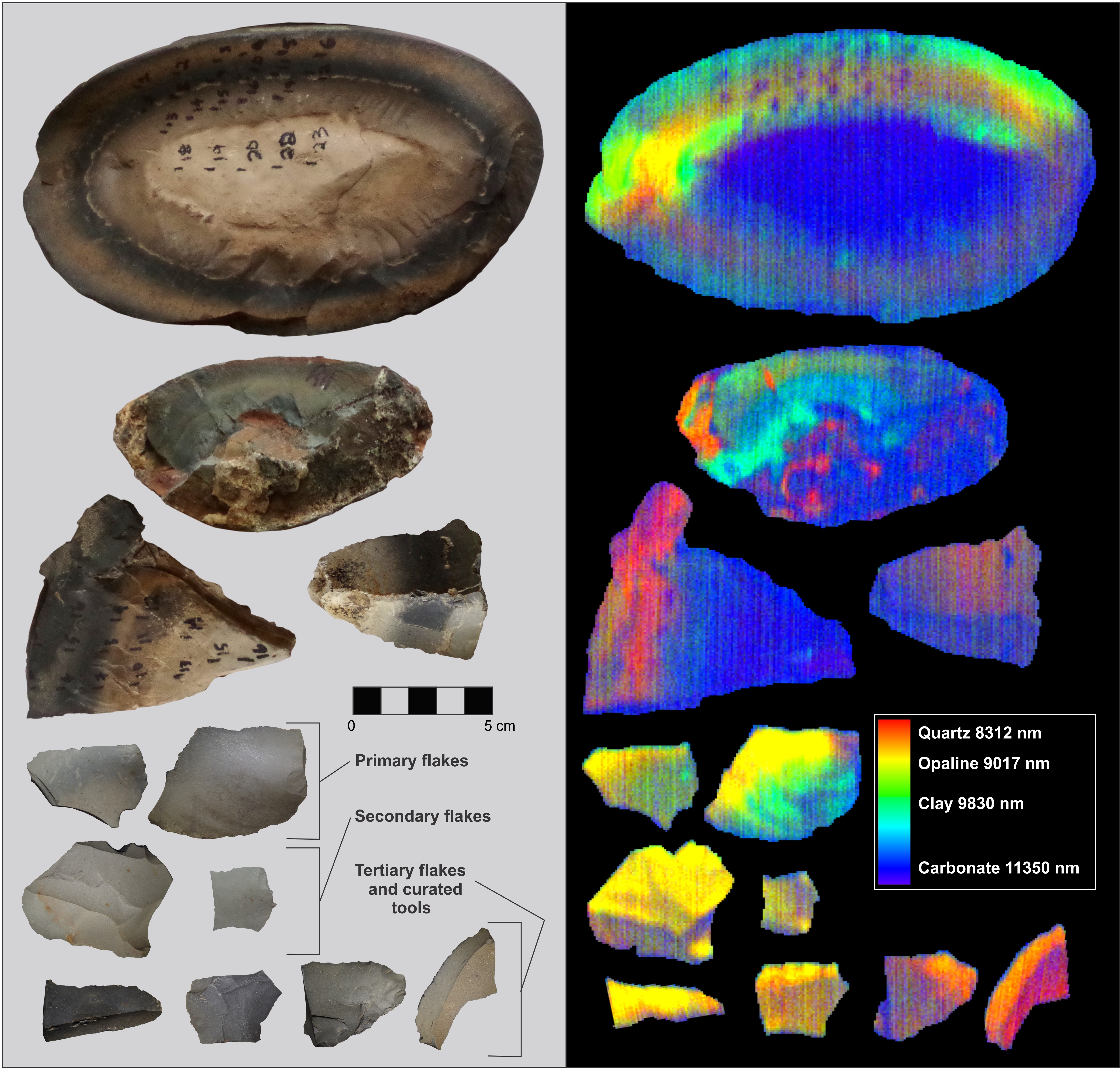
A laboratory technique called hyperspectral scanning has confirmed that the composition of artifacts made from Glacier Pass concretions matches the composition of specific bands or portions of the cobbles from Glacier Pass. Glacier Pass concretions formed when bands of silica-rich rock grew around a core over millions of years. Some bands were good for stone tools while other portions of the rock were thrown out because they were too soft and/or unpredictable to flake or ‘flint knap’. Source: Todd Kristensen.
Based on the number of artifacts found by archaeologists, Glacier Pass was likely visited by small groups of people thousands of times over thousands of years. The stone quarry was part of a seasonal round when people moved from month to month to different areas to exploit or target different things. The alpine concretions at Glacier Pass were probably collected after the snow melted in summer or in fall when people hunted big game animals on high slopes like sheep and caribou.
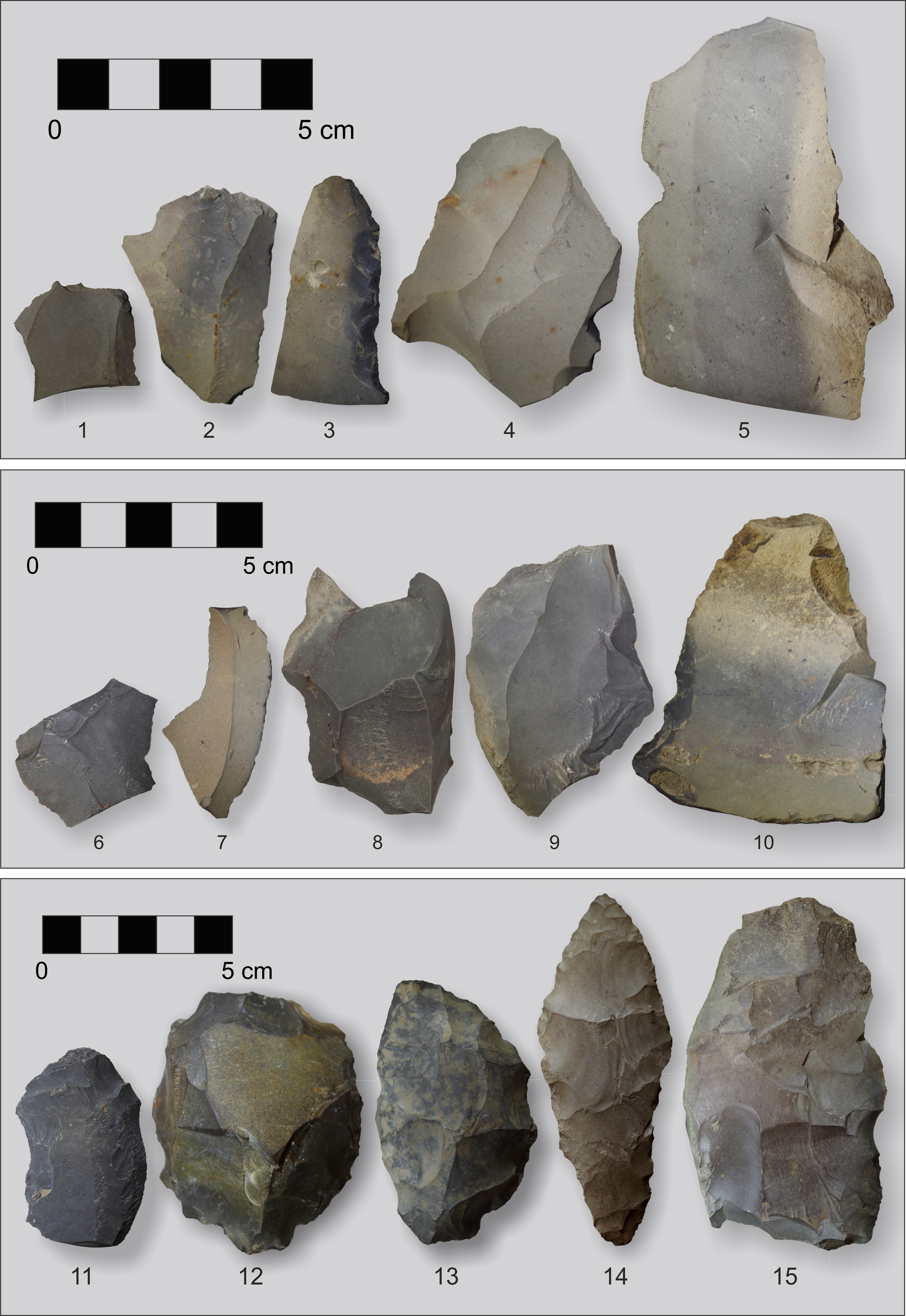
Recent research by an archaeological team from the Archaeological Survey of Alberta, Parks Canada and the University of Alberta has revealed that pre-contact people cracked Glacier Pass concretions to get at specific zones or bands of high quality stone that was ideal for making stone tools. The first two rows in this picture are mostly flakes removed while making tools. The bottom row (artifacts 11-15) are stone tools including knives, a core and a likely spear head that may be over 6,000 years old (14). Source: Todd Kristensen.
Modern visitors to Glacier Pass are unlikely to see tools: most of the artifacts there today are flakes of rock that people broke off while making stone tools. Almost all the finished products were carried away from the area. Visitors are reminded to respect the story of parks and mountain landscapes in Alberta by leaving all artifacts and rocks in place for others to experience. And remember that the land under our feet has a deep history full of geological wonders and human adaptations.
Glacier Pass between Jasper National Park and Willmore Wilderness Park is a beautiful and fragile place. To preserve the story of this landscape, and others in Alberta, visitors are encouraged to leave stones and artifacts in place. Source: Todd Kristensen.
Editor’s note: This post was originally published in 2018. To recognize Black History Month, we here at RETROactive are pleased to share this important documentary with you again.
Winner of the 2018 Alberta Historical Resources Foundation 2018 Heritage Awareness award, We Are the Roots is a documentary that tells the stories of African American immigrants who settled in Alberta and Saskatchewan in the early 1900s.
In the film, you’ll hear stories from 19 descendants of original settlers, as they moved north to escape slavery, persecution and racism in America. Once in Canada, these families would then experience more discrimination, both in Edmonton and in rural communities they settled.
The film was produced and created through a partnership between documentary film production company Bailey and Soda Films along with Edmonton’s Shiloh Centre for Multicultural Roots,
Click the image above to view the full-length documentary.
Well would you look at that, it’s Valentine’s Day! Whether you’re an adherent to the original feast honouring Valentinus, or just like getting flowers from a significant other, it’s the time of year to spend a greeting card-mandated night with your sweetheart.
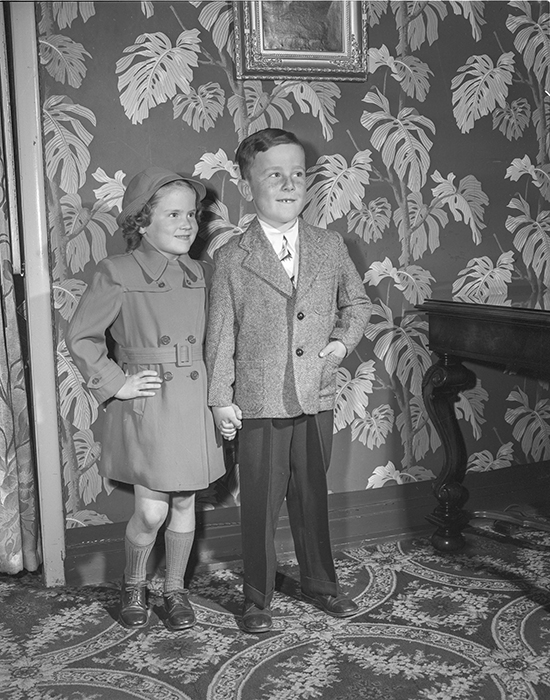
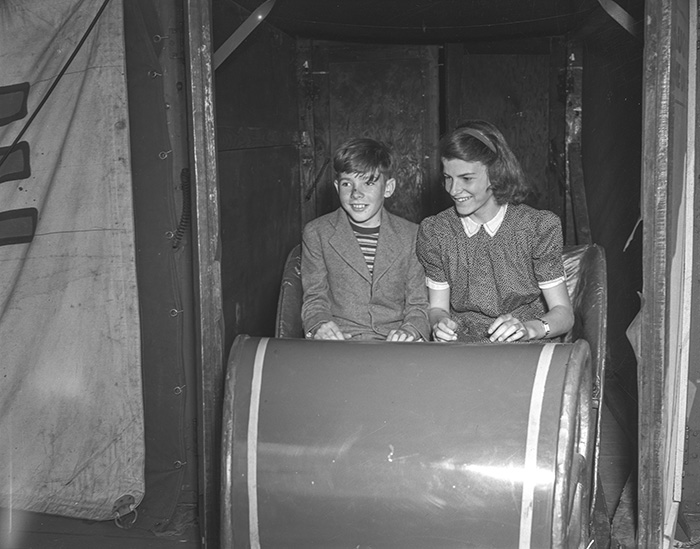
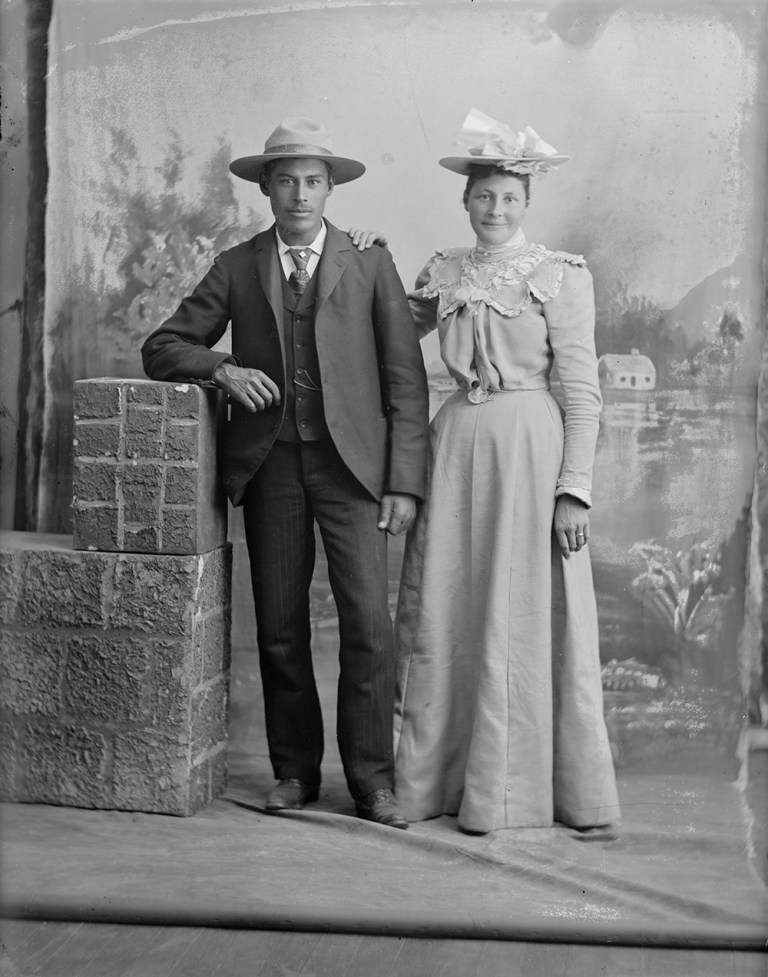
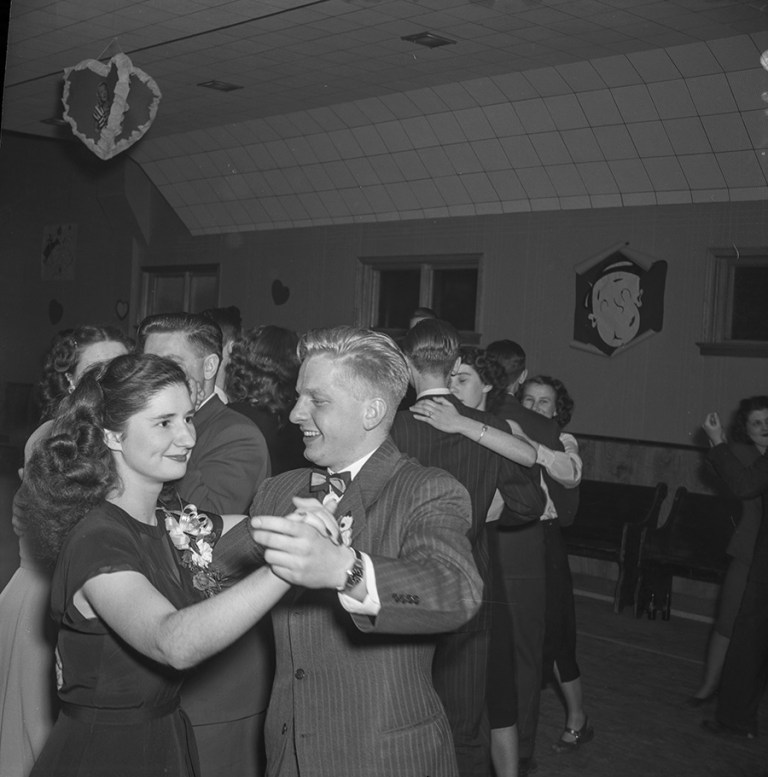
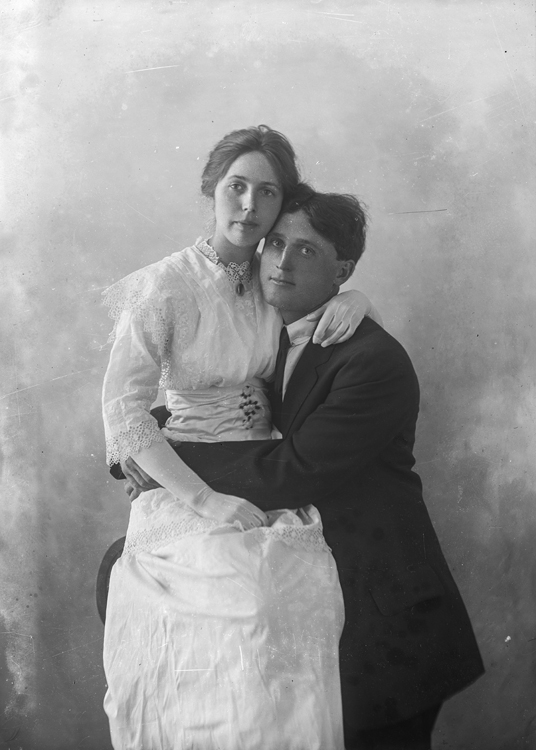
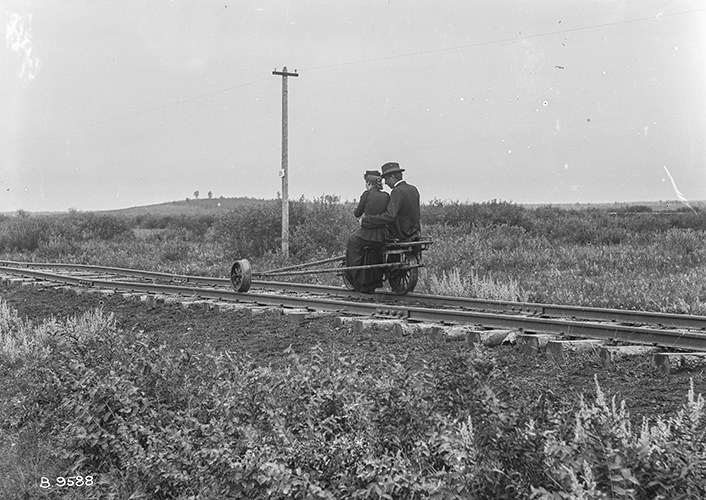
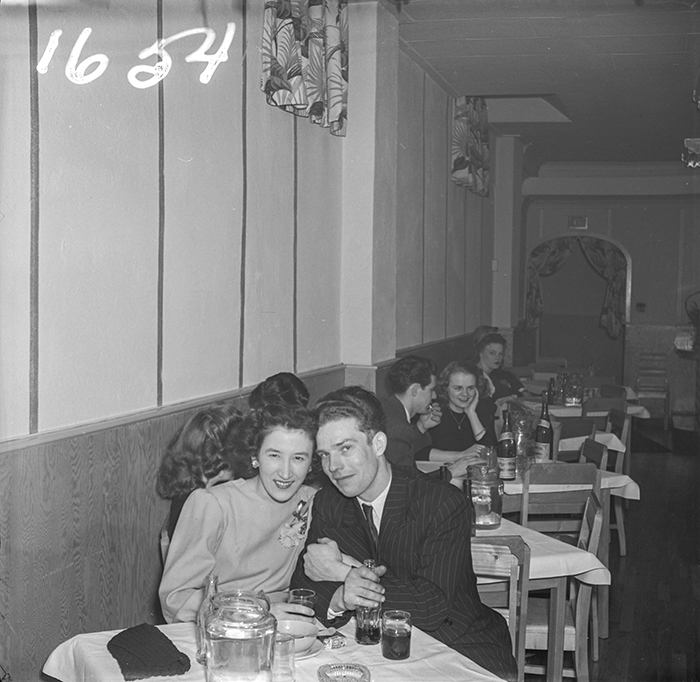
In celebration of this special day, here are a few Alberta couples, young and old, showing their love for one another.
Fashion show for kids, taken in Edmonton’s McKernan neighbourhood on April 11, 1951. Source: Provincial Archives of Alberta.
Children on rides at the Exhibition in Edmonton. Photo taken July 17, 1947. Source: Provincial Archives of Alberta.
Photo of couple, last name Calihoo, by the Ernest Brown Studios. Date unknown. Source: Provincial Archives of Alberta.
Valentine’s Dance by M.H. Charnetski Sr., taken in 1948. Source: Provincial Archives of Alberta.Photo of couple, last name Ellefnon, by the Ernest Brown Studios. Date uknnown. Source: Provincial Archives of Alberta.
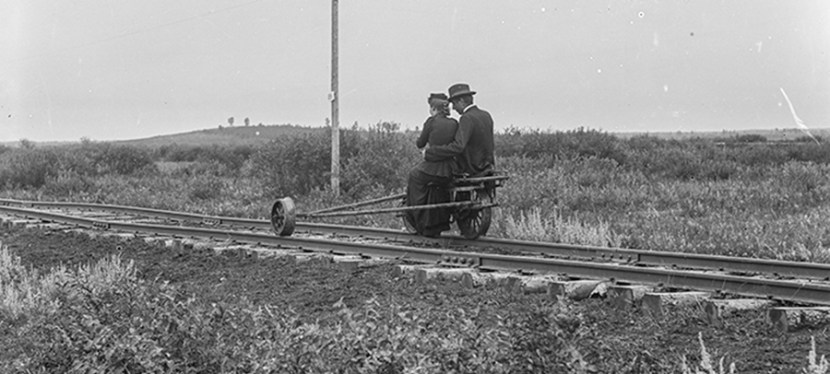
Rev. Gray and Miss Dixon on railroad scooter. Photo taken Aug. 10, 1894. Source: Provincial Archives of Alberta.
Nick Spivak with C. Anton, February 1948. Source: Provincial Archives of Alberta.
Written by: Michael Gourlie, Government Records Archivist, Provincial Archives of Alberta
Hey, remember a few weeks ago when the ENTIRE PROVINCE was under an extreme cold weather warning? Below 30, minus 40 weather for several days. Fun times, good stuff.
It was probably no surprise that folks wanted to hunker down and hibernate until temperatures become more seasonable (like a balmy -15C). But there are better options than hibernating! For example, visiting the Provincial Archives of Alberta’s new exhibit, BRReathtaking Images of a Winter City.
Featuring the work of award-winning Edmonton photographer Nick Ochotta, the exhibit highlights the beauty, fun and drudgery of living in a winter city. As largest, northernmost metropolis in the world, it is better to accept that snow, ice and chilly temperatures are a seasonable and inevitable part of Alberta’s winter wonderland. At least you can be warm inside looking at images of winters past. If they made it through, so can you!
The exhibit is on display until March 31, 2020, by which point the province may have thawed out. Maybe.
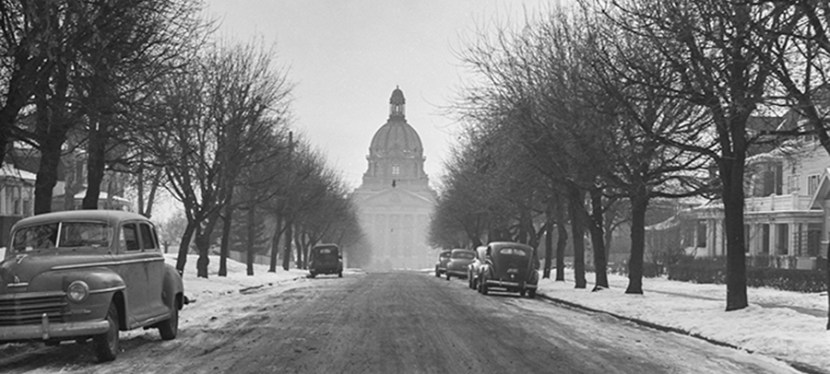
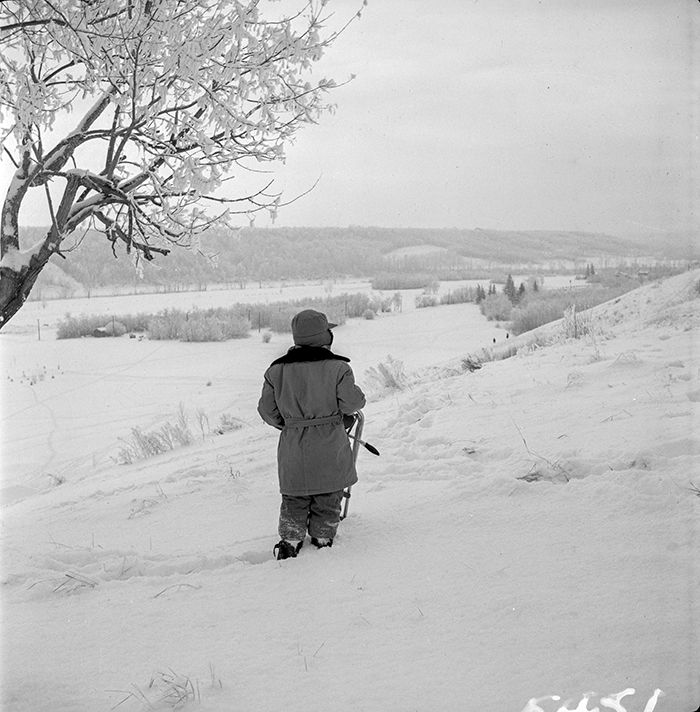
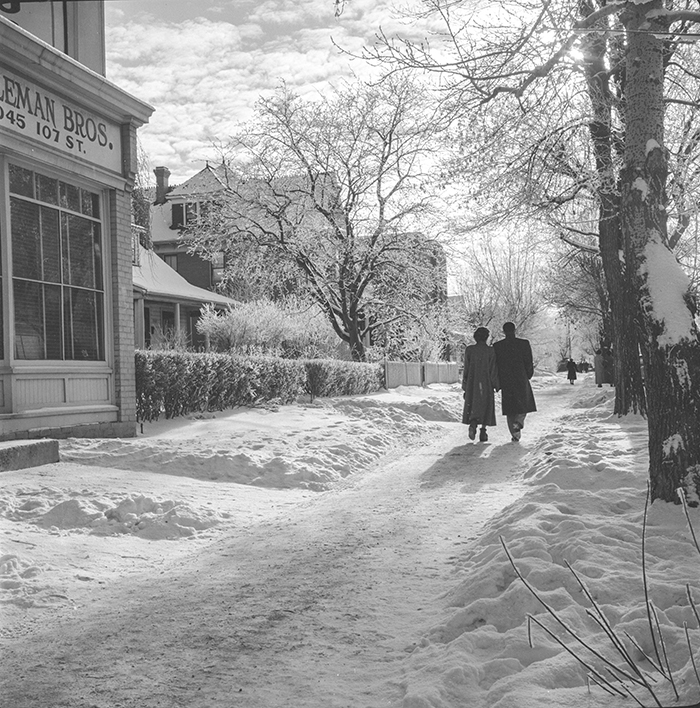
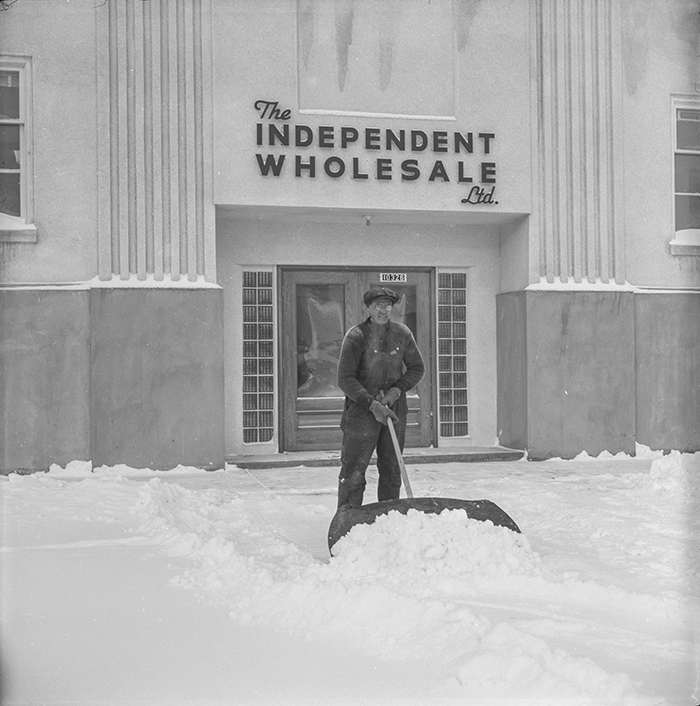
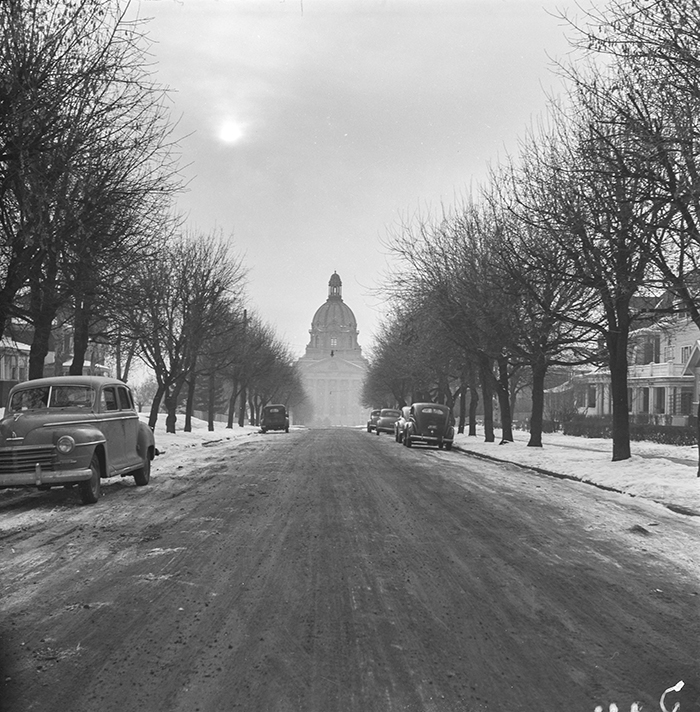
Surveying the land, sled in hand. Possibly near present-day Ezio Faraone Park in Grandin. Photo taken in 1953 by Nick Ochotta. Source: Provincial Archives of Alberta.A familiar winter scene by Templeman Bros. on 107 St. Photo taken in 1953 by Nick Ochotta. Source: Provincial Archives of Alberta.I’ll take the classic shovel over a leaf blower any day of the week. The hardworking man in the picture is also named Harry Snow. For real. Photo taken in 1948 by Nick Ochotta. Source: Provincial Archives of Alberta.View from 108 St. just south of Jasper Ave. Photo taken in 1948 by Nick Ochotta. Source: Provincial Archives of Alberta.
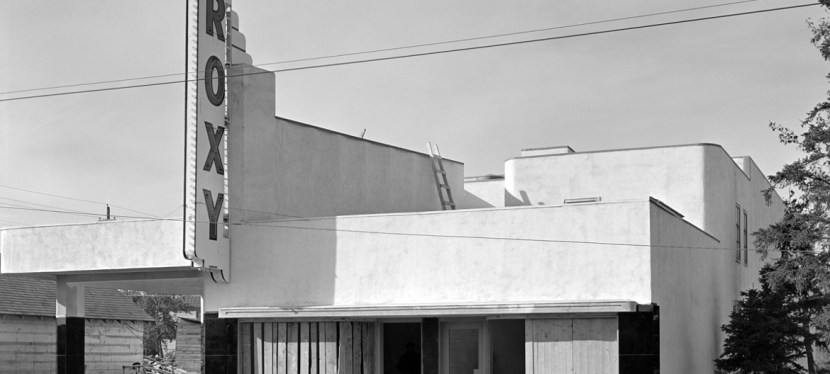
Editor’s note: The image above is of the famous Roxy Theatre on 124 St. Opened in 1938, the theatre was destroyed by a fire in 2015. The theatre is currently being rebuilt. The image is courtesy of the Edmonton Historical Board.
Written by: Jared Majeski, Historic Resources Management Branch
Continuing along in our series spotlighting Municipal Historic Resources (MHRs) around the province, we move along to the historic Westmount neighbourhood in west-central Edmonton.
Thought to have been named after a suburb in Montréal, Westmount is known for many Craftsman-inspired single family detached houses along tree-lined boulevards between 123 St. to 127 St. and 107 Ave. to 111 Ave. You get the feeling of being transported back in time when you’re walking or riding your bike down one of these streets. And since the City of Edmonton officially recognized the historic significance of this, the Westmount Architectural Heritage Area (WAHA), the heritage value of this important Edmonton neighbourhood will hopefully be supported for decades to come.
Let’s take a look at a few properties in the area that make this neighbourhood unique.
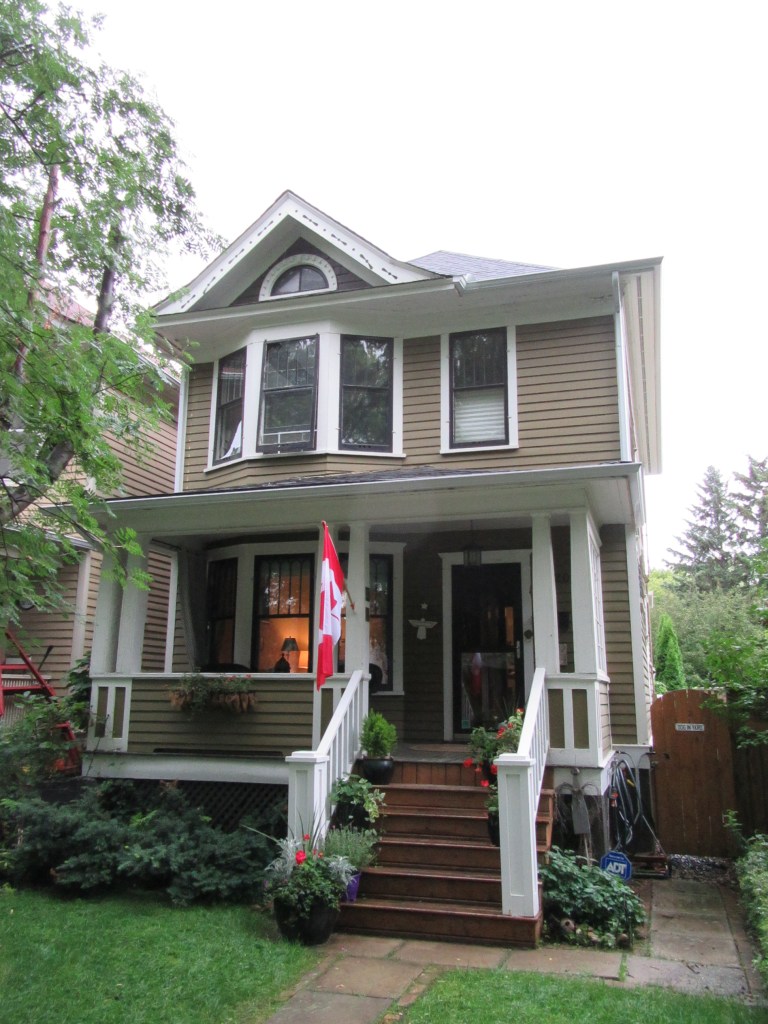
Marshall Hopkins Residence
The Marshall Hopkins Residence is valued for its association with the early development of the Westmount neigbourhood during Edmonton’s population boom in the pre-war period.
Built in 1912, the Marshall Hopkins Residence on 126 Street is significant as an early example of wood-framed, Foursquare construction. This architectural design was popular at the time for its simple design and efficient floor plans.
The two-storey residence is significant for its association with Marshall W. Hopkins, Chief Land Surveyor for the Alberta Land Titles Office, who was the first occupant of the residence from c. 1913 to 1914. In addition, the Marshall Hopkins Residence is also significant for its association with the Canadian National Railway as it was home to a number of occupants who were employed by the company after the Canadian National Railway arrived in Edmonton in 1905.
The residence was officially designated an MHR in May 2019.
Ellen Elliot Residence
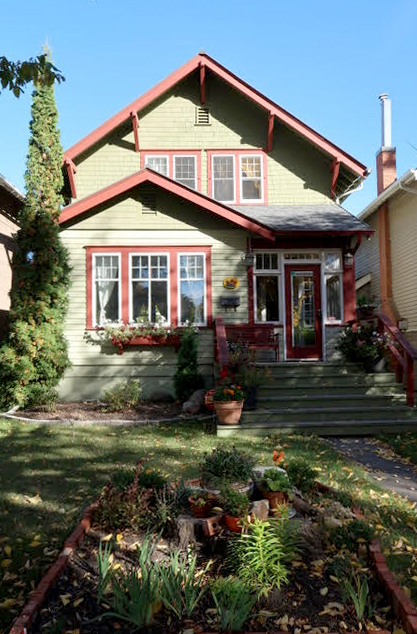
The Elliot Residence is significant as an early example of a front gabled dwelling with Craftsmen design elements influences, and for its associations with an early owner and builder.
The Ellen Elliot Residence on 125 Street is unique in a number of ways, least of all due to the fact that the first resident and owner of the building was a woman. Mrs. Ellen Elliot, widow of Thomas Elliot (who may have been a builder), purchased the property which would have been rare and unusual at that time. She lived in the residence until 1932.
Design elements of the two-storey building include the original wood frame construction, with horizontal wood siding on the lower level and wood shingle siding in gable peaks, and a front gabled-roof addition and porch. Fire insurance maps of the area show the original structure with a veranda in 1913. However, city records indicate that the house was built in 1920. The 1920 date may have come from when the front porch was captured and brought into the house as an extension of the living room and the mudroom.
This property was designated an MHR in June 2019.
Walton L. Smith Residence
The Smith residence is one of many similar Craftsman Influenced houses built in the neighbourhood in the first quarter of the 20th century, and demonstrates the popularity of this style in the early days of west Edmonton and other prestigious neighbourhoods.
The 1914 two-storey Walton L. Smith Residence is a wood frame construction with strong Craftsman design influences. It has horizontal wood siding on the lower level, and wood shingles on the upper levels and façade. The roof is a slightly bellcast, medium pitch gable, with exposed rafters and decorative brackets on the front-facing gable. An offset closed porch with a slightly bellcast gable roof is on the right hand side of the façade.
As interesting as the design of this property is the story of its original building applicant, who ironically, never actually lived in the house at all.
This residence was constructed following application for a building permit at the site on May 14, 1914. Robert W. Hedley, the applicant, was prominent in Edmonton affairs. Born and educated in Ontario at the University of Toronto and Hamilton Normal College, he then taught until moving to Edmonton in 1912. Hedley was Art Supervisor for the Edmonton Public School Board from 1914 until 1929. He designed the art course for Alberta high schools in 1922. Hedley taught art at University of Alberta summer sessions, and was appointed to the Normal School staff in 1929, serving as a lecturer in art and math. Hedley retired in 1937, but remained active in the local art scene, becoming director of the Edmonton Museum of Arts from 1943 to 1951. Hedley organized the western Canadian art circuit, adult and children’s classes and a women’s society to support the Edmonton Museum of Arts. He received an Honourary LLD from the
University of Alberta in 1953, a citation from the College Art Association of America in 1955, and became the first Albertan to receive a Fellowship from the Royal Society of Arts. He was an arts critic for the Edmonton Journal for many years. Hedley died on November 16, 1965, having never lived in the house he originally applied to build in 1914.
This residence was designated an MHR in June 2019.
Griffin Residence
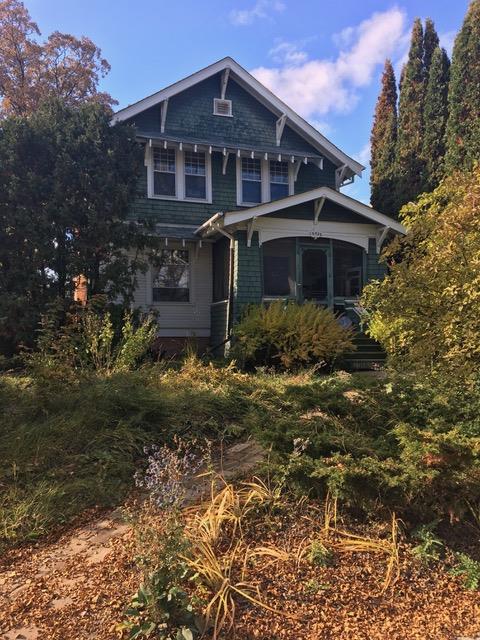
The house is located within the Westmount Architectural Heritage Area. Throughout history the neighbourhood of Westmount has retained a strong sense of architectural character, and is noted for its large collection of single detached homes, that were built between 1911 and 1925.
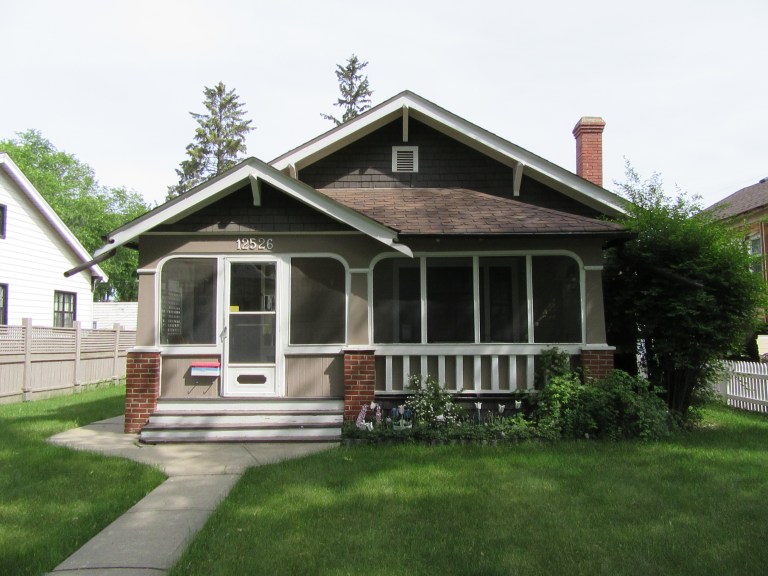
Built in 1922, Griffin Residence on 125 Street is significant for its Arts and Crafts influences, in particular, Craftsman style elements. This design style first appeared in the last years of the 19th century and remained popular until the 1930s.
The residence features a medium pitched gable roof, with projecting eaves, exposing original wood rafters, soffits, fascia, and brackets. It is clad with wood clapboard siding on the upper portion, and wood shingles on the lower portion of the residence, and in all the peaks of the gables. The enclosed front veranda has a hipped roof with an offset medium pitched gable over the entrance. Both the east and west elevations feature pitched gables, with bay windows. The residence is located on a residential street in the Westmount neighbourhood, one of Edmonton’s most mature neighbourhoods, where the majority of lots still maintain their original structures.
Griffin Residence was designated an MHR in August 2018.
Street Railway Substation No. 600
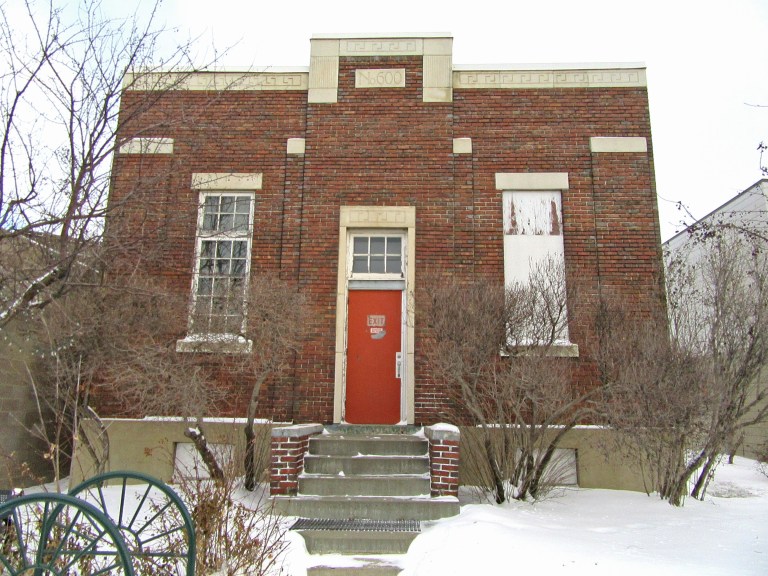
Street Railway Substation No. 600 is significant as a rare and well preserved example of the Art Deco Style of architecture in Edmonton.
Constructed in 1938, Street Railway Substation No.600 is a one storey brick and concrete building designed in the Art Deco Style, located on a commercial portion of 124 Street in the neighbourhood of Westmount.
This substation is significant for its association with the development of the Westmount neighbourhood. Westmount is one of the oldest residential subdivisions in Edmonton. After 1911, residents of the neighbourhood could commute downtown on the electric streetcar that ran south from 110 Avenue along 124 Street before turning east along Jasper Avenue. As the neighbourhood grew and demand placed on the west end section of the street railway increased, it was necessary to build Street Railway Substation No. 600 to house equipment which reduced the loss of electricity from the lines, allowing the street railway to operate more efficiently.
The substation was designated an MHR in May 2017.
These recently designated Municipal Historic Resources join seven other Westmount neighbourhood resources previously designated by the City of Edmonton:
By designating these properties as Municipal Historic Resources, the City of Edmonton is ensuring the preservation of the heritage character of the Westmount neighbourhood.
Currently at the Royal Tyrrell Museum of Palaeontology is arguably the world’s most fascinating (and best-preserved) armoured dinosaur. The Borealopelta markmitchelli was discovered by a worker in the Suncor Millenium Mine in 2011 and, at 112-100 million years old, is the oldest known dinosaur ever found in Alberta.
To learn about how this one-of-a-kind discovery happened, and how scientists at the Tyrrell worked to preserve it, you can watch Dinosaur Cold Case on CBC’s The Nature of Things right now! If you’re in Canada, click here to unravel this made-in-Alberta mystery.
Written by: Suzanna Wagner, Program Coordinator, Historic Sites and Museums
If a highly contagious epidemic was spreading through your city, what would you do?
Well, if you were a merchant in Edmonton in 1918, you’d be making sure people are still buying things.
A virulent strain of influenza spread around the world in the fall of 1918, striking once again in fall 1919 and still another time in 1920. Alberta saw more than 31,000 cases of the flu over the fall of 1918 with 4,308 deaths before the flu subsided in May 1919. The illness was often referred to as the “Spanish Flu” because it was mistakenly believed to have originated in Spain.
On behalf of RETROactive, happy holidays to everyone out there. Whether you’re a new subscriber or have been a follower for years, we want to thank you all for your continued support. We’ll be back in mid-January with even more blog posts about Alberta’s unique history!
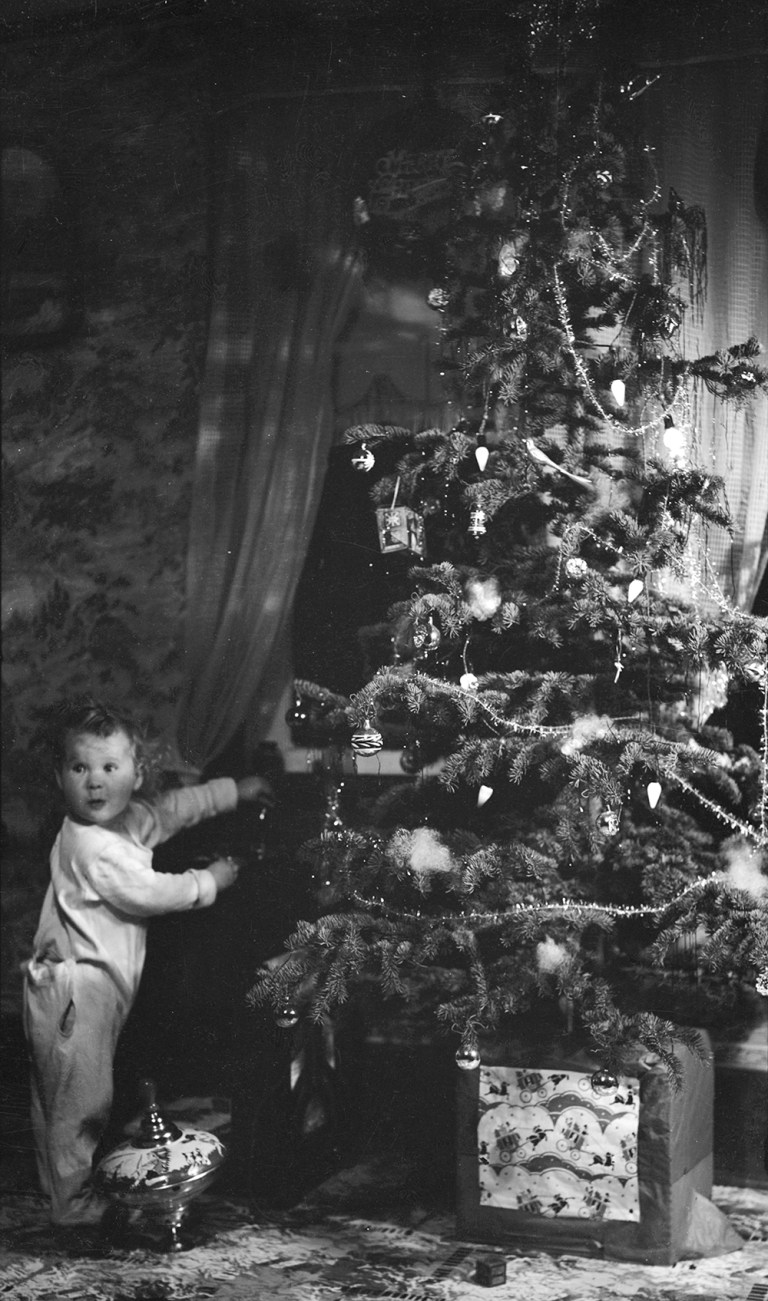
Mary or Sandy Lee with Christmas Tree, Mountain Park Alberta, ca. 1938, CL130, From the Charles Lee Fonds. Source: Provincial Archives of Alberta
Written by: Sara King (Provincial Archives of Alberta) and Jared Majeski (Historic Resources Management Branch)
It was a magical time in Edmonton in 1980. One area code, the Rat Hole, liver and onions at the Silk Hat on Jasper Ave. It was also a time with enchanted headphones and a young, open-collared Bruce Bowie.
Harriet’s Magic Hats was an educational program for children created by ACCESS TV, which primarily explored different careers as a girl named Susan travelled around with the assistance of her Aunt Harriet’s collection of mystical headgear. In addition to being an example of local programming in Alberta, the episode is a time capsule of technology and popular culture of the time it was made.
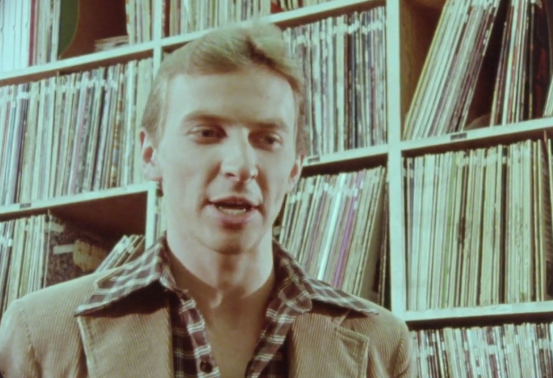
630 CHED’s Bruce Bowie explaining to Susan how the music from vinyl records in their music library makes it out to the airwaves. Source: Provincial Archives of Alberta YouTube.
In this episode, Susan mysteriously transports into the booth at 630 CHED, right in the middle of a broadcast from legendary announcer Bruce Bowie. From there, Bowie shows young Susan the radio ropes, from programming commercials to the station’s automated system for playing records.
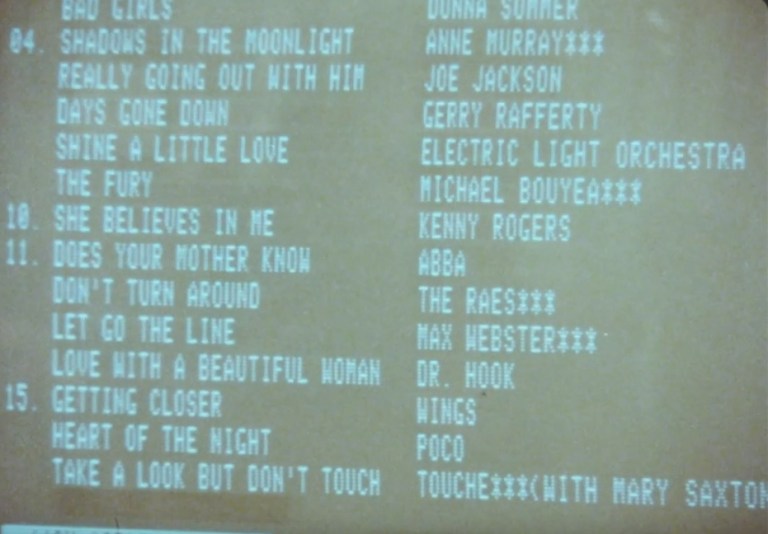
With the exception of Wings’ “Getting Closer”, ELO and a Donna Summer disco hit, the playlist from CHED in 1980 is pretty middle of the road easy rock. Nice to see some pre-Kim Mitchell Max Webster in the rotation too. Source: Provincial Archives of Alberta YouTube.
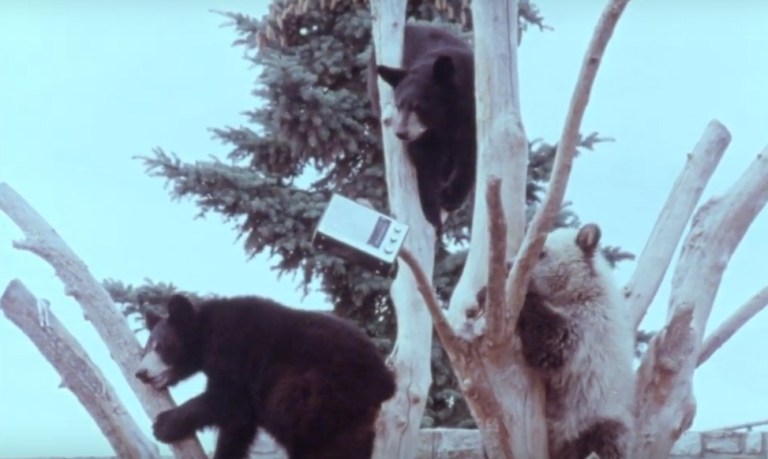
This episode concludes with a jaunty montage of various Edmontonians biking, lounging, paddling and dancing along to the radio. Heck, even the bears and elephants are listening!
One can only assume a brave Valley Zoo employee had to climb that tree to place the radio. The bears seem to be enjoying the tunes at least. Source: Provincial Archives of Alberta YouTube.
Sharon Alexander, the actress who played Susan in the Harriet’s Magic Hat series, would go on to do a ton of voice acting, as well as appear in episodes of The X-Files, Da Vinci’s Inquest, The Outer Limits and Cold Squad.
ACCESS TV was the designated educational broadcaster in Alberta, created by the Alberta Educational Communications Corporation (AECC), an arms length corporation of the Government of Alberta. From its founding in 1973 until its privatization in 1995, it would produce, broadcast, and distribute television-based multimedia, in partnership with Alberta Education and the province’s universities and colleges.
The Provincial Archives of Alberta has a collection of 1506 video cassettes, 1071 video reels, 2220 audio reels, 731 audio cassettes, and 240 16 mm film reels in our ACCESS TV fonds (PR3368) as well as 1198 films and other government records transferred to the archives when ACCESS was a government body. But not all of them are quite as magical as this one.
Editor’s note: This is part two of a two-part series on the history of human relationships with trees in Alberta. If you missed part one, read it now.
Written by: Todd Kristensen, Archaeological Survey of Alberta
Development of Alberta’s Forestry Industry
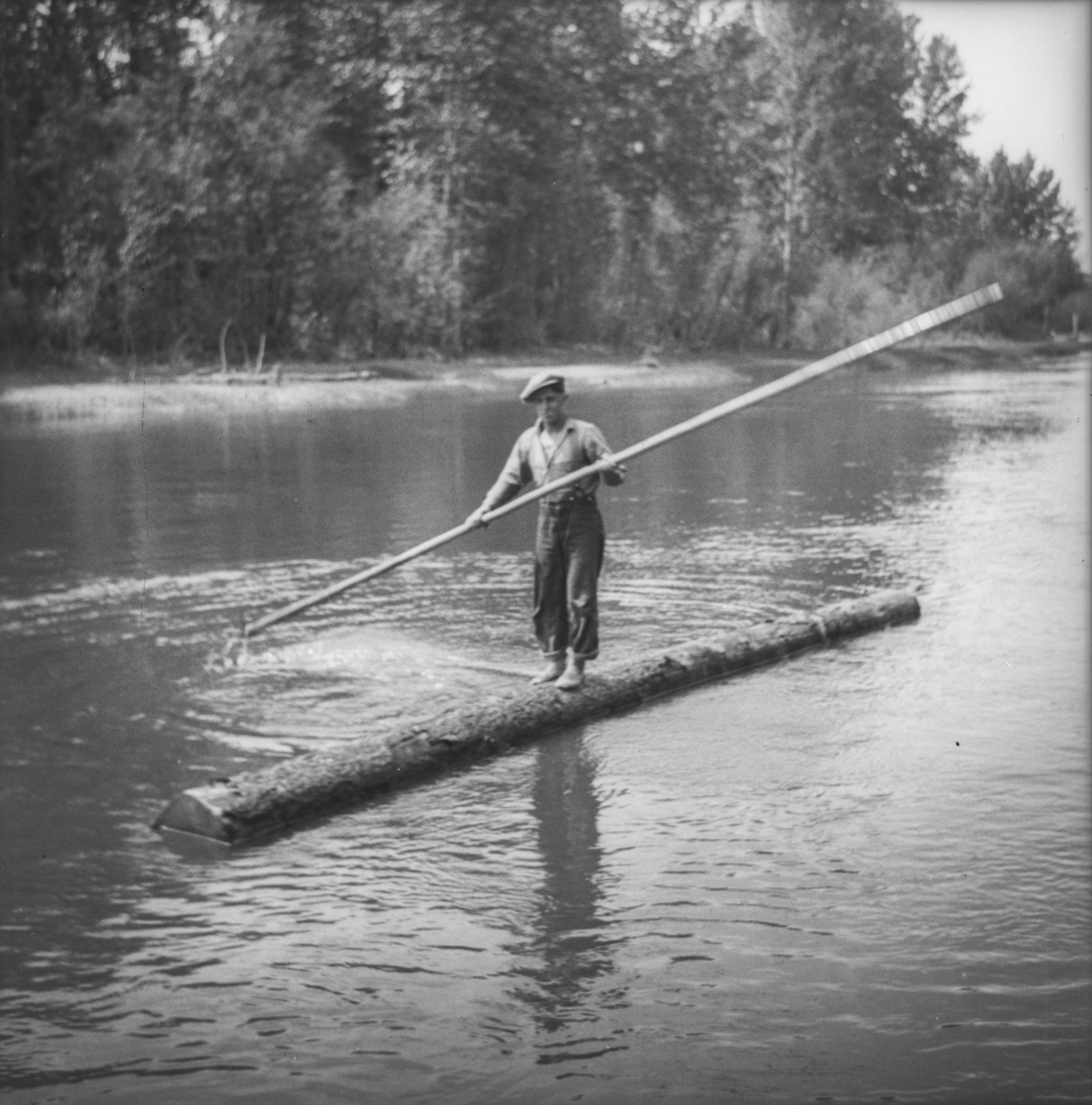
From 1900 to 1910, population growth and steady local demand for lumber meant that most settlements had commercial sawmills. Because of the way that timber berths were leased to operators, most sawmills were small and portable. Some operators harvested in the summer and moved their timber using rivers, flumes (a series of wooden chutes that filled with water and carried logs), splash dams (a temporary wooden dam that held back water that would then be released in a surge to carry logs), and log drives along big rivers that brought wood to riverside mills or to rail yards in river valleys. But winter was generally the ideal time to log because wood could be moved by horses and sleds. Portable sawmills would move machinery on skis to temporary camps in western and northern Alberta. The seasonal nature was perfect for struggling families because farmers could work the fields in warm seasons and cut timber for mills in the winters.
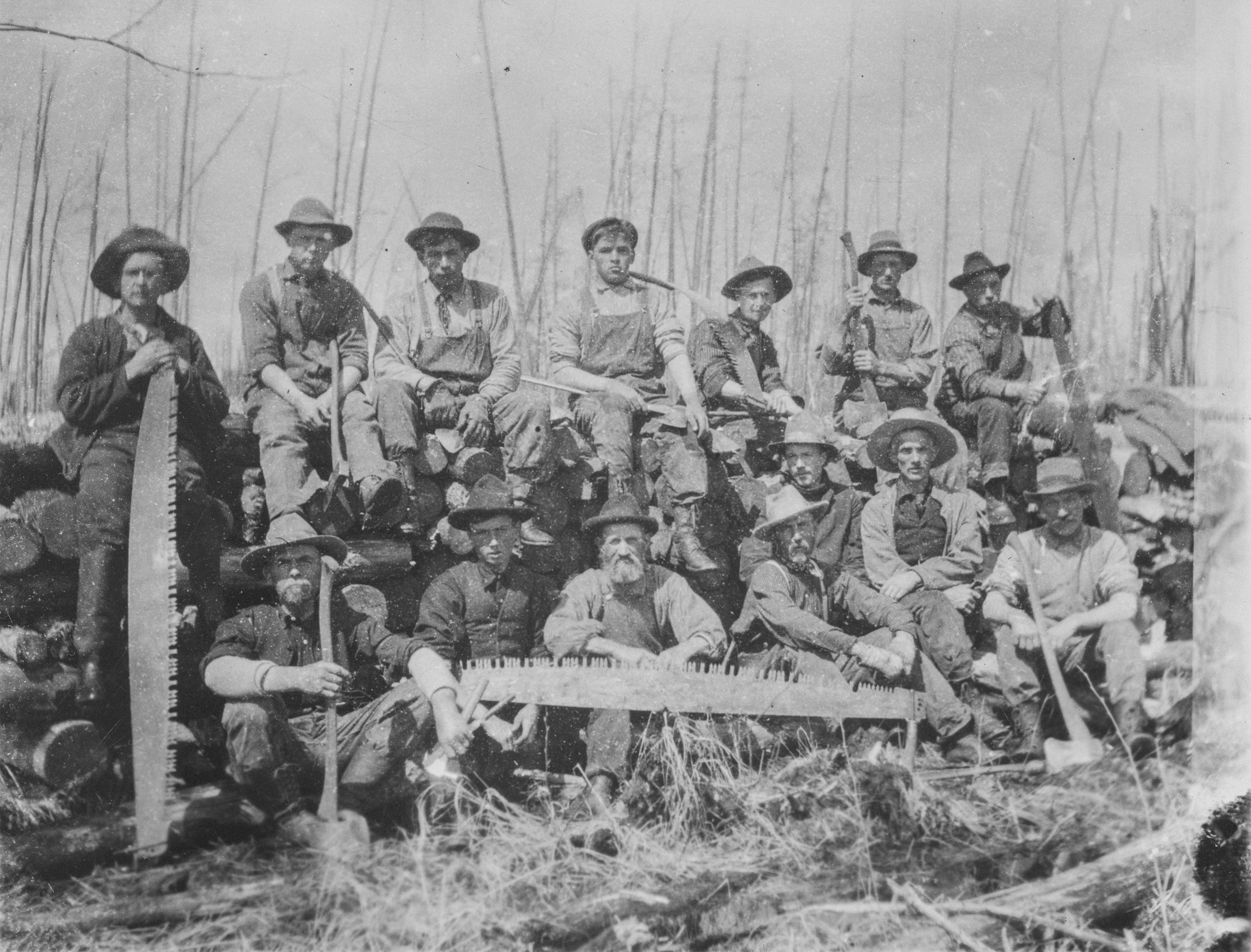
A man poling down Athabasca River between 1937-39 (from the Chisholm Sawmill and Freeman River Lumber Camp). Log drivers floated along with the timbers to dislodge jams and notify the mills when shipments were arriving by water. Image A3790 courtesy of the Provincial Archives of Alberta.A logging camp (the Jackpine Wood Camp on Little Slave River in 1909) with men and their tools. Image A2532 courtesy of the Provincial Archives of Alberta.
Alberta’s forestry industry was younger than in British Columbia and neighbouring states to the south, many of which had various gold rushes that required commercial sawmills in the 1800s. It was fairly common for Alberta farmers to log in B.C. during winters in the early 1900s and many Alberta ranches provided B.C. logging operations with horses. A good-sized sawmill in B.C. or Alberta could employ several hundred men and up to 60 horses over the winter.

 RETROactive