
The history and conservation of the Colonel’s Cabin

Editor’s note: The banner image above is courtesy of the Glenbow Library and Archives Collection, Libraries and Cultural Resources Digital Collections, University of Calgary.

Cowritten by: Fraser Shaw, Heritage Conservation Advisor and Ronald Kelland, Geographical Names Program Coordinator

A panoramic 1945 photograph shows a snowbound mountain landscape in the grip of winter. Plumes of smoke rise from rows of tarpaper-covered buildings huddled behind barbed wire fences and guard towers. This is Camp 130, one of a series of Prisoner of War (POW) camps established across Canada during the Second World War. Outside the prisoners’ compound is a small, single-story log cabin occupied by the camp commandant. Built in 1936, the “Colonel’s Cabin” was protected as a Provincial Historic Resource in 1982 as one of few remaining structures in Alberta directly linked to the internment of prisoners of war and to recognize the site’s earlier association with the Kananaskis Forest Experimental Station.
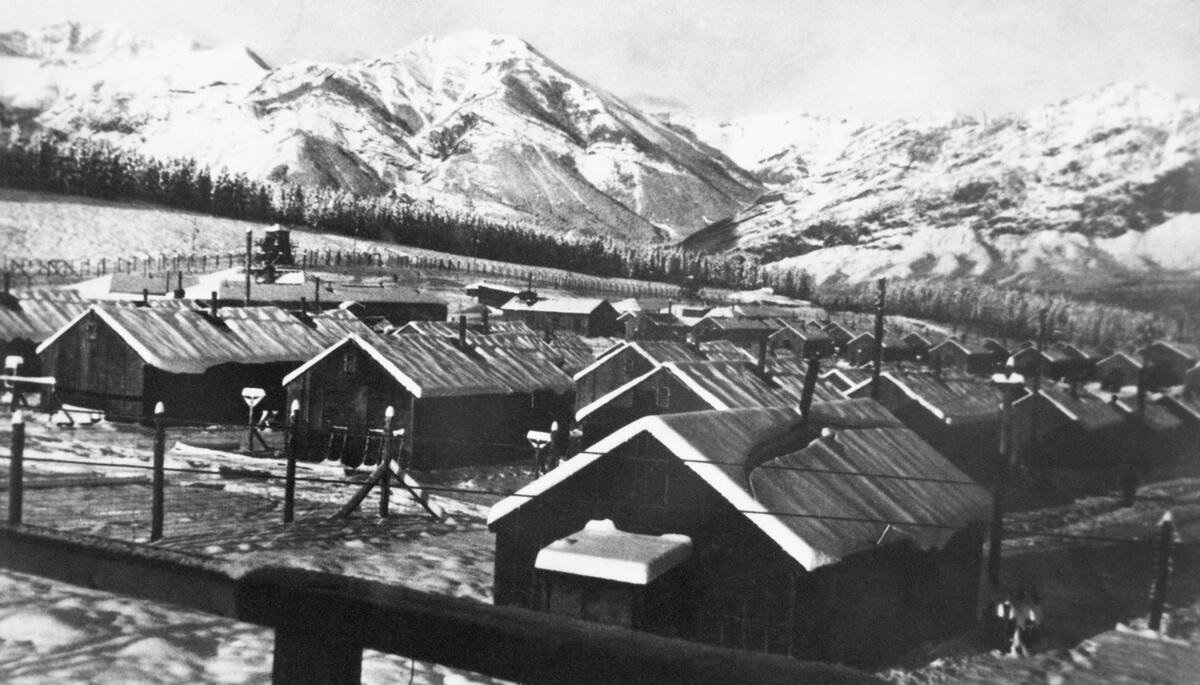
Camp 130 Prisoner of War Camp, winter 1944 or 1945. Source: Glenbow Library and Archives Collection, Libraries and Cultural Resources Digital Collections, University of Calgary, CU1128370 (NA-4824-2os).

During the Great Depression, Canada’s middle-class, political and economic elites were concerned about the large number of unemployed men roaming the country and how that long-term unemployment might result in moral degradation, petty criminality and the fostering of revolutionary communist ideology. Under pressure from religious organizations and municipal and provincial governments, the Dominion government established a series of temporary work camps for single, unemployed men to be administered by the Department of National Defence. By 1936, camps had been established at Acadia, New Brunswick; Valcartier, Quebec; Petawawa, Ontario; Duck Mountain, Manitoba; and Kananaskis, Alberta. Ostensibly created to engage unemployed and homeless men in work that was seen as being necessary for their physical, psychological and spiritual betterment, the camps also kept these unemployed, transient men out of sight and far from transportation routes and urban centres.

Read more
Designation and protection: 50 years of the Historical Resources Act (Part 2)

Editor’s note: Catch up with part one of 50 years of the Historical Resources Act. The banner image above is courtesy of the Royal Alberta Museum.

Written by: Valerie Knaga, Indigenous Heritage Section, Ronald Kelland, Historic Places Research Officer and Fraser Shaw, Heritage Conservation Adviser, Southern Region

Indigenous heritage

Indigenous heritage has existed long before Indigenous Peoples had first contact with European settlers, long before the establishment of Alberta as a province in 1905 and long before the Historical Resources Act was enacted. While Indigenous people have been subject to legislation and policies that sought to undermine their connection to their culture and heritage, they have retained a powerful connection to their historic places and the rich repository of cultural meaning they embody. While Indigenous heritage was not explicitly referenced in Alberta’s Historical Resources Act when it was passed in the 1970s, the Act has played a key role in helping to preserve Indigenous heritage sites. That is not to say that some Indigenous voices were not present during the development of this legislation.  The Public Advisory Committee on the Conservation of Archaeological and Historical Resources which advised on the creation of the legislation included representative Chief John Snow and one of the briefs presented at the public hearings was from Allan J. Wolf Leg of the Calgary Native Development Society. 

A historic settlement site south near Muskwa Lake was documented in February 2020 during field work with Bigstone Cree Nation. Source: Laura Golebiowski.
Read more

Heart of a Historic Prairie Oasis: Restoring the Duke of Sutherland Bungalow

Written by: Fraser Shaw, Heritage Conservation Advisor

The southern Alberta horizon shimmers in the summer heat and seems limitless as one drives across southern Alberta near Brooks. Approaching the region, indistinct bands of green in the distance thicken and, like a mirage, resolve into shelterbelts and dense stands of trees. The striking, even surreal, contrast with the surrounding semi-arid prairie is the result of large-scale irrigation works of the early twentieth century financed and backed by, among others, Canadian Pacific Railway (CPR). Conceived to make “Palliser’s Triangle” fertile for agriculture and settlement, these works included the Bassano Dam, hundreds of kilometres of irrigation canals and ditches and the Brooks Aqueduct, a 3.2 km-long reinforced concrete flume. One of the largest aqueducts of its kind in the world and an engineering tour de force when built, the decommissioned aqueduct is both a Provincial Historic Resource and a National Historic Site of Canada.

Duke of Sutherland Residence or Bungalow, south facade, September 2021. Source: Historic Resources Management Branch.

At the epicentre of this transformed landscape, just outside Brooks, lies the Duke of Sutherland Site Complex, a Provincial Historic Resource comprised of a large residence, a barn and pumphouse, Delco generator building and remnants of irrigation ditches on an approximately two-hectare site. This was the administrative heart of a 2,752-hectare agricultural colony of Scottish and English settlers established in 1909 by the Fourth Duke of Sutherland of Scotland. Eager to invest in Canada and to promote irrigation and farming in the Brooks area, the Duke was a major CPR shareholder whose extensive holdings including a large ranching operation on rented CPR land.

Read more