Editor’s note: We continue our series highlighting significant fossil discoveries found by members of the public. Remember, if you find a fossil, follow these instructions.
1997: Nichollsemys baieri (TMP 1997.099.0001)
Holotype skull of Nichollsemys baieri. Source: Royal Tyrrell Museum of Palaeontology.
Life in southeastern Alberta was exciting for Ron Baier and his brother growing up near Taber. They enjoyed exploring the land and searching for rocks and fossils. Development of irrigation lines unearthed many interesting artifacts, including arrowheads. As the development slowed, Ron started branching out to new areas in search of artifacts and fossils.
Ron Baier with his fossil collection, including the skull of Nichollsemys. Source: Royal Tyrrell Museum of Palaeontology.
Editor’s note: We continue our series highlighting significant fossil discoveries found by members of the public. Remember, if you find a fossil, follow these instructions.
1995: Atrociraptormarshalli (TMP 1995.166.0001)
The holotype of Atrociraptor marshalli. Source: Royal Tyrrell Museum of Palaeontology.
Wayne Marshall has been scouring the badlands for fossils in southern Alberta for more than 30 years. First, he discovered petrified wood while working as a surveyor on road construction projects. His passion for palaeontology led to a position in the Royal Tyrrell Museum’s mounting shop from 1983-85, helping construct the soon-to-open exhibits.
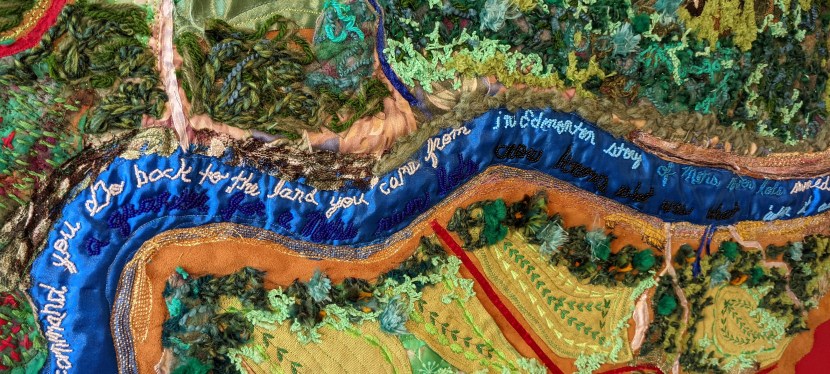
Editor’s note: For our first in a series of posts recognizing June as National Indigenous History Month, take a look at how the Provincial Archives of Alberta assisted a local artist with her newest project. The banner image above photographed by Erin Sekulich.
Written by: Erin Sekulich, Provincial Archives of Alberta
Artist Heather Shillinglaw is a bubbly woman who immediately makes you feel special. Her passion is evident in her work and it is exciting to see that some of the inspiration for her artistic pieces was taken from the Provincial Archives. Heather explains that Miyotamon Nananis – it is a good road in all directions – is the second project she has created that references archival records. Her inspiration is drawn from familial oral history, but the archival resources help fill the gaps in the story. She has gathered research from Library and Archives Canada, Hudson’s Bay Company Archives and the Provincial Archives of Alberta.
Artist Heather Shillinglaw worked from scrip, maps, paintings, letters, and drawings – even negotiating with fellow researchers for records they were already viewing; trading and exchanging knowledge through the process. Source: Heather Shillinglaw.
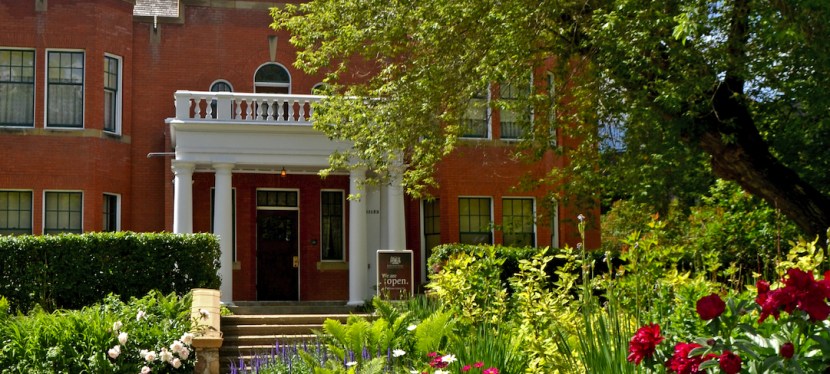
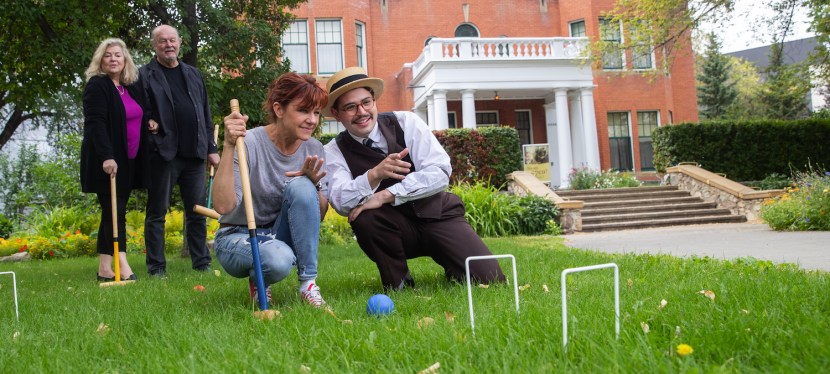
Imagine inviting the entire graduating class of the University of Alberta in for tea. That’s what Alberta’s first premier, Alexander Rutherford, and his wife Mattie did in 1912. All 20 members of the university’s graduating class attended with their family members. After the first graduation tea, a party they named Founder’s Day, the Rutherfords made the celebration an annual event until 1938. Over 300 grads took tea with the Rutherfords that final year.
The tea party celebrating graduation was held at the Rutherfords’ elegant Edwardian mansion just east of the university campus. Not just neighbours, the Rutherfords had a close relationship with the university. Alexander Cameron Rutherford co-founded the university in 1908. He continued to play an active role at the University, serving as Chancellor from 1927 until his death in 1941. Mrs. Mattie Rutherford played an active role organizing and hosting Founders’ Day. She also hosted, at her home, numerous meetings of the University Women’s Club, of which she was an honourary member. Both the Rutherford children, Cecil and Hazel attended some university classes. Hazel in particular was active within the university community, contributing articles to the university newspaper The Gateway, which helped to keep students away serving during World War One up to date with local news.
Editor’s note: We continue our series highlighting significant fossil discoveries found by members of the public. Remember, if you find a fossil, follow these instructions.
1987: Devil’s Coulee Nesting Site (TMP 1987.003.0003)
Technician Dawna Macleod poses with a prepared hadrosaur nest from Devil’s Coulee.Source: Royal Tyrrell Museum of Palaeontology.
Wendy Sloboda spent much of her youth exploring the Warner area of southern Alberta. As a high school student in 1986, she worked as an assistant under the direction of Dr. Len Hills at the University of Calgary on a palaeontological impact assessment for a proposed dam near Milk River. She came across abundant dinosaur eggshell fragments on the Milk River Ridge near her home, and reported them to Dr. Hills. A team from the Royal Tyrrell Museum, including Dr. Philip Currie, visited the site with Wendy and her parents to inspect the find.
The Devil’s Coulee Provincial Historic Site.Source: Royal Tyrrell Museum of Palaeontology.
Written by: Suzanna Wagner, Edward van Vliet, Stephanie McLachlan
May 18 might be an ordinary Wednesday for some, but for Alberta’s Provincial Historic Sites, it’s a much anticipated day. After two seasons of COVID closures, seven historic sites will be re-opening to visitors next week.
In the eastern part of the province, Fort George & Buckingham House is kicking off summer 2022 in grand style. Not only has the site’s official book Opponents and Neighbours: Fort George and Buckingham House and the early fur trade on the North Saskatchewan River, 1792 to 1800, been published, but 2022 is the visitor centre’s 30th anniversary.
The modern visitor centre at Fort George & Buckingham House was opened exactly 200 years after the original fur trade forts were built. Inside you’ll find an interactive museum gallery, travelling exhibits, activities, guided tours and modern visitor facilities. Source: Historic Sites and Museums.
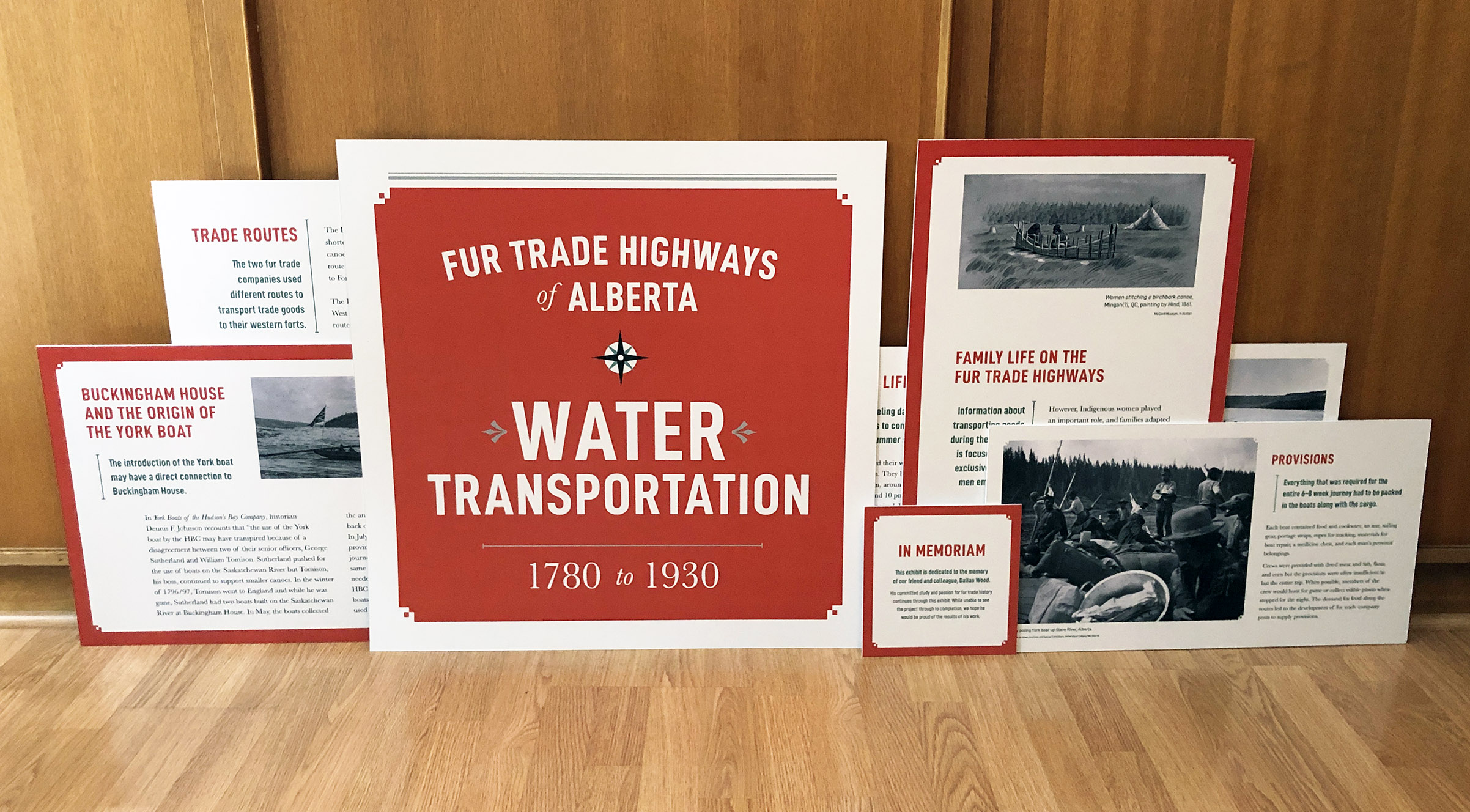
This season also marks the debut of a new exhibit. “Fur Trade Highways of Alberta: Water Transportation, 1780 to 1930,” covers fur trade companies’ gradual transition from canoes, to York boats, to paddle wheelers over 150 dramatic years of change in the fur trade. The exhibit features boating artifacts, a music station, a video about York boat building and life-size boat outlines in the ground to give visitors a real-life sense of how big these boats were.
To celebrate these many milestones, each weekend in July and August will have a different theme. There will be a book launch party, weekends celebrating the river, boats, and the new exhibit, weekends to explore the storied archaeological history of the site, events featuring stories of the many people who lived at Fort George & Buckingham House and a return of the ever-popular Bears and Berries festival!
Reminder that there are just over three weeks left to submit your nominations for the 2022 Heritage Awards!
The Heritage Awards, presented by the Alberta government, help to honour the work of Alberta citizens, groups and communities helping to share protect, preserve and promote our province’s history. The awards recognize individuals, non-profit organizations, corporations, municipalities, First Nations and Metis settlements. To get a sense of the outstanding effort from community members, take a look at the recipients from the last Heritage Awards.
Recipients will be recognized at an awards ceremony in September during Alberta Culture Days.
To nominate an individual or group, fill out a nomination form and drop off, mail, courier or email your nomination package to:
Heritage Awards Program Old St. Stephen’s College Building 8820 112 Street Edmonton, Alberta T6G 2P8 Email: csw.heritageawards@gov.ab.ca
Written by: Colleen Haukaas, Archaeological Survey
From the Alberta government’s Historic Resources Management Branch, the Spring 2022 edition of the Listing of Historic Resources is now available. The Listing is a geospatial product showing lands that are known to contain or likely to contain historic resources (i.e. archaeological sites, historic sites, palaeontological sites, Indigenous heritage sites) in Alberta. The Listing is designed to be used by developers, land agents and other professionals in the cultural resources professional sphere. Publishing the Listing allows us to more quickly communicate concerns about historic resources on the landscape, while also protecting some of the confidentiality of historic resource sites. Even though the Listing is targeted for professionals, anyone can access it. A new edition of the Listing each year in the spring and fall.
Category
Description
a
archaeological
c
cultural
gl
geological
h
historic
n
natural
p
palaeontological
Categories used in notations in the Listing of Historic Resources.
When you think about “preserving” history, what comes to mind? Maybe it’s the university academic who has dedicated their lives to understanding one particular subject. Maybe it’s an exhibit at facilities like the Royal Alberta Museum. Or perhaps it’s a developer working to restore a historical building. Whatever the avenue or activity, helping ensure our stories are told, understood and not forgotten are vital to healthy, vibrant communities.
The Heritage Awards, presented by the Alberta government, help to honour the work of Alberta citizens, groups and communities helping to share protect, preserve and promote our province’s history. The awards recognize individuals, non-profit organizations, corporations, municipalities, First Nations and Metis settlements. To get a sense of the outstanding effort from community members, take a look at the recipients from the last Heritage Awards.
Recipients will be recognized at an awards ceremony in September during Alberta Culture Days.
To nominate an individual or group, fill out a nomination form and drop off, mail, courier or email your nomination package to:
Heritage Awards Program Old St. Stephen’s College Building 8820 112 Street Edmonton, Alberta T6G 2P8 Email: csw.heritageawards@gov.ab.ca
Launched in 2013, the Edmonton City as Museum Project (ECAMP) is an initiative of the Edmonton Heritage Council that explores the history of our city through story. Through stories, podcasts and live events, ECAMP helps tell the stories that connect us, the stories that divide us, and the stories that nurture an appreciation of our differences as Edmontonians.
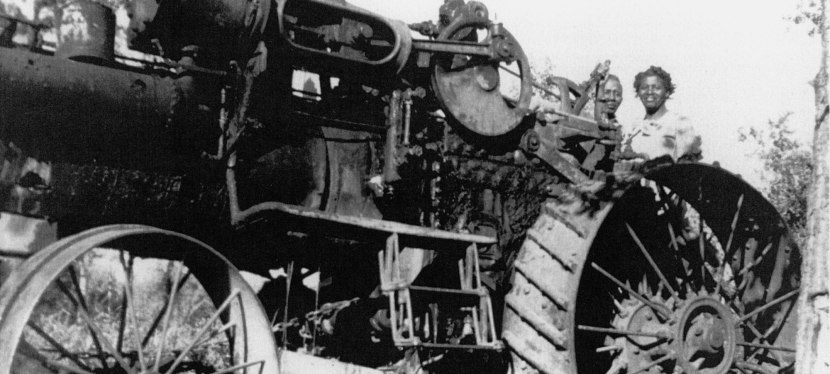
In our final instalment for Black History Month, it is our pleasure to share And Still We Rise: A Black Presence in Alberta, a virtual exhibit highlighting the formation of Alberta’s Black communities from the late 1800s to the early 1970s. The banner image at the top of the page is courtesy of the Athabasca Archives.






 RETROactive