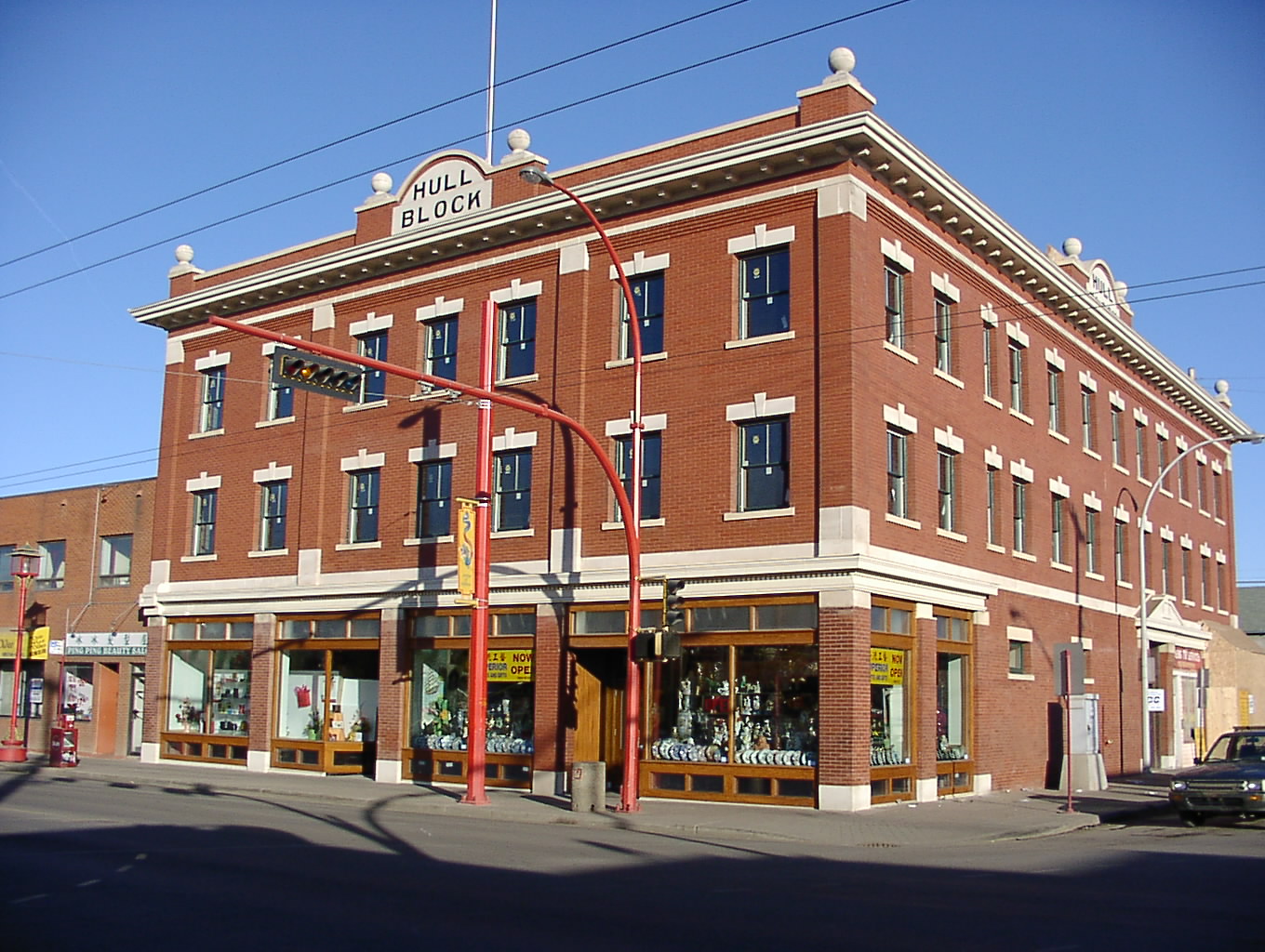
Hull Block, Edmonton

With the turn of the 20th century, Edmonton was beginning a period of rapid development, initiated mainly by its position as the commercial gateway to northwestern CanadaIn 1904, Edmonton became a city, and, in 1905, two other events occurred which would solidify its position as a metropolis. First, the city was named the capital of the new province of Alberta, and, second, just as the first Legislative Assembly was convening in September, the tracks of the Canadian Northern Railway were being laid, giving the city a direct line to Winnipeg and the markets of eastern Canada.  Four years later, the Canadian Northern was joined by the Grand Trunk Pacific, with a line through the city’s north end and a spur to the city center.

The arrival of these railways brought dramatic change to the city center where, to the west end, a large warehouse district evolved.  The north side also saw extensive development as many large industries chose to locate plants and warehouses near the tracks.  The railways and the industries they spawned brought masses of working class immigrants to Edmonton, most of who chose to live in neighborhoods near their centers of employment, such as McCauley, Norwood, Riverdale and Bellevue.  As a result, small community commercial areas sprang up to provide easy shopping for residents, and facilitate local businesses.

Being close to the city center, the McCauley district had little need for a separate shopping district, and yet there remained an inclination for many small businesses to locate as close to the people as possible.  As a result, Namayo Avenue (97th Street) was soon developed into a commercial artery, extending from Jasper Avenue all the way to 111th Avenue, with sections of the street also holding small dwellings.  North of the tracks, the street soon assumed the appearance of a small community shopping district, with grocery stores, drug stores, hardware stores, restaurants, barber shops, laundries and convenience stores. The shops were mostly modest two story structures, and often the proprietors would live in the same buildings.

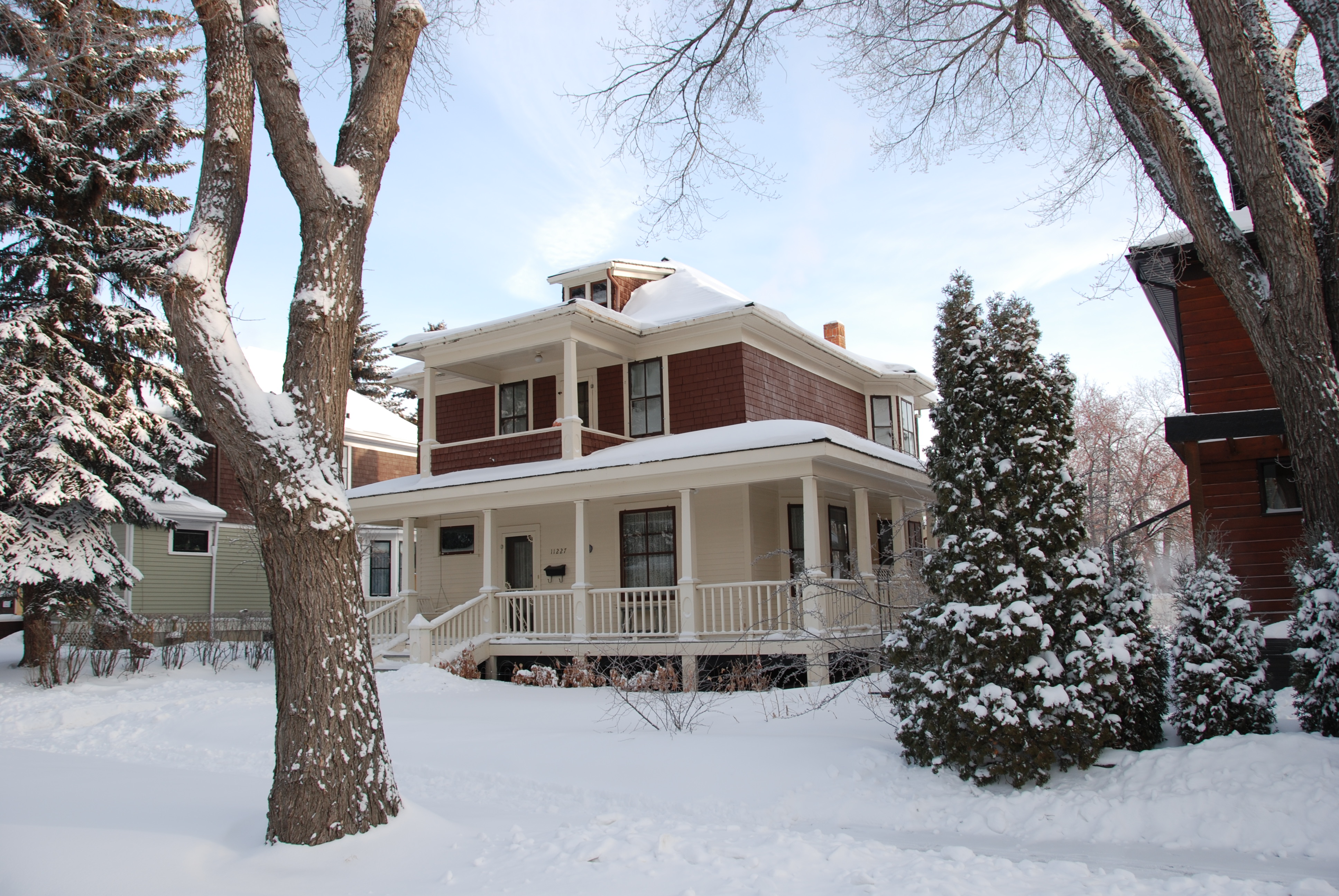
In June 1914, when the commercial boom in Edmonton had actually just passed its apex, a headline in the Edmonton Bulletin read “New $35,000 Block for Namayo Avenue.”  The owner of the property on the corner of Namayo Avenue and Sutherland Street (9664-106th Avenue) was the Calgary business tycoon, William Roper Hull, who apparently saw the need for an office complex in the area.  As designed by E.C. Hopkins and opened the following year, the building was no doubt expected to facilitate small retail businesses and apartment dwellers, as well as office space.  The concept of the combined facility was not unlike the Beuna Vista Apartments and the Gibbard Block recently erected among small commercial buildings in other areas of the city that were surrounded by extensive urban development.

Among the first tenants in what became known as the Hull Block was Herb E. Thomson Drugs, which would occupy the premises until 1940.  Countless other tenants also came to occupy the building, which today appears to be serving the same purpose for which it was built 87 years ago.  Its historical significance lies in its representation of the tremendous commercial growth of downtown Edmonton during the early part of the 20th century.  It is also representative of the kind of commercial structure intended to evoke the ethos of a large office complex, but, due to its location near an urban population, was also made to facilitate small retail businesses and apartment dwellers.  It is also a significant landmark in the McCauley district of Edmonton.  In July 2003, it was designated a Provincial Historic Resource.

Written by: David Leonard, Historian

Visit the Alberta Register of Historic Places to learn more about the heritage value of the Hull Block. In order for a site to be designated a Provincial Historic Resource, it must possess province-wide significance. To properly assess the historic importance of a resource, a historian crafts a context document that situates a resource within its time and place and compares it to similar resources in other parts of the province. This allows staff to determine the importance of a resource to a particular theme, time, and place. Above, is some of the historical information used in the evaluation of the Hull Block.
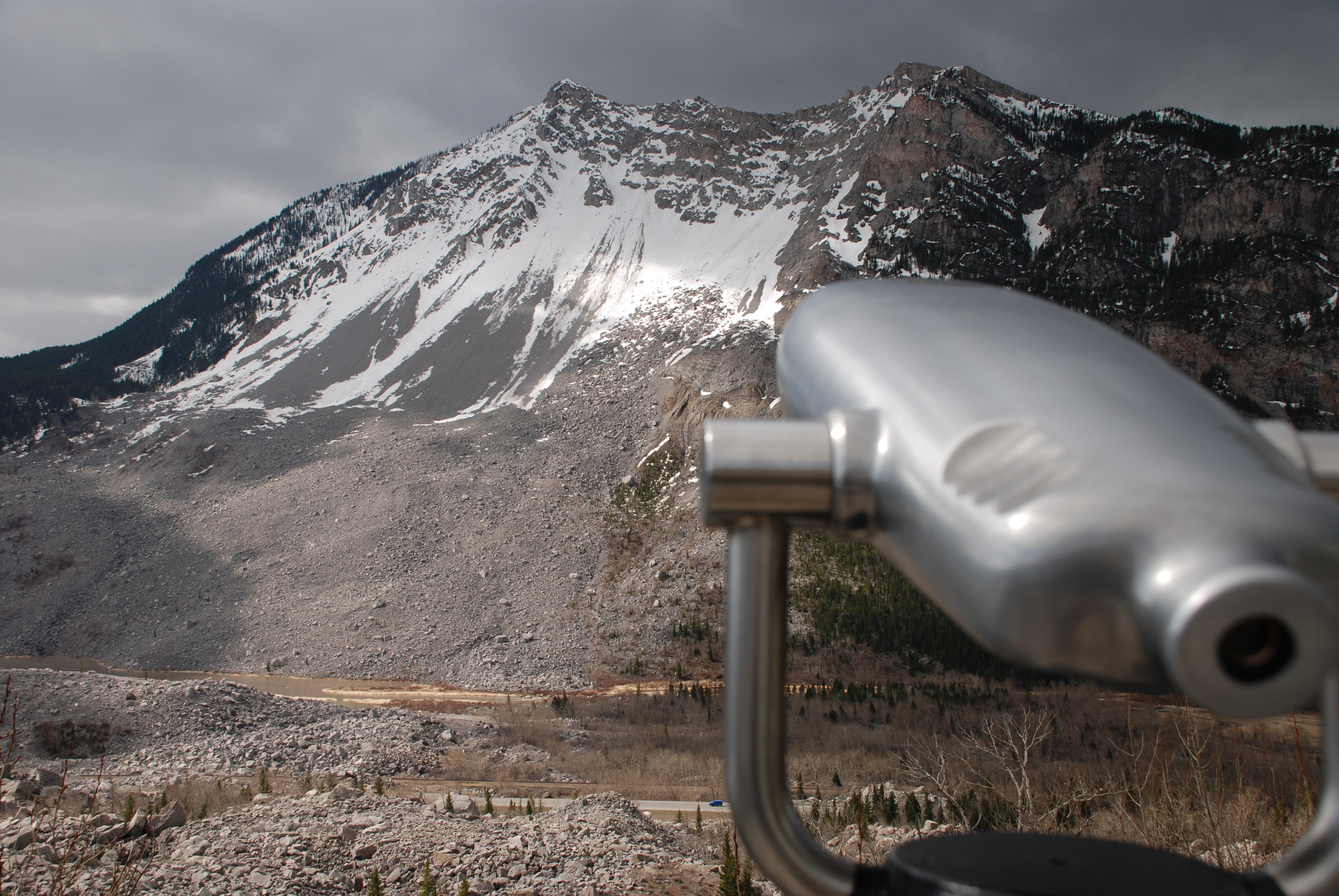
Moving Mountains – My Visit to the Frank Slide Interpretive Centre

View of Turtle Mountain from the Frank Slide Interpretive Centre

Last week I was in southern Alberta for meetings with Vulcan County and the Town of Pincher Creek. To fill a meeting-free morning I decided to visit the Frank Slide Interpretive Centre (a thirty minute drive west of Pincher Creek on Highway 3). Throughout my visit grey clouds blanketed the sky, which befitted the destruction, sorrow and magnitude of the Frank Slide disaster.

On April 29, 1903 at 4:10 in the morning the east face of Turtle Mountain toppled and slid four kilometres into the Crowsnest River valley. In a mere ninety seconds, 82 million tonnes of limestone collapsed upon the southern end of the Town of Frank, a section of the Canadian Pacific Railroad (CPR) and the mine plant of the Canadian-American Coal Company. In total, at least ninety people were killed. To date, this is Canada’s deadliest rockslide.

In 1977 the Government of Alberta designated the site a Provincial Historic Resource for its significance as the site of Alberta’s worst natural disaster, for it being a geological phenomenon and for it serving as a provincial landmark (to learn more about the site’s heritage value, read the Frank Slide Statement of Significance). Visitors to the area can learn first-hand about the disaster through interactive multi-media displays at the Frank Slide Interpretive Centre, and by walking the Frank Slide Interpretive Trail.

Interpretive Centre

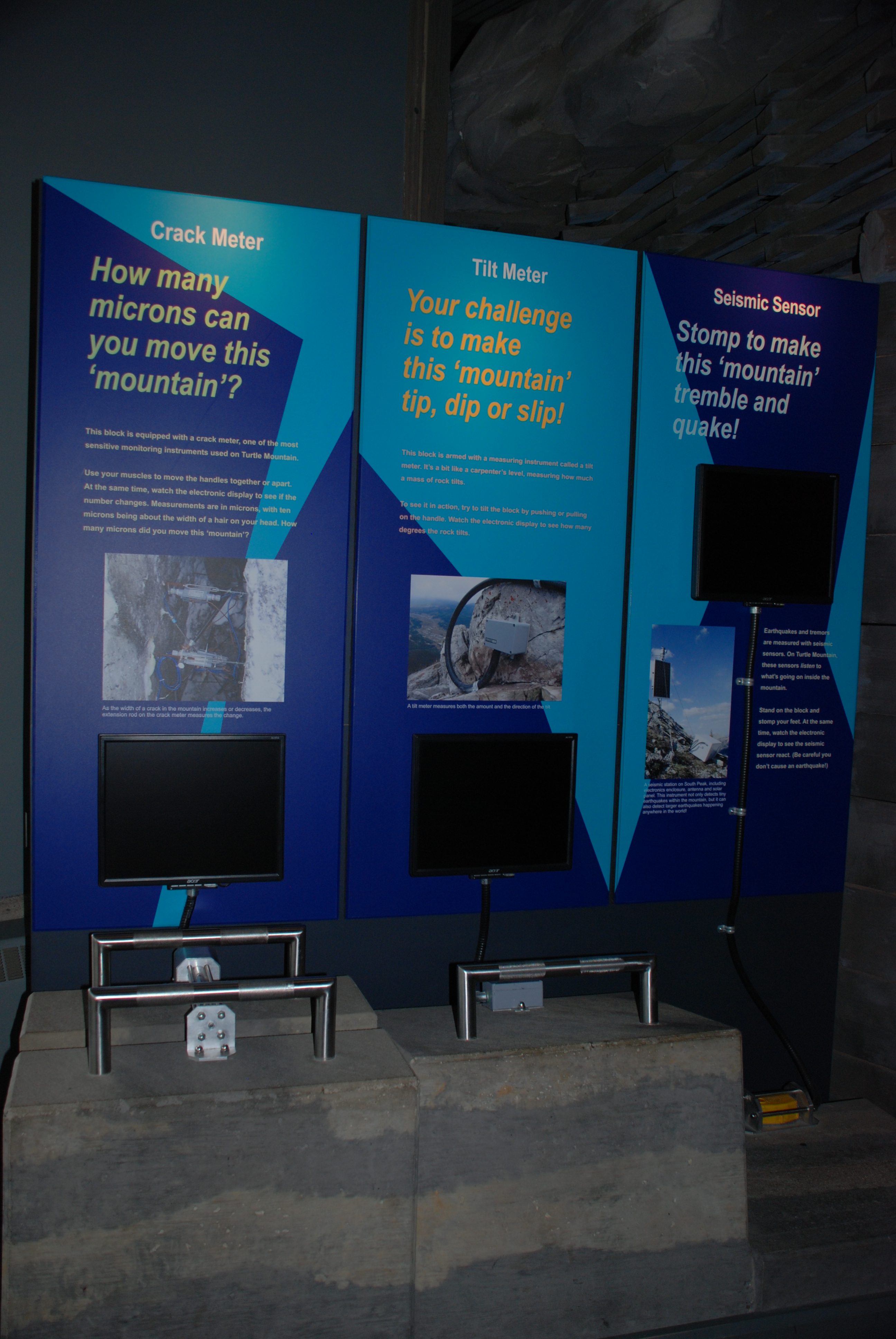
What force can you exert on a mountain by jumping, stomping, pushing, pulling, lifting ... ?

Four levels of display space recount not only the horrors and triumphs of the people that awoke one morning to find their town buried, but provide geological and seismic information about the causes of the disaster. Audio-visual components and 3-D models allow visitors to visualize how Mother Nature could wreck such havoc. My favourite display was a set of three mountain monitoring sensors that are like those currently installed on Turtle Mountain to detect movement. Visitors are encouraged to stomp, jump, push, pull and lift blocks of concrete connected to a crack meter, tilt meter and seismic sensor. Computer screens reveal how sensitive the monitors are AND how strong YOU are! Yes, I jumped, stomped, pushed and pulled … the next time someone asks I will now be able to confidently state that I really can move mountains!

Interpretive Trail

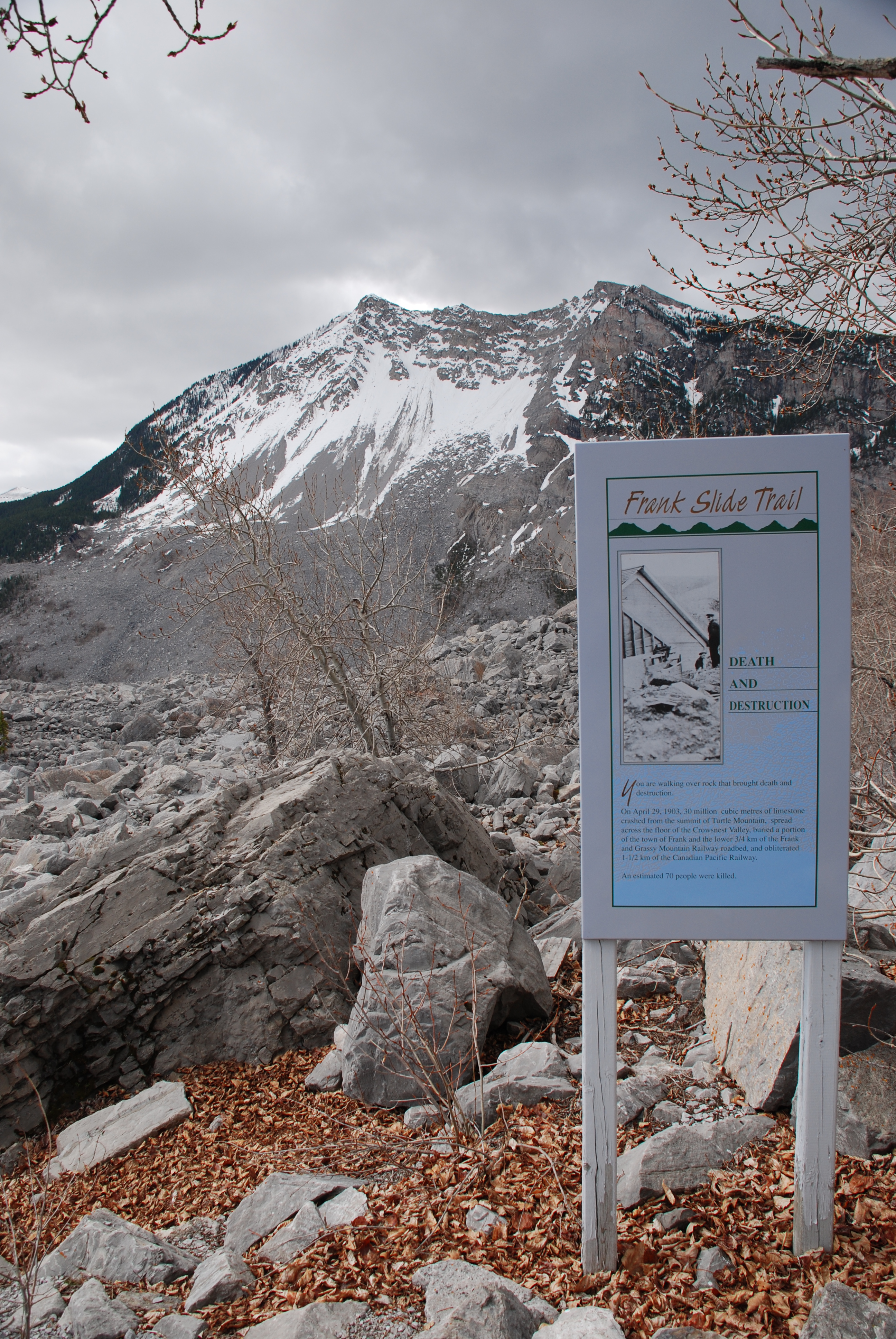
View of Turtle Mountain near the trail head.

A 1.5 kilometre trail, beginning from the Interpretive Centre parking lot, winds through mounds of limestone rubble. Looming views of Turtle Mountain offer a stark reality check when walking along the trail. Hopes, dreams and memories lay beneath.

I walked the trail with an interpretive brochure in hand. Waypoints marked along the path explained what I saw and some of the events that occurred on that fateful day. The last quarter of the trail winds along the western edge of the fallen rock and loops back up to the parking lot through a wooded area. I paused during this reconnection with nature to read that, “mammals such as bears, deer and moose use these cool, sheltered woodlands to skirt the slide’s harsh, open environment as they move through the Crowsnest River valley. Mule deer can frequently be seen along this portion of the trail, particularly early and late in the day.” Taking a step to carry on my way, I thought how great it would be to see some deer. The breaking of twigs caused me to again pause. To my amazement I looked up to discover four deer staring at me!! All five of us stared. Soon enough they returned to their feeding while I continued staring. What a joy!

Turtle Mountain Web Cameras

The Alberta Geological Survey has installed two web cameras for viewing Turtle Mountain. One is in the valley looking up at the mountain and the other is positioned on the south peak providing a view of the valley below. Click here to see a current view of Turtle Mountain.

The Frank Slide Interpretive Centre is open to the public, daily, from 10:00am to 5:00pm. July 1 through Labour Day, the Centre is open daily from 9:00am to 6:00pm. Click here for additional information.

Written by: Brenda Manweiler, Municipal Heritage Services Officer

P.S. I must extend a big thank you to Monica and Myriah for welcoming me to the Interpretive Centre and for providing a great tour! I really enjoyed my visit.

Strathcona Fire Hall No. 1

When the Calgary & Edmonton Railway arrived at the south bank of the North Saskatchewan River in 1891, the C & E immediately subdivided a town site which it named South Edmonton.  Being at the end of steel, the community steadily grew throughout the decade until, in 1899, it was incorporated as the Town of Strathcona with a population exceeding 1,000.  To serve this burgeoning community, which consisted primarily of wood frame buildings, it was obvious that some method of organized fire protection was needed.  A volunteer fire brigade was organized in 1901, and, that same year, Town Council provided for the construction of a wood frame fire hall on lot 2, block 79, just north of main street, and near the Town water well.  A horse drawn fire wagon with a wooden water tank was then acquired.

As with Edmonton to the north across the river, Strathcona grew rapidly in the wake of the Klondike gold rush.  In 1907, it was incorporated as a city with an estimated population of 3,500.  It was soon evident that the old fire hall was inadequate, and, so, provision was made for a newer and larger structure.  As the City waterworks was right next door to the old fire hall, it was felt appropriate to build the new structure at the same location.  The firm of Wilson and Herrald was thus contracted to design, and the firm of J.M. Eaton contracted to build a modern two-story red brick facility which could accommodate three fire wagons.  The estimate for construction was $13,715.  A stable in the rear was designed for nine horses, while a bell tower extended from the middle of the structure 77 feet in the air.  The second floor was made to accommodate a chief’s office, a general hall, bedrooms, a band room, and a bathroom with showers.  Two fire poles facilitated instant access to the ground floor.

The Strathcona Fire Hall with its horse-drawn wagons served the City of Strathcona until its amalgamation with Edmonton in 1912.  It was then designated as Edmonton Fire Hall #6 and became part of the Edmonton Fire Department.  A permanent salaried chief was assigned to the Hall, and the number of salaried firefighters grew over the passage of time.  The crews were always supplemented by volunteers in times of emergency.  By 1954, however, the facility was considered dilapidated and outdated, and, so, a new fire hall was constructed nearby.  The old structure was apparently slated for demolition but was considered adequate for storage, and, so, it was leased to Strathcona Furniture, which used it as a warehouse.

By the early 1970’s, there was a growing appreciation in Edmonton about the early buildings of Strathcona, and, so, when the Walterdale Theatre began to plan for a new home, thoughts turned to the old fire hall, which seemed to provide adequate space for a live theatre building.  The Walterdale group moved into its internally renovated facility in 1974, and, in 1976, the structure was designated a Registered Historic Resource.  In the years that followed, it became a central venue for Edmonton’s Fringe Festival.

In September 2007, the Strathcona Fire Hall was designated a Provincial Historic Resource.  Its historical significance lies in its provision of structural evidence of fire fighting facilities in a large urban area in the early 20th century in Alberta.  It is the oldest major fire hall in the province.  It is also important as one of the surviving early public buildings of the City of Strathcona, which tells of life in general in this community.      

Written by: David Leonard, Historian

Visit the Alberta Register of Historic Places to learn more about the heritage value of the Strathcona Fire Hall. In order for a site to be designated a Provincial Historic Resource, it must possess province-wide significance. To properly assess the historic importance of a resource, a historian crafts a context document that situates a resource within its time and place and compares it to similar resources in other parts of the province. This allows staff to determine the importance of a resource to a particular theme, time, and place. Above, is some of the historical information used in the evaluation of the Strathcona Fire Hall.

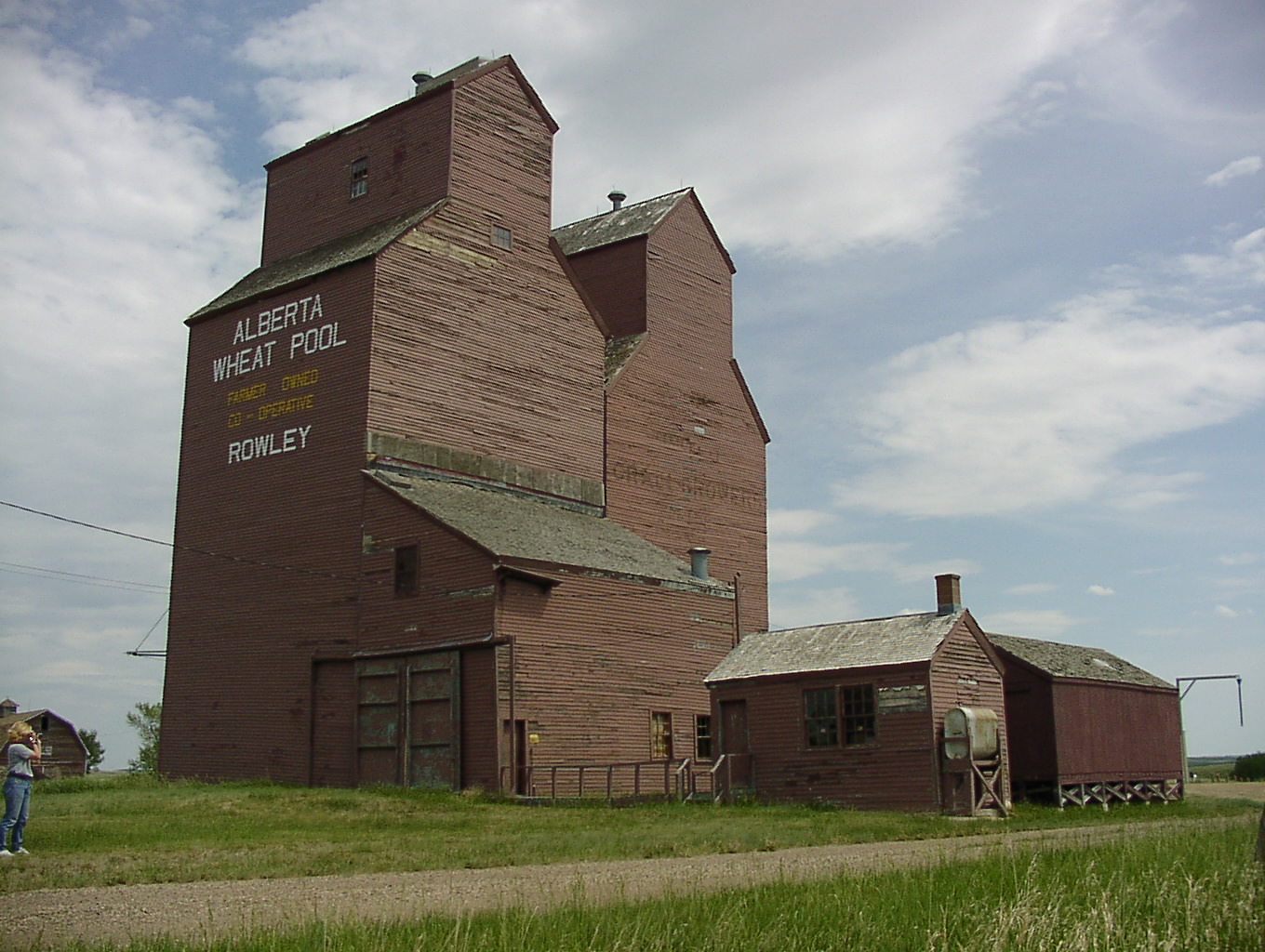
Rowley Grain Elevator Row

In the spring of 1909, Premier Rutherford of Alberta announced his government’s commitment to a vast program of railway expansion in Alberta.  To do this, the government offered to guarantee the bonds of major railway companies to the extent of $20,000 per mile of completed track.  Taking advantage of this, the Canadian Northern Railway decided to incorporate several subsidiary companies to undertake specific lines in Alberta.  One of these was the Alberta Midland, which was chartered by the provincial government in May 1909 to build a line from Vegreville south through Drumheller to Calgary.  One purpose was to open up new land for farming, another was to tap into the coal reserves around Drumheller which had hitherto been unavailable to the Canadian Northern or any of its subsidiaries.

By the end of 1911, the Alberta Midland line was completed.  Along it, several stations were built.  One of these, 25 km north of Drumheller, was named Rowley, after the Manager of the Calgary branch of the Canadian Bank of Commerce.  The Bank itself had provided substantial backing to the Canadian Northern.  Behind the station, a townsite was subdivided, and, before long, a community evolved, the main purpose of which was to provide services to the surrounding hinterland where mixed farming was the staple economy.

It was essential therefore that Rowley be provided with grain elevators, and, in 1915, the first one was built by the Home Grain Company.  It was apparently not well constructed however, for, shortly after its completion, it collapsed.  Though rebuilt soon after, another mishap occurred when an annex burst, and, not long after that, the elevator burned down.  In the wake of these mishaps, two other elevators were built in 1917.  These were owned by the National Grain Company and the United Grain Growers.  The UGG had only recently been incorporated as a farmer-owned company, and it was a good time for it to build for, like most of the western prairies, the Rowley district was seeing high yields and much demand because the war in Europe was diverting the activities of farmers there to other matters.

The National and the UGG had a monopoly on the local grain export at Rowley until 1923, when the Searle Grain Company, formerly the Home Grain Company, decided erect another elevator on the site of their first one at Rowley.  At 40,000 bushels, this would be the biggest of the village’s three elevators.  It was an unusual time to build, for grain prices had recently collapsed in the wake of the post war overproduction of wheat.  Also, during 1919-20, both the Canadian Northern and the Grand Trunk Railways had been taken over by the federal government and consolidated into Canadian National.  This meant reduced services, and, in 1922, rail traffic between Vegreville and Drumheller were significantly reduced.

The three grain elevators in Rowley managed to survive however, and, in 1928, the UGG structure was acquired by the Alberta Wheat Pool.  Formed five years earlier, in the wake of plummeting grain prices, the Pool was a business concept advocated by UFA president Henry Wise Wood which saw farmers pool their wheat in a co-operative to ensure that no member would suffer unduly in times of stress.  Such stress occurred during the early 1930’s, when the price of #1 wheat fell to 32 cents a bushel and many farmers could not afford to ship out their wheat.  During the end of the decade however, with Great Britain gearing for war, the demand for wheat began to rise, and, with it, productivity on the Canadian prairies.  In 1940 therefore, the Wheat Pool decided to twin its elevator in Rowley with a new 40,000 bushel structure.

The three grain elevators at Rowley continued to serve the district long after the war.  In 1967, the Searle elevator was sold to the Federal Grain Company, and, in 1972, to the Wheat Pool, which then owned all three elevators.  In 1989 however, the CN line between Rowley and Morrin was closed down, and farmers soon began trucking their grain to Morrin or elsewhere.  The elevators therefore were closed also.  They remained standing however, and, in recent years, have been acquired by the Rowley Community Hall Association which is seeking to preserve them.

In June 2010, the grain elevators in Rowley were designated a Provincial Historic Resource.  Their historical significance lies in their representation of the major economy of Alberta for most of the 20th century, the growth and export of grain, and mainly wheat.  They are also important as landmarks in Rowley, providing structural evidence of the community dating back to 1917, when the district was prospering.  The first elevator represents the main source of that prosperity, and the three of them the economy of the district in the years that followed.    

Written by: David Leonard, Historian

Click here for statistics on remaining grain elevators in Alberta.

Visit the Alberta Register of Historic Places to learn more about the heritage value of the Rowley Grain Elevator Row. In order for a site to be designated a Provincial Historic Resource, it must possess province-wide significance. To properly assess the historic importance of a resource, a historian crafts a context document that situates a resource within its time and place and compares it to similar resources in other parts of the province. This allows staff to determine the importance of a resource to a particular theme, time, and place. Above, is some of the historical information used in the evaluation of the Rowley Grain Elevator Row.


Alberta’s Wooden Country Grain Elevators

In February one of our Facebook fans asked how many grain elevators still stand on the Alberta horizon. Dorothy Field, our Heritage Survey Program Coordinator has compiled some statistics.

The twentieth century saw the rise and fall – literally – of the wooden country grain elevator in Alberta. As rail lines spread across the province, grain elevators sprouted like mushrooms after a spring rain. The high water mark for wooden country grain elevators was in 1934. New elevators were added in every decade, but this has been exceeded by the rate of demolition or closure ever since. Check out the following “index” of Alberta’s wooden country elevators, called “elevators” for short in this list.

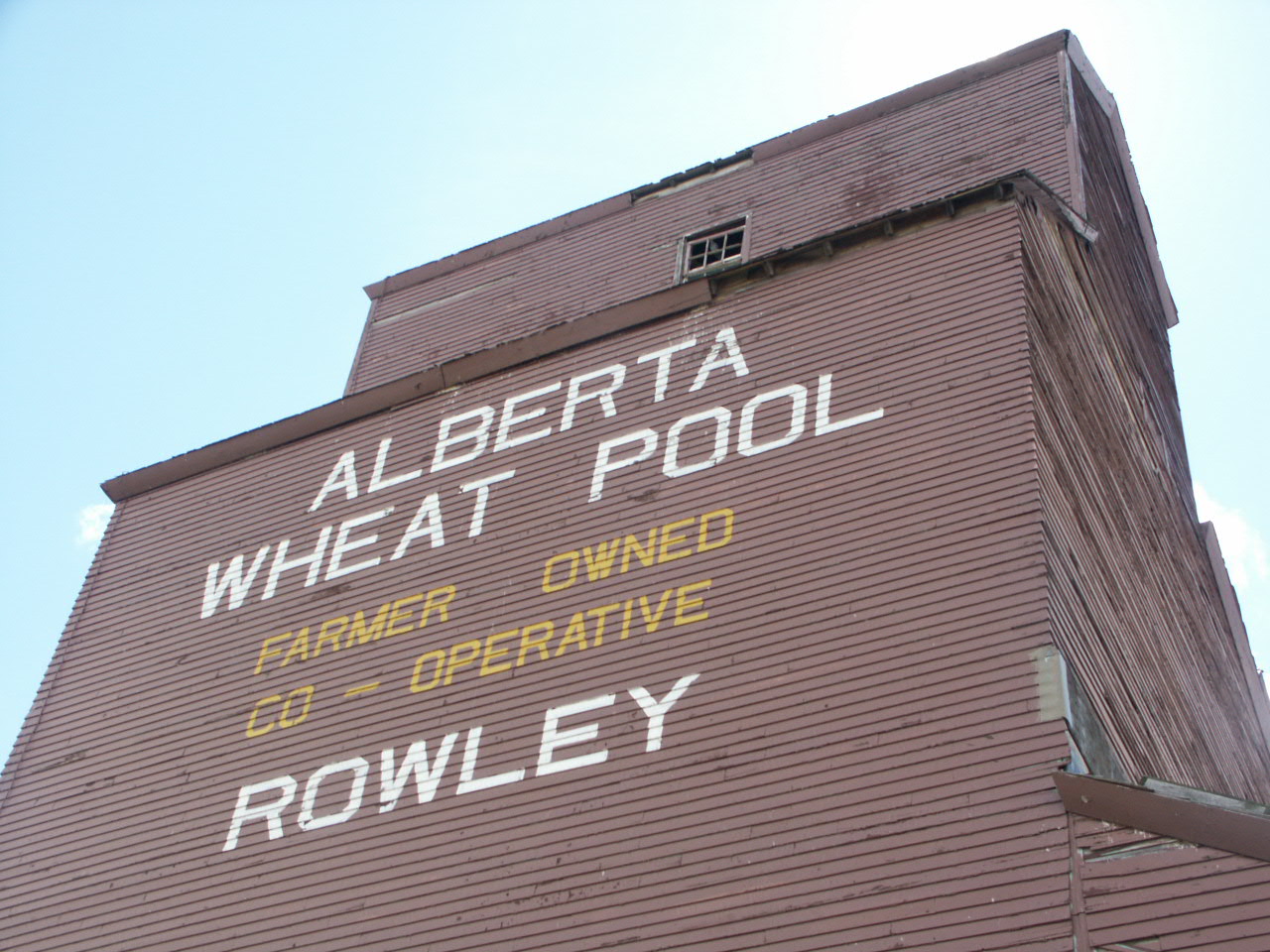
Rowley Grain Elevator Row, Provincial Historic Resource

Number of elevators in Alberta:

  • in 1934:  1,781
  • in 1951:  1,651
  • in 1982:  979
  • in 1997: 327
  • in 2005: 156
  • in 2012 on railway rights-of-way:  130

Number of communities with:

  • at least one elevator:  95
  • 2 or more elevators:  26
  • 3 or more elevators:  7
  • 4 or more elevators:  1 (Warner)
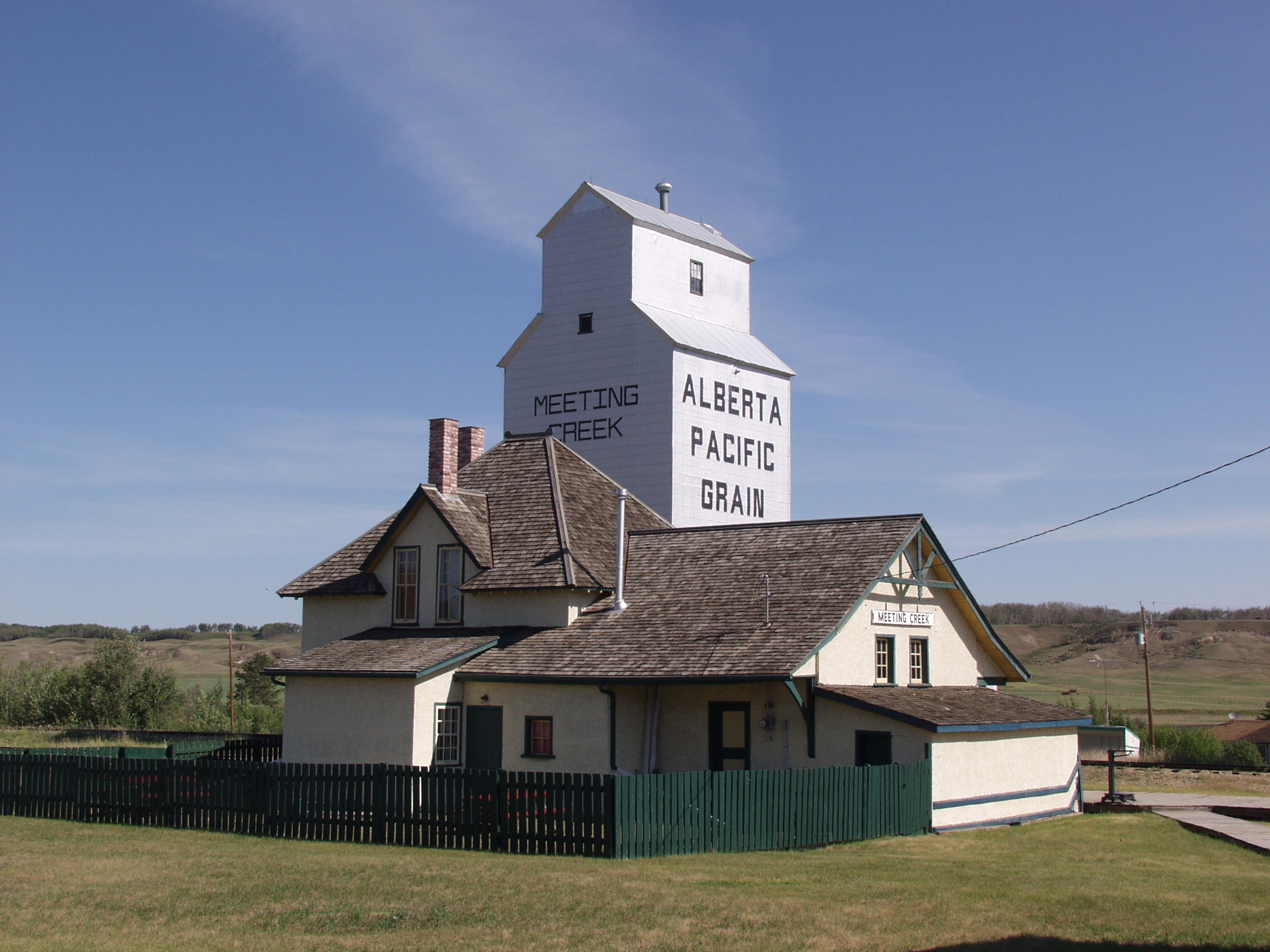
Alberta Pacific Grain Elevator Site Complex, Meeting Creek, Provincial Historic Resource

Additional statistics:

  • Number of elevators in Alberta’s longest row:  6
  • Oldest remaining elevator: 1905 (Raley)
  • Number of remaining elevators that pre-date 1910:  3 (Raley, St. Albert, De Winton)
  • Newest remaining elevator: 1988 (Woodgrove)
  • Decade with the largest number of surviving elevators:  1920s (33)
  • Decade with the second largest number of surviving elevators:  1980s (26)
  • Decade with the fewest (after pre-1910) number of surviving elevators:  1940s (5)
  • Number of elevators that have been designated a Provincial Historic Resource (PHR):  13
  • Number of communities with at least one elevator designated as a PHR:  10
  • Oldest designated elevator: 1906 (St. Albert)
  • Newest designated elevator:  Leduc (1978)
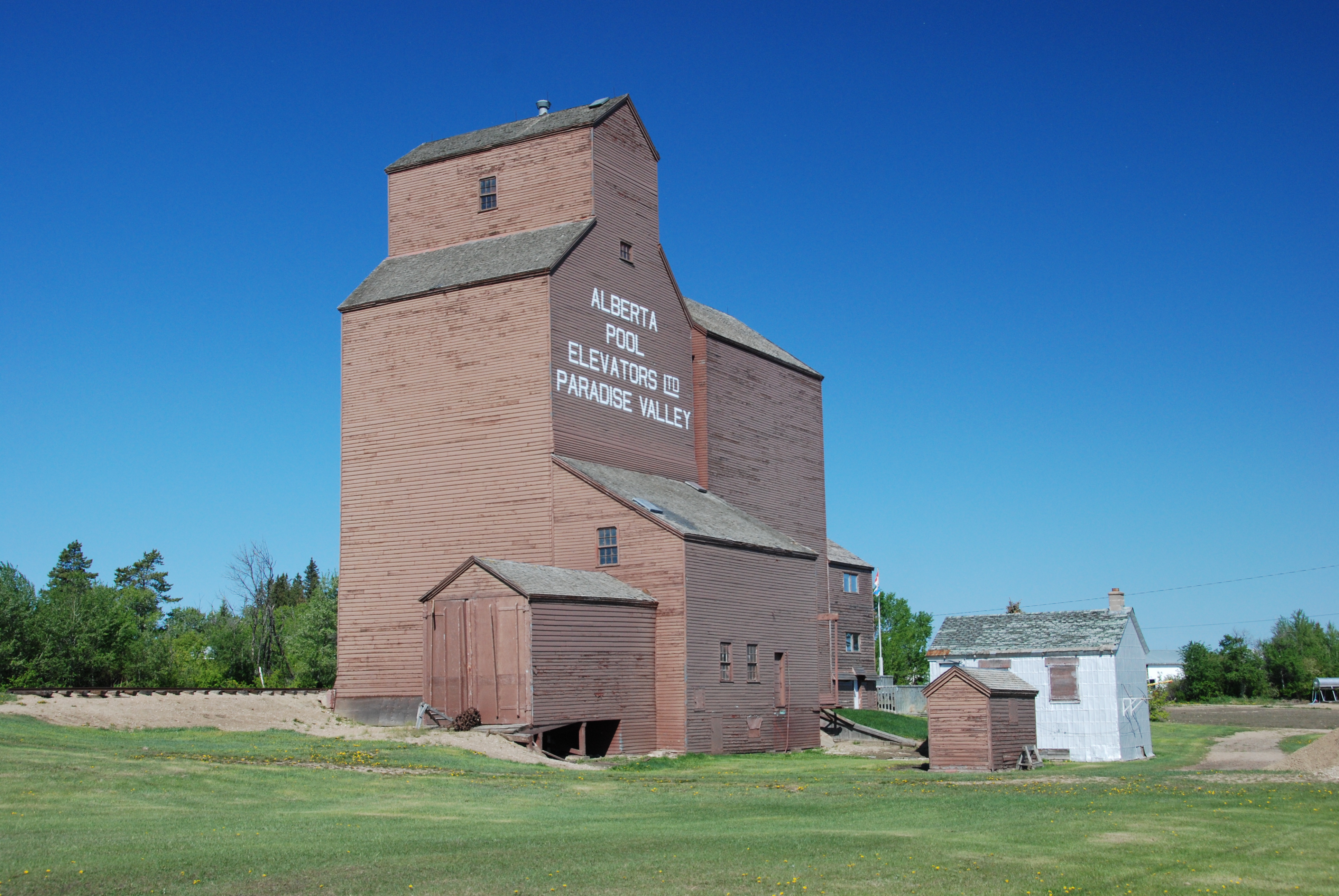
Alberta Wheat Pool Grain Elevator, Paradise Valley, Provincial Historic Resource

For a list of communities in Alberta with designated and non-designated elevators, please click here.

Please Note:

  • Grain elevators that have been moved off railway rights-of-way – to a farmyard or a museum, for instance – are not included in these statistics.
  • Grain elevators located on railway rights-of-way where the rails have been torn up are included in these statistics.
  • Concrete or steel elevators are not included.
  • Elevators used for other purposes, such as seed cleaning or fertilizer storage, are not included.
  • Most of these elevators were last documented by the Heritage Survey in 2005. It is possible that some of the elevators on the list are now gone.

Additional Information:

Written by: Dorothy Field, Heritage Survey Program Coordinator

Sharman House, near Onoway

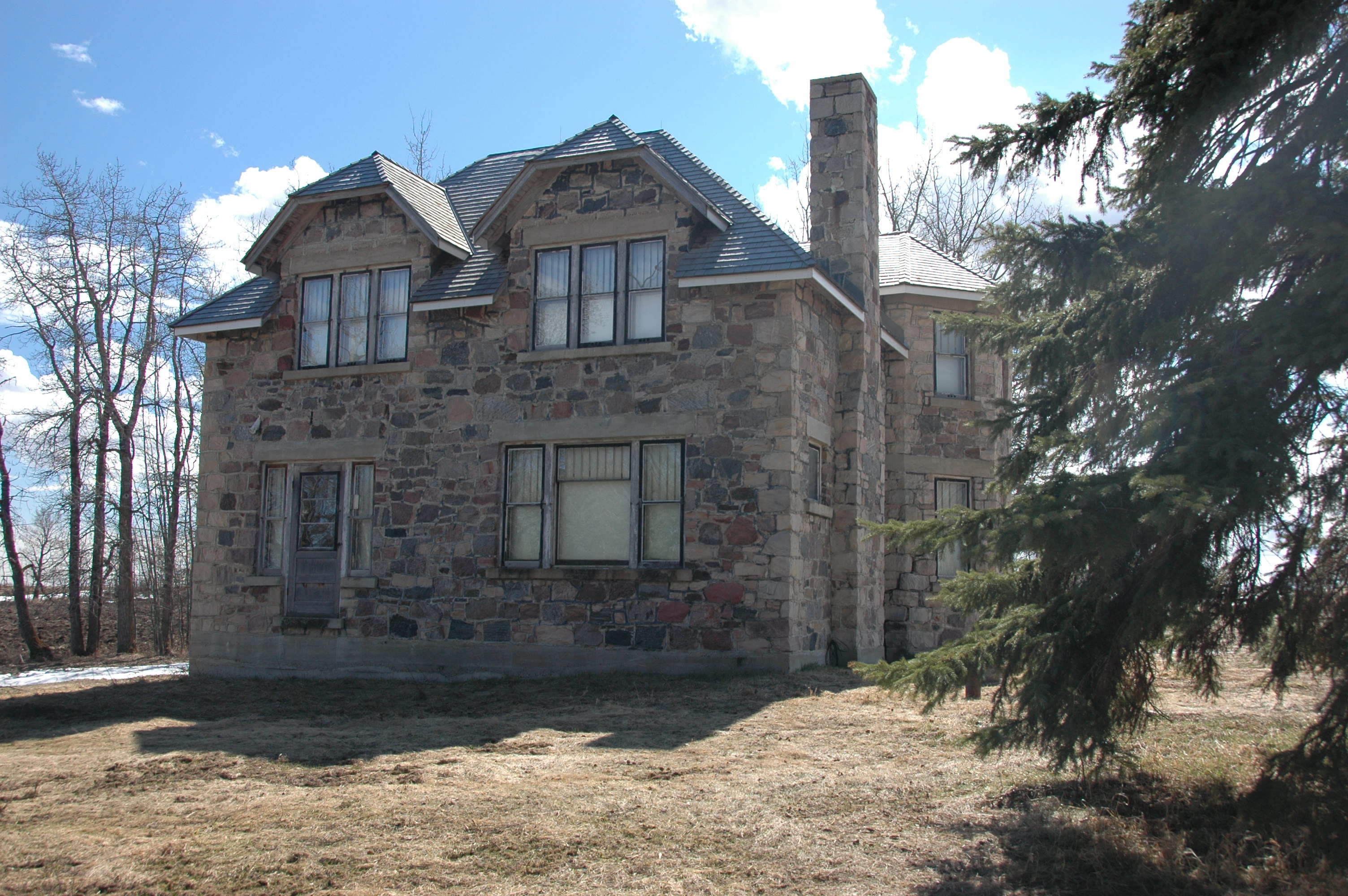
When the Canadian Northern Railway extended a line through Onoway in 1909, en route to Jasper and Vancouver, much of the rich agricultural land east of Lac Ste Anne was made immediately viable for homesteading.  Even before the railway arrived however, and indeed even before the Dominion Land Surveys of 1904-05, a number of settlers had taken up land in the Onoway area.  One of these was Thomas Sharman, who settled on NW34 TP52 R3 W5 in 1903, in a district soon to be known as Heatherdown.  Sharman was born in Ireland and had come to western Canada from North Dakota, where he had been a stonemason as well as a farmer.  He first attempted to homestead near Camrose, but was unsuccessful.  Near Heatherdown however, he and his wife succeeded in proving up, and eventually they acquired five quarters.

As he cleared and broke his land, Sharman made a point of salvaging pristine stones that inundated his fields.  Being a stonemason, he had an idea that one day these would prove useful.  By the mid 1920s, he decided to use these stones for a new house.  With the help of his youngest son, Lawrence, and local neighbors, he designed and built a large dwelling utilizing the material he had salvaged.  He moved into his new home in about 1927, and lived there with his wife until passing away a few years later.  The house and the farm were then taken over by Lawrence Sharman and his wife, Florence, who died tragically in a fire on the farm in 1936.  The Sharman House then continued to be occupied by Lawrence on his own until he moved to British Columbia in 1947.  It was then acquired by Gordon Stewart, his wife Lenabelle, and their son, Lowell.  With Lenabelle’s death, Gordon and Lowell continued to farm the land and occupy the house as bachelors.

The historical significance of the Sharman House  lies in its representation of the settlement of the Onoway area, and of the richness of the farmland in the district.  It is also significant in demonstrating the inventiveness and craftsmanship of one of Onoway’s early settlers.  Its heritage value lies in the excellent craftsmanship evident in its split fieldstone construction and the home’s picturesque aesthetic appeal.  It is distinguished by its picturesque exterior, which is composed of different shapes and sizes of split fieldstone.  Other prominent features of the home include a hipped roof with intersecting roof ridges, hipped wall dormers, three tall stone chimneys, and a two-storey bay projecting from the southwest corner of the building.  The yard of the home includes a garden and mature evergreen trees north of the house dating from the period of construction. The Sharman House was designated a Provincial Historic Resource in 2007.

Written by: David Leonard, Historian

Visit the Alberta Register of Historic Places to learn more about the heritage value of the Sharman House. In order for a site to be designated a Provincial Historic Resource, it must possess province-wide significance. To properly assess the historic importance of a resource, a historian crafts a context document that situates a resource within its time and place and compares it to similar resources in other parts of the province. This allows staff to determine the importance of a resource to a particular theme, time, and place. Above, is some of the historical information used in the evaluation of the Sharman House.

Alequiers Ranch House, near Longview

During the latter part of the 19th century, the foothills of what is now southern Alberta were given over largely as grazing leases to several big ranching companies, many of them with close ties to the Conservative Party.  With the election of the Liberal party in 1896 however, more emphasis came to be placed on settling the West with small, independent farmers.  Under Interior Minister Clifford Sifton therefore, many grazing leases, when expired, were not renewed, in order that the land could be subdivided into quarter-sections for homesteading, or given over to the CPR Land Department.

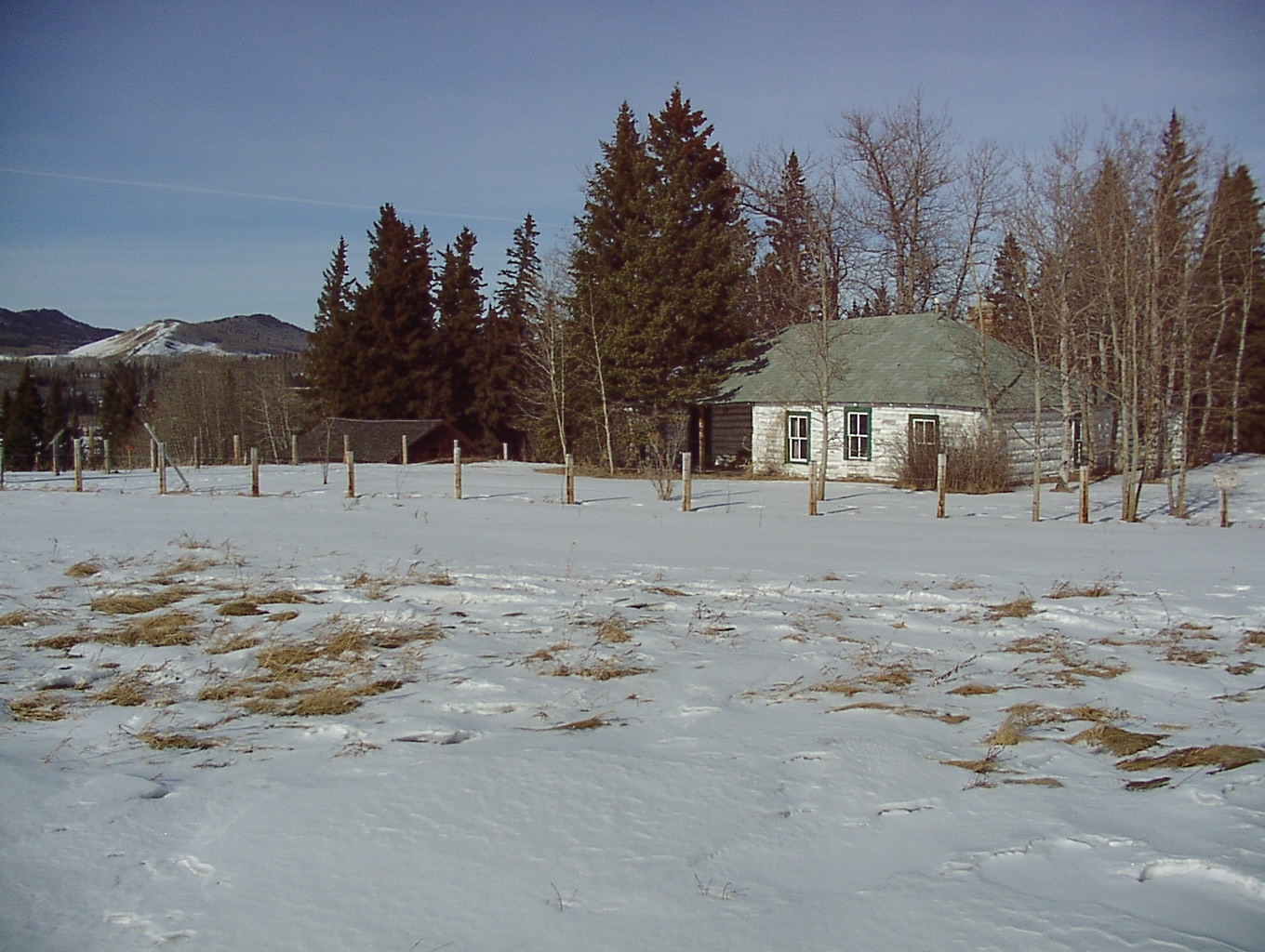
Among the many homesteaders to flock into the region during the turn of the 20th century were Nellie and Alexander Weir who, in July 1900, filed for SE18 TP18 R3 W5, on the east bank of the Highwood River, some 20 km northwest of High River.  This was on land previously occupied by the North-West Ranch Company.  The Weirs were from Ontario, and, like many of the new settlers, they combined dryland farming with cattle raising.  In May 1905, Alexander Weir received title to his land, and, in February 1906, the High River Times reported that he was erecting a new 26’ x 26’ log home on his ranch.

The Weirs never owned more than one single quarter-section of land, and, with grain prices declining during the early 1900’s, they probably found it difficult to make ends meet.  At the time, their property was surrounded by a large ranch owned by George Lane, which consisted of several sections.  At any rate, as soon as Weir gained title to his quarter, he mortgaged it to the Fairchild Company of Winnipeg.  Two years later, the Fairchild Company became owners of the land, while Weir apparently drifted off to some other form of employment.  Shortly thereafter, the western portion of the quarter-section was sold to an Italian immigrant named George Pocaterra, who turned it into a dude ranch called the Buffalo Head Ranch.  The eastern portion, which held Weir’s house, was acquired by an English immigrant named Owen Royal, who seems to have had business interests in Calgary.  It was Royal who upgraded the house, adding three bedrooms, a kitchen and a porch, while landscaping the yard and planting trees.  Royal named it Alequiers, a name derived from the spelling of Alex McQueen Weir.

In 1939, the Alequiers property was acquired by an artist named Ted Schintz.  Schintz had migrated to western Canada from Holland in the 1920’s, taking odd jobs and cultivating his skills as a painter.  In 1928, he stayed at the Buffalo Head Ranch and developed an affinity for the foothills environment.  In 1931, he married Jeanette Kay from England, and the couple stayed for a while at Algequiers before traveling to Europe.  While the couple took odd jobs, Ted enrolled in the Academy of Arts in Munich, studying under Angelo Yank.  Upon his graduation, the Schintzes returned to western Canada, and, soon, Ted began to sell his paintings at reasonably high prices, mostly to magazines like Country Guide and Cattleman, which were interested in images of the prairie West.  Jeanette was also able to sell some of her work.  Finally, in 1939, the couple had sufficient means to purchase Alequiers, where they lived until retiring to High River in the 1960’s.

The Alequiers Ranch House was designated a Provincial Historic Resource in 2005.  Its historical significance lies in its provision of structural evidence of the homesteading experience on the southern foothills of Alberta after the break-up of many of the large ranches that had dominated the area.  The expanded house of about 1920 is also important as the showpiece home of Owen Royal and, more importantly, the artist Ted Schintz, many of whose works have graced magazine covers with images of the southwestern plains of Canada, and several of which are stored in the Glenbow Museum.

Written by: David Leonard, Historian

Visit the Alberta Register of Historic Places to learn more about the heritage value of the Alequiers Ranch House. In order for a site to be designated a Provincial Historic Resource, it must possess province-wide significance. To properly assess the historic importance of a resource, a historian crafts a context document that situates a resource within its time and place and compares it to similar resources in other parts of the province. This allows staff to determine the importance of a resource to a particular theme, time, and place. Above, is some of the historical information used in the evaluation of the Alequiers Ranch House.

Brrrrr… Oh, wait! It isn’t that cold!

Sitting at my desk enjoying the sun streaming in through the window, I can’t help but wonder what Eda Owen would think about the unseasonably warm winter we are experiencing. Who is Eda Owen, you ask? Working out of the Owen Residence / Dominion Meteorological Station in Edmonton, Owen was a pioneering meteorologist serving from 1915 to 1943. She was one of only a small number of female meteorologists working at weather stations throughout the world.

The Owen Residence / Dominion Meteorological Station was designated a Provincial Historic Resource in 1994, in part, because of its association with Eda Owen. On the Alberta Register of Historic Places, the Statement of Significance says:

In 1908, Eda and Herbert William Owen emigrated from London to Edmonton. After a number of temporary employments in his new home, Herbert accepted a position as an assistant in the Dominion government’s Meteorological Office. In 1913, the weather office was moved into the Owen residence in the Highlands neighbourhood. Wartime exigencies prompted both Owen and his supervisor, Captain S. M. Holmden, to enlist in 1915 for active service overseas. In their absence, Eda Owen, who had learned the arts of reading navigational charts and employing scientific instruments from her husband, took over meteorological duties at the Highlands station. Herbert never returned home, dying in a prisoner of war camp in Europe. Though overcome by grief, Eda continued her work at the station. In 1921, following a brief spell as an assistant meteorologist, she was formally named Provincial Agent and Weather Observer for Alberta by the federal Department of Marine and Fisheries. Her work was incredibly demanding. The Highlands station was arguably the most significant meteorological post outside of Toronto. Eda was required to take hourly readings from 36 different instruments throughout the day and compile reports from over 140 stations in the region. The information she amassed had wide currency, being circulated to forest rangers, aviators, agriculturalists, as well as radio and newspaper personnel. For most of her service from 1915 until she resigned her post in 1943, Eda was the only woman employed as an observer at a major Canadian meteorological station. Indeed, she was one of only a handful of woman meteorologists at major stations in the world at the time. As a result of her trailblazing work, she garnered international acclaim. MacLeans, the Toronto Star Weekly, and the Christian Science Monitor all featured Eda in their pages, hailing the “Weather Woman of the West” as a pioneer in a scientific field largely dominated by men.

What would Owen think of our warm winter? We will never know, but I would like to think that between readings from the 36 meteorological instruments she would have found time to enjoy the warm spring-like conditions.

To read the complete Statement of Significance, please click here.

Written by: Brenda Manweiler, Municipal Heritage Services Officer

Cypress Club, Medicine Hat

As the Canadian Pacific Railway was planning its route between Winnipeg and Fort Calgary, the decision was made to cross the South Saskatchewan River at a wide valley west of Fort Walsh lush with cypress trees.  Here a station was erected and a townsite subdivided called Medicine Hat after a Cree medicine man.  The surrounding district was soon the domain of numerous ranches, and, during the 1890’s, Medicine Hat emerged as the regional metropolis of a cattle domain.  In 1898, it was incorporated as a town with over 500 people.  By this time, gas reserves were discovered in the district and incentive was provided for industrial development, particularly in pottery.  In the meantime, the city’s streets came to glow from gaslight.  By 1906, Medicine Hat was large enough to be incorporated as a city.  By 1911, its population stood at 5,600.  Contributing to its growth was its comparative isolation, and the conversion of much of the surrounding ranching leases into farmland, which resulted in the emergence of a large farming population in the hinterland.

Though the surrounding countryside and growing urban population of Medicine Hat was ethnically mixed, the business elite of the community was primarily British.  The first ranchers had been mainly British, and the new wave of industrialists and real estate developers were also of British origin, primarily immigrants from Ontario.  It was natural therefore that the first City Councils would often contain the same people as the Chamber of Commerce, with names such as Fewings, Tweed, Cousins, Crawford, Milne, Pingle, Sissons, Kealy, Huckvale and Stewart predominating.  It was probably also natural that such people would found a social club, where affairs of common interest could be discussed with less formality and out of the public eye.  Thus, on 21 November 1903, the Cypress Club was incorporated by an act of the Legislative Assembly of the North-west Territories.  Like the Edmonton Club and Ranchman’s Club (Calgary) before it, the Cypress Club was intended to provide a retreat for local business and community leaders to plot the development of the community in an atmosphere of brotherhood and congeniality.  A great incentive was the authority such a private club would have to obtain a liquor license and so provide intoxicants to its members at any time it chose.  As was typical, membership was confined to men.

Three of the first six presidents of the Cypress Club, F.L. Crawford, William Cousins and Charles Pingle, would also be presidents of the Medicine Hat Chamber of Commerce at roughly the same time, while numerous others would also be members of City Council.  To expand its scope, the Club also encouraged membership among the more prominent of the local ranch owners, and also the professional classes, particularly lawyers.  The first president was F. L. Crawford, the manager of the Bank of Commerce, but the tradition would soon be established that the presidency should alternate between City businessmen and district ranchers.

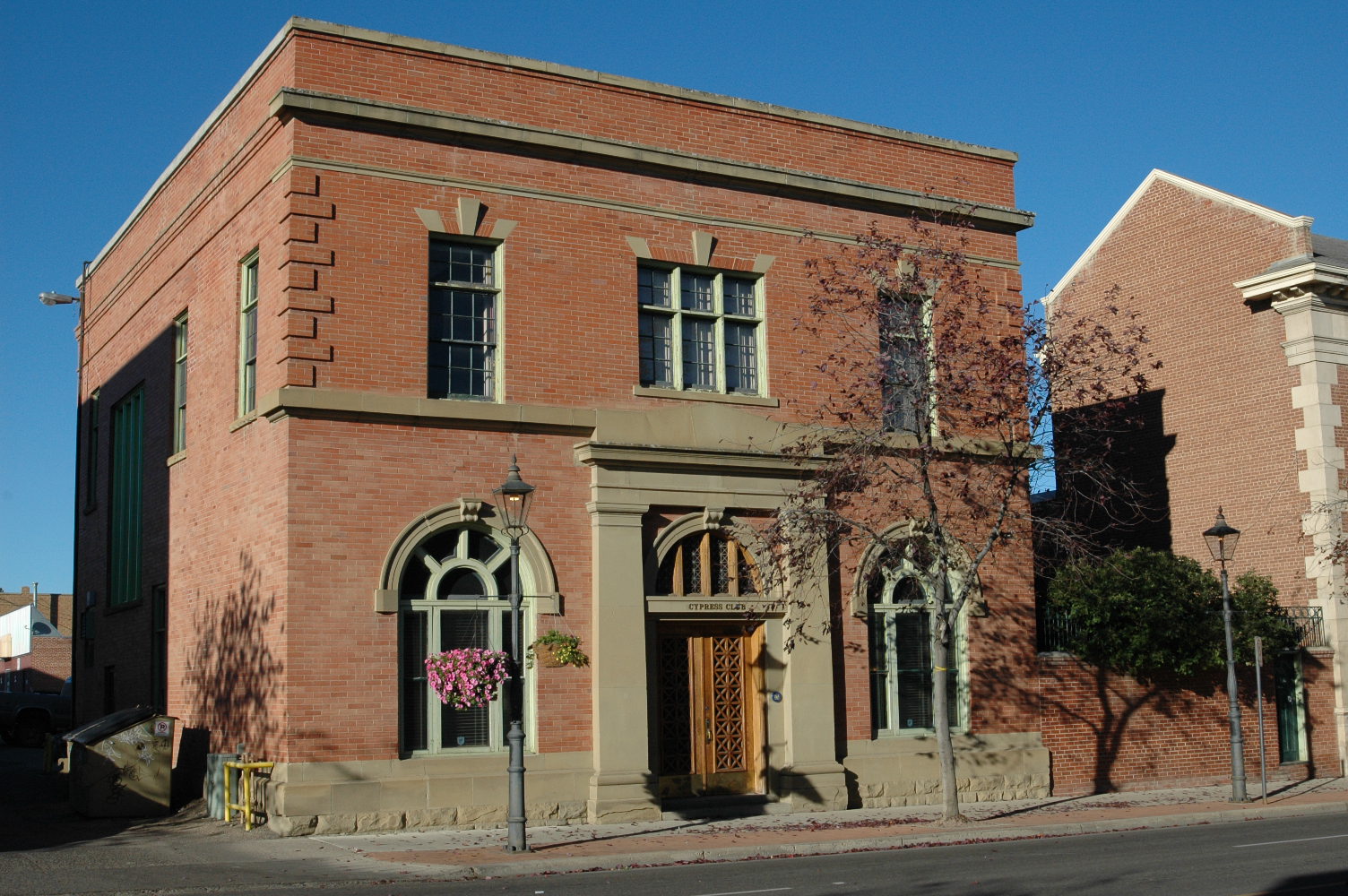
Members of the Cypress Club first met in the Cousins Block in downtown Medicine Hat.  As membership soared, and the Club quickly evolved into the elite social club of the business community, there was incentive and resources to construct a self contained building.  In 1907 therefore, the Club purchased the lot on 218 – 6th Avenue SE in the downtown core and contracted the prominent local architect, William T. Williams, to design a small, but elegant structure of red brick and sandstone to serve exclusively the functions of the Club, or whatever other purpose the Club would choose.  A deal was struck with the Bank of Commerce which gave the Bank the front half of the property on Main Street, while the Club building itself was to be built on the back part, within easy walking distance for most of the local businessmen.  When the design of the $15,000 building was complete, A.P. Burns was contracted to begin construction.  This was done through a loan from Hop Yuill, who would be repaid over the years from membership dues and fundraising activities.

As time passed, the Cypress Club continued to serve the business and professional elite of Medicine Hat and its surrounding district as a men’s social club.  During World War II, it was turned over to the Empire Club for use by armed service personnel stationed in the district.  Occasional internal renovations would occur, and, at times, financing was precarious, but, invariably, members from the business community would come to the rescue with loans.  Members over the years would include most of Medicine Hat’s mayors and members of City Council, several of the districts Members of the provincial Legislative Assembly, and Members of Parliament William Wylie, Bud Olson and Bert Hargrave.  Other members to gain a strong reputation outside the district of Medicine Hat include Judge John Sissons and Edmonton Journal editor Andrew Snaddon.

In 2002, the Cypress Club was designated a Provincial Historic Resource.  Its historical significance lies in its service as the main social club for men in the city and district of Medicine Hat since its inception in 1903.  

Written by: David Leonard, Historian

Visit the Alberta Register of Historic Places to learn more about the heritage value of the Cypress Club. In order for a site to be designated a Provincial Historic Resource, it must possess province-wide significance. To properly assess the historic importance of a resource, a historian crafts a context document that situates a resource within its time and place and compares it to similar resources in other parts of the province. This allows staff to determine the importance of a resource to a particular theme, time, and place. Above, is some of the historical information used in the evaluation of the Cypress Club.

Provincial Historic Resource Project Approvals – Why you need them!

Since I started my new post as a Heritage Conservation Adviser for the Edmonton Region, I have occasionally needed to write up project approvals for interventions occurring at a Provincial Historic Resource. Sometimes these projects were already underway or even completed. There are a number of reasons why project approvals should be issued before work occurs on or within the designation boundaries of a Provincial Historic Resource, including:

1. It’s the LAW!  Not to scare anyone, but it’s true. Section 20(9) and (10) of Alberta’s Historical Resources Act states:

(9) Notwithstanding any other Act, no person shall destroy, disturb, alter, restore, repair any historic resource or land that has been designated under this section (i.e. Provincial Historic Resource), or remove an historic object from an historic resource that has been designated under this section, without the written approval of the Minister. (10) The Minister, in the Minister’s absolute discretion, may refuse to grant an approval under subsection (9) or may make the approval subject to any conditions the Minister considers appropriate.

Please note: owners of Municipal Historic Resources must obtain approval from their municipal council (or its designate) prior to completing any work that will “destroy, disturb, alter, restore or repair” the designated property. See Section 26(6) of the Historical Resources Act for detailed information. With any questions, please contact your municipality.

2. It ensures the Standards and Guidelines for the Conservation of Historic Places in Canada  are followed. The Standards and Guidelines must be followed for the approval of any intervention. This pan-Canadian document, which has been formally adopted by the Government of Alberta, is an important reference tool in learning how to conserve one’s historic resources. The decision to perform work on any given historic resource starts with having an understanding of the place.  This is done during the designation process of Provincial Historic Resources and is documented in their individual Statements of Significance, which can be found on the Alberta Register of Historic Places. Only after a place is understood can successful planning for interventions begin. This is where the Provincial Historic Resource Project Approval process comes in as it allows for the evaluation of proposed work and serves to validate and document the methods and materials that will be used during the planned project. Without first understanding and planning, the last step of the conservation decision-making process – completing the actual intervention – may not be successful!

Finally, the last and most important reason to obtain a Project Approval for an intervention to a Provincial Historic Resources is:

3. You get to meet ME or one of my fellow Heritage Conservation Advisers. We are available to provide you with free advice on the maintenance and care of your designated Provincial Historic Resource so that it is allowed to continue to survive for generations to come.  Involving a Heritage Conservation Adviser at the outset of any given project might provide you with an insight previously not considered. It is also a requirement should you submit an application for grant funding with the Alberta Historical Resources Foundation. This funding could help in covering 50% of the expenses related to a conservation project, up to a maximum amount of $100,000. (Owners of Municipal Historic Resources are eligible to receive up to a maximum of $50,000.)

The care and maintenance of our designated Provincial Historic Resources is in the best interests of all Albertans. Let’s work together to ensure that this work is done to the best of our abilities and documented properly so that the lessons we learn from the process and results are not forgotten.

Written by: Carlo Laforge, Heritage Conservation Adviser.