
Editor’s note: November 8 is Indigenous Veterans Day, a time to commemorate the service and sacrifice of Indigenous Veterans and acknowledge the historical injustices that many faced during and after their military service. This post also relates to residential school histories. If reading this is causing pain or bringing back distressing memories, please call the Indian Residential Schools Crisis Line at 1-866-925-4419. The Crisis Line is available 24 hours a day and can also provide information on other health supports provided by the Health Canada Indian Residential Schools Resolution Health Support Program.
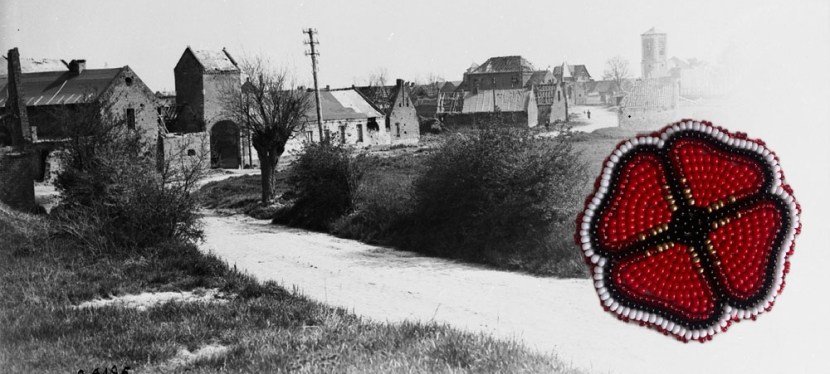
The banner image above is “Arras Front, Dury,” April 1919. Canadian Official War Photograph O.4496. The artist of the overlaid beaded poppy is Tiffany Dettieh.
Written by: Laura Golebiowski (Indigenous Consultation Adviser) in collaboration with Saddle Lake Cree Nation
Between 1914 and 1918, more than 400 western Canadian Natives enlisted and fought for Canada. They suffered casualties at a greater rate than that of the non-Indian Canadian soldiers who fought overseas. For their sacrifice they gained little in return.
-L. James Dempsey, in Warriors of the King: Prairie Indians in World War One
Many Indigenous men who enlisted in World War One were heralded for the skills they brought from their home communities and culture: patience, stealth and marksmanship. But some were just boys, who spent most of their childhood sequestered in residential school.
When Britain declared war in August 1914, Red Deer Industrial School was in its 21st year of operation. Forty-seven boys and 35 girls were enrolled, including 25 children from the Saddle Lake Agency, comprised in part by the Nations contemporarily known as Saddle Lake Cree Nation and Whitefish (Goodfish) Lake First Nation #128.
Children continued to labour to support school operations. “The half-day system is followed and the older pupils work on the farm and at housework.” At the time, the school buildings were falling into disrepair. However, planned improvements to the school were halted because of the outbreak of the war. First Nations were becoming increasingly frustrated with the living conditions and the extreme distance between Red Deer and the children’s home communities.
In his book Warriors of the King: Prairie Indians in World War I, L. James Dempsey writes: “Dissatisfaction with school life and a need for excitement probably best explain why a number of school-aged Natives ran away to enlist.” At Red Deer, at least three boys ran away from the school to enlist.
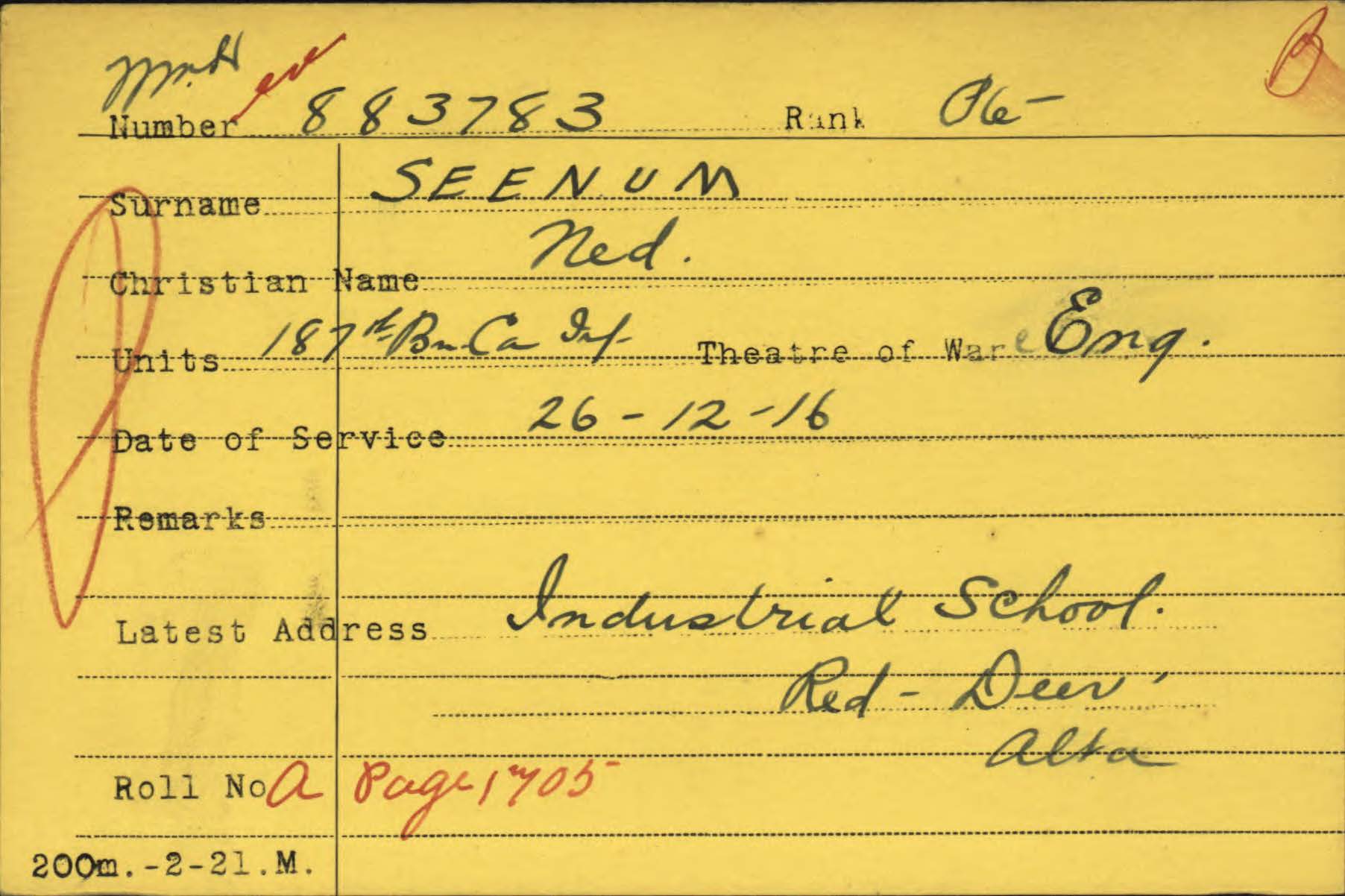
Ned Seenum, Louie Seenum and Frank Makokis were three boys from Saddle Lake Agency, forced to attend Red Deer Industrial School in the early 1900s. Ned Seenum had attended the school the longest; having been admitted on November 13, 1908, at the age of seven. Frank Makokis was admitted on November 21, 1910, at the age of 10; Louie Seenum was admitted on August 14, 1912, at the age of 12. Little is known about the boys’ experience at Red Deer. We can assume they were assigned the vocation of farming. Ned is noted as assisting with the fencing of the school’s new hog pasture.
On November 21, 1916, Ned, Louie and Frank each signed their respective attestation papers to enlist in the Canadian Overseas Expeditionary Force. To do so, they escaped Red Deer Industrial School, made their way to Calgary and lied about their age. Each stated that he was born in 1898—an exaggeration of at least two years. The boys left Canada on December 15, 1916, and arrived in England on December 28.
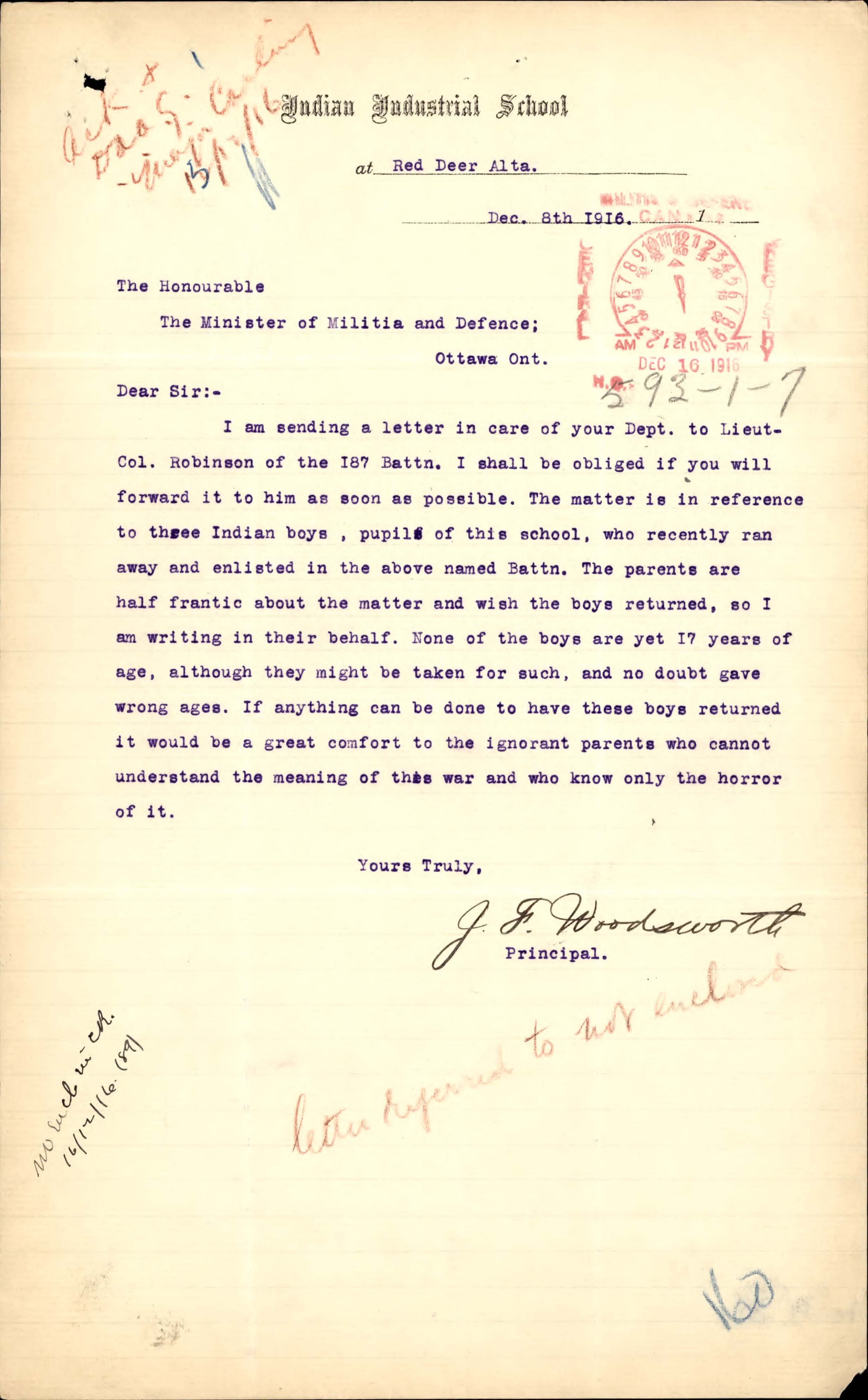
It did not take long for their absence to be noticed. On December 8, 1916, Red Deer Industrial School Principal J. F. Woodsworth wrote the Minister of Militia and Defence in Ottawa:
The matter is in reference to three Indian boys, pupils of this school, who recently ran away and enlisted in the above named [battalion]. The parents are half frantic about the matter and wish the boys returned, so I am writing in their behalf. None of the boys are yet 17 years old age, although they might be taken for such, and no doubt gave wrong ages.
Per Ned Seenum’s military records, he began the return journey home to Canada on March 23, 1917. He was discharged from the military on May 6, 1917: “Under Age, returned from England.” Like his last address, Ned’s intended place of residence upon military discharge was listed as Red Deer Industrial School. However, Principal Woodsworth did not allow for Ned’s return. “Discharged after running away and going overseas in 1916,” was the remark made in the student register.
One can question if Woodsworth wanted Ned, Frank and Louie to return to Canada at all, or whether he viewed remaining overseas in active service as the nobler choice for the children. “If anything can be done to have these boys returned,” he wrote to Ottawa in 1916, “it would be a great comfort to the ignorant parents who cannot understand the meaning of this war and who know only the horror of it.”
Eneas Makokis, from Saddle Lake, was born on August 9, 1897, to parents John and Eliza. He entered Red Deer Industrial School on December 9, 1910, at the age of 13 with his older brother Zaccheus. Eneas had previously spent seven years at the day school in Onion Lake.
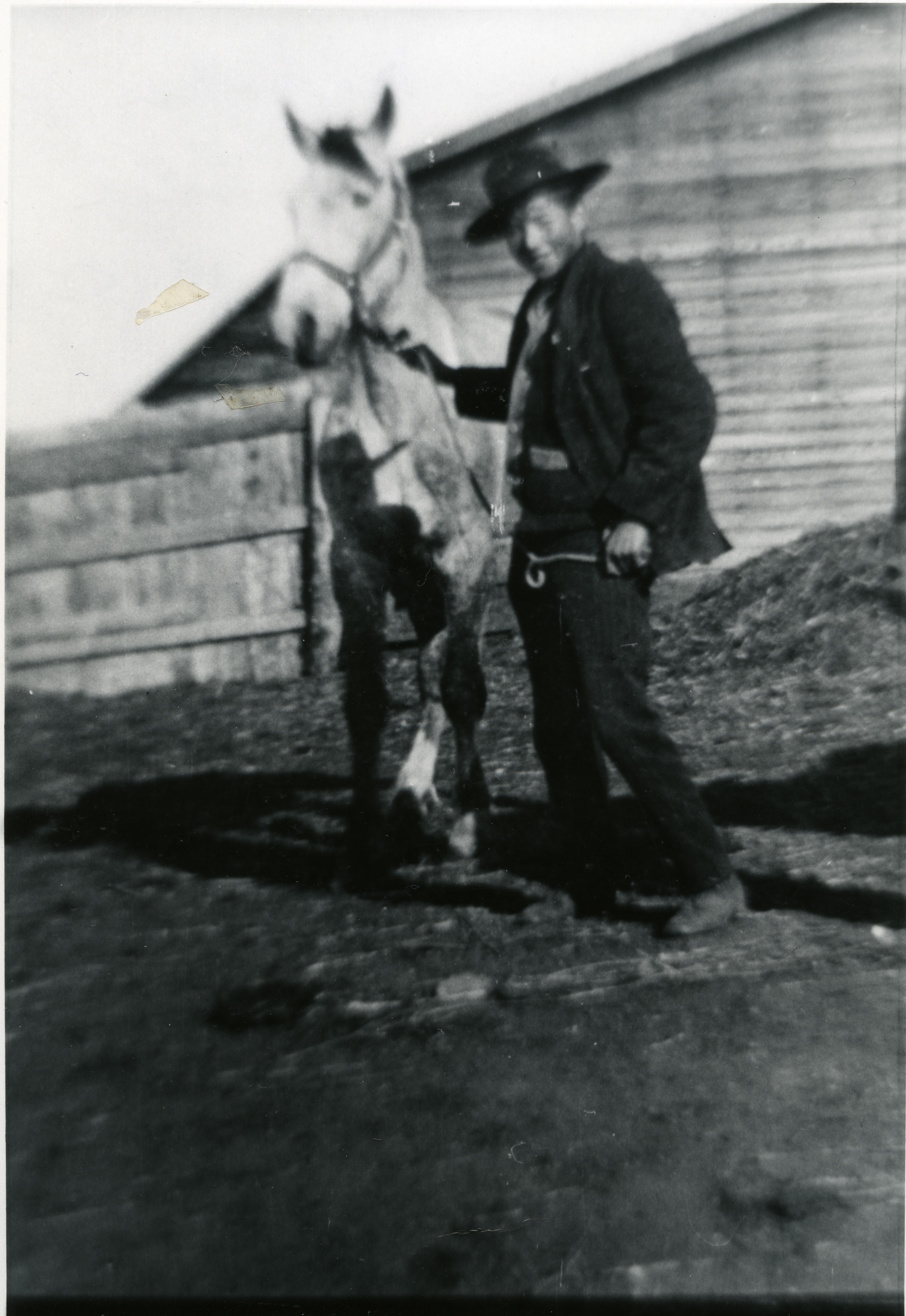
Eneas reached 18 years of age at Red Deer and subsequently was “honourably” discharged. The principal remarked that he was a good farmer. Returning to Saddle Lake, Eneas is documented in the 1916 census as a labourer on the reserve, living with his brother Zaccheus. Eneas reportedly wrote the school advising that he was enjoying attending meetings of the Epworth League—a Methodist young adult association.
When he was 19 years old, Eneas returned to Red Deer to enlist in the Canadian Overseas Expeditionary Force. On January 30, 1917, Eneas signed his attestation papers to the 50th battalion. His father John Makokis and sister Mary Hunter are listed as his next of kin. On March 28, 1917, Eneas departed Halifax at 6 a.m. and arrived in Liverpool on April 7.
In September 1918, Eneas and his battalion fought in the Second Battle of Arras near Dury, France. The war diaries of the 50th Canadian Infantry Battalion state that on September 2, the weather was fine with a southwest wind. Firing began at 5 a.m. “Either side opened fire and furnished the heaviest and most effective barrage ever experienced by our troops.”
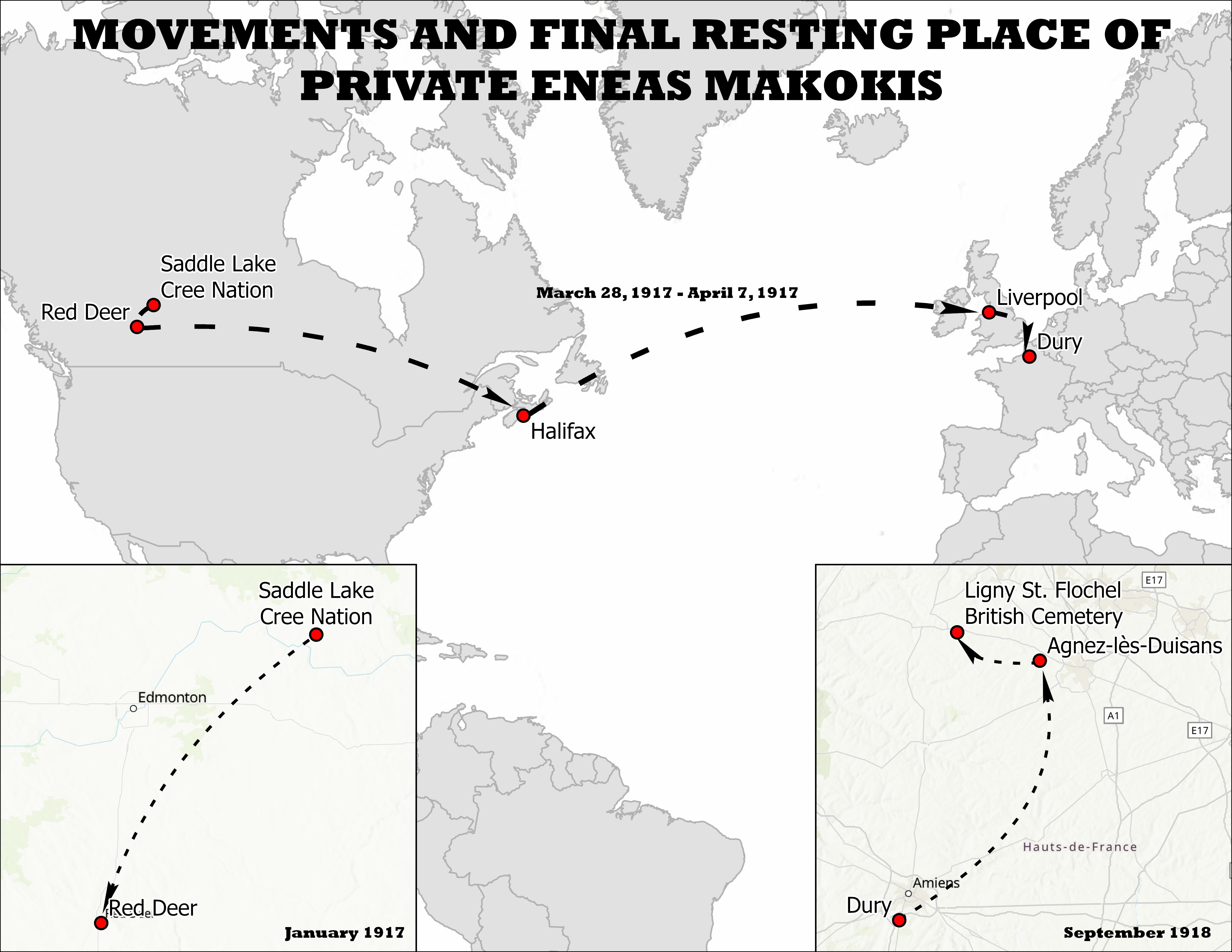
Eneas was hit with shrapnel in the head and body. Injured, he was transported approximately 80 kilometres north to where the First Canadian Casualty Clearing Station had just set up at Agnez-lès-Duisans. He was one of 900 patients received by the station that day.
Eneas died of his injuries at the clearing station. He was only 21 years old. He was buried in the Ligny St. Flochel British Cemetery, far from his family, his Nation and the country he was fighting for.
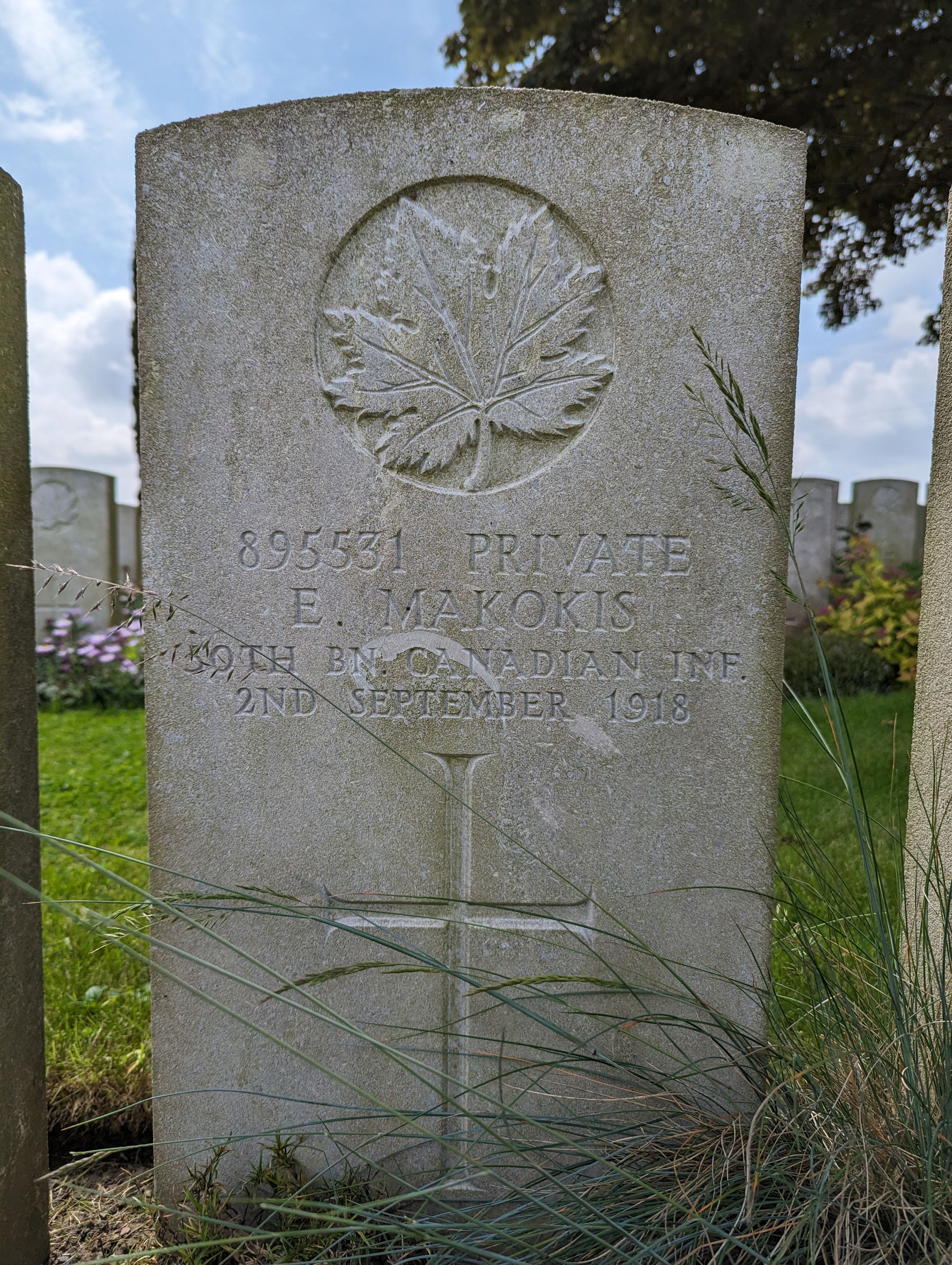
L. James Dempsey writes: “When the Indian soldiers came home they believed they were returning to an enlightened society for which many of them had fought and died. Overseas they had been exposed to new ideas which had broadened their outlook and their expectations. On their return home, Indian soldiers began to seek better treatment for themselves and their people…In reality, however, nothing had changed.”
Mark Steinhauer, from Saddle Lake, attended Red Deer Industrial School from 1903 until June 1911. In 1916, in a school report of former pupils, Mark is stated to have “donned the khaki” and was completing military training in Edmonton. He enlisted in World War One on April 5, 1916, and returned home at the end of the war on June 5, 1919.
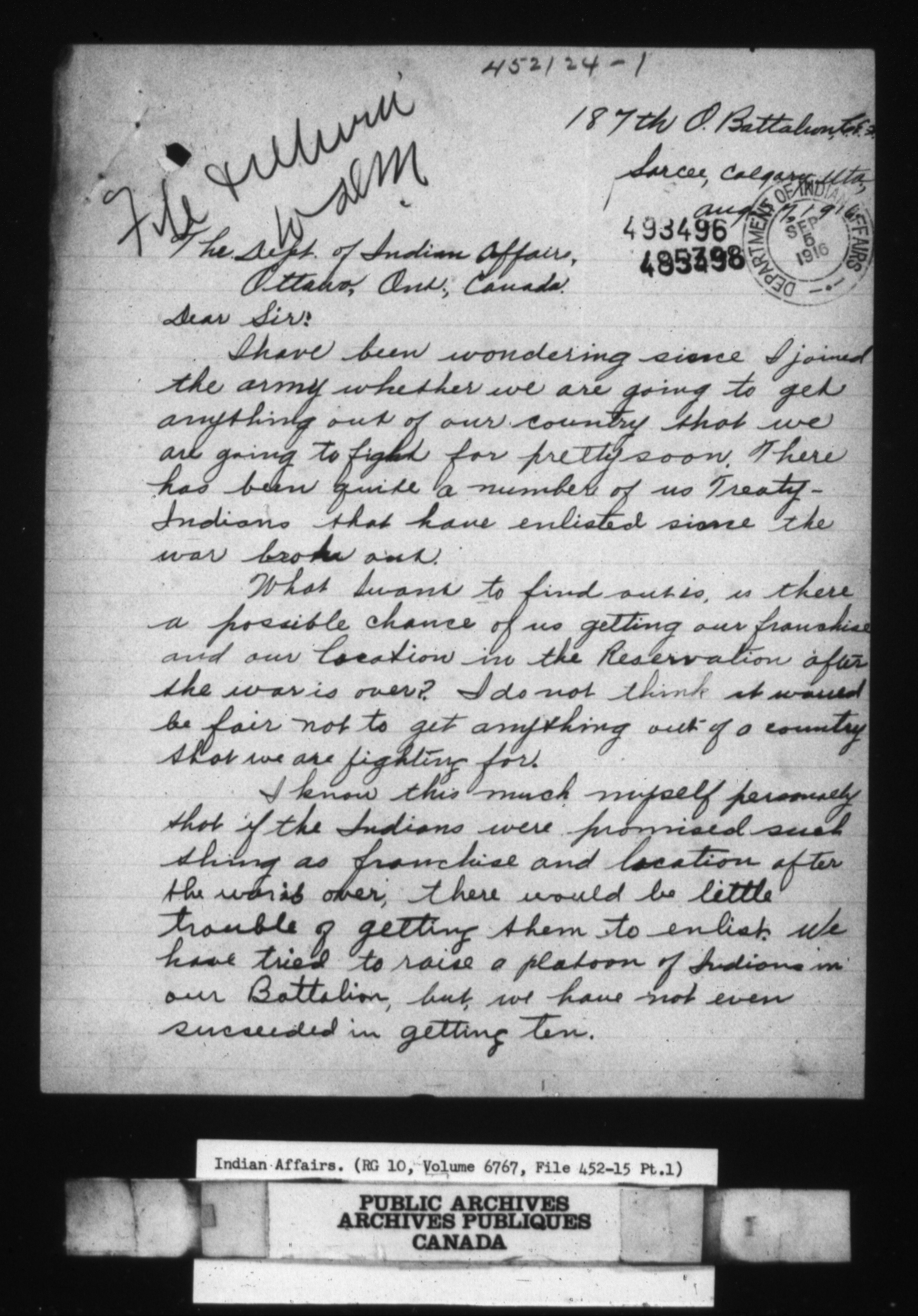
Before travelling overseas, Mark questioned the benefits he would receive because of his service. He wrote the Department of Indian Affairs in 1916, requesting more information regarding enfranchisement (many First Nations people lost their legal Indian Act status as a result of serving in the First or Second World War) and his ability to receive a land grant near his home of Saddle Lake:
I have been wondering since I joined the army whether we are going to get anything out of our country that we are going to fight for pretty soon. There has been quite a number of us Treaty Indians that have enlisted since the war broke out…
I have been asked almost by everyone that I have tried to get to enlist in our Battalion, am I going to get anything out [of] the country if I go and fight for it? All the answer I could give was “I do not know.”
By 1927, only two status Indian veterans in Alberta had received a loan for land under the Solider Settlement Act of 1919. The legislation directly conflicted with a 1906 Indian Act amendment, disallowing Indians and non-Treaty Indians from acquiring a homestead on Dominion lands. Dempsey concludes: “While conditions for the majority of Canadians improved, the same could not be said for Natives. Even though they survived the war, many Indian veterans continued to live at the bottom of the economic ladder and as the years passed their situation did not improve. One can imagine the despair they experienced, especially when comparing themselves to their white colleagues.”
On Indigenous Veterans Day, we remember the Survivors of Red Deer Industrial School who enlisted in World War One: Andrew Larocque, Daniel Joshua, Eneas Makokis, Frank Makokis, James Saskatchewan, Louie Seenum, Mark Steinhauer, Ned Seenum and William Pocha.
The Historic Resources Management Branch is honoured to be collaborating with Survivor communities regarding the preservation and recognition of the Red Deer Industrial School cemetery, and on broader truth-telling initiatives. Thank you to Saddle Lake Cree Nation for helping tell these stories. Special thank you to Lorna Redcrow for her ongoing guidance and collaboration. Hiy hiy.
Sources and further reading
Dempsey, L. James. (1999). Warriors of the King: Prairie Indians in World War I. Regina: Canadian Plains Research Centre.
Enlistment of Indians for Overseas Service. WWI. RG24-C-1-a, Volume number: 1221, File number: HQ-593-1-7, File part: 1. Library and Archives Canada.
First Word War Personnel Records. Makokis, Eneas. RG 150, Accession 1992-93/166, Box 5862-39, Library and Archives Canada.
First Word War Personnel Records. Makokis, Frank. RG 150, Accession 1992-93/166, Box 5862-40, Library and Archives Canada.
First Word War Personnel Records. Seenum, Louis. RG 150, Accession 1992-93/166, Box 8764 – 46, Library and Archives Canada.
First Word War Personnel Records. Seenum, Ned. RG 150, Accession 1992-93/166, Box 8764 – 47, Library and Archives Canada.
First Word War Personnel Records. Steinhauer, Mark. RG 150, Accession 1992-93/166, Box 9266-15, Library and Archives Canada.
Fox, Uta. (1993). The failure of the Red Deer Industrial School [Master’s thesis]. University of Calgary. Retrieved online from https://ucalgary.scholaris.ca/items/e1672ffe-d390-4740-b7bf-3815b58e4ad4.
Gaffen, Fred. (2008). Forgotten soldiers. Produced for the Canadian Defence Academy by 17 Wing Winnipeg Publishing Office. Retrieved online from https://publications.gc.ca/collections/collection_2023/mdn-dnd/D2-232-2008-eng.pdf.
Indian Affairs. RG10, Volume number: 3921, file 116, 818-1B. Library and Archives Canada.
Indian Affairs. RG10, Volume 6767, File 452-15 Pt. 1. Library and Archives Canada.
Red Deer Industrial Student Register, Provincial Archives of Alberta PR1979.0268/162.
Titley, Brian. (1992). “Red Deer Indian Industrial School: A case study in the history of Native education.” Exploring our educational past: Schooling in the North-West Territories and Alberta, (eds. Nick Kach and Kas Mazurek). Calgary: Detselig Enterprises Limited., 55-72.
War diaries – 1st Canadian Casualty Clearing Station = Journal de guerre – 1er Poste d’évacuation canadien. RG9-III-D-3, Volume number: 5032, Microfilm reel number: T-10921, File number: 838, File part: 1=1914/08/13-1916/06/30;2=1916/07/01-1919/03/31. Library and Archives Canada.
War diaries – 50th Canadian Infantry Battalion = Journal de guerre – 50e Bataillon d’infanterie canadien. RG9-III-D-3, Volume number: 4941, Microfilm reel number: T-10748, File number: 441, File part: 2=1918/01/01-1918/06/30;3=1918/07/01-1919/05/28. Library and Archives Canada.

