Women in the Great War

In August of 1914, Canada entered the First World War, an arduous experience for Albertans who served on the battlefront and for those who remained in Canada. Thousands of men enlisted and quickly left Alberta for the front, leaving a gap in both the workforce and civil society. During the war, women took on many of these roles, opening a realm of new possibilities. Women helped raise funds for the Canadian Red Cross Society and entered the workforce, while others enlisted in the medical core as nurses. This post will give an overview of Canadian women in the First World War by looking at the shift in traditional labour roles, Canadian nurses and the voluntary initiatives that women organized. It is important to recognize the sacrifices that were made by these women and to show how they contributed to the war effort, on the home front as well as overseas.
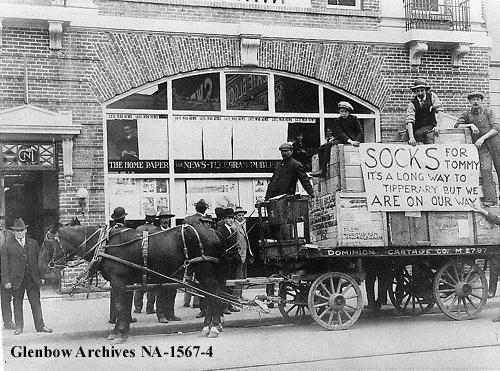
Wagon loaded with socks for soldiers in Calgary, Alberta, ca.1916. (Glenbow Archives, NA-1567-4)

For most Canadian women, participation in the First World War was limited to serving on the home front. With almost 50,000 of Alberta’s men deployed overseas, this created openings in the service and farming industries back home. The demand for more workers increased and jobs that were traditionally reserved for men were opened to women for the first time. The need for additional labour differed by region across the country. Central Canada, for instance, experienced a greater need for employees to work in munitions factories, while in Alberta, labourers were needed to assist with farm work. Other positions that women filled were administrative clerks, factory workers and as delivery vehicle drivers. Female participation in the clerical and banking fields increased significantly and there were women who remained in this line of work even after the war ended. Women were exposed to more job opportunities than ever before, whereas prior to the First World War, they were largely limited to domestic duties.

Between 1914 and 1918, there was an overwhelming need for labour and this compelled employers to hire women. Many employers, and even some women, viewed the female worker as a temporary substitute needed to meet a wartime emergency. Not surprisingly, women faced opposition at times for their participation in the workforce, particularly during the initial outbreak of the war in the street railway service and banking fields. In several cities across Canada, male workers with the railway system were outraged that women were allowed to be hired as conductors on their cars. While some areas disapproved of women taking on non-traditional labour roles, other employers recognized that women were a much needed source of labour. The Canadian government hired 1,325 women in civilian jobs, such as clerks and typists, with the military. Another 1,200 women were employed by the Royal Air Force in Canada to work in mainly technical positions, and by 1918, they had hired 750 female mechanics. This indicates that the prejudice against working women had to be overruled in order to alleviate the shortage of manpower. The war produced a necessity for human labour and this opened up a wider array of opportunities for women. The roles that women stepped into during the war years had a significant impact on the province by challenging traditional gender roles and began legitimizing the idea of women in the labour force.
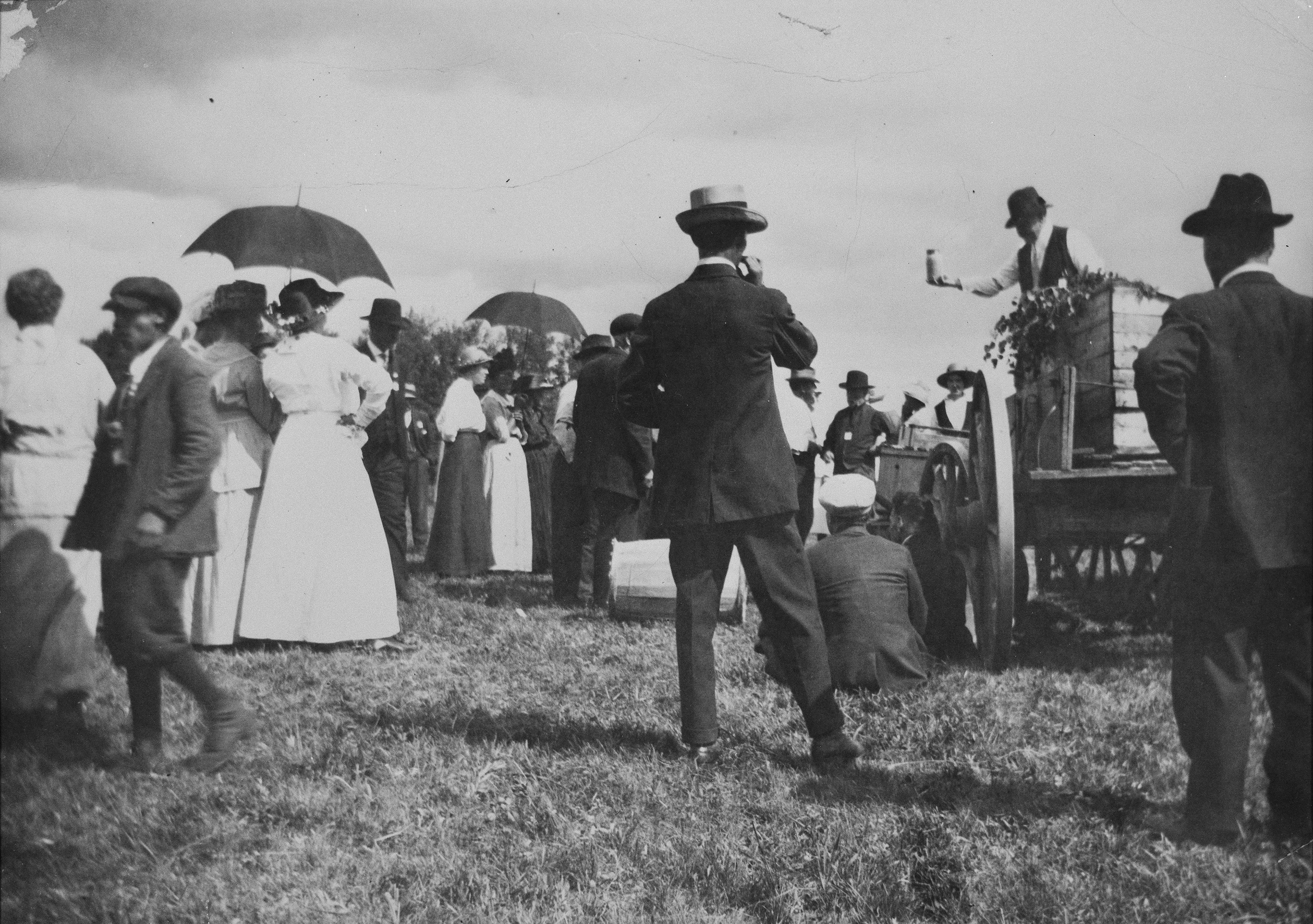
Crowd gathered for Patriotic Day and Red Cross sale at Two Hills, auction at Fred Schoff Store to raise funds for WW I, 1917. (Provincial Archives of Alberta, A10676)

Many women initially entered the labour market to demonstrate their patriotism, but this move had a number of positive effects. There was an increase in financial opportunities for women and wage disparity between men and women began to lessen. In addition, the war opened up a whole host of social opportunities. Women were participating more in the public sphere, both in the workforce and social circles, and this provided the foundation for a fervent energy that helped to ignite the women’s movement across Canada. Women desired greater participation in politics and the idea that women should vote and run for office quickly became mainstream. On April 19, 1916, this right was granted to Alberta women. Obtaining the vote was an achievement which contributed to an increased political consciousness amongst women in Alberta. This momentum continued and by the following year, Louise McKinney and Roberta MacAdams, had become the first women to be elected to the Alberta legislature. The dramatic increase of women in the labour field and social community was a significant force that paved the way for women’s rights in Canada.
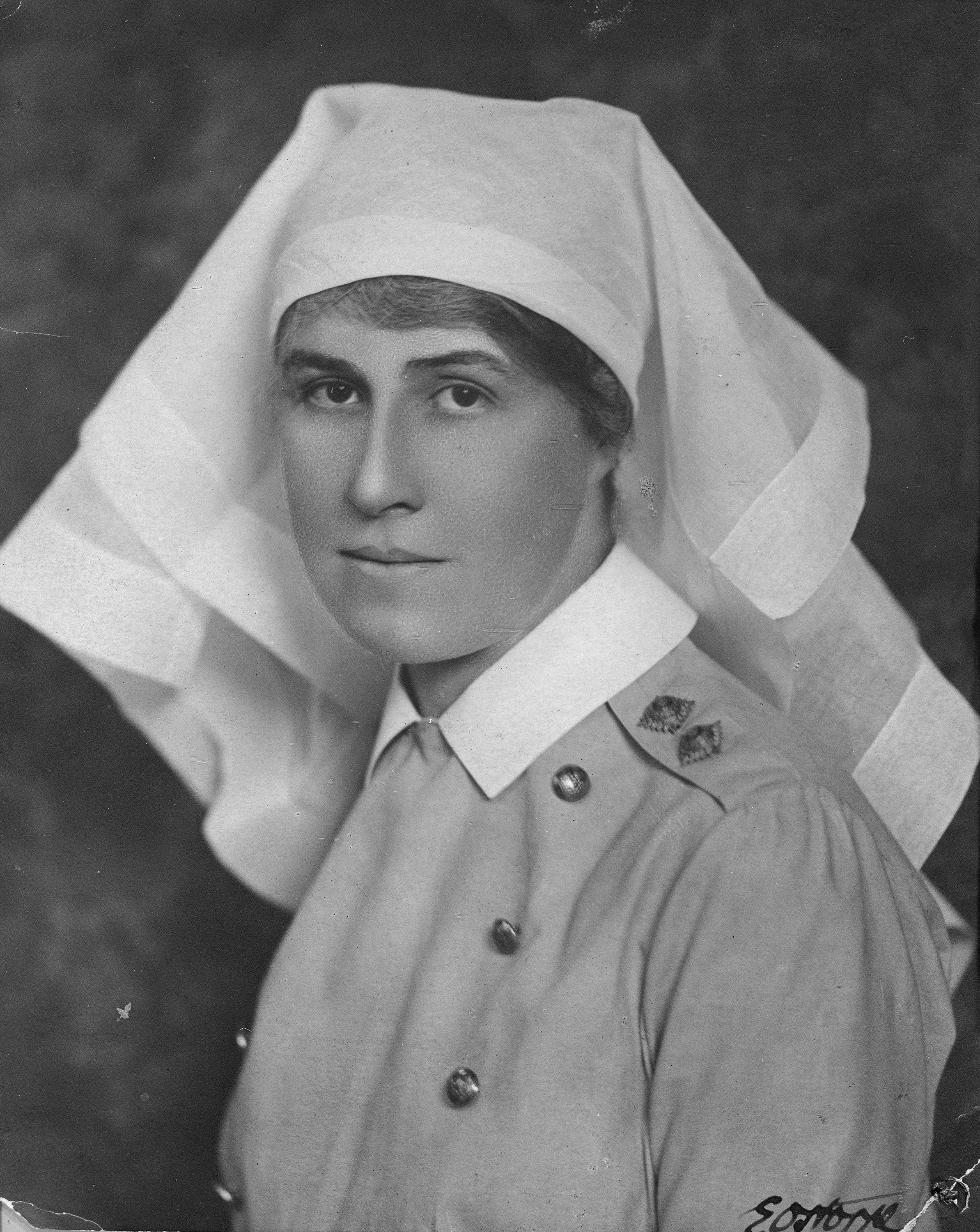
Future member of the Alberta Legislature, Lieutenant Roberta MacAdams, was a dietician stationed in England during the First World War, 1917. (Provincial Archives of Alberta, A13185)

There were a number of Canadian women who contributed their services abroad, primarily in the medical service field. The Canadian Army Medical Corps required a number of trained nurses to help provide medical care to Canadian soldiers. Trained nurses joined the Nursing Sisters of Canada and there was no shortage of volunteers. 3,141 nurses served in the medical core, with 2,504 of those serving overseas. There were women from Alberta who enlisted as military nurses and at the initial outbreak of the war in 1914, 10 nurses from Edmonton went abroad and assisted the troops serving on the front. Canadian nurses worked tirelessly to provide medical services to those who were wounded in battle and cared for recovering soldiers. They were commonly known as “bluebirds” due to their uniform colours. Later on, the nurses were referred to as the “Sisters” or “Angels of Mercy” by the soldiers. These monikers are indicative of the caring service that the nurses provided and were often praised for. Throughout the First World War, Canadian nurses were commended for their heroism and became well known for their compassion when treating the afflicted.

Women without nursing experience could enlist through the Voluntary Aid Detachment which was operated by the Canadian branch of the St. John Ambulance. V.A.D. nurses received basic first aid training and worked in hospitals as medical assistants and carried out general duties such as cooking and cleaning. The role of the V.A.D. allowed women who were not trained as nurses to be directly involved in the war efforts and approximately 2,000 Canadian women served as unpaid nurses during the First World War. Around 500 were sent to Europe and the majority remained at convalescent hospitals in Canada. Nine Edmonton women were trained as V.A.D.s and deployed overseas.
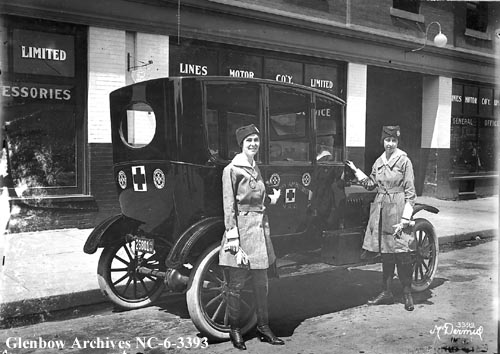
St. John Ambulance Voluntary Aid Detachment vehicle, Edmonton, Alberta, 1918. (Glenbow Archives, NC-6-3393)

The First World War brought changes to the military medical services. Medical units were originally established in hospitals and then Casualty Clearing Stations were created near the frontlines to give faster treatment to the soldiers injured in battle. While this provided better service for the wounded, it put Canada’s nurses closer to combat. They faced the danger of enemy artillery attacks, air raids and also endured vermin, fleas and disease, just as the men in the trenches. Canadian nurse, Katherine Wilson-Simmie, details her account in The Memoirs of Nursing Sister Kate Wilson, Canadian Army Medical Corps, 1915-1917. While stationed near the front lines, Wilson-Simmie witnessed an unforgettable day when the first gassed soldiers were admitted for medical assistance. She describes the event as “an entirely new kind of warfare – horrible, and contemptible. It was a terrible experience for the men and for those trying to help them.” Women not only observed the abysmal conditions of war, they were eyewitness to the immediate impact that battle had on human life.

As the nurses returned from overseas, they could take pride in the contribution that they had made for their country, but they had also witnessed firsthand the devastating toll of war. Approximately 50 Canadian nurses lost their lives in the First World War. The Canadian Nursing Sisters are commemorated at The Nurses’ Memorial on Parliament Hill, Ottawa.

Women supported numerous initiatives across Canada and overseas during the First World War, but the Canadian Red Cross Society (CRCS) was the primary humanitarian organization in the country. Women were eager to serve the Red Cross which gave them the opportunity to participate in the war from the home front. The society provided aid and comfort to soldiers and their families who were affected by the war and women supported these relief efforts in a number of ways. They fundraised, distributed gifts, prepared care packages and medical supply kits as well as knitted extra clothing to send to soldiers.

When the war was declared, women endorsed the work of the Red Cross Society without hesitation and a number of auxiliaries emerged across the country during this time. This support allowed the Canadian Red Cross to provide relief assistance and volunteers visited recovering soldiers in British hospitals, attempted to trace missing people and helped Canadians correspond with their families and friends abroad. The society also worked with Red Cross affiliates overseas to fulfill requests for medical assistance when possible. A volunteer, and later Alberta resident, Madeleine Jaffray, was one of ten Canadian nurses who were recruited through the Red Cross to serve in the French Flag Nursing Corp. In Belgium, just miles from the frontlines, Jaffrey’s unit was frequently targeted by bombs. During one attack, her foot became severely wounded and was later amputated. She was awarded a French military medal, the Croix de Guerre, for her service and was the first Canadian woman to receive this honour.
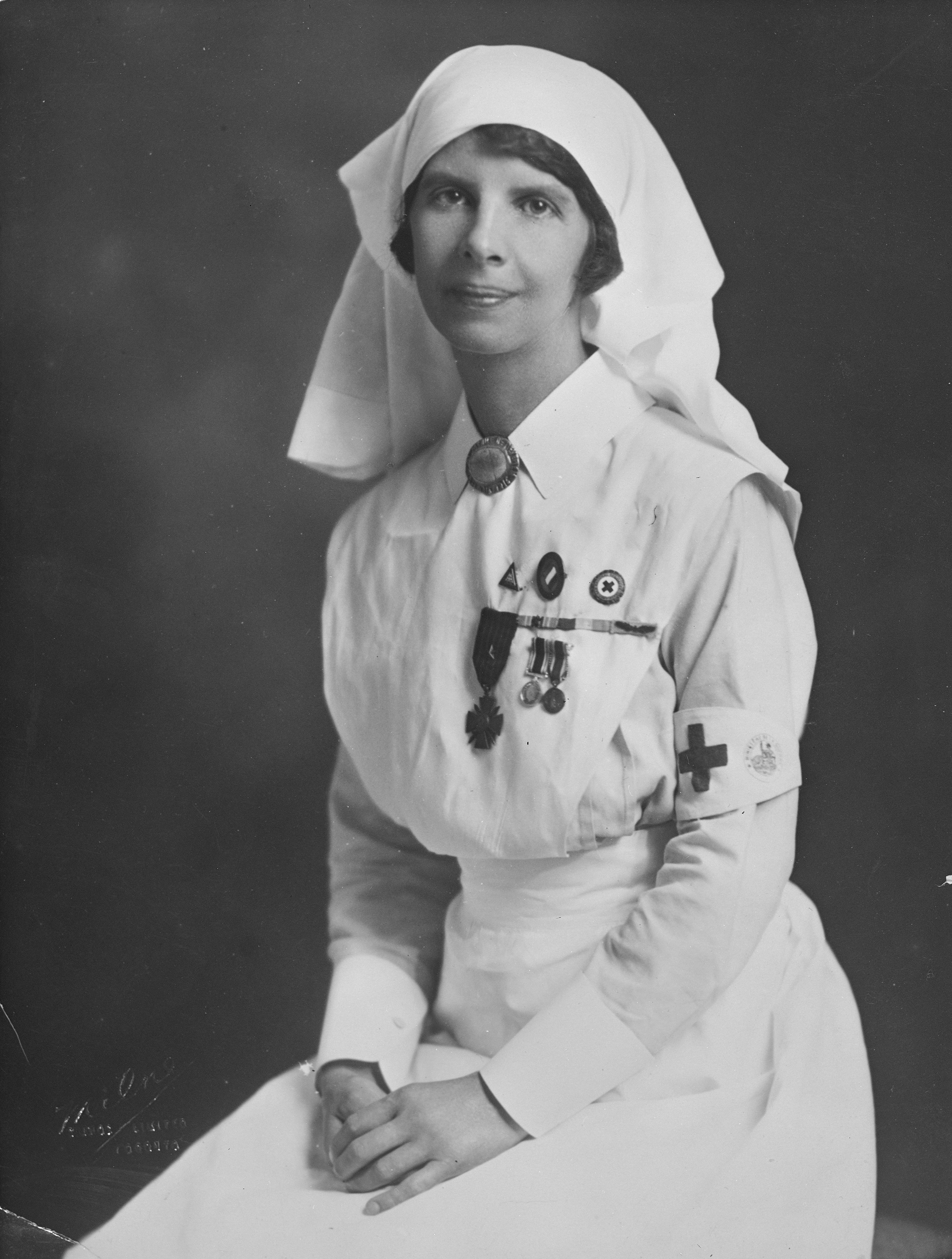
Formal portrait of Madeleine Jaffray in nurses’ uniform, ca. 1919. (Provincial Archives of Alberta, A14050)

With the help of donors and dedicated volunteers, the Canadian Red Cross Society established a headquarters in London, so they could better coordinate with the people on the front line in France. The organization also helped to create and maintain hospitals for soldiers who were wounded in battle. The Red Cross played a significant role by providing comfort and support services to Canadians. This was made possible through the voluntary services that were initiated by women on the home front. The Red Cross was a valuable organization in a time of need and gave women a variety of ways to help their loved ones who had gone overseas to war.

Alberta women contributed to the Canadian efforts to win the First World War in many ways. Initial participation in the war efforts was largely out of patriotic respect, but a number of outcomes emerged as a result. Notably, there was an increased female presence in civil society and the Alberta suffragist movement emerged. The efforts displayed by women during the Great War are remembered for the impact that they have had on women’s history in Canada.

This was the second part of a series commemorating the First World War. This series will look at a range of topics that will show Alberta’s involvement in this historic event.

To learn more about women in Alberta’s history, refer to the Alberta Women’s Memory Project, an initiative that was created to preserve and promote the history of women in Alberta.

Written by: Erin Hoar, Historic Resources Management Branch Officer

Sources

Byfield, Ted, ed. Alberta in the 20th Century: The Great War and its Consequences 1914-1920. Vol. 4. Edmonton, Canada: CanMedia Inc., 1995.

Canadian Red Cross. “The First World War: 1914-1918.” (Accessed August 5, 2014).

Canadian Great War Project. (Accessed August 19, 2014).

Canadian War Museum. (Accessed August 5, 2014).

Dundas, Barbara. A History of Women in the Canadian Military. Montreal: Art Global and Department of National Defense, 2000.

Glassford, Sarah, and Amy Shaw, eds. A Sisterhood of Suffering and Service: Women and Girls of Canada and Newfoundland During the First World War. Vancouver: UBC Press, 2012.

Love, David W. A Nation in Making: The Organization and Administration of the Canadian Military During the First World War. Vol. 2. Ottawa: Service Publications, 2012.

Nicholson, G.W.L. Canada’s Nursing Sisters. Toronto: Samuel Stevens Hakkert & Company, 1975.

Payne, Michael, Donald Wetherell, and Catherine Cavanaugh, eds. Alberta Formed Alberta Transformed. Vol. 2. Edmonton, Canada: University of Alberta Press, 2006.

Veterans Affairs Canada. “The Nursing Sisters of Canada.” (Accessed August 6, 2014).
Alberta Historical Resources Foundation Meets in Pincher Creek

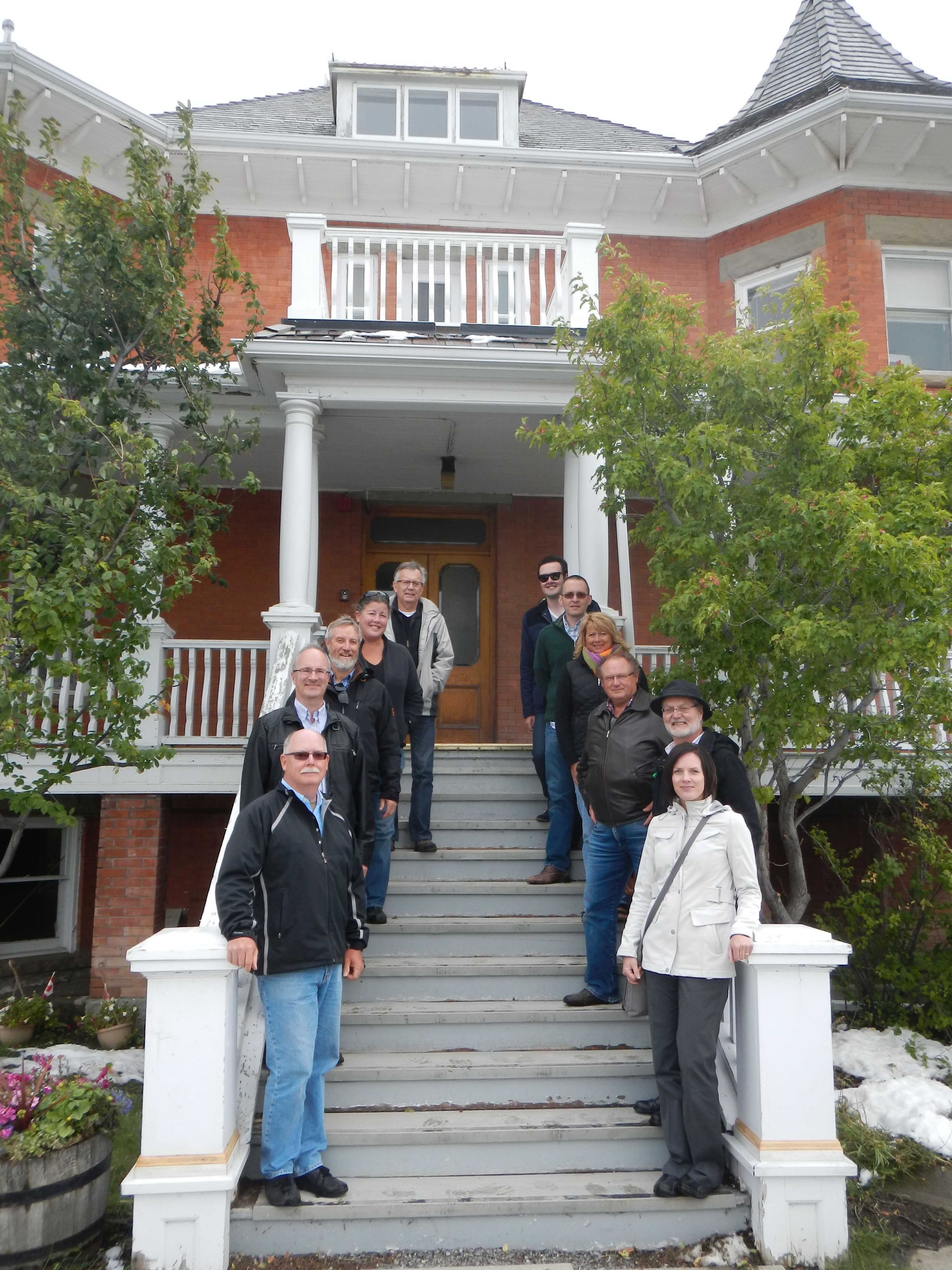
The Board of the Alberta Historical Resources Foundation met in Pincher Creek, September 12th-13th, 2014. Since this meeting was not one where the Board was actively adjudicating many grant applications, the focus was more on policies and other planning to help conserve and celebrate Alberta’s heritage.

The Board of the Alberta Historical Resources Foundation, on the steps of Lebel Mansion, the Town of Pincher Creek's first designated Municipal HIstoric Resource.
The Board of the Alberta Historical Resources Foundation, on the steps of Lebel Mansion, the Town of Pincher Creek’s first designated Municipal HIstoric Resource.

As is their custom, Board members took the opportunity to explore some of the local historic places in the community where they met. The Town of Pincher Creek’s Director of Community Services, Diane Burt Stuckey, and Curator of the Kootenai Brown Pioneer Village Museum, Farley Wuth, led an informative tour of locally significant historic places, as well as two community museums.

Some of the historic places featured on the driving tour included an historic buffalo jump site on the west side of town, and also the Lebel Mansion, newly designated by the Town as as Municipal Historic Resource. Originally built as a grand residence by the merchant Timothee Lebel, the building later served as hospital, and now as the home for the Allied Arts Council. It is a great example of another historic place serving the cultural community in Alberta.

After a visit to Heritage Acres Farm Museum, where the Board was able to see first-hand the extensive collection of agricultural equipment, Board Chair Fred Bradley facilitated a meaningful conversation with local heritage-sectors leaders and municipal officials, including Town of Pincher Creek Mayor Don Anderberg, and M.D. of Pincher Creek Reeve Brian Hammond. The Foundation was able to hear and discuss issues that are important to local communities working hard to conserve their heritage.

After a busy day of seeing the sites and learning more about the history of Pincher Creek, the Board settled in for its day-long meeting, involving a broad range of issues affecting the heritage community across Alberta. Future posts will showcase some of the decision made in Pincher Creek, so stay tuned to RETROactive!

The next meeting of the Alberta Historical Resources Foundation will take place in Edmonton, November 28th-29th.


Early Cabins in the West

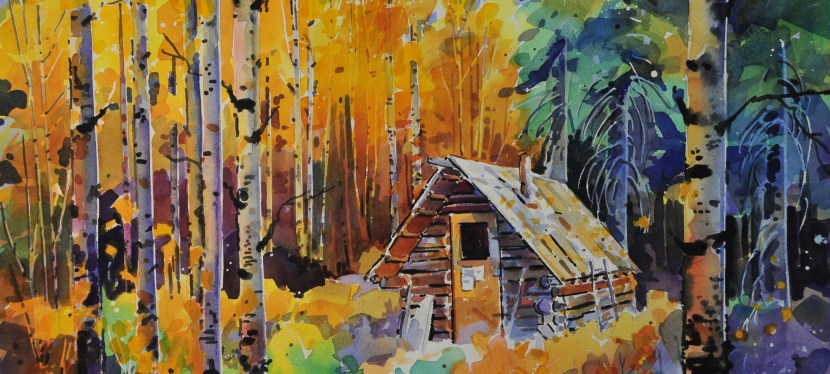
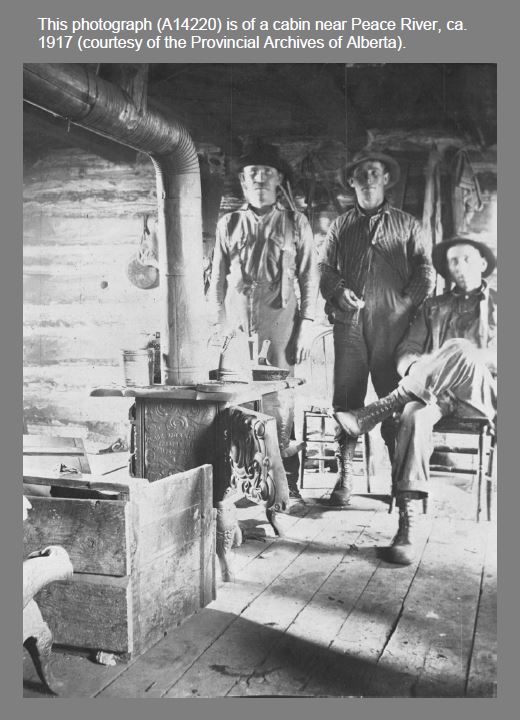
Cabins performed a variety of functions in Alberta’s past from homesteading to hunting and post offices to ranger cabins. Many events and daily challenges that defined our province unfolded on the wooden floors of early cabins. Just like the characters they housed, each cabin’s architecture and associated artifacts are unique.

Cabin and tobacco tin

To encourage an appreciation of cabins and the surviving record of them, as well as other historic resources in the province, a collaborative team from the Historic Resources Management Branch, the University of Alberta, and the Royal Alberta Museum initiated the Heritage Art Series. The goal is to create artworks that depict scenes from Alberta’s past that captivate public audiences. We hope that these artworks, like the cabin painting above, stimulate an interest in learning about our province’s heritage, which will in turn instill a greater respect for the past.

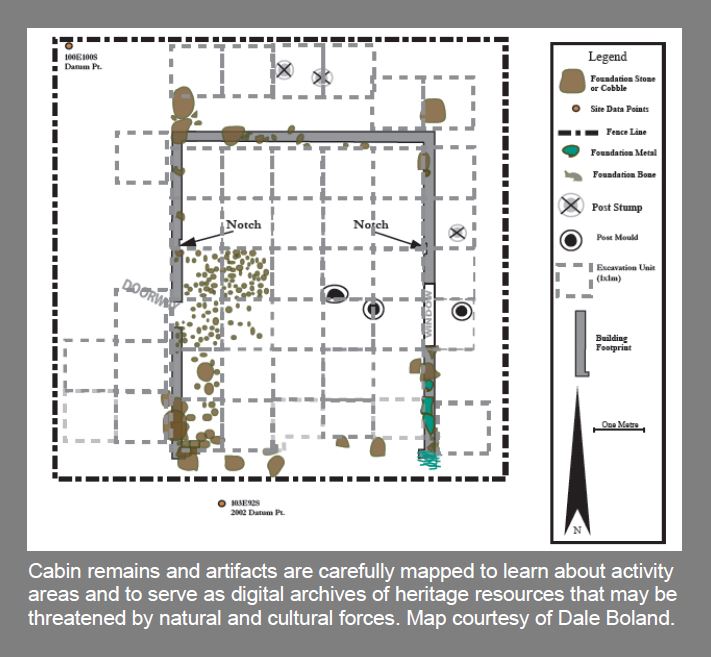
Cabins were typically made of raw timbers with a variety of corner joints, roofs, sawn floorboards, and chimneys. Associated features include outhouses, garbage pits, ice houses (for storing food), cellars, and drying racks. What can the archaeological record tell us about cabins and their occupants? Maps of cabins and associated structures reveal how people utilized landscapes and interacted with each other within cabins. Our modern homes are often relatively large with multiple rooms and levels, which is drastically different from the single-room cabins that many Albertans spent their lives in. An historical perspective informs us that changes in domestic architecture have had a real impact on the way Alberta’s families interact with each other and with their neighbours.

Cabin map

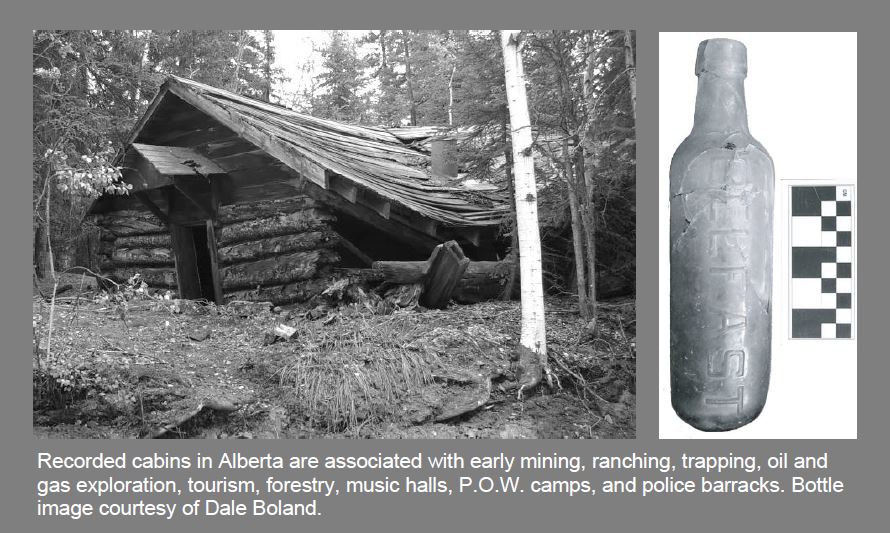
Cabins are often associated with historic trails that influenced how regions were settled and how goods were transported across the country. Cabin modifications over time tell stories of trial-and-error adaptations to new landscapes while artifacts can indicate the types of activities conducted around cabins, cultural affinities, number of occupants, and the season of occupation. Outhouses and garbage pits can reveal past diets, wealth, access to luxury goods, hygiene, medical conditions, and entertainment.

Cabin and bottle

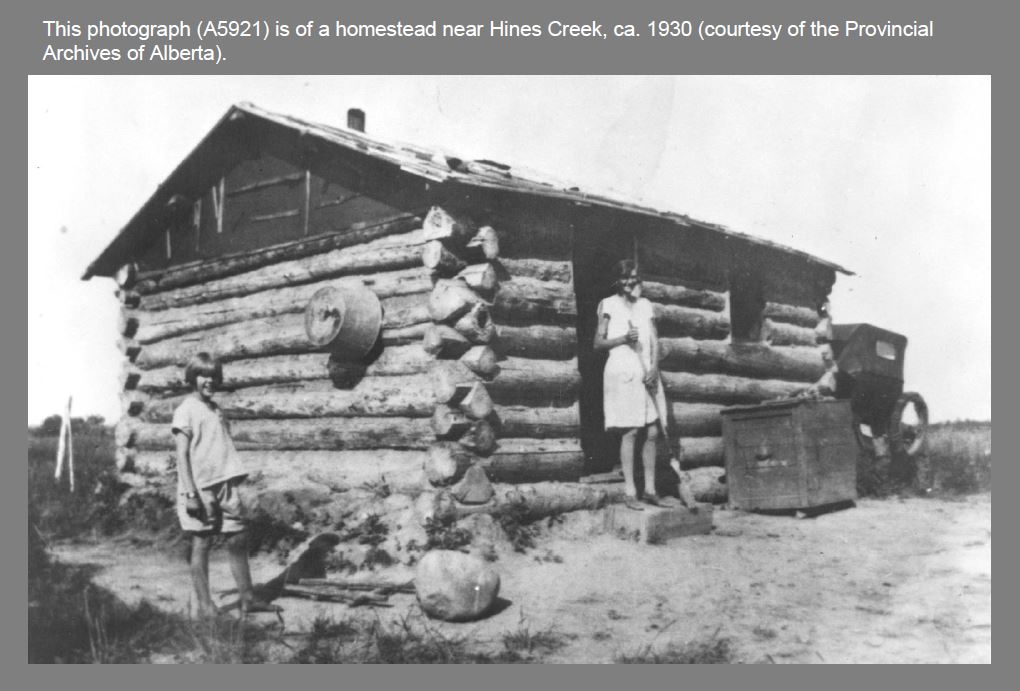
Aside from cabins’ phsycial make-up and artifact assemblages, they are significant heritage resources because they were often the first permanent structures to appear on many of Alberta’s landscapes. They represent a new adaptation and a new way of life for the people who first built them. There are over 550 recorded archaeological sites in Alberta with cabin components. Over 115 of these sites also have a pre-contact First Nations component, which suggests that many of the good spots for cabins have always been good places to make a living on the land.

Homestead photograph

The painting at the top of this article by Gregg Johnson is of a trapper’s cabin in the autumn foothills. It captures the solitude of the trapper’s life. Autumn was a busy time as trapper’s geared up for winter. Supplies were brought in, trap lines were re-established, and wood was cut for the long winter ahead. Like many of Alberta’s industries, modern trapping has an interesting past and an informative historic record. Archaeology offers a unique opportunity to learn about the past lives of people who may not be represented in historical accounts. In this sense, the study of historic resources gives a voice to people who have not been given the chance to speak for hundreds of years.

Miners cabin

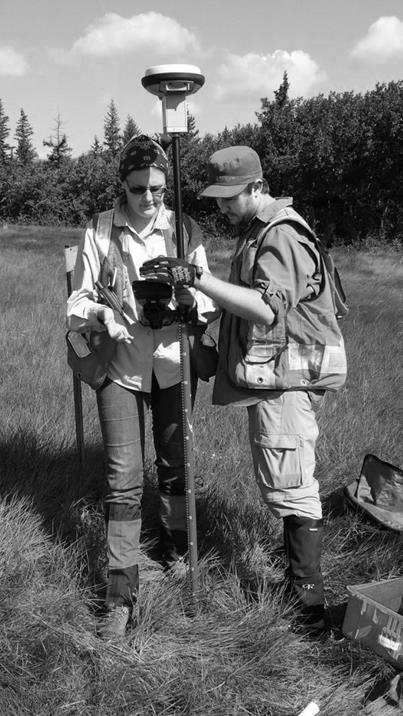
An example of a current research project about cabins that will illuminate the past record of a poorly understood group of people is that by Dr. Kisha Supernant at Buffalo Lake. Dr. Supernant and her research team from the University of Alberta are studying the adaptations of Metis and First Nations people who occupied Buffalo Lake in the 1800s in order to acquire meat that supplied neighbouring trade posts like Fort Edmonton. Her excavations and mapping program will uncover an important way of life that helped shape our province.

Mapping crew
Dr. Supernant and a graduate student use GPS equipment to map archaeological features.

The next blog of the Heritage Art Series will be about the changing landscape and rock art of Writing-on-Stone Provincial Park.

Written by: Todd Kristensen, Northern Archaeologist, and Dr. Kisha Supernant, University of Alberta

Alberta Coal!

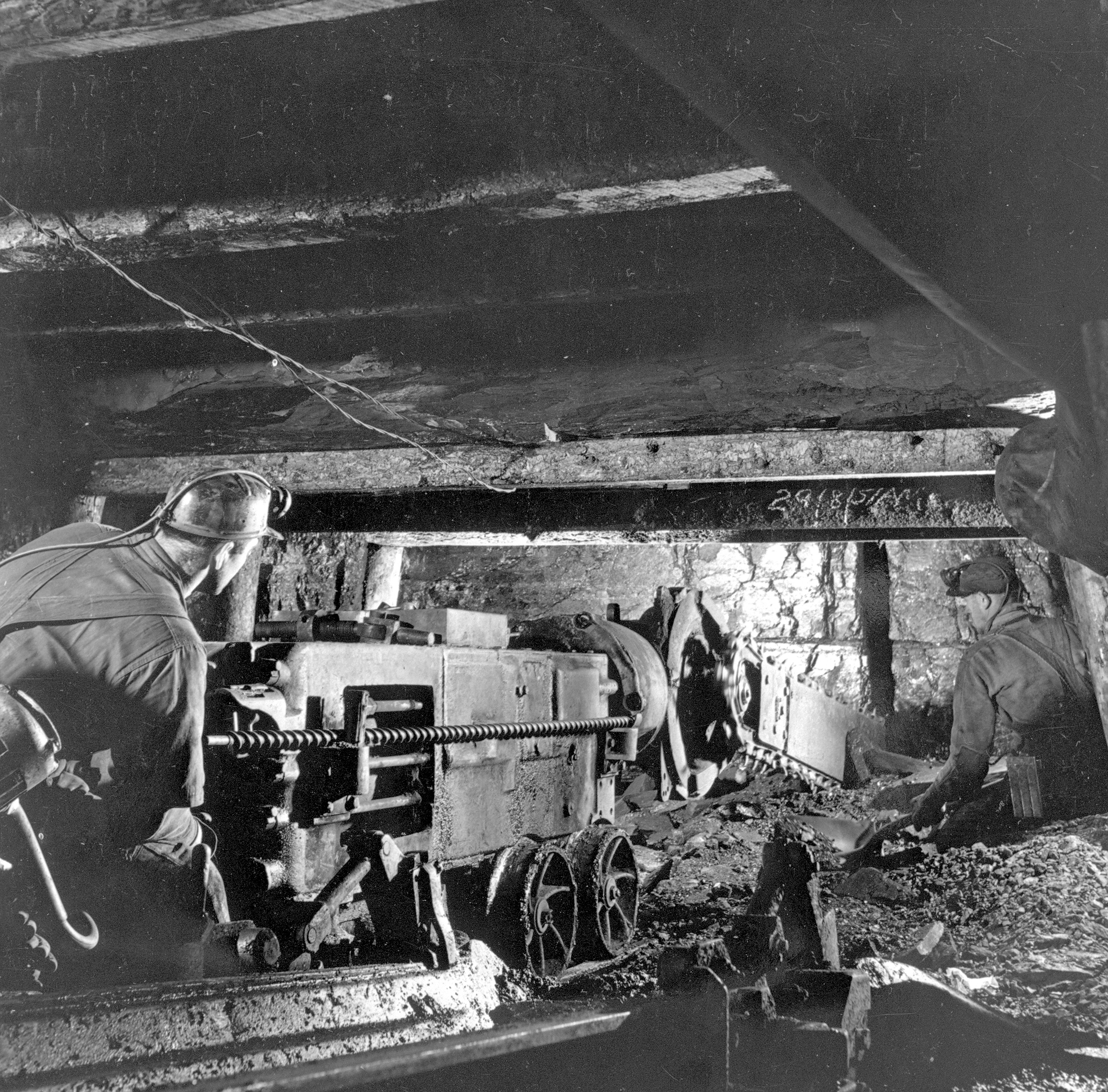
Miners using a universal coal cutter at Lethbridge Collieries, ca. 1950 Source: Provincial Archives of Alberta, A9908
Miners using a universal coal cutter at Lethbridge Collieries, ca. 1950
Source: Provincial Archives of Alberta, A9908

Alberta Culture has developed a comprehensive website that explores and promotes a deeper appreciation for the rich history of energy resources in our province and their role in shaping Alberta’s past, present, and future. The Energy Resources Heritage website explores the Alberta history of coal, conventional oil, oil sands, natural gas, electricity and alternative energy. It also profiles Bitumount, the pioneering industrial facility north of Fort McMurray that laid the foundations for Alberta’s modern oil sands industry.

The coal section of the Energy Resource Heritage Website examines the history of coal from the earliest times through the Industrial Revolution and the development of the coal industry in Alberta. It explores how the science and technology associated with coal mining has evolved, and how the industry responded to the sharp decline in demand for coal with the rise of oil and natural gas use after World War Two. It also explores topics relevant to the social history of the coal industry in Alberta, such as the evolution of coal towns; the roles played by women and children in coal communities; and the emergence of organized labour, which fought for better wages and safer working conditions in one of the world’s most dangerous industries.

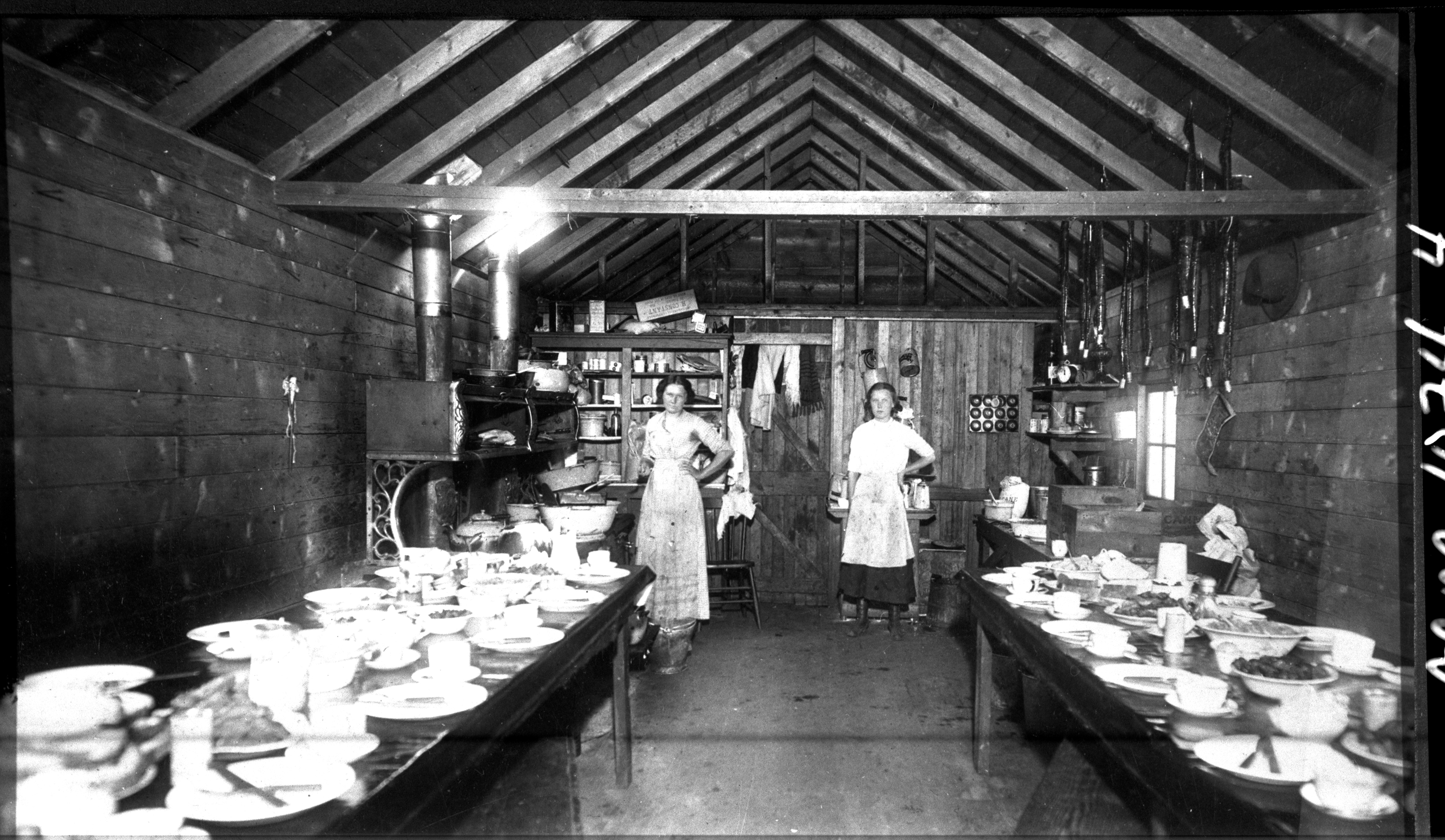
Two women stand in a cookhouse at Newcastle Mine in Drumheller Valley, ca. 1912; Newcastle was one of the first mine operations in Drumheller Valley to establish a cookhouse, which fed up to 100 miners three times a day. Source: Courtesy of Atlas Coal Mine National Historic Site
Two women stand in a cookhouse at Newcastle Mine in Drumheller Valley, ca. 1912; Newcastle was one of the first mine operations in Drumheller Valley to establish a cookhouse, which fed up to 100 miners three times a day.
Source: Courtesy of Atlas Coal Mine National Historic Site

The history of coal use by humans stretches back thousands of years, as coal’s ready availability and different properties have long made it a valuable resource in many parts of the world. In addition to burning it for heat, ancient peoples used coal for cultural and artistic expression. Bronze Age people in Wales, for example, incorporated coal into their burial customs, while ancient artisans in China carved coal into jewelry and other ornamental items. Similarly, First Nations people in Alberta used coal for decoration and carving, such as the extraordinary bison sculptures unearthed in a farmer’s field near Barrhead in 1949 (now housed at the Royal Alberta Museum).

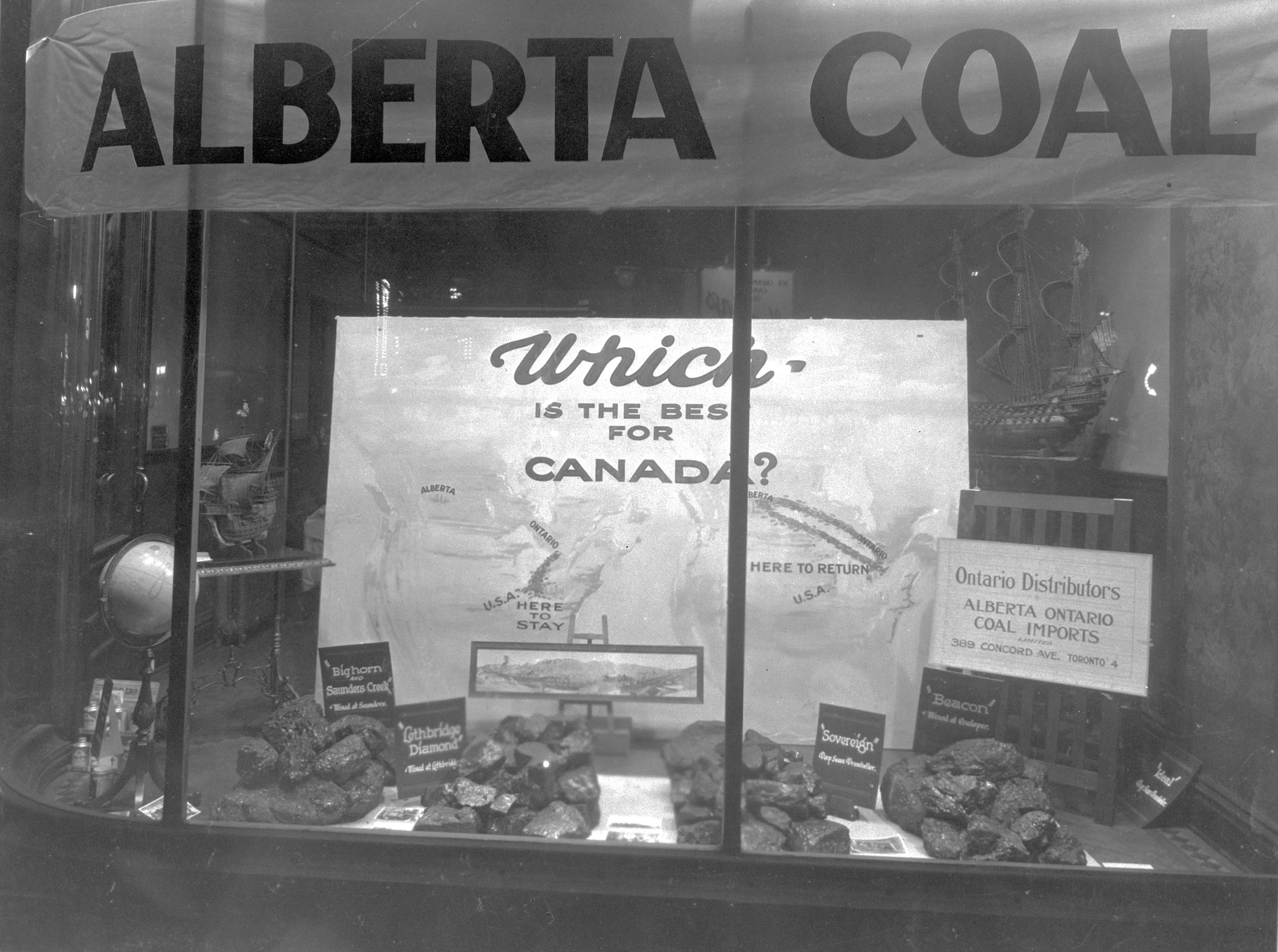
An Alberta coal company advertises in Ontario, n.d. Source: Provincial Archives of Alberta, A3975
An Alberta coal company advertises in Ontario, n.d.
Source: Provincial Archives of Alberta, A3975

The key turning point in the history of coal was the Industrial Revolution. As the primary fuel that drove steam engines in factories and railroads, coal became extremely valuable and was mined on an enormous scale. Railways quickly took over from watercraft as the most important means of commercial transportation, which in turn had a decisive impact on the history of Alberta. In 1881, the Canadian Pacific Railway was contracted to build a railway line across Canada and the company turned to the rich coal seams of Alberta as a crucial source of fuel. The province’s early coal industry was centred in southern Alberta (primarily near Lethbridge and in the Crowsnest Pass) but as rail lines spread throughout the province other centres of coal production emerged, including Drumheller and the communities of the Coal Branch. The rise of major cities like Calgary and Edmonton further drove the demand for coal, both for heating and for the generation of electricity at the province’s earliest coal-fired power plants.  Coal thus played a crucial role in the growth of Alberta in the late nineteenth and early twentieth centuries – it attracted investment and immigration and led to the development of some of Alberta’s earliest communities.

From the earliest use of coal to the challenges faced by the industry today, the coal section of the website offers visitors an introduction to the fascinating history of one of Alberta’s most important natural resources.

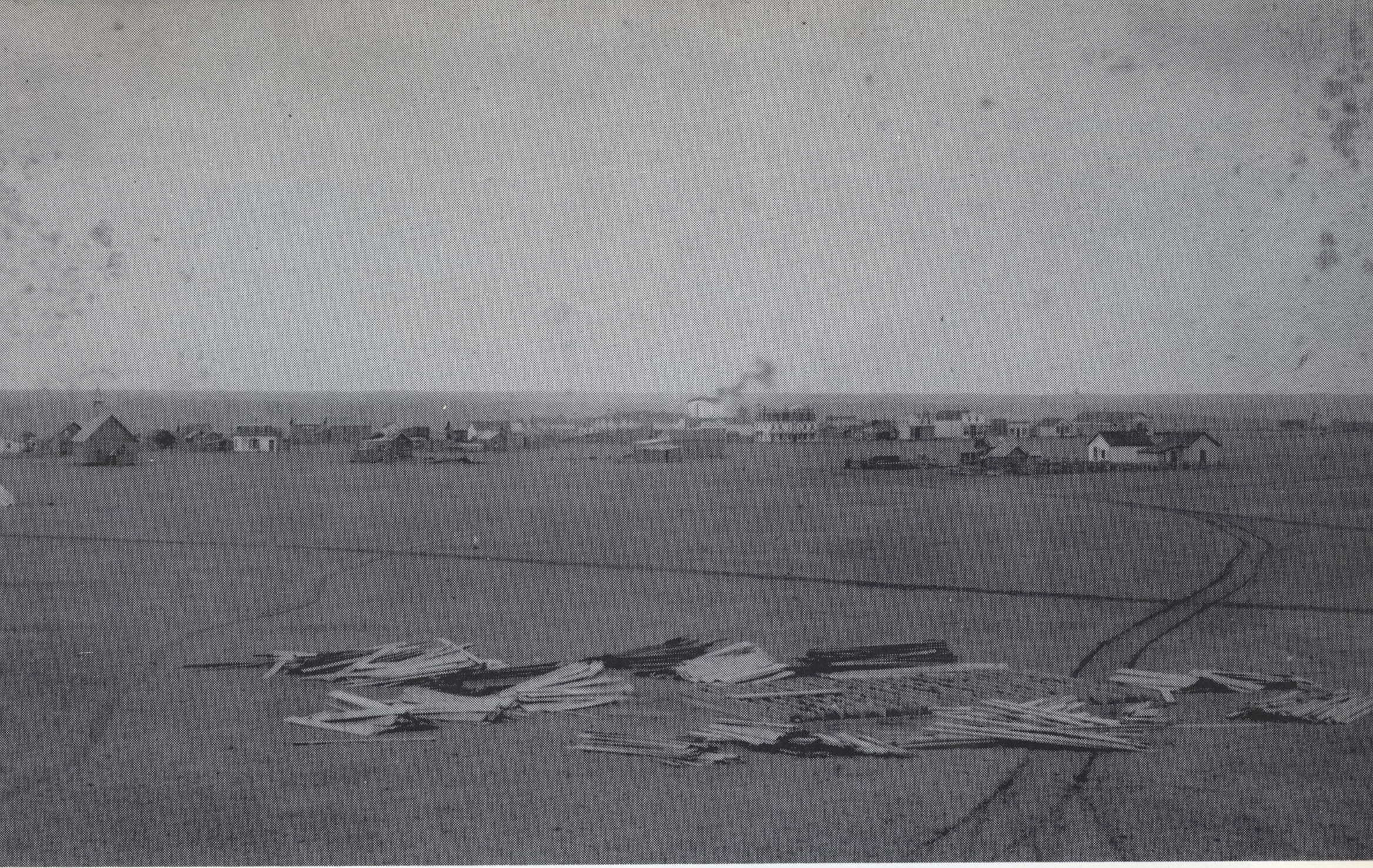
Lethbridge, an early coal producing centre, as it looked by November of 1886 Source: Galt Museum & Archives, P19770171000GP
Lethbridge, an early coal producing centre, as it looked by November of 1886
Source: Galt Museum & Archives, P19770171000GP

Written by: Allan Rowe, Historic Places Research Officer

Labour Day in Alberta, 1894-1914

As a social historian, I am fascinated by the history of holidays and public celebrations. Holidays are one way that political authority and popular culture influence each other: governments decide which holidays to recognise, but the people decide how to celebrate them. Records of these celebrations offer a unique window into the past, yielding insight into how our culture and society has (or has not) changed. In honour of this year’s September long weekend, I took the opportunity to look back at how Albertans celebrated Labor Day in the late nineteenth and early twentieth centuries.

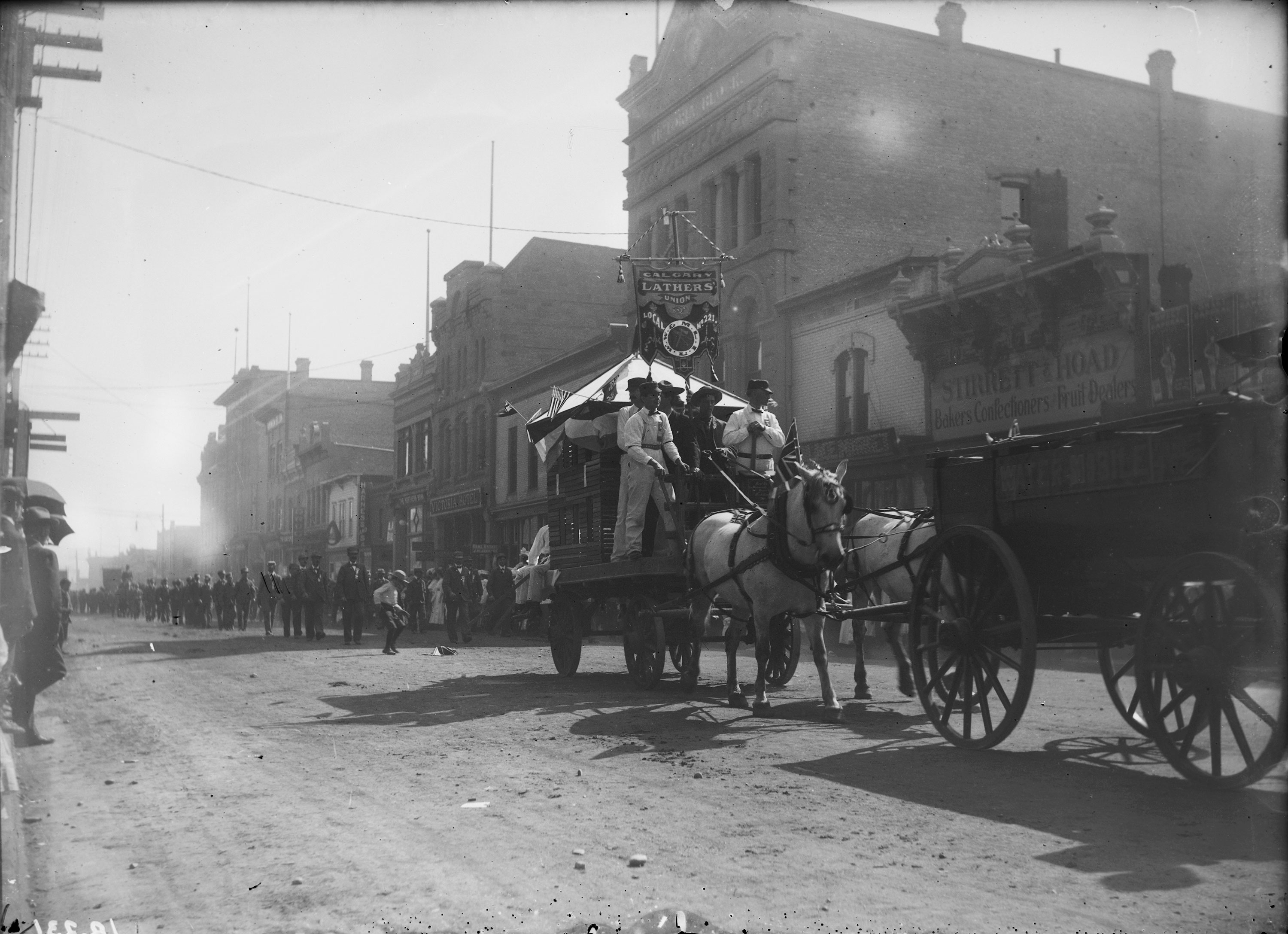
The Calgary Lathers’ Union, Local 221, participating in an early twentieth-century Labour Day parade (ca. 1908). Courtesy of the Provincial Archives of Alberta, IR231

The Parliament of Canada passed legislation in 1894 setting aside the first Monday in September as a statutory holiday. The proclamation of this new holiday was one of the many recommendations in the final report of the Royal Commission on the Relations of Labour and Capital (1889), which had investigated conditions in factories and industrial worksites across Canada. Given the range of problems exposed by the Commission – including low wages, unsafe working conditions, and the widespread use of child labour – a new holiday was perhaps less urgently needed than other reforms. Nonetheless, the idea of a new holiday received widespread support, and Canada celebrated its first Labour Day on September 3, 1894.

In the heavily-industrialised cities of eastern Canada, this legislation merely caught up with what was already happening in many urban communities, where organised labour had started to take root in the late nineteenth century. Skilled workers such as carpenters, printers, stonemasons and pipefitters organised into craft unions to protect their particular interests. Leaders of these craft unions began to push hard for a holiday that recognised the importance of their labour, and many cities responded by declaring Labour Day a civic holiday in the 1880s. By the time Labour Day was declared a national holiday in 1894, workers in cities like Toronto, Hamilton and Montreal had already been celebrating it for many years.

By contrast, in the relatively new and lightly-industrialised cities of Alberta, the first Labour Day passed with little fanfare. “To-day is Labor day, or rather, no labor day,” the Edmonton Bulletin dryly commented in September 1894, “and as a consequence, the stores in town are closed.” Within a few years, however, each Labour Day was met with greater enthusiasm, and Albertans enjoyed the holiday in ways that would be familiar to us over a century later.

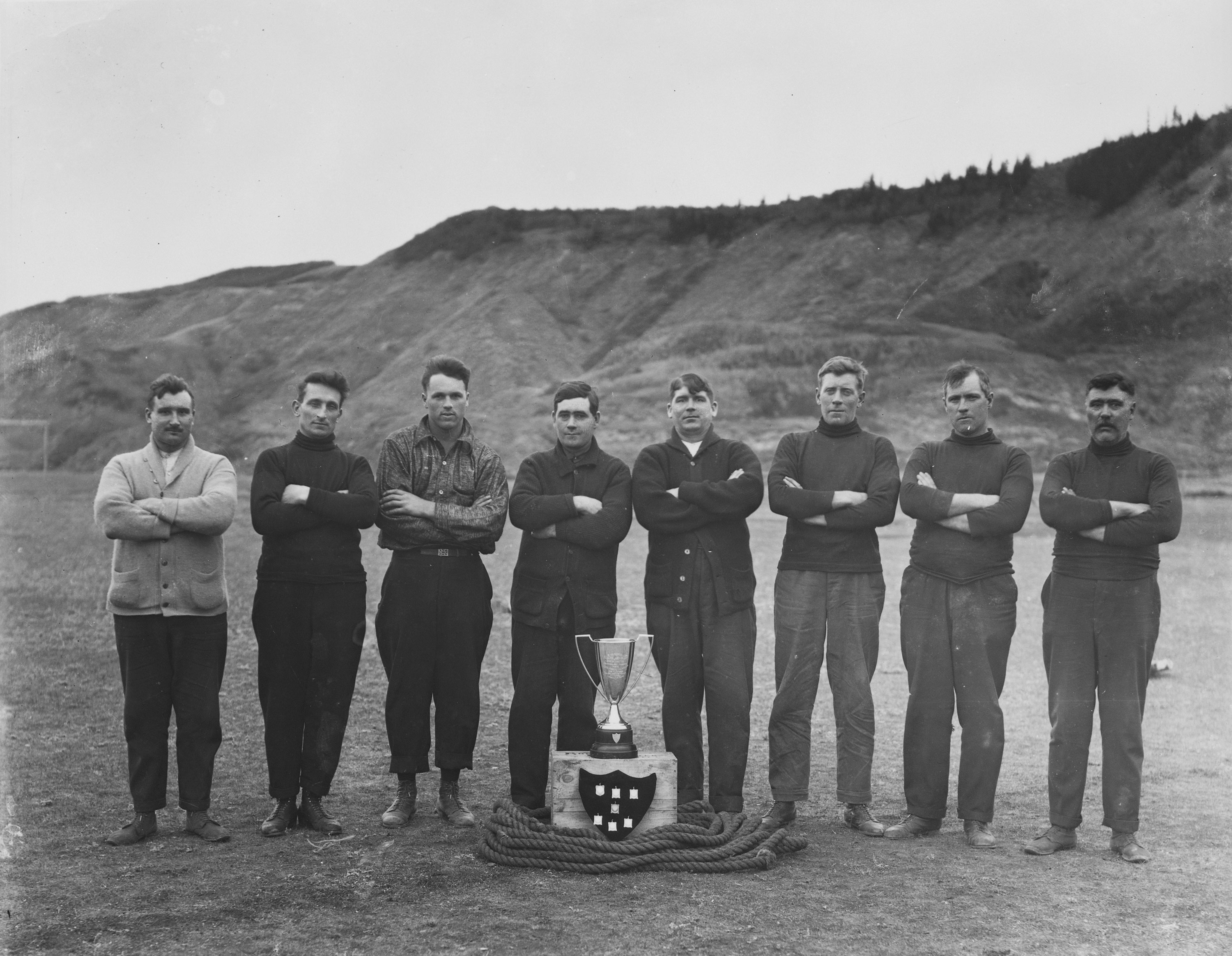
From the outset, sports were an important part of Labour Day celebrations. These miners pose with their trophy after winning the Labour Day Tug-of-War in Drumheller (ca. 1920). Courtesy of the Provincial Archives of Alberta, A15048.

Outdoor recreation soon became an important feature of the day, as sportsmen took advantage of the newly-created long weekend for hunting and fishing excursions. Organised sports were soon an important part of Labour Day as well, with bicycle races, track and field competitions, and team sports organised in different parts of the province by the late 1890s. In 1899, the Edmonton Cricket Club invited their rivals from Calgary for a tournament on the Labour Day weekend – an early example of the Calgary-Edmonton sports rivalry that remains such a feature of Labour Day in present-day Alberta.

Early Labour Day celebrations in Alberta were marked by sports, leisure and recreation, but had little to do with recognising the working class.

This changed after 1900 with the rise of organised labour in Alberta, particularly in its largest cities. Between 1900 and 1910, roughly one-third of the skilled tradesmen in Calgary and Edmonton organised into craft unions.  As a result, Labour Day celebrations in Calgary and Edmonton began to resemble the much larger events held in eastern Canada, with parades, speeches, and labour-organised leisure events. In 1904, for example, the Edmonton Trades and Labour Council organised a “monster parade” of the city’s craft unions down Jasper Avenue. The men (and they were all men – early twentieth-century craft unions were exclusively male organisations) marched in orderly procession behind banners, flags and brass bands, wearing find clothes to emphasise their respectability to the general public. The parade included a number of floats where tradesmen demonstrated their craft to the audience. The day ended with organised sports, pitting one union against another in good-natured competition, and speeches where union leaders spoke about the contributions of labour to social and economic prosperity. In Calgary in 1907, an estimated two thousand people marched down Stephen Avenue, followed by an afternoon of sports and family entertainment in Victoria Park. Similar scenes played out on a smaller scale in Alberta’s coal mining centres such as Drumheller and the Crowsnest Pass.

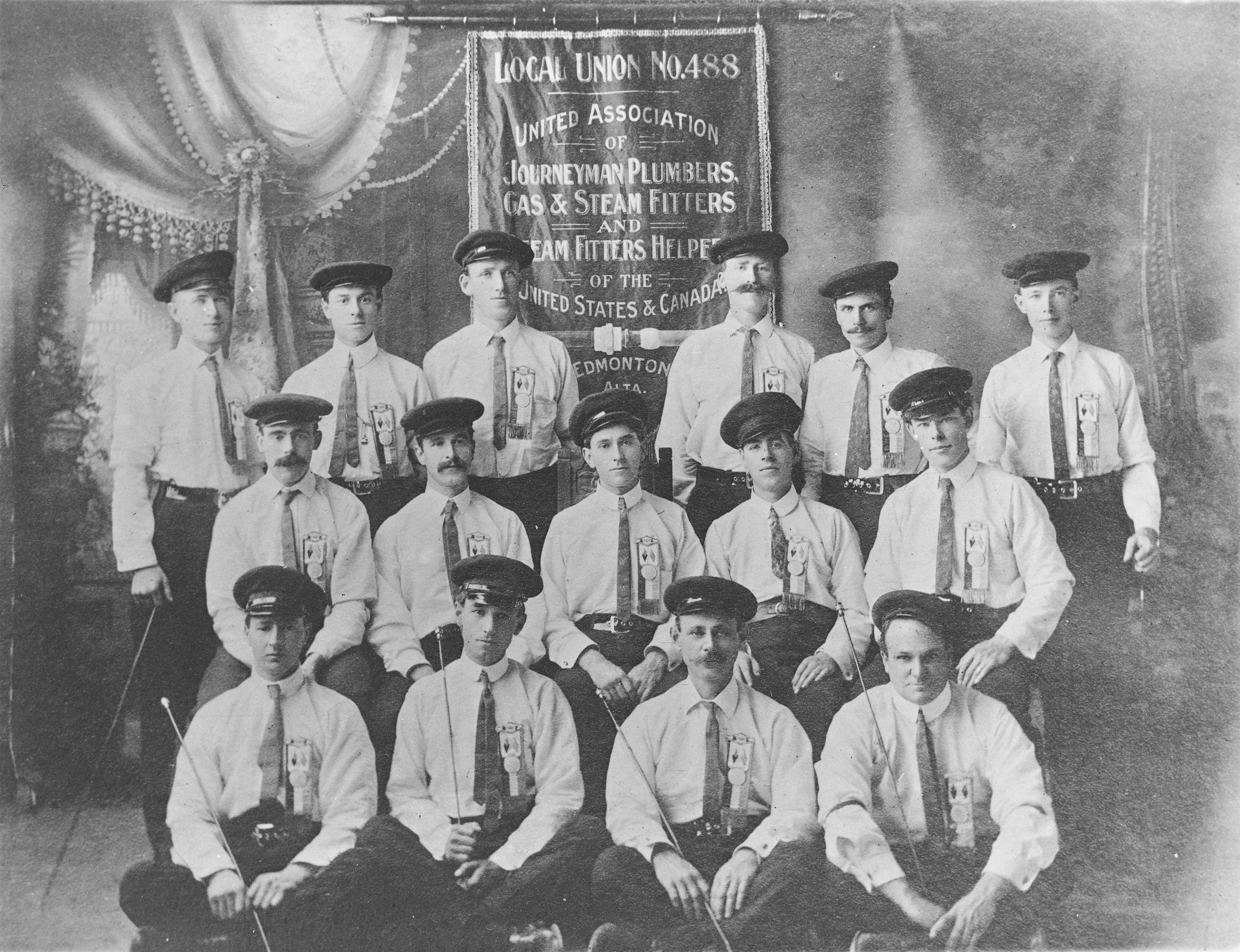
Local 488 of the United Association of Plumbers and Pipefitters, Edmonton (1904). This portrait illustrates the images that craft unions wanted to project to the public during Labour Day parades – well dressed, respectable and dignified. Courtesy of the Provincial Archives of Alberta, A19670.

These events, of course, did not represent Alberta’s entire working class. Early Labour Day celebrations were driven by craft unions – unskilled workers had little official presence at the events. The labour contributions of women were not generally recognised at these events, though women certainly took part in the leisure and recreation activities after the parade. Further, the exclusive focus on organised labour was soon diluted by the participation of other community groups and organizations in the annual parade. Nonetheless, these parades represent a colourful and important part of Alberta’s labour history, when craft unions sought to use a holiday to claim public space and promote an image of respectability and dignity. Such events were very uncommon after World War Two, as Labour Day celebrations returned to the pattern established in the 1890s – informal recreation, family leisure, and of course, sports rivalries.

Written by: Allan Rowe, Historic Places Research Officer.

Sources

Bright, David. Limits of Labour: Class Formation and the Labour Movement in Calgary, 1883-1929. Vancouver: UBC Press, 1998.

Finkel, Alvin. Working People in Alberta: A History. Edmonton: Athabasca University Press, 2012.

Herron, Craig and Steve Penhold. The Workers’ Festival: A History of Labour Day in Canada. Toronto: University of Toronto Press, 2005.

Ancient and Early Historic Fishing in the North

In the boreal forest, where big game animals were often hard to find, fish were a life-saving staple for thousands of years. Archaeological and historical records reveal a wide variety of fascinating angling techniques used by Alberta’s First Nations.

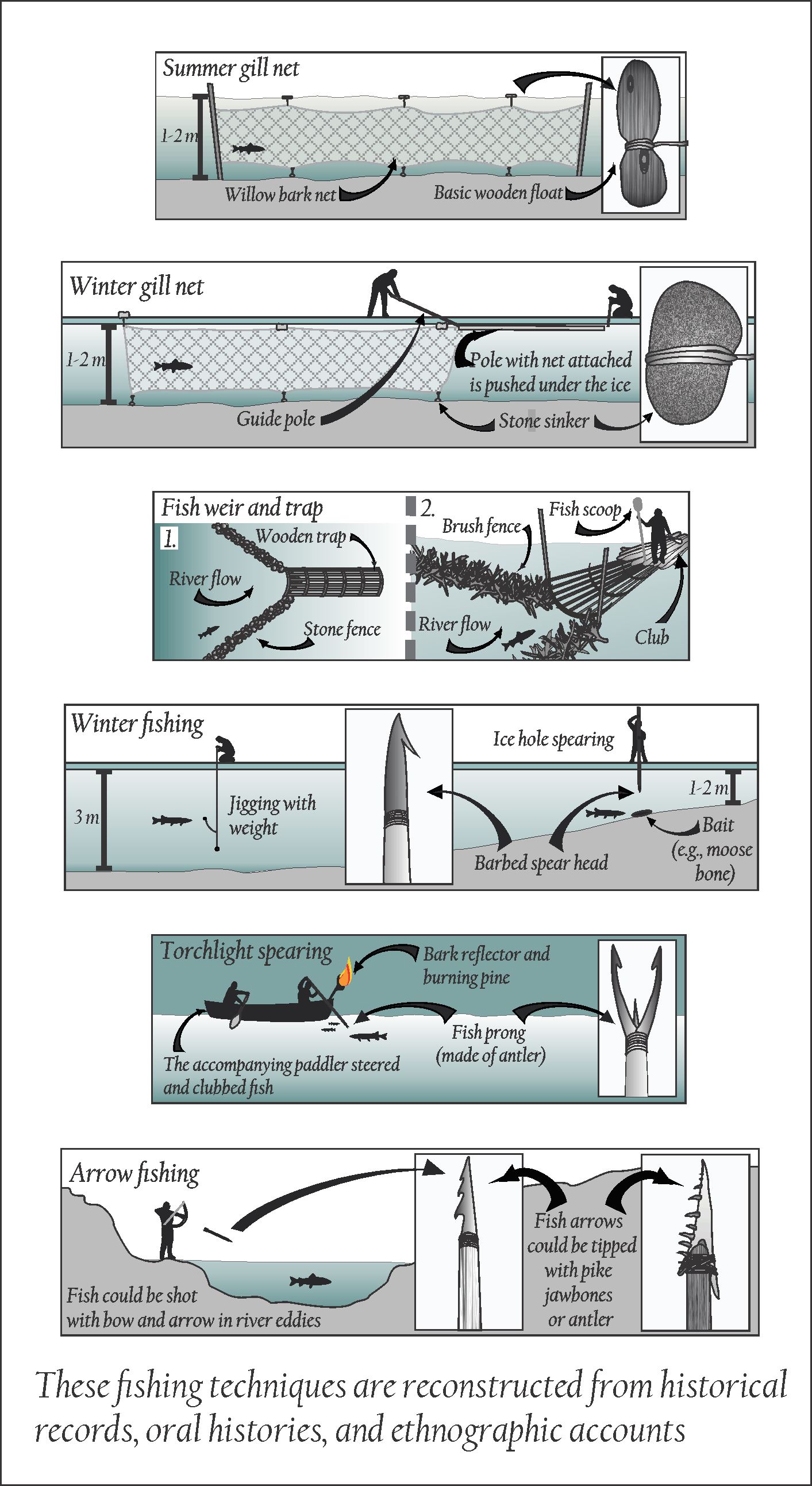
Figure 9. Fishing techniques edit


To increase awareness of these practices and other elements of Alberta’s past, a collaborative team of the Historic Resources Management Branch, the Royal Alberta Museum, and the University of Alberta initiated the Heritage Art Series project. The goal is to create artwork that captivates the public in order to encourage the appreciation and protection of Alberta’s past.

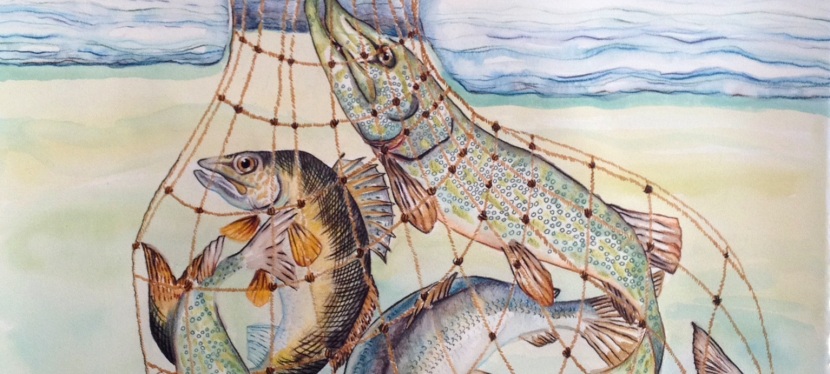
The second painting in the series is a symbolic depiction of a mother teaching her daughter about the relationship between people and fish. First Nations survived in Alberta by passing down immense amounts of knowledge, which this image by Jenny Keith illustrates. The artwork also celebrates the role that women make to traditional diets. Fishng was primarily a women’s task in Northern Alberta. Women needed to know where to catch fish, how to make nets, how often to check them, and when to repair them.

The largest catch of fish was traditionally by gill net during fall spawning runs of whitefish. Whitefish were particularly important because they are high in fat, which becomes scarce in the north during long winters. Gill nets are long rows of interconnected squares that capture fish by the gills. What were nets made of before twine? Amazingly, women spent hundreds of hours weaving twisted willow bark or animal sinew into long nets.

Figure 10. Net IMG_1047
This is an example of a willow bark net from the Royal Alberta Museum.

Gill nets were set across rivers or narrow channels during warmer months or were strung through holes under the ice in winter. Large fish were also shot with bow and arrow or were speared by canoe. Some First Nations made fishing arrowheads out of pike jaw bones: nothing catches fish better than fish! Jigging with hooks made of bone and wood was also done, primarily in winter. Hooks were baited with meat scraps, hair, feathers, and beaver oil.

Fishing increased in importance when Europeans arrived. Fur traders in Northern Alberta made a living on pelts but they lived on fish. At Fort Chipewyan in Northeast Alberta, traders caught 33 000 fish from October to January in 1822. The ration was four fish a day (and a potatoe if they were lucky). Some northern trade posts even had to be relocated because they lacked good access to fisheries.

The archaeological record of fishing is sparse because fishing tools are often organic while fish bones tend to be fragile: very little of this survives in Alberta’s acidic soils. Some interesting fish-related fnds include possible stone fish hooks, bone prongs used on fish spears, sinkers (weights) that weighed down nets, and fish vertebrae that were drilled to make beads.


Artifact compilation
This is a collection of pre-contact fish-related artifacts from Alberta that span several thousand years.

Recently developed scientific techniques have also enabled the recovery of fish blood from the edges of stone tools like arrowheads and knives. Even though fish bones don’t survive, archaeologists studying blood residue have been able to determine that fish like pike, walleye, and whitefish were caught thousands of years ago. Lastly, fur trade forts have yielded an interesting array of early hooks. Some are entirely metal while others, like the example below, are a combination of bone and iron.

Figure 4. Fish hook
This fur trade fish hook was found by Jack McIntosh at Dunvegan near Grande Prairie.

When asked to imagine ancient life and food harvesting practices, people often think of men stalking mammoths or stampeding buffalo over cliffs. In reality, for much of Alberta’s human history, women have made just as important if not more important contributions to traditional diets. The painting above is intended to broaden perspectives of hunting and fishing practices while emphasizing the social dimension of food harvesting. People didn’t just survive by capturing food; they persisted for thousands of years by acquiring generations of knowledge that was passed down from parent to child year after year after year.

Stay tuned for the next installation of the Heritage Art Series, which will present the physical record of cabins and their significance in Alberta’s early history.

Written by: Todd Kristensen, Northern Archaeologist, and Dr. Jack Ives.

When it was Cookin’ Hot

Cooking Lake with its cool breeze was the place to be in the halcyon summers to the end of World War I. The wealthiest Edmontonians spent summers in one of the rustic cabins, swimming, sailing and canoeing or lounging at the docks. Others had to make do with day trips and special picnic outings to the beaches on its south shore.

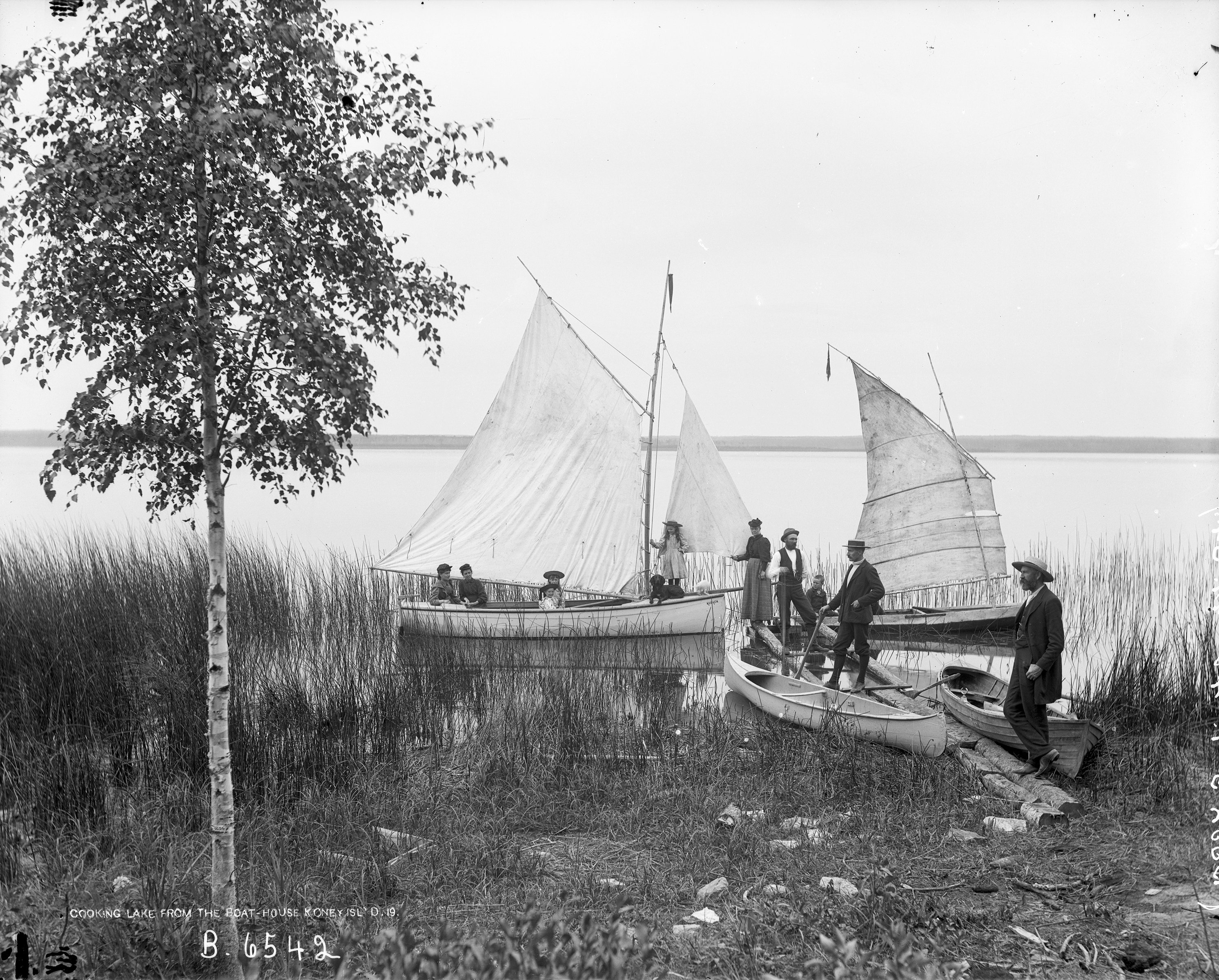
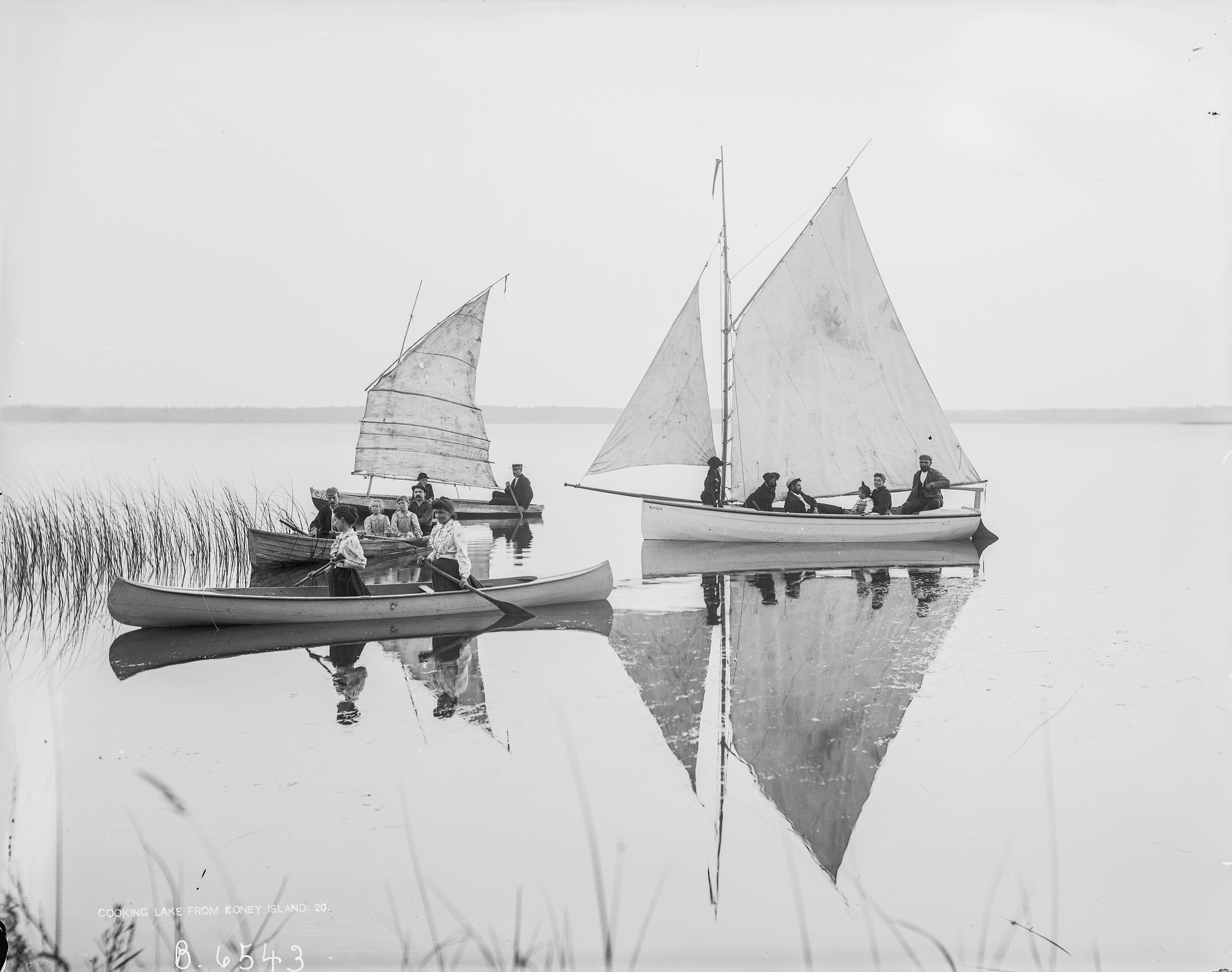
A group of prominent Edmontonians formed the Koney Island Sporting Co. Ltd. in 1894 to develop a small island located in a bay on the west side of the lake. It was an exclusive resort, complete with a log clubhouse nestled among the spruce trees. Members built cabins and erected docks. The serene lake waters were ideal for boating and one of the first club projects was a sailboat: the Mudhen. She was carvel-built using hand sawn lumber.

Koney Island Club member showing off their floatilla: The gaff-rigged sloop Mudhen, along with a row boat and two canoes, one with a small sail as was popular at the time. (Courtesy of the Provincial Archives of Alberta, B.6542.)

Koney Island was an isolated spot: Dr. Goodwin, one of the club members, may have been surprised to meet Dominion Land Surveyor Ernest Hubbel who arrived to survey its shores in 1895. Goodwin lent Hubbel a club rowing boat to do his work. The island offered a “splendid rendez-vous” for club members, Hubbbel noted, and was “a tranquil and exceedingly picturesque spot.” Nevertheless, club members may have tired of rowing out to the island when they arrived dusty and hot from Edmonton, as in 1898 they bought a 20 foot gasoline launch that could carry 12 passengers.

On the south side of the lake Sheriff Walter Robertson built a large lodge from logs and opened a resort in 1898.  Here no company membership was required and holidayers could stay, enjoy the beach area and social functions at the lodge. The commercial resort slowly developed into the hamlet of South Cooking Lake, complete with post office by 1906.

Cooking Lake really took off as a summer lake destination in 1909 when the Grand Trunk Pacific Line to Edmonton passed along its north shore. Day trippers came out from Edmonton on the morning train east, alighting at the small station of Cooking Lake. Part of the day’s fun was crossing the lake on the motor launch Daisy Girl that operated as a taxi to White Sand Beach on the south side at Ministik, where children built sandcastles before the evening’s return trip.

The gaff-rigged sloop Mudhen becalmed at Koney Island, along with two canoes, one with a small sail as was popular at the time. (Courtesy of the Provincial Archives of Alberta, B. 6543.)

Company picnics for employees were popular. The Esdale Printing Company picked a warm day in 1914 for its annual outing. Couples sat by the shore watching children swim or splash about. Some women had umbrellas for shade while other relied on their straw hats. A tug-of war competition was organized among the women, while a group of men spent most of the afternoon roasting an entire calf on a spit built over a camp fire. Everyone sat down at long trestle tables to enjoy the meal in the shade of the trees.

Cooking Lake was a destination for outings on Empire Day (celebrated on the school day immediately preceding May 24). The day had beautiful fine weather in 1916, which must have sorely disappointed the young people in Edmonton’s First Presbyterian church group, who cancelled plans for a picnic and boat ride due to incessant rain the previous day. Church camps were held at the lake, and the Young Womens’ Christian Association had a bungalow at Military Point.

By 1916 many Edmontonians had cabins at Cooking Lake. A taxi service was available from the city and motorists increasingly ventured out for the day. More facilities and accommodations were built on the lake shore, which had a graded “lake promenade.” Lunch could be enjoyed at Mrs. McMenomy’s “high class restaurant,” and canoes and row boats hired by the hour. Further along the promenade at South Cooking Lake, visitors played pool at Chris Falks’ ice cream parlour.

Larger motor launches were evident on the lake in the 1920s and soon sea planes were landing on its waters, even before a seaplane base was built in 1935. The Cooking Lake Sea Plane Base was used recreationally as well as by bush pilots returning from the north. While other lakes around Edmonton enticed vacationers, Cooking Lake, the city’s first summer escape, remained popular into the 1960s. Water levels and water quality at Cooking Lake have always fluctuated: Koney Island became a peninsula in 1962. Sailors and swimmers became disenchanted during the 1970s. The summer of 2007 brought a record low-water level stranding the lake’s piers and cabins. Although waters have risen again recently, it seems unlikely that long summer days at the lake will ever be as cookin’ hot as they were a hundred years ago.

Written by: Judy Larmour, Historian.

The First World War started 100 years ago today

On August 4th, 1914 the United Kingdom declared war on Germany on behalf of the British Empire, including Canada. The First World War had begun. 2014 marks the centenary of Canada’s (and thus Alberta’s) entrance into “The Great War,” a period which tested the province’s strength and demonstrated its resilience. This post will look at recruitment, life in the trenches, conscription and the final 100 days of the First World War.

In August 1914, communities across Canada prepared to serve, organising the people and resources that would be needed to assist the allied forces in victory. Canada was thrust into a situation that required everyone to help the war effort and Albertans responded without hesitation.

Group photo of the 187th Regiment, Canadian Expeditionary Force from Stettler, Alberta. November 18, 1916 (Provincial Archives of Alberta, A5037b)

During the initial stages of the war Albertans were eager to volunteer, and within the first few days men from all over the province had enlisted for military service. Alberta supported the Canadian Expeditionary Force, including 180 cavalrymen from the 19th Alberta Dragoons, more than 400 from the Princess Patricia’s Canadian Light Infantry, 900 members from the 101st Edmonton Militia Regiment and more than 300 hundred men from the 103rd Calgary Rifles Regiment. By 1916, 24 battalions had been raised in Alberta, consisting of approximately 1,000 men each.

Reaching the trenches, the enthusiasm that volunteer soldiers felt upon enlistment quickly wore off. It became obvious to the men that they had been given inadequate training and the weapons they were issued, particularly the Ross Rifle, proved to be ill-suited for trench warfare. As soon as soldiers reached the trenches, they were met with deplorable conditions: vermin, rain, mud and disease were common and the horror of seeing friends and countrymen suddenly killed or maimed became a weirdly familiar experience. The letters that soldiers sent to friends and relatives back home, although often censored, detailed some of their experiences, but it was impossible to describe the realities of being in the middle of a war zone to civilians. One soldier, Private Maus, stated during correspondence with his uncle in Edmonton: “It is a rather muddy picnic, with fireworks free.” This illustrates Private Maus’ wry sense of humour, but also alludes to the dirty conditions and the never-ending noise of artillery fire that were commonplace. Men from Alberta served alongside other Canadians throughout four years of trench warfare.

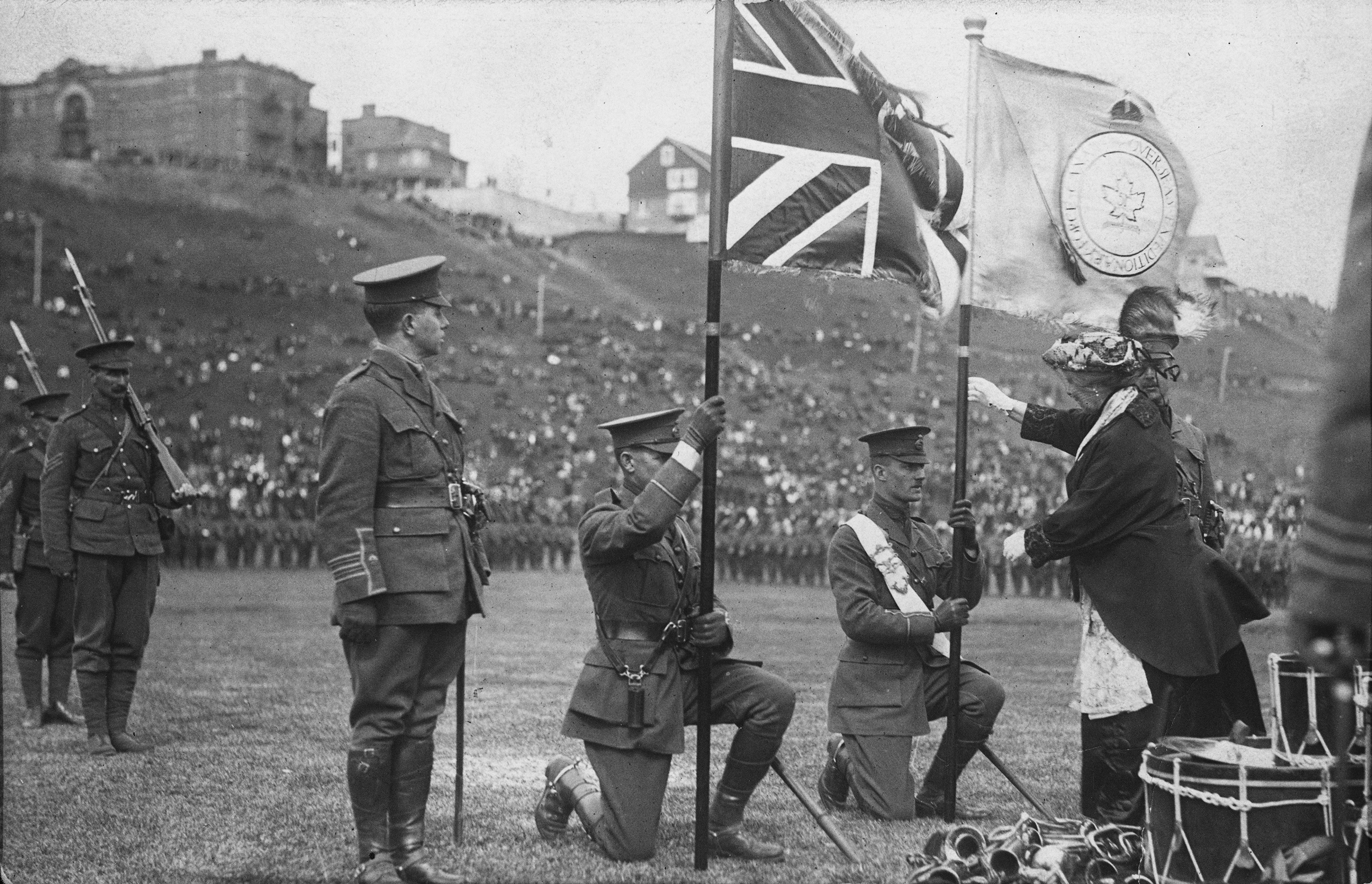
Presentation of Colours to the 51st Battalion, Canadian Expeditionary Force in Edmonton, Alberta, ca. 1915 (Provincial Archives of Alberta, A2526)

A number of men enlisted for military service with the hope of fighting alongside their friends, relatives and neighbour, but very few of the battalions remained together. Units were regularly disbanded and their members reassigned to reinforce other battalions that had been depleted as a result of casualties. Only four battalions from Alberta remained intact and they fought in the front line at second battle of Ypres, the Somme, Vimy Ridge and Passchendaele. They were the 50th battalion from Calgary; the 49th from Edmonton; the 31st, comprised of recruits from southern Alberta; as well as the 10th which recruited members from Calgary and Winnipeg. In total, around 49,000 men from Alberta enlisted as soldiers in infantry, artillery battery operators, field hospital workers, aircraft crews, as well as other equally important areas.

The strong number of volunteers who were initially eager to take on the duties of war had declined sharply by 1917. Once word had reached the home front about the death toll that accompanied war service, recruitment became a challenge. Prime Minister Robert Borden and his cabinet nevertheless felt a duty to maintain its front line ranks and, with the lack of new and willing recruits, talk of conscripting able bodied men into military service began. Borden had seen firsthand the toll Canadian soldiers paid while visiting hospitals in England and the battlefront in France.[1] As a result, Borden pushed a conscription bill through Parliament, despite strong opposition, and mandatory enlistment was made law on August 28, 1917.

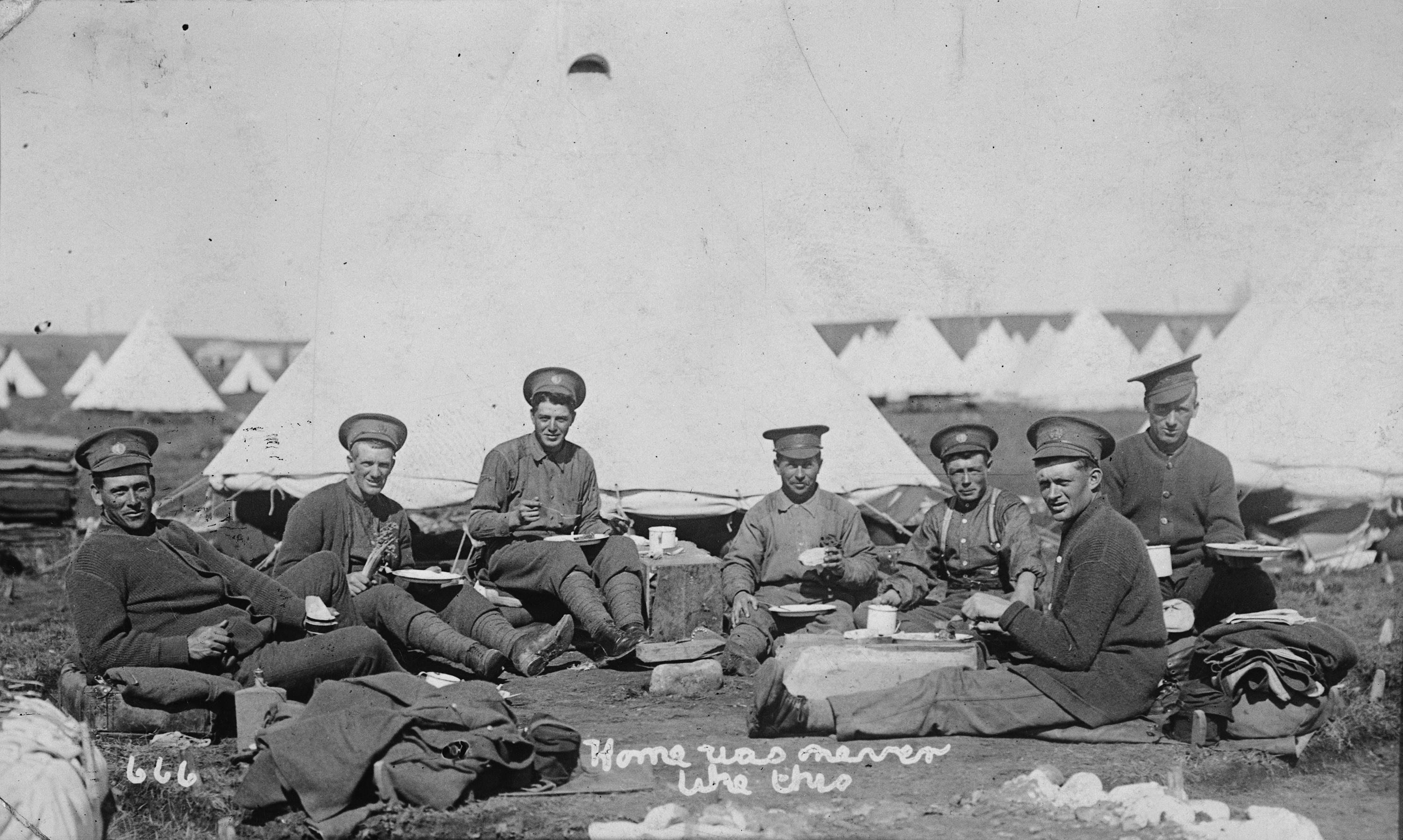
Len Foster and other soldiers overseas during the First World War, ca. 1916 (Provincial Archives of Alberta, A6741)

All eligible men were instructed to immediately sign up for military service. This included men who were unmarried or childless widowers between the ages of 20 and 34, although there were other exemptions. War-time workers who were deemed essential to the war effort and conscientious objectors were a few of the exceptions that men could apply for. In Calgary, 11,953 males requested exemption and 60% of Alberta’s conscripts who registered in Edmonton were deemed unfit to send to war. Conscription was passed with the intention of enlisting 70,000 new recruits from across Canada, but approximately 26,000 were sent to Europe. This was far less than Borden’s goal.

The final 100 days before the armistice were among the darkest, with Canadians fighting in a series of bloody battles in France. The Amiens campaign began on the foggy morning of August 8, 1918, when Canadian soldiers, along with the British, Australian and French forces, pushed through German defences within the first day. Albertans in the 10th battalion of the Canadian Expeditionary Force made significant advances, being the first to reach their offensive objective and they were soon followed by the 31st battalion. The Canadian forces forged ahead and up next was the region of Arras, where a large numbers of German defenses still remained. The battalions that had been raised in Alberta remained on the front line during the attack and assisted in taking control of the Drocourt-Quéant Line. This was a significant breakthrough for the allied forces in progressing towards the German border. What followed was a series of campaigns that showed the Canadians as a vital fighting force, and victory was claimed again in the subsequent, major battles of Canal du Nord, Cambrai and Valenciennes. Throughout these conflicts, the battalions made up of Albertans remained at the forefront of the action until the very end, with the liberation of Mons, Belgium. After years of violence, armistice was declared on November 11, 1918, and the conclusion of the war brought a mixture of shock and relief to Alberta’s soldiers.

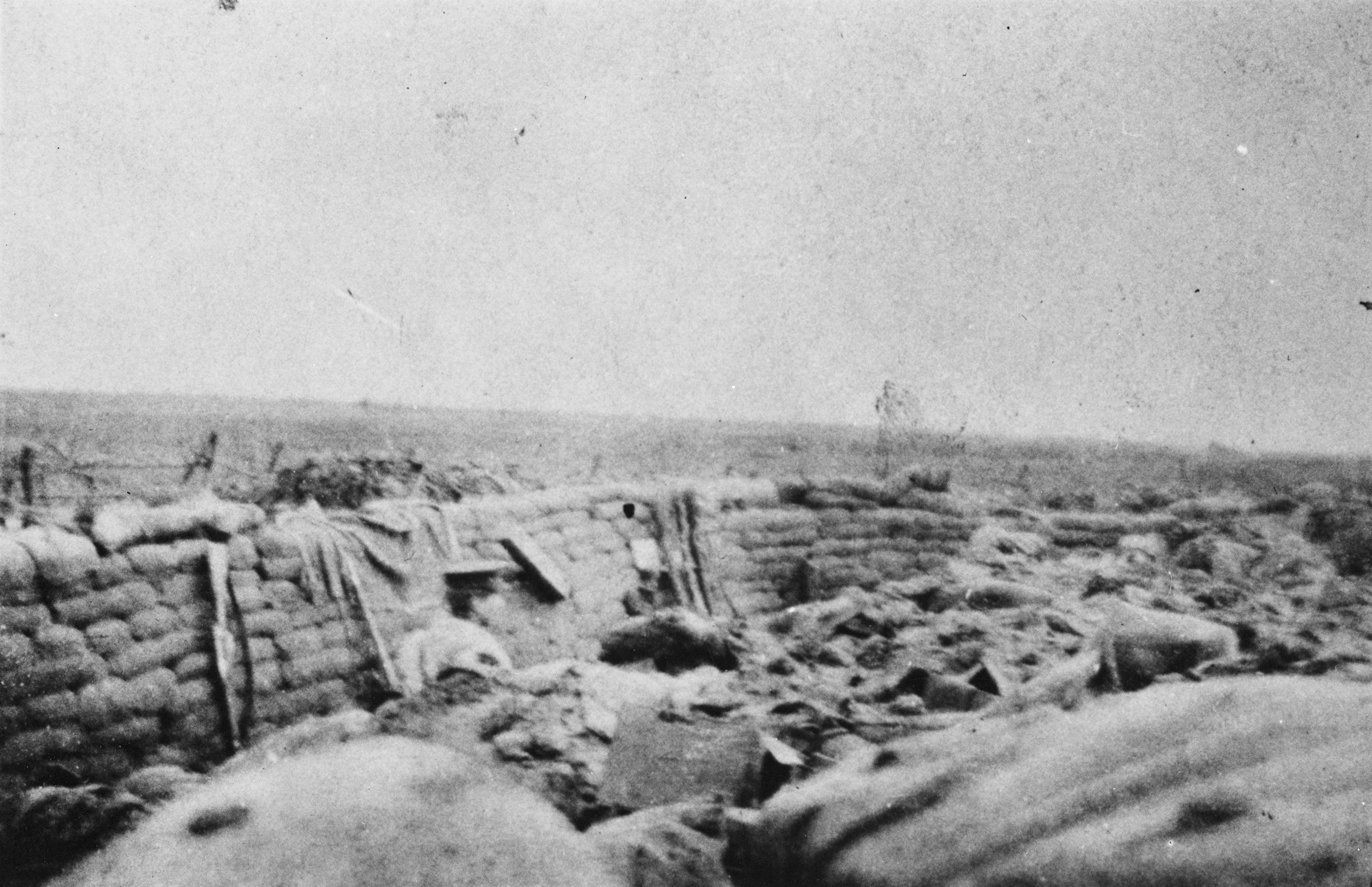
Trenches in France during the First World War (Provincial Archives of Alberta, A9020)

Alberta paid the price for their involvement, with approximately 6,140 men killed and another 20,000 wounded. One in eight of those who enlisted never came back. The casualties of war were felt across the province. From the town of Gleichen, 250 men were deployed to fight and one in five of those soldiers lost their lives. Edmonton’s 49th battalion alone recorded approximately 1,000 losses, enough to assemble an entire battalion. In February of 1919, war veterans gradually began to return home, but the province had changed as a result of the First World War. Sacrifices were made by those who fought in the war as well as the by people who remained on the home front. From the social impact to the human toll, life in the province was altered for Alberta’s people in subsequent generations.

Soldiers in the 49th Battalion return to Edmonton, Alberta from Europe after the end of the First World War. March 22, 1919 (Provincial Archives of Alberta, A18513)

For more information on Alberta in the First World War, refer to Alberta in the 20th Century: The Great War and its Consequences 1914-1920 or Alberta Formed Alberta Transformed. The Great War: 1914-1918 features a number of editorials that are specific to Alberta.

This was the first part of a series commemorating the First World War. Over the next month, this series will look at a range of topics that will show Alberta’s involvement in this historic event.

Written by: Erin Hoar, Historic Resources Management Branch Officer.

Sources

Blue, John. Alberta: Past and Present. Vol. 1. Chicago: Pioneer Historical Publishing Co., 1924.

Byfield, Ted, ed. Alberta in the 20th Century: The Great War and its Consequences 1914-1920. Vol. 4. Edmonton, Canada: CanMedia Inc., 1995.

Canadian War Museum. (Accessed July 18, 2014).
Love, David W. A Nation in Making: The Organization and Administration of the Canadian Military During the First World War. Vol. 1. Ottawa: Service Publications, 2012.

Payne, Michael, Donald Wetherell, and Catherine Cavanaugh, eds. Alberta Formed Alberta Transformed. Vol. 2. Edmonton, Canada: University of Alberta Press, 2006.

Notes

[1] Canadian War Museum. (Accessed July 18, 2014).
A Futuristic Elevator that Lives on in Brazil

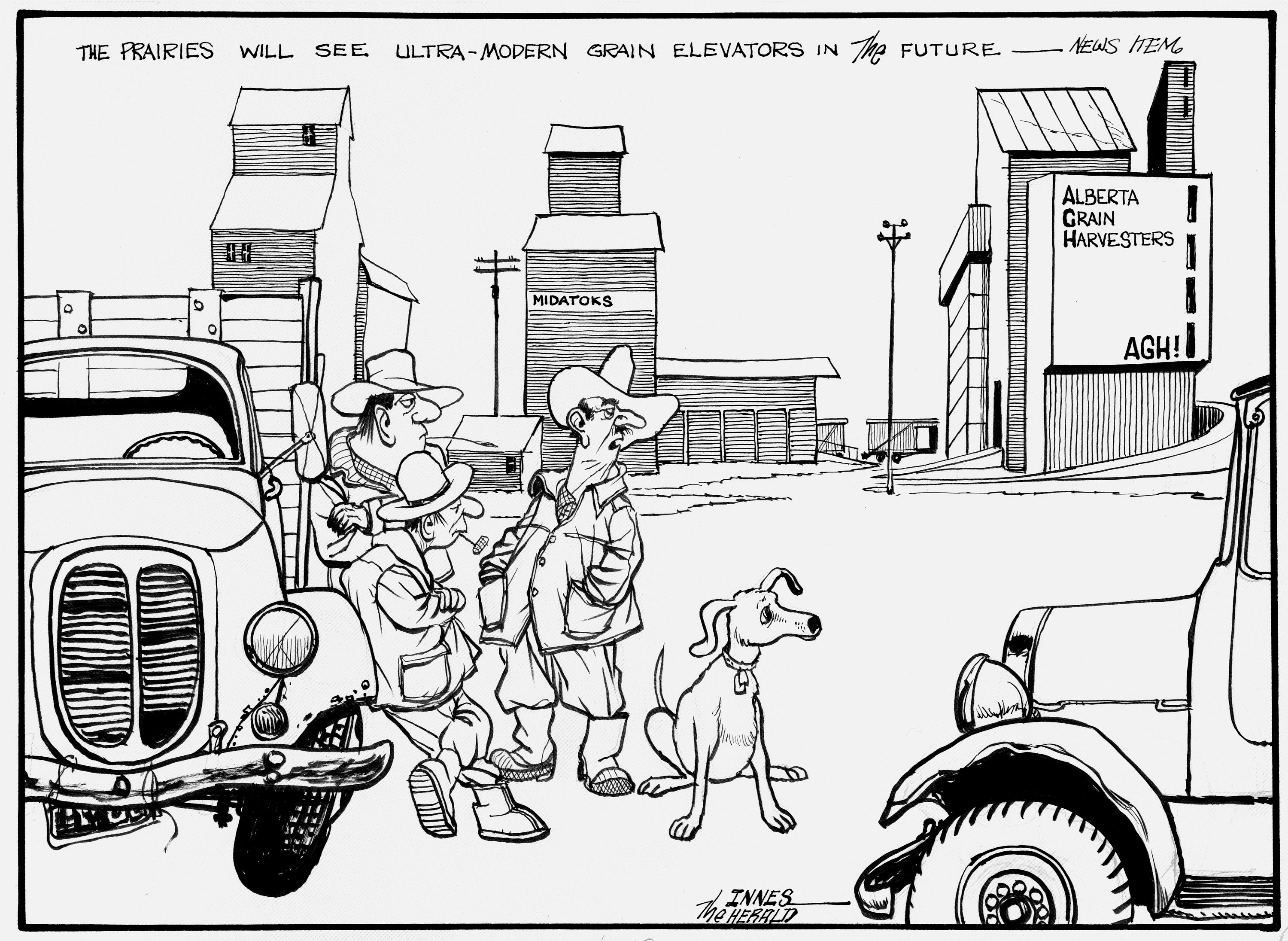
As this cartoon indicates some farmers were skeptical of the Buffalo design. (Courtesy of Glenbow Archives, M-800-344.)

Not long ago, Alberta, had country grain elevators named for the indigenous bison that roamed the plains before grain was grown. The innovative Buffalo, as they were called, were designed in Alberta, and constructed in both Alberta and Brazil. In the late 1970s times were good for Alberta’s farmers and their grain Company—the Alberta Wheat Pool. Bumper crops and high grain prices kept the grain elevators humming. As fires destroyed many wood elevators, and the railways were pushing for ever more streamlined grain handling, the Pool decided to use some of its profits to experiment with concrete country elevator designs. It began working with Buffalo Engineering of Edmonton, headed by Klaus U. Drieger. This resulted in a partnership company ABL Engineering Ltd. to produce a design for an elevator that was radically different, and formed a second company, Buffalo Beton Ltd. of Calgary to construct them.

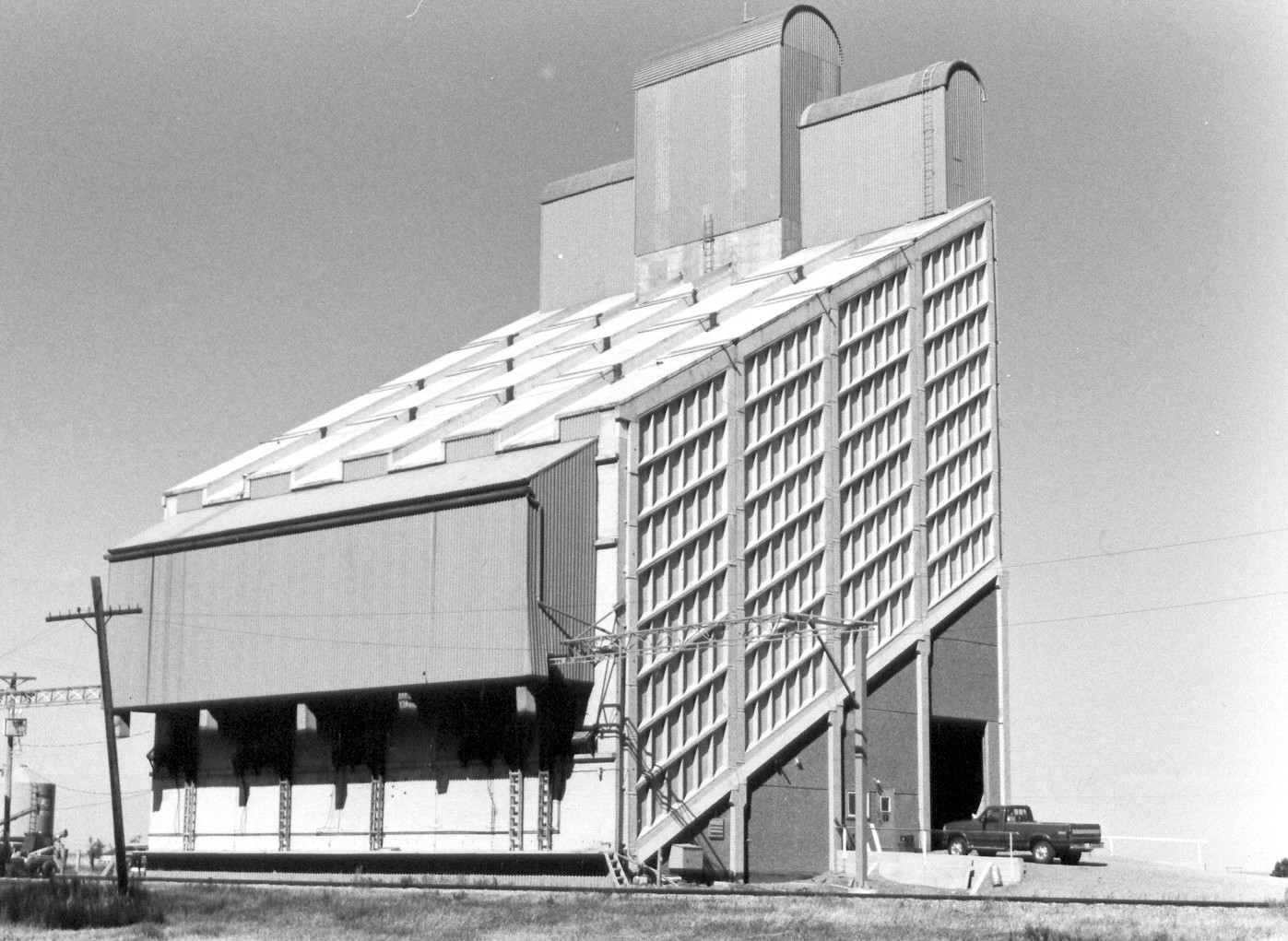
The first design was the trapezoidal Buffalo 1000, colloquially named the Buffalo Slope. In a complete departure from traditional wood-crib elevator design, this elevator was built up using 42 square pre-cast concrete modules, stacked like cord wood at a thirty degrees angle from the ground. The elevator could hold 206,000 bushels. The first was built at Magrath in 1979 and opened with huge fanfare—the festivities included a community band and farmer tours of the facility. Two more Buffalo Slopes were erected in 1981, at Vegreville and Fort Saskatchewan. The Buffalo Slope design worked well with some grains, but the 30 degrees slope was inadequate for barley and oats to slide out the bottom of the module and the complicated conveyor systems were high maintenance. Faced with less than stellar reviews, ABL Engineering went back to the drawing board.

Buffalo Elevator at Magrath in 1997. (Courtesy Alberta Heritage Survey, 97-R0293-17A.)

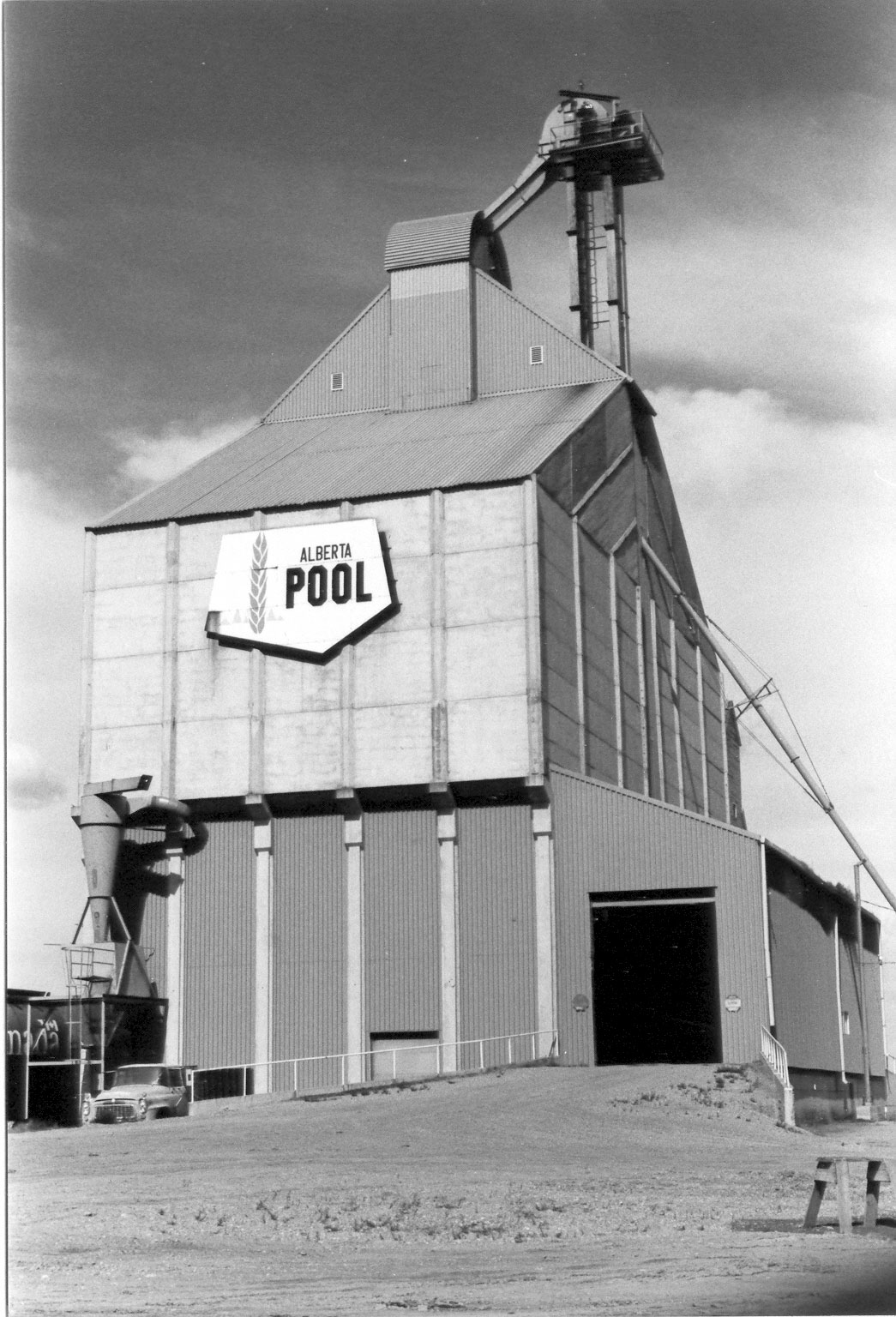
The second design, the Buffalo 2000, was also constructed with precast panels in conjunction with poured-in-place concrete, although it had a more conventional shape. The elevator has vertical bins with hopped bottoms, fashioned with precast bin floors and cast-in-place concrete bin walls. The Buffalo 2000 holds about 190,000 bushels in thirty bins. The Alberta Wheat Pool built two of these, at Lyalta in 1982 and at Foremost in 1983. These fireproof elevators worked well, but were expensive. The Pool built nine cheaper wood-cribbed double-composite elevators next, the last one at Dapp in 1985. Then in 1986 a final Buffalo 2000 was built at Boyle, a year before the Buffalo consortium folded.

Ironically, the futuristic Buffalo designs were obsolete soon after they were built as the era of the country elevator was over. After 1995 all the grain companies built slip-form concrete silo elevators. These were high capacity high-throughput regional terminal elevators designed to collect grain from hundreds of kilometers around. They were located on spur lines able to handle 52 or 104 car trains. The buffalo, built on railway sidings without sufficient space to load many cars, were too slow for high throughput: a Buffalo could load a grain car in thirty minutes while the new terminal elevators could load one in six to seven minutes. The days of the country elevator were numbered, whether wood-crib or concrete Buffalos. As the wood-crib elevators, even new ones, were demolished, the concrete Buffalo, despite not being used by the grain companies, proved to be survivors as they passed to individual farmer groups. The Canada Malting Company buys and stores malt barley in the Buffalo 2000 at Lyalta. Two were recently demolished: the Buffalo slope at Vegreville and the Buffalo 2000 at Boyle.

Buffalo Elevator at Lyalta in 1997. (Courtesy Alberta Heritage Survey, 97-R0248-17.)

The Buffalo design also survives in Brazil. The Buffalo engineering team designed the huge Buffalo 4000 that was constructed from precast concrete modules to build up bins in a double V pattern. Several of these inland terminals with a capacity ranging from 25,000 tonnes (957, 500 bushels) to 100,000 tonnes (3,750,000 bushels) were constructed in Brazil during the early 1980s. A 25,000 facility was located in Brasilia and another in Campo Grande, Mato Grosso del Sul in central-west Brazil. In the state of Minas Gervais in the west part of the country, where wheat and soy beans are among the main crops, a massive 100,000 tonne Buffalo 4000 was constructed at Uberlandia. The Buffalos of Brazil, where sixty-percent of grain is moved by truck, remain an international monument to Alberta engineering innovation.

Written by: Judy Larmour.

Alberta’s Energy Resources Heritage Website

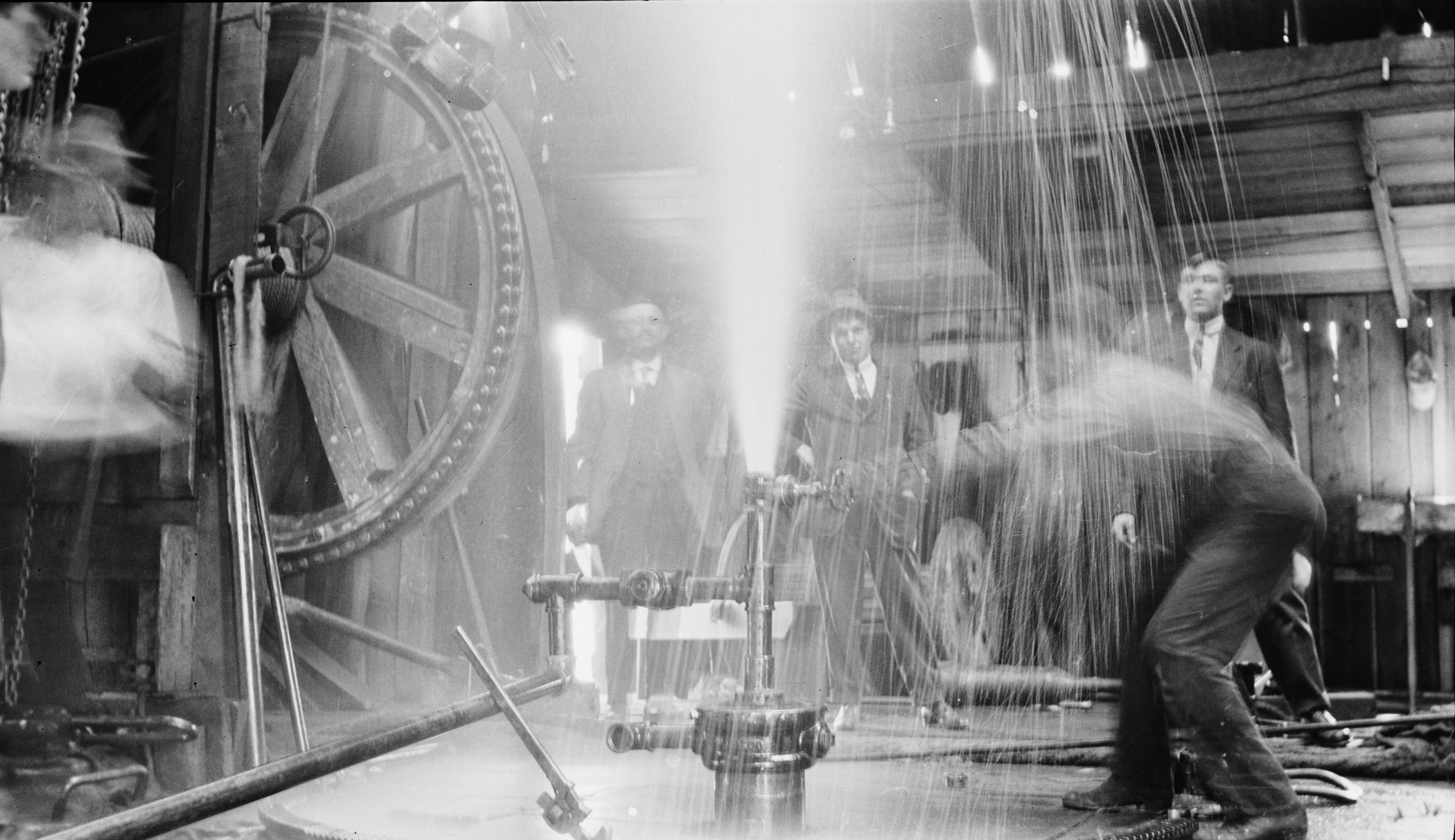
Energy Resources Website HomepageThe Historic Resources Management Branch of Alberta Culture is pleased to announce the launch of the Alberta Energy Resources Heritage website. The site was developed with the aim of promoting an understanding and appreciation of the Province’s abundant energy resources, the rich history of resource extraction and production, and the important role that this sector has played and continues to play in Alberta’s social, political and economic history.

Turner Valley Discovery Well Blowing, 1914. (Provincial Archives of Alberta, P1883.)
Turner Valley Discovery Well Blowing, 1914.
(Provincial Archives of Alberta, P1883.)

As the homepage of the website points out:

“Ancient forces shaped Alberta’s geology, creating a land rich in energy resources. Yet, the story of energy in this province goes well beyond geological formations or petroleum chemistry. It is also the story of individuals, of people driven to reveal the province’s energy secrets and unlock the power of its resources. The quest to locate and unlock Alberta’s energy potential began with them—with their persistence, their innovative thinking and even their passion. It was their energy as much as any other that transformed Alberta, economically, socially and politically.”

Five areas of Alberta’s resource development are explored in detail: coal, conventional oil, natural gas, electricity and alternative energy and the oil sands. Also profiled is Bitumount, north of Fort McMurray where the earliest scientific research on industrial oil sands extraction took place. This pioneering work would later transform Alberta into a major player in the global energy market.

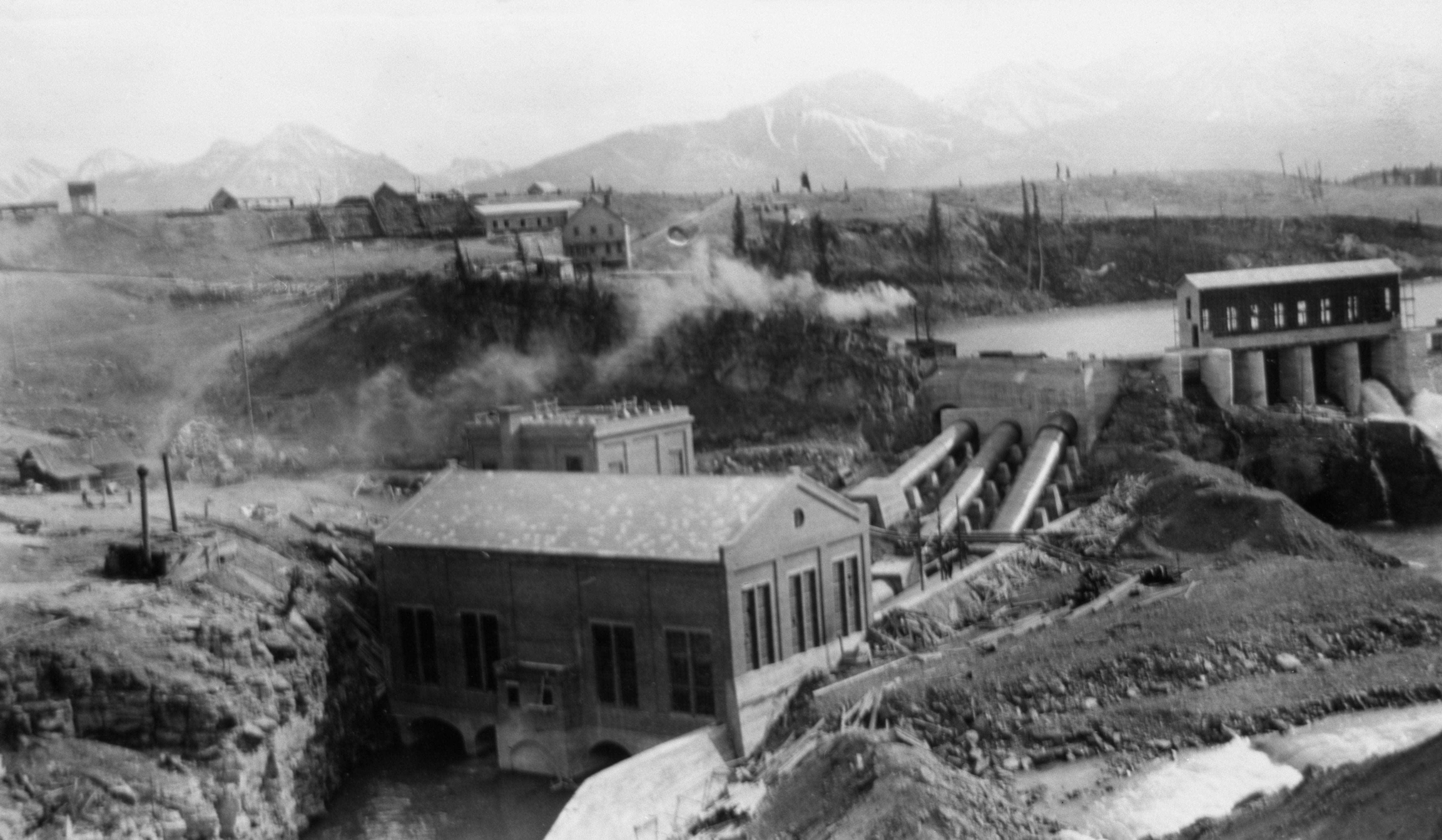
Calgary Power’s power house at Horseshoe Falls on the Bow River, ca. 1912 (Glenbow Archives, NA-3544-28.)
Calgary Power’s power house at Horseshoe Falls on the Bow River, ca. 1912
(Glenbow Archives, NA-3544-28.)

The website is intended to be informative and comprehensive, offering insights into the geological formation of resources, the ancient uses of various energy resources and exploration and industrialization within Alberta. Energy resources are examined through over 300 thematic entries, covered in more than 600 pages of text. Hundreds of archival images, charts, maps, and documents as well as dozens of videos augment the text as do extensive technical glossaries and lists of documentary sources. In addition to exploring the earliest and evolving histories of these sectors the site offers special insights into Alberta’s social history ranging from the miners of the Crowsnest Pass through to the rough necks of the Oil Patch, to pioneering proponents of alternative solutions for the province’s ongoing energy requirements.

Educators, students and the general public are invited to visit the website and explore its various components.

Written by: Peter Melnycky, Historian.