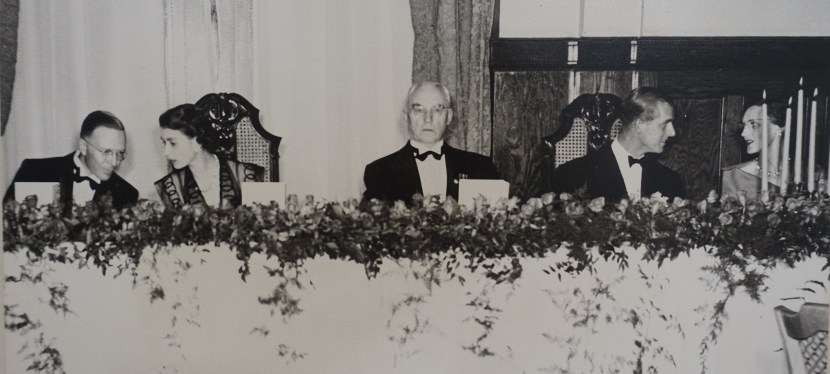
J.J. Bowlen, the Vice-Regal Cowboy of Alberta

Written by: Sara Bohuch, BA Archaeology (Simon Fraser University) , MSc Conservation Practice (Cardiff University)

The philosopher Cicero once said that memory is the treasury and guardian of all things. It is also a fleeting feature of the brain, so people have attempted to capture their memory in a physical format for as long as humans have existed.

If these physicalized memories are still considered a treasury, then the place where they are stored becomes less a place to stash random material and more of a bank. If you get enough memory kept in the same place, that bank can start to reflect and inform the identity of a people.

Read more

Black History Month: Edmonton boxing legend George Dunn

Written by: Michael Gourlie, Government Records Archivist, Provincial Archives of Alberta

In the early 1950s, George Dunn appeared frequently on the Edmonton sports pages.  Described as a lightning flash, his boxing career lasted only about a decade in Canada, but his contributions to sport continued after he left the ring.

Dunn was born in Raleigh, North Carolina in 1925, the son of William Moses Dunn and Mary Helen High-Dunn. His parents died several months apart in 1926, and he was raised by his siblings. He was working in Hartford, Connecticut at the Pratt and Whitney Aircraft factory in 1943 when he registered for the World War II draft.  He served in the US Army for just over two years during the Second World War, seeing action in the Philippines and New Guinea. During this period, Dunn took up boxing to avoid “KP” (kitchen patrol) duties.  He became a professional boxer in 1946 and lost only two matches between 1946 and 1948, racking up 14 knockouts. In his early career, he fought against Sonny Boy West and Lil’ Arthur King.

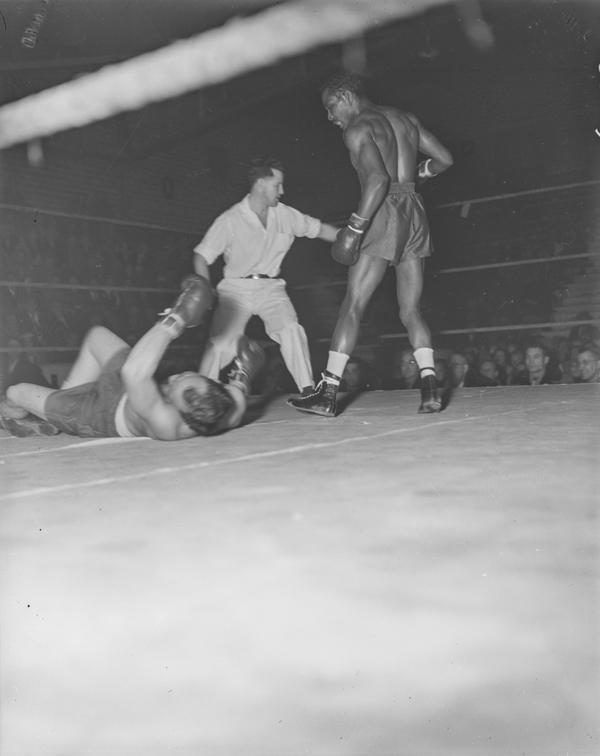
Geo Dunn vs. Dutch Hopper, 1950 at the Edmonton Stock Sales Pavilion. Source: Provincial Archives of Alberta, photo number: GS798
Read more

The story of a non-descript trowel: Alexander Rutherford and education in Alberta

Written by: Colby Parkkila, Historical Interpreter, Rutherford House Provincial Historic Site

Within the walls of Rutherford House, the home of Alberta’s first premier Alexander Cameron Rutherford, there are numerous artifacts that are displayed for public viewing. While some items receive plenty of attention, such as Mrs. Rutherford’s piano, Alexander’s bust of Prime Minister Wilfred Laurier, or Mrs. Rutherford’s china, there are many that receive considerably less attention. However, each of these items, big or small, are representative of stories and histories that are deeper and more important than they first appear.

One of these often overlooked artifacts sits atop a nondescript doily on the second shelf of a side table in the library of Rutherford House – a silver-plated brick-laying trowel. Often missed simply because of its slightly obscured location, the trowel appears unassuming at first. After all a trowel is merely a working man’s implement. However, upon closer inspection more is revealed to the keen-eyed observer.

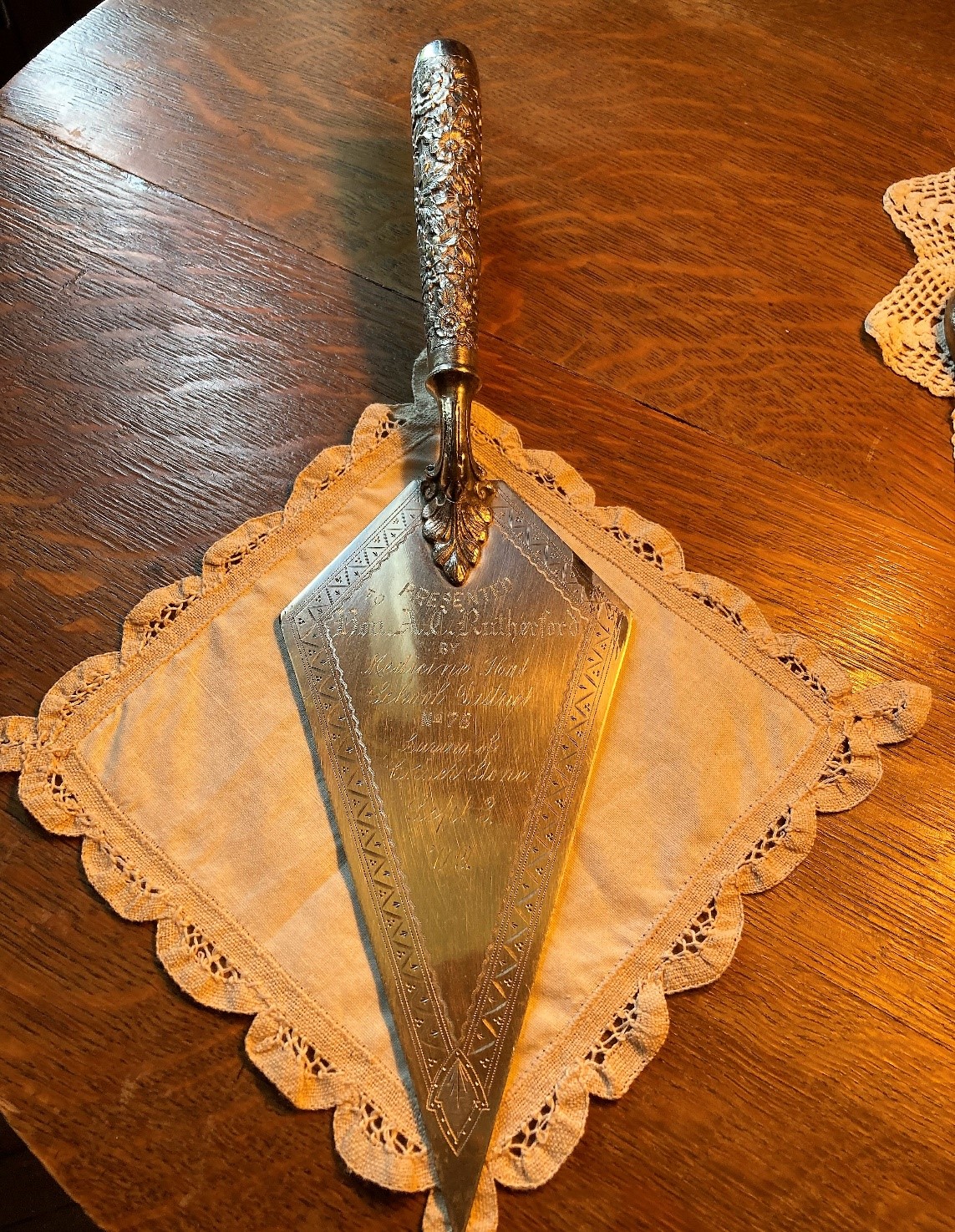
Trowel presented to Alexander Rutherford on September 3rd, 1909, in honour of the laying of the cornerstone for Alexandra School. Source: Rutherford House Provincial Historic Site.

Immediately noticeable is the trowel’s material. Unlike most other trowels, it is not made of wood and metal, but is silver-plated with ornate flowers carved into the handle and a decorative border added to its blade. Both elements suggest that the trowel is not meant for use in construction, but for display and commemorative purposes. Upon closer inspection, an inscription can also be found, reading “Presented to Hon. A. C. Rutherford by Medicine Hat School District No. 76. Laying of Corner Stone Sept 3. ‘09.” The inscription provides some valuable information regarding the provenance and the occasion during which Alexander received this trowel. However, it also raises additional questions: What was this school and why was Alexander present at the laying of its corner stone?

Read more

Adaptability and modern amenities: Laundry in Pakan at the turn of the twentieth century

Written by: Julia-Rose Miller, Honours Undergraduate, U of A Department of History, Classics and Religion

Laundry has always been among humanity’s greatest burdens. In the past, much like today, clothing had to be washed, bleached, starched, ironed and dried. However, historically, a household’s clothing was by far their most expensive and precious domestic possessions. This meant that the maintenance and laundering of clothing was even more crucial, even though households were likely not in possession of all of our modern cleaning chemicals and detergents. Laundry in Pakan was no different from other areas of Canada at this time as they had access to all the ‘modern amenities’ (hand cranked washing machines, wringers, mangles, irons, clothes lines, laundry tubs, washboards, wash boilers, ironing boards and clothes horses) via catalogues.

Catalogue and Buyers Guide Spring and Summer 1885 no. 57. Source: Chicago: Montgomery Ward & Co. 1885.

Studying domestic labour is at times rather complicated, because, like many other pieces of women’s work, there are few written records detailing laundry activities. To deal with the lack of Pakan-specific sources, my examination of laundry centered on images from Pakan in conjunction with other resources from different parts of Canada like the Eaton’s catalogues and household manuals. Images from Pakan established that residents were wearing western-style, cloth-based textiles, suggesting that they would likely also be using European laundering techniques developed for these articles of clothing. Annie B. Juniper’s Girls’ home manual of cookery, home management, home nursing and laundry provided a comprehensive explanation of numerous laundering techniques and materials popular at the turn of the century. This book, published in Victoria, B.C. in 1913, was given to school girls to instruct them on proper methods for home maintenance.

Read more

Christmas at Dunvegan

What makes your holiday season complete? Is it fruit cake, latkes or bannock? Lighting a menorah, Christmas tree or a kinara? How old or new are the traditions you participate in? Where did they originate?

The Beaver people who first inhabited the areas bordering the Peace River have been gathering at Dunvegan for thousands of years. Like other Indigenous peoples, before the arrival of the fur traders and missionaries, it’s possible they may have celebrated the Winter Solstice while camping in the area.

When Northwest Company fur traders arrived in 1805 and established Fort Dunvegan, they brought with them the customs of European Christians, particularly those of the Scots. You’ve probably heard of Kwanzaa, but have you ever heard of Hogmanay? In Scotland, Christmas was celebrated quietly, while Hogmanay or New Year’s Eve, was well…a party! Being as many fur traders originally hailed from Scotland, those traditions came with them over to what is now known as Canada.

Indeed, this is reflected in the journals left by the men in charge at Fort Dunvegan through the 1800s. In some cases, Christmas isn’t even mentioned at all on December 25. When it is mentioned it’s often to say that nothing of importance happened. But every entry that was made on January 1 (at least between 1822 and 1844) mentions everyone gathering at the fort for their usual treat of a ration from the store. This included gifts of tobacco, rum, meat or biscuits. Even lime juice has been mentioned as a special treat given to visitors.

Read more

Designation and protection: 50 years of the Historical Resources Act (Part 2)

Editor’s note: Catch up with part one of 50 years of the Historical Resources Act. The banner image above is courtesy of the Royal Alberta Museum.

Written by: Valerie Knaga, Indigenous Heritage Section, Ronald Kelland, Historic Places Research Officer and Fraser Shaw, Heritage Conservation Adviser, Southern Region

Indigenous heritage

Indigenous heritage has existed long before Indigenous Peoples had first contact with European settlers, long before the establishment of Alberta as a province in 1905 and long before the Historical Resources Act was enacted. While Indigenous people have been subject to legislation and policies that sought to undermine their connection to their culture and heritage, they have retained a powerful connection to their historic places and the rich repository of cultural meaning they embody. While Indigenous heritage was not explicitly referenced in Alberta’s Historical Resources Act when it was passed in the 1970s, the Act has played a key role in helping to preserve Indigenous heritage sites. That is not to say that some Indigenous voices were not present during the development of this legislation.  The Public Advisory Committee on the Conservation of Archaeological and Historical Resources which advised on the creation of the legislation included representative Chief John Snow and one of the briefs presented at the public hearings was from Allan J. Wolf Leg of the Calgary Native Development Society. 

A historic settlement site south near Muskwa Lake was documented in February 2020 during field work with Bigstone Cree Nation. Source: Laura Golebiowski.
Read more

Designation and protection: 50 years of the Historical Resources Act (Part 1)

Editor’s note: The banner image above is courtesy of the Royal Alberta Museum.

Written by: Todd Kristensen, Archaeological Survey of Alberta and Dan Spivak, Head, Resource Management Program, Royal Tyrrell Museum of Palaeontology

This year, the Historical Resources Act (HRA or the Act) in Alberta celebrates its 50th anniversary. When it was passed in 1973, the Act provided a range of tools to manage historic resources across the province. This now includes archaeological sites, historic buildings, Indigenous traditional use sites of an historic character and palaeontological sites. It was a landmark achievement on a national scale because it stimulated the first stand-alone provincial department whose purpose was to ensure site protection during industrial development. Since inception, the Act has led to the documentation of over 42,000 archaeological sites, 110,000 historic structures, 7,200 palaeontological sites and 2,400 historical Indigenous traditional use sites. While the goals of heritage management in Alberta have evolved along with the Act, it continues to protect the past.

To recognize this milestone, RETROactive contributors will look at the legacy of the Act in managing historic resource sites, including archaeological, palaeontological, historic building and Indigenous traditional use sites. They will also explore the role of the Act in establishing the names of geographical locations across the province.

A map of heritage legislation and preceding acts or policies across Canada. Source: Todd Kristensen.
Read more

The Archaeological Survey in Numbers – 2022 Update Part Two

Written By: Colleen Haukaas, Archaeological Survey

This post looks at archaeological sites recorded in Alberta under 2022 archaeological permits issued by the Archaeological Survey. Part One of this post has more information about archaeological permits, field activities, and professional activities.

The majority of sites each year are recorded during CRM projects in response to potential impacts from proposed developments. Researchers in universities, museums, and other research facilities also record sites each year. Together, archaeologists record and re-record (revisit) 500-700 sites annually.

There are more than 40,000 known sites recorded in Alberta, ranging from small scatters of a few artifacts to complex sites like the Quarry of the Ancestors, Áísínai’pi, and Cluny Fortified Village sites. The infographic below shows basic categories of information about sites recorded in 2022, including site class and type.

You can explore previous Survey in Numbers to compare statistics year over year

Métis Week 2023

Editor’s note: Banner image of a Métis sash courtesy of Laura Golebiowski.

Written by: Laura Golebiowski, Indigenous Consultation Advisor

On November 16, 1885, Métis leader and Manitoba founder the Right Honourable Louis Riel was executed in Saskatchewan, after he was charged with six counts of high treason. Now, annually, Albertans are invited to mark the sombre anniversary of Riel’s death and recognize the broader histories, sacrifices and accomplishments of the Métis Peoples. This year, Métis Week takes place November 12 – 18, 2023.

Canadian Pacific Railway Survey. Fort Edmonton, from point below the Wesleyan Mission, December 1871. The York boat and red river cart, both pictured, are important historical contributions and symbols of Métis material culture. Source: Charles Horetzky/Library and Archives Canada/e011183607-v8.

Youth, educators and the general public are encouraged to further their learning through Rupertsland Centre for Teaching and Learning resources, which include live online events most days of Métis Week. The live program includes jigging, red river cart stories and Michif language learning—in addition to the interactive resources, printables and videos accessible year-round.

The St. Albert-Sturgeon County Métis Local and the City of St. Albert will be holding a flag raising and proclamation ceremony on November 16 at 2:00pm at St. Albert place. On November 13, Métis Week opening ceremony activities will take place at Calgary City Hall all morning and early afternoon.

Visit the Métis Nation of Alberta or the Métis Settlements General Council (did you know that the eight Alberta Métis Settlements are the only collectively-held Métis land base in Canada?) websites to learn more about Métis heritage, contemporary initiatives and cultural events held throughout the year.

If your community has a Métis Week 2023 event you’d like us to know about, please leave a comment with the details.