Borealopelta: A Selective Herbivore

Editor’s note: Alberta’s rich fossil history, including the field of palaeontology, is recognized around the world. RETROactive is now pleased to be sharing stories of discovery from the world-renowned Royal Tyrrell Museum of Palaeontology.

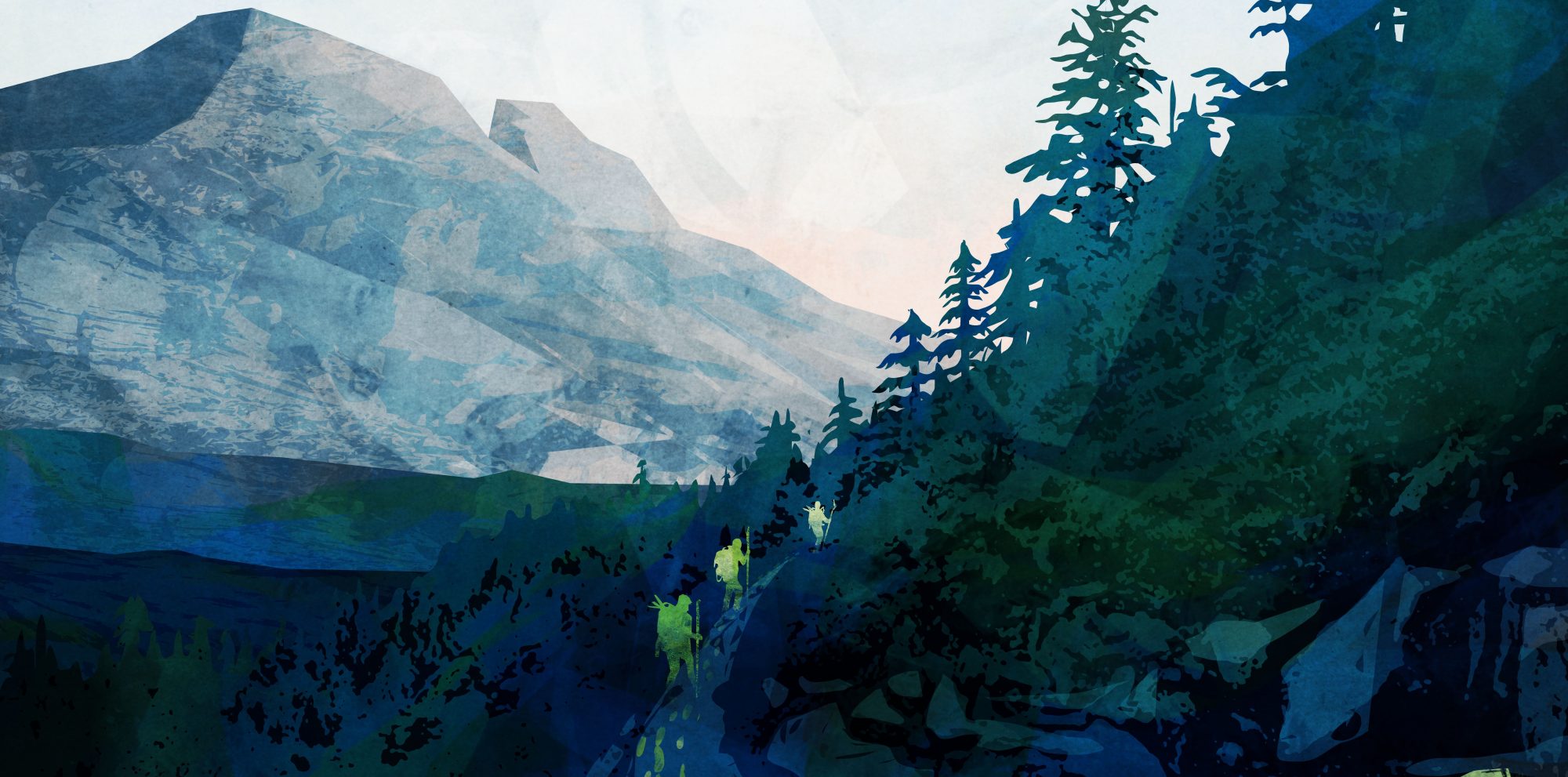
The banner illustration above is courtesy of Julius Csotonyi.

The nodosaur Borealopelta markmitchelli is the world’s best-preserved armoured dinosaur. This amazing specimen has helped answer many important questions about dinosaur biology and behaviour. Now, new research supports the theory that the nodosaur was a picky eater.

Read more…

Alberta’s heritage places need your voice

Alberta is known for its abundant heritage places, from traditional cultural sites to architectural heritage to the heritage values enshrined in our cultural and natural landscapes. 

With this in mind, a project has been started to examine the creation of an inclusive provincial network for Alberta’s heritage places and to consider the re-establishment of regular Alberta forums for historic places, cultural landscapes, built heritage and related concerns. Such a network and forum could create an environment where individuals can come together as peers to share knowledge relevant to each other’s work while providing mutual support when needed. This style of collaboration could achieve far more than any single entity could accomplish alone.

Through this initiative, the committee aims to ensure that Alberta protects and preserves its heritage resources for future generations. Your feedback is essential to understanding the initiative’s viability and the heritage communities’ greater needs. Please help the committee by completing their survey.  The survey will only be open a limited time – from January 4 to January 18 – so please follow the link today.

Season’s Greetings from RETROactive

On behalf of the staff and contributors to RETROactive, we wish you and your family the happiest (and warmest) of holidays. Thank you once again for your support and interest in the stories, people and places from Alberta’s past and present. We will see you all in 2023 with more captivating stories exploring Alberta’s history.

Source: Robert C. Fitzsimmons fonds, Provincial Archives of Alberta.

Alberta and the Clovis connection

Editor’s note: The banner image above courtesy of the Norman Petty Recording Studio.

Written by: Jeremy Witten

If you read a cultural history of 1960s Alberta or if you read a cultural history of the people who lived here 13,000 years ago, there is an unusual word you might come across in both contexts: “Clovis.” Between 1962 and 1974, several Albertan bands drove to a small town in New Mexico called Clovis to record with a famous producer who lived there. His name was Norman Petty and prior to recording bands from Alberta, he recorded international stars like Buddy Holly and Roy Orbison. But that town in New Mexico has a deeper connection to the land that people now call Alberta.

A Clovis point found in Alberta that is made from Knife River Flint, a type of stone found in North Dakota. Source: Royal Alberta Museum.

Clovis, New Mexico shares the name of the Clovis people, a prehistoric Indigenous group whose artifacts continue to be found not only in New Mexico, but also scattered across Alberta. The archetypical technology of the Clovis people is called a “Clovis point,” which was a finely crafted stone tip that was attached to a wooden shaft to form a highly effective weapon. Interestingly, if one maps the trip that Albertan bands took to Clovis in the 1960s, that route intersects with several important archaeological sites where Clovis points have been found. Despite this, it’s entirely possible those Albertan musicians were unaware of the prehistoric connection between Clovis and the land where they lived as they continued their drive south through forests, plains and deserts.

Who were these Albertan bands? There were at least two dozen of them: Calgary-based acts who recorded in Clovis included Done On Bradstreet, Eddie Canada, Gainsborough Gallery, Jim Aiello, Molly, Sheraton Fountain and the Happy Feeling. The list of Edmonton acts to record with Norman Petty is a bit longer, including Barry Allen, Colored Rain, Dennis Paul, Doug Roberts, Famous Last Words, Happy Cooker, Privilege, Shame Tree, Southbound Freeway, Stu Mitchell, the Brinkman Brothers, the Nomads, the Preachers, Victory Group, Vik Armen, Wes Dakus & the Rebels and Willie & the Walkers.

Several of these bands changed line-ups and even names over time; the Rebels were once known as the Club 93 Rebels. Southbound Freeway and the Happy Feeling also released music under the more concise monikers “Freeway” and “The Feeling.” In the liner notes of the compilation album From Canada to Clovis, Canadian producer and discographer Shawn Nagy shares historical details of some of these recording sessions. Nagy writes that only three members of the Nomads made the initial drive to Clovis in May 1962 and that they drove down in a jam-packed 1955 Buick. Back then, the option for Albertan bands, “was to travel 2,200 miles to Quality Studios in Toronto or 1,750 miles to Clovis.”

Read more

Métis Week 2022

Métis Week celebrates the culture, history and contributions of Métis people to Alberta and Canada. On November 16, Métis people across Canada pay tribute to the Right Honourable Louis Riel by holding a commemorative ceremony on the date of his execution. In addition to recognizing Louis Riel Day on November 16, this week has been declared “Métis Week” by the Métis Nation of Alberta. The week is devoted to commemorating the sacrifices of the Métis and to celebrate Métis contributions to Alberta’s history and Métis culture in general. Many places in Alberta have a unique Métis history, and we encourage you to learn these stories and celebrate with the Métis peoples during this time. Below are some suggestions for online offerings and events taking place.

If you have an event to commemorate Métis Week 2022, let us know and we will look to add it to the list above.

Pilots North: Alberta and IMAX Dome film history

Written by: Jeremy Witten

The importance of American filmmaker Roger Tilton in the history of IMAX Dome cinema is well documented, but his unique connection to Alberta and Albertan film history is less well-known.

In 1973, the San Diego Hall of Science premiered the world’s first IMAX Dome film Garden Isle, directed by Tilton. By this time, IMAX film had already existed for more than five years, but the concept of projecting that film onto a dome screen was new and it was in this arena that Roger Tilton was an innovator. Eight years later, Tilton traveled to Alberta with a vision for another dome film: Canadian bush pilots flying their planes to remote northern communities during the 1920s and 1930s. Since Edmonton was historically considered the “Gateway to the North,” Tilton wanted some of the film shot in the Edmonton area, with other scenes shot in northern Alberta and Northwest Territories. Albertan filming sites included St. Albert, Peace River and Fort Vermillion. The resulting film, Pilots North, premiered at Edmonton’s Klondike Days Exhibition in 1981.

Roger Tilton (left) on the Pilots North set in 1981. Source: Wilma Kuipers.
Read more

Buried treasure: panning for gold in Edmonton’s river valley

Editor’s note: The banner image above is courtesy of the Provincial Archives of Alberta.

Written by: Brandon Nadeau, Security Supervisor and Melissa Bowerman, Assistant Curator, Geology

Most people think the only link between Edmonton and gold is the fact that it was situated on one of the routes to the historic Klondike Gold Rush. But Edmonton has its own direct claim to gold with its own gold rush that predates the Klondike. To this day, many people continue the search for gold in the North Saskatchewan River valley.

Gold is found either as lode gold within solid rock or as placer gold which has been eroded and moved by water and deposited in sands and gravels. In Edmonton, gold is often found in tiny flakes less than half a millimetre across known as flour gold. Flakes of platinum are also present in the placer deposits along the North Saskatchewan River, though in smaller amounts relative to gold.

Washing gold circa 1890. Source: Provincial Archives of Alberta.
Read more

Stories of discovery: life under the sea

Editor’s note: We continue our series highlighting significant fossil discoveries found by members of the public. Remember, if you find a fossil, follow these instructions.

1997: Nichollsemys baieri (TMP 1997.099.0001)

Holotype skull of Nichollsemys baieri. Source: Royal Tyrrell Museum of Palaeontology.

Life in southeastern Alberta was exciting for Ron Baier and his brother growing up near Taber. They enjoyed exploring the land and searching for rocks and fossils. Development of irrigation lines unearthed many interesting artifacts, including arrowheads. As the development slowed, Ron started branching out to new areas in search of artifacts and fossils.

Ron Baier with his fossil collection, including the skull of Nichollsemys. Source: Royal Tyrrell Museum of Palaeontology.
Read more

From Belize to Bezanson: Synergistic research in northwestern Alberta

Editor’s note: All images below courtesy of the authors.

Written by: Shawn Morton, Northwestern Polytechnic and Meaghan Peuramaki-Brown, Athabasca University

Our careers as archaeologists have been dominated by research on ancient Maya peoples and places, particularly of the Classic Period (ca. 250-900 CE). Since beginning the community-engaged Stann Creek Regional Archaeology Project in 2014, our activities have focused on characterizing and explaining the settling and eventual abandonment of a relatively short-lived ancient townsite in Belize.

When urban centres expand rapidly in response to resource development, “instant cities” arise. These remarkable settlements are also called “boomtowns” or “rapid-growth communities”. They typically emerge in what are perceived as severely disadvantaged or isolated frontier zones. They might boom then bust over a short period, boom indefinitely or in cycles, or experience an incomplete boom. Their success is often dependent on their location relative to resource extraction and distribution activities, though not exclusively.

With its location along well-documented inland and coastal trade routes, and with access to an abundance of natural resources on the margins of the ever-expanding heartland of the southern Maya lowlands, the ancient Maya townsite currently known as “Alabama” (ancient name unknown) would seem to fit the “boomtown” bill. We have consistently invoked the concept as a heuristic tool in explaining its development.

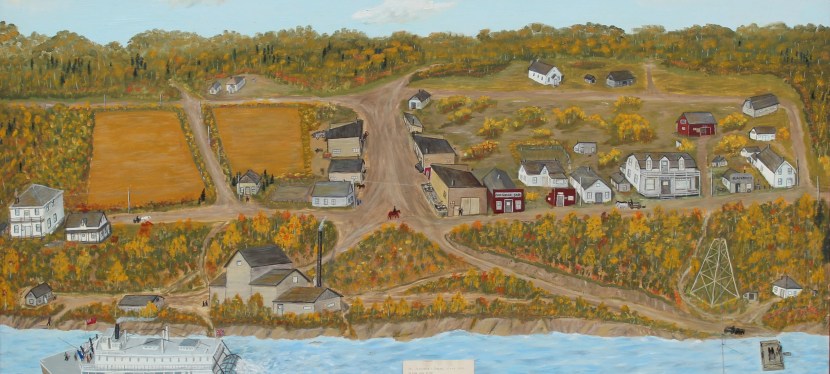
Drone shot of Old Bezanson Townsite along the banks of the Smoky River.
Read more

Painting Alberta

Editor’s note: Learn about another artist who used resources from the Provincial Archives of Alberta on her latest project.

Written by: Erin Sekulich, Provincial Archives of Alberta

For five years, Sabine Lecorre-Moore has been traveling all over Alberta to museums, archives and community collections to find photographs featuring the experiences of Albertans. These images mainly depict the outdoors and feature her own interpretation of photographs from the 1800s to the present. While Lecorre-Moore works with several mediums, acrylic paint is Sabine’s tool for her latest project Painting Alberta. The 6”x 6” canvases are intended to be arranged and re-arranged into various patterns based on the exhibit space.

Sabine Lecorre-Moore working in the late Harry Kiyooka’s painting studio.
Read more