Part I of The Lure of Gold in Alberta’s History can be read here.
The Last Great Gold Rush
In 1896, gold production in Edmonton reached $55,000,[i] with local banks purchasing gold dust off miners at $15 an ounce.[ii] No small amount for a town of roughly 1200 people. However, this amount was nothing compared to the following year when parties of gold seekers, upon news of rich gold strikes in the Yukon, began outfitting themselves in Edmonton on their way to the Klondike. By the summer of 1898, the stampede was over with local merchants having taken in $500,000.[iii]
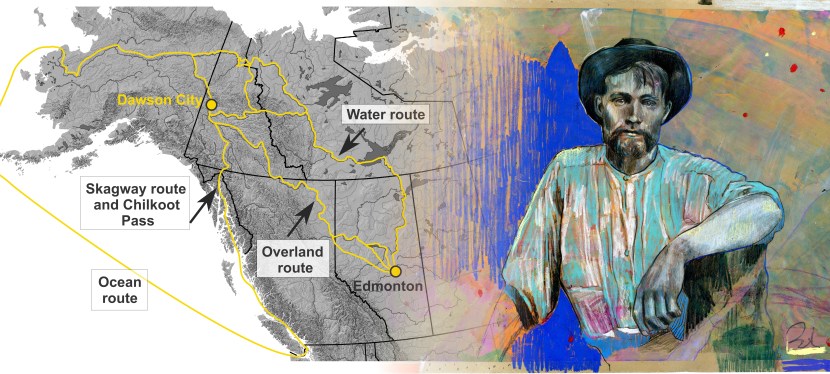
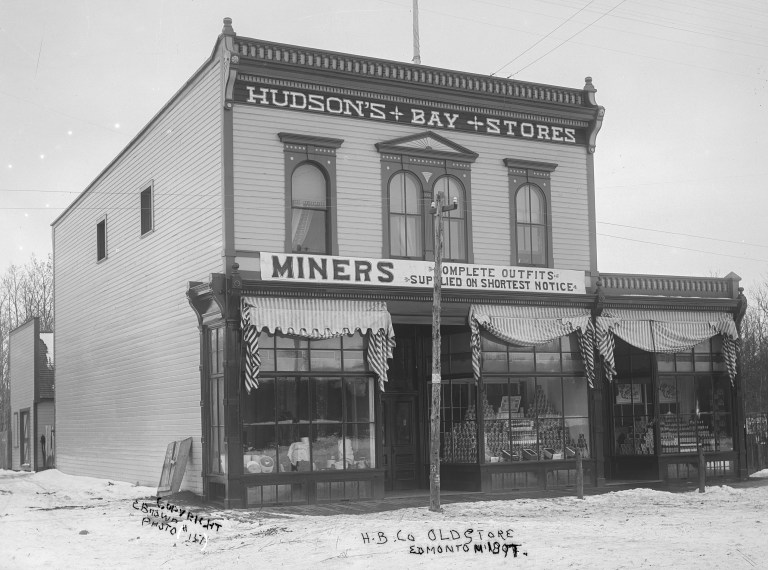
When parties slowly began arriving in Edmonton by train in the summer of 1897, the business community quickly seized upon the opportunity and began actively advertising Edmonton as the, ‘All Canadian Route to the Klondike’, ‘The Back Door to the Yukon’, and ‘The Poor Man’s Route to the Yukon.’[iv] By Christmas, there were people from Chicago, eastern Canada, the Atlantic seaboard, Europe, and Australia camped in small groups all over town. Historian J.G. MacGregor wrote that by mid-winter 1898, “…the town was knee deep in Klondikers.”[v]
Figure 1. A storefront in Edmonton advertising supplies for prospectors (image B4424 reproduced with permission from the Provincial Archives of Alberta).
On a map, distances could be deceiving, and many lacked the experience required for such a rigorous journey. One man writing to the editor of the Edmonton Bulletin inquired as to the feasibility of travelling to the Yukon by bicycle,[vi] and two Parisians who set off from Athabasca Landing admitted to having originally entertained the idea of travelling to the Klondike by balloon.[vii] The distances alone were daunting but the real challenge was carrying with them two years of supplies. This amounted to 2500 lbs of food and gear for each individual, and, depending on the route and the season, they required horses, dog teams, sleds, sleighs, and boats. Read more →
“Having disposed of our holdings on the creeks the five of us packed through the South Kootenai Pass and soon after started for Edmonton, where we heard they were mining placer gold on the Saskatchewan River. We had no very clear knowledge of where Edmonton was, and there was no one there to tell us.”[i]
– ‘Kootenai’ Brown (1865)
Gold! It was dreams of golden wealth and the promise of adventure that drew thousands of young men west to California and British Columbia in the 1800s. Although never achieving the spectacular wealth in gold of its neighbors to the west, Alberta witnessed its own gold rush in the 1860s, and over the subsequent decades many people passed through the province on their way to other mining frenzies that swept across the northwest. Many prospectors settled in the province and became leading members of Alberta’s burgeoning communities.
The First Gold in Western Canada
The 1849 rush in California brought ‘Forty-Niners’ from the U.S. Eastern Seaboard and Midwest who traveled overland and by sea. Ocean travel also brought Peruvians and Chileans, Mexicans, Australians, Europeans, and Chinese. In the spring of 1858, the easier diggings long since worked out in California, news arrived in San Francisco of discoveries on the Thompson and Fraser Rivers – to the north in British territory.[ii] By July, it was estimated that 30,000 “half-wild Californians” had passed through the sedate, trading outpost of Fort Victoria Read more →
The rehabilitation of the Tipton Investment Company is now complete! Designated a Provincial and Municipal Historic Resource, the building is located within the Old Strathcona Provincial Historic Area along Whyte Avenue in Edmonton. It was constructed in the early days of the 1900s and survives as one of the last wood “boom town” style commercial structures in the district.
Storefront Elevation (Before) – September 2015 Source: Alberta Culture and Tourism – Heritage Division
Storefront Elevation (After) – September 2018 Source: Alberta Culture and Tourism – Heritage Division
The current owners, with the assistance from their consultants, contractors, and provincial and municipal heritage regulators, have successfully preserved the heritage values of the modest single-story structure while expertly incorporating an addition. The rehabilitation not only changes the property to a creative two-story multi-tenant complex, but does so while honouring the wood building as the primary heritage value on the lot. Now that’s how it’s done!
The rehabilitation of the Tipton Investment Company is a shining example of how to keep what is of value, provide upgrades to services and Read more →
Commemorated annually in Alberta, Métis Week remembers the efforts and execution of Louis Riel, while also celebrating the historical and contemporary achievements of Métis people working toward rights and recognition of their Nation.
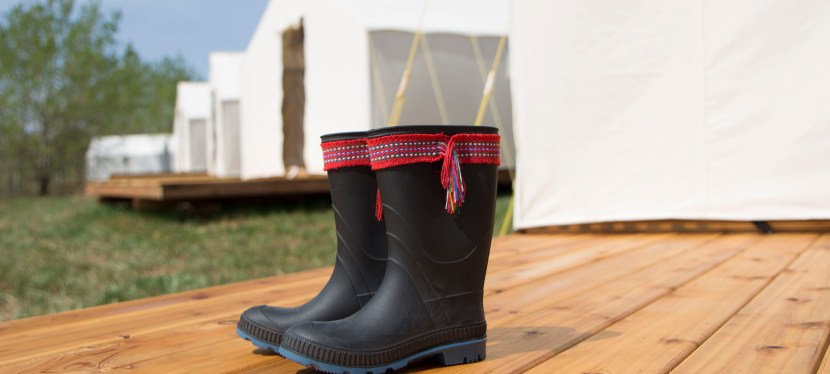
Many of the historical resources, sites and museums across Alberta contain Métis connections and stories. As the owners and managers of many of these sites, the Heritage Division strives to foster partnerships and collaborations with community to ensure that these stories are told accurately and respectfully. We also recognize how significant it is when these heritage places are owned and managed by Indigenous peoples and communities themselves. In honour of Métis Week, we are pleased to share the work of the team at Métis Crossing, who recently celebrated the ground-breaking at their new gathering centre, slated to open next fall.
Métis Crossing is the first major Métis cultural interpretive centre in Alberta and began as a major initiative of the Métis Nation of Alberta. Their mission is to be a premiere center for Alberta Métis cultural interpretation, education, gatherings, and business development. The 512-acre site is designed to engage and excite visitors, and is comprised of river lot titles from the original Métis settlers who arrived in the late 1800’s. Their programming encourages active participation of visitors in activities that promote appreciation of Métis people, customs, and celebrations.Read more →
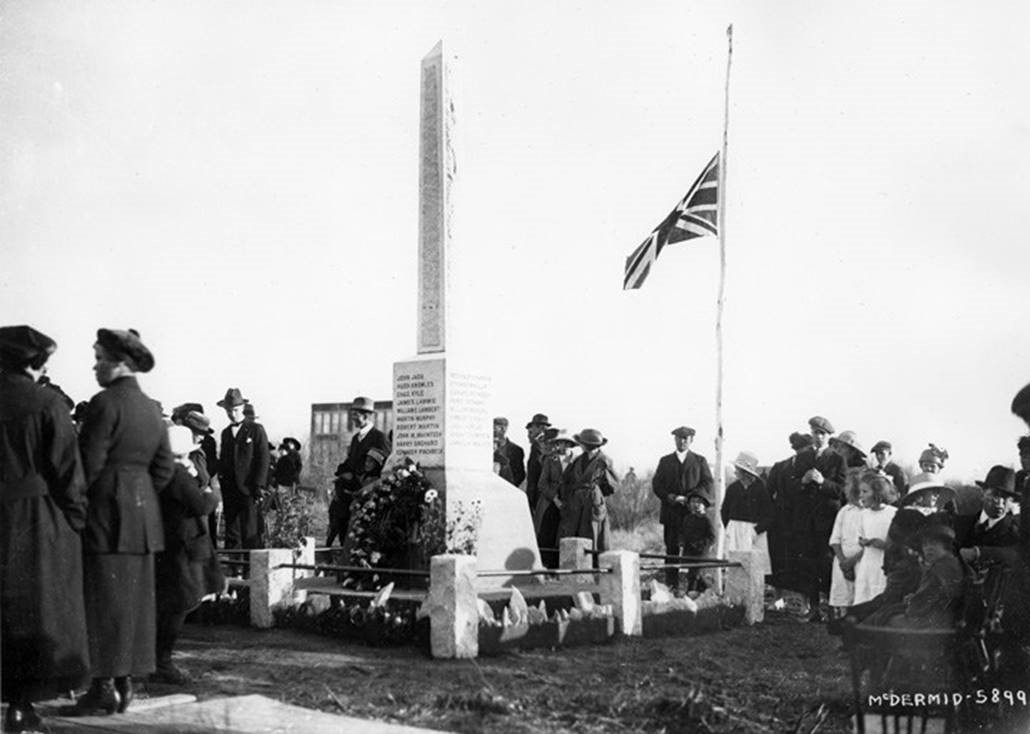
The Beverly Cenotaph, a simple stone obelisk, was unveiled on October 17, 1920. (City of Edmonton Archives, EA-160-14)
On November 11, 1918, after more than four years of fighting the “war to end war”, an armistice was called in France and all hostilities came to an end on the Western Front of the First World War. While the battles may have ceased, the effects of the conflict continued to reverberate around the world and across the years, even to the present day, a century later.
Albertans were among those who fought alongside fellow British citizens, as well as French and American soldiers – among others – to defeat Germany and its allies. Estimates place the number of Albertan soldiers at 48,885 – or over one third of the province’s male population aged 18 to 45. Of these, about one in eight did not return from the war, and almost half of those who did return had been wounded.1 The effect of the distant, unseen war was felt throughout the province on a personal level.
One way Albertans dealt with the trauma and loss was to come together and commemorate those who had sacrificed their lives. A model for these activities was provided by “Peace Day”, celebrated on July 19, 1919, in London, England, in honour of the signing of the Treaty of Read more →
Tomorrow is Aboriginal Veterans Day. It is estimated that more than 12,000 First Nations members, Inuit, and Métis served in WWI, WWII and the Korean War.
At first glance, the voluntary participation of several young Niitsitapi (Blackfoot) men in the First World War appears to confirm their assimilation into Euro-Canadian culture. Recent graduates of prototype residential schools, they shunned requests by their elders to remain in Treaty 7 territory and were inspected, inducted, drilled, and disciplined. Many were sent overseas to fight for God, King, and Country. Some were killed in action. We might interpret a 1917 letter home from Siksika (Blackfoot) soldier Mike Foxhead as an indication of his acceptance of colonial values. He wrote:
I’ll stick to it until the end to put up a name for the Reserve, so they can say that they have one of their boys over here. I could have got out of it when the other boys got their discharge only I wanted to do my bit like all other Canadians. I knew that somebody had to go and fight for the Empire, and I made up my mind that I would go because it would be my duty sooner or later.[1]
Yet as historian James Dempsey has shown, there were important elements of Blackfoot warrior culture that accompanied Blackfoot mobilization during the Great War.[2] As the nineteenth-century waned, so too did opportunity for young men to prove themselves in battle, raid their enemy’s camps for horses, and recount Read more →
If you think back on any of the horror films you’ve seen recently, or the science fiction novels you’ve read, how many of these have themes or actions where people contact the dead or interact with ghostly apparitions? What about notions of an elaborate spirit world that interrelates with the laws of our physical world? Or individuals with superhuman abilities like mind-reading, clairvoyance, telepathy, or telekinesis? These themes are core aspects of the Spiritualist movement which have been hybridized and diffused, becoming the defining touch to horror, science fiction, and related genres. But where did this phenomena come from and why? While modern media portrayals of Spiritualism may involve Ouija boards and séances to foreshadow the horrific events that result from the release of evil spirits of the Beyond, the actual phenomena of Spiritualism is rooted in a complex network of socio-political interactions at the turn of the 20th century between the advent of science and technology, the women’s rights movement, and WWI.
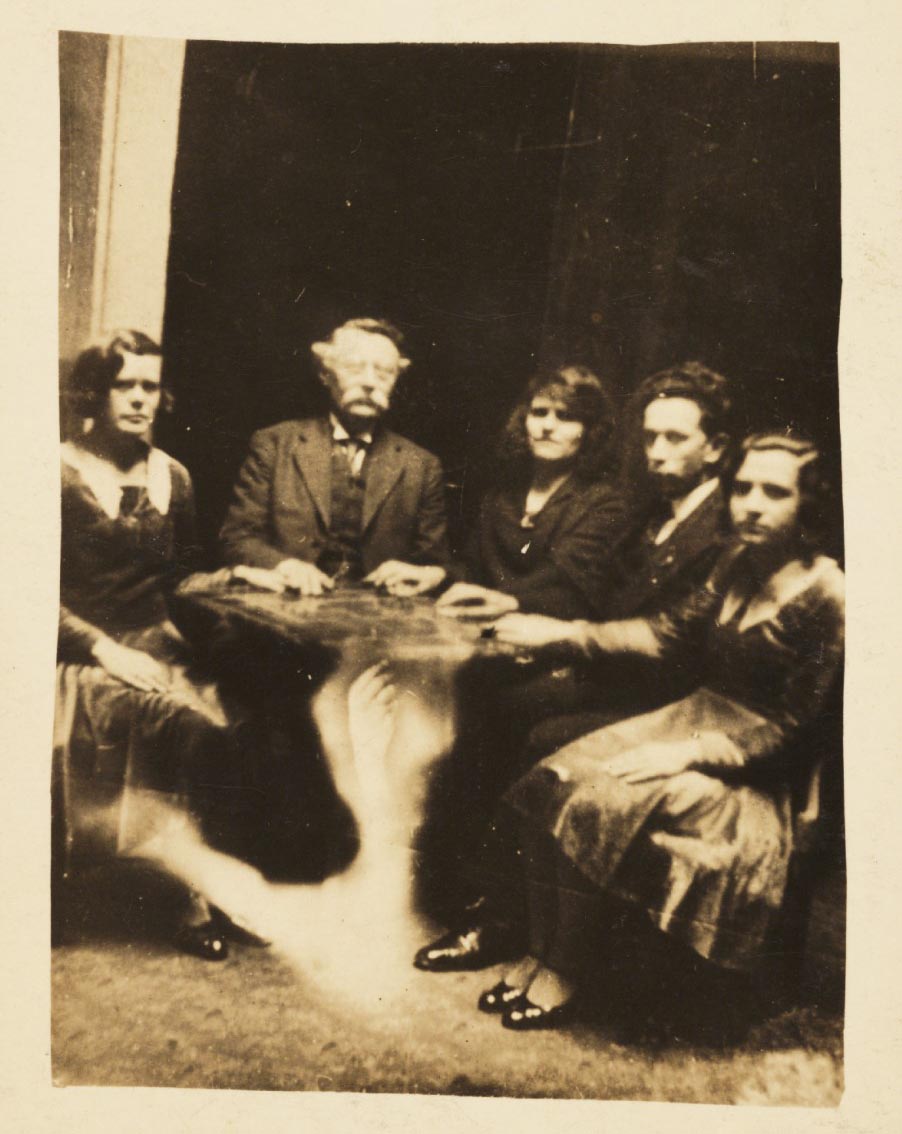
The information accompanying the spirit album states that the table is levitating – in reality the image of a ghostly arm has been superimposed over the table through double exposure. Photograph 1920 by William Hope (1863-1933). National Media Museum Collection: 2002-5054/10. Public Domain.
Spiritualism arose at the turn of the 20th century, when North American society was dominated by Protestant and Roman Catholic churches. However, traditional beliefs were being challenged by the rise of sects and cults arriving in Upper Canada from the northern United States, including Unitarianism, Swedenborgianism, Universalism, Quakerism, and Shakerism. Many of these new sects adopted and incorporated what can be considered progressive beliefs into their doctrines, Read more →
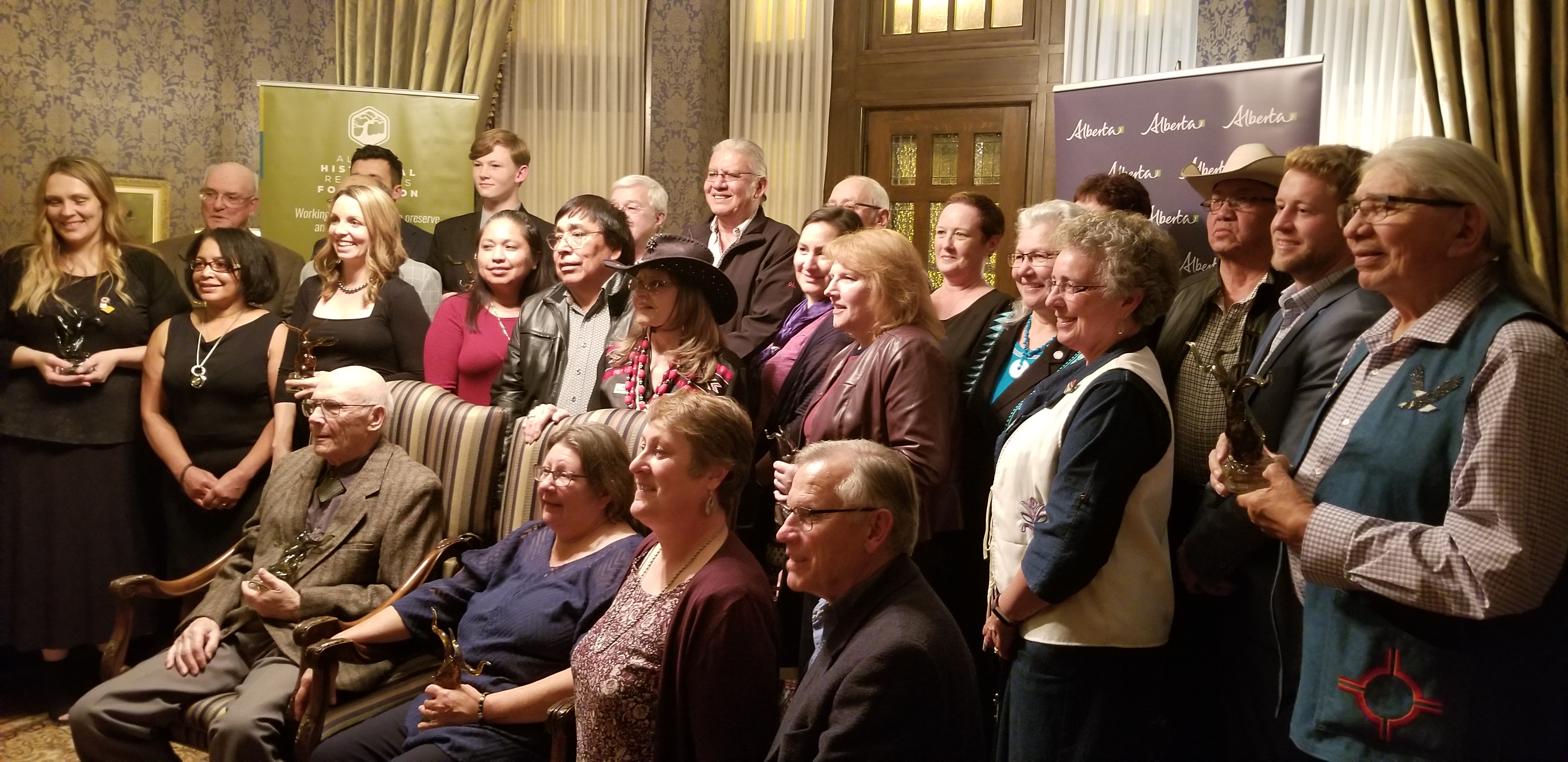
Alberta Historical Resources Foundation 2018 Heritage Award Recipients.
Held every two years, the Alberta Historical Resources Foundation Heritage Awards are presented to recognize groups and individuals’ efforts to research, promote or preserve Alberta’s diverse history and heritage.
Last night, 16 different winners received Heritage Awards at a ceremony held at the famed Government House in Edmonton. Read more →
This post was originally published on RETROactive on October 31, 2012. However, since we live in Alberta, this topic is almost ALWAYS relevant – what to do about frosty windows!
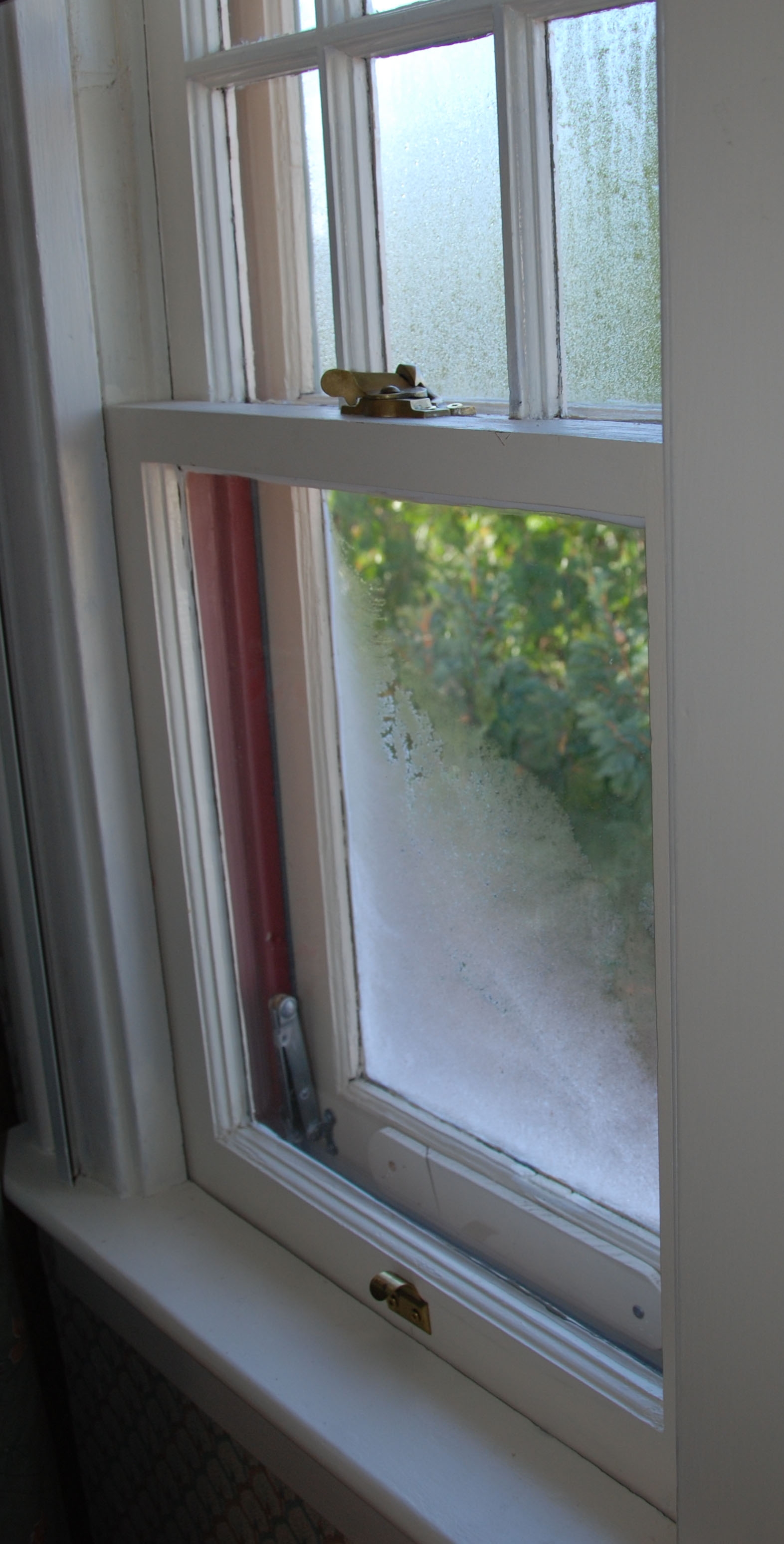
With winter coming, some owners of historic places might be witnessing the formation of frost on their single pane wood windows and storms, most notably on the second storey. The reasons for this will vary and subsequently so will the solutions. Generally speaking, a little frost now and again should not harm the window frame but a more persistent formation will saturate the surrounding material and, in the long run, potentially cause significant damage. Should this be the case, ignoring the situation is far from the recommended solution.
Frosty window. Note the closed storm window vent cover. During the winter it should be open.
So what is one to do? The first step, as with any intervention on a historic place, is to develop an understanding of the problem. What is causing frost to form on the window? The answer: warm moist air comes in contact with the cold glass and condenses, which then freezes on the surface. So how does one mitigate this? Should you let the house freeze so that the interior temperature matches the outside, or should you turn the house into an oven to eliminate any and all moisture in the air? Obviously, neither scenario is plausible.
So what is one to do – replace the windows? Speaking from a heritage conservation perspective, replacing authentic historic windows would be the equivalent to someone shaving their head bald because they found a grey hair. Historic windows have, in my experience, proven themselves to be longer lasting than any modern window and can continue to serve their function with proper care and maintenance, while modern windows wear out and routinely need to be replaced.
As air moisture is the general cause of frosted windows, controlling it would appear to be the most appropriate approach. However, there is more than one way to control moisture during the winter. One can control moisture levels with a dehumidifier, or by preventing it from reaching the cold glass with weather stripping techniques. As well, one could better manage the presence of moisture with exhaust fans and insulation. Any combination of these efforts will help to reduce the frost on windows but it should also be noted that there are pre-existing systems that should be taken advantage of in regards to this problem.
Storm windows traditionally have three holes at their bases with a flap cover. During the winter, these should be open to let moisture and condensation escape. When bugs arrive with spring, close the flap. Double hung windows generally have locks where the sashes meet – use them to tighten the window and reduce air leakage. Should you decide to proceed with a form of weather stripping, concentrate on the interior side of the window and allow the storm window to breathe. This will create a micro-climate (similar to the ventilation in one’s roof), which should help prevent frost and therefore better sustain and protect the window.
Hopefully, the preceding information will be useful for those who might be dealing with frosty windows. There are many articles on the Internet, which tackle this issue and propose similar, different and additional solutions ranging from “free to expensive”. As a Heritage Conservation Adviser, my advice, and that of the Standards and Guidelines for the Conservation of Historic Places in Canada, is to start with the minimal approach. With any luck, that is all that will be needed.
Written by: Carlo Laforge, Heritage Conservation Adviser.
Thank you to guest writer, Sydney Hampshire, for sharing her experience of documenting built heritage in Flagstaff County.
Growing up in Northern Alberta kept myself, my siblings, and my parents a long way away from our extended family. We had only occasional visits with both sets of grandparents, which caused a disconnect between us. However, this disconnect also built a mystique around the lives of the past generation – and with it came an inherent curiosity.
My grandmother, Joy Hampshire (nee Innes), was born, and lived all her life in Flagstaff County after her mother and father immigrated from Scotland. Flagstaff County harbours an abundance of built heritage structures that showcase the region’s rich past. As a child, I was exposed to this heritage on each trip we took to our grandparents and I remember becoming terribly intrigued by this built heritage and the relics of my grandmother’s past. I remember each visit to Grandma’s farm required a visit or two to nearby abandoned homesteads. Each trek into a forgotten house, shed, or barn brought me great excitement: What would I find? What would I see? What would I infer about the people that used to live there?
I believe we all have a little bit of this adventurous spirit in us; it comes from a desire to understand the unknown and seek out answers. While exploration and Read more →




 RETROactive