Pincher Creek Municipal Heritage Survey

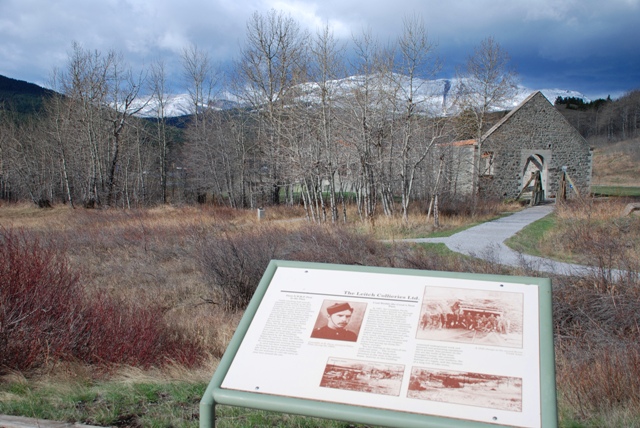
At the end of April I attended an open house for the Town of Pincher Creek Municipal Heritage Survey project. Over the past year, the Town, through the dedicated assistance of community volunteers and the guidance of Farley Wuth at the Kootenai Brown Pioneer Village, has been working on documenting up to 300 sites. These sites, all older than the 1940s, include residential, commercial and industrial properties. The sites are being documented through photography and by recording geographical, architectural and historical information. Once complete, all documented sites may be viewed on the Provincial Heritage Survey database.

The open house was attended by project volunteers and interested community members. Their interest in the project was inspiring. With each documented property, the volunteers uncover new facts about their community.  Who lived where, and when? Which properties contain unique architectural features? How did the properties evolve after alterations and repairs? With each discovery, a greater sense of community pride seems to emerge.

Completing a Municipal Heritage Survey is a great way for municipal staff to learn about the older building stock (and other sites) in their communities. The information gathered provides valuable information for things such as:

– public and private research

–   historic walking tours

–   school and museum programs

– municipal decision-making

–   information on historic and existing land uses

–   development patterns

–   tourism opportunities

– assistance in long-term conservation objectives

–   evaluation of potential historic places

–   photographic record to aide future conservation projects

Essentially, a Municipal Heritage Survey is an information gathering exercise, which enables future decisions and projects associated with potential historic places. Properties documented through a survey are not placed under any restrictions.

To learn more about the Pincher Creek Municipal Heritage Survey project, click here.

To learn how the Town of Pincher Creek is completing this project, please visit the Municipal Heritage Partnership Program website.

Written by: Brenda Manweiler, Municipal Heritage Services Officer

Delburne Alberta Government Telephones Exchange Building

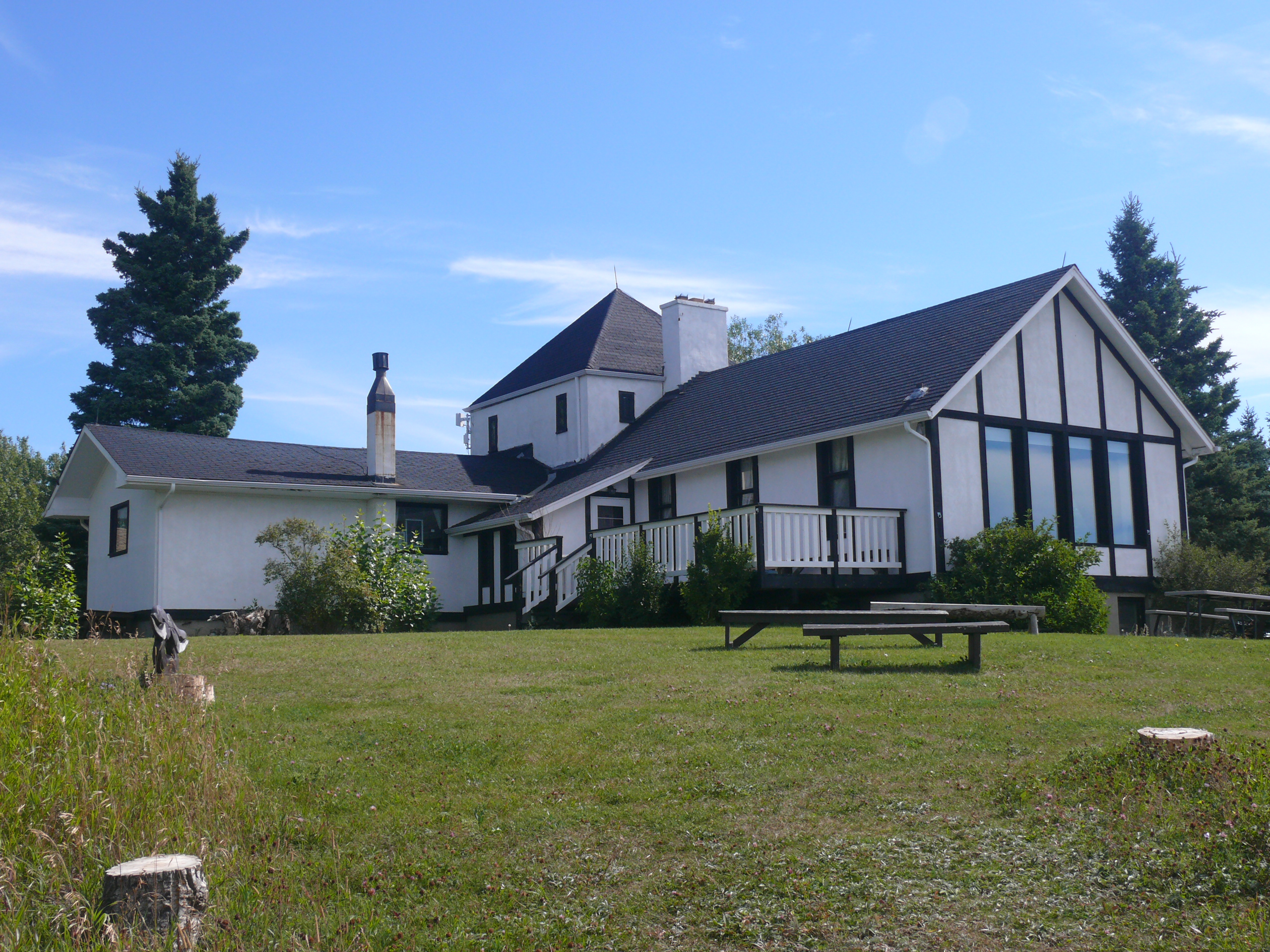
One of Alberta’s most recently designated historic resources is the Delburne Alberta Telephones Exchange Building. Designated in January as a Municipal Historic Resource by the Village of Delburne, it has recently been listed on the Alberta Register of Historic Places.

Although now a residence, the building once housed the switching equipment that first connected the village and the surrounding area to the long-distance telephone network. To read more about the heritage value of this building take a look at the statement of significance on the Alberta Register of Historic Places.

Municipal Heritage Services staff helped the Village of Delburne finalize the documentation needed to designate and then list the site on the Alberta Register of Historic Places. If you want to learn more about identifying, evaluating and protecting local heritage resources, please visit the Municipal Heritage Partnership Program website. We are available to assist your municipality.

Written by: Michael Thome, Municipal Heritage Services Officer

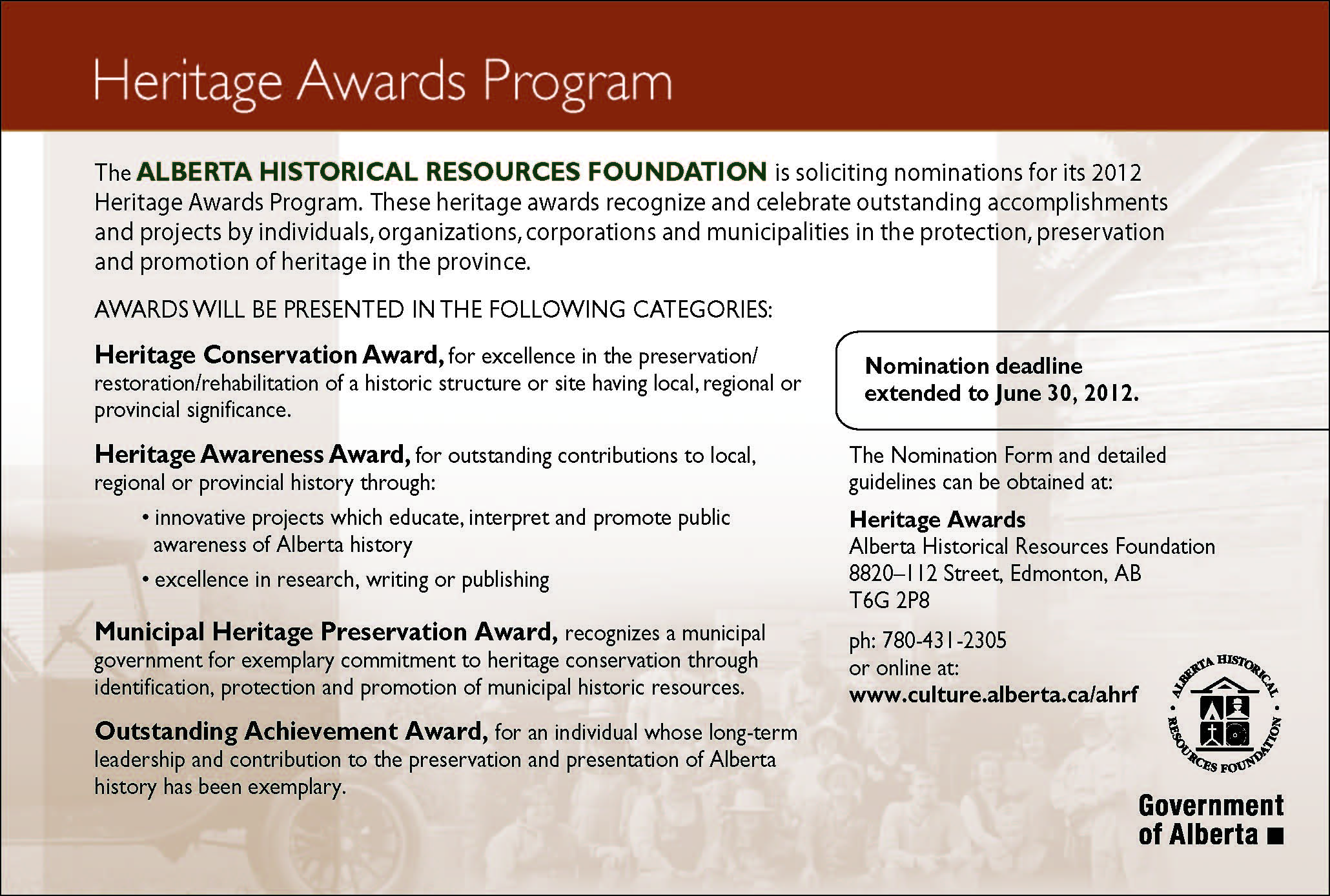
REMINDER: Submit Nominations for the AHRF Heritage Awards

Deadline: June 1, 2012

As part of its ongoing efforts to honour local contributions in the protection, preservation and promotion of Alberta’s heritage, the Alberta Historical Resources Foundation is seeking nominations for the Heritage Awards 2012.

The Heritage Awards Program provides an excellent opportunity to recognize and celebrate the outstanding accomplishments of individuals, organizations, corporations and municipalities who have demonstrated their commitment in preserving our province’s heritage.  Awards are presented as follows: to projects for the Heritage Conservation and Heritage Awareness Awards; to municipalities for the Municipal Heritage Preservation Award; and to individuals for the Outstanding Achievement Award.

Conserving Alberta’s heritage benefits all of us, but it is often the actions of individuals and communities that drive these efforts forward.  If you know of an exceptional building conservation project, a heritage awareness initiative, a municipality or individual in your community, this is your chance to have them recognized.

The deadline for submitting nominations is June 1st.  The awards ceremony will take place in November.

For a copy of the guidelines and nomination form, click here or contact me at 780-431-2305.

Written by: Carina Naranjilla, Grant Program Coordinator

Nominations Invited: Prince of Wales Prize for Municipal Heritage Leadership

Since 2000, the Heritage Canada Foundation has recognized municipalities that have demonstrated leadership in conserving Canada’s historic places with the Prince of Wales Prize for Municipal Heritage Leadership. Recently the Foundation announced that this year’s deadline for nominations for the Prize has been extended to May 31st.

Mayor Mandel and the Prince of Wales

Previous recipients include municipalities across Canada, including the City of Edmonton, the only Alberta municipality to ever be awarded the Prize (awarded in 2009).

From the Heritage Canada Foundation’s website:

In keeping with His Royal Highness’ commitment to architecture, the environment, and inner-city renewal, The Prince of Wales agreed to lend his title to the creation in 1999 of a prize to be awarded annually to the government of a municipality which has demonstrated a strong and sustained commitment to the conservation of its historic places. The local government must have a record of supporting heritage preservation through such means as regulation, policies, funding and exemplary stewardship. The nomination must provide evidence that heritage properties in the given municipality have improved over a period of time.

The award consists of a metal plaque and a scroll, as well as a flag or pennant to be flown outside the winning municipality’s headquarters and/or placed on permanent display. The Prince of Wales Prize logo must be displayed on the homepage of the municipality’s website.

Communities interested in making nomination for the Prince of Wales Prize may do so by following the “Eligibility Criteria and Nomination Procedures” established by the Heritage Canada Foundation.

Written by: Matthew Francis, Manager of Municipal Heritage Services

Moving Mountains – My Visit to the Frank Slide Interpretive Centre

View of Turtle Mountain from the Frank Slide Interpretive Centre

Last week I was in southern Alberta for meetings with Vulcan County and the Town of Pincher Creek. To fill a meeting-free morning I decided to visit the Frank Slide Interpretive Centre (a thirty minute drive west of Pincher Creek on Highway 3). Throughout my visit grey clouds blanketed the sky, which befitted the destruction, sorrow and magnitude of the Frank Slide disaster.

On April 29, 1903 at 4:10 in the morning the east face of Turtle Mountain toppled and slid four kilometres into the Crowsnest River valley. In a mere ninety seconds, 82 million tonnes of limestone collapsed upon the southern end of the Town of Frank, a section of the Canadian Pacific Railroad (CPR) and the mine plant of the Canadian-American Coal Company. In total, at least ninety people were killed. To date, this is Canada’s deadliest rockslide.

In 1977 the Government of Alberta designated the site a Provincial Historic Resource for its significance as the site of Alberta’s worst natural disaster, for it being a geological phenomenon and for it serving as a provincial landmark (to learn more about the site’s heritage value, read the Frank Slide Statement of Significance). Visitors to the area can learn first-hand about the disaster through interactive multi-media displays at the Frank Slide Interpretive Centre, and by walking the Frank Slide Interpretive Trail.

Interpretive Centre

What force can you exert on a mountain by jumping, stomping, pushing, pulling, lifting ... ?

Four levels of display space recount not only the horrors and triumphs of the people that awoke one morning to find their town buried, but provide geological and seismic information about the causes of the disaster. Audio-visual components and 3-D models allow visitors to visualize how Mother Nature could wreck such havoc. My favourite display was a set of three mountain monitoring sensors that are like those currently installed on Turtle Mountain to detect movement. Visitors are encouraged to stomp, jump, push, pull and lift blocks of concrete connected to a crack meter, tilt meter and seismic sensor. Computer screens reveal how sensitive the monitors are AND how strong YOU are! Yes, I jumped, stomped, pushed and pulled … the next time someone asks I will now be able to confidently state that I really can move mountains!

Interpretive Trail

View of Turtle Mountain near the trail head.

A 1.5 kilometre trail, beginning from the Interpretive Centre parking lot, winds through mounds of limestone rubble. Looming views of Turtle Mountain offer a stark reality check when walking along the trail. Hopes, dreams and memories lay beneath.

I walked the trail with an interpretive brochure in hand. Waypoints marked along the path explained what I saw and some of the events that occurred on that fateful day. The last quarter of the trail winds along the western edge of the fallen rock and loops back up to the parking lot through a wooded area. I paused during this reconnection with nature to read that, “mammals such as bears, deer and moose use these cool, sheltered woodlands to skirt the slide’s harsh, open environment as they move through the Crowsnest River valley. Mule deer can frequently be seen along this portion of the trail, particularly early and late in the day.” Taking a step to carry on my way, I thought how great it would be to see some deer. The breaking of twigs caused me to again pause. To my amazement I looked up to discover four deer staring at me!! All five of us stared. Soon enough they returned to their feeding while I continued staring. What a joy!

Turtle Mountain Web Cameras

The Alberta Geological Survey has installed two web cameras for viewing Turtle Mountain. One is in the valley looking up at the mountain and the other is positioned on the south peak providing a view of the valley below. Click here to see a current view of Turtle Mountain.

The Frank Slide Interpretive Centre is open to the public, daily, from 10:00am to 5:00pm. July 1 through Labour Day, the Centre is open daily from 9:00am to 6:00pm. Click here for additional information.

Written by: Brenda Manweiler, Municipal Heritage Services Officer
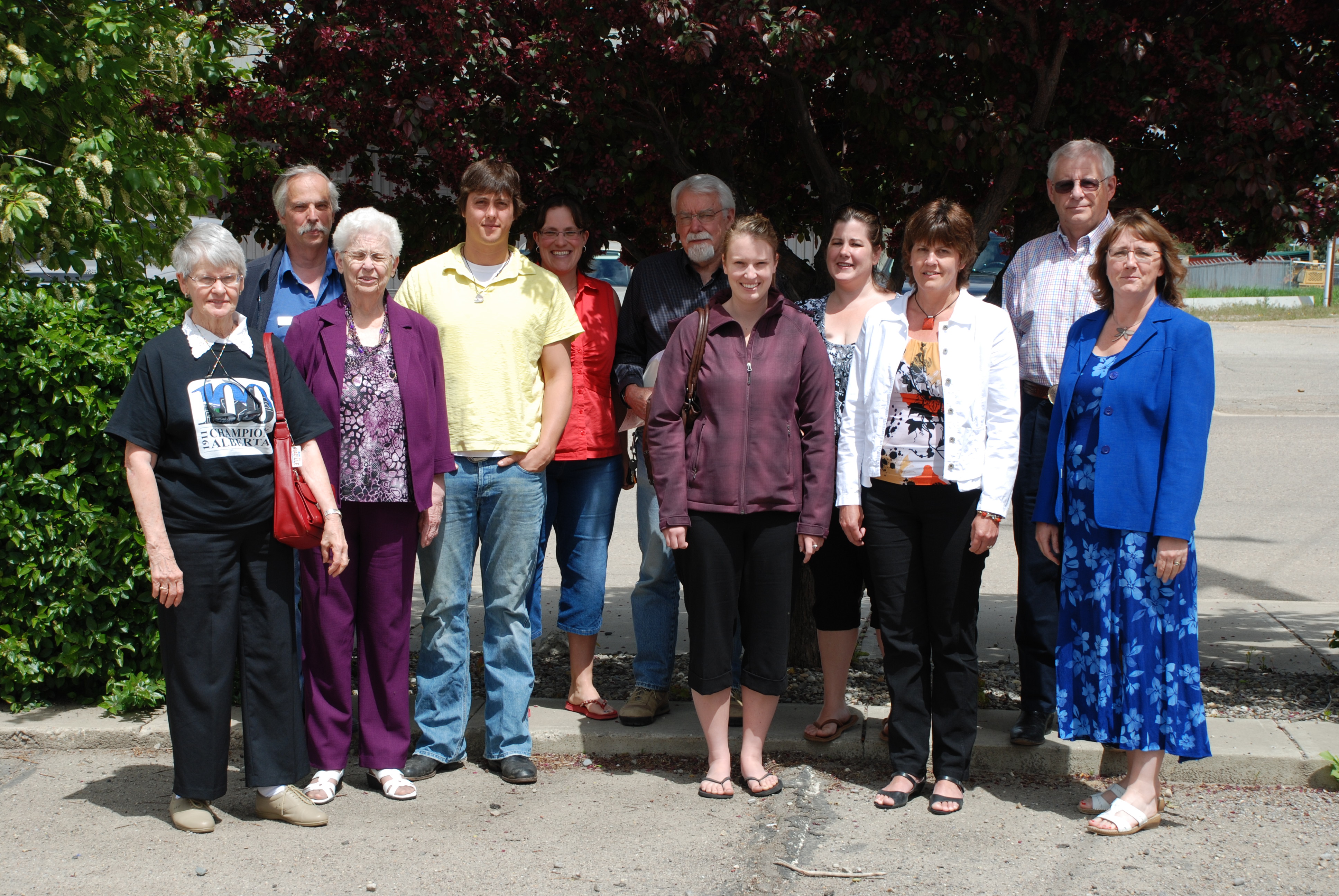
P.S. I must extend a big thank you to Monica and Myriah for welcoming me to the Interpretive Centre and for providing a great tour! I really enjoyed my visit.

Gibb Lake: Honouring an Early Homesteading Family and a Wartime Sacrifice

Stanley Gibb (Photo provided by the family.)

The Alberta Historical Resources Foundation and the Minister of Culture and Community Services has officially adopted the name Gibb Lake for a previously unnamed lake in Clear Hills County. The small lake is located approximately 16 kilometres north east of the Village of Hines Creek. The newly adopted name serves two commemorative purposes. Firstly, it commemorates the family of William and Christina Gibb, early homesteaders in the Hines Creek region. Secondly, it commemorates the service of their sons, many of whom served in the armed forces, particularly Private Stanley Alexander Gibb, Loyal Edmonton Regiment, R.C.I.C., who lost his life during the conflict.

William Gibb was born about 1899; he was raised in the Gordon district of the Scottish borderlands where he worked as a farmer or farm labourer. His wife Christina, who was born about 1901, was from Newtyle, Scotland. In 1925, they and their four sons (Charles Howard, aged 5; Stanley Alexander, aged 3; David William, aged 2; and three month old John William) immigrated to Canada aboard the Canadian Pacific liner SS Marburn. They arrived in Quebec on August 22 and immediately traveled to Wolseley, Saskatchewan where William was employed as a farm labourer in the employ of a Mr. Alex Callander.

David Gibb (Photo provided by the family.)

The family moved to Fairview, Alberta in 1928 and William Gibb filed for a homestead in the relatively unsettled Hines Creek region (NE ¼, Section 5, Township 85, Range 4, West of the 6th Meridian). The family would grow to include eight children – Charles, Stanley, David, John, Marjorie, William and Chris. While proving up the homestead, William Gibb Sr. became an active member of the community. In addition to farming, he worked on regional road crews and served as a trustee for the Ednam School District No. 4359 (the school district being named for the market town of Ednam, Scotland, which was near William Gibb’s birthplace). According to a long-time resident of the region, the Gibb’s also provided entertainment at community gatherings with their singing (in Gaelic) and traditional Scottish dancing. Despite only clearing 10 of the required 30 acres, the Gibb family was granted title to their land in December 1935. The inspection agent determined that the Gibb’s land was extraordinarily difficult to clear and declared that the 10 acres was equal to 30 acres of cleared land elsewhere in the province.

With clear title to their land, the Gibb’s existence should have been more stable. However, their lives, like those of many Alberta families, were irrevocably disturbed with the outbreak of war in 1939. A number of the Gibb sons enlisted for service. It has not been possible to track down records for many of them, but Stanley’s service records indicate that he had two brothers (unnamed) serving, one with the Royal Navy and the other with the Royal Air Force. However, since the lake became officially named, more information has been revealed by a family member (William Gibb Jr.), which suggests strongly that Stanley’s Service Record may be inaccurate or incomplete.

According to William Gibb Jr., almost all of the Gibb sons did their part for their country either during or following the war:

– Charles Gibb enlisted in the Army and spent most of the war as a sergeant, training troops in England;

– David Gibb enlisted, but was released after six months due to having poor eyesight. He returned home, and worked on the construction of the Alaska Highway under the employ of the American Armed Forces;

– John Gibb enlisted later in the war and served with the Occupation Army in Germany during 1944-45;

– William Gibb served in the Canadian Merchant Navy and then as a seaman and helmsman on a hydrographical survey ship (CGS W. J. Stewart) on the Pacific Coast;[1]

– Chris Gibb served with the Royal Canadian Air Force from 1953 to 1956.

The Gibb’s second son, Stanley Alexander Gibb, had perhaps the most interesting and ultimately the most tragic experience. Stanley served as a Private with the Loyal Edmonton Regiment. In his enlistment papers he stated that he was employed as a farm labourer and expressed interest in training as either a mechanic or a railroad engineer. He also indicated that he collected stamps and enjoyed boxing and baseball (he played third base).  He trained in Calgary and embarked for Great Britain in August 1941 where he received further training, served garrison duties and was temporarily assigned to a Mechanical Transport Vehicle Reception Depot. In June 1943, Private Gibb was deployed to the Mediterranean. Soon after arrival in North Africa, he contracted malaria and spent three weeks in hospital.

The Loyal Edmonton Regiment was actively involved throughout the Italian campaign, but Private Gibb’s role in most of these engagements is not known. However, on October 22, 1943, The Regiment fought in a battle that became known as the Savio Bridgehead. The Loyal Edmonton Regiment and the Seaforth Highlanders of Canada launched supporting attacks to the Princess Patricia Canadian Light Infantry’s second attempt to cross the Savio River just north of Cesena and gain a foothold on the opposite bank. The attack began with an artillery barrage at 8pm. By 9pm, the Edmontons were in the fast flowing river and attempting to reach the other side. An early setback occurred when Major W. G. Longhurst, the commander of the first company to attempt the crossing, was killed. A second company joined the fight and the Edmontons recovered. The crossing continued until daylight, when they reached Case Gentili, a small hamlet west of the river. The Regiment received Battle Honours for their actions in this engagement. For most of the Regiment, the fight continued. However, during the crossing, Private Stanley Alexander Gibb had stepped on a landmine. According to his service record, he suffered the traumatic amputation of his right foot and severe wounds to both legs and both arms. He was evacuated to a field hospital and underwent surgery, having his right leg amputated at the knee and his right arm amputated above the elbow. His post-operative condition was listed as stable, but infection and fever set in the following day, from which he did not recover. Private Stanley Gibb died of his wounds on October 27, 1944. He is buried in the Cesena War Cemetery, in the Italian province of Forli.

During the war, William and Christina sold the Peace Country farmstead and relocated to Vancouver Island, where much of the family remains today.

The application to have Gibb Lake adopted as the official name for that lake was made by a member of the Clear Hills Watershed Initiative in September 2009. The proposal was supported by the Municipal Council of Clear Hills County and the local MLA. After considerable research, the proposal was presented to the Board of the Alberta Historical Resources Foundation during their December 3, 2011 meeting in Calgary, at which they agreed to accept the name. On January 31, 2012, the Minister of Culture and Community Services concurred with the board’s decision and the adoption of the name became official. Notification of the adoption of the name Gibb Lake was published in Alberta Gazette on February 29 and it was added to the Canadian Geographical Names Database, ensuring the name appears on new maps of the region produced by the federal and provincial governments.

This has been a very interesting naming proposal to work on. The name was made official following nearly two years of research. Since the name was officially adopted and media stories began to appear, new information has been received. Keep checking back to this blog, updates will be posted about the Gibb family’s record of service to their country as more information is discovered and verified.

Written by: Ron Kelland, Historic Places Research Officer and Geographical Names Program Coordinator

For location information and a list of additional resources:  Read more

Application of the Standards and Guidelines to replace the cedar shingle roof on Old St. Stephen’s College

Old St. Stephen’s College, designated a Provincial Historic Resource in 1983, and office of the Historic Places Stewardship Section (the authors of RETROactive), is getting a new roof. The work is compliant with the principles and recommendations outlined in the Standards and Guidelines for the Conservation of Historic Places in Canada. Below is a brief description of the conservation work that will be completed throughout April and May 2012.

The roof over the west wing and its multiple hip-roofed dormers are cited in the Statement of Significance as character-defining. The design for the cedar roof replacement may seem straight-forward at first, but when planning this work it was important to consider not only the look, but how the roof would perform. The introduction of new underlay products and flashings were examined in order to better help keep the water out and extend the service life of the roof.

For any historic place, the Standards and Guidelines for the Conservation of Historic Places in Canada must be consulted for all proposed interventions.  In this case, a cedar shingle finish for roof surfaces, ridge caps and dormer side walls was verified as appropriate with reference to general Standards 1 to 9 and Standards 10 to 12 for rehabilitation treatments (see pages 22 and 23 in your Standards and Guidelines document).  Standard 8, in particular, confirms the replacement “in kind of any extensively deteriorated or missing parts of character-defining elements, where there are surviving prototypes.”

In addition to the replacement of the shingles, the opportunity to introduce new weatherproofing materials was presented.  Particular areas at risk with this roof were identified, which included the six dormers penetrating each side of the peaked roof, along with multiple valley and ridge flashings.  Also complicating the design is the presence of deep gutters with internal drains just behind the brick and cast-stone parapets.  A new continuous ice dam membrane underlay was proposed that would be installed from the parapet through the gutter, to the top of the dormers, lapping the membrane up the dormer sidewalls, and to the underside of window sills.  This has been likened to installing a weatherproof girdle under the shingles, covering most of the roof surface, to help protect the vulnerable complicated intersections from leaks.

The proposed introduction of new underlay material to this roof was confirmed in the Guidelines for Roofs (page 142), where it is recommended to “improve the detailing of roof elements, following recognized conservation methods, to correct faulty details.”  Such improvements, however, should be physically and visually compatible with the authentic roof detailing.

So, all the boxes are checked with regard to the west wing’s roof replacement and the protection of its heritage values.  The Standards and Guidelines for the Conservation of Historic Places in Canada provides a defendable verification that planned work for historic places retains recognized heritage values.

Written by: Tom Ward, Manager of Heritage Conservation Advisory Services

What’s New with the Alberta Heritage Survey? (12.01)

There’s been some spring cleaning on the Alberta Heritage Survey website – it’s been tidied up, rearranged and revamped! Check out all the information and new links. You’ll find a description of the Alberta Heritage Survey (AHS) Program, and a link to an electronic version of Photographic Memory , the Provincial Archives of Alberta  exhibit which was previously featured on RETROactive (What’s New with the Alberta Heritage Survey? 11.01). As well, links on the website will take you to pdf versions of documents providing a wealth of information about the heritage survey process, and there are sections with details about HeRMIS, the AHS eForm, and historical walking and driving tour booklets.

This photograph is an example of what may be found on the Alberta Heritage Survey.

HeRMIS, the Heritage Information Management System, provides online access to the database where the Alberta Heritage Survey is stored. You can explore the records of the AHS by querying the database, using the Basic or the Advanced query window. Almost 100,000 records have been entered so far, and more are being added all the time. Images are the latest innovation. A search on the name “Siracky” using the text search field of the Basic Search brings up an interesting selection of buildings in east central Alberta. To explore the records, click on View Details. Once you are in a record you can double click on the images to see larger versions. Click on “Return to Search Results” to go back to the list and access another record.

The eForm is an exciting development that allows data, including images, to be submitted to the Alberta Heritage Survey via the internet. Now, information can be added to the database from anywhere with internet access. This feature is only available on a restricted basis, but you can follow the links to learn how it works.

Over the years, in cooperation with communities and groups across the province, the AHS has produced numerous historical walking and driving tours. Many of these are now out of print, but they are still available through the AHS web page, where pdf versions of 22 tours are available for downloading. As the very first AHS blog post, Spring Forward!  pointed out, a bit of heritage sightseeing is a perfect excuse to get out and enjoy the spring weather.

If you have any comments about the spruced up AHS web page, please contact Dorothy Field.

Written by: Dorothy Field, Heritage Survey Program Coordinator

Strathcona Fire Hall No. 1

When the Calgary & Edmonton Railway arrived at the south bank of the North Saskatchewan River in 1891, the C & E immediately subdivided a town site which it named South Edmonton.  Being at the end of steel, the community steadily grew throughout the decade until, in 1899, it was incorporated as the Town of Strathcona with a population exceeding 1,000.  To serve this burgeoning community, which consisted primarily of wood frame buildings, it was obvious that some method of organized fire protection was needed.  A volunteer fire brigade was organized in 1901, and, that same year, Town Council provided for the construction of a wood frame fire hall on lot 2, block 79, just north of main street, and near the Town water well.  A horse drawn fire wagon with a wooden water tank was then acquired.

As with Edmonton to the north across the river, Strathcona grew rapidly in the wake of the Klondike gold rush.  In 1907, it was incorporated as a city with an estimated population of 3,500.  It was soon evident that the old fire hall was inadequate, and, so, provision was made for a newer and larger structure.  As the City waterworks was right next door to the old fire hall, it was felt appropriate to build the new structure at the same location.  The firm of Wilson and Herrald was thus contracted to design, and the firm of J.M. Eaton contracted to build a modern two-story red brick facility which could accommodate three fire wagons.  The estimate for construction was $13,715.  A stable in the rear was designed for nine horses, while a bell tower extended from the middle of the structure 77 feet in the air.  The second floor was made to accommodate a chief’s office, a general hall, bedrooms, a band room, and a bathroom with showers.  Two fire poles facilitated instant access to the ground floor.

The Strathcona Fire Hall with its horse-drawn wagons served the City of Strathcona until its amalgamation with Edmonton in 1912.  It was then designated as Edmonton Fire Hall #6 and became part of the Edmonton Fire Department.  A permanent salaried chief was assigned to the Hall, and the number of salaried firefighters grew over the passage of time.  The crews were always supplemented by volunteers in times of emergency.  By 1954, however, the facility was considered dilapidated and outdated, and, so, a new fire hall was constructed nearby.  The old structure was apparently slated for demolition but was considered adequate for storage, and, so, it was leased to Strathcona Furniture, which used it as a warehouse.

By the early 1970’s, there was a growing appreciation in Edmonton about the early buildings of Strathcona, and, so, when the Walterdale Theatre began to plan for a new home, thoughts turned to the old fire hall, which seemed to provide adequate space for a live theatre building.  The Walterdale group moved into its internally renovated facility in 1974, and, in 1976, the structure was designated a Registered Historic Resource.  In the years that followed, it became a central venue for Edmonton’s Fringe Festival.

In September 2007, the Strathcona Fire Hall was designated a Provincial Historic Resource.  Its historical significance lies in its provision of structural evidence of fire fighting facilities in a large urban area in the early 20th century in Alberta.  It is the oldest major fire hall in the province.  It is also important as one of the surviving early public buildings of the City of Strathcona, which tells of life in general in this community.      

Written by: David Leonard, Historian

Visit the Alberta Register of Historic Places to learn more about the heritage value of the Strathcona Fire Hall. In order for a site to be designated a Provincial Historic Resource, it must possess province-wide significance. To properly assess the historic importance of a resource, a historian crafts a context document that situates a resource within its time and place and compares it to similar resources in other parts of the province. This allows staff to determine the importance of a resource to a particular theme, time, and place. Above, is some of the historical information used in the evaluation of the Strathcona Fire Hall.

The Royal Jubilee, Queen Elizabeth II and Place Names

Reigning heads of state, their siblings and children have been the inspiration behind many names. In Alberta there are places and features named for Queen Victoria, King Edward VII and Queen Alexandra, Princess Patricia and of course Princess Louise Caroline Alberta.

View of Maligne Lake and the Queen Elizabeth Ranges, 1938 (Mountains from LtoR are: Samson Peak, Maligne Mountain, Mount Paul, Mount Mary Vaux, Mount Charlton, and Mount Unwin). Provincial Archives of Alberta (Weiss Collection), A3088, photograph by Joe Weiss.

To have features and places named for these people provides a connection to our historical heads of state and Canada’s ties to the British Empire and the Commonwealth of Nations; but, what of our current head of state?

Queen Elizabeth II became queen upon the death of her father King George VI on February 6, 1952. Over the ensuing days, she received proclamations of allegiance from all of her realms – Canada being the first to do so, beating the United Kingdom by about two hours. However, the celebrations and honours that accompany the crowning of a new monarch did not begin in earnest until her coronation over a year later on June 2, 1953. During the coronation year, honours for the new Queen came from all corners of the Commonwealth. Not surprisingly, Canada offered a grand gesture to mark the occasion. What may not be so well known is that, this honour was proposed by the Province of Alberta in the form of a series of mountain ranges.

The Queen Elizabeth Ranges

The mountains known today as the Queen Elizabeth Ranges are located in Jasper National Park. They almost encircle Maligne Lake, bordering the lake on its east, south and south-west sides. During her 1908 expedition, Mary Schäffer visited Maligne Lake, possibly being the first non-native person to do so. As her party was travelling by raft down the lake, she wrote:

As we were rounding what was supposed to be our debarking point, there burst upon us that which, all in our little company agreed, was the finest view any of us had ever beheld in the Rockies. … those miles and miles of lake, the unnamed peaks rising above us, one following the other, each more beautiful than the last. …we wandered about to drink it all in. How pure and undefiled it was! We searched for some sign that others had been there, – not a tepee-pole, not a charred stick, not even tracks of game; just masses of flowers, the lap-lap of the waters on the shore, the occasional reverberating roar of an avalanche, and our own voices, stilled by a nameless presence.

During her 1908 and 1911 expeditions to Maligne Lake, Mary Schäffer named many of the surrounding mountains, but the mountain groups or ranges were never specifically given a name, although some considered them to be part of the vaguely defined Maligne or Brazeau Range.

In April 1953, the Geographic Board of Alberta (GBA) received a suggestion from the Alberta Travel Bureau to commemorate the coronation of Queen Elizabeth II. The Bureau proposed that the province “name the entire unnamed range [of mountains] along the eastern side of Medicine Lake and Maligne Lake region the Queen Elizabeth Range.” The Travel Bureau proposed that the range should include Leah Peak, Maligne Mountain, Mount Paul, Mount Warren, Mount Brazeau and Mount Henry MacLeod.

The GBA approved the proposal during its the April 18 and April 22 meetings. In the process it dropped Mount Brazeau from the list, but expanded the demarked area to include the unnamed peaks south east of Beaver Lake as well as Monkhead, Mount Warren, Mount Unwin, Mount Charlton, Llysfran Peak, Mount Mary Vaux, Replica Peak and Coronet Mountain. The support of Premier Ernest Manning was acquired and the proposal was forwarded to Ottawa for consideration, where it received the consent of both the Geographic Board of Canada and the Parks Branch. Finally, after receiving the consent of Buckingham Palace, an announcement was made on June 19 that

Her Majesty had been pleased to approve a proposal that mountains which practically encircle beautiful Maligne Lake, one of the most photographed bodies of water in the Rockies, be named the “Queen Elizabeth Ranges”…these ranges tower ten thousand feet or more into the cloud flecked heavens and the whole scene makes one of the most perfect pictures of Alpine grandeur – bold rocky forms, ice and snow gleaming against a blue sky, dark forests and a sapphire blue lake – a fitting memorial to the Queen.

Queen Elizabeth Provincial Park, Lac Cardinal

Even after naming a series of mountains in honour of Queen Elizabeth II, Alberta was not yet done; just over twenty years later, Alberta honoured the Queen with a provincial park.

In 1958, the Government of Alberta established Lac Cardinal Provincial Park. The park was located just west of Grimshaw on the shores of Lake Cardinal, from which it took its name. In 1912, Lake Cardinal, formerly known as “Bear Lake,” was named for Louis Cardinal, an early settler in the region.

In 1978, Edmonton hosted the Commonwealth Games. Part of the games’ festivities was a Royal Tour of Canada by the Queen and Prince Philip, along with their sons Prince Andrew and Prince Edward. The Royal family visited Grande Prairie and the Peace Country, including a stop at Lac Cardinal Provincial Park to meet Chief Chonkolay-Colo, who presented the Queen with gifts from his tribe. On August 1, 1978, the Government of Alberta renamed the park as Queen Elizabeth Provincial Park, Lac Cardinal in honour of her visit. Information and maps of Queen Elizabeth Provincial park, Lac Cardinal can be found on the website of Tourism, Parks and Recreation.

Mount Queen Elizabeth?

Interestingly, there is a mountain on the Alberta/British Columbia boundary west of Turner Valley named Mount Queen Elizabeth. Many people believe that it is also named for our current Queen. In actuality, it is not. This mountain was named in 1916 by the Interprovincial Boundary Commission. It commemorates Elisabeth, Duchess of Bavaria and Queen of the Belgians (and yes, the Boundary Commission got the spelling wrong).

A nearby mountain is named for Elisabeth’s husband, King Albert I of Belgium. These names were bestowed to commemorate Albert’s role as commander of the Belgian Army during the First World War and Elisabeth’s visits to the front lines to boost troop morale. Both names were officially adopted for mapping purposes in 1918.

Written by: Ron Kelland, Historic Places Research Officer and Geographical Names Program Coordinator

For location information and a list of additional resources: Read more