Written by: Sara Bohuch, BA Archaeology (Simon Fraser University) , MSc Conservation Practice (Cardiff University)
The philosopher Cicero once said that memory is the treasury and guardian of all things. It is also a fleeting feature of the brain, so people have attempted to capture their memory in a physical format for as long as humans have existed.
If these physicalized memories are still considered a treasury, then the place where they are stored becomes less a place to stash random material and more of a bank. If you get enough memory kept in the same place, that bank can start to reflect and inform the identity of a people.
Editor’s note:The research presented in this blog is from a published journal paper co-authored by Timothy Allan, John Ives, Robin Woywitka, Gabriel Yanicki, Jeffrey Rasic and Todd Kristensen.
Ice sheet margins derived from: Dalton, A. S., M. Margold, C. R. Stokes, L. Tarasov, A. S. Dyke, R. S. Adams, S. Allard, et al. 2020. An Updated Radiocarbon-Based Ice Margin Chronology for the Last Deglaciation of the North American Ice Sheet Complex. Quaternary Science Reviews 234: 106223–27. https://doi.org/10.1016/j.quascirev.2020.106223.
Written by: Todd Kristensen, Archaeological Survey of Alberta
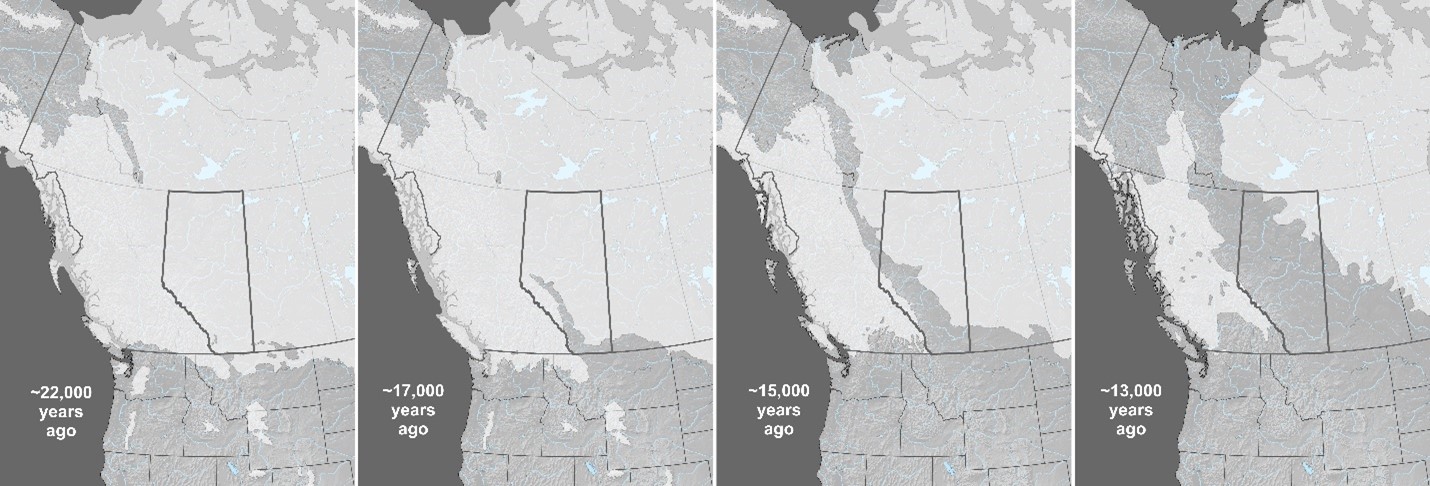
Alberta was once covered with glacial ice. Around 22,000 years ago, portions of the ice that sprawled across the province were over 1.5 kms thick. When the ice began to melt, it retreated in two directions (northeast and west) and exposed a pathway dubbed the Ice-Free Corridor that crossed through Alberta and connected previously exposed land masses over the warmer United States and a colder but drier region to the north called Beringia (parts of Northwest Territories, Yukon, Alaska, and Russia). People had settled into the corridor in what is now Alberta by 13,000 years ago. Where did they come from?
The melting of ice sheets over Alberta from roughly 22,000 to 13,000 years ago (based on data from Dalton et al. 2020). The ages are ‘calibrated’ from radiocarbon dates.
New archaeological discoveries are pushing back the ages of when people arrived in Beringia and to the south in the United States. To help understand which of those two areas are the likely source of people who came to Alberta, archaeologists have recently looked at the tools they were carrying, specifically, what kinds of stone the tools were made of. Some of the rock types that people used to craft things like spear points, scrapers and knives, are only found in certain areas in North America: their presence in Alberta’s archaeological record indicates that the stones were transported from far away. In turn, archaeologists look at changes in those ‘toolstone’ materials to track changing relationships; in the absence of other things that don’t preserve in Alberta’s soil, stone tools reveal where people migrated from, who they were interacting with (their ‘kin’) and how that all changed over thousands of years.
Written by: Michael Gourlie, Government Records Archivist, Provincial Archives of Alberta
In the early 1950s, George Dunn appeared frequently on the Edmonton sports pages. Described as a lightning flash, his boxing career lasted only about a decade in Canada, but his contributions to sport continued after he left the ring.
Dunn was born in Raleigh, North Carolina in 1925, the son of William Moses Dunn and Mary Helen High-Dunn. His parents died several months apart in 1926, and he was raised by his siblings. He was working in Hartford, Connecticut at the Pratt and Whitney Aircraft factory in 1943 when he registered for the World War II draft. He served in the US Army for just over two years during the Second World War, seeing action in the Philippines and New Guinea. During this period, Dunn took up boxing to avoid “KP” (kitchen patrol) duties. He became a professional boxer in 1946 and lost only two matches between 1946 and 1948, racking up 14 knockouts. In his early career, he fought against Sonny Boy West and Lil’ Arthur King.
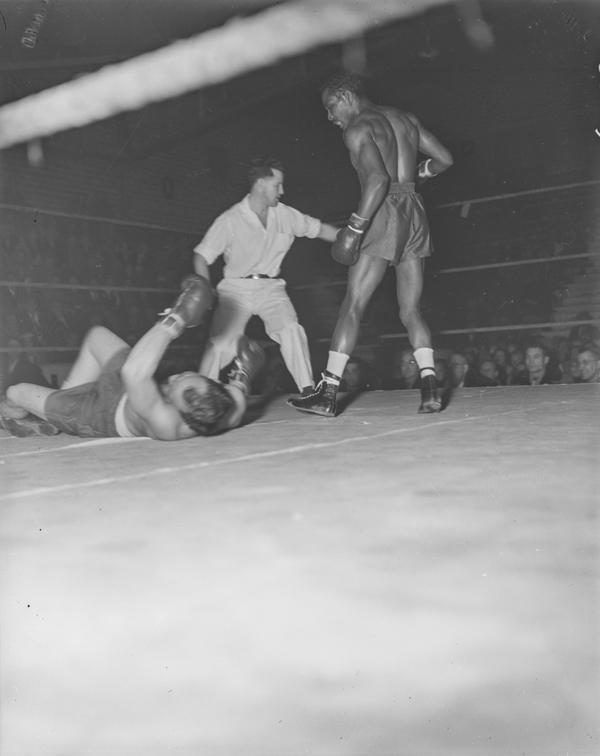
Geo Dunn vs. Dutch Hopper, 1950 at the Edmonton Stock Sales Pavilion. Source: Provincial Archives of Alberta, photo number: GS798


 RETROactive