
Editor’s note: September 30 is the National Day for Truth and Reconciliation and Orange Shirt Day. Reading residential school histories can be a painful process. If reading this is causing pain or bringing back distressing memories, please call the Indian Residential Schools Crisis Line at 1-866-925-4419. The Crisis Line is available 24 hours a day and can also provide information on other health supports provided by the Health Canada Indian Residential Schools Resolution Health Support Program.
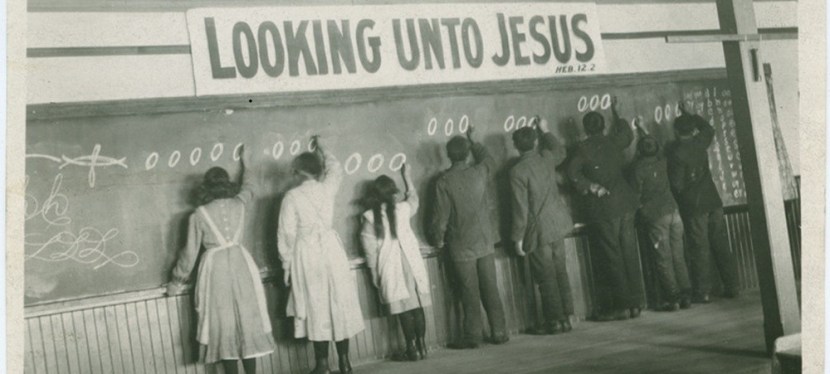
The banner image above is “A class in penmanship, Red Deer Institute.” ca 1914-1919. From Mission to Partnership Collection, United Church of Canada Archives.
Written by: Laura Golebiowski (Indigenous Consultation Adviser) in collaboration with Samson Cree Nation and Paul First Nation
Industrial and residential schools in Canada were established for purposes of assimilation, Christianization, and colonization. The institutionalization of Indigenous girls, alongside boys, became an early part of that equation.
In the beginning of the industrial school system on the prairies, the federal government and churches subscribed to Victorian ideologies of gender, class, and education. These ideologies were firmly entrenched in society at the time. Schooling was seen as the means to condition and prepare men for work in the outside world, and to enforce women’s roles inside the home as wives, mothers and providers of domestic service. Additionally, colonial government officials feared that young Indigenous men would return from schools to the reserve, only to ‘revert’ back to their culture, language and religion. Indigenous women were viewed as likely culprits: men would marry, only to be, “pulled back into Indian savagery by her.” In 1883, Liberal party leader Edward Blake argued: “If this scheme is going to succeed at all, you will, unless these Indian bucks are to be veritable bachelors all their lives, have to civilize the intended wives as well as the husbands.”
When Red Deer Industrial School opened in 1893, 52 children were enrolled. The number of boys nearly doubled that of the girls. The school operated on a half-day system, where a portion of the day was spent in the classroom, and the remainder was spent working to support the school in delegated trades and vocations. The boys were generally assigned the trade of farming, carpentry or potentially blacksmithing. Girls were relegated to domestic labour: cooking, cleaning, and making clothes.
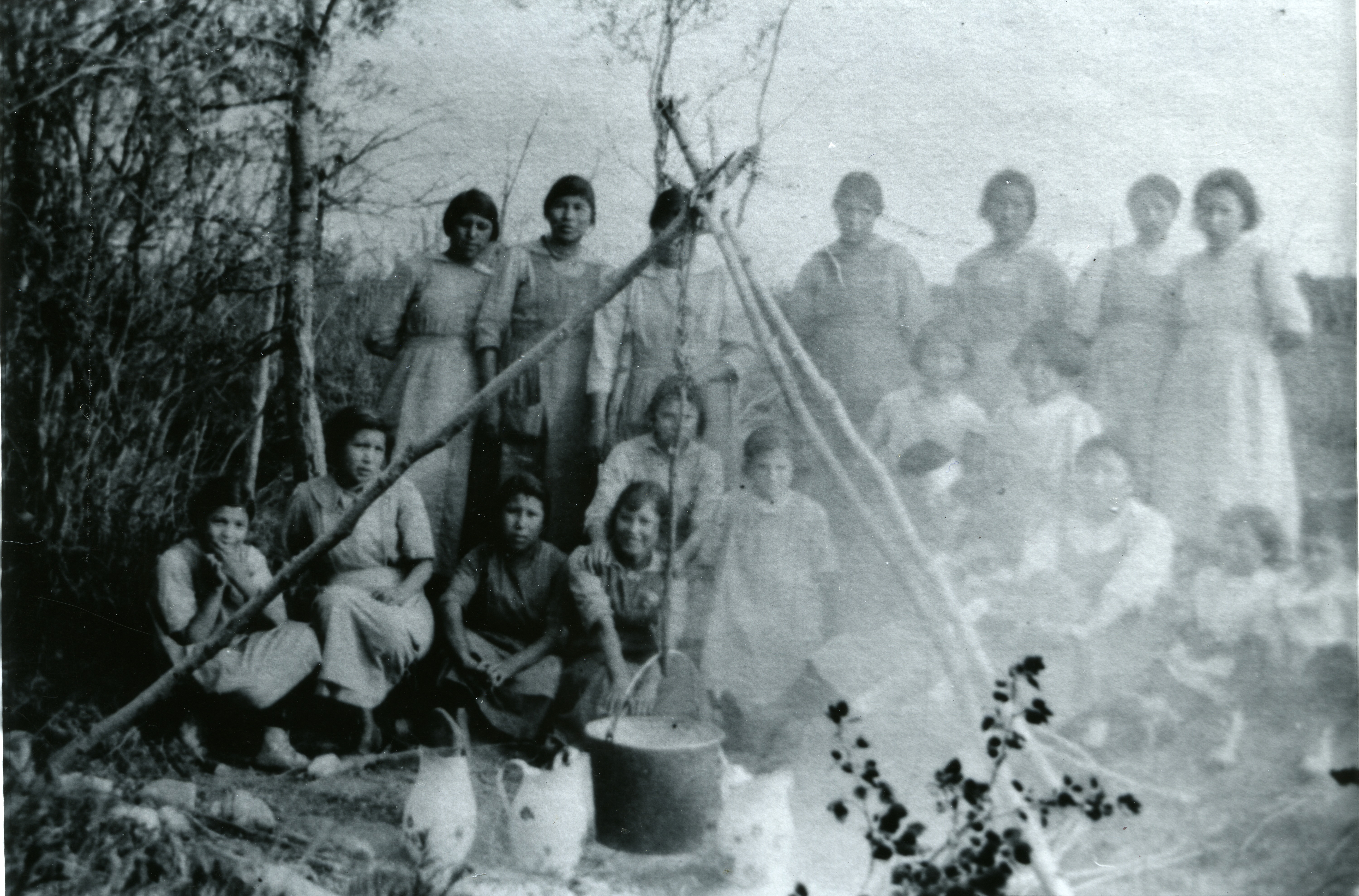
During the first year of the school’s operation, the divide and distinction between boys and girls was stark. The boys were put to work cutting hay and building fences, under the direction of the farming instructor. “[Mr. McClelland] possesses the happy faculty of persuading the boys that work is only play after all, and although only boys, they can do the work of ordinary men.” Of the girls, Principal John Nelson wrote: “The parents are delighted to know their daughters are able to make good bread, and to see them dressed in near and becoming clothes cut and made by the girls themselves.”
Female students’ labour was a necessity for continued operations at the school. “The girls work in the dairy, bakery, laundry, sewing room, kitchen, dining room and do general housework. All their clothes are made themselves, also the house linen, boys’ shirts and night-shirts…they knit all the stockings, socks and mitts, [and] do all the darning and mending.” Work comprised most of the children’s days; academics scarcely took up three hours.
In Shingwauk’s Vision: A History of Native Residential Schools, author J.R. Miller writes: “One of the most marked features of Canada’s residential schools was their fanatical segregation of female and male students.” At Red Deer, this was not only true of the children’s working hours, but also during their limited recreational and personal time. While the boys were provided organized recreation and sport (hockey, baseball, hunting and fishing), girls were seemingly limited to “swinging,” “skipping” and “[being] taken for long walks by the lady members of the staff.”
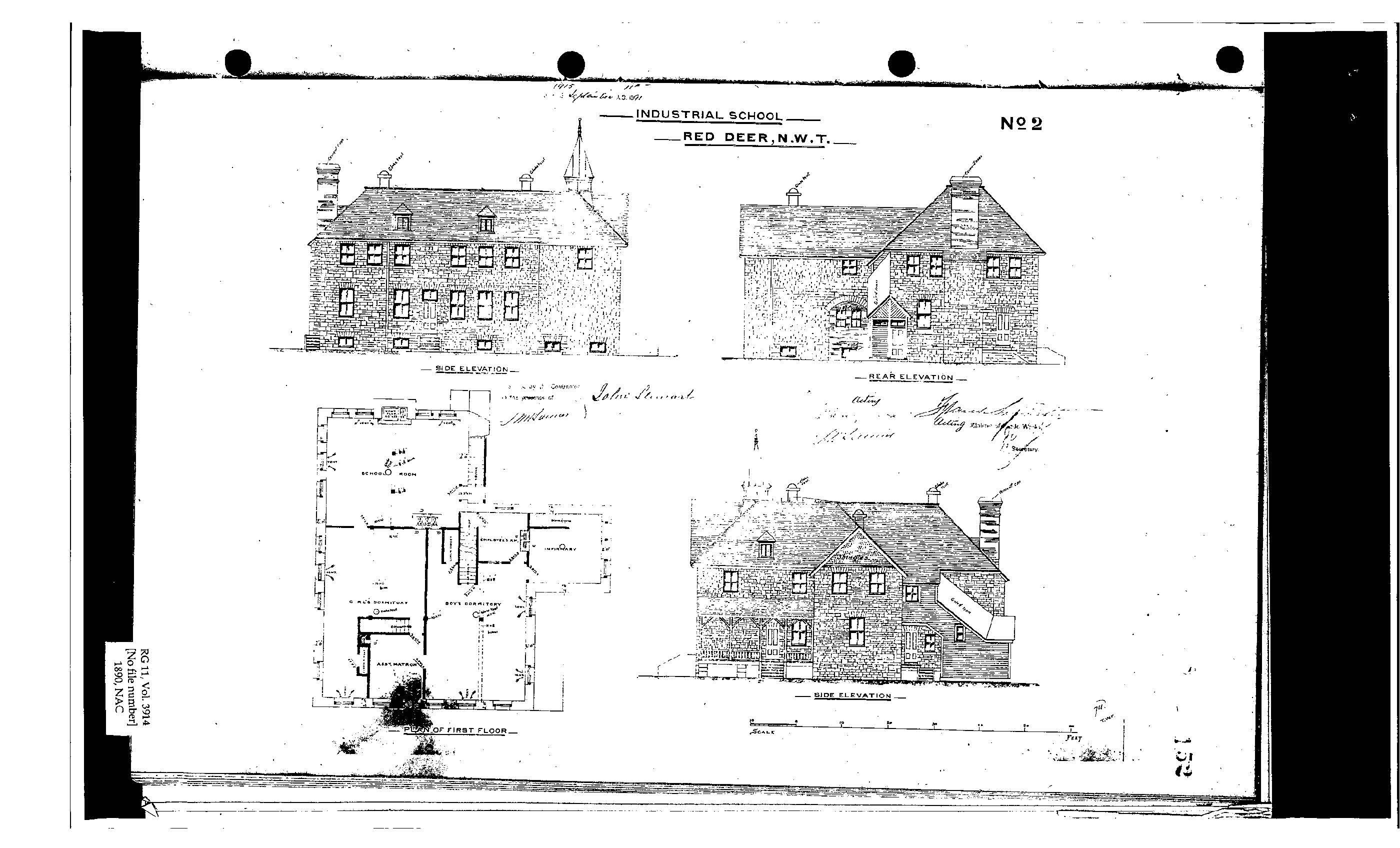
By 1906, a new brick building containing the boys’ dormitory was constructed. Girls, and boys under 12 years of age, were relegated to the original building, made of grey stone quarried from the banks of the Red Deer River directly below the school. In 1896, scarlet-coloured counterpanes—thin, top coversheets—were on top of each of the 17 iron bedsteads. The beds are described as having palliasses—thin, stiff mattresses filled with hay. If girls’ possessed feather pillows, they were not provided by the school—those would have been brought from home. Despite the bleak, institutional provisions, the girls evidentially tried to make their space their own: “the walls were covered with pictures, mottoes and photographs…altogether there was no neater or more cheerful room to be seen anywhere.”
Similarly, despite the labour they were forced into, the girls demonstrated skill and talent in everything they were tasked with. In 1896, Clara Nenekatawap (elsewhere spelled Nee-nee-kut-a-wap and Neeneekutwayo), then 17, took first prize in sewing. Bella Sinclair took home first prize for socks and Ida Baldhead received second prize for her baked bread (“in competition with white people”). Calgary’s Daily Herald noted that a display of handmade boots and shoes, “made by the Indians of the Red Deer Industrial School,” deserved “special mention.” In a subsequent year, 10 of the 15 homemade items entered into the Red Deer Agricultural Society fair received top-three honours.
The girls also showed academic prowess—despite the little instruction they received. In 1908, top-scoring essays by Eliza Jane Bull and Nina Pocha were published in the Red Deer Advocate. The essays were prefaced by an editorial note reminding readers that: “with an ancestry absolutely untrained in intellectual pursuits, these little minds are starting right at the beginning of things in literary composition.” As Brian Titley noted: “This condescension was unnecessary; the published essays were at least as good as what might have been expected at the time from the majority of non-Indian children with the same level of education.”
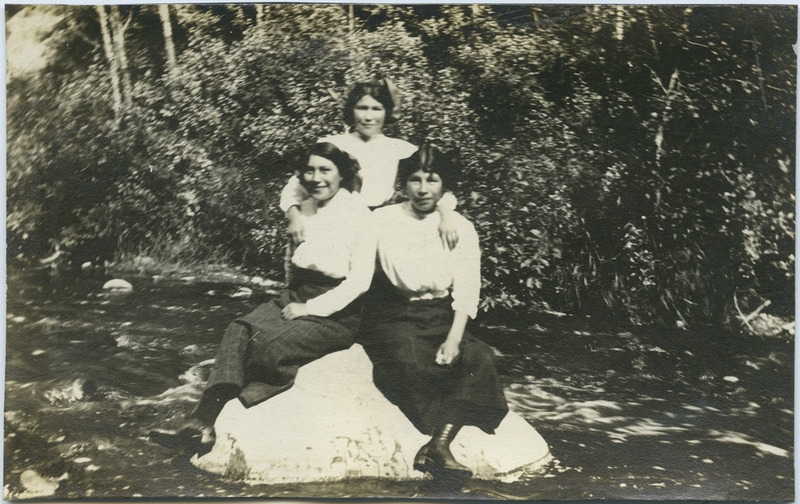
Abbie Sampson (elsewhere spelled Samson), from Samson Cree Nation, was born on July 16, 1903, to parents Jane and Lazarus. Her birth name was Blandine, but she always went by her second name—Abbie. Shortly after she was born, her father died. Her Nation surrounded her with support and comfort. As told in Those Who Know: Profiles of Alberta’s Aboriginal Elders: “The little girl who had lost her father at such a young age stole the hearts of Elders on the reserve. Among Abbie’s earliest memories are those of old people picking her up, tears glistening in their eyes as they remembered her deceased father.” Abbie and her younger sister grew up with matriarchs: their mother and grandmother. They lived in a big log house with a fireplace made of clay and willow. The women kept their home clean and comfortable. Abbie milked cows and rode horses. She completed three years at the Samson day school, close to home.
In the 1906 and 1911 censuses, Abbie (recorded with last name Twins) is documented at home on the “Hobbema Indian Reserve.” But within a year, in 1912 and at the age of nine, she was taken to Red Deer Industrial School.
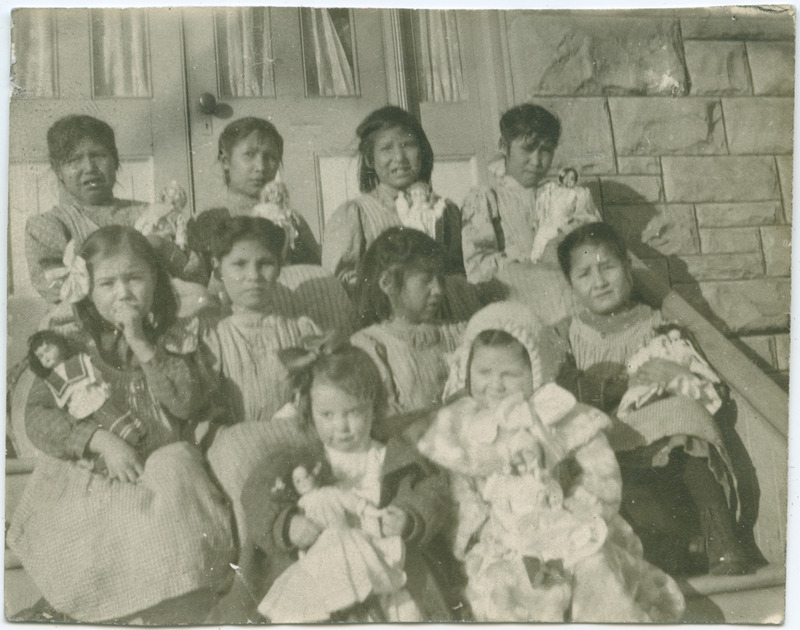
In the school register, Abbie was not assigned a trade or vocation. If she had been, it almost certainly would have been “housekeeping”—the only vocation assigned to the girls forced to attend Red Deer Industrial School. She likely spent much of her time in the basement, where the laundry and bakery were located. A large, brick oven extended underground beyond the building. In 1916, the school newsletter stated: “Jessie Bull and Maggie Bull make very good bread under the instruction of Miss Story. They sometimes leave some of the plain bread dough in the morning and at about one o’clock Abbie Sampson rolls it into small balls about the size of a hen egg and lets it rise three and a half hours.” Boys and girls were segregated when Abbie went to Red Deer, but per her memories—relayed by grandson Eugene (Ross) Burnstick—the children snuck from their dormitories at night to speak Cree with one another.
When she was 88 years old, Abbie was interviewed; her story appears in Dianne Meili’s Those Who Know: Profiles of Alberta’s Aboriginal Elders. Within the chapter are one of only a few examples of a Survivor’s testimony about Red Deer Industrial School. In Abbie’s own words:
“We only went home for a month in July. Many a time we had to cry, we were so lonely. We were taught to do housework real good, but we didn’t get much education…
[T]hey fenced us girls in like little prisoners. The boys were free to go most places—we couldn’t go anywhere.”
Abbie survived Red Deer Industrial School. She was known as one of the first women from her Nation to travel and wear pants in the 1920s. In 1936, she married Peter Burnstick, himself a Survivor of Red Deer Industrial School (Peter was admitted to the school in 1909 at the age of 10). Abbie moved to Paul First Nation and raised her family; she remained there until her death in 1993.
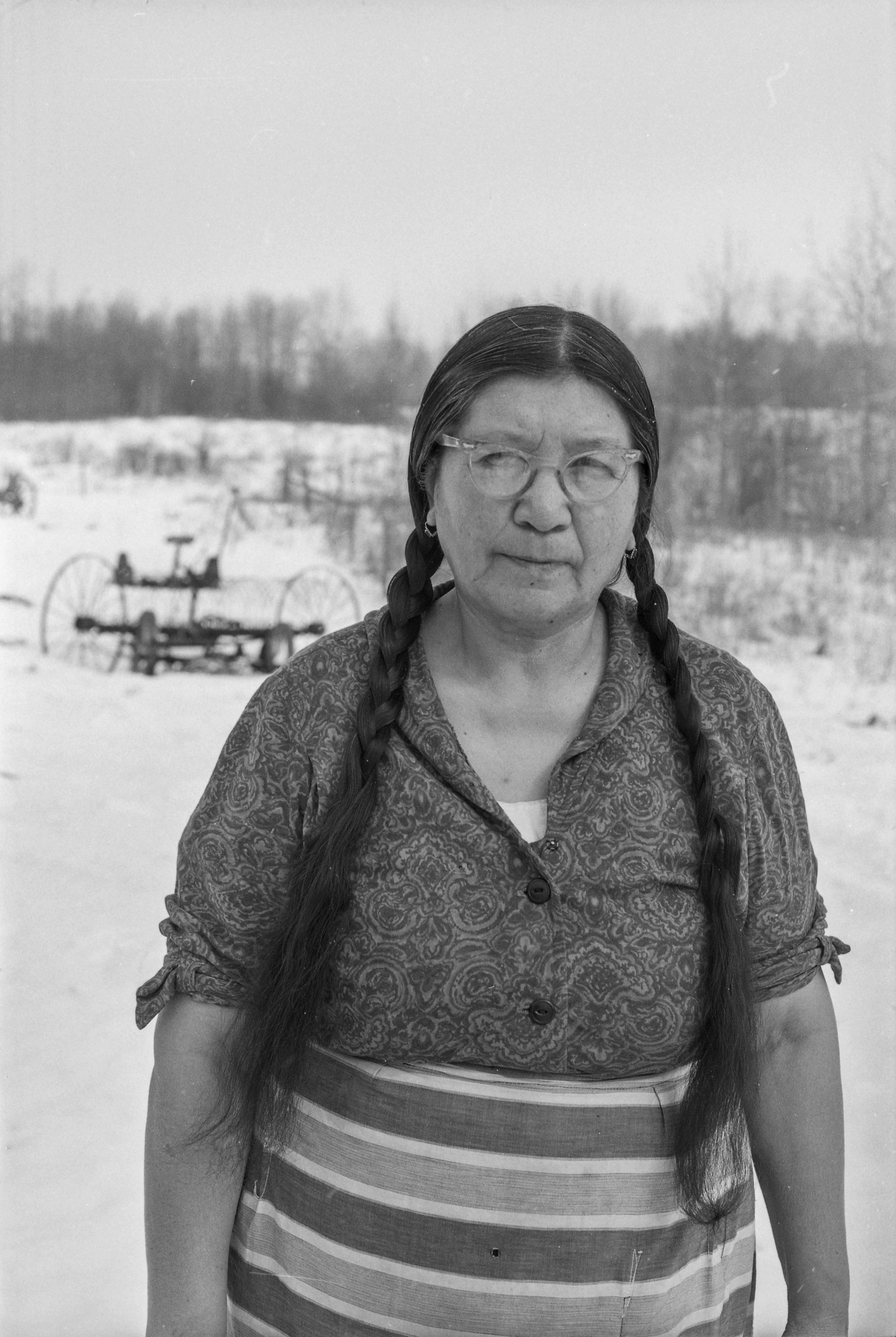
Within Paul First Nation, Kokum Abbie is remembered as being exceptional. As a Survivor of Red Deer Industrial School, she was subjected to inarguable harshness, yet she demonstrated no ill will or bitterness toward others. She was welcoming of everyone and never turned anyone away. She remained busy as an Elder, actor, artist, mother and grandmother. Paul First Nation member Donald (Donny) Rain, who spent much of his childhood with Abbie, recalled: “[She was] the most loving human being I have ever known…there is no greater motivation or inspiration as a Survivor than her.”
During the Truth and Reconciliation Commission’s Red Deer Hearing in 2013, the late Métis activist Muriel Stanely Venne spoke to the lasting, intergenerational impacts of residential schools. She honoured both the girls who were taken, and the mothers who were left behind. “…[T]he women suffered. As the givers of life, the women suffered the most, perhaps…Our women imploded. They lost their reason for living, in many cases.”
Abbie herself educated thousands of Canadians about the impacts of colonial violence and MMIWG2S through her role as Granny in Maria Campbell’s 1978 film The Red Dress. The film explores themes of cultural identity, sexual assault and the familial impact of colonialism. Disproportionate violence against Indigenous women, girls and Two-Spirit peoples remain one of the most disturbing legacies of colonialism, spurring the Truth and Reconciliation Commission’s Call to Action 41, the National Inquiry into Missing and Murdered Indigenous Women and Girls, and further research regarding the harmful, intergenerational effects of residential schools.
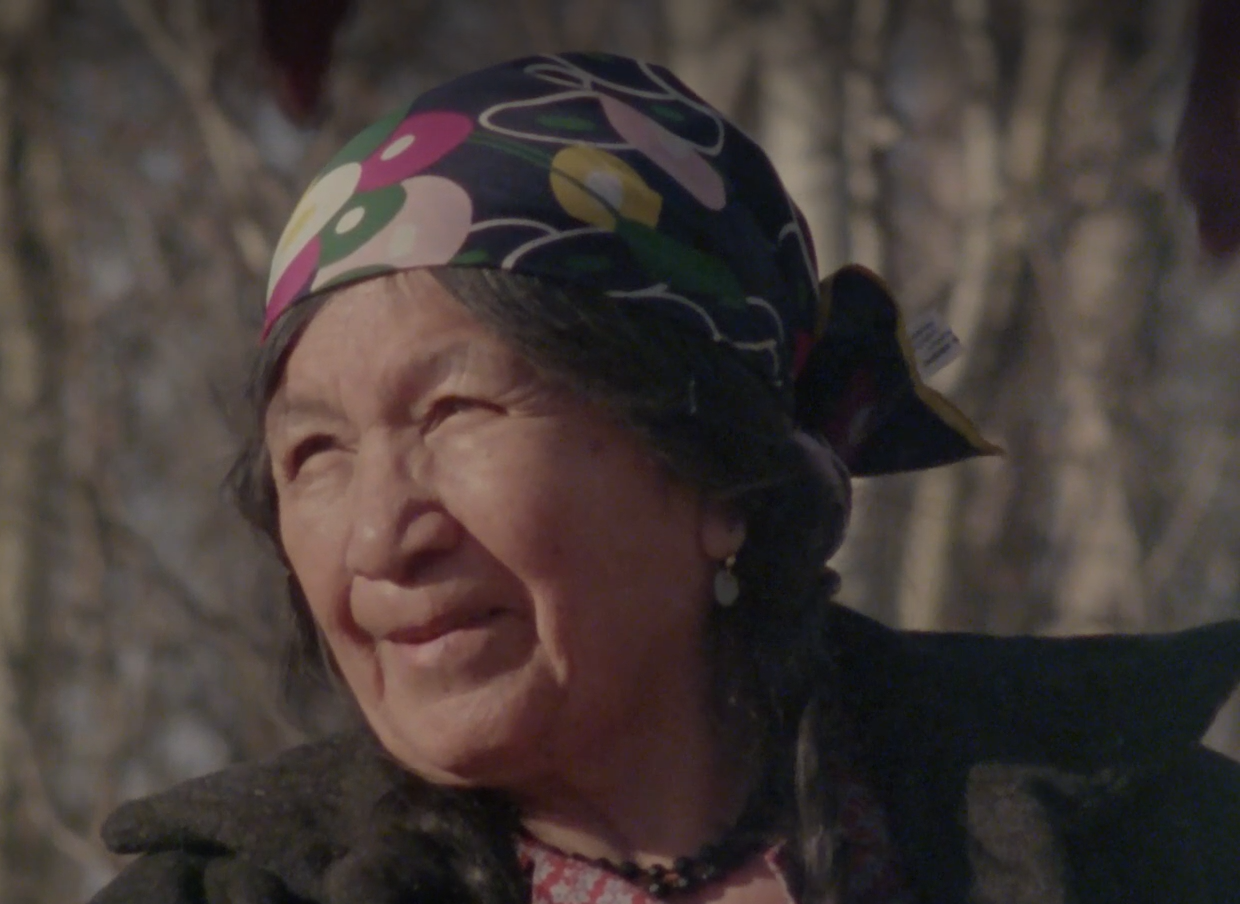
Abbie Burnstick was one of more than 350 children, and one of 133 girls, who were forced to attend Red Deer Industrial School during its 26 years of operation. The Historic Resources Management Branch is honoured to be collaborating with Survivor Nations regarding the preservation and recognition of the Red Deer Industrial School cemetery, and on broader truth-telling initiatives. We recognize this post represents just the beginning of uncovering and sharing these dark truths.
Thank you to Harvey Buffalo from Samson Cree Nation and Donny Rain from Paul First Nation for their ongoing collaboration and guidance. Special thanks to Eugene (Ross) Burnstick for sharing his memories of his kokum. Hiy hiy and ishnish.
Sources and further learning
Buffalo, Harvey, Treaty 6 Territory. Wolf Creek. Personal communication, August 26, 2026.
Burnstick, Eugene (Ross), Treaty 6 Territory. Enoch Cree Nation. Personal communication, September 23, 2026.
ChiefCalf, April Rosenau. (2002). Victorian ideologies of gender and the curriculum of the Regina Indian Industrial School, 1891-1910 [Master’s thesis]. University of Saskatchewan. Retrieved online from https://gladue.drc.usask.ca/sites/gladue.drc.usask.ca/files/2022-08/Victorian%20Ideologies_ChiefCalf.pdf
Dominion of Canada. (1894). Annual report of the Department of Indian Affairs for the year ended June 30, 1894. Retrieved online from https://recherche-collection-search.bac-lac.gc.ca/eng/home/record?browse=1&app=indaffannrep&IdNumber=29&ecopy=1894r001
Dominion of Canada. (1906). Annual report of the Department of Indian Affairs for the year ended June 30, 1906. Retrieved online from https://central.bac-lac.gc.ca/.redirect?app=indaffannrep&id=43&lang=eng&ecopy=1906r001.
Fox, Uta. (1993). The failure of the Red Deer Industrial School [Master’s thesis]. University of Calgary. Retrieved online from https://ucalgary.scholaris.ca/items/e1672ffe-d390-4740-b7bf-3815b58e4ad4.
Library and Archives Canada. Indian Affairs. RG10, Volume number: 3921, file 116, 818-1B.
Meili, Dianne. (2012). Those who know: Profiles of Alberta’s Aboriginal Elders. Edmonton: NeWest Press.
Miller, J.R. (1996). Shingwauk’s vision: A history of Native residential schools. Toronto: University of Toronto Press.
National Centre for Truth and Reconciliation. Muriel Stanley Venne. Red Deer hearing sharing panels. Retrieved online from https://archives.nctr.ca/SP116_part08.
No author. (1896, October 20). “A successful fall fair–Notes on the cattle and other exhibits.” The Daily Herald.
Rain, Donald (Donny), Treaty 6 Territory. Paul First Nation. Personal communication, September 2, 2026.
Red Deer Industrial Student Register, Provincial Archives of Alberta PR1979.0268/162.
Sessional papers of the Dominion of Canada: volume 9, fifth session of the seventh Parliament, session 1895. Library and Archives Canada. Retrieved online from: https://www.canadiana.ca/view/oocihm.9_08052_28_9/6
Sessional papers of the Dominion of Canada: volume 10, sixth session of the seventh Parliament, session 1896. Library and Archives Canada. Retrieved online from: https://publications.gc.ca/collections/collection_2021/parl/x12-3/X12-3-10-1896-eng.pdf
Sessional papers of the Dominion of Canada: volume 11, fifth session of the eighth Parliament, session 1900. Library and Archives Canada. Retrieved online from: https://publications.gc.ca/collections/collection_2021/parl/x12-3/X12-3-11-1900-eng.pdf
Titley, Brian. (1992). “Red Deer Indian Industrial School: A case study in the history of Native education.” Exploring our educational past: Schooling in the North-West Territories and Alberta, (eds. Nick Kach and Kas Mazurek). Calgary: Detselig Enterprises Limited., 55-72.
Truth and Reconciliation Commission. (2015). Honouring the truth, reconciling for the future: Summary of the final report of the Truth and Reconciliation Commission of Canada. Retrieved online from https://nctr.ca/wp-content/uploads/2021/01/Executive_Summary_English_Web.pdf.

