Editor’s note:September 30 is the National Day for Truth and Reconciliation and Orange Shirt Day.Reading residential school histories can be a painful process. If reading this is causing pain or bringing back distressing memories, please call the Indian Residential Schools Crisis Line at 1-866-925-4419. The Crisis Line is available 24 hours a day and can also provide information on other health supports provided by the Health Canada Indian Residential Schools Resolution Health Support Program.
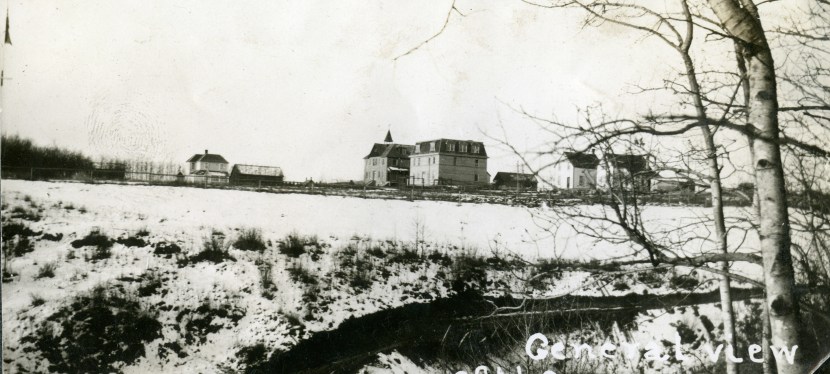
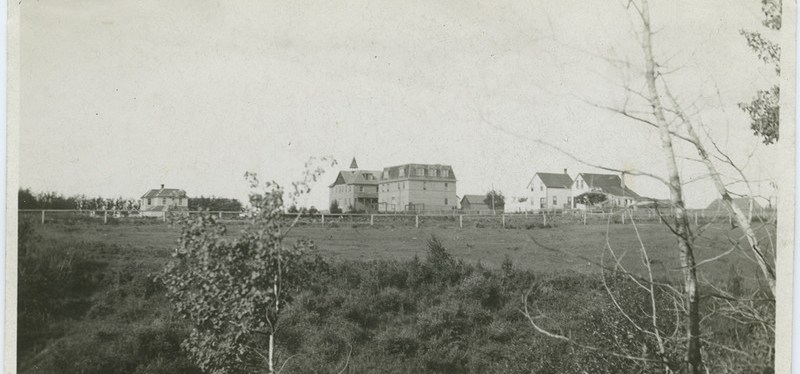
The banner image above is “General view of the I.I. School.” Date unknown. Source: City of Red Deer Archives, P10890.
Written by: Laura Golebiowski (Indigenous Consultation Adviser) in collaboration with Whitecap Dakota First Nation.
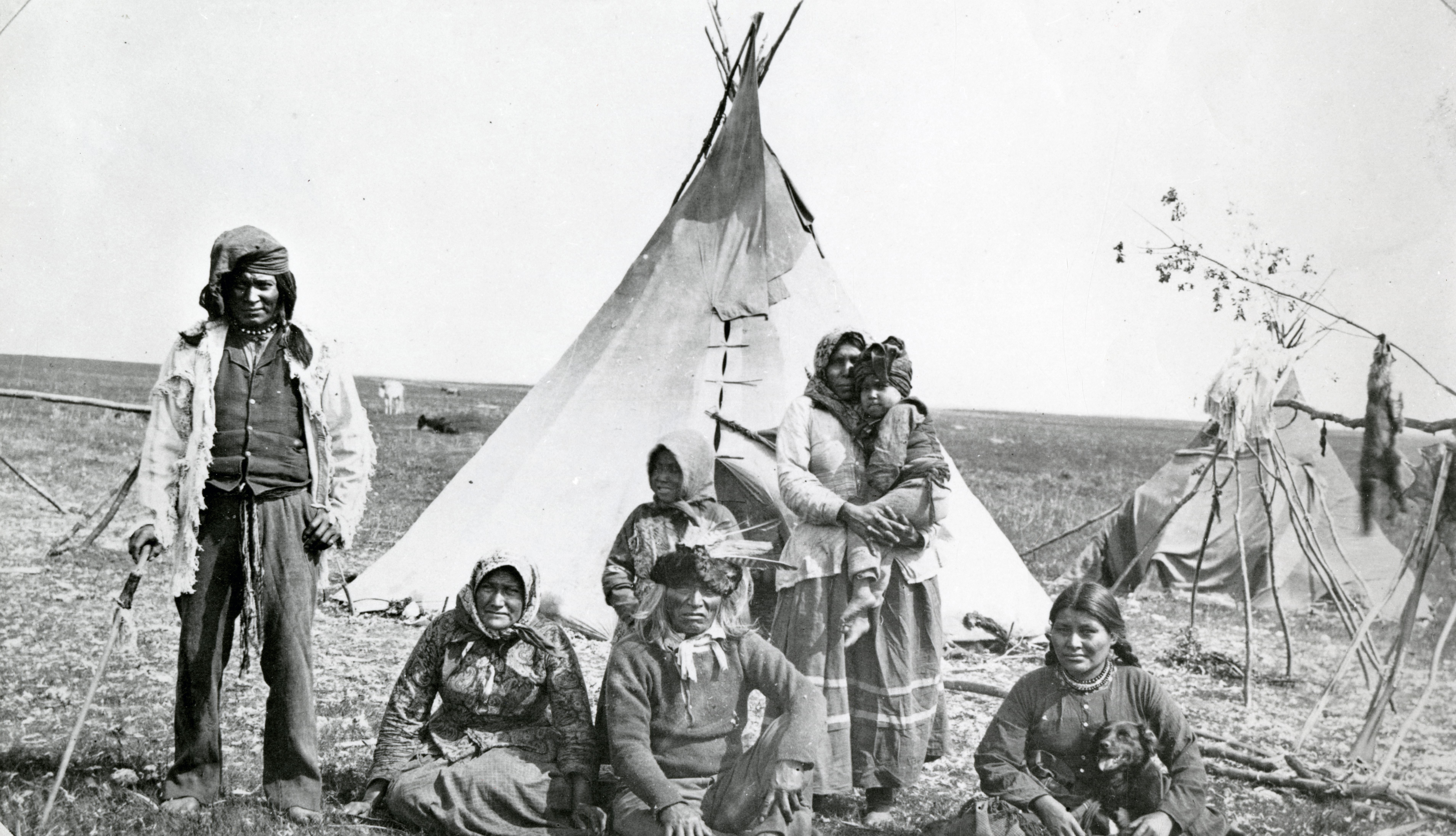
In the late 1880s, a group of Dakota Oyate led by Chief Whitecap were making their home along the northern extent of their territory. They settled near Mni Duza—the South Saskatchewan River—on a landscape known as “Moose Woods”: rich with water, wood, wildlife and plants for sustenance and ceremony.
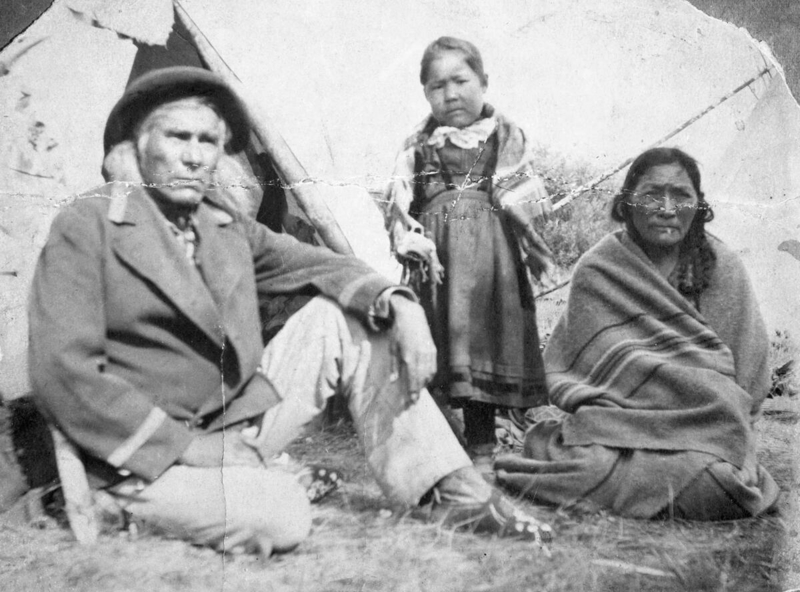
Chief White Cap (seated centre) and members of his family, ca 1885. LH-5418, Saskatoon Public Library.
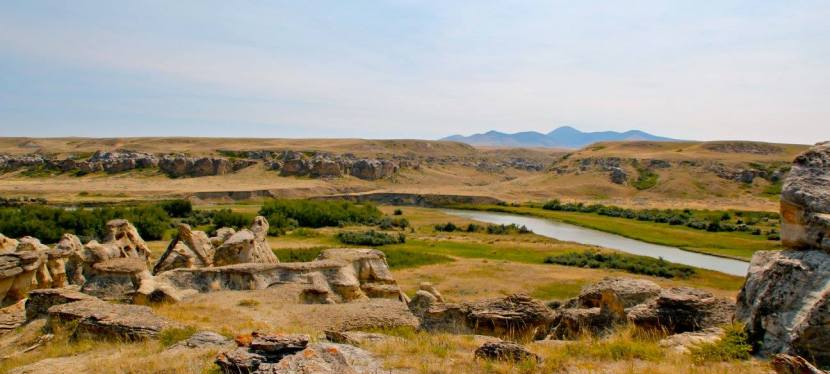
Editor’s note: The banner image above is of Áísínai’pi/Writing-on-Stone. Source: Laura Golebiowski.
Blair First Rider is a Kainai (Blood Tribe) Elder and Horn Society grandparent, and an Indigenous Consultation Adviser with the Historic Resources Management Branch. Thank you Blair for sharing your grandfather’s stories. Suukapi!
Written by: Blair First Rider and Laura Golebiowski, Indigenous Consultation Advisers
In a previous RETROactive blog post, we discussed the seasonal round: the Niitsitapi (“the real people,” how the Blackfoot refer to themselves) concept that structures the year and our relationship to the land and one another. In this post, we learn some of the ways the Niitsitapi spent time during the hot summer months at the turn of the century.
This knowledge was shared by George First Rider, Blair’s paternal grandfather. George was born in 1904 on the Kainaiwa (Blood Tribe) reserve. His father was Dog Child and his mother was The Only Handsome Woman, also known as Catching Another Horse.
George First Rider was a kipita-poka: a grandparent’s child. Deeply loved and cared for by his family, he was afforded a lifestyle of traditional knowledges and practices. He was also a member of the Horn Society and other age-grade Societies (the complex social and ceremonial system that Niitsitapi men participate in from the age of seven or eight to adulthood. Niitsitapi women participate in the Motokis Society). Through ceremonial transfers, George learned many songs and earned the ability to conduct many ceremonies.
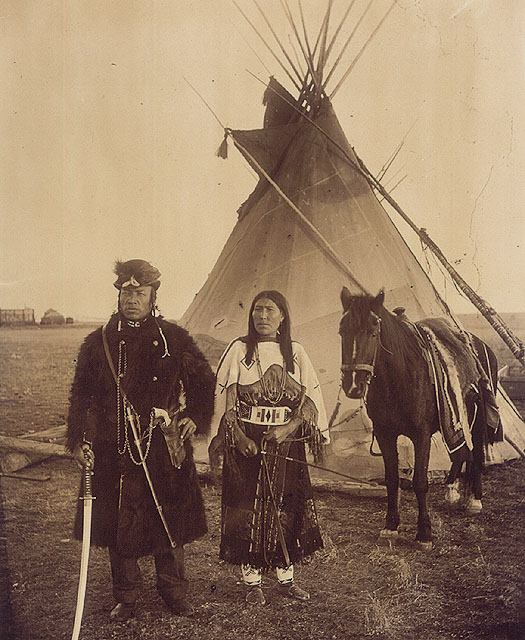
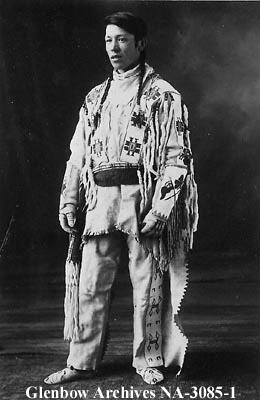
Dog Child, a North West Mounted Police scout, and his wife, The Only Handsome Woman, members of the Blackfoot Nation.” [ca 1890]. Credit: Trueman and Caple / Library and Archives Canada / PA-195224.“George First Rider, Blood.” [1925-02-21] (CU 187940) by Atterton. Courtesy of Glenbow Library and Archives Collection, Library and Cultural Resources Digital Collections, University of Calgary.Read more →
Editor’s note: September 30 is National Day for Truth and Reconciliation and Orange Shirt Day. Reading residential school histories can be a painful process. If reading this is causing pain or bringing back distressing memories, please call the Indian Residential Schools Crisis Line at 1-866-925-4419. The Crisis Line is available 24 hours a day and can also provide information on other health supports provided by the Health Canada Indian Residential Schools Resolution Health Support Program.
An earlier version of this article appeared in the December/January 2024 issue of Nisichawayasi Achimowina.
Written by: Laura Golebiowski (Indigenous Consultation Adviser), in collaboration with Nisichawayasihk Cree Nation.
“Eight children, an equal number of boys and girls, were going with us to enter a Residential School… I applied, but without success, to the Principal of the Brandon Residential School, for the admittance of the Indian children. That they were “non-treaty” was the alleged objection. As, however, the Red Deer school was willing to receive them, we decided to take them there…In the course of two or three years, five of those apparently healthy children had died from Tuberculosis.”
– Samuel Gaudin, in Forty-Four Years with the Northern Crees
Nisichawayasihk Cree Nation are the Nisichawayasi Nehethowuk: the people whose ancestors lived near where the three rivers meet and who speak Nehetho, the language of the four winds. Their territory includes the rich lands of the Canadian Shield and boreal forest in what is now northern Manitoba. Their central community hub is located at Nelson House, a long-time place of Indigenous occupation where the Hudson’s Bay Company established a trading post in the late 1700s.
The rocky shoreline of Footprint Lake, Nisichawayasihk Cree Nation territory near Nelson House, Manitoba. Source: Laura Golebiowski.
Editor’s note: Tansi! June is National Indigenous History Month, the opportunity to learn about the unique cultures, traditions and experiences of Indigenous communities in what is now Alberta and across Canada. This month also marks the 125th anniversary of the signing of Treaty 8, which encompasses a land mass of approximately 840,000 kilometres and includes portions of Alberta, British Columbia, Saskatchewan and the Northwest Territories. In Alberta, much of Treaty 8 territory is delineated by the Athabasca River extending north. Treaty 8 territory also includes the north shore of Lac La Biche extending northeast to the Saskatchewan border, as well as portions of Jasper National Park.
The banner image above is courtesy of Laura Golebiowski.
Written by: Laura Golebiowski (Indigenous Consultation Adviser) in collaboration with Woodland Cree First Nation.
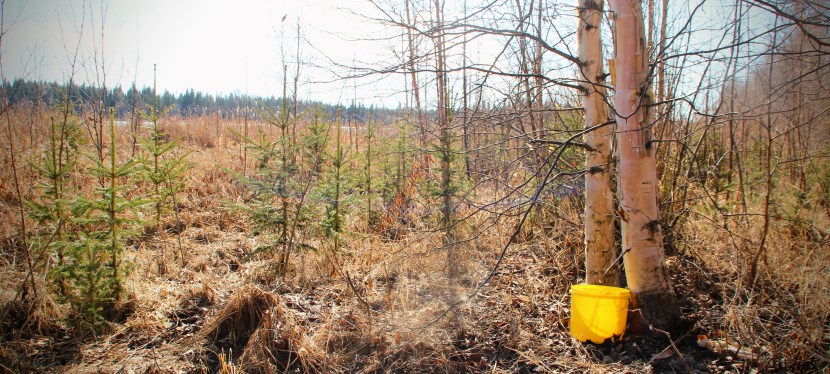
“I believe Spring speaks its truest word when you can see the women setting out pails to get that sap from the birch tree,” Chief Dan George narrates in the 1973 film Season of the Birch. The short documentary focuses on intangible heritage knowledge and practices that are still present in Cree communities in Treaty 8 today: the tapping of birch trees and the making of birch syrup.
The window for birch tapping is incredibly narrow. The waskwayâpoy (birch sap) runs best in the early spring when the snow has melted, but before the tree leaves appear. At the kind invitation of Lawrence Lamouche, Traditional Lands Manager, I visited Woodland Cree First Nation in late April, to witness this centuries-old practice and learn how Knowledge-Keepers harvest waskwayâpoy and make birch syrup.
Editor’s note: September 30 is National Day for Truth and Reconciliation and Orange Shirt Day. Reading residential school histories can be a painful process. If reading this is causing pain or bringing back distressing memories, please call the Indian Residential Schools Crisis Line at 1-866-925-4419. The Crisis Line is available 24 hours a day and can also provide information on other health supports provided by the Health Canada Indian Residential Schools Resolution Health Support Program.
Written by: Laura Golebiowski (Indigenous Consultation Adviser) in collaboration with Whitefish Lake First Nation #128.
Emma Stanley was born in 1886, in the area known today as Whitefish Lake in northeastern Alberta. Her mother was Eliza and her father was Cheepo-Koot, or Charles. She had at least two sisters. The last name Stanley was assigned to Indigenous families upon christening by the Methodist ministers of time. These assigned names are still known and common in the community today.
Emma and her family were members of James Seenum’s Band, contemporarily known as Whitefish Lake First Nation #128. Their leader was Chief Pakan, or James Seenum: “a very forceful and highly respected figure.” When the Nation signed Treaty Six, Cheepo-Koot was selected as one of three Councillors.
In the years and decades prior to Emma’s birth, James Seenum’s Band members lived by the Cree seasonal round, which influenced their hunting, fishing, agricultural and travel practices. “In the spring-time, after the potatoes and turnips were planted, [the people] went south on their buffalo hunt, leaving the missionary and a few of the older people at home to look after the place and anything that had to be done. They would travel till they came to the buffalo range. After a good day’s hunt there was lots to do, such as curing the meat so it would keep. The surprising thing was that there was no such thing as flies to bother the fresh meat.”
“James Seenum, Pakan, and family at Whitefish Lake reserve, Alberta,” ca early 1900s. (CU194507) by unknown photographer. Source: Glenbow Library and Archives Collection, Libraries and Cultural Resources Digital Collections, University of Calgary.
Editor’s note: Banner image of Dene Tha’ First Nation drummers at M’behcholia courtesy of Laura Golebiowski.
Written by: Laura Golebiowski (Indigenous Heritage Section) in collaboration with Dene Tha’ First Nation and Matt Munson (Yves Claus Didzena)
It was known as The Place of Frozen Smoke. Where, on cold winter days, the smoke from countless campfires could be seen rising high above the lakeshore. A landscape that has sustained Dene Tha’ First Nation since time immemorial. It’s name is M’behcholia, translating to Big Knife, or Bistcho Lake. The name of the lake itself is M’behcho. Multiple English spellings and translation attempts exist for these names.
For many, it is an ancestral place where all living Dene Tha’ First Nation members have a connection. Elders and knowledge-keepers tell us there are trails all around, extending from the lake. The Dene Tha’ used horses, canoe and dog teams to travel the vast expanse of shoreline, pitching tents and tipis to camp and make dry fish and meat along the way. The lakeshore was dotted with permanent settlements, seasonal camps, fishing spots, gravesites and sacred places. Each place had a Dene name, inspired by the activities that occurred there.
M’behcholia in the fall. Source: Laura Golebiowski.
It was the birthplace of several Ndátin—dreamers or prophets—including Gochee (Brother), Mbek’ádhi (He is Recovered) and Nógha (Wolverine). These spiritual leaders were trained by listening to the stories of animals and powerful ancestors, and would relay visions of the future to the Dene Tha’.
Written by: Travis Rider (Stoney Nakoda Nations) and Laura Golebiowski (Indigenous Heritage Section)
The Stoney people have called the Rocky Mountains home since time immemorial. We are often referred to as Îyâhre Wîchastabi, meaning people of the Rocky Mountains or the people in the shimmering mountains. Today we are known as the Stoney/Assiniboine People. We are linguistically related to the woodland and plains Nakoda speakers and a part of the Great Sioux Nation.
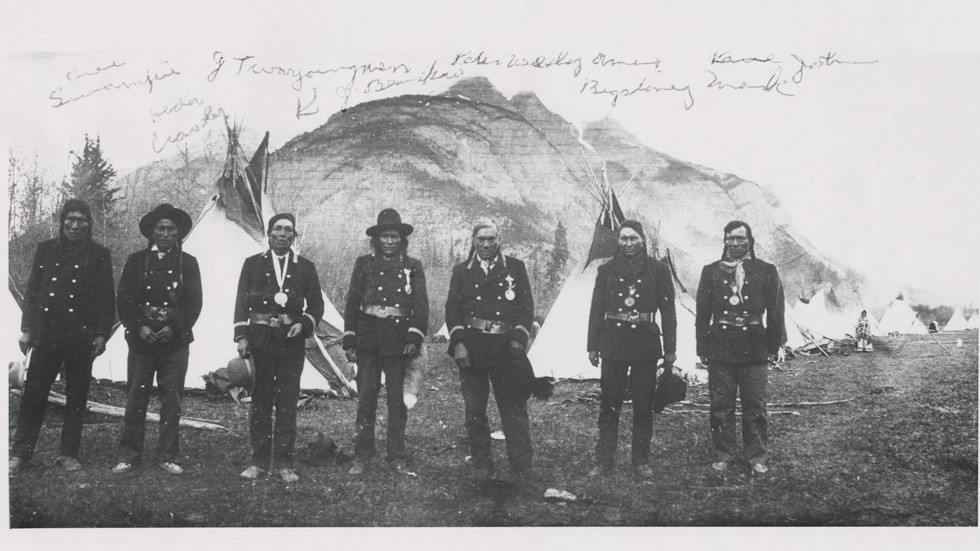
Stoney men in front of Mînî Hrpa (Cascade Mountain), ca 1901. Hector Crawler, Travis Rider’s great-great-great grandfather, is second from the left. Source: Peter and Catharine Whyte Fonds, Whyte Museum of the Canadian Rockies.
I am a Stoney Nation member and language-keeper. I grew up with the teachings, language and traditions of my mother, father, grandmothers and great-grandfathers. I did not speak English until I began school, and today I facilitate in addictions and mental health, incorporating the language. I was also part of the Stoney Education Authority’s dictionary initiative, working with Elders, linguists and community members to build a database of vocabulary and develop resources for the promotion of the Stoney language for future generations.
Written by: Laura Golebiowski, Indigenous Heritage Section
Editor’s note: November 14-20 is Métis Week, the annual invitation to remember the leadership, advocacy, sacrifice and legacy of Louis Riel, and to celebrate the continued achievements of Métis peoples across their homelands.
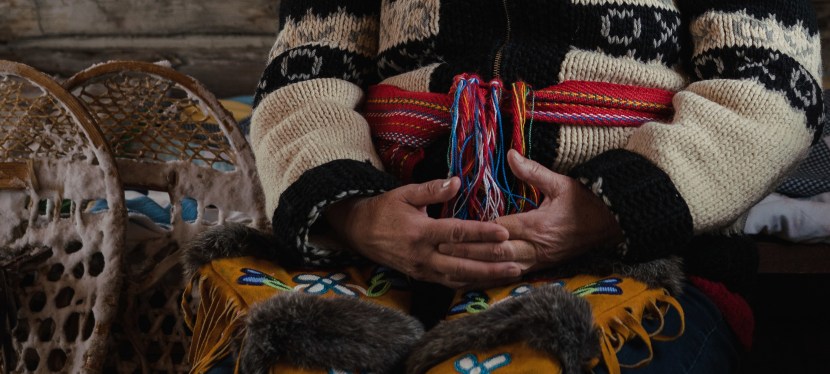
RETROactive readers will already be familiar with Matt Hiltermann for his extensively researched accounts of the Métis presence in southern Alberta. Did you know he is also a skilled fingerweaver and sashmaker? With Matt’s help, writer Laura Golebiowski dives into the historical roots and evolving cultural significance of the Métis sash.Note: banner image above courtesy of Travel Alberta.
Métis public historian Matt Hiltermann is the first to note the origins of the Métis sash are convoluted and obscure. Though several cultures produced woven textiles, the sash’s beginnings are understood to lie with the traditional weaving practices of eastern woodland First Nations, combined—quite literally—with woolen goods introduced by early French visitors. The coming together of these two cultures and crafts produced a unique item truly of its time and place. “It couldn’t have happened any other way or anywhere else.”
With practical beginnings, the sash likely served numerous functions, including a rope, tumpline (a carrying strap worn across the head), pocket, tourniquet, emergency sewing kit or belt. The earliest designs were that of the double-chevron or arrowhead. The Assomption sash, or ceinture fléchée (“arrow belt”), proliferated with the fur trade and made its way to west. Varying colours and designs were used to signify rank, status and trading allegiances or employment.
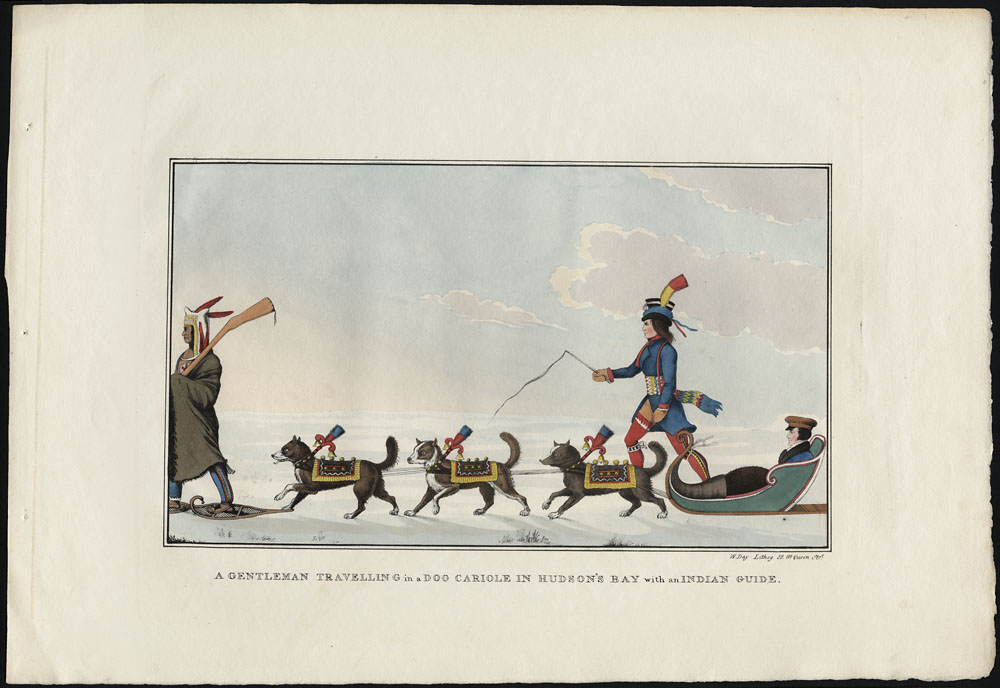
“A gentleman travelling in a dog cariole in Hudson’s Bay with an Indian guide,” 1825. Source: Library and Archives Canada, Acc. No. R9266-1052.2 Peter Winkworth Collection of Canadiana. Although not explicitly identified as such (typical of exclusionary practices of the time), the middle individual driving the cariole and wearing a traditional capote, leggings and sash is very likely Métis.
Editor’s note: Abawashded!June is National Indigenous History Month, an invitation to honour the history, diversity, strength and contemporary achievements of Indigenous peoples.
Written by: Barry Mustus (Alexis Nakota Sioux Nation) and Laura Golebiowski (Aboriginal Consultation Adviser)
Like many Albertans, I have spent a considerable portion of the last year outdoors. I have become better acquainted with my neighbourhood and city parks, and have spent most weekends hiking, camping or cross-country skiing in the mountains. I am grateful to be in a position (both in terms of privilege and location) to access the diverse and beautiful outdoor spaces that our province provides.
When you recreate outdoors, do you consider whose traditional territory you are on? Do you think about those who walked these trails and enjoyed these landscapes before you?
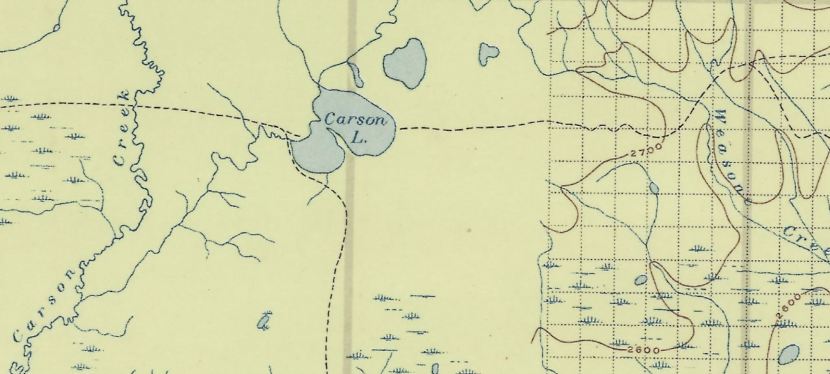
Barry Mustus does. An Alexis Nakota Sioux Nation member currently based in Whitecourt, Barry has dedicated numerous years to the research and reidentification of a historic Indigenous trail network which extended from Lac Ste. Anne north to Whitecourt and beyond. To date, Barry’s work has focused on a 30 km stretch of trail from the Hamlet of Blue Ridge, southeast of the Town of Whitecourt, to Carson-Pegasus Provincial Park. Referring to the trail as, “The Nakota Trail of 1877” (the year Alexis Nakota Sioux Nation signed an adhesion to Treaty 6), Barry’s efforts strive to demonstrate how Nakota peoples have shaped, and continue to shape, this region of what is now Alberta.
The Stoney people, also referred to as the Assiniboine, have long occupied this area. In 1859, James Hector, a companion of Captain John Palliser, noted a group of Stoney camping at the confluence of the McLeod and Athabasca Rivers, where present-day Whitecourt is located. Earlier still, fur trader Alexander Henry makes mention of a Stoney presence in the Upper Athabasca in 1808. Today, Alexis Nakota Sioux Nation is the most northwestern representative of the Siouan language family and has four reserves: the largest at Glenevis near Wakamne (Lac Ste. Anne) with three satellite reserves at Cardinal River, Elk River and Whitecourt.
Alexis Nakota Sioux Nation Family, Peter Alexis and Wife, Lac Ste Anne. Unknown photographer or date. Source: Library and Archives Canada.
Written by: Blair First Rider and Laura Golebiowski, Aboriginal Consultation Advisers
Oki! For many of us, the spring season represents new life and a fresh start. But did you know, in Blackfoot culture, the new year begins in the spring? Aboriginal Consultation Advisers Blair First Rider and Laura Golebiowski, both based in Treaty 7, discuss the significance of the seasonal round: a concept that not only structures the year, but also our relationships to the land and one another.
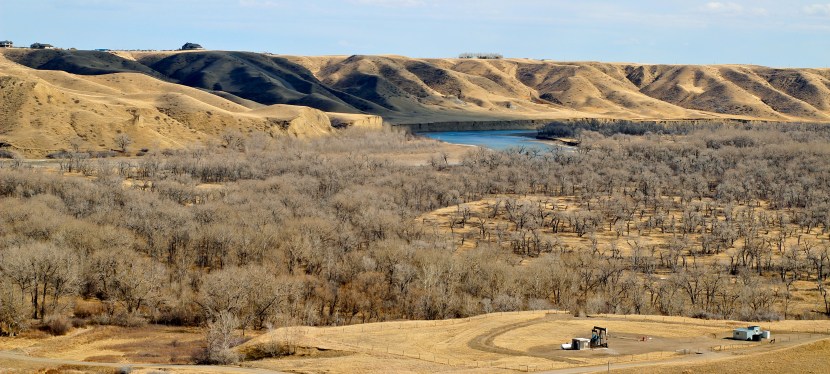
We meet today on Kainai Nation at an area called Weasel Fat Bottom, a flood plain on the south side of the Oldman River. These flats also served as an ideal traditional camping location, with proximity to water, cottonwood tree stands and grazing areas. The trees provide shelter from the wind, and beneath them medicinal plants and berries grow. We are here to learn about the seasonal round: a concept that has guided the travel, occupation and relationships of the Niitsitapi (how the Blackfoot refer to themselves, translating to “the real people”) since time immemorial, and one that still has important teachings today.
Blair First Rider stands in front of a modern medicine wheel, built during a recent Blackfoot Confederacy gathering. Source: Laura Golebiowski.
In the old days, Sky Being Ksisstsi’ko’m (Thunder) gave the Niitsitapi the Thunder Medicine Pipe Bundle. The pipe offered protection, as well as a promise that Ksisstsi’ko’m would bring the rains that would make the berries grow large and ripe. Accordingly, the new year is marked by the first clap of thunder of the first rainstorm. It is commemorated with ceremony: the gathering of the seven Societies and the opening of the sacred bundles. Through prayer, song and dance, the relationships and commitments between Niitsitapi and the Creator, the Sky Beings and the land, are renewed and affirmed. As Betty Bastien wrote in Blackfoot Ways of Knowing: the Worldview of the Siksikaitsitapi, “During these ceremonies we acknowledge and give thanks to our alliances for another cycle. We ask for continued protection, prosperity, long life, growth, and strength.”





 RETROactive