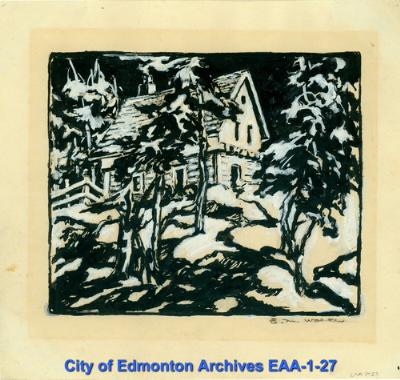
In a remote corner of north east Edmonton, bounded by Clareview Road and 129th Avenue, is a small unmarked parcel of land commanding a dramatic view of the North Saskatchewan River valley. Only faint ground depressions and a small interpretive marker betray the fact that this is the location of Canon William Newton’s Hermitage and the birthplace of the Anglican Church in what would become the Province of Alberta.
“The Hermitage” by Ella May Walker, City of Edmonton Archives, EAA-1-27.
William Newton was born in 1828 at Halstead, Essex, England into a family of weavers. Having obtained an education through the help of wealthy benefactors, he trained for the Unitarian Church, served as a Congregationalist minister and published two books of sermons. In 1870 he immigrated to Canada and was ordained into the Anglican Church by Bishop A.N. Bethune of Toronto. He spent four years at Rosseau and Howard Township in Ontario before being accepted by Bishop John McLean of Saskatchewan as a missionary with the Society for the Propagation of the Gospel at Fort Edmonton. Read more →
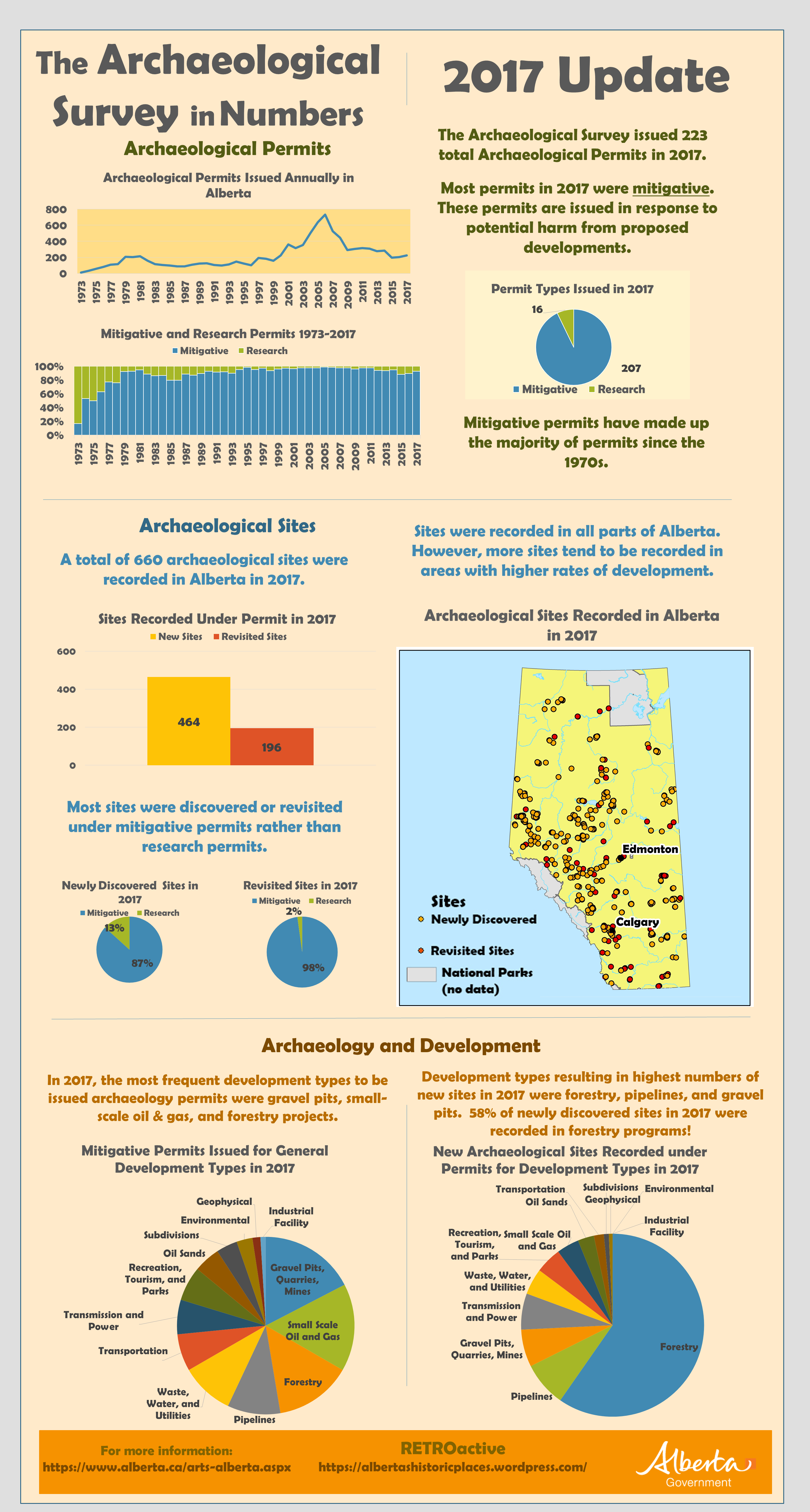
This week’s post is an update on archaeological project and site data for 2017 from the Archaeological Survey. Click the image below and zoom to see the full size infographic.
Note on archaeological sites: the site counts for 2017 are not yet final. They are constantly being updated as consultants and researchers submit their records to the Archaeological Survey. Stay tuned to RETROactive for up-to-date numbers.
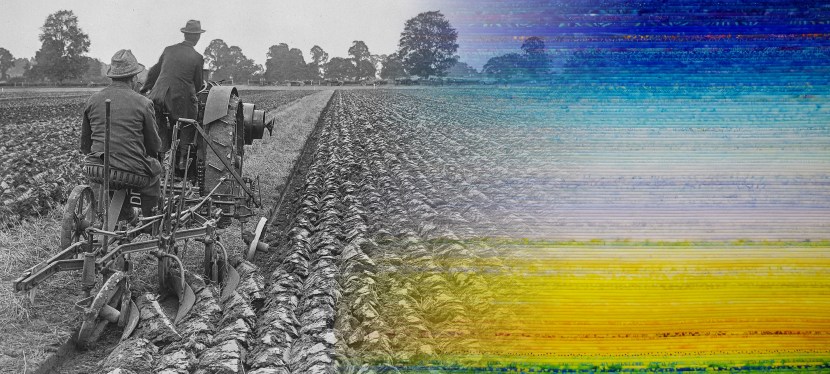
Farming in Alberta has been shaped by a deep and layered history of geological, biological, and human forces. This article takes us back to the beginning.
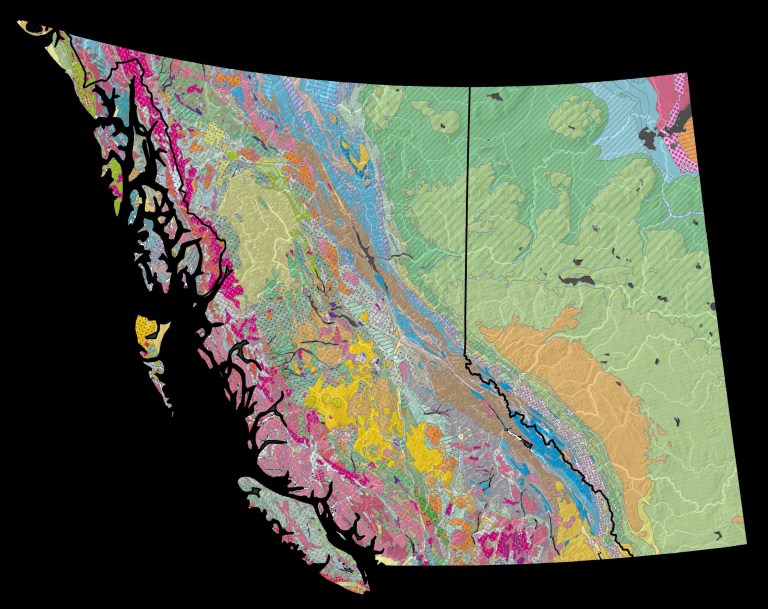
Farming is based on a sliver of soil that caps kilometers of sediment and bedrock. To understand how our fields first formed, we need to read an ancient geological story of how Alberta has been raised and tilted then scoured and capped over time. Alberta has sat inside a continental plate (or ‘craton’) for over 300 million years. Around 180 million years ago, the western edge of this plate began crunching to form the up-and-down terrain of the Coast Mountains of British Columbia (B.C.) and the Rocky Mountains between B.C. and Alberta (Figure 1). Mountain building finished about 50 million years ago.
Figure 1. This is a bedrock map of Alberta and B.C. “Bedrock” refers to the stony basement below our modern soil and loose sediment (gravel, sand, and silt). B.C. is striped with colour because its bedrock is made of diverse chunks of land called terranes that got repeatedly mashed against a moving continental plate that Alberta lay within. One product of this mash-up (‘accretion’) was mountain building (‘orogeny’). Creation of the western mountains forever shaped the development of soils and agriculture in the Prairie Provinces (map by Todd Kristensen with bedrock data from the USGS 2015).
For almost 200 million years, Alberta has been tilted: our bedrock is formed largely of shales and sandstones that built up when sediment either poured off the mountains and solidified into rock or settled down in ancient waters that once filled a basin over Alberta. From about 50 to 5 million years ago, huge sheets of gravel and sand continued to shed off the Rockies (carried by rivers and streams) before settling into our basement. Read more →
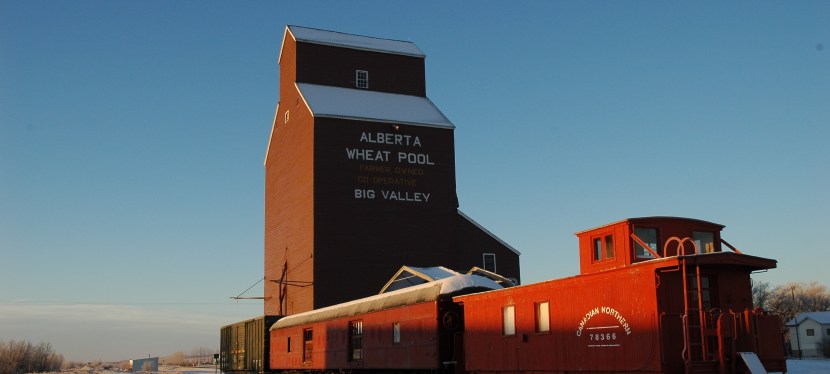
This post was originally published on RETROactive on March 6th, 2012 and again on August 26, 2015. Interest in grain elevators remains strong, so a revisit seems in order. Some additional data has been added, an updated list of communities with elevators can be accessed below, as well as a variety of resources and documents relating to Alberta’s Grain elevators.
The twentieth century saw the rise and fall—literally—of the wooden country grain elevator in Alberta. As rail lines spread across the province in the early 1900s, grain elevators sprouted like mushrooms after a spring rain. The height of wooden country grain elevators was reached in 1934. New ones continued to be added until the 1990s, but with increasing numbers being demolished, these icons of the prairie became scarcer. Today, the remaining wooden country grain elevators number only about six percent of the maximum reached in the 1930s. Check out the following “index” of Alberta’s wooden country grain elevators, called “elevators” for short in this article.
Grain elevators, Altario.
Stavely grain elevators, 1920 (Image: Provincial Archives of Alberta, P659).
Whether excavating archaeological sites or surveying the land in search of undiscovered ones, archaeologists create data. That data can take the form of field journals, artifact catalogues, GPS tracks and waypoints, photographs, excavation plans, level records, site forms, and reports. It is often said that for every month spent in the field, an archaeologist will spend a year in the lab and the office processing the field data they collected.
The Archaeological Survey (the Survey) began managing Alberta archaeological sites, research, and mitigation in 1972, with the passing of what is now known as the Historical Resources Act. At the same time, the Survey also became the official provincial repository for most archaeological data. Today the Survey collects and archives data for use by archaeological researchers, consultants, and other stakeholders, and also relies on archaeological data in order to run the historic resources management machinery. Read more →
Stampeders President Tom Brook holding the Grey Cup with Woody Strode in Toronto, November, 1948. Courtesy of the Calgary Stampeder Football Club.
In conjunction with Black History Month, RETROactive profiles Woody Strode, a pioneering African American player with the Calgary Stampeders who went on to a remarkable career in Hollywood.
The arrival of Herb Trawick to the Montreal Alouettes in 1946 signalled the beginning of African Americans playing in the Canadian Football League (CFL), expanding the talent pool of athletes available for Canada’s professional teams. The first African Americans to play in Alberta were Charles Clay (Chuck) Anderson and Woody Strode who joined the Calgary Stampeders for the 1948 season. Although Strode only played with Calgary for two seasons, he made a lasting contribution to the lore of Grey Cup festivities that are now considered to be Canada’s premier sporting event.
Woodrow Wilson Woolwine Strode, whose ancestors had intermarried with Creek (Muscogee), Cherokee and Blackfoot Native Americans, was born 25 July 1914 in Los Angeles. He studied at the University of California, Los Angeles where he had a stellar record as a decathlete and football player. Part time jobs with Hollywood film studios led to several uncredited film appearances and foreshadowed his future career. During the Second World War, Strode served with the Fourth Air Read more →
This recently completed scope involved foundation upgrades and stair revisions to the ground level access points of the building, including the addition of a compatible, distinguishable and subordinately designed barrier-free access ramp, as well as masonry repairs and the replacement of the 1980’s metal storms with more historically appropriate wooden units that will have the added benefit of allowing more natural ventilation in the building. Additional work also included the rehabilitation of the former fire exit door openings, the return of the round window at the top level of the building and the addition of vented caps to the non-functional chimneys. Read more →
For an animal that looks like an awkward collision of snail and squid (Figure 1), ammonites have played surprisingly important roles in international history. To Blackfoot First Nations on the Plains of North America, the ornate edges of ammonite segments resemble miniature bison (sometimes called buffalo), and, for over a thousand years, they have been used in ceremonies to summon bison spirits. Across the ocean, 16th to 19th Century fossil hunters propelled ammonites into palaeontological fame by using them to anchor theories of an ancient earth (Figure 2). In modern Alberta, Canada, miners and members of Blackfoot First Nations are seeking iridescent ammonites to fuel a global demand for art and jewellery; sacred and secular, and now economic, ammonites are immersed in a complex story. Read more →
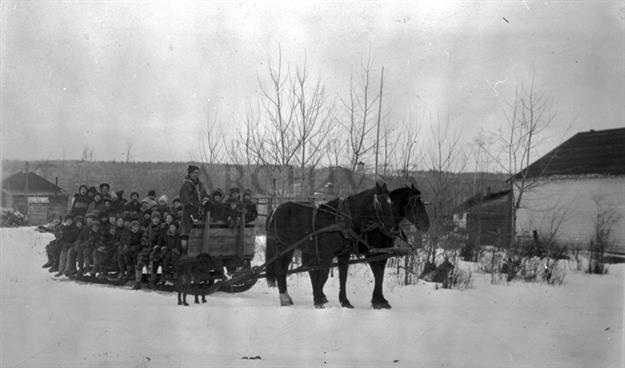
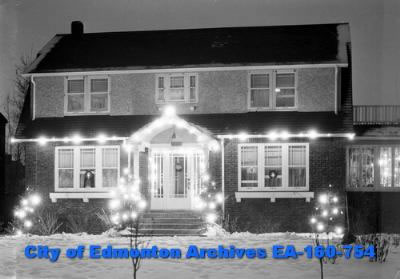
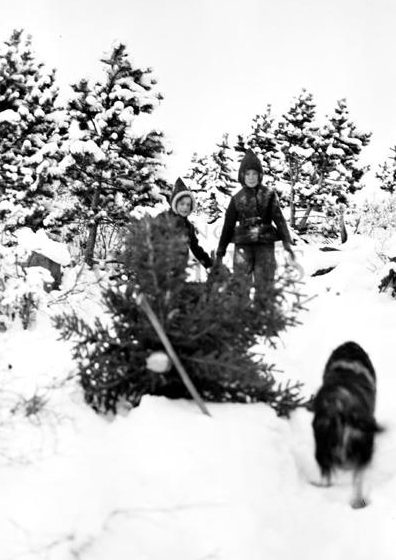
Season’s Greetings! With its hustle and bustle, Christmas Day will soon be here. Before we celebrate the magic of the holiday season, let us look back at the wonder and charm of a simpler time. The extensive photo collections at the Provincial Archives of Alberta and the City of Edmonton Archives offer a unique glimpse into the celebrations of Christmases past in Alberta; the following images were selected from their holdings to create a photo montage dedicated to old-fashioned holiday memories and traditions. Enjoy!
Christmas sleigh ride, Fort McMurray, December 1926, (Provincial Archives of Alberta, A11935)
Dowdell House, one of first homes to display Christmas lights in Edmonton, December 1931 (City of Edmonton Archives EA-160-754)
Got Christmas tree, Mountain Park, Alberta [ca. 1943-1944], (Provincial Archives of Alberta, CL120).
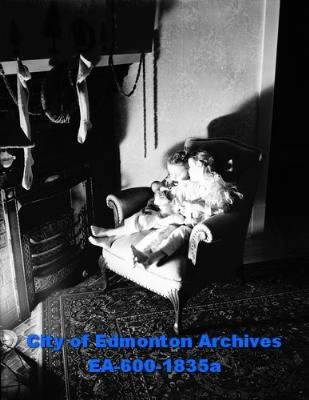
Judy and Paddy Unwin waiting for Santa Claus to come; they sit by fireplace – December 22, 1948 (City of Edmonton Archives EA-600-1835a)
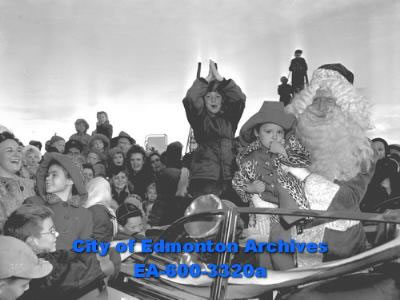
Santa arrives at airport. Patty Young sits on Santa’s knee – November 20, 1949 (City of Edmonton Archives EA-600-3320a)
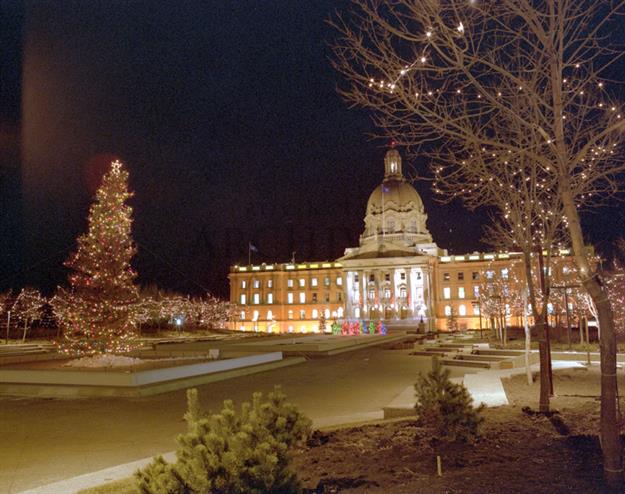
Alberta Legislature grounds and building, Christmas lights – Dec 7, 1987 (Provincial Archives of Alberta, A15850)
PLUM PUDDING – A VICTORIAN CHRISTMAS MUST!
Not only does the holiday season include fun outdoor activities, festive bright lights and the sweet sounds of Christmas melodies, but it is always filled with an assortment of tasty old-fashioned baked treats. Thanks to our colleagues at Rutherford House Provincial Historic Site, we are pleased to share one of Mrs. Rutherford’s classic Christmas desserts, a treasured family recipe for plum pudding passed down from her mother.
GRANDMOTHER BIRKETT’S PLUM PUDDING
Chop fine 2# suet, add #2 seeded raisins cut in half, #2 seedless raisins, ½# peel, ½ # almonds cut in half or slices 4 cups bread crumbs. Beat 8 eggs, 2 cups milk and 2 cups brown sugar together. Add sifted 2 cups of flour, ½ tsp cinnamon, ½ tsp nutmeg, 2tsp salt, 4 tsp baking soda. Combine with fruit. Fill oiled moulds 2/3 full. Steam 3 – 4 hours.
Sauce for Plum Pudding (Foamy)
½ cup butter
1 cup sugar
3 tbsp boiling water
1 egg
Juice of ½ lemon
1 tsp nutmeg
Cream butter and sugar, beat egg lightly add with lemon juice and nutmeg, beat until light and fluffy. Add water 1 teaspoon at a time and beat well heated over hot water (double boiler?). Serve hot on pudding.
Should any of our readers decide to take it upon themselves to try and make Grandmother Birkett’s Plum Pudding recipe, please let us know how it turns out. Comments are always appreciated; we anxiously await your review!
Traditional Christmas Plum Pudding (from Mrs. Beeton’s Book of Household Management, Food Plate of Puddings – 1890s edition)
Written By: Marsha Mickalyk, Archaeological Permits and Digital Information Coordinator & Pauline Bodevin, Regulatory Approvals Coordinator, Historic Resources Management Branch.
This post was originally published on RETROactive on December 11, 2014. We are back into ski season, so please enjoy this post that highlights the history of ski jumping in Alberta!
“If you get the right angle to float on top of the pressure of the wind you get more distance.” (Clarence Sverold, Canadian Olympian)
The huge metal ski jump at the Stoney Creek Valley in Camrose is an impressive sight. It is the legacy of the daring Norwegian flyers who made Camrose the birth place of ski jumping in Alberta. Adolph and Lars Marland, P. Mikkelson and the Engbretonson brothers formed the Fram Ski Club there in 1911. It was named for the Fram, meaning “forward” in Norwegian, the ship that carried Roald Amundsen on his famous expedition to Antarctica.
The Fram Ski club began construction in the fall of 1911 on a fifty-foot scaffold tower with a long slide in the Stoney Creek valley. Anticipation mounted for the club’s first ski jump tournament held in January 1912. People came from miles around in sleighs and cutters and happily paid the 25 cents entry fee. Adolph Marland soared seventy-four feet through the air to be acclaimed the winner.
The Fram Ski Club soon had competition. Not to be outdone, Edmonton also formed a club in 1911, and built a bigger jump at Connor’s Hill for the 1912 season. Camrose hosted the first tournament between the two clubs on February 17th 1912. Read more →








 RETROactive