Old as… ?: Dating Archaeological Sites

Knowing the date of an archaeological site is one of the things that makes it most interesting – when were people here?

Two main types of dating are applied to archaeological sites when possible– relative and absolute dating. Relative dating puts sites or artifacts “in order” by simply determining if one event happened before or after another. A common example of relative dating in Alberta is by using Mazama Ash. About 7600 years ago, Alberta was blanketed in ash after the Mazama volcanic eruption. This ash is still sometimes found today in stratigraphic profiles, buried under other deposits of sediment. When this ash is encountered it can be used as a time marker. Anything below it is older than 7600 years and anything found above it is younger than 7600 years.
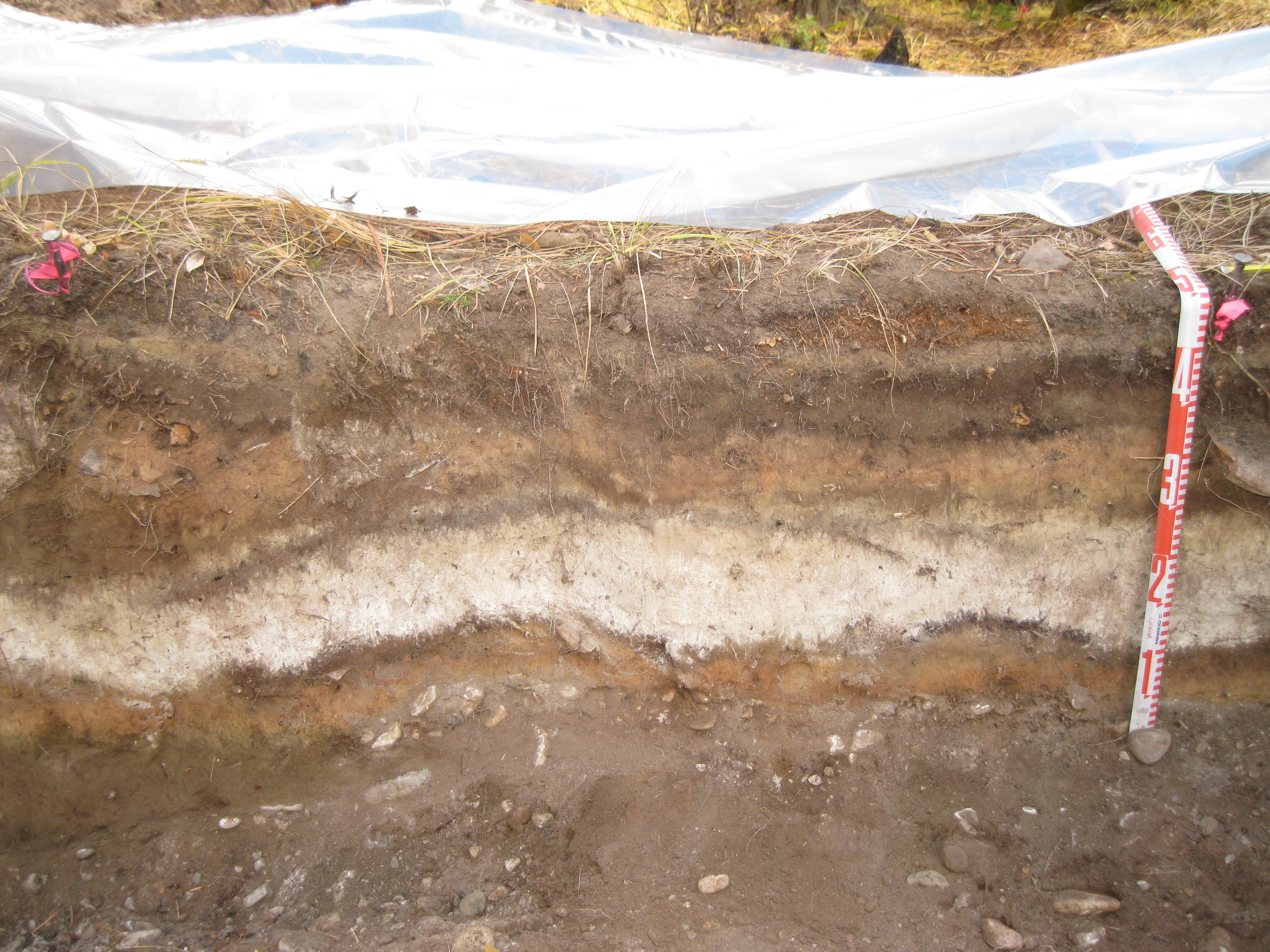
Example of a buried volcanic ash (also known as tephra) found during archaeological excavation. The ash is the lightest coloured layer in the profile, between 25 and 35 cm below the surface (between the 1 and 3 on the tape measure).

Relative dates can also be obtained using artifact styles. Projectile points are one of the most common types of artifacts used to relatively date sites. Spearpoints represent the oldest projectile point technology and indicate that the site falls within the “Early Prehistoric Period” (11,200-7,500 calendar years before present), dartpoints are representative of the “Middle Prehistoric Period” (7,500-1,350 calendar years before present) and arrowpoints represent the emergence of the use of bow and arrow in the “Late Prehistoric Period” (1,350-250 calendar years before present). Dates can be further refined within each general time period based on the spear, dart or arrow style.

Absolute dating is more specific than relative dating and provides a more exact date (with standard deviation) of when the site or artifact was used. There are several methods of absolute dating but one of the most common methods used by archaeologists is radiocarbon dating. Radiocarbon dating can be used on organic material such as bone or charcoal. A radiocarbon date can be obtained by measuring the amount of Read more
“Erin go Bragh” in Alberta

This post was originally published on RETROactive on March 17th, 2015. We are once again approaching St. Patrick’s Day and we wanted to highlight this great post that talks about the history of the holiday in Alberta. Happy St. Patrick’s Day! Enjoy.

“What is the matter with the Calgary Irishmen?” asked a frustrated correspondent to the Calgary Herald in March 1916. The writer, who identified themself as ‘F. Fitzsimmons,’ was complaining about the city’s apparent lack of enthusiasm for St. Patrick’s Day, with no public events planned to celebrate the day. Fitzsimmons conceded that people were likely distracted by the war effort, but lamented that Calgary’s leading Irish citizens had gotten “cold feet” and failed to plan any celebrations. “If all Irishmen were like the Calgary bunch” closed the writer, then “‘God Save Ireland.’”

The language used by Fitzsimmons in this letter is highly suggestive. By stating that Calgary’s Irish leaders had gotten ‘cold feet,’ he/she was implying that they lacked the courage to publicly celebrate their ethnic heritage. Further, ‘God Save Ireland’ was an explicitly nationalist slogan, associated with the last words of three Irish revolutionaries executed by the British in 1867. In short, Fitzsimmons was calling for an open celebration of Irish identity that did not shy away from nationalist politics. What Fitzsimmons saw as a simple issue, however, was much more complex for the majority of Irish people in Calgary and across Alberta. The often turbulent politics of the Irish homeland, and the campaign for Irish autonomy from Read more

Obadiah Place, Amber Valley: Commemorating African American Settlement in Alberta

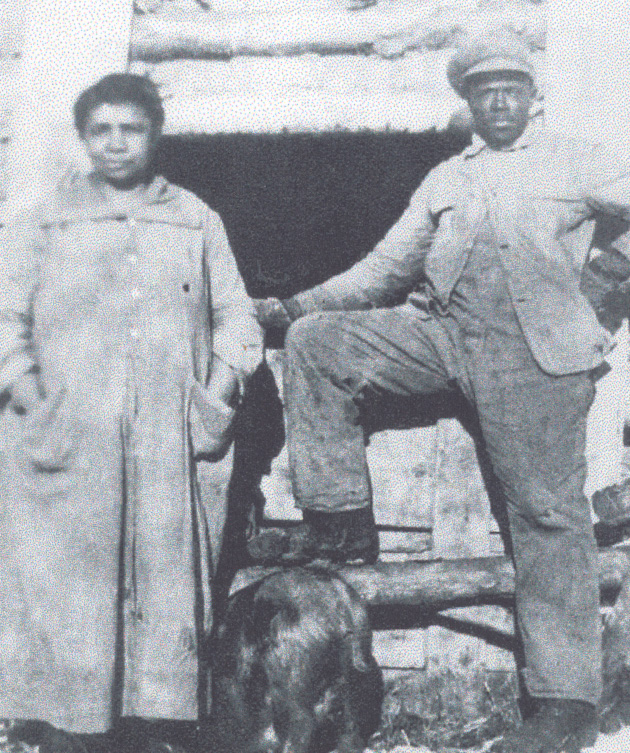
Willis and Jeanie Bowen at Amber Valley, courtesy of the Black Settlers of Alberta and Saskatchewan Historical Society.

In January of 2017 the Government of Alberta officially proclaimed February as Black History Month, recognizing the contributions people of African and Caribbean descent have made to the province. This year marks the 20th anniversary of Black History Month in Canada, a time to celebrate the history and achievements of black Canadians within Canada.

In the spirit of that announcement, RETROactive would like to feature one of Alberta’s historic places, which commemorates African American settlement. The Obadiah Place at Amber Valley was designated as a Provincial Historic Resource in 1990. The following information is adapted from the Alberta Register of Historic Places.

In 1911, a party of black Americans made their way from Oklahoma to seek a new life on lands north of Edmonton. Recent statehood for Oklahoma had brought with it restrictive ‘Jim Crow’ laws and many black Read more

“IT THREW A MUSHROOM CLOUD JUST LIKE AN ATOMIC BOMB”: THE LEDUC No.1 OIL DISCOVERY – 70 YEARS AGO

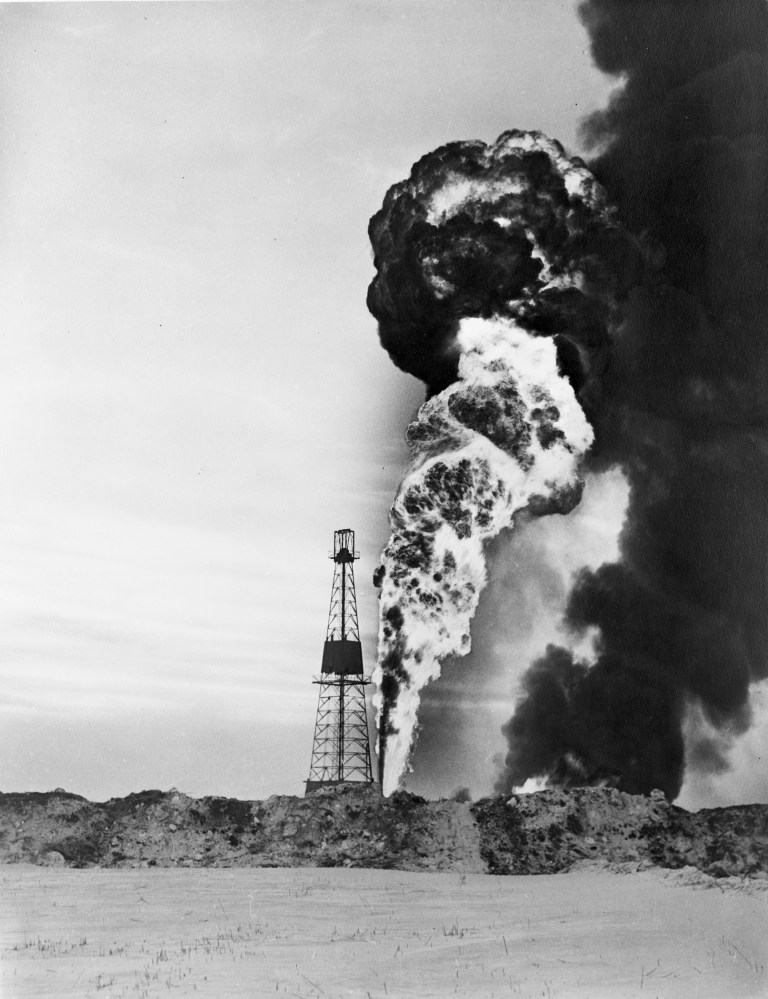
On a bitterly cold afternoon, at 3:55pm, Nathan E. Tanner, Minister of Lands and Mines turned a valve at the Leduc No. 1 oil well as a rig hand held out a burning rag, setting alight a massive column of smoke and flame that roared hundreds of feet skyward. That event took place on February 13, 1947, seventy years ago today and it heralded in a new era for Alberta. An era of rapid development and prosperity fed by the now discovered reserves of oil deep under the province.

p1342
“It flared hundreds of feet” is how tool push Vern Hunter described the lighting of the flare as the Leduc No. 1 oil well was brought in on February 13, 1947. Source, Provincial Archives of Alberta, P1342

Read more

Mountain Movement: How the Rockies Shape Alberta

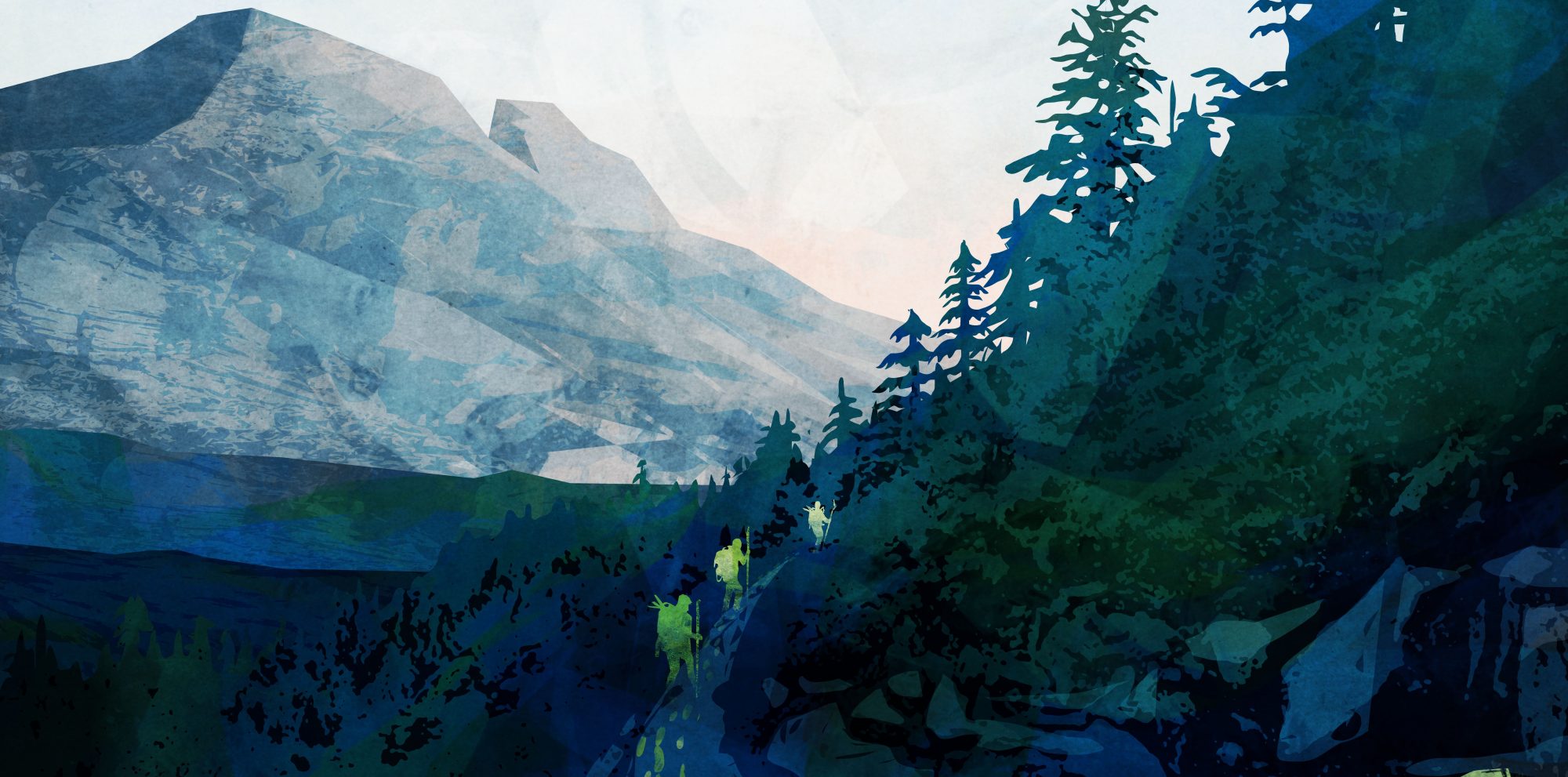
Most of Alberta’s Rocky Mountains finished uplifting 50 million years ago – they’ve been pouring sediment across the province ever since. The Rockies shaped our water drainage network and, with the help of glaciers, erected the house of silt, sand, and stone that we all live in. The tilt that our mountains built is largely responsible for the development of our prairie soils and modern agriculture. Our mountains have also shaped how cultures interact and move, which has moulded much of our history.

At first glance, the Rockies are imposing – an impressive barrier rising from the foothills like a stony gate. But for thousands of years, people traveled across and within them to trade and acquire goods. Groups in southeastern British Columbia, like the Kootenai, often descended into Alberta’s valleys to hunt bison and other big game. The Kootenai engaged in trade and formalized sport (like the hoop and arrow game) with local Blackfoot, Cree, and other groups. Large caches of meat and hides were then transported back across Read more

Christmas at the Ukrainian Cultural Heritage Village 2017

The Ukrainian Cultural Heritage Village is a major open-air museum with the network of provincial historic sites and museums operated by Alberta Culture and Tourism. Located 50 km east of Edmonton, the museum preserves more than 35 historic structures and interprets the lives of Ukrainian settlers in east central Alberta between the years of 1892 and 1930. Based on extensive contextual and site specific research, the museum is an important steward of the intangible cultural heritage of Alberta’s Ukrainian settlers. Read more

St. Nicholas Peak

You better watch out
You better not cry
You better not pout
I’m telling you why
Santa Claus is coming to town.

He sees you when you’re sleeping,
He knows when you’re awake,
He knows when you’ve been bad or good,
So be good for goodness sake!
(J.F. Coots & H. Gillespie, 1934, © EMI Feist Catalog Inc; Haven Gillespie Music)

How can Santa Claus see all of this? How can he know what we are doing all of the time? Where exactly does he get his information? While some more imaginative people believe that Santa Claus must have magical, all-knowing, all-seeing powers. Other, more practical-minded folk, insist that he must have a vast network of elfin spies keeping tabs on every boy and girl in his domain. However, here in Alberta we know better. Santa Claus obviously does his recon from his lofty vantage point in the Canadian Rockies from which he can see great distances – perhaps even into your own home (and isn’t that just a little bit creepy?). Read more

From North Dakota with Flair

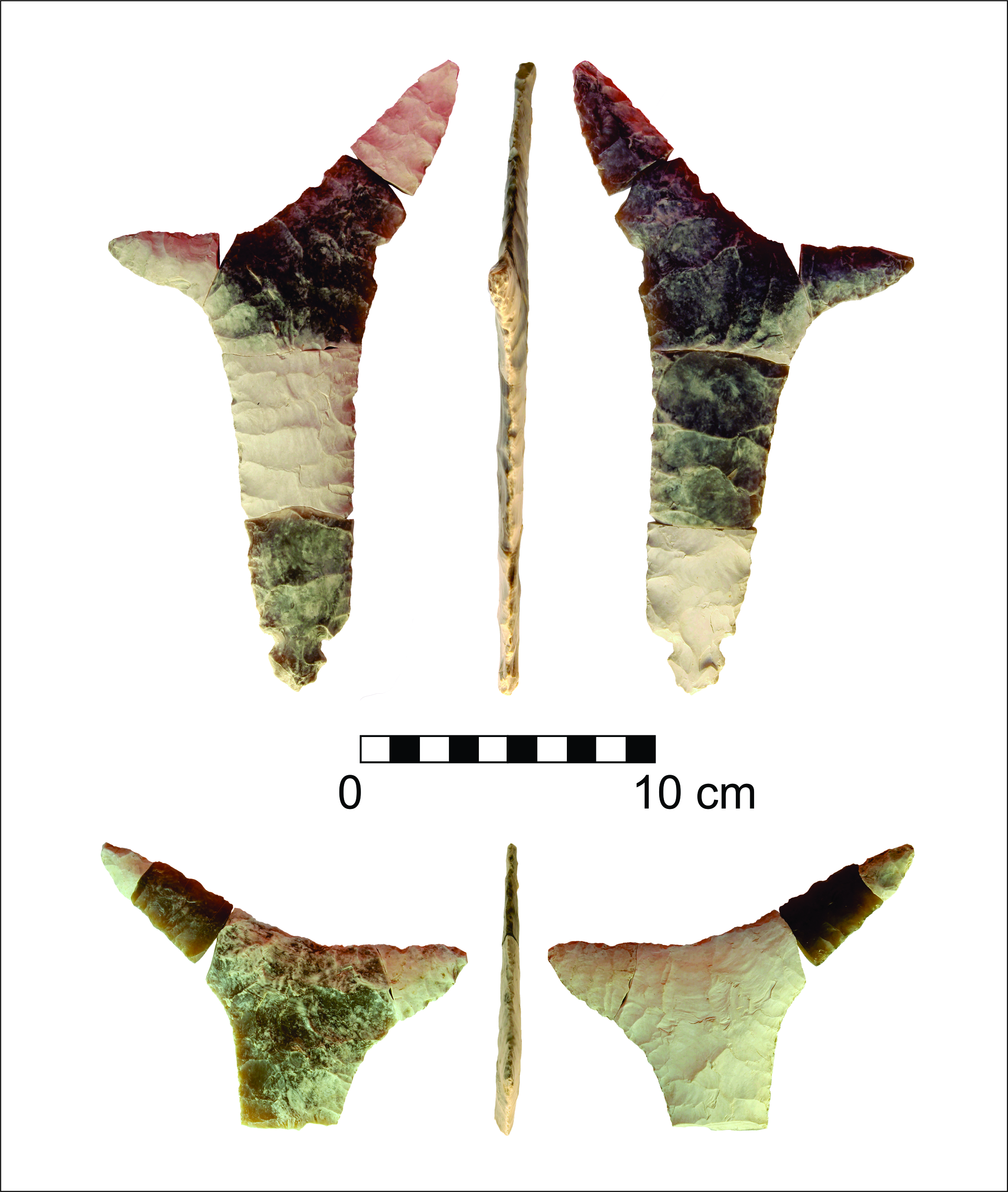
The St. Mary Reservoir, near Cardston in southern Alberta, was built and filled by the early 1950s. During reservoir draw downs and droughts, lake bottom sediments are exposed and quickly eroded, which has revealed a unique collection of artifacts and even trackways of now extinct megafauna like mammoth and camel.

Two particularly interesting artifacts are termed ‘eccentrics’ because their shape and significance are so unusual. Eccentrics are very rare artifacts, the shapes of which are thought to be determined more by aesthetic rather than functional reasons. Some archaeologists think that the large flintknapped stone artifacts from St. Mary Reservoir are symbolic representations of the branched “horns” of pronghorn antelope once common across the Great Plains. Others think they may have been ceremonial knives used on special occasions.

figure-1-eccentrics-colour
Knife River Flint ‘eccentrics’ from St. Mary Reservoir. The different colourations of these pieces are due to ‘patination’. This is when a chemical rind develops over time around particular edges or faces of artifacts depending on their exposure to different local conditions (courtesy of Shayne Tolman).

Read more

ELIZABETH STREET SCHOOL, MEDICINE HAT – MUNICIPAL HISTORIC RESOURCE

In February 2016, the City of Medicine Hat designated the Elizabeth Street School as a Municipal Historic Resource. In September, a plaque about the school’s history and designation was unveiled. The school is the most recent of Medicine Hat’s historic resources to be listed on the Alberta Register of Historic Places.

a10594
Elizabeth Street School during construction, ca. 1912. The school’s Classical Revival details, notably the cornice at the roofline and the keystone and voissoir details around the entryways, are evident.
Source: Provincial Archives of Alberta, A10594

Read more

The 2016 Alberta Historical Resources Foundation Heritage Awards

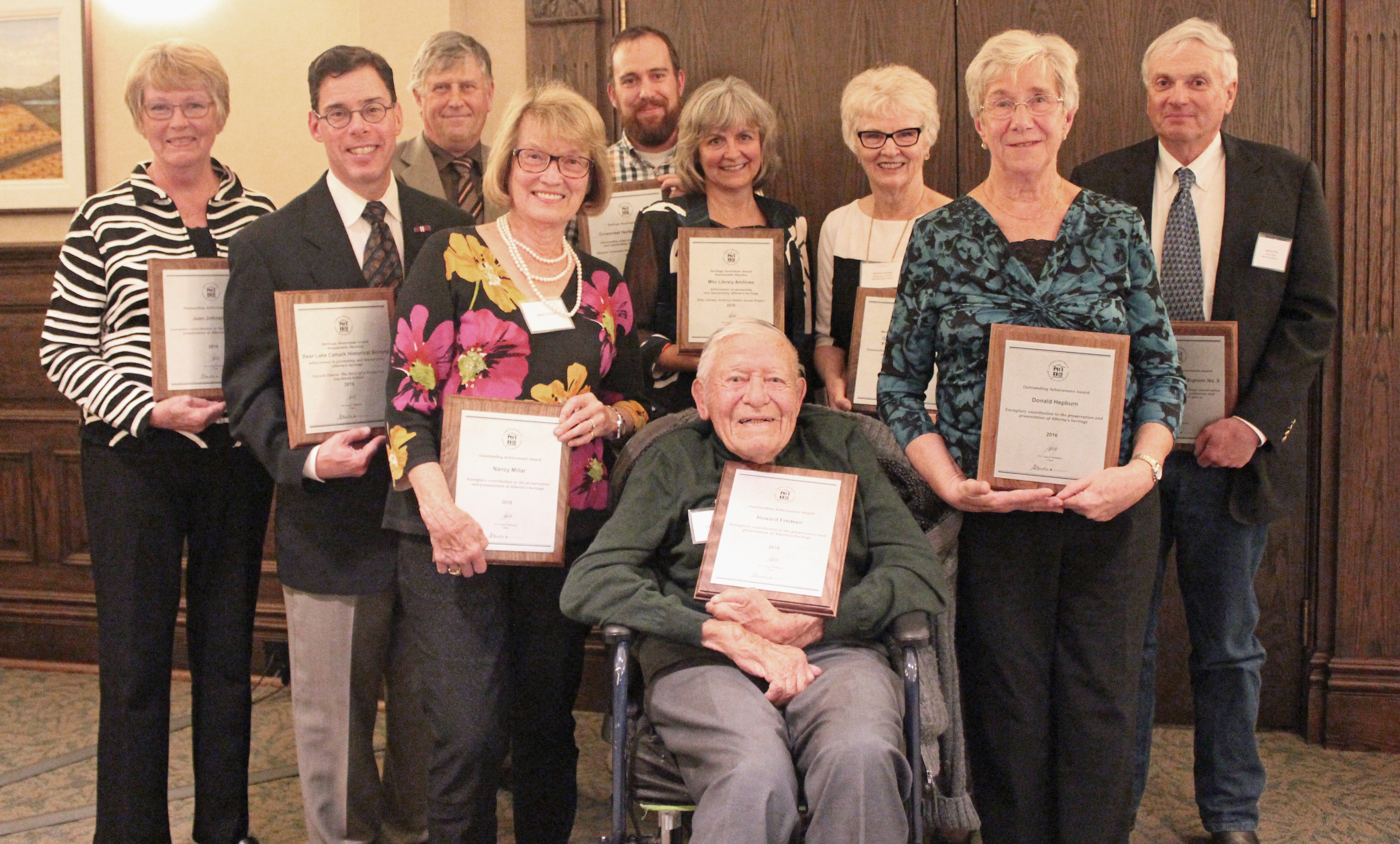
Alberta Historical Resources Foundation 2016 Heritage Award Recipients.

The night of October 14 was filled with pride and honour as award recipients, guests, staff and board members celebrated the biennial Heritage Awards at the historic McDougall Centre in Calgary.

The Alberta Historical Resources Foundation presented the awards in four categories to 14 deserving individuals and organizations in recognition of their accomplishments and contribution to the preservation and promotion of Alberta’s heritage.

Outstanding Achievement

  • Don Hepburn (Red Deer)
  • Howard Fredeen (Lacombe)
  • Jean Johnstone (Lethbridge)
  • Nancy Millar (Calgary)
  • Honourable mention – Elizabeth and Bill Bullick (Coronation)

Heritage Conservation

  • Glen Leslie Church Preservation Group (County of Grande Prairie), Glen Leslie Church restoration
  • Empress and District Historical Society (Empress), Canadian Pacific Railway Station restoration

Heritage Awareness

  • Crowsnest Heritage Initiative, “Discover Crowsnest Heritage” signage program
  • Haying in the 30’s Cancer Support Society, “Haying in the 30’s” event
  • Honourable mention – Bear Lake Canuck Historical Society, “Canuck Classic: The Story of a Treasured One-Room School”
  • Honourable mention – Milo Library Archives, “Milo Library Archives On-Line Access Project”

Municipal Heritage Preservation

  • Municipal District of Bighorn No. 8
  • Yellowhead County
  • Honourable mention – Town of Raymond

Additional information is available on the Alberta Historical Resources Foundation webpage at http://culture.alberta.ca/heritage-and-museums/grants-and-recognition/heritage-awards/.

Congratulations and thank you to all Heritage Award Recipients!