

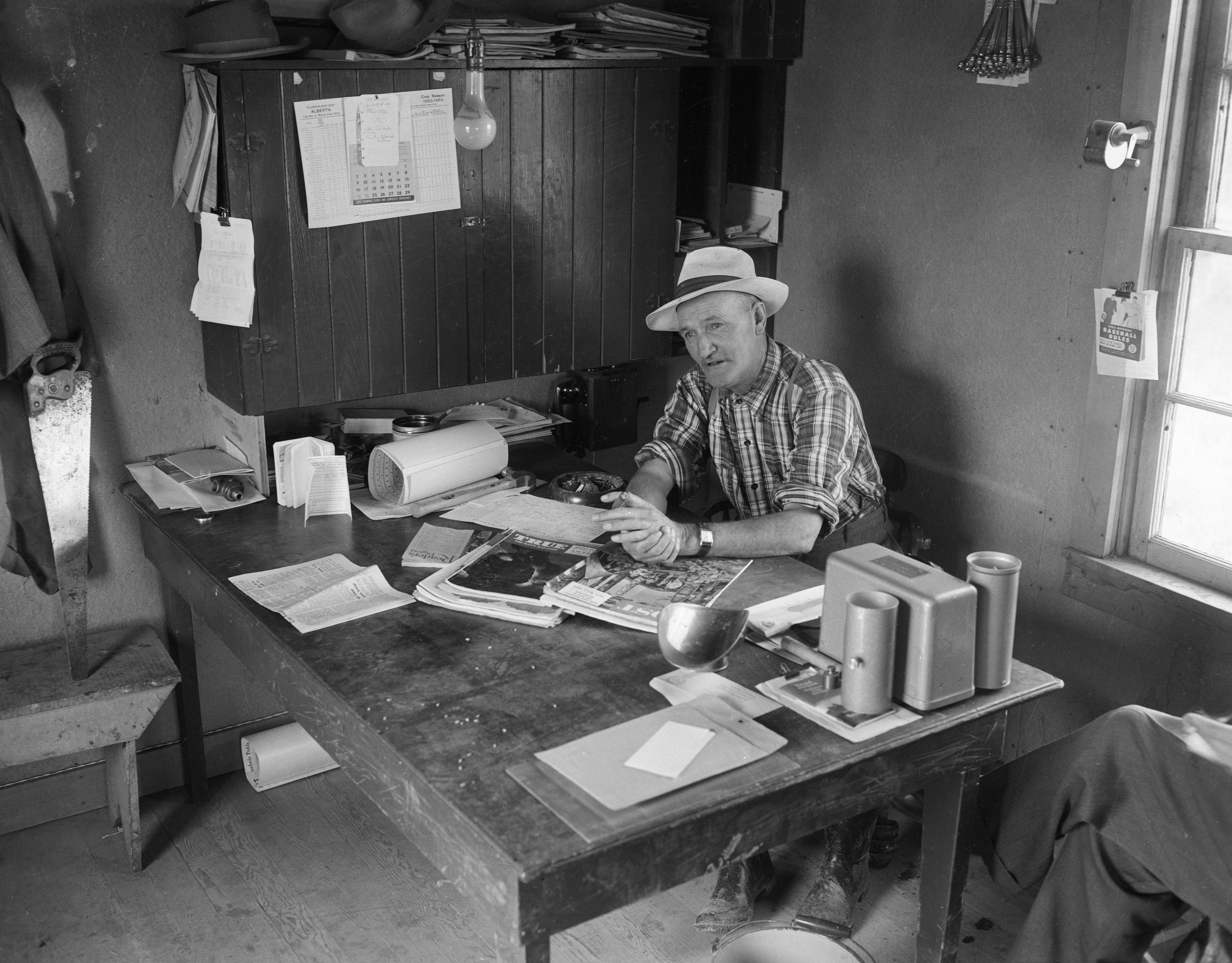
It’s when the grain is ripe for harvest in late August or early September that I miss going to our local Alberta Wheat Pool elevator the most. Jumping off the combine and going to the elevator to have its friendly agent, Bill, run a moisture test on a grain sample and discuss the state of the crop was one of my jobs on the farm. When I arrived in Alberta in the 1980s, drinking coffee and shooting the breeze with the neighbours while the elevator agent was busy, was part of the culture, but the old-timer grain farmers could smell change the air. How right they were.
Our closest local elevator, a single composite wood crib facility constructed in 1963, at Eckville, closed in 2001. Since then we rarely visit an elevator. Now we have our own moisture tester, analysis market conditions using the internet, and have our grain trucked from the bins in the yard to the inland terminal at Lacombe or further afield—selling grain over the phone and having it trucked to a concrete silo is not much fun!

In past decades farmers were in and out of the elevator office in a rhythm that reflected the farmer’s seasonal activity. A major reason to go to the elevator was to update the permit book, which kept a record of the type, quantity and grade of grain delivered as well as the number of acres seeded to various grains, and the acreage assigned to each grain for quota purposes. Canadian Wheat Board regulations required that all grain sales, even to local users, be recorded in the permit book.
The permit book had its origins in the quota system on cereal grains introduced during the Second World War. Beginning with the crop year 1941-1942, farmers were only able to deliver limited amounts of grain, based on their acreage, at certain times. The quota system, administered by the Wheat Board, was designed to prevent the clogging of the grain handling system at a time when production exceeded available markets. It continued after the war in an attempt to give each producer an equal opportunity to sell his or her grain at the Wheat Board price for the crop year.
A farmer’s pay check and hence his loyalty to one grain company over another was ultimately determined by whether he could get space in the elevator to deliver his quota of grain. If there was room, some farmers preferred to haul to the Alberta Wheat Pool or United Grain Growers elevator, lured by the promise of patronage dividends on deliveries in relation to the companies’ profits for the year.
Many farmers made a point of being at the elevator office often, not only to find out what was going on but to establish a good relationship with the agent. They sometimes helped out when the agent was especially busy. In years when the harvest was plentiful, railway box cars were often in short supply and elevator storage space was limited, bonds of friendship, along with a reputation for reliable delivery and honesty might ensure one’s grain would be taken in before the neighbour’s.
There were a thousand and one reasons why a farmer might be at the elevator other than when he was delivering grain. He bought coal and flour throughout the year, seed in the spring and from the 1950s, fertilizer. He might be in to check prices, find out if there was space in the elevator for his grain or pick up a cheque for grain previously delivered. Farmers needed the use of the scale at the elevator for inter-farm grain sales, and the elevator agent usually obliged.
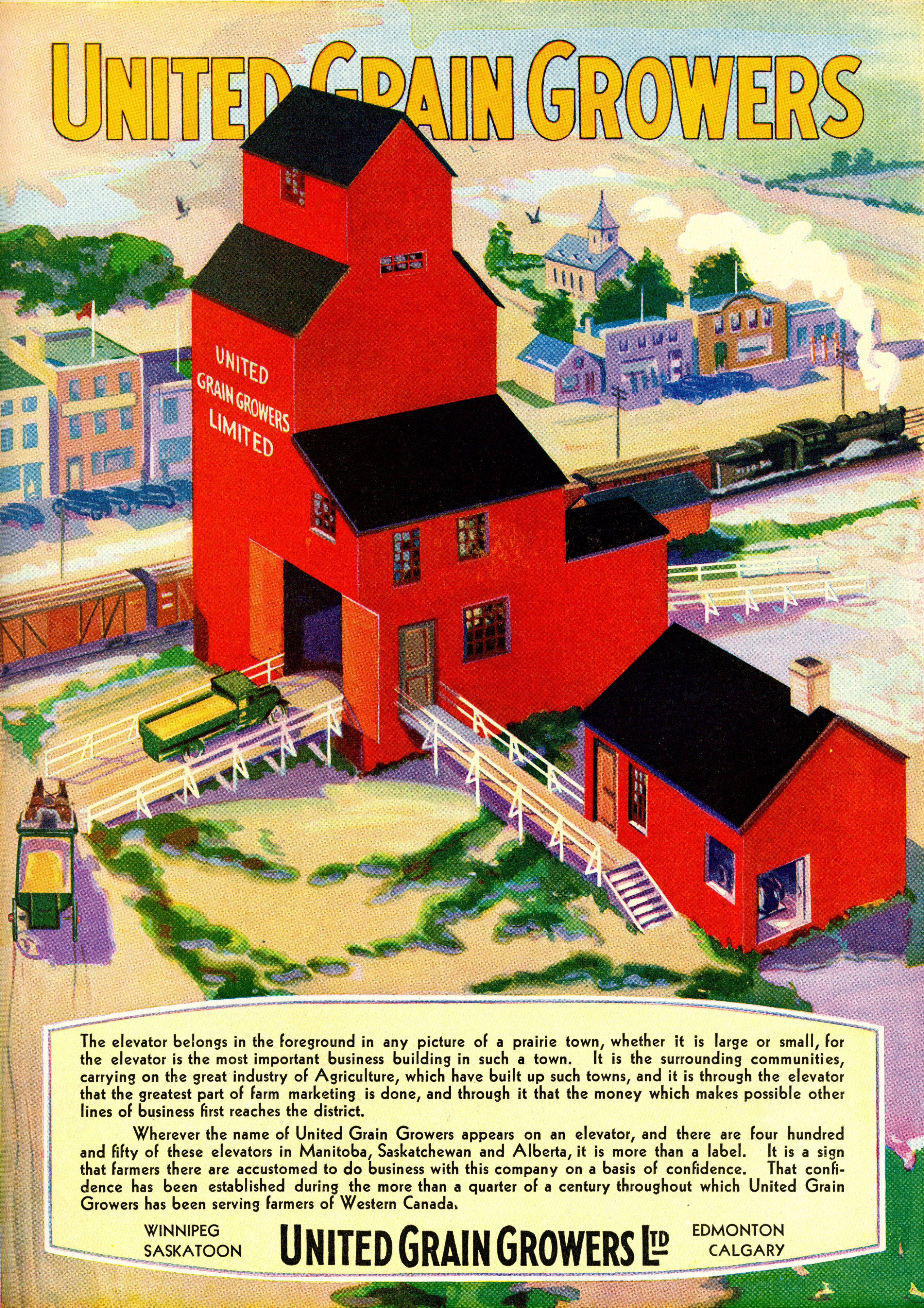
There was no need for a business excuse to go to the elevator. On wet days farmers dropped in to see who else was there, play crib or just to complain about the weather. The elevator office was a good place to catch up on local gossip: who had bought a new tractor, who was selling out, who was renting land from who, and to gauge the relative condition of neighbouring crops, as well as shifting land and machinery auction prices.
Farmers gravitated towards the elevator they dealt with and elevator agents played host to groups of farmer-customers in their cramped offices during visits to town. The elevator agent, urged on by his company to network and increase sales, was part of the community, involved in social and sporting events. At Forshee, a long forgotten elevator siding between Rimbey and Bentley, Harry Proudfoot, a U.G.G. agent from 1946-1968, was a member of several athletic teams, and helped his farmer neighbours during haying season and other times when grain deliveries were slow.
Back in the 1930s when elevator agents often had the only radio in the district, broadcasts were a lure for farmers, who might hope to catch more than the day’s grain prices. In the 1990s farmer went to the elevator to catch the farm weather cast and to watch world-wide commodity trading on cutting-edge computers. The farmers gathered whiled away hours discussing every farming topic under the sun. The agent would go off to receive a load or two of grain, and they would often still be there when he returned from the driveway.
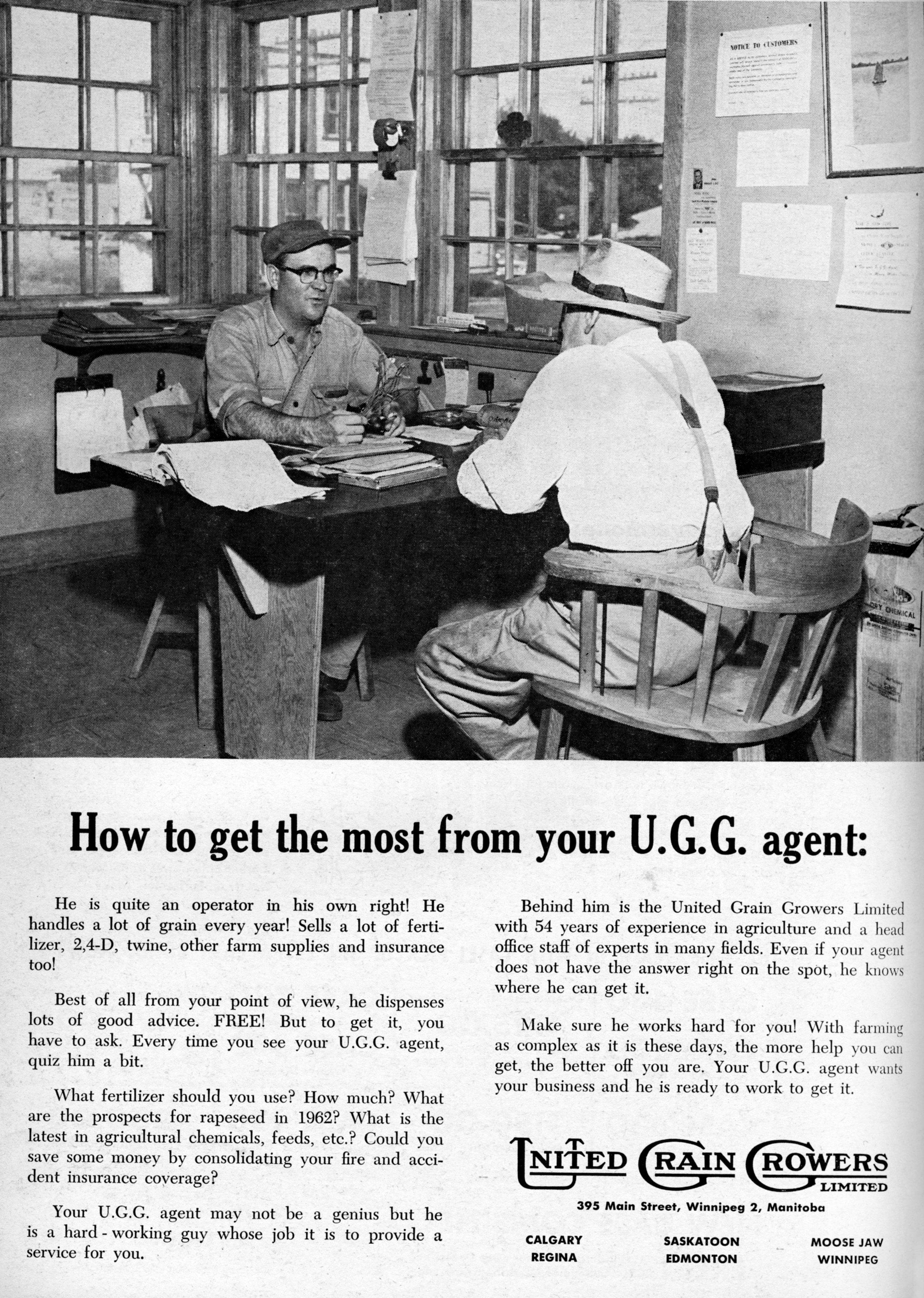
From the mid-twentieth century, much of the farmer’s economic news, social connections, information about the latest cropping practices, and even family activities and entertainment came through the elevator office as grain companies vied to be foremost in the farmers’ lives and keep their business. All grain companies, especially the farmer-owned Alberta Wheat Pool and United Grain Growers, pushed the image of the grain elevator as the stable symbol of rural life.
It ended for us in 2001. We knew it would happen. We saw elevators topple all over the province after 1995. When Eckville went down in a cloud of dust we did not go to watch. Now in 2014, the Canadian Wheat Board is no more: there are no quotas, no permit book. We market our own grain. Like so many others in the farming community we have lost a connectedness with fellow grain producers and direct involvement with the grain handling system that really was centred in the elevator office.
Written by: Judy Larmour.






 RETROactive