Written by: Ron Kelland, MA, MLIS, Geographical Names Program Coordinator
November 11 is Remembrance Day. The day that Canadians are called to set aside in honour and recognition of its military service personnel that paid the ultimate price in their defence of our nation and its values. Canadians have fought in numerous wars and as the memories of some of those wars are fading as decades pass and the last surviving veterans of those wars pass away, it becomes even more important to remember those that fought and died and those that fought and lived to preserve the memories of their fallen comrades. Canada’s Commemorative Map is one of the ways to keep the memory of those sacrifices alive.
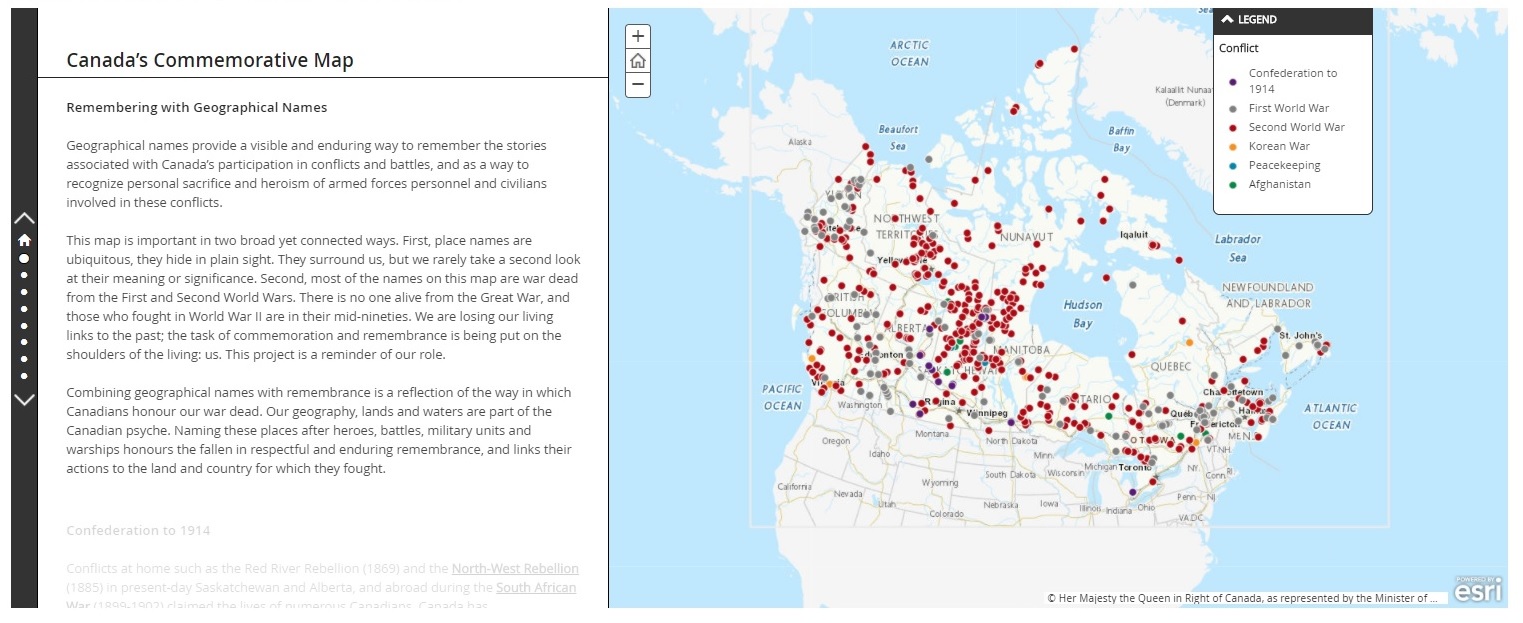
In 2018, the Geographical Names Board of Canada launched Canada’s Commemorative Map, an interactive, digital map that highlights places and features in Canada that were named to honour and commemorate Canada’s war heroes and casualties. Source: Geographical Names Board of Canada.
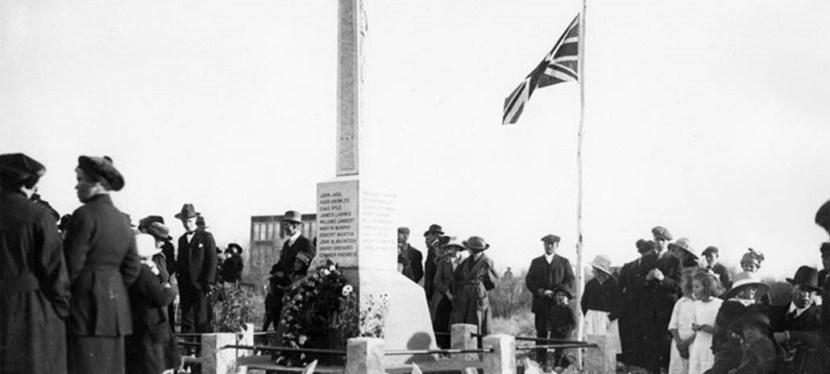
Commemoration of Canada’s war casualties have taken many forms. Following the end of the First World War, there was a national effort to erect plaques, cenotaphs and other memorials in cities, towns and villages across the country. These memorials of the First World War are often the sites of our Remembrance Day services and ceremonies to this day. Some communities built needed infrastructure and facilities, such as arenas, performing arts centres, libraries and community halls dedicated to memory of those that gave their lives in military services.
Written by: Fraser Shaw, Heritage Conservation Advisor
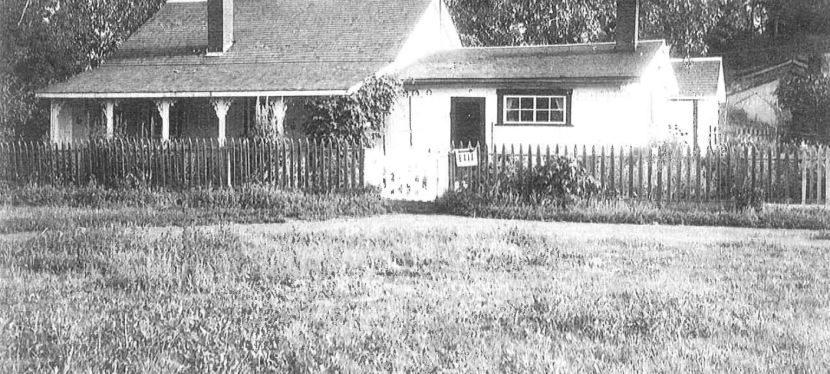
Recently, I visited the Maccoy Homestead in High River after seven long years of flood repairs and conservation. Nestled in Sheppard Family Park near the south edge of High River, this was the farm and home of well-known local resident Ruth Maccoy for over 70 years. Upon her passing in 1995 and at her bequest, the farm became Sheppard Family Park with the homestead as its nucleus.
The home is a charming 1883 whitewashed log building, the earliest structure on the site, with a frame addition and porch built by her parents in the 1920s and surrounded by a garden and picket fence lovingly tended by Ruth Maccoy over the years. Behind the house are a garden shed, a small guesthouse, and a root cellar set into an embankment, while the garage is located nearby. A path leads west through the trees to a footbridge over the Little Bow River, usually a shallow creek, to the historic water source in a natural spring.
One of High River’s first municipal designations, the Sheppard/Maccoy House was designated as a Municipal Historic Resource in 2009 by the Town of High River for its association with Ruth Maccoy and early settlement in the area. An exceptional example of an early farm, the site also exemplifies the contribution of women’s labour to homesteading and agriculture in rural Alberta and was designated a Provincial Historic Resource in 2015. The site is a good example of how complementary municipal and provincial heritage values tell a richer story and was the subject of a RETROactive post earlier this summer.
On August 20, 1940, Sir Winston Churchill, recently named Prime Minister of the United Kingdom, gave a speech to the House of Commons and uttered one of his most well-known statements: “Never in the field of human conflict has so much been owed by so many to so few.” Churchill was referring to the efforts of air personnel fighting in the air war over the United Kingdom, an air war now known as the Battle of Britain. This week will see ceremonies and events in Canada and throughout the Commonwealth marking the 80th anniversary of the Battle of Britain.
In 1940, Germany began an air offensive on British cities and military installations, attempting to force the Royal Air Force (RAF) from the skies and soften Britain’s defences enough to allow for an invasion. As the Battle of Britain occurred early in the Second World War, the majority of Allied air personnel that took part were British. However, pilots and other aircrew from many Allied nations took part, including a Royal Canadian Air Force (RCAF) squadron.
Some members of the RCAF also served with the RAF, with a number of Canadians enlisting directly with the RAF in the years preceding the war. Exact numbers are difficult to ascertain, but sources suggest that up to 112 Canadians and one Newfoundlander saw action in the skies over the British Isles during the months-long air battle. Many of those men lost their lives either during the Battle of Britain or in other engagements in the weeks, months and years that followed.
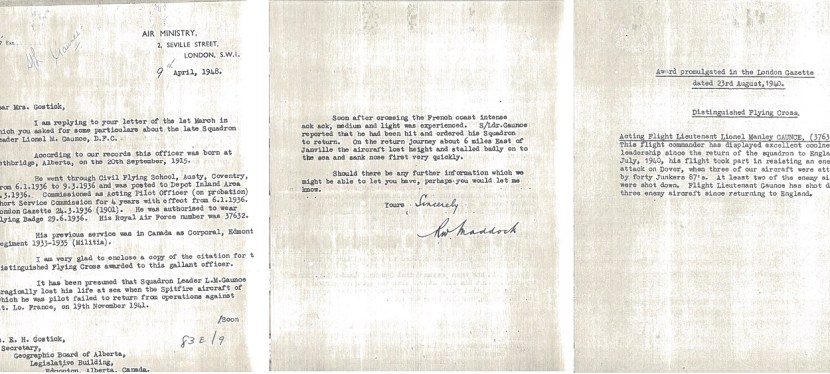
Following the end of the Second World War, there was an effort to commemorate the military personnel that made the ultimate sacrifice. This commemoration took many forms, one of which was to name geographical features and places for war casualties. In Alberta, three geographical features and a railway point were named for pilots that lost their lives in the air force operations around the time of the Battle of Britain.
Editor’s note: Welcome to the final post in a series of blog posts developed with municipalities in mind who either have or are considering undertaking Municipal Historic Resource designation. In this post, we will discuss how the evaluation of a historic resource at the provincial and municipal level may result in complimentary or differing heritage values. You can read the previous post here.
For more information, please review the “Creating a Future” manuals available here or contact Rebecca Goodenough, Manager, Historic Places Research and Designation at rebecca.goodenough@gov.ab.ca or 780-431-2309.
Written by: Fraser Shaw, Heritage Conservation Adviser and Ron Kelland, Historic Places Research Officer, Historic Resources Management Branch
Complementary and differing values
Alberta’s Historical Resources Act empowers both the Government of Alberta and municipalities to designate, or recognize and protect, a range of historic resources whose preservation is in the public interest. These resources can be places, structures or objects that may be works of nature or people (or both) that are of palaeontological, archaeological, prehistoric, historic, cultural, natural, scientific or aesthetic interest. Albertans value these historic resources because our past, in its many forms, is part of who we are as a society and helps give our present significance and purpose.
As of July 2020, there are currently 390 Provincial Historic Resources (PHR) and 413 Municipal Historic Resources (MHR) in Alberta, some 60 of which are designated both provincially and municipally. These resources merit designation for various reasons, from their association with significant events, activities, people or institutions; as representative examples of architectural styles or construction methods; for their symbolic and landmark value; or their potential to yield information of scientific value.
Heritage values are described in short Statements of Significance, which are listed on the Alberta Register of Historic Places. In this post, we look at examples of heritage values that municipal and provincial governments recognize and how local and provincial values may align, differ or complement each other.
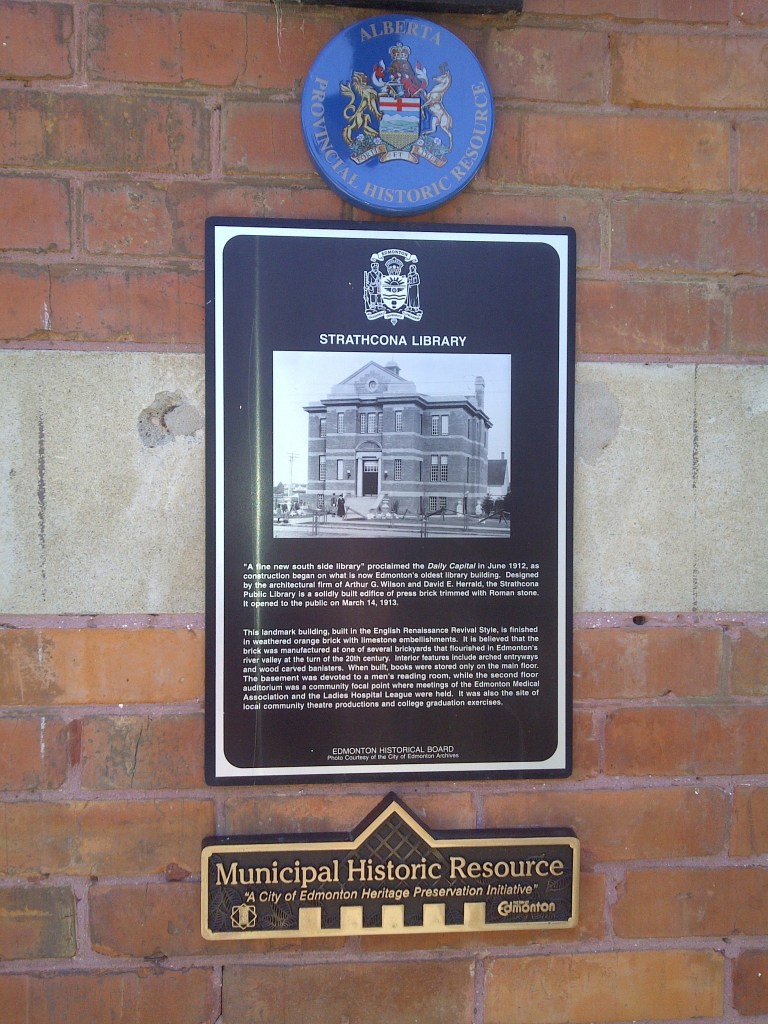
Plaques or markers are often used to identify designated historic resources. These plaques, affixed to Strathcona Public Library in Edmonton, show that it has been designated as a Provincial Historic Resource and a Municipal Historic Resource. PHRs are identified by a blue, enamel button or marker. MHRs can be identified by a variety of plaques and markers depending on the procedures of the municipality. Source: Historic Resources Management.
Editor’s note: Welcome to the seventh post in a series of blog posts developed with municipalities in mind who either have or are considering undertaking Municipal Historic Resource designation. In this post, we will talk about the importance of developing Statements of Integrity, and how they help to both increase understanding and manage change to historic resources over time. You can read the previous post here.
For more information, please review the “Creating a Future” manuals available here or contact Rebecca Goodenough, Manager, Historic Places Research and Designation at rebecca.goodenough@gov.ab.ca or 780-431-2309.
Written by: Carlo Laforge, Heritage Conservation Adviser and Tom Ward, Manager, Heritage Conservation Advisory Services, Historic Resources Management Branch
Statements of Integrity
The process for evaluating if an historic place merits designation under the Historical Resources Act (HRA) starts with determining if and why it is significant. Then, determining whether it retains sufficient physical integrity to convey that significance. Earlier blog posts described how to develop a Statement of Significance (SOS). The next step works through whether enough of the physical features that relate to the heritage values exist, and are in acceptable condition to convey heritage values. Not all places merit designation as historic resources, especially if integrity is in question.
Below is an outline of what goes into determining integrity and how to summarize findings in a Statement of Integrity (SOI). It is important to remember that the development of an SOS and SOI are complementary processes. The information and facts discovered by each related investigation help to compliment, influence and improve each document to enable the best decision possible in terms of proceeding with a designation.
Understanding what is of value
A review of the heritage values expressed in the SOS provides the person analyzing the integrity of a place with a reminder of why it is potentially of historic significance and what details may be important. The heritage values and the period of significance are critical to keep in mind when observing and evaluating the historic place.
Written by: Karl Giroux, Consultation Director, Driftpile Cree Nation and Laura Golebiowski, Aboriginal Consultation Adviser
Editor’s note: On July 24, 2018, Driftpile Cree Nation conducted a site visit with representatives of the Historic Resources Management Branch. The purpose of the site visit was to identify the “Drift-Pile Camp” referenced in the journal of George Mercer Dawson, as he traveled what is now Alberta for the Geological Survey of Canada in the late 1800s. Below, Laura Golebiowski (Aboriginal Consultation Adviser, Historic Resources Management Branch) and Karl Giroux (Consultation Director with Driftpile Cree Nation) share their experiences visiting the location.
“The Athabasca River derives its name from the great lake into which it flows, which is called A-pē-pas-kow by the Crees. The upper part of the river is known as Mas-ta-hi-sī-pī or Great River.
On reaching its north bank on our traverse from Sturgeon Lake, Mr. MacLeod and I had arranged to separate, Mr. MacLeod continuing on overland toward Dirt Lake, while I intended to make a canoe and descend the river. As no traces had yet been found of the party which was supposed to be on the way from Edmonton to meet us, we now set fire to a great pile of drift-logs on one of the bars, and sent one Indian up and another down the river to seek for information, but all with no result. It was further unexpectedly found that no cottonwood trees suitable for making a canoe existed in the valley, and as the river was evidently quite unsuited to be descended on a raft, by reason of its swiftness and the number of shoal bars which occur now on one side and now on the other, it became difficult to know in what way the programme could be carried out. It was finally decided to use the canvass cargo-covers and blanket wrapped in the construction of a canoe. To this all hands devoted themselves for three days, when we had the satisfaction of seeing a large canoe, properly framed and strengthened, which when painted over with a mixture of bacon fat and spruce gum was nearly water-tight.”
The above text is taken from George Mercer Dawson’s 1881 Report on Exploration from Port Simpson on the Pacifica Coast to Edmonton on the Saskatchewan. George Dawson was a Nova Scotia-born geographer who conducted numerous expeditions for the Geological Survey of Canada, beginning in 1875 until his unexpected death in 1901.
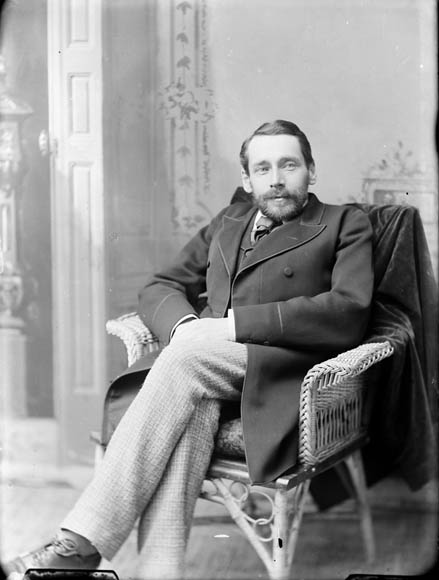
George Mercer Dawson, then Assistant Director of the Geological Survey of Canada in May 1885. Source: Library and Archives Canada.
Written By: Colleen Haukaas (Archaeological Survey)
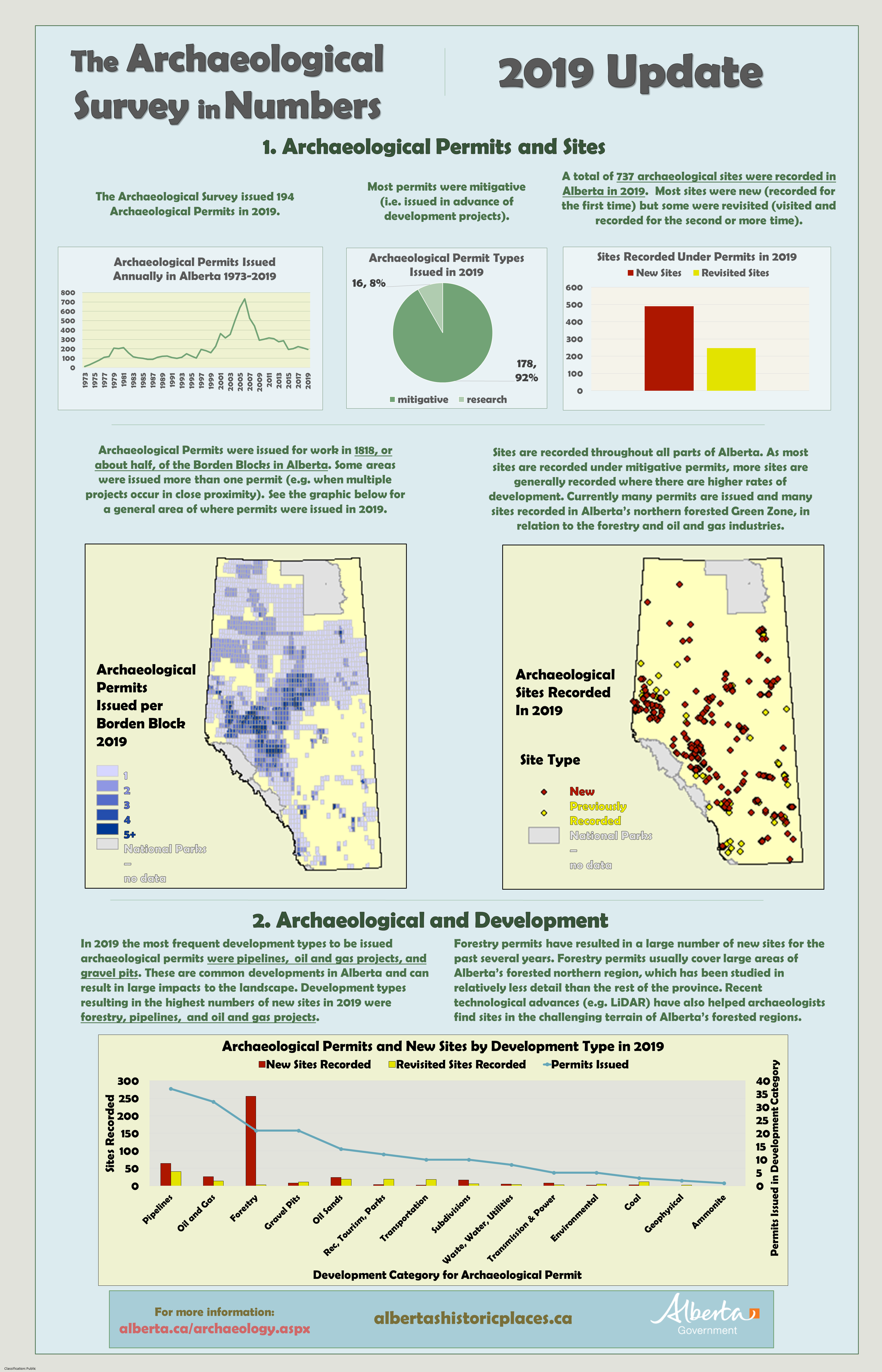
This week’s post is an update on archaeological project and site data for 2019 from the Archaeological Survey. Click the image below the see the full size.
Disclaimer: the archaeological site counts for 2019 may not be final. They are constantly being updated as consultants and researchers submit their reports to the Archaeological Survey.
Editor’s note: Welcome to the sixth post in a series of blog posts developed with municipalities in mind who either have or are considering undertaking Municipal Historic Resource designation. In this post, we will introduce the concept of a “period of significance” and explain why it is important to establish as part of the designation process. You can read the previous post here.
For more information, please review the “Creating a Future” manuals available here or contact Rebecca Goodenough, Manager, Historic Places Research and Designation at rebecca.goodenough@gov.ab.ca or 780-431-2309.
Written by: Stefan Cieslik, Heritage Conservation Adviser and Rebecca Goodenough, Manager Historic Places Research and Designation
Period of Significance
Simply put, the period of significance of a historic resource is the time frame when the place acquired its significance. The heritage value section of the Statement of Significance (SOS) articulates why the place is historically significant, such as an association with an event, person, theme, institution, style of design, etc. Each of these heritage values will have an associated time frame, which informs the period of significance.
Some associations will have start and end periods while others will still have the association today. The period may be very specific if the resource is significant for a single event, or it may span hundreds of years if it is a prehistoric cultural landscape. A period of significance is specific to a site—it is not a general era of development for a community or other reference point. Where the historic place is a building, it should never predate the date of construction.
Editor’s note: Welcome to the fifth post in a series of blog posts developed with municipalities in mind who either have or are considering undertaking Municipal Historic Resource designation. In this post, we will continue to discuss Statements of Significance as the primary tool for summarizing the significance of designated historic places. You can read the previous post here.
For more information, please review the “Creating a Future” manuals available here or contact Rebecca Goodenough, Manager, Historic Places Research and Designation at rebecca.goodenough@gov.ab.ca or 780-431-2309.
Written by: Dorothy Field, Heritage Survey Coordinator, Sandy Aumonier, Heritage Conservation Adviser and Allan Rowe, Historic Places Research Officer, Historic Resources Management Branch
As previously mentioned, a Statement of Significance (SOS) is a one- to two-page summary document written as a clear, concise and brief narrative of a historic resource. It is written for a broad audience that is not familiar with the resource. The SOS has three sections: description of historic place, heritage values and character-defining elements.
An SOS is central to understanding a resource and any of its elements that might be protected and why.
If a historic resource is designated, the SOS will thereafter be an important planning and property management tool and essential for developing a conservation plan for ongoing management of the resource.
Editor’s note: Welcome to the fourth post in a series of blog posts developed with municipalities in mind who either have or are considering undertaking Municipal Historic Resource designation. In this post, we will continue to discuss Statements of Significance as the primary tool for summarizing the significance of designated historic places. You can read the previous post here.
For more information, please review the “Creating a Future” manuals available here or contact Rebecca Goodenough, Manager, Historic Places Research and Designation at rebecca.goodenough@gov.ab.ca or 780-431-2309.
Written by: Dorothy Field, Heritage Survey Coordinator, Sandy Aumonier, Heritage Conservation Adviser and Allan Rowe, Historic Places Research Officer, Historic Resources Management Branch
As previously mentioned, a Statement of Significance (SOS) is a one- to two-page summary document written as a clear, concise and brief narrative of a historic resource. It is written for a broad audience that is not familiar with the resource. The SOS has three sections: description of historic place, heritage values and character-defining elements.
An SOS is central to understanding a resource and any of its elements that might be protected and why.
If a historic resource is designated, the SOS will thereafter be an important planning and property management tool and essential for developing a conservation plan for ongoing management of the resource.





 RETROactive